Regulation of Gene ExpressionRegulation of Gene Expression
By – Ajay Kumar
M.Sc. -2
Paper- 1
Discovery
Francois Jacob and Jacques
Monod (Pasteur Institute,
Paris, France)
• Studied the organization and
control of the lac operon in
E. coli.
• Awarded the Nobel Prize in
Physiology and Medicine
1965.
Francois Jacob
Jacques Monod
What is Operon ???
Cluster of genes in which expression is regulated by operator-
repressor protein interactions. plus the operator region itself and
the promoter.
• Contents of an operon:
Promoter
Repressor
Operator (controlling site)
Coding sequences
Structure of Lac Operon
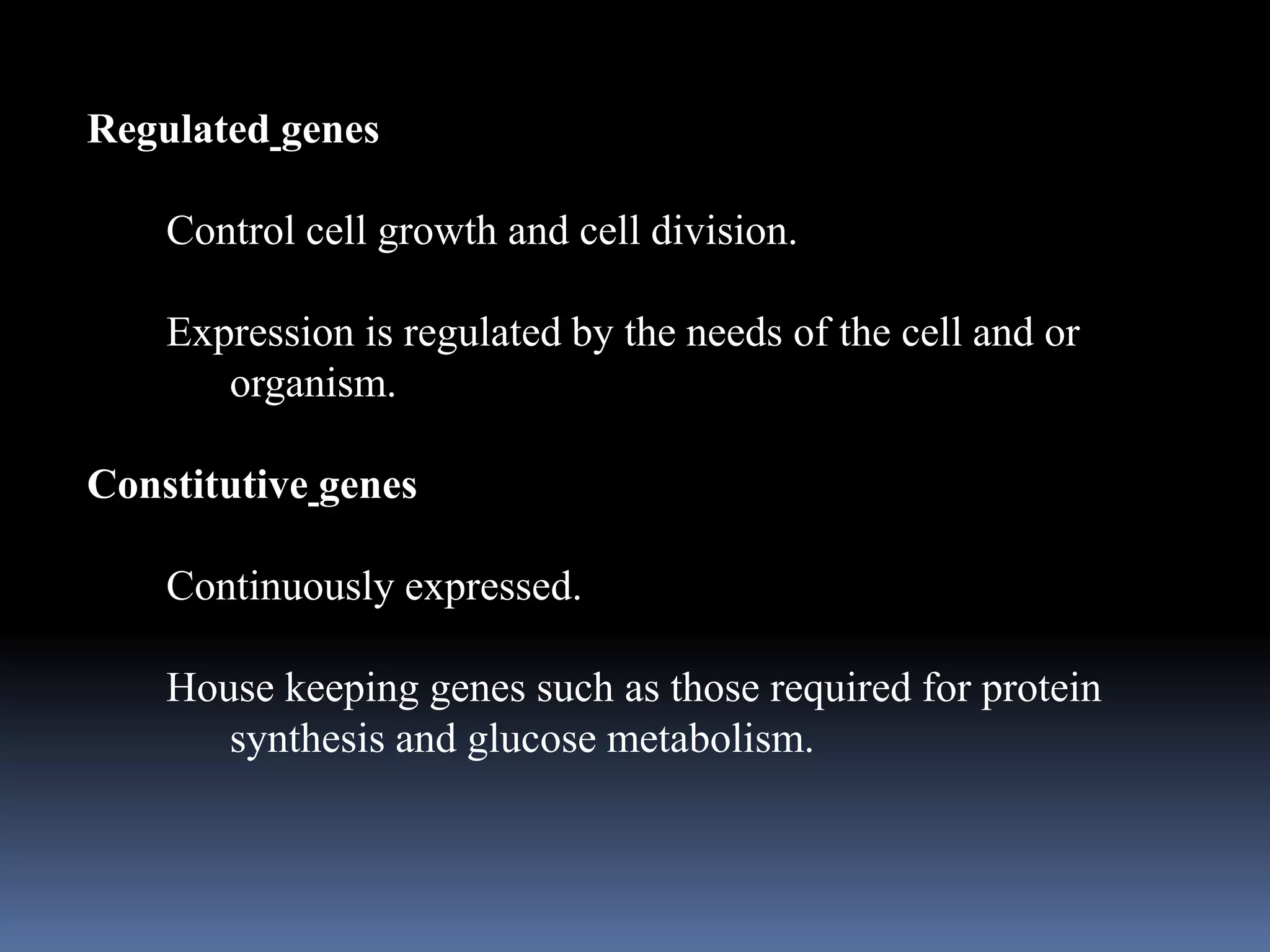
Regulated genes
Control cell growth and cell division.
Expression is regulated by the needs of the cell and or
organism.
Constitutive genes
Continuously expressed.
House keeping genes such as those required for protein
synthesis and glucose metabolism.
-galactosidase (lacZ)
•Breaks lactose into glucose + galactose.
•Converts lactose to the allolactose, regulates lac operon.
•Lactose permease (lacY)
•Transports lactose across cytoplasmic membrane.
•Transacetylase (lacA)
•transfers an acetyl group from acetyl-CoA to -galactosides.
Structural gene
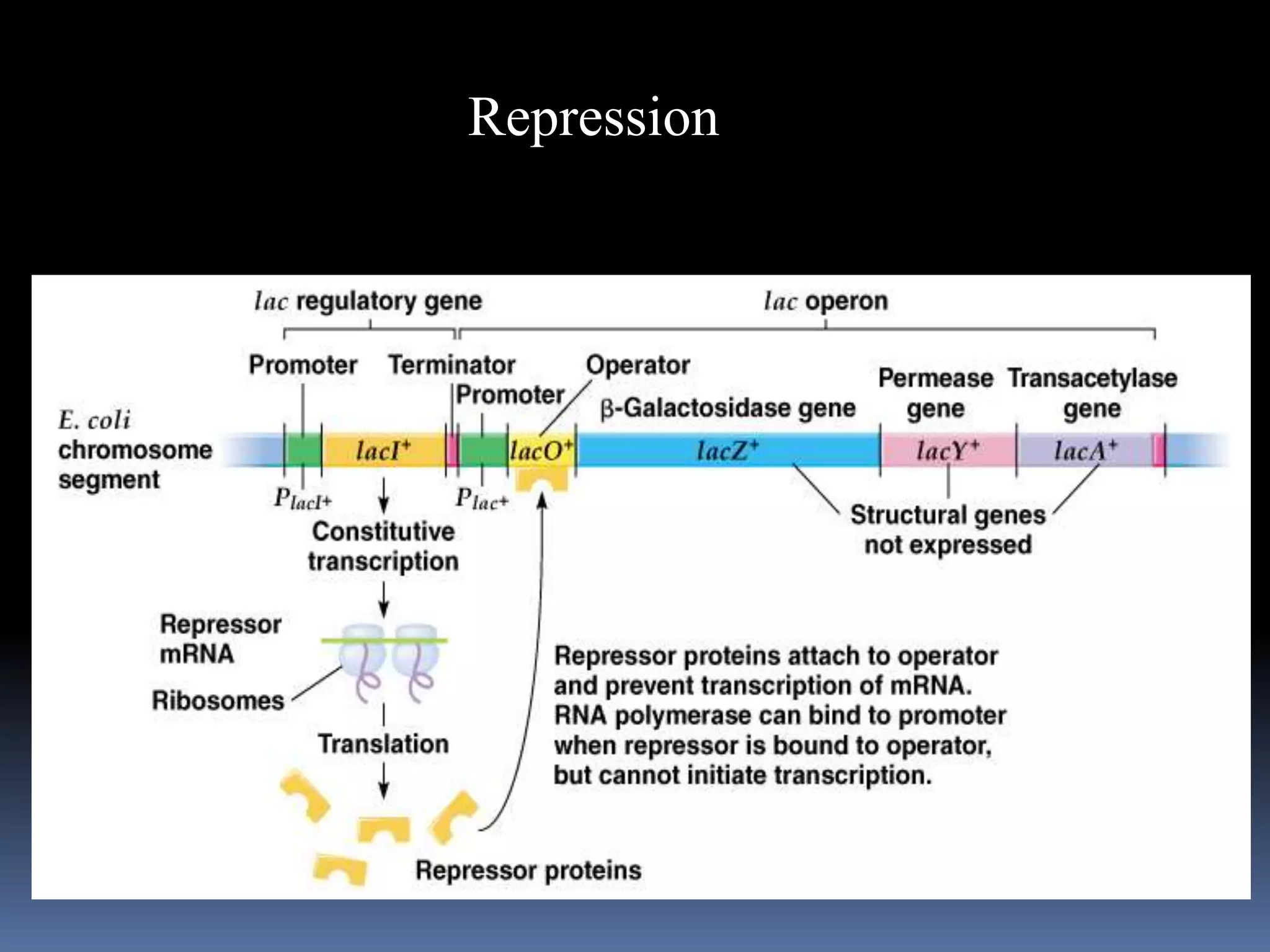
Repression
E. Coli lac operon:
• Lactose = disaccharide (glucose + galactose), provides energy.
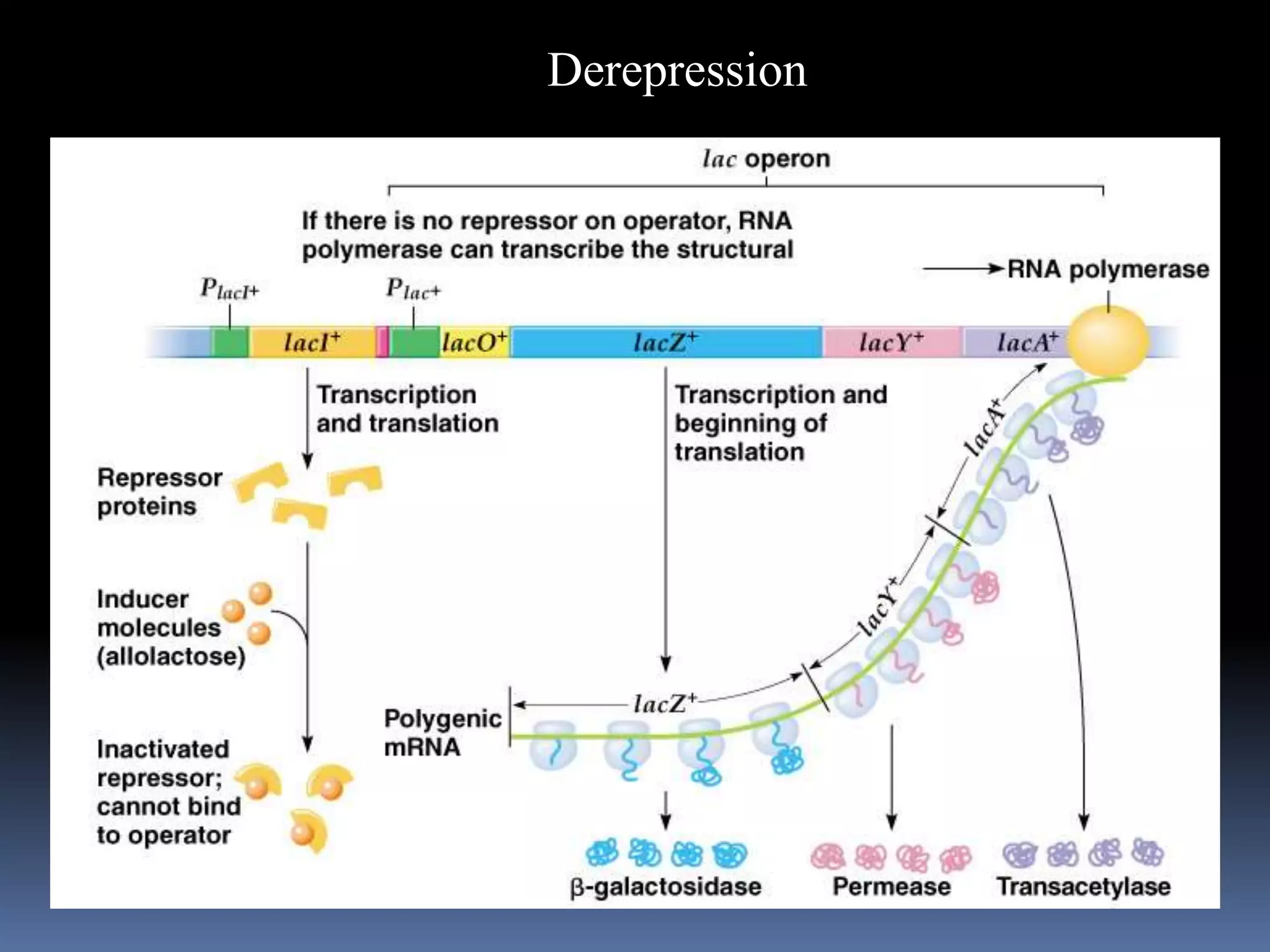
Derepression
Positive control in the lac operon:
• When glucose and lactose are present, E. coli preferentially uses glucose due to
low levels of active CAP (low cAMP).
• Catabolite activator protein (CAP) binds cAMP, activates, and binds to a CAP
recognition site upstream of the promoter (cAMP is greatly reduced in presence
of glucose).
• CAP changes the conformation of DNA and facilitates binding of RNA
polymerase and transcription.
• Adding cAMP to cells restore transcription of the lac operon even when glucose
is still present.
Bibliography & webliography
I-Genetics A Molecular approach third edition
By- Peter J. Russell
Genetics (from Genes to Genomes)
By- Michael Goldberg,Leory Hood
www.cat.cc.md.us/courses/bio141/lecguide/
unit4/genetics/protsyn/regulation/
THANK YOU

Regulation and gene expression

  • 1.
    Regulation of GeneExpressionRegulation of Gene Expression By – Ajay Kumar M.Sc. -2 Paper- 1
  • 2.
    Discovery Francois Jacob andJacques Monod (Pasteur Institute, Paris, France) • Studied the organization and control of the lac operon in E. coli. • Awarded the Nobel Prize in Physiology and Medicine 1965. Francois Jacob Jacques Monod
  • 3.
    What is Operon??? Cluster of genes in which expression is regulated by operator- repressor protein interactions. plus the operator region itself and the promoter. • Contents of an operon: Promoter Repressor Operator (controlling site) Coding sequences
  • 4.
  • 5.
    Regulated genes Control cellgrowth and cell division. Expression is regulated by the needs of the cell and or organism. Constitutive genes Continuously expressed. House keeping genes such as those required for protein synthesis and glucose metabolism.
  • 6.
    -galactosidase (lacZ) •Breaks lactoseinto glucose + galactose. •Converts lactose to the allolactose, regulates lac operon. •Lactose permease (lacY) •Transports lactose across cytoplasmic membrane. •Transacetylase (lacA) •transfers an acetyl group from acetyl-CoA to -galactosides. Structural gene
  • 7.
  • 8.
    E. Coli lacoperon: • Lactose = disaccharide (glucose + galactose), provides energy.
  • 9.
  • 10.
    Positive control inthe lac operon: • When glucose and lactose are present, E. coli preferentially uses glucose due to low levels of active CAP (low cAMP). • Catabolite activator protein (CAP) binds cAMP, activates, and binds to a CAP recognition site upstream of the promoter (cAMP is greatly reduced in presence of glucose). • CAP changes the conformation of DNA and facilitates binding of RNA polymerase and transcription. • Adding cAMP to cells restore transcription of the lac operon even when glucose is still present.
  • 12.
    Bibliography & webliography I-GeneticsA Molecular approach third edition By- Peter J. Russell Genetics (from Genes to Genomes) By- Michael Goldberg,Leory Hood www.cat.cc.md.us/courses/bio141/lecguide/ unit4/genetics/protsyn/regulation/
  • 13.