Transcription  & Translation  are the two major steps in protein synthesis
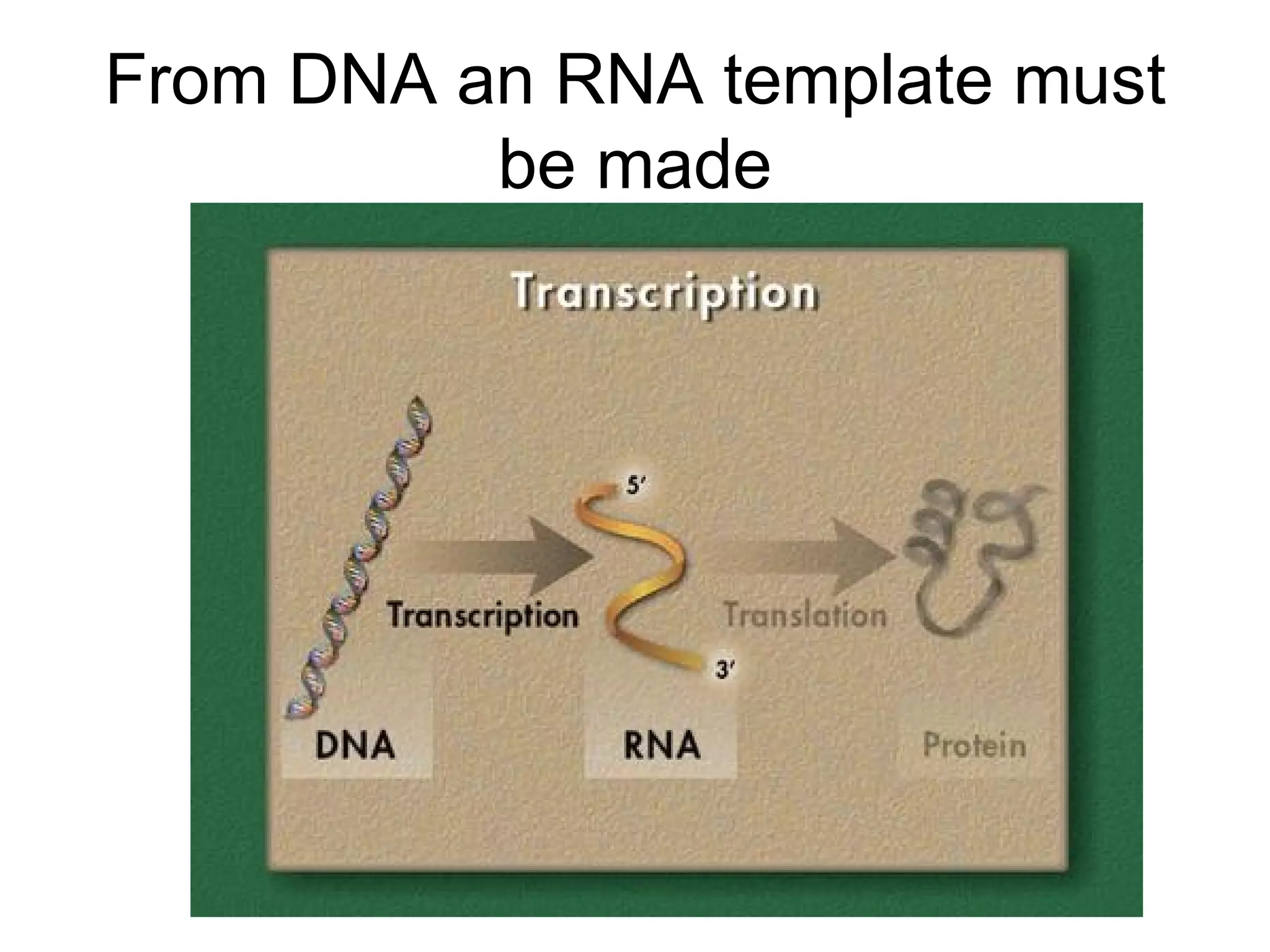
From DNA an RNA template must be made
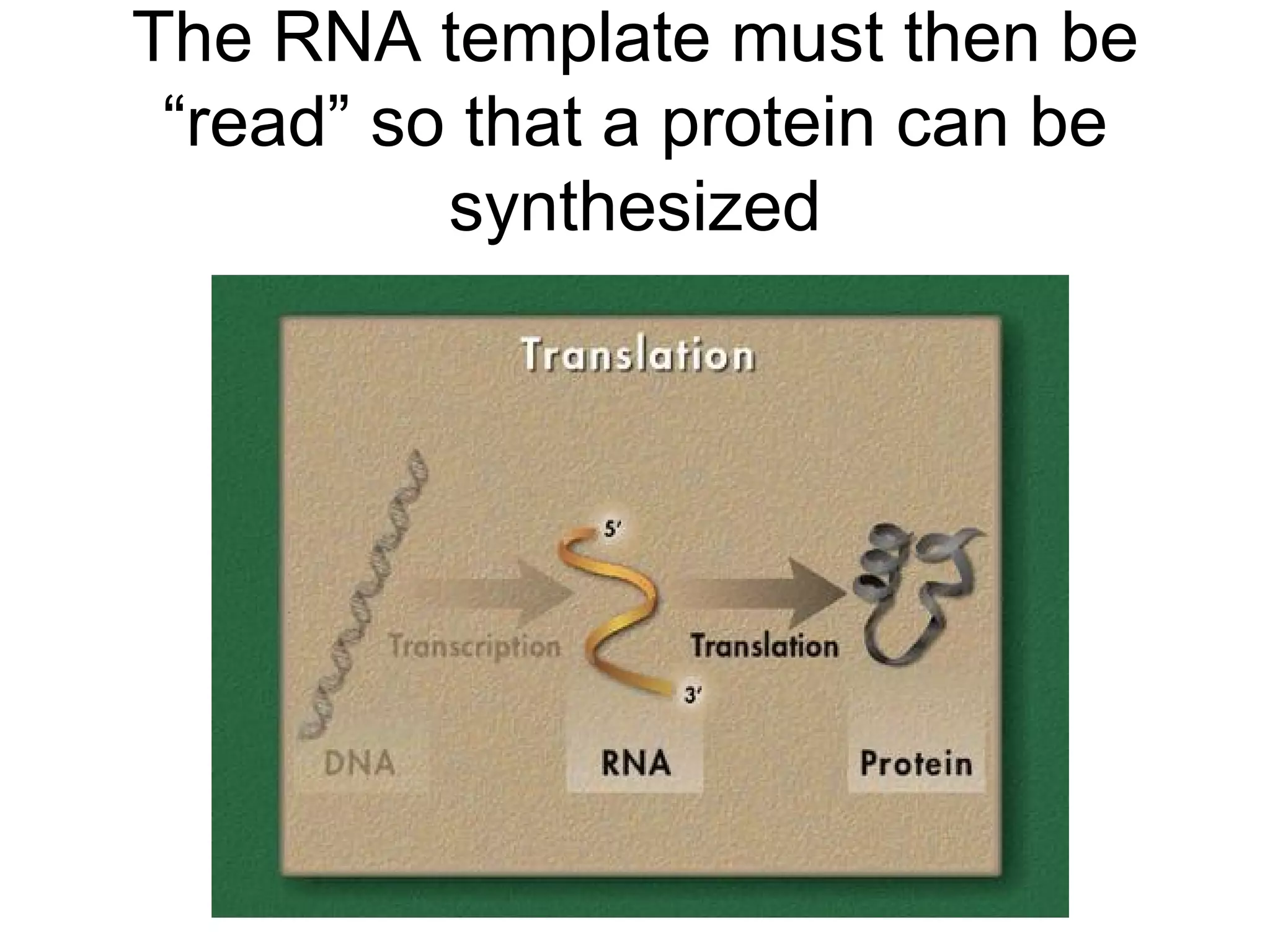
The RNA template must then be “read” so that a protein can be synthesized
DNA    mRNA    tRNA   protein DNA must first unzip so that ONE side may be read Which side?  The one that allows mRNA to be synthesized in the 5’    3’ direction mRNA must leave the nucleus and travel to the ribosome so protein synthesis can take place.
Leaving the nucleus The nucleus has pores formed by proteins DNA is double stranded, too fat to fit through the pore! mRNA is a single strand and once it is properly modified [more later…] it can exit through the pore so translation can occur at a ribosome
 
Complementary base pairs are added.  Uracil replaces thymine in RNA
Ribonucleic Acid  vs.  Deoxyribonucleic Acid See the “missing” oxygen atom? What’s the difference here?
Before mRNA can leave the nucleus, it must be modified Not all of the DNA is expressed at once. Usually only one gene or a few genes at a time Exons  are the part of the mRNA transcript that are  EXPRESSED Introns  are the  INERT  part
An enzyme cuts out the  intron  and splices the  exons  together
This saves valuable ENERGY for the cell so it is not making proteins it doesn’t need.
Opening and closing the nuclear pore Next, the ends of the mRNA must be modified to signal to the pore to “open” and “close” A cap is added 5’ end A poly A tail is also added to the 3’ end Remember synthesis is 5’  3’ so the 3’ end is always the tail!
Summary of mRNA processing
What makes transcription begin? There is a regulatory region ON THE DNA that regulates [go figure] the transcription of DNA into mRNA
Both sides of the DNA can be utilized at the same time, but synthesis occurs in the 5’  3’ direction
More about the regulatory region later…for now, know that a promoter “promotes” transcription!
We say that the regulatory region is “upstream” from the coding region of the gene. The promoter bases are NOT transcribed.
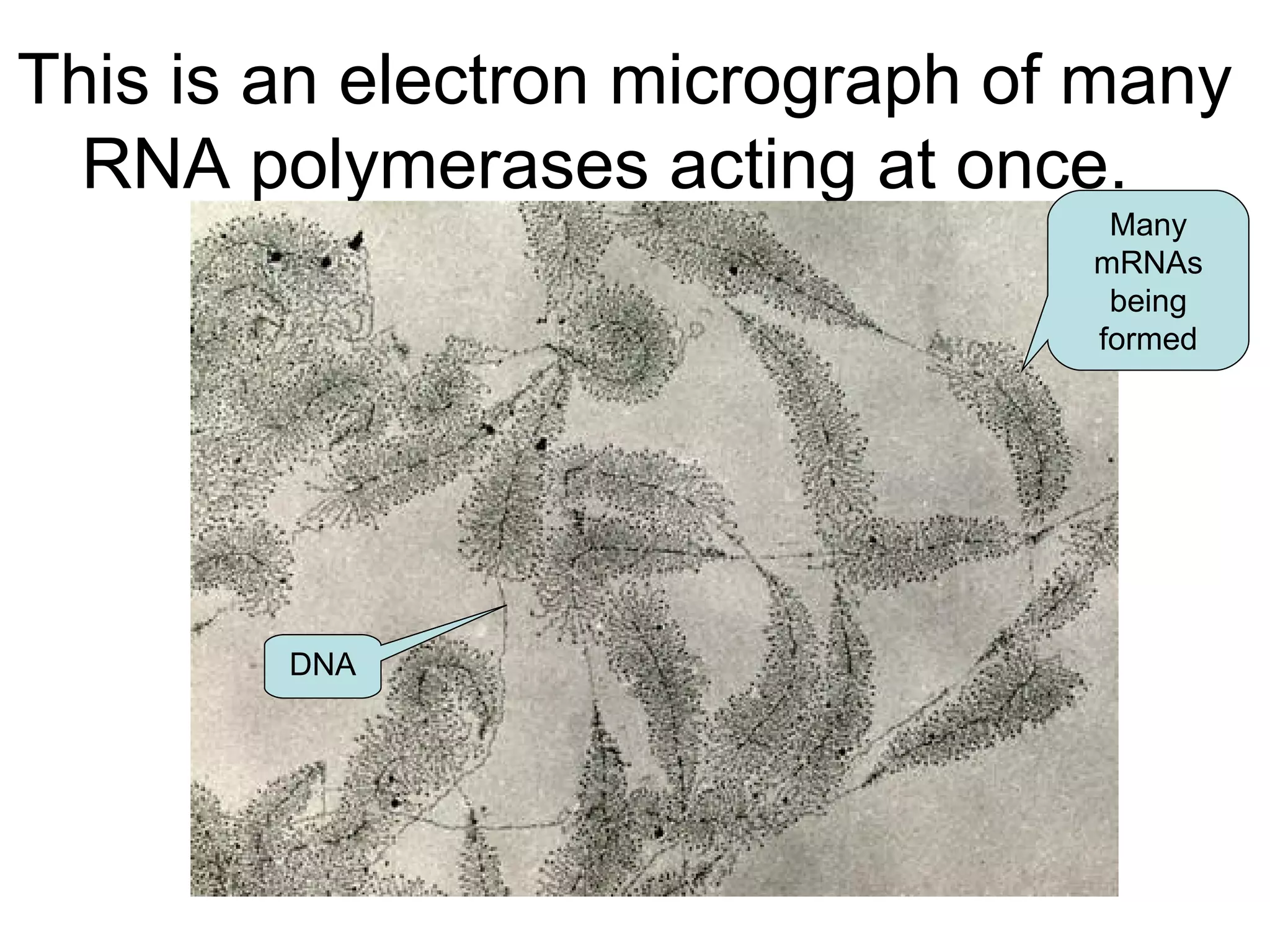
Once transcription begins, many RNA polymerases may read the DNA at once to get hundreds of mRNA templates made simultaneously—very efficient!
What stops transcription? A sequence of bases on the DNA that cause the RNA polymerase and mRNA strand to be released—remember mRNA has to be modified before it can leave the nucleus!
This is an electron micrograph of many RNA polymerases acting at once.  DNA Many mRNAs being formed
Transcription Animation
There are other types of RNA
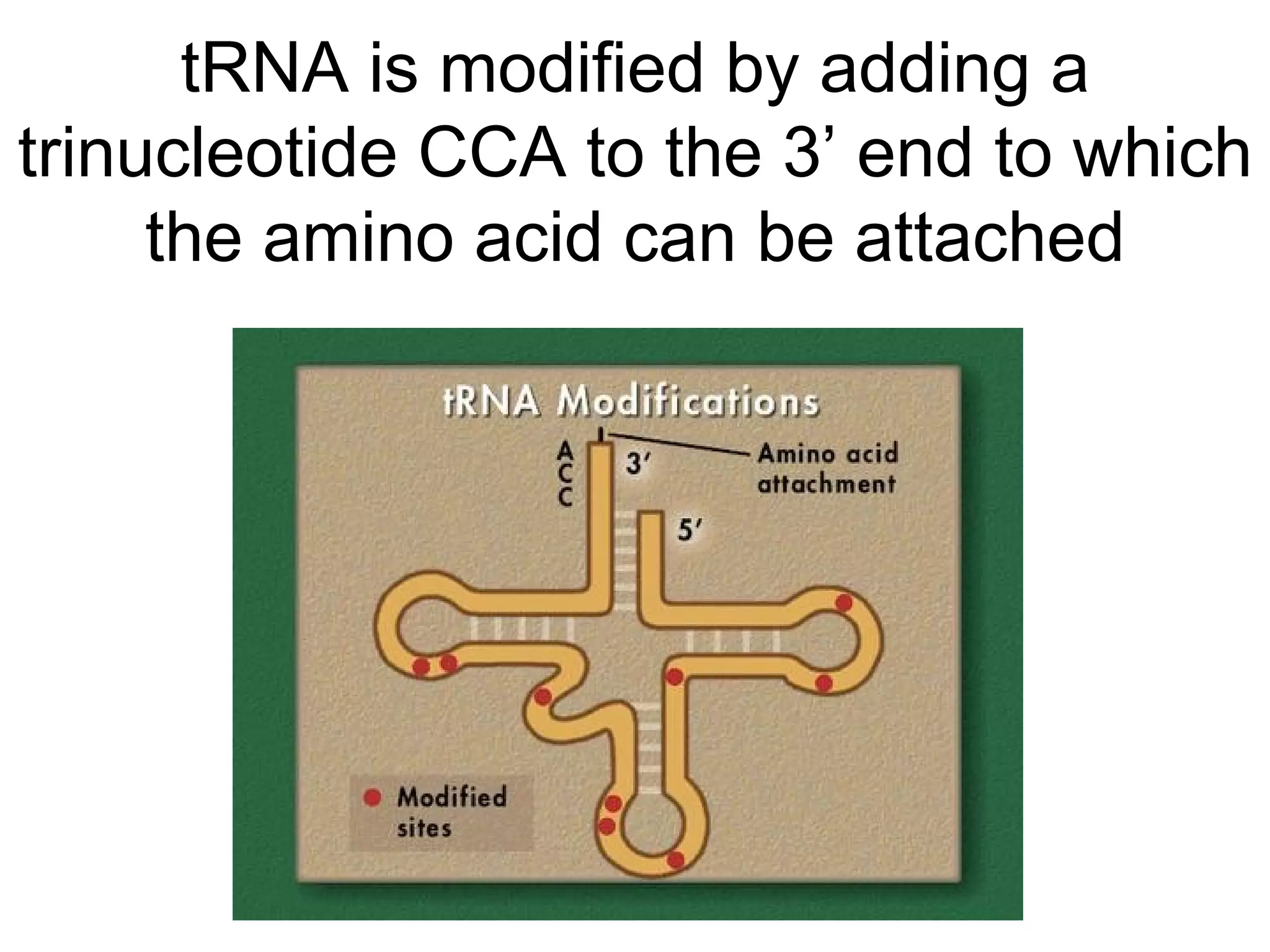
tRNA is modified by adding a trinucleotide CCA to the 3’ end to which the amino acid can be attached
Remember there are 20 amino acids necessary for life. 23 actually exist.
Three different ribosomal RNAs are made from a long primary transcript by removing sequences separating the rRNAs.
RNA structure: not always a single strand
Translation
Overview First the mRNA leaves the nucleus The 2 subunits of the ribosome attach to mRNA tRNA carrying an amino acid matches its anticodon to the codon on mRNA Peptide bonds form between the amino acids tRNA is released from the ribosome
What does rRNA do? It is thought to have a catalytic role
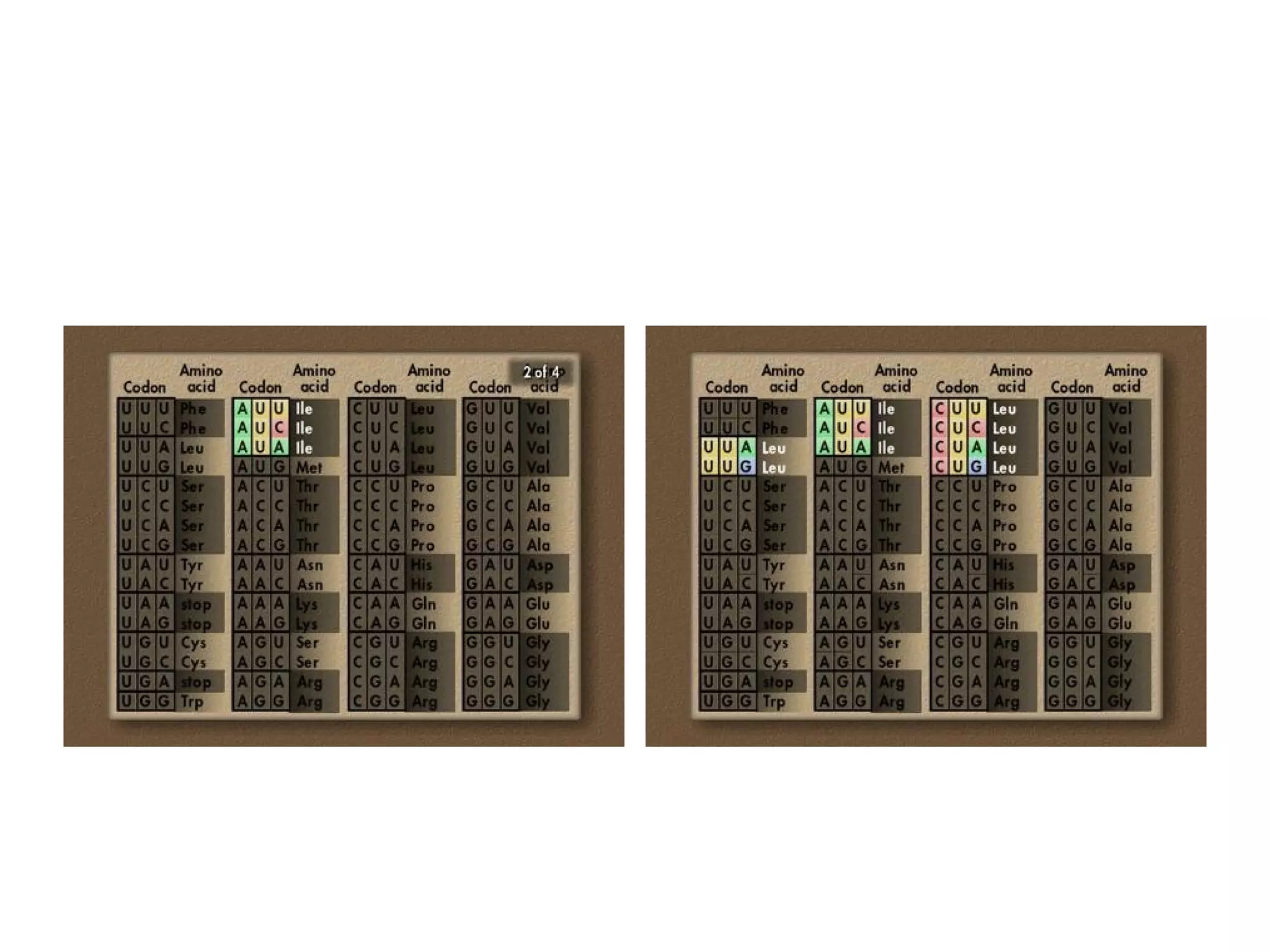
The start codon on mRNA always codes for methionine Easy to remember… … we always start school in AUGust!
There are three stop codons—they do NOT code for any amino acid.
3 base pairs coding for an amino acid allows for minor mistakes in the DNA not becoming major mistakes in the protein!
These are the most forgiving—get the first 2 bases in the third doesn’t matter!
 
Notice tryptophan is not at all forgiving—it is only coded for by UGG
Here’s the whole picture:  just memorize AUG as the start codon and remember all polypeptide chains begin with methionine.  No need to memorize more.
What begins translation?
The ribosomal subunits consist of rRNA and proteins—don’t memorize!
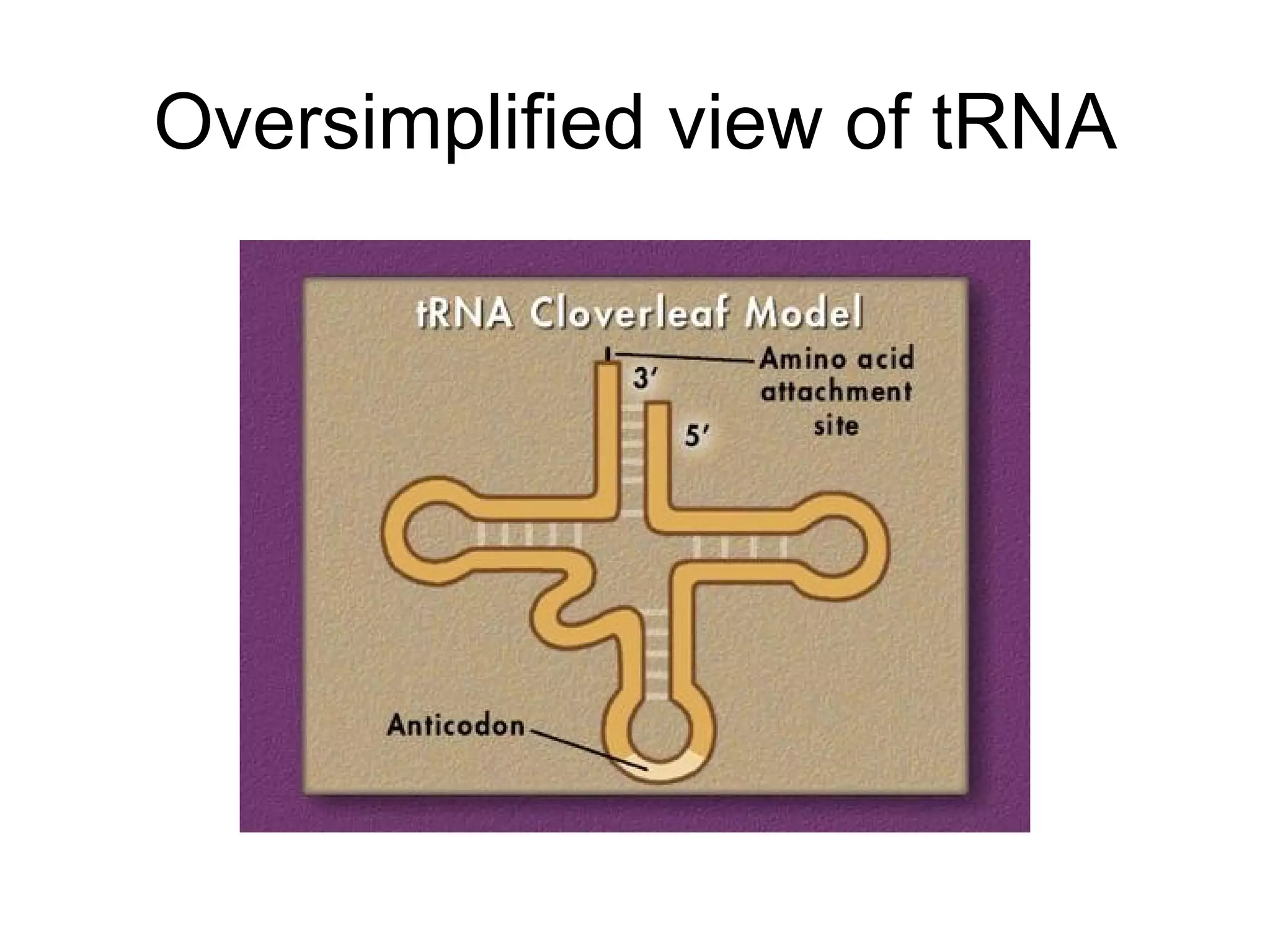
Oversimplified view of tRNA
Now you know why we simplify!
One region contains the anitcodon.
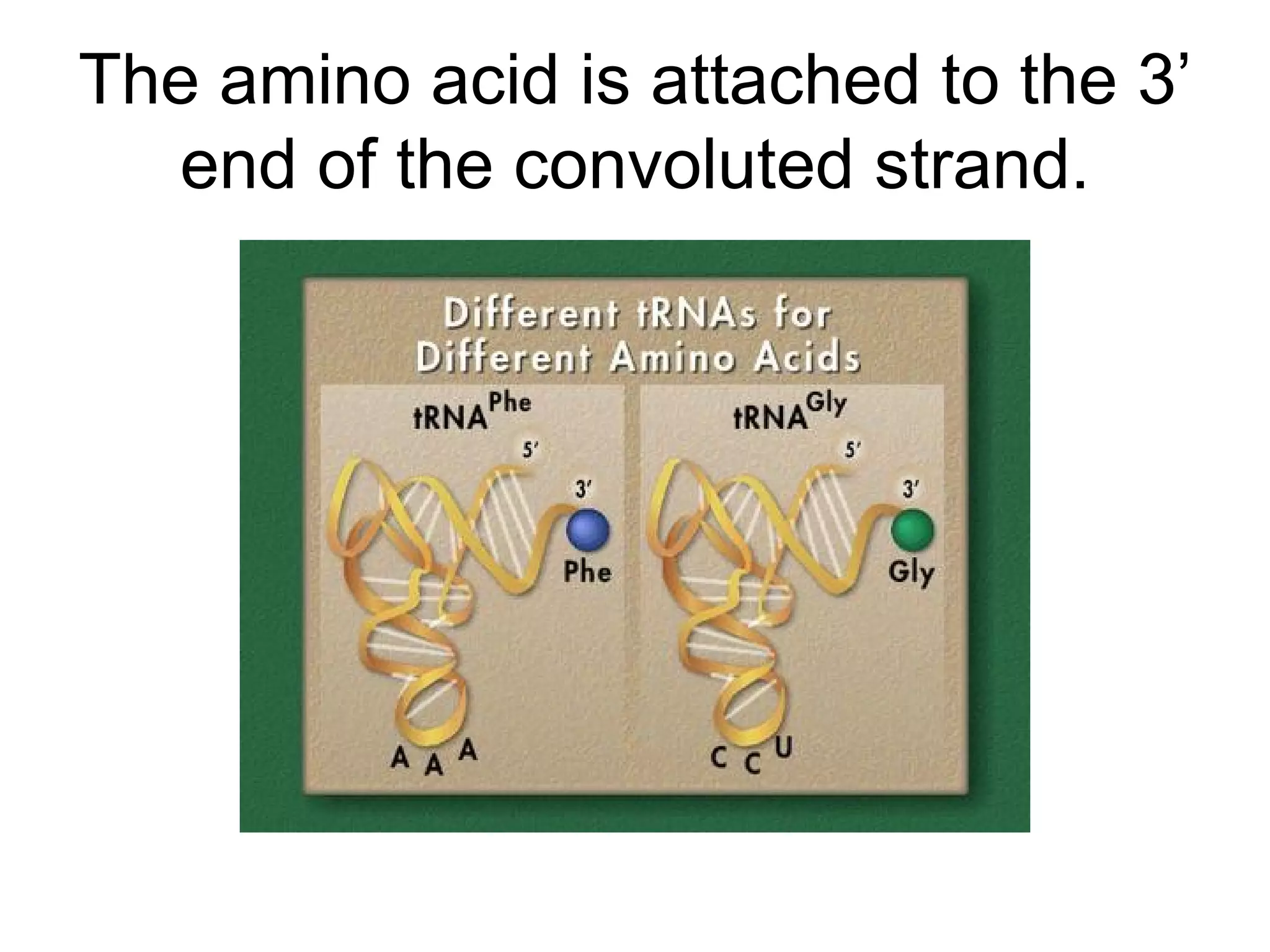
The amino acid is attached to the 3’ end of the convoluted strand.
AUG on the mRNA is matched with UAC on the tRNA and methionine is now in place.
The next codon is “read” and the next aa is placed.  The peptide bond is formed between the amine group of one aa and the carboxylic acid group of the next aa.
A peptide bond is a dehydration synthesis!
Once the peptide bond forms, tRNA releases its aa and is recycled. The ribosome shifts down the mRNA strand in a, you guessed it, 5’  3’ direction.
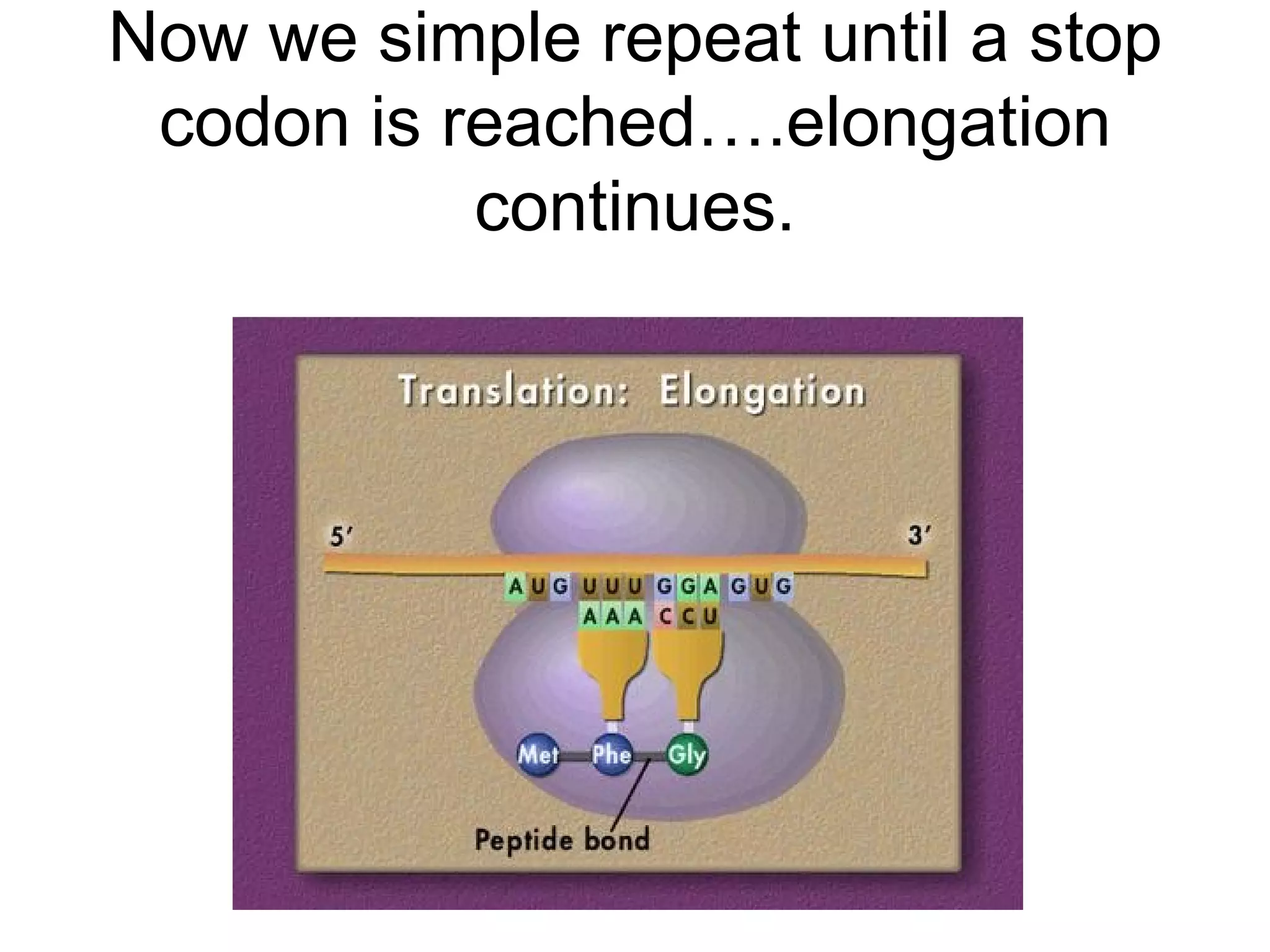
Now we simple repeat until a stop codon is reached….elongation continues.
Translation stops when the stop codon is reached at the 3’ end of mRNA
Once a stop codon is reached, the polypeptide is released.
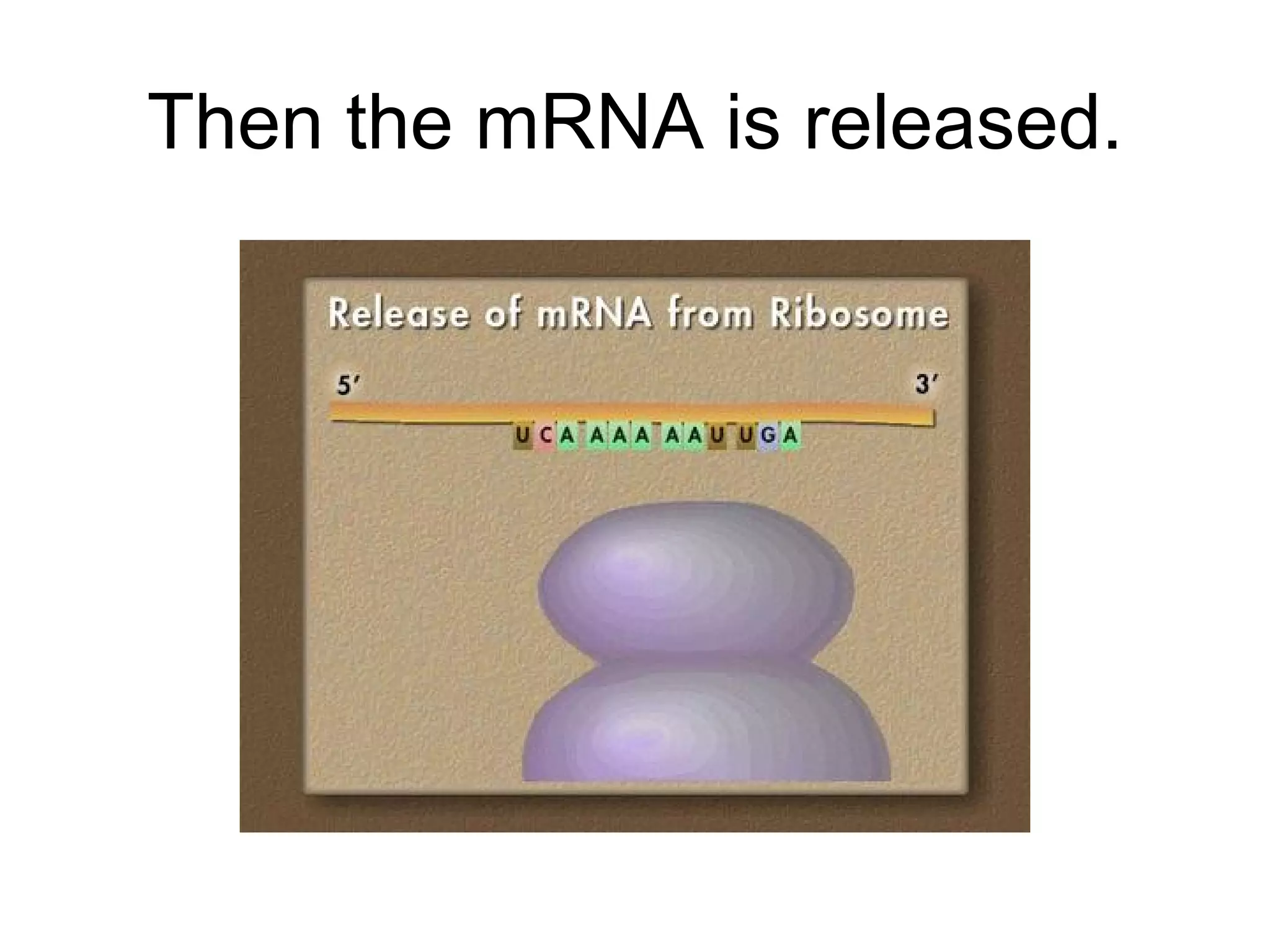
Then the mRNA is released.
Translation Animation

Transcription & Translation

  • 1.
    Transcription &Translation are the two major steps in protein synthesis
  • 2.
    From DNA anRNA template must be made
  • 3.
    The RNA templatemust then be “read” so that a protein can be synthesized
  • 4.
    DNA  mRNA  tRNA  protein DNA must first unzip so that ONE side may be read Which side? The one that allows mRNA to be synthesized in the 5’  3’ direction mRNA must leave the nucleus and travel to the ribosome so protein synthesis can take place.
  • 5.
    Leaving the nucleusThe nucleus has pores formed by proteins DNA is double stranded, too fat to fit through the pore! mRNA is a single strand and once it is properly modified [more later…] it can exit through the pore so translation can occur at a ribosome
  • 6.
  • 7.
    Complementary base pairsare added. Uracil replaces thymine in RNA
  • 8.
    Ribonucleic Acid vs. Deoxyribonucleic Acid See the “missing” oxygen atom? What’s the difference here?
  • 9.
    Before mRNA canleave the nucleus, it must be modified Not all of the DNA is expressed at once. Usually only one gene or a few genes at a time Exons are the part of the mRNA transcript that are EXPRESSED Introns are the INERT part
  • 10.
    An enzyme cutsout the intron and splices the exons together
  • 11.
    This saves valuableENERGY for the cell so it is not making proteins it doesn’t need.
  • 12.
    Opening and closingthe nuclear pore Next, the ends of the mRNA must be modified to signal to the pore to “open” and “close” A cap is added 5’ end A poly A tail is also added to the 3’ end Remember synthesis is 5’  3’ so the 3’ end is always the tail!
  • 13.
    Summary of mRNAprocessing
  • 14.
    What makes transcriptionbegin? There is a regulatory region ON THE DNA that regulates [go figure] the transcription of DNA into mRNA
  • 15.
    Both sides ofthe DNA can be utilized at the same time, but synthesis occurs in the 5’  3’ direction
  • 16.
    More about theregulatory region later…for now, know that a promoter “promotes” transcription!
  • 17.
    We say thatthe regulatory region is “upstream” from the coding region of the gene. The promoter bases are NOT transcribed.
  • 18.
    Once transcription begins,many RNA polymerases may read the DNA at once to get hundreds of mRNA templates made simultaneously—very efficient!
  • 19.
    What stops transcription?A sequence of bases on the DNA that cause the RNA polymerase and mRNA strand to be released—remember mRNA has to be modified before it can leave the nucleus!
  • 20.
    This is anelectron micrograph of many RNA polymerases acting at once. DNA Many mRNAs being formed
  • 21.
  • 22.
    There are othertypes of RNA
  • 23.
    tRNA is modifiedby adding a trinucleotide CCA to the 3’ end to which the amino acid can be attached
  • 24.
    Remember there are20 amino acids necessary for life. 23 actually exist.
  • 25.
    Three different ribosomalRNAs are made from a long primary transcript by removing sequences separating the rRNAs.
  • 26.
    RNA structure: notalways a single strand
  • 27.
  • 28.
    Overview First themRNA leaves the nucleus The 2 subunits of the ribosome attach to mRNA tRNA carrying an amino acid matches its anticodon to the codon on mRNA Peptide bonds form between the amino acids tRNA is released from the ribosome
  • 29.
    What does rRNAdo? It is thought to have a catalytic role
  • 30.
    The start codonon mRNA always codes for methionine Easy to remember… … we always start school in AUGust!
  • 31.
    There are threestop codons—they do NOT code for any amino acid.
  • 32.
    3 base pairscoding for an amino acid allows for minor mistakes in the DNA not becoming major mistakes in the protein!
  • 33.
    These are themost forgiving—get the first 2 bases in the third doesn’t matter!
  • 34.
  • 35.
    Notice tryptophan isnot at all forgiving—it is only coded for by UGG
  • 36.
    Here’s the wholepicture: just memorize AUG as the start codon and remember all polypeptide chains begin with methionine. No need to memorize more.
  • 37.
  • 38.
    The ribosomal subunitsconsist of rRNA and proteins—don’t memorize!
  • 39.
  • 40.
    Now you knowwhy we simplify!
  • 41.
    One region containsthe anitcodon.
  • 42.
    The amino acidis attached to the 3’ end of the convoluted strand.
  • 43.
    AUG on themRNA is matched with UAC on the tRNA and methionine is now in place.
  • 44.
    The next codonis “read” and the next aa is placed. The peptide bond is formed between the amine group of one aa and the carboxylic acid group of the next aa.
  • 45.
    A peptide bondis a dehydration synthesis!
  • 46.
    Once the peptidebond forms, tRNA releases its aa and is recycled. The ribosome shifts down the mRNA strand in a, you guessed it, 5’  3’ direction.
  • 47.
    Now we simplerepeat until a stop codon is reached….elongation continues.
  • 48.
    Translation stops whenthe stop codon is reached at the 3’ end of mRNA
  • 49.
    Once a stopcodon is reached, the polypeptide is released.
  • 50.
    Then the mRNAis released.
  • 51.