Eukaryotic Gene Regulation
Eukaryotic vs. Prokaryotic Cells Eukaryotic cells have a much larger genome Eukaryotes have much greater cell specialization Thus eukaryotic cells contain an enormous amount of DNA that does not program the synthesis of RNA or protein This requires complex organization
Eukaryotic Chromatin Eukaryotic chromatin is more complex than prokaryotic Organization requires more packing DNA associates with proteins to form chromatin Chromatin is ordered into higher structural levels
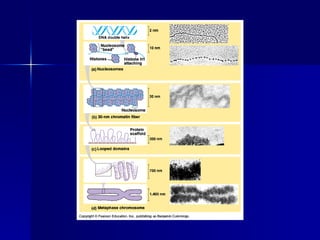
Chromatin Organization Histones create the first level of DNA packing Unfolded DNA looks like beads on a string Each “bead” and its DNA =  nucleosome The beaded string undergoes higher-order packing Mitotic chromosomes show several stages of chromatin coiling Packaging steps are specific, so that the same genes always end up at the same place Even during interphase, certain portions of chromosomes are highly condensed, an thus visible This is called heterochromatin to distinguish from euchromatin, “true chromatin”
 
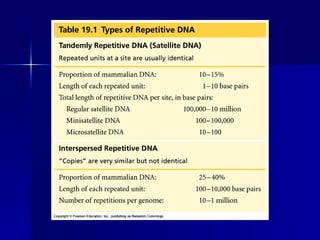
Non-coding DNA In humans, ~97% of the DNA does not code for protein or RNA Some is regulatory For most, the function is unknown Some of this is introns, some are repetitive sequences  Repetitive Sequences Tandem repetitive DNA  Short sequences repeated over and over Some are coding and can be associated with genetic diseases Interspersed Repetitive DNA Repeat units are scattered throughout the genome One group are the Alu elements These are transcribed, but function is unknown
 
Multi-gene Families A collection of identical or very similar genes Some genes are present in more than one copy, or two copies closely resemble each other Likely evolved from a single ancestral gene Like repetitive DNA May be clustered or dispersed in the genome Probably arose by repeated gene duplication, resulting from errors during DNA replication and recombination
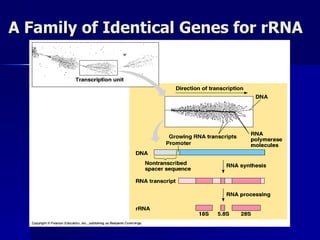
A Family of Identical Genes for rRNA
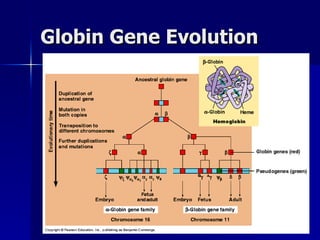
The Hemoglobin Example Two related families of genes encode globins, the alpha and beta subunits of hemoglobin Similarities suggest that the alpha and beta globins evolved from a common ancestral globin One family on chromosome 16 encodes for varied versions of alpha globin The other, on chromosome 11 encodes versions of beta globin Different versions of each globin are expressed at different time in development, improving the flexibility of hemoglobin
Globin Gene Evolution
Alterations of Gene Expression DNA of somatic cells can be altered Changes do not effect gametes so they are not passed to offspring Do effect gene expression within a cell These include:  Gene amplification Gene loss Rearrangement
Gene Amplification The number of copies of a gene may increase in some cells at a particular time in development Example:  Gene for ribosomal RNA in amphibians The developing ovum synthesizes over a million additional copies of the rRNA gene Enables the developing egg cell to make many more ribosomes These are needed for the burst of protein synthesis following fertilization
Gene Loss & Rearrangement Gene Loss In some insects, genes can also be selectively lost in certain tissues during development Genetic Rearrangement Shuffling of substantial stretches of DNA Not the rearrangement of meiosis, but rearrangement in somatic cells Rearrangement can alter gene expression
Transposons Stretches of DNA that can move from one location to another within the genome If a transposon “jumps” into the middle of a coding sequence of another gene, it can prevent normal functioning. If a transposon inserts in a sequence regulating transcription, it may increase or decrease protein production The transposon may also carry a gene that becomes activated if it is inserted downstream of a promoter.
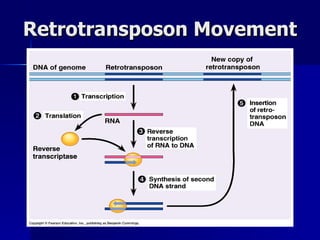
Retrotransposons Transposable elements that move within a genome that move with a genome by means of an RNA intermediate A transcript of the retrotransposon DNA This is accomplished by reverse transcriptase The Alu elements are retrotransposons
Retrotransposon Movement
Control of Gene Expression Each cell of a multi-cellular eukaryote expresses only a small fraction of its genes Gene expression must be controlled to reflect differentiation (specialization) A typical human cell expresses only 3 – 5% of its genes at a given time Cells must continuously turn certain genes on and off in response to environmental signals
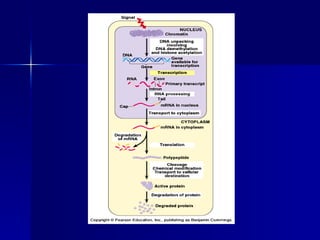
Steps in Gene Regulation Control can occur at any step in the pathway from gene to protein Key stages in the expression of a protein coding gene that can be regulated: Unpacking DNA Transcription RNA processing Translation Each stage is a possible control point where gene expression can be turned on or off, speeded up or slowed down
 
Chromatin Modification The physical state (packing) of DNA in or near a gene helps control whether the gene is available for transcription Example:  Genes in heterochromatin, which is highly condensed, are usually not expressed A gene’s location relative to nucleosomes can affect whether it is transcribed Chemical modifications of chromatin help regulate transcription: DNA methylation Histone acrtyylation
DNA Methylation The attachment of methyl groups (-CH 3 ) to DNA bases after synthesis Inactive DNA is generally highly methylated compared to DNA that is actively transcribed The same genes in different tissues are more heavily methylated in cells where they are not expressed Demethylating inactive genes can turn them on May determine long term inactivation of genes Methylation patterns are passed on, preserving a record of embryonic development May account for genomic imprinting in mammals Methylation permanantly turns off either the maternal or paternal allele of some genes
Histone Acetylation The attachment of acetyl groups (-COOH 3 ) to certain amino acids of histone proteins May play a direct role in the regulation of gene transcription When histones of a nucleosome are acetylated, they change shape so they grip the DNA less tightly This allows transcription enzymes easier access to the genes Enzymes that acetylate or deacetylate histones may be closely associated with or part of transcription factors that bind promoters Thus histone acetylation and gene transcription are structurally and functionally coupled
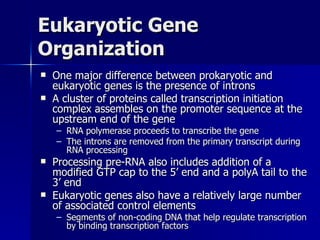
Transcription Initiation Finer tuning of gene regulation begins with the interaction of transcription factors with DNA sequences that control specific genes Once a gene is “unpacked” initiation is the most common point of control of gene expression
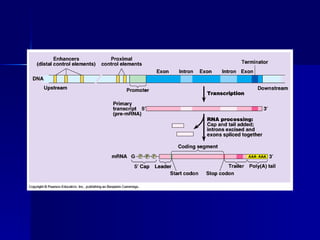
Eukaryotic Gene Organization One major difference between prokaryotic and eukaryotic genes is the presence of introns A cluster of proteins called transcription initiation complex assembles on the promoter sequence at the upstream end of the gene RNA polymerase proceeds to transcribe the gene The introns are removed from the primary transcript during RNA processing Processing pre-RNA also includes addition of a modified GTP cap to the 5’ end and a polyA tail to the 3’ end Eukaryotic genes also have a relatively large number of associated control elements Segments of non-coding DNA that help regulate transcription by binding transcription factors
 
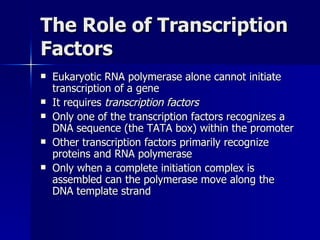
The Role of Transcription Factors Eukaryotic RNA polymerase alone cannot initiate transcription of a gene It requires  transcription factors Only one of the transcription factors recognizes a DNA sequence (the TATA box) within the promoter Other transcription factors primarily recognize proteins and RNA polymerase Only when a complete initiation complex is assembled can the polymerase move along the DNA template strand
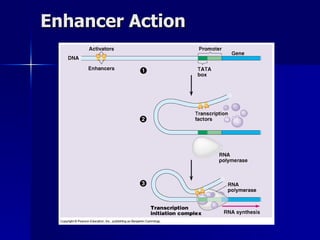
The Role of Control Elements Some control elements on the DNA are close to the promoter ( proximal ) More distant ( distal ) control elements are called  enhancers May be thousands of nucleotides away or within an intron Bending of the DNA enables transcription factors bound to enhancers to communicate with transcription initiation complex proteins at the promoter A transcription factor that binds an enhancer and stimulates transcription of a gene is called an  activator
Enhancer Action
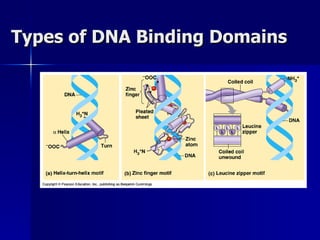
DNA-binding Domains A transcription factor generally has a DNA-binding domain A part of its 3D structure that binds to DNA There are only a few types of these domains Each transcription factor has a protein-binding domain that recognizes another transcription factor
Types of DNA Binding Domains
Coordinately Controlled Genes Some genes with related functions need to be turned on or off at the same time In prokaryotes such genes are often clustered into an  operon Share a promoter and other control elements located upstream Genes are transcribed and translated together Not found in Eukaryotes Coordinate gene expression in Eukaryotes depends on association of control elements with all of the genes in a dispersed group Transcription factors that recognize these control elements bind to them, promoting simultaneous transcription of the genes.
Post-transcriptional Mechanisms The expression of a protein-coding gene is measured by the amount of functional protein a cell makes  Gene expression may be blocked or stimulated by post-transcriptional steps Post-transcriptional regulatory mechanisms can fine tune gene expression and respond to changes in the environment These include: Alternative RNA splicing Regulation of mRNA degradation Control of translation Protein processing & degradation
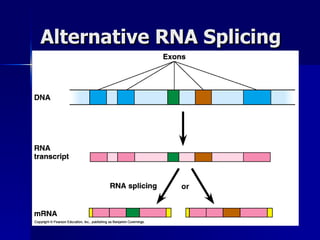
Alternative RNA Splicing Different mRNA molecules are produced from the same primary transcript Different RNA segments are treated as exons or introns Regulatory proteins control intron-exon choices by binding to regulatory sequences  within the primary transcript
Alternative RNA Splicing
Regulation of mRNA Degradation mRNA molecules in eukaryotes are longer-lived than those in prokaryotes A common pathway of mRNA breakdown is enzymatic shortening of the Poly-A tail This triggers enzymes that remove the 5’ cap Once the cap is removed nuclease enzymes chew up the mRNA
Control of Translation Translation of specific mRNAs can be blocked by regulatory proteins that bind to sequences within the leader region at the 5’ end of the mRNA Prevents attachment of ribosomes Important in embryonic development Ovum provides a variety of mRNAs that can be translated at specific stages in development
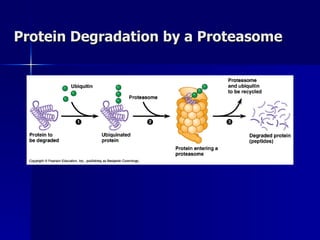
Protein Processing & Degradation The final opportunities for regulation are after translation Eukaryotic polypeptides must often be processed to create functional proteins They may be cleaved, acquire sugars or phosphate groups Polypeptides often must be transported to specific destinations in the cell to function The cell also degrades defective or damaged proteins To mark a protein for destruction, the cell attaches the small protein, ubiquitin Protein complexes, called proteasomes, recognize ubiquitin and degrade the tagged protein
Protein Degradation by a Proteasome

Eukaryotic Gene Regulation

  • 1.
  • 2.
    Eukaryotic vs. ProkaryoticCells Eukaryotic cells have a much larger genome Eukaryotes have much greater cell specialization Thus eukaryotic cells contain an enormous amount of DNA that does not program the synthesis of RNA or protein This requires complex organization
  • 3.
    Eukaryotic Chromatin Eukaryoticchromatin is more complex than prokaryotic Organization requires more packing DNA associates with proteins to form chromatin Chromatin is ordered into higher structural levels
  • 4.
    Chromatin Organization Histonescreate the first level of DNA packing Unfolded DNA looks like beads on a string Each “bead” and its DNA = nucleosome The beaded string undergoes higher-order packing Mitotic chromosomes show several stages of chromatin coiling Packaging steps are specific, so that the same genes always end up at the same place Even during interphase, certain portions of chromosomes are highly condensed, an thus visible This is called heterochromatin to distinguish from euchromatin, “true chromatin”
  • 5.
  • 6.
    Non-coding DNA Inhumans, ~97% of the DNA does not code for protein or RNA Some is regulatory For most, the function is unknown Some of this is introns, some are repetitive sequences Repetitive Sequences Tandem repetitive DNA Short sequences repeated over and over Some are coding and can be associated with genetic diseases Interspersed Repetitive DNA Repeat units are scattered throughout the genome One group are the Alu elements These are transcribed, but function is unknown
  • 7.
  • 8.
    Multi-gene Families Acollection of identical or very similar genes Some genes are present in more than one copy, or two copies closely resemble each other Likely evolved from a single ancestral gene Like repetitive DNA May be clustered or dispersed in the genome Probably arose by repeated gene duplication, resulting from errors during DNA replication and recombination
  • 9.
    A Family ofIdentical Genes for rRNA
  • 10.
    The Hemoglobin ExampleTwo related families of genes encode globins, the alpha and beta subunits of hemoglobin Similarities suggest that the alpha and beta globins evolved from a common ancestral globin One family on chromosome 16 encodes for varied versions of alpha globin The other, on chromosome 11 encodes versions of beta globin Different versions of each globin are expressed at different time in development, improving the flexibility of hemoglobin
  • 11.
  • 12.
    Alterations of GeneExpression DNA of somatic cells can be altered Changes do not effect gametes so they are not passed to offspring Do effect gene expression within a cell These include: Gene amplification Gene loss Rearrangement
  • 13.
    Gene Amplification Thenumber of copies of a gene may increase in some cells at a particular time in development Example: Gene for ribosomal RNA in amphibians The developing ovum synthesizes over a million additional copies of the rRNA gene Enables the developing egg cell to make many more ribosomes These are needed for the burst of protein synthesis following fertilization
  • 14.
    Gene Loss &Rearrangement Gene Loss In some insects, genes can also be selectively lost in certain tissues during development Genetic Rearrangement Shuffling of substantial stretches of DNA Not the rearrangement of meiosis, but rearrangement in somatic cells Rearrangement can alter gene expression
  • 15.
    Transposons Stretches ofDNA that can move from one location to another within the genome If a transposon “jumps” into the middle of a coding sequence of another gene, it can prevent normal functioning. If a transposon inserts in a sequence regulating transcription, it may increase or decrease protein production The transposon may also carry a gene that becomes activated if it is inserted downstream of a promoter.
  • 16.
    Retrotransposons Transposable elementsthat move within a genome that move with a genome by means of an RNA intermediate A transcript of the retrotransposon DNA This is accomplished by reverse transcriptase The Alu elements are retrotransposons
  • 17.
  • 18.
    Control of GeneExpression Each cell of a multi-cellular eukaryote expresses only a small fraction of its genes Gene expression must be controlled to reflect differentiation (specialization) A typical human cell expresses only 3 – 5% of its genes at a given time Cells must continuously turn certain genes on and off in response to environmental signals
  • 19.
    Steps in GeneRegulation Control can occur at any step in the pathway from gene to protein Key stages in the expression of a protein coding gene that can be regulated: Unpacking DNA Transcription RNA processing Translation Each stage is a possible control point where gene expression can be turned on or off, speeded up or slowed down
  • 20.
  • 21.
    Chromatin Modification Thephysical state (packing) of DNA in or near a gene helps control whether the gene is available for transcription Example: Genes in heterochromatin, which is highly condensed, are usually not expressed A gene’s location relative to nucleosomes can affect whether it is transcribed Chemical modifications of chromatin help regulate transcription: DNA methylation Histone acrtyylation
  • 22.
    DNA Methylation Theattachment of methyl groups (-CH 3 ) to DNA bases after synthesis Inactive DNA is generally highly methylated compared to DNA that is actively transcribed The same genes in different tissues are more heavily methylated in cells where they are not expressed Demethylating inactive genes can turn them on May determine long term inactivation of genes Methylation patterns are passed on, preserving a record of embryonic development May account for genomic imprinting in mammals Methylation permanantly turns off either the maternal or paternal allele of some genes
  • 23.
    Histone Acetylation Theattachment of acetyl groups (-COOH 3 ) to certain amino acids of histone proteins May play a direct role in the regulation of gene transcription When histones of a nucleosome are acetylated, they change shape so they grip the DNA less tightly This allows transcription enzymes easier access to the genes Enzymes that acetylate or deacetylate histones may be closely associated with or part of transcription factors that bind promoters Thus histone acetylation and gene transcription are structurally and functionally coupled
  • 24.
    Transcription Initiation Finertuning of gene regulation begins with the interaction of transcription factors with DNA sequences that control specific genes Once a gene is “unpacked” initiation is the most common point of control of gene expression
  • 25.
    Eukaryotic Gene OrganizationOne major difference between prokaryotic and eukaryotic genes is the presence of introns A cluster of proteins called transcription initiation complex assembles on the promoter sequence at the upstream end of the gene RNA polymerase proceeds to transcribe the gene The introns are removed from the primary transcript during RNA processing Processing pre-RNA also includes addition of a modified GTP cap to the 5’ end and a polyA tail to the 3’ end Eukaryotic genes also have a relatively large number of associated control elements Segments of non-coding DNA that help regulate transcription by binding transcription factors
  • 26.
  • 27.
    The Role ofTranscription Factors Eukaryotic RNA polymerase alone cannot initiate transcription of a gene It requires transcription factors Only one of the transcription factors recognizes a DNA sequence (the TATA box) within the promoter Other transcription factors primarily recognize proteins and RNA polymerase Only when a complete initiation complex is assembled can the polymerase move along the DNA template strand
  • 28.
    The Role ofControl Elements Some control elements on the DNA are close to the promoter ( proximal ) More distant ( distal ) control elements are called enhancers May be thousands of nucleotides away or within an intron Bending of the DNA enables transcription factors bound to enhancers to communicate with transcription initiation complex proteins at the promoter A transcription factor that binds an enhancer and stimulates transcription of a gene is called an activator
  • 29.
  • 30.
    DNA-binding Domains Atranscription factor generally has a DNA-binding domain A part of its 3D structure that binds to DNA There are only a few types of these domains Each transcription factor has a protein-binding domain that recognizes another transcription factor
  • 31.
    Types of DNABinding Domains
  • 32.
    Coordinately Controlled GenesSome genes with related functions need to be turned on or off at the same time In prokaryotes such genes are often clustered into an operon Share a promoter and other control elements located upstream Genes are transcribed and translated together Not found in Eukaryotes Coordinate gene expression in Eukaryotes depends on association of control elements with all of the genes in a dispersed group Transcription factors that recognize these control elements bind to them, promoting simultaneous transcription of the genes.
  • 33.
    Post-transcriptional Mechanisms Theexpression of a protein-coding gene is measured by the amount of functional protein a cell makes Gene expression may be blocked or stimulated by post-transcriptional steps Post-transcriptional regulatory mechanisms can fine tune gene expression and respond to changes in the environment These include: Alternative RNA splicing Regulation of mRNA degradation Control of translation Protein processing & degradation
  • 34.
    Alternative RNA SplicingDifferent mRNA molecules are produced from the same primary transcript Different RNA segments are treated as exons or introns Regulatory proteins control intron-exon choices by binding to regulatory sequences within the primary transcript
  • 35.
  • 36.
    Regulation of mRNADegradation mRNA molecules in eukaryotes are longer-lived than those in prokaryotes A common pathway of mRNA breakdown is enzymatic shortening of the Poly-A tail This triggers enzymes that remove the 5’ cap Once the cap is removed nuclease enzymes chew up the mRNA
  • 37.
    Control of TranslationTranslation of specific mRNAs can be blocked by regulatory proteins that bind to sequences within the leader region at the 5’ end of the mRNA Prevents attachment of ribosomes Important in embryonic development Ovum provides a variety of mRNAs that can be translated at specific stages in development
  • 38.
    Protein Processing &Degradation The final opportunities for regulation are after translation Eukaryotic polypeptides must often be processed to create functional proteins They may be cleaved, acquire sugars or phosphate groups Polypeptides often must be transported to specific destinations in the cell to function The cell also degrades defective or damaged proteins To mark a protein for destruction, the cell attaches the small protein, ubiquitin Protein complexes, called proteasomes, recognize ubiquitin and degrade the tagged protein
  • 39.