TRYPTOPHAN OPERON
By
DEVI PRIYA SUGATHAN
MSC BIOCHEMISTRY AND
MOLECULAR BIOLOGY
The trp Operon
 The 20 common amino acids are required in
large amount for protein synthesis, and E.coli
can synthesize all of them.
 The genes for the enzymes needed to synthesize
a given amino acid are generally clustered in an
operon and are expressed whenever existing
supplies of that amino acid are inadequate for
cellular requirements.
 When the amino acid is abundant the
biosynthetic enzymes are not needed and the
operon is repressed.
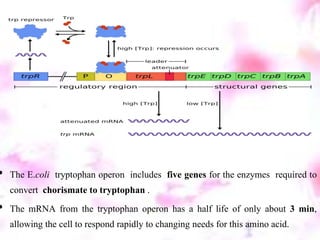
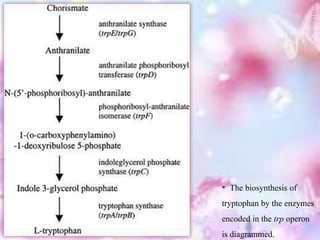
• The E.coli tryptophan operon includes five genes for the enzymes required to
convert chorismate to tryptophan .
• The mRNA from the tryptophan operon has a half life of only about 3 min,
allowing the cell to respond rapidly to changing needs for this amino acid.
• The biosynthesis of
tryptophan by the enzymes
encoded in the trp operon
is diagrammed.
Regulatory Sequence
• This Operon is regulated by two mechanisms:
 The repressor binds to its operator
 The transcription of trp mRNA is attenuated.
The trp repressor
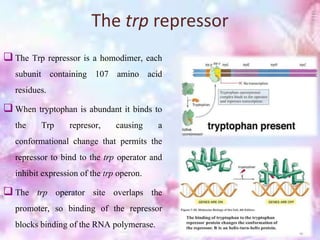
 The Trp repressor is a homodimer, each
subunit containing 107 amino acid
residues.
 When tryptophan is abundant it binds to
the Trp represor, causing a
conformational change that permits the
repressor to bind to the trp operator and
inhibit expression of the trp operon.
 The trp operator site overlaps the
promoter, so binding of the repressor
blocks binding of the RNA polymerase.
Transcriptional Attenuation
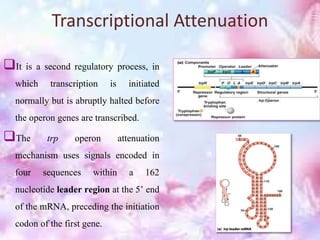
It is a second regulatory process, in
which transcription is initiated
normally but is abruptly halted before
the operon genes are transcribed.
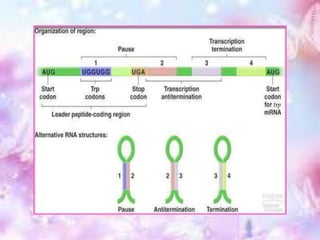
The trp operon attenuation
mechanism uses signals encoded in
four sequences within a 162
nucleotide leader region at the 5’ end
of the mRNA, preceding the initiation
codon of the first gene.
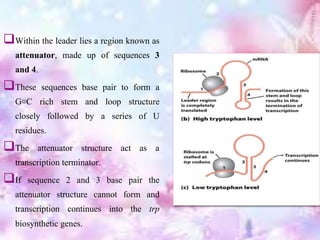
Within the leader lies a region known as
attenuator, made up of sequences 3
and 4.
These sequences base pair to form a
G≡C rich stem and loop structure
closely followed by a series of U
residues.
The attenuator structure act as a
transcription terminator.
If sequence 2 and 3 base pair the
attenuator structure cannot form and
transcription continues into the trp
biosynthetic genes.
What mechanism determines whether sequence 3 pairs
with sequence 2 or with sequence 4 ?
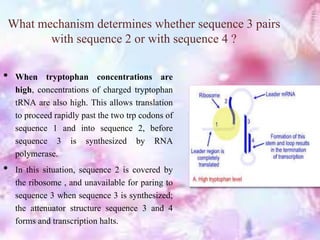
• When tryptophan concentrations are
high, concentrations of charged tryptophan
tRNA are also high. This allows translation
to proceed rapidly past the two trp codons of
sequence 1 and into sequence 2, before
sequence 3 is synthesized by RNA
polymerase.
• In this situation, sequence 2 is covered by
the ribosome , and unavailable for paring to
sequence 3 when sequence 3 is synthesized;
the attenuator structure sequence 3 and 4
forms and transcription halts.
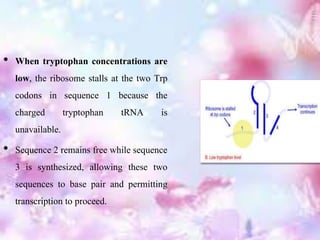
• When tryptophan concentrations are
low, the ribosome stalls at the two Trp
codons in sequence 1 because the
charged tryptophan tRNA is
unavailable.
• Sequence 2 remains free while sequence
3 is synthesized, allowing these two
sequences to base pair and permitting
transcription to proceed.
Summary

Tryptophan operon

  • 1.
    TRYPTOPHAN OPERON By DEVI PRIYASUGATHAN MSC BIOCHEMISTRY AND MOLECULAR BIOLOGY
  • 2.
    The trp Operon The 20 common amino acids are required in large amount for protein synthesis, and E.coli can synthesize all of them.  The genes for the enzymes needed to synthesize a given amino acid are generally clustered in an operon and are expressed whenever existing supplies of that amino acid are inadequate for cellular requirements.  When the amino acid is abundant the biosynthetic enzymes are not needed and the operon is repressed.
  • 3.
    • The E.colitryptophan operon includes five genes for the enzymes required to convert chorismate to tryptophan . • The mRNA from the tryptophan operon has a half life of only about 3 min, allowing the cell to respond rapidly to changing needs for this amino acid.
  • 4.
    • The biosynthesisof tryptophan by the enzymes encoded in the trp operon is diagrammed.
  • 5.
    Regulatory Sequence • ThisOperon is regulated by two mechanisms:  The repressor binds to its operator  The transcription of trp mRNA is attenuated.
  • 6.
    The trp repressor The Trp repressor is a homodimer, each subunit containing 107 amino acid residues.  When tryptophan is abundant it binds to the Trp represor, causing a conformational change that permits the repressor to bind to the trp operator and inhibit expression of the trp operon.  The trp operator site overlaps the promoter, so binding of the repressor blocks binding of the RNA polymerase.
  • 7.
    Transcriptional Attenuation It isa second regulatory process, in which transcription is initiated normally but is abruptly halted before the operon genes are transcribed. The trp operon attenuation mechanism uses signals encoded in four sequences within a 162 nucleotide leader region at the 5’ end of the mRNA, preceding the initiation codon of the first gene.
  • 8.
    Within the leaderlies a region known as attenuator, made up of sequences 3 and 4. These sequences base pair to form a G≡C rich stem and loop structure closely followed by a series of U residues. The attenuator structure act as a transcription terminator. If sequence 2 and 3 base pair the attenuator structure cannot form and transcription continues into the trp biosynthetic genes.
  • 10.
    What mechanism determineswhether sequence 3 pairs with sequence 2 or with sequence 4 ? • When tryptophan concentrations are high, concentrations of charged tryptophan tRNA are also high. This allows translation to proceed rapidly past the two trp codons of sequence 1 and into sequence 2, before sequence 3 is synthesized by RNA polymerase. • In this situation, sequence 2 is covered by the ribosome , and unavailable for paring to sequence 3 when sequence 3 is synthesized; the attenuator structure sequence 3 and 4 forms and transcription halts.
  • 11.
    • When tryptophanconcentrations are low, the ribosome stalls at the two Trp codons in sequence 1 because the charged tryptophan tRNA is unavailable. • Sequence 2 remains free while sequence 3 is synthesized, allowing these two sequences to base pair and permitting transcription to proceed.
  • 12.