Chapter 7
From DNA to Protein
DNA to Protein
• DNA acts as a “manager” in the process
of making proteins
• DNA is the template or starting
sequence that is copied into RNA that is
then used to make the protein
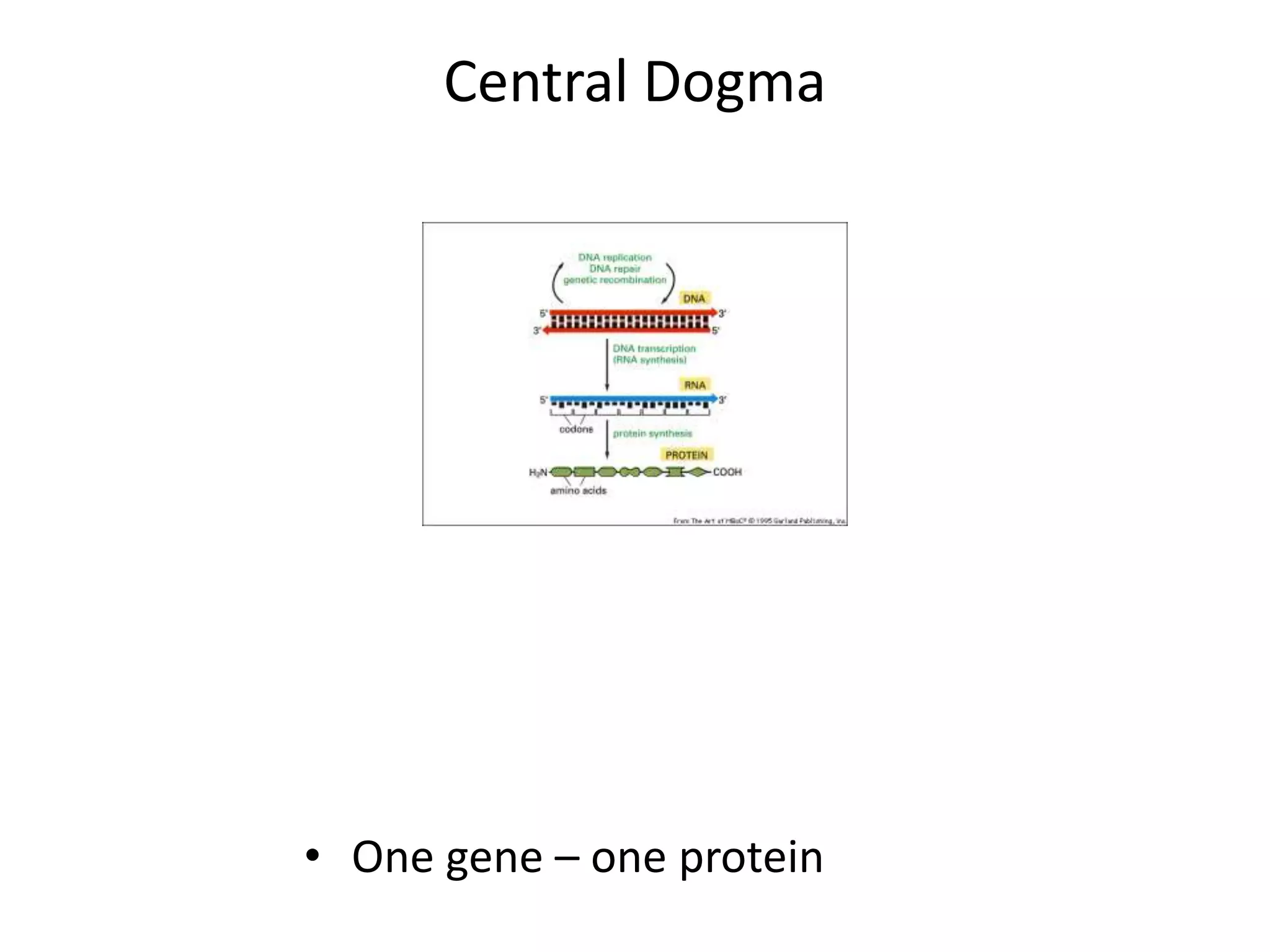
Central Dogma
• One gene – one protein
Central Dogma
• This is the same for bacteria to humans
• DNA is the genetic instruction or gene
• DNA  RNA is called Transcription
– RNA chain is called a transcript
• RNA  Protein is called Translation
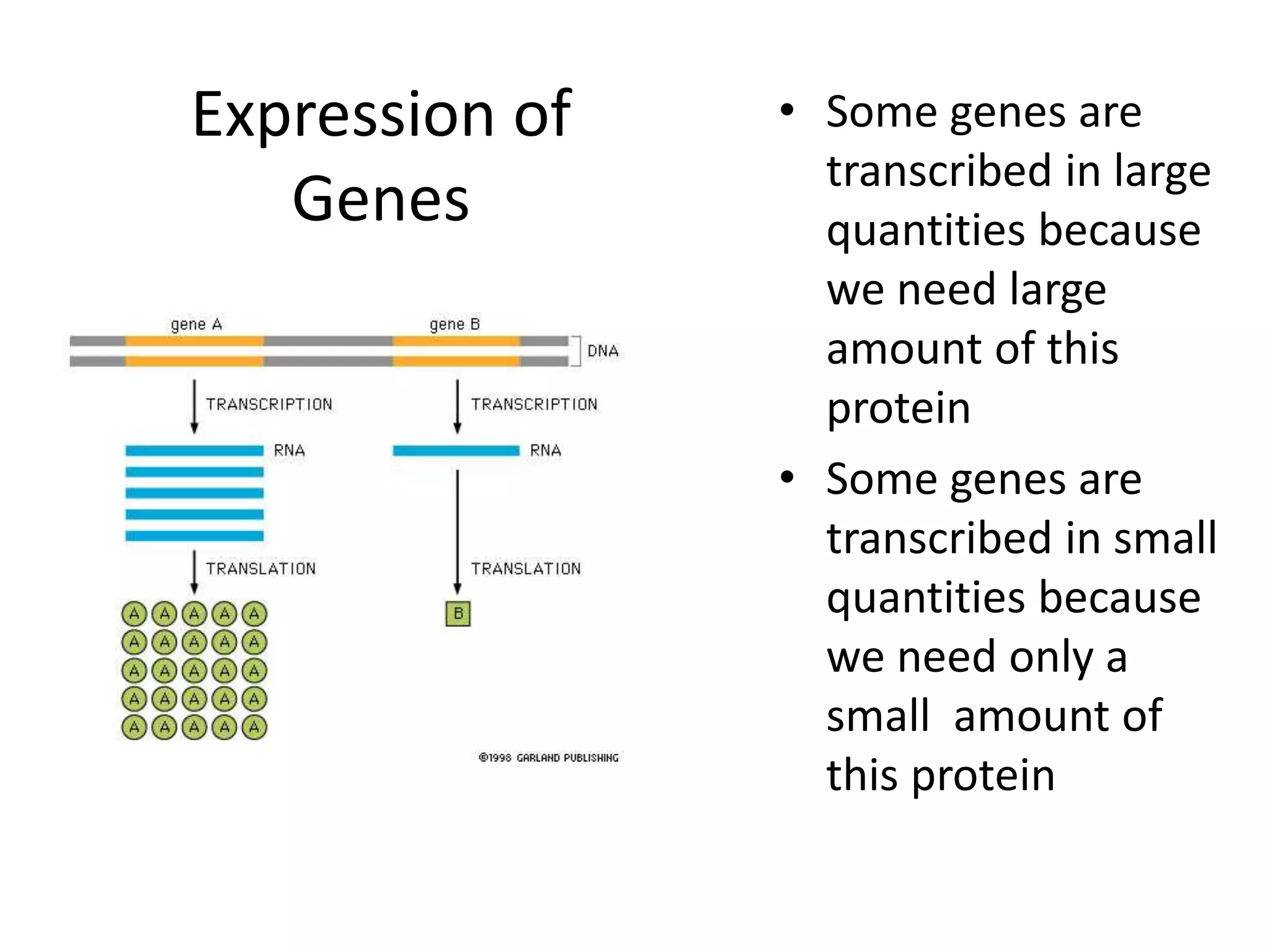
Expression of
Genes
• Some genes are
transcribed in large
quantities because
we need large
amount of this
protein
• Some genes are
transcribed in small
quantities because
we need only a
small amount of
this protein
Transcription
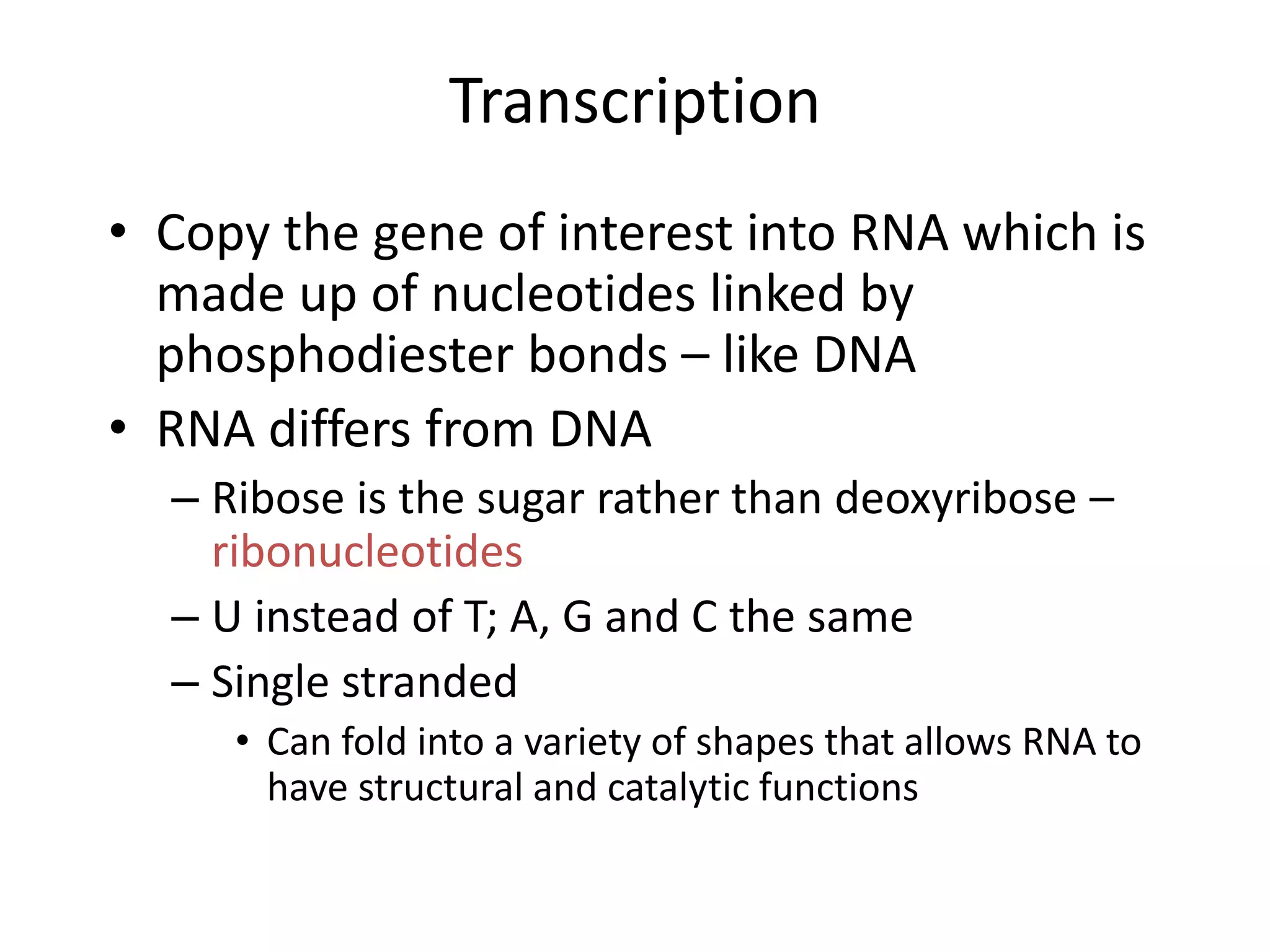
• Copy the gene of interest into RNA which is
made up of nucleotides linked by
phosphodiester bonds – like DNA
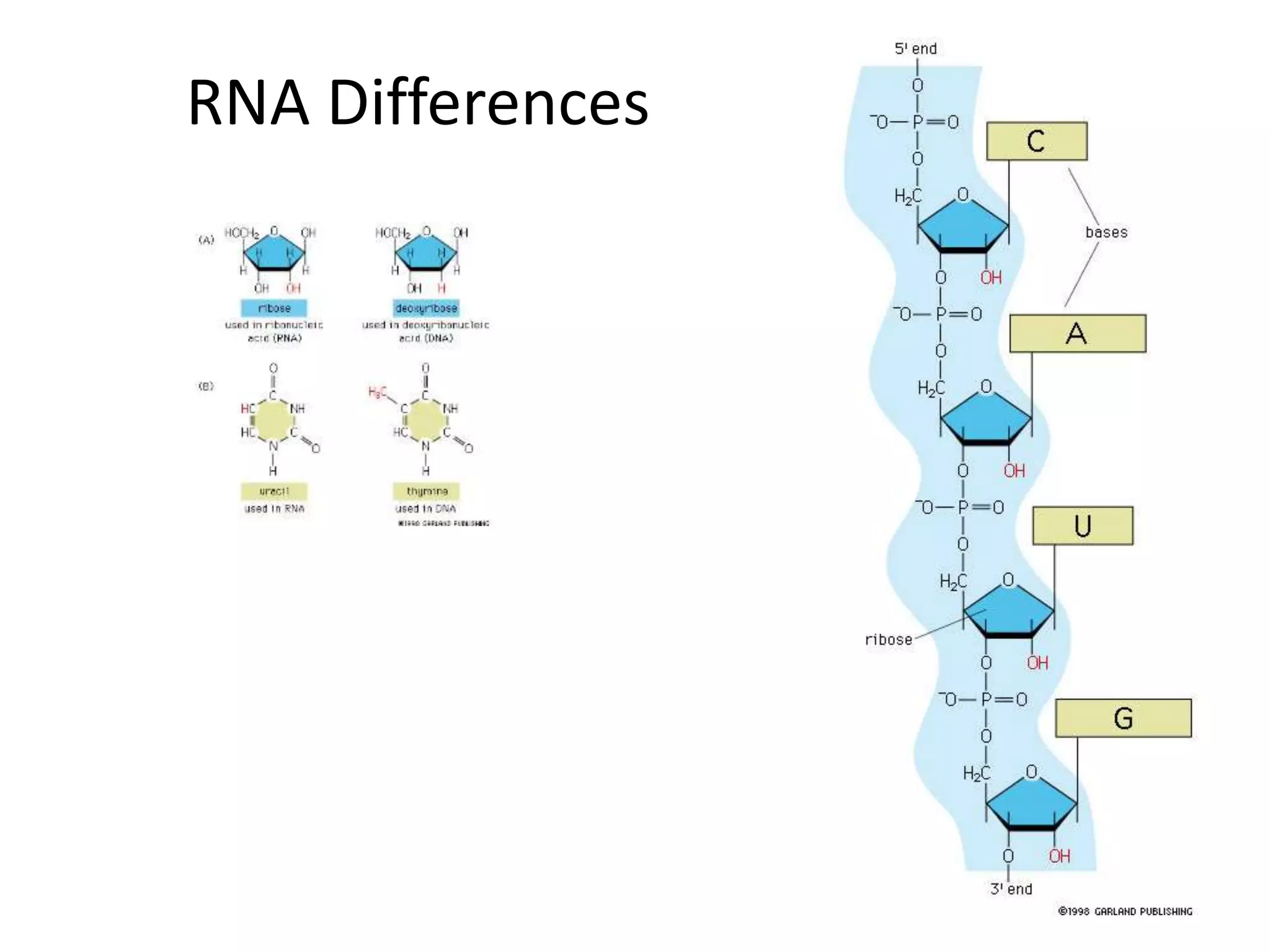
• RNA differs from DNA
– Ribose is the sugar rather than deoxyribose –
ribonucleotides
– U instead of T; A, G and C the same
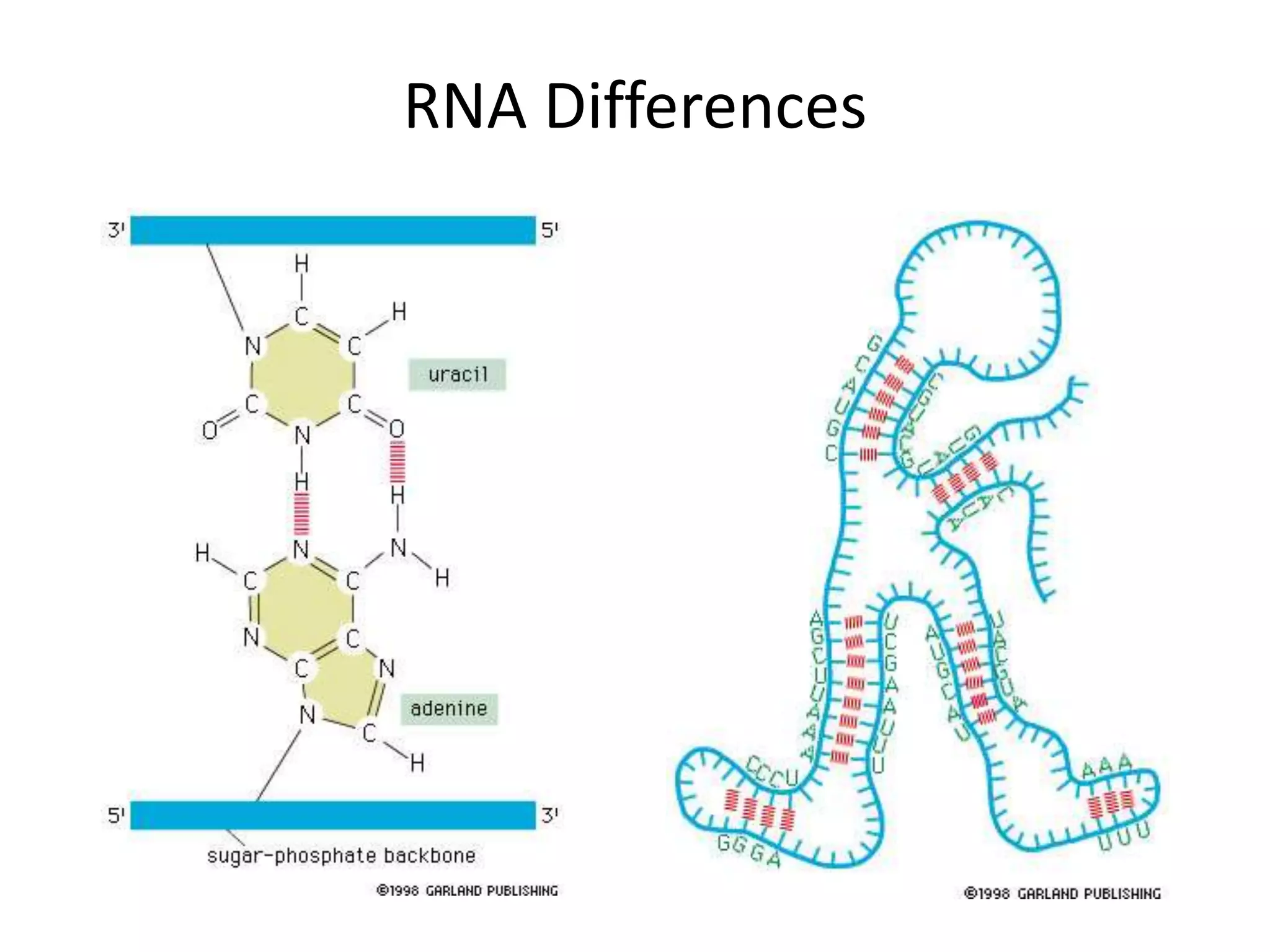
– Single stranded
• Can fold into a variety of shapes that allows RNA to
have structural and catalytic functions
RNA Differences
RNA Differences
Transcription
• Similarities to DNA replication
– Open and unwind a portion of the DNA
– 1 strand of the DNA acts as a template
– Complementary base-pairing with DNA
• Differences
– RNA strand does not stay paired with DNA
• DNA re-coils and RNA is single stranded
– RNA is shorter than DNA
• RNA is several 1000 bp or shorter whereas DNA is
250 million bp long
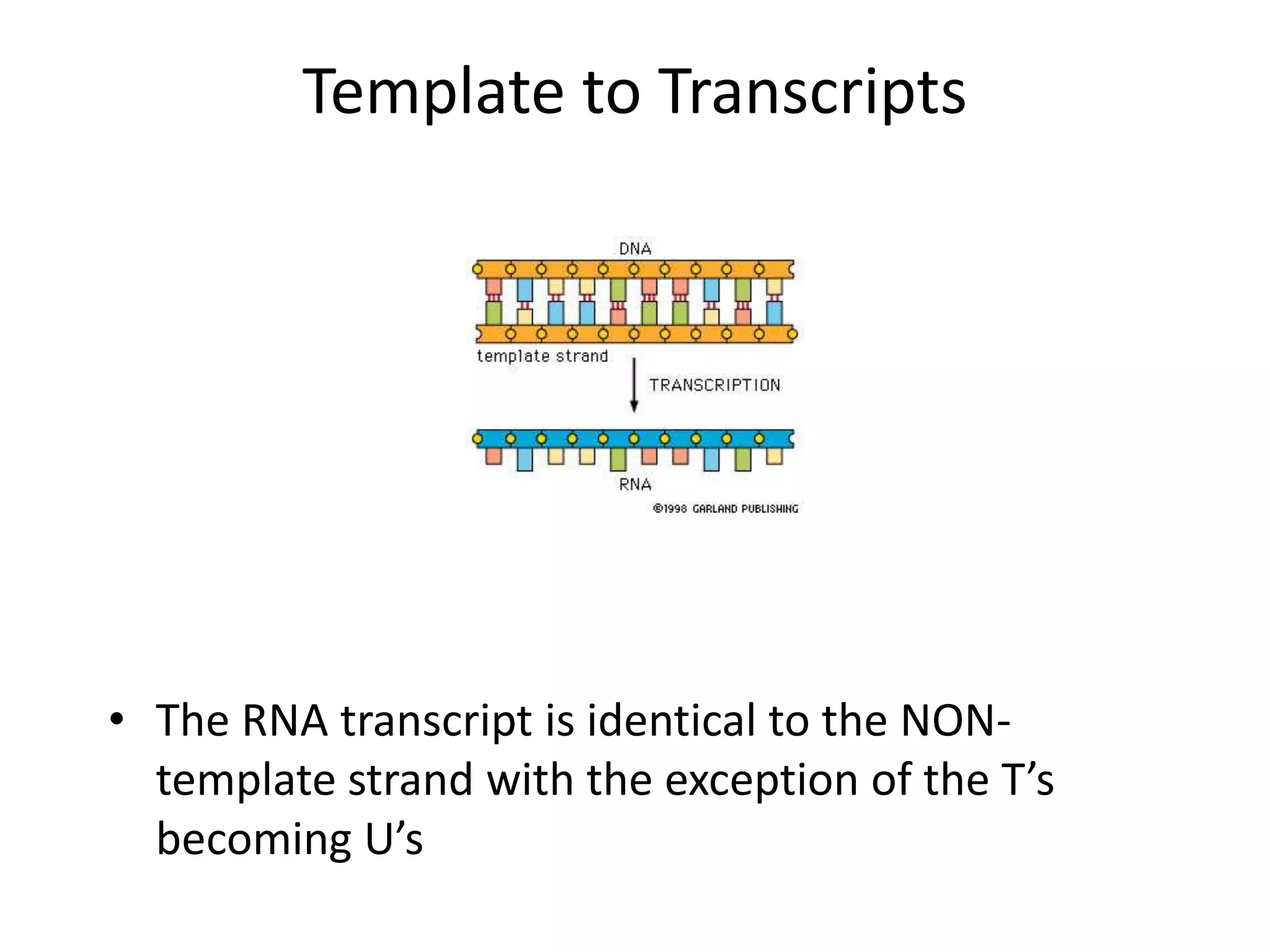
Template to Transcripts
• The RNA transcript is identical to the NON-
template strand with the exception of the T’s
becoming U’s
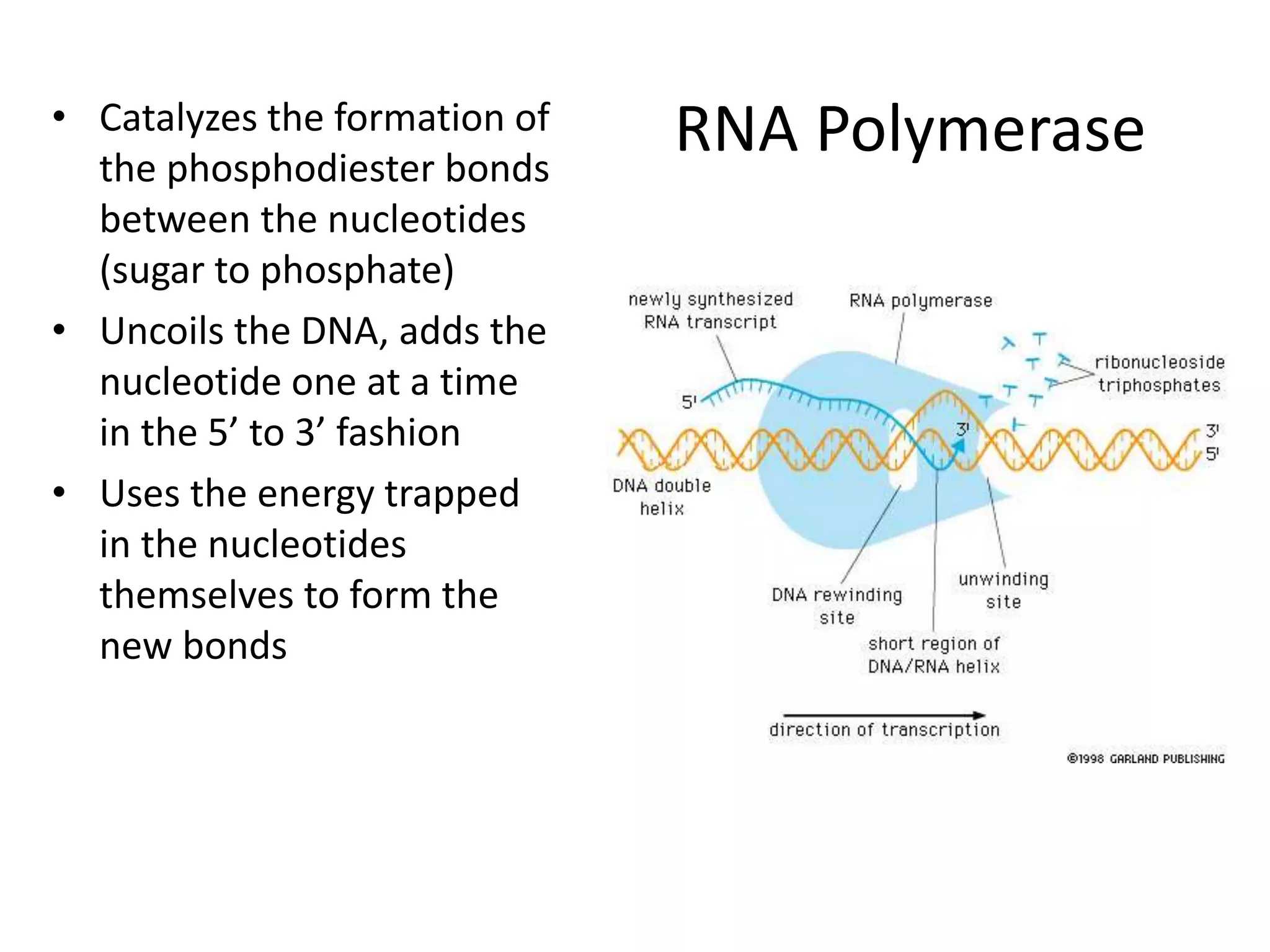
RNA Polymerase
• Catalyzes the formation of
the phosphodiester bonds
between the nucleotides
(sugar to phosphate)
• Uncoils the DNA, adds the
nucleotide one at a time
in the 5’ to 3’ fashion
• Uses the energy trapped
in the nucleotides
themselves to form the
new bonds
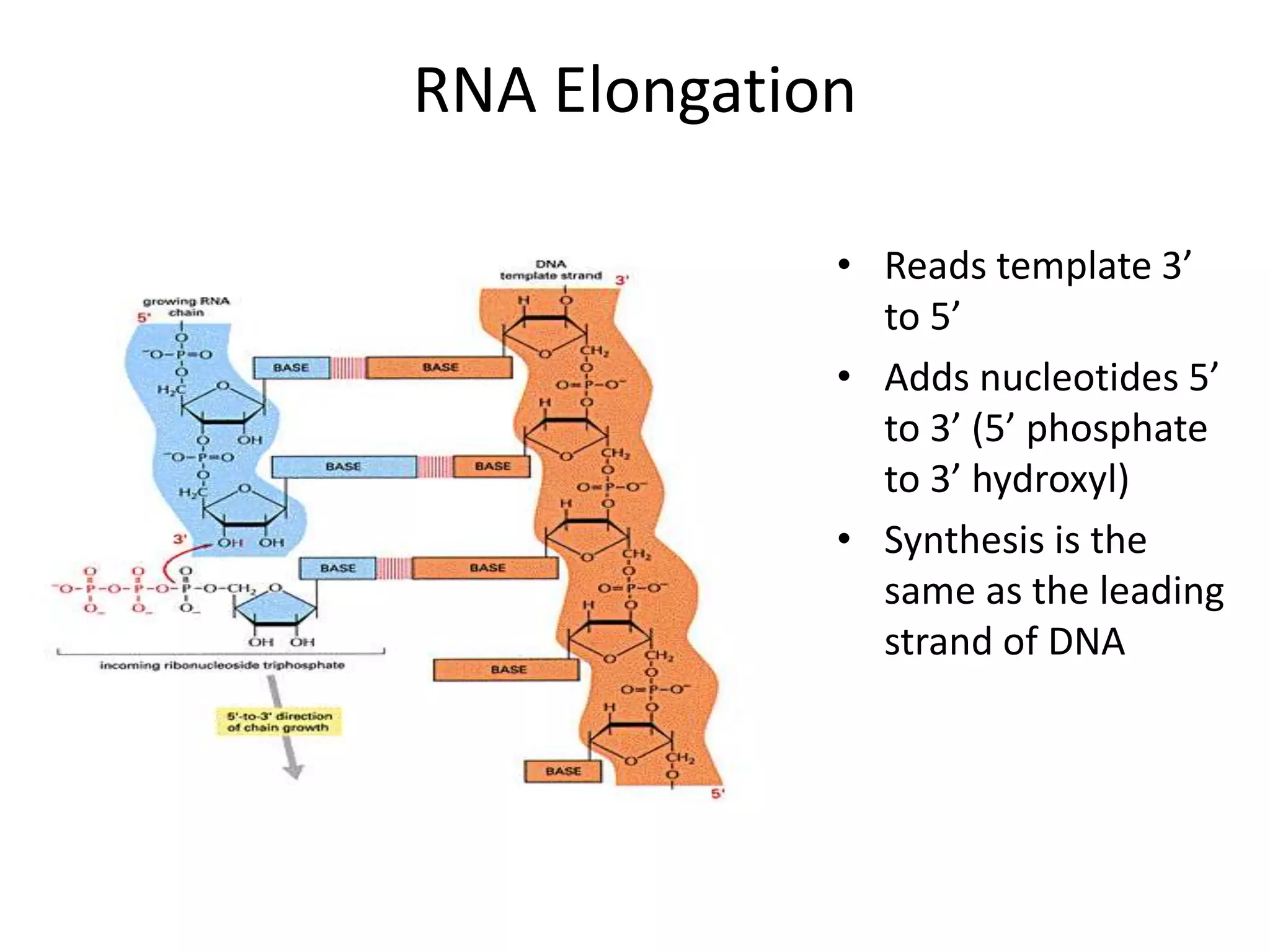
RNA Elongation
• Reads template 3’
to 5’
• Adds nucleotides 5’
to 3’ (5’ phosphate
to 3’ hydroxyl)
• Synthesis is the
same as the leading
strand of DNA
RNA Polymerase
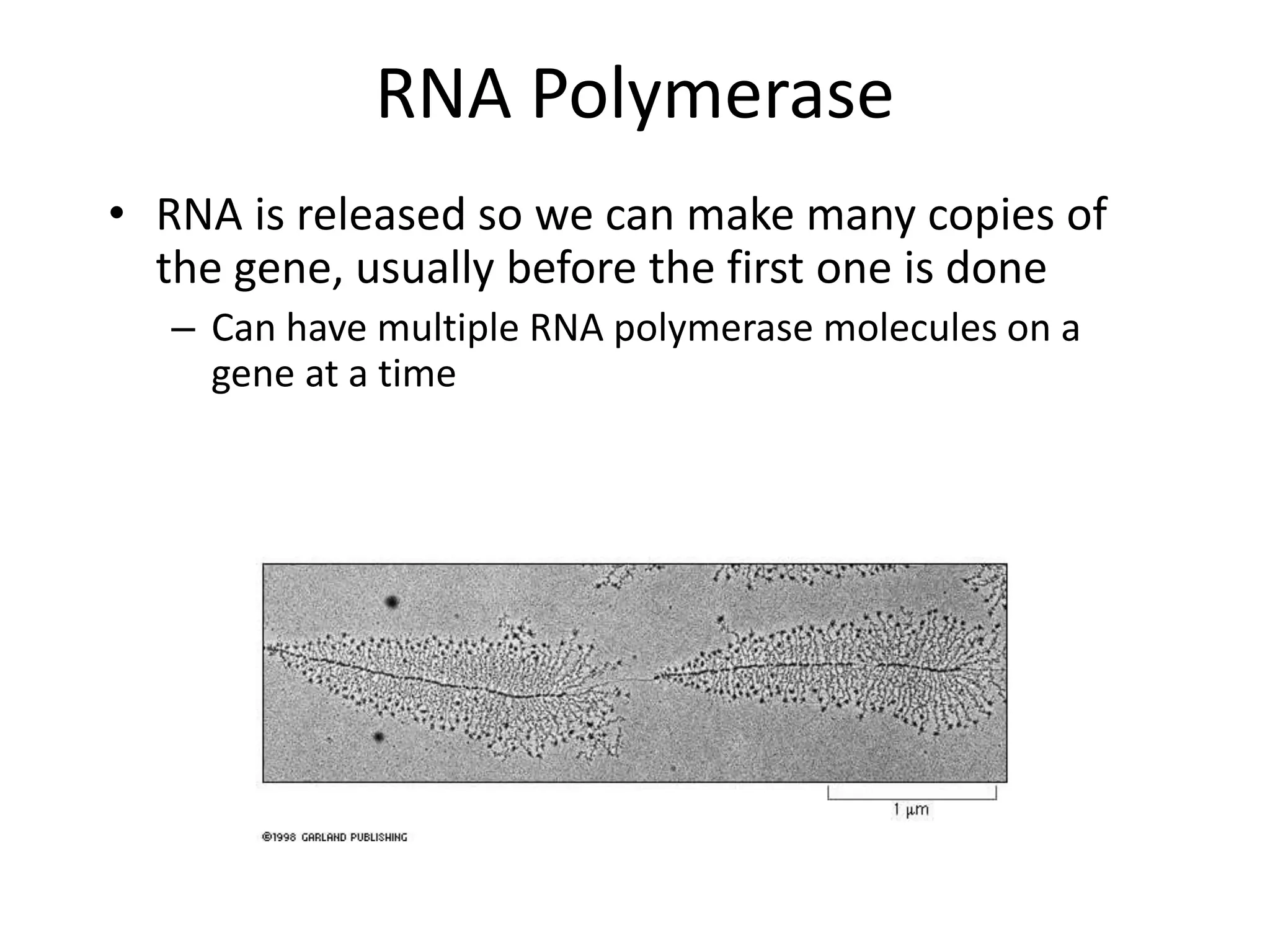
• RNA is released so we can make many copies of
the gene, usually before the first one is done
– Can have multiple RNA polymerase molecules on a
gene at a time
Differences in
DNA and RNA Polymerases
• RNA polymerase adds ribonucleotides not
deoxynucleotides
• RNA polymerase does not have the ability to
proofread what they transcribe
• RNA polymerase can work without a primer
• RNA will have an error 1 in every 10,000
nucleotides (DNA is 1 in 10,000,000 nucleotides)
Types of RNA
• messenger RNA (mRNA) – codes for
proteins
• ribosomal RNA (rRNA) – forms the core of
the ribosomes, machinery for making
proteins
• transfer RNA (tRNA) – carries the amino
acid for the growing protein chain
DNA Transcription in Bacteria
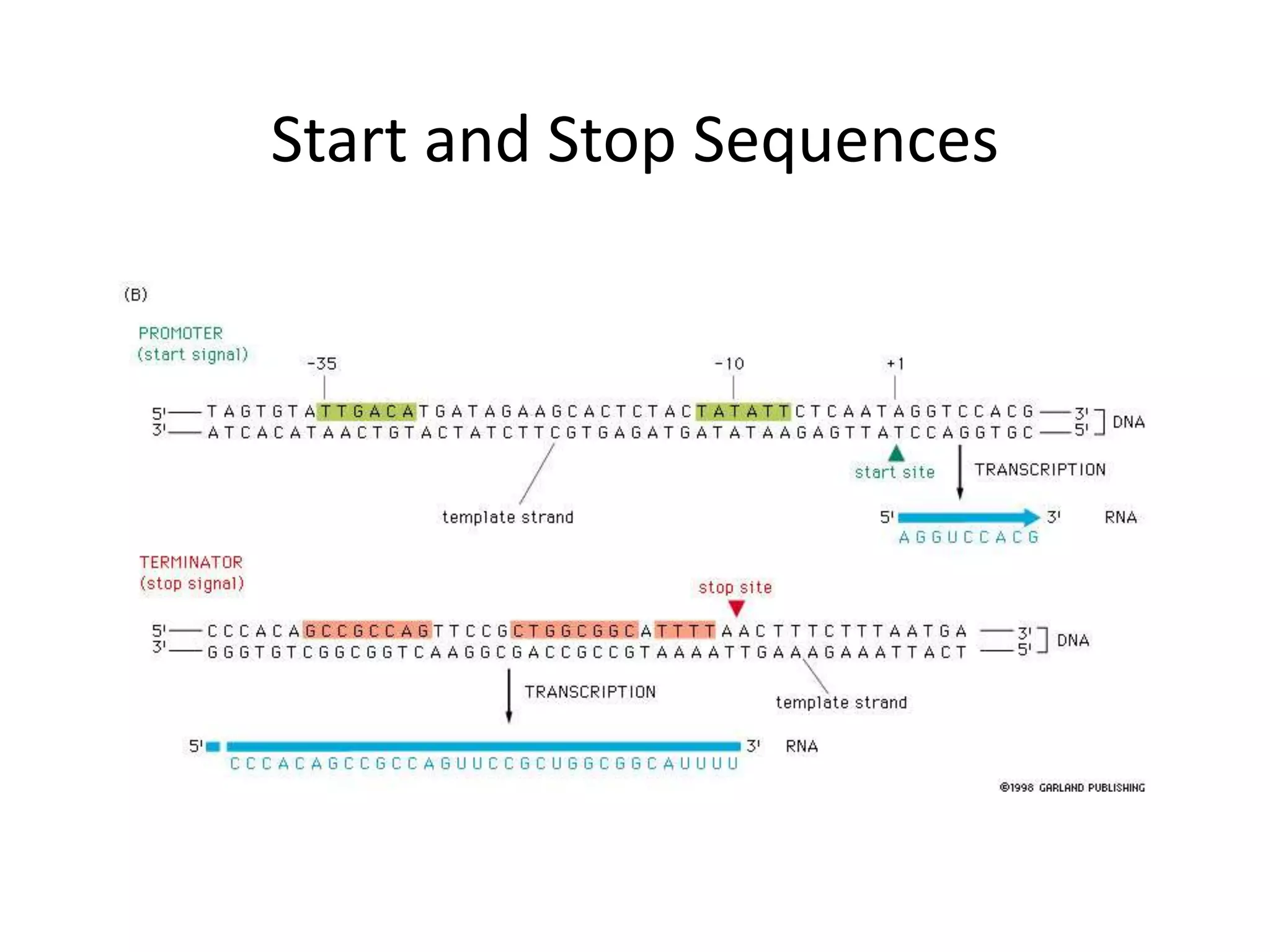
• RNA polymerase must know where the start
of a gene is in order to copy it
• RNA polymerase has weak interactions with
the DNA unless it encounters a promoter
– A promoter is a specific sequence of nucleotides
that indicate the start site for RNA synthesis
RNA Synthesis
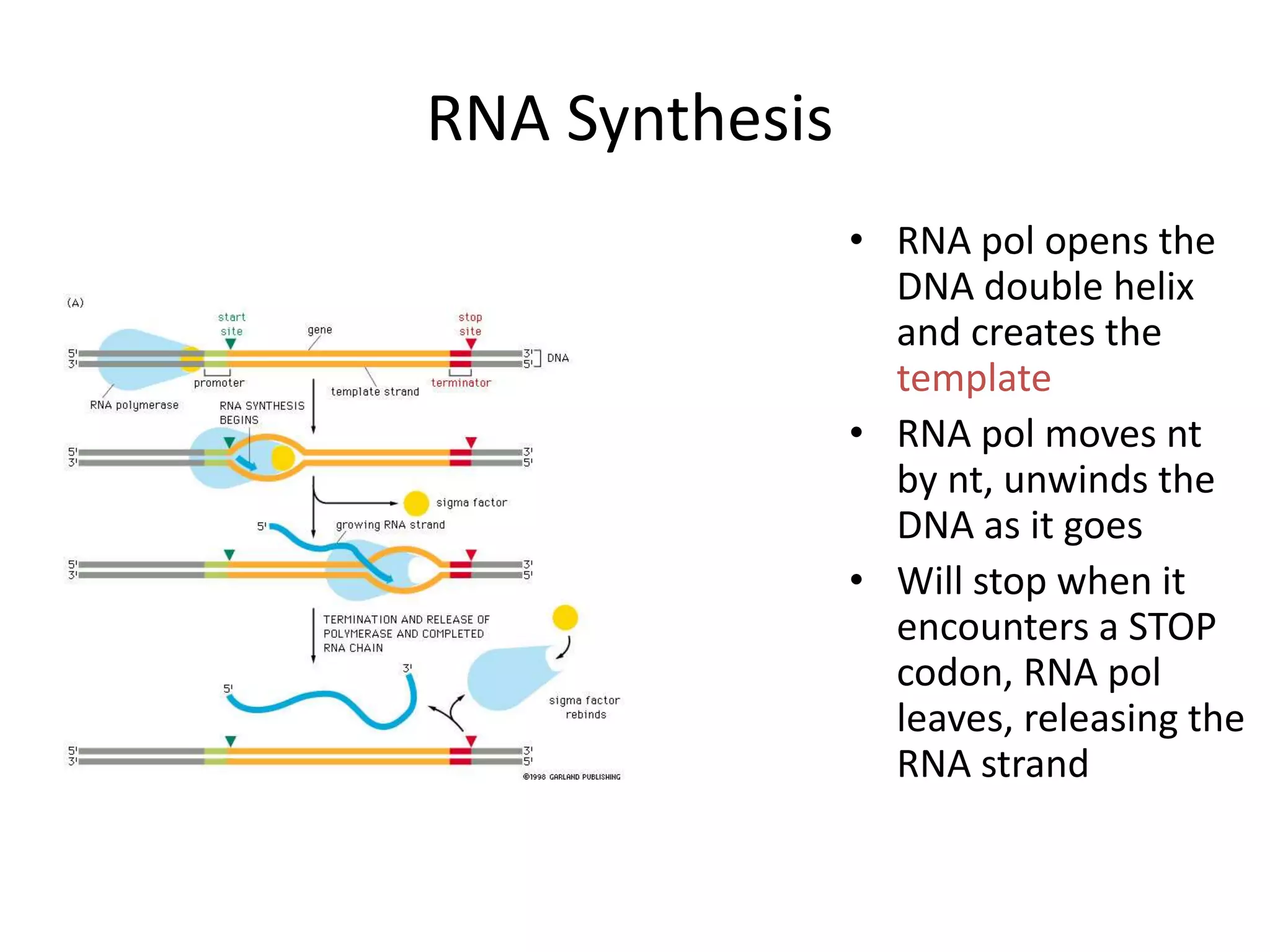
• RNA pol opens the
DNA double helix
and creates the
template
• RNA pol moves nt
by nt, unwinds the
DNA as it goes
• Will stop when it
encounters a STOP
codon, RNA pol
leaves, releasing the
RNA strand
Sigma () Factor
• Part of the bacterial RNA polymerase that
helps it recognize the promoter
• Released after about 10 nucleotides of RNA
are linked together
• Rejoins with a released RNA polymerase to
look for a new promoter
Start and Stop Sequences
DNA Transcribed
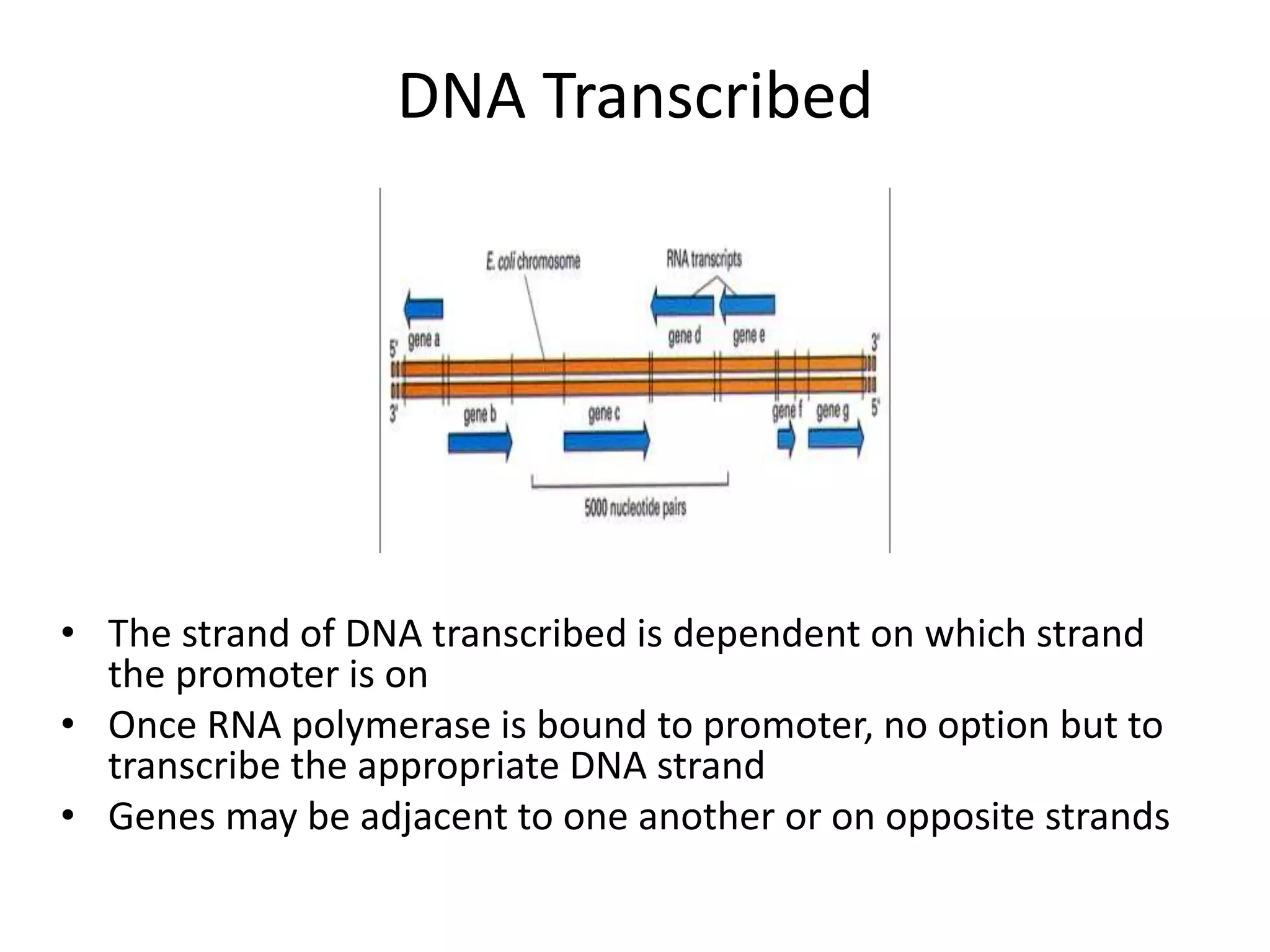
• The strand of DNA transcribed is dependent on which strand
the promoter is on
• Once RNA polymerase is bound to promoter, no option but to
transcribe the appropriate DNA strand
• Genes may be adjacent to one another or on opposite strands
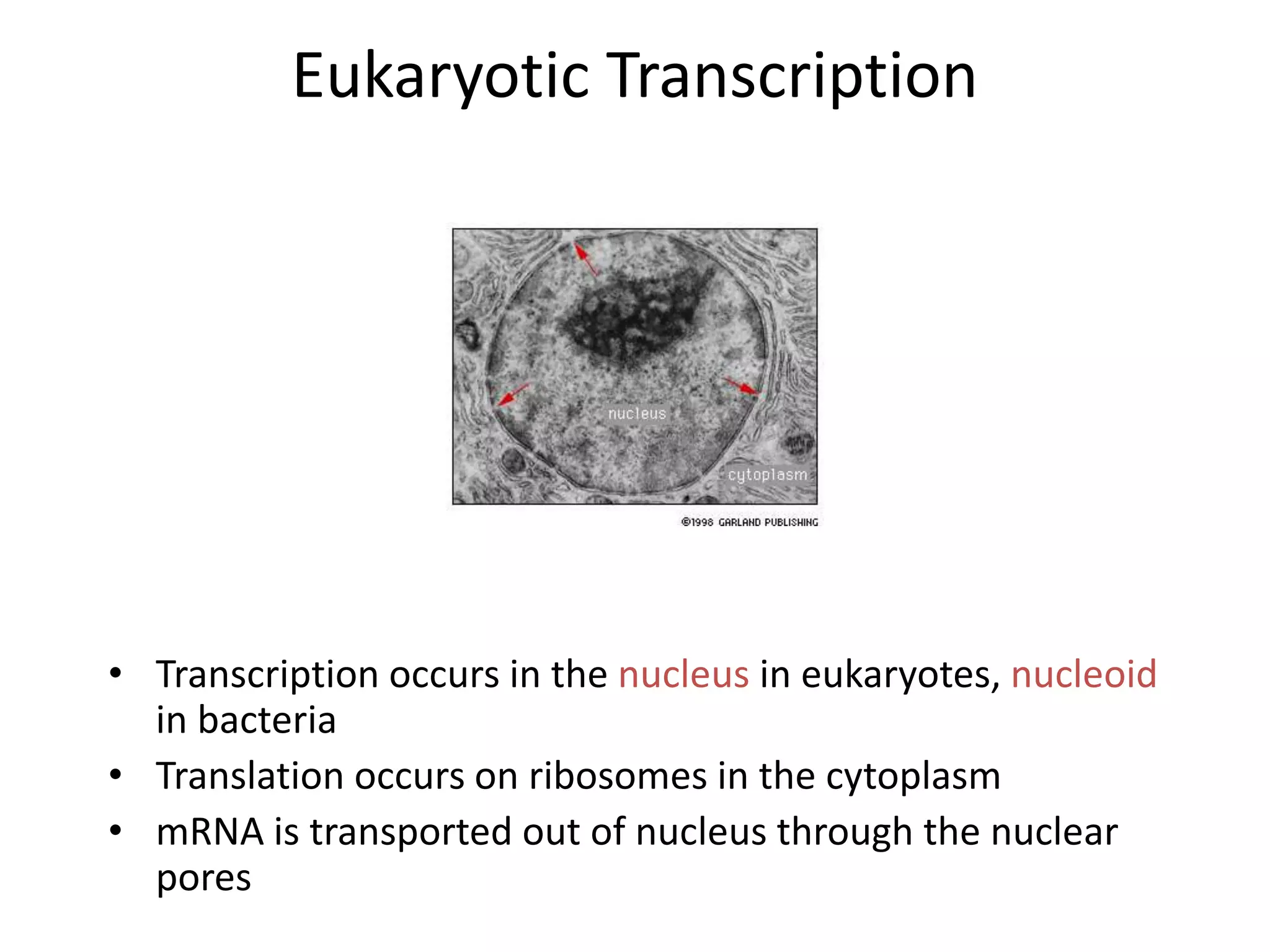
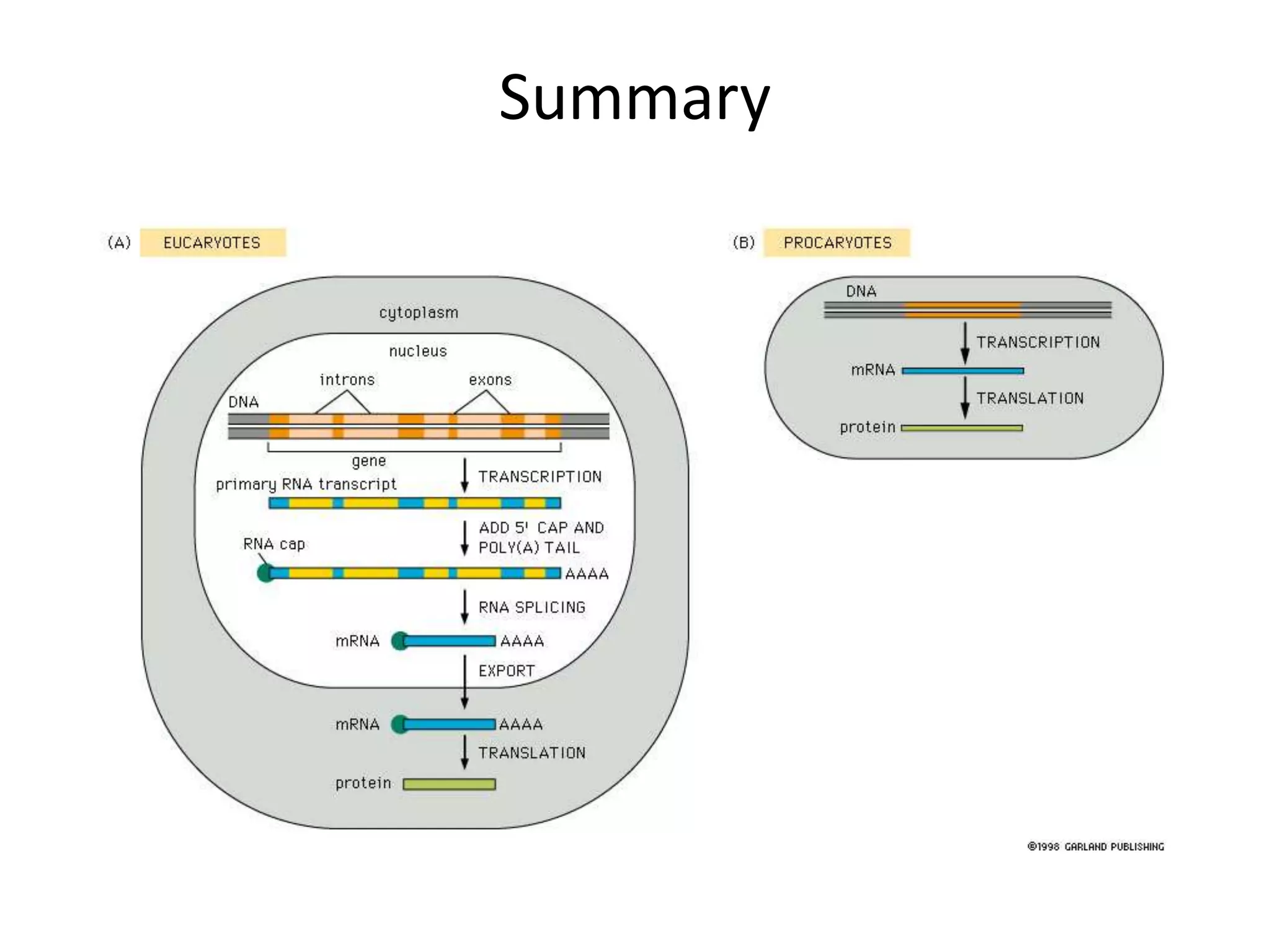
Eukaryotic Transcription
• Transcription occurs in the nucleus in eukaryotes, nucleoid
in bacteria
• Translation occurs on ribosomes in the cytoplasm
• mRNA is transported out of nucleus through the nuclear
pores
RNA Processing
• Eukaryotic cells process the RNA in the
nucleus before it is moved to the cytoplasm
for protein synthesis
• The RNA that is the direct copy of the DNA is
the primary transcript
• 2 methods used to process primary transcripts
to increase the stability of mRNA being
exported to the cytoplasm
– RNA capping
– Polyadenylation
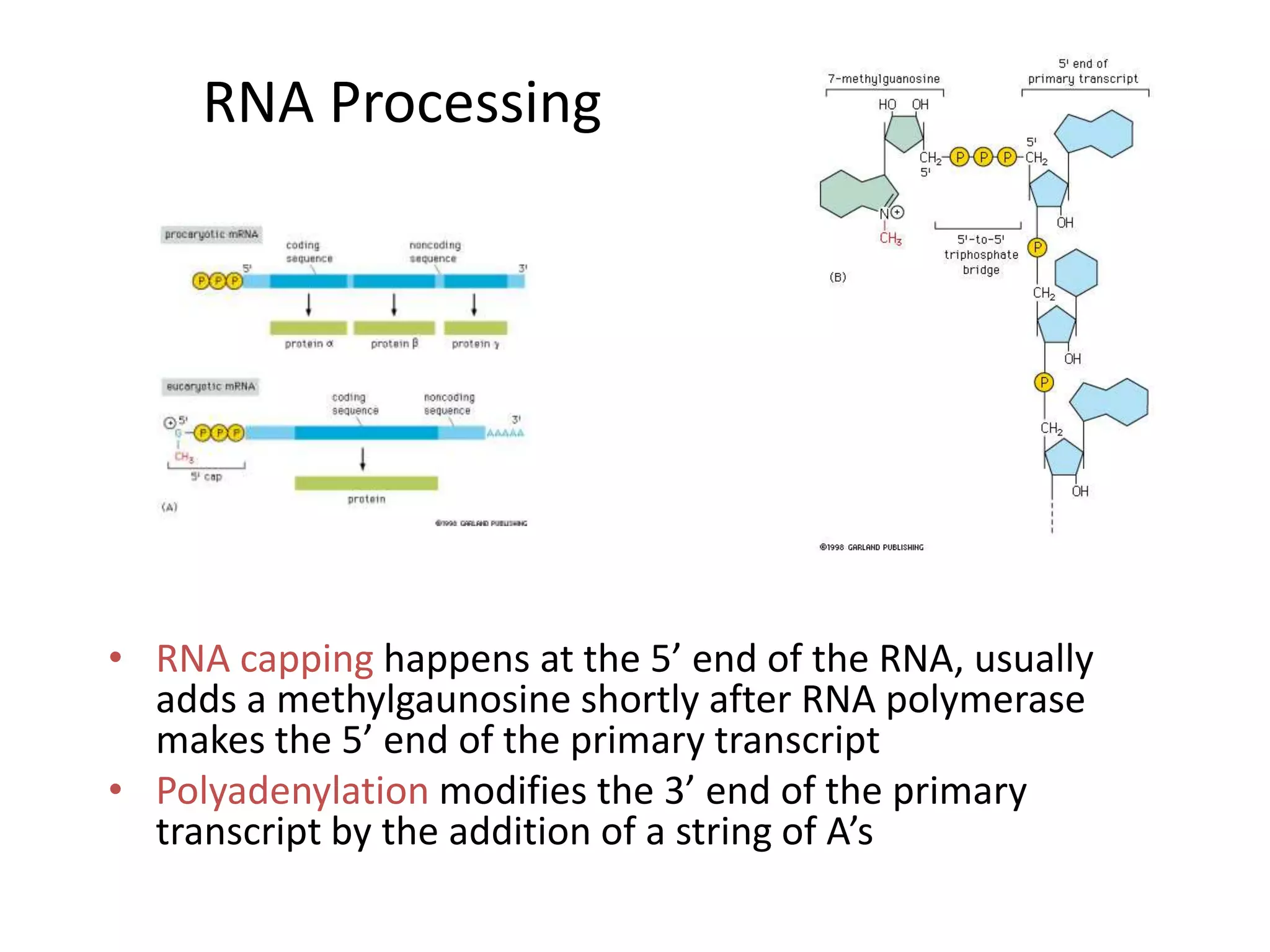
RNA Processing
• RNA capping happens at the 5’ end of the RNA, usually
adds a methylgaunosine shortly after RNA polymerase
makes the 5’ end of the primary transcript
• Polyadenylation modifies the 3’ end of the primary
transcript by the addition of a string of A’s
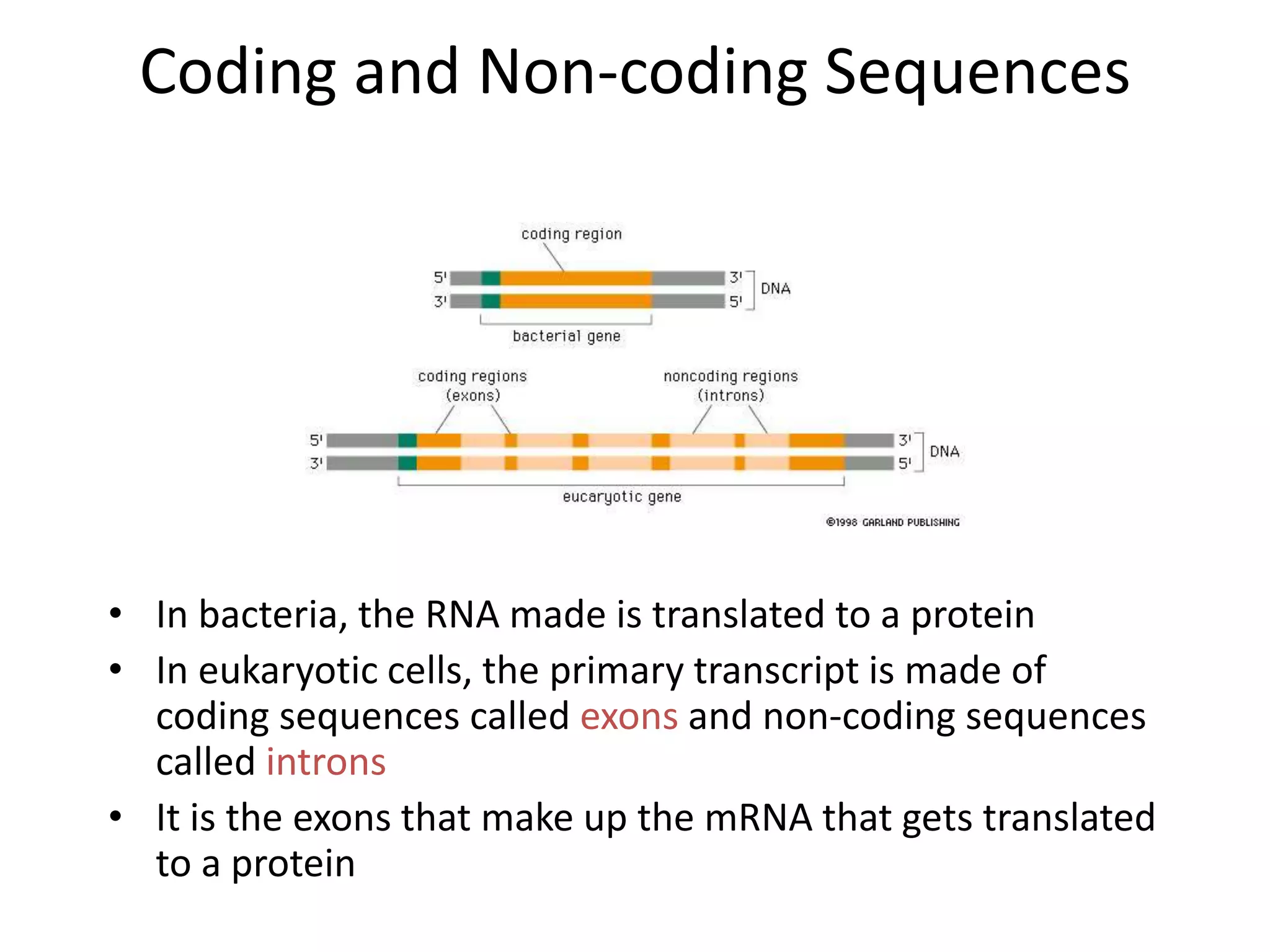
Coding and Non-coding Sequences
• In bacteria, the RNA made is translated to a protein
• In eukaryotic cells, the primary transcript is made of
coding sequences called exons and non-coding sequences
called introns
• It is the exons that make up the mRNA that gets translated
to a protein
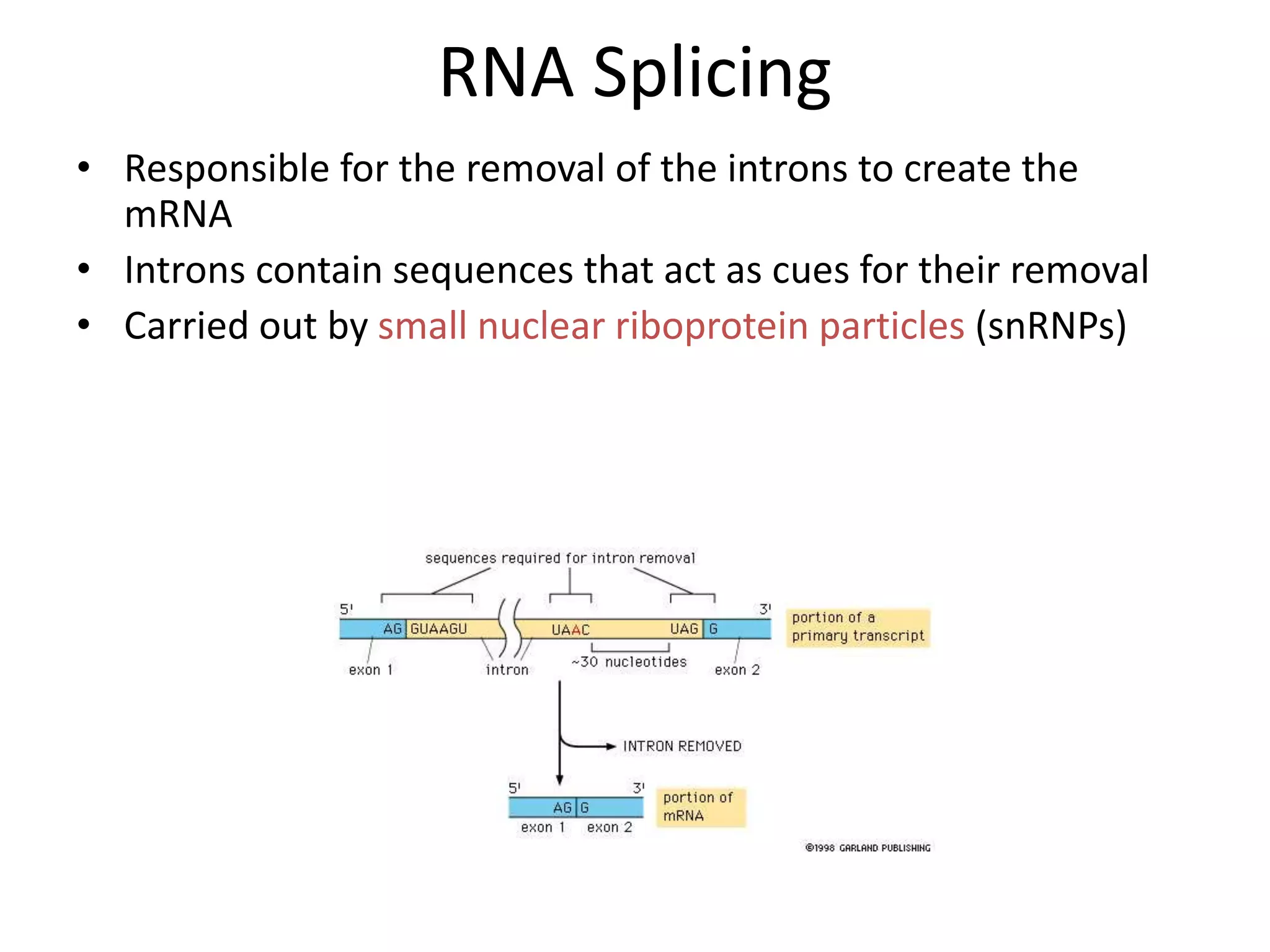
RNA Splicing
• Responsible for the removal of the introns to create the
mRNA
• Introns contain sequences that act as cues for their removal
• Carried out by small nuclear riboprotein particles (snRNPs)
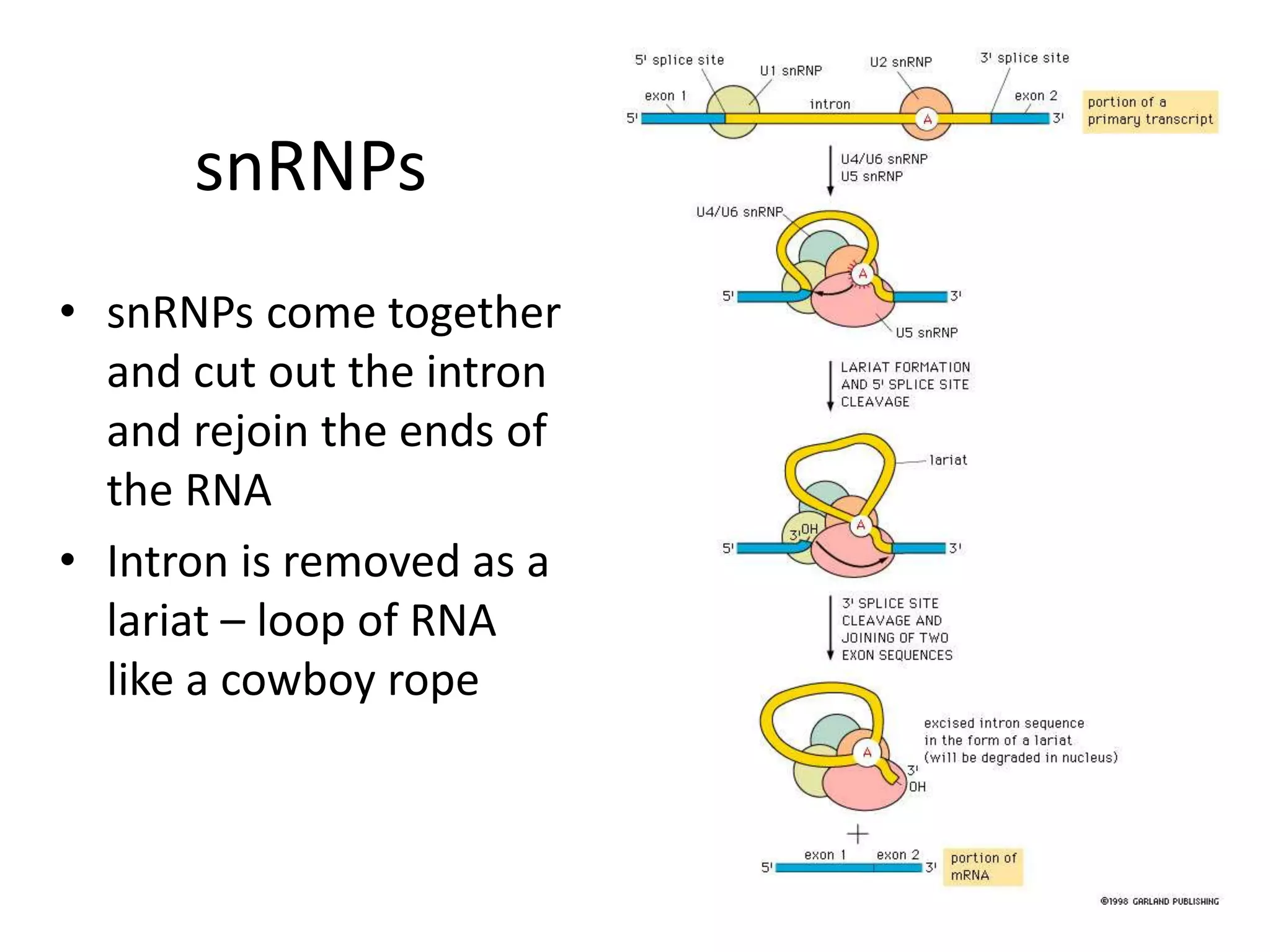
snRNPs
• snRNPs come together
and cut out the intron
and rejoin the ends of
the RNA
• Intron is removed as a
lariat – loop of RNA
like a cowboy rope
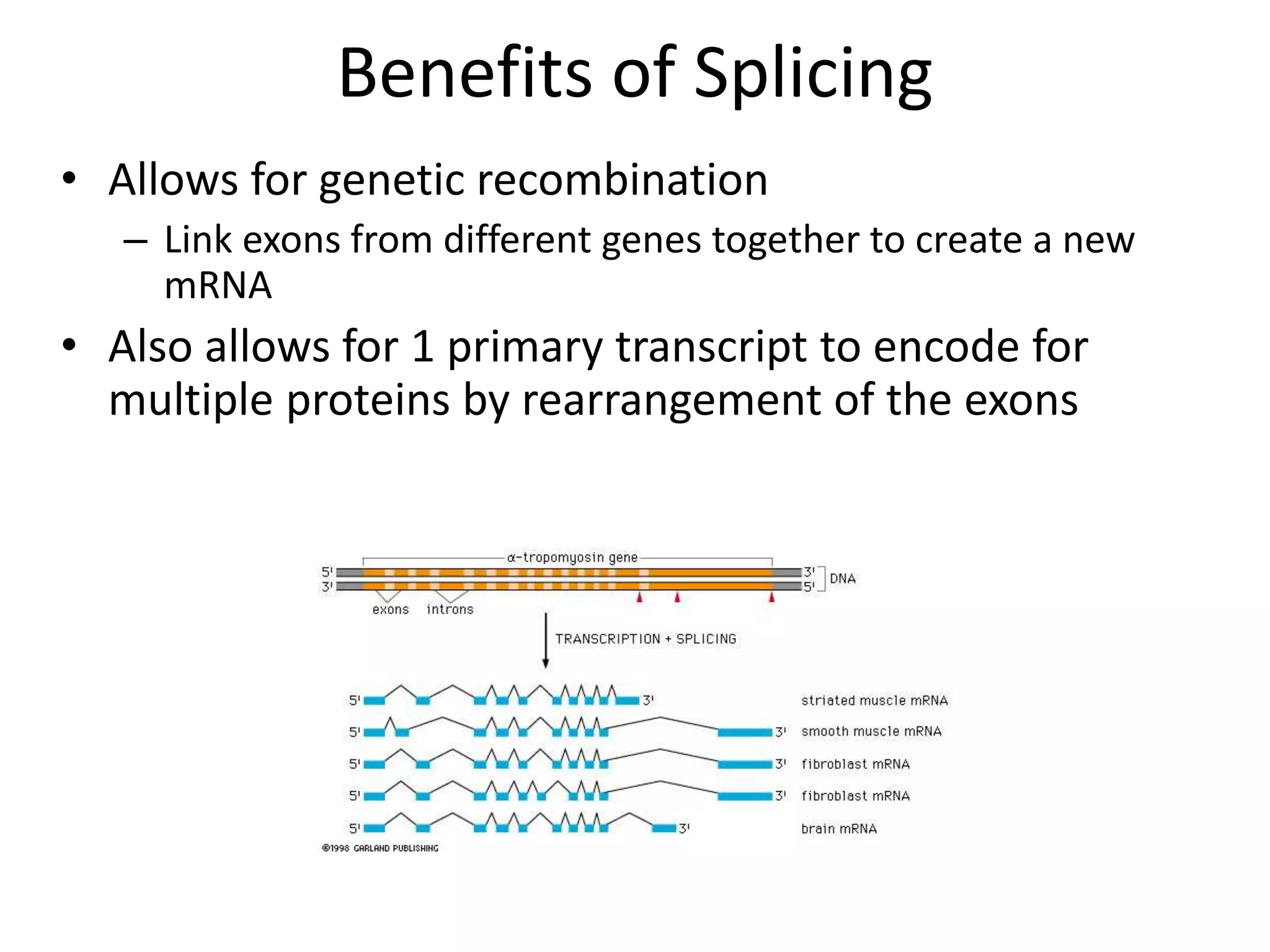
Benefits of Splicing
• Allows for genetic recombination
– Link exons from different genes together to create a new
mRNA
• Also allows for 1 primary transcript to encode for
multiple proteins by rearrangement of the exons
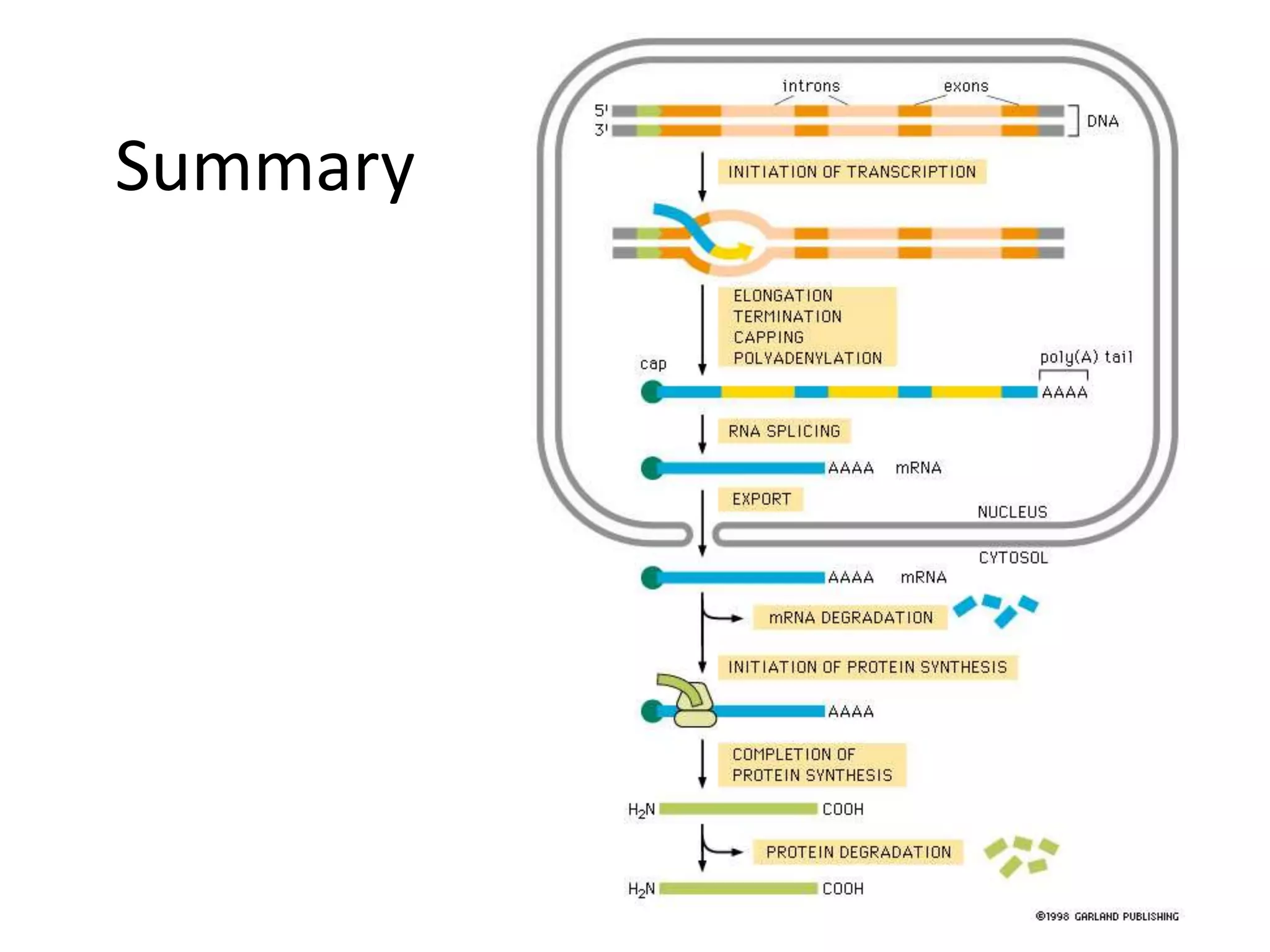
Summary
RNA to Protein
• Translation is the process of turning
mRNA into protein
• Translate from one “language” (mRNA
nucleotides) to a second “language”
(amino acids)
• Genetic code – nucleotide sequence
that is translated to amino acids of
the protein
Degenerate DNA Code
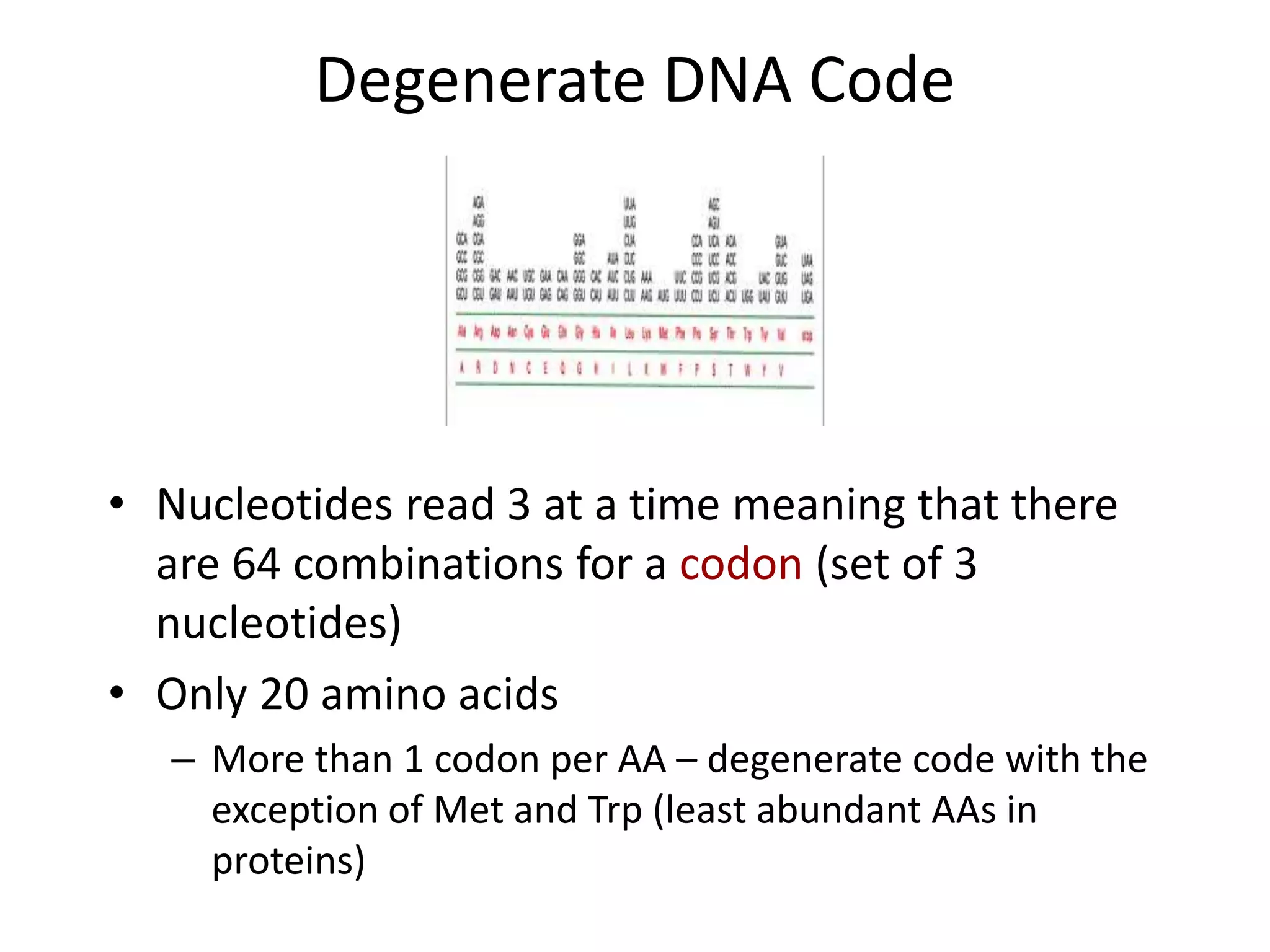
• Nucleotides read 3 at a time meaning that there
are 64 combinations for a codon (set of 3
nucleotides)
• Only 20 amino acids
– More than 1 codon per AA – degenerate code with the
exception of Met and Trp (least abundant AAs in
proteins)
Reading Frames
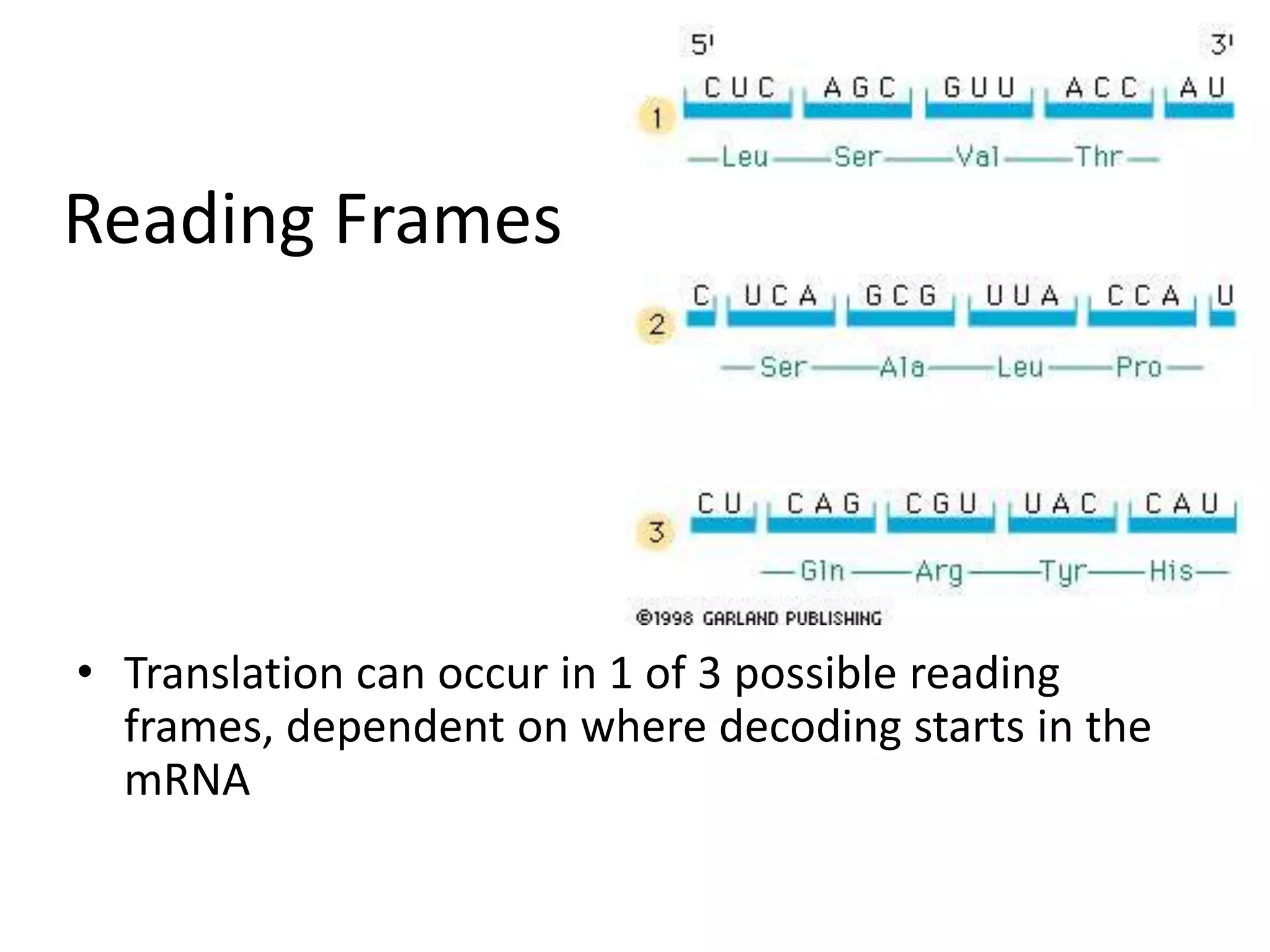
• Translation can occur in 1 of 3 possible reading
frames, dependent on where decoding starts in the
mRNA
Transfer RNA
Molecules
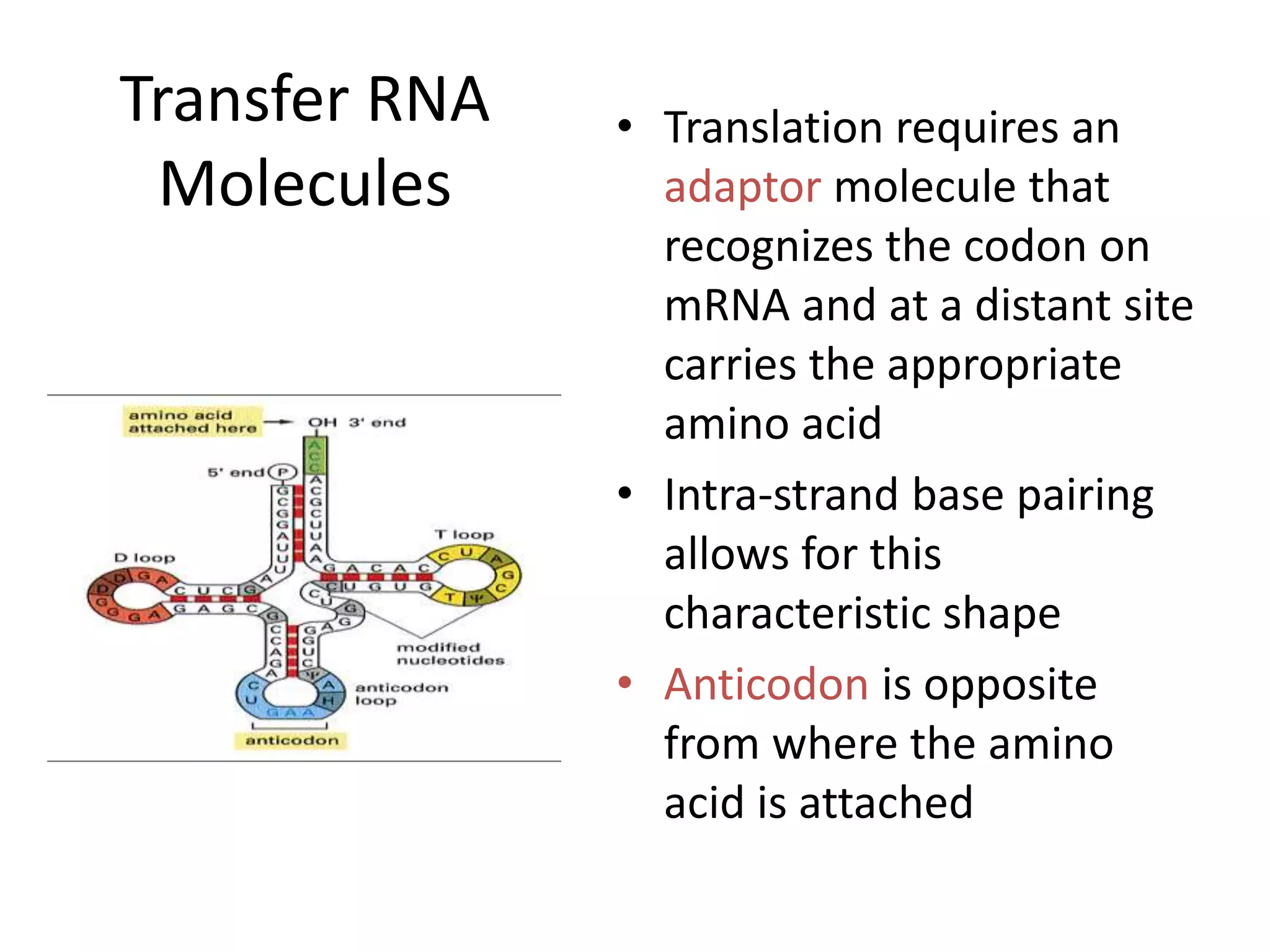
• Translation requires an
adaptor molecule that
recognizes the codon on
mRNA and at a distant site
carries the appropriate
amino acid
• Intra-strand base pairing
allows for this
characteristic shape
• Anticodon is opposite
from where the amino
acid is attached
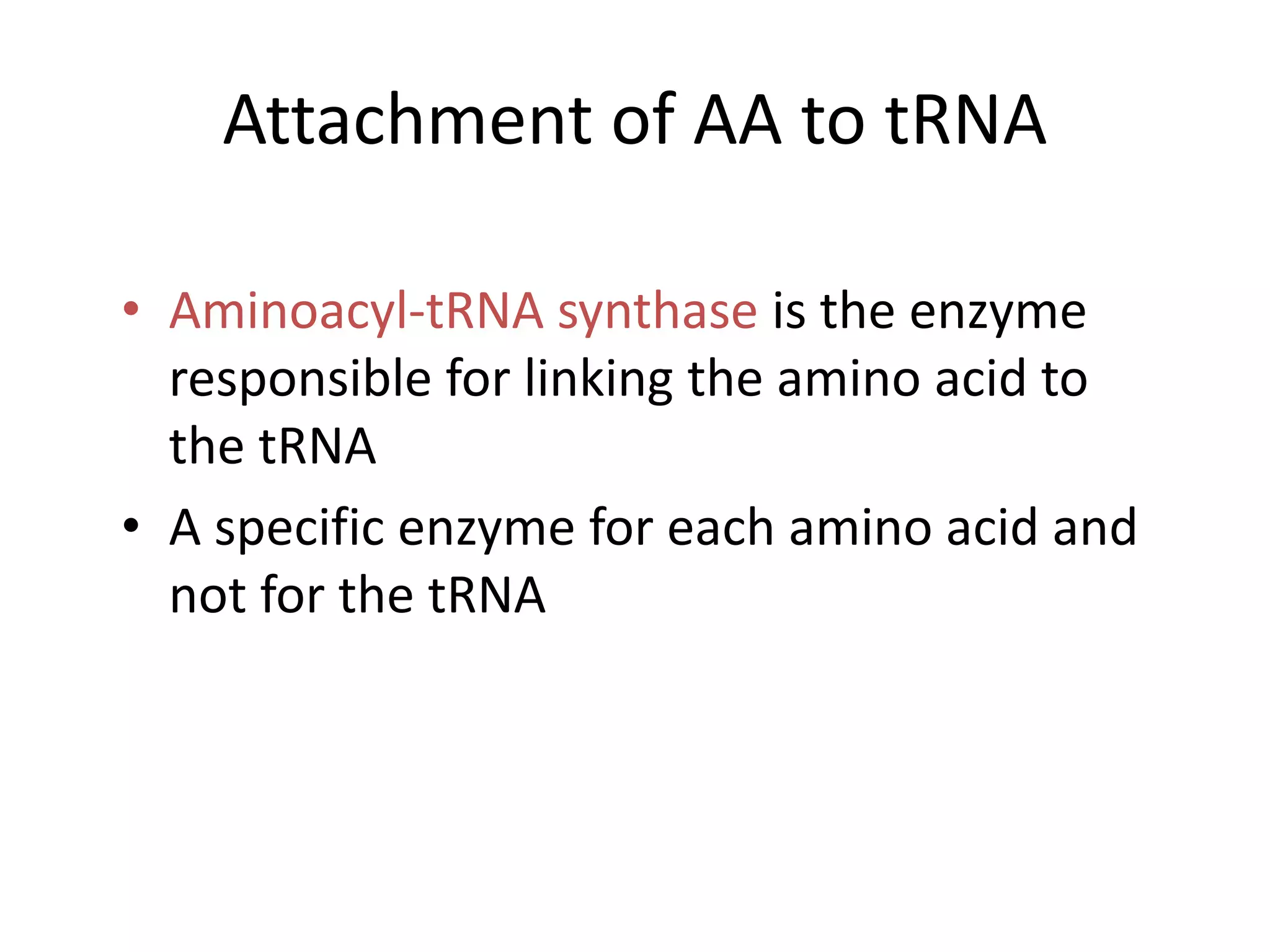
Wobble Base Pairing
• Due to degenerate code for amino acids some tRNA
can recognize several codons because the 3rd spot
can wobble or be mismatched
• Allows for there only being 31 tRNA for the 61
codons
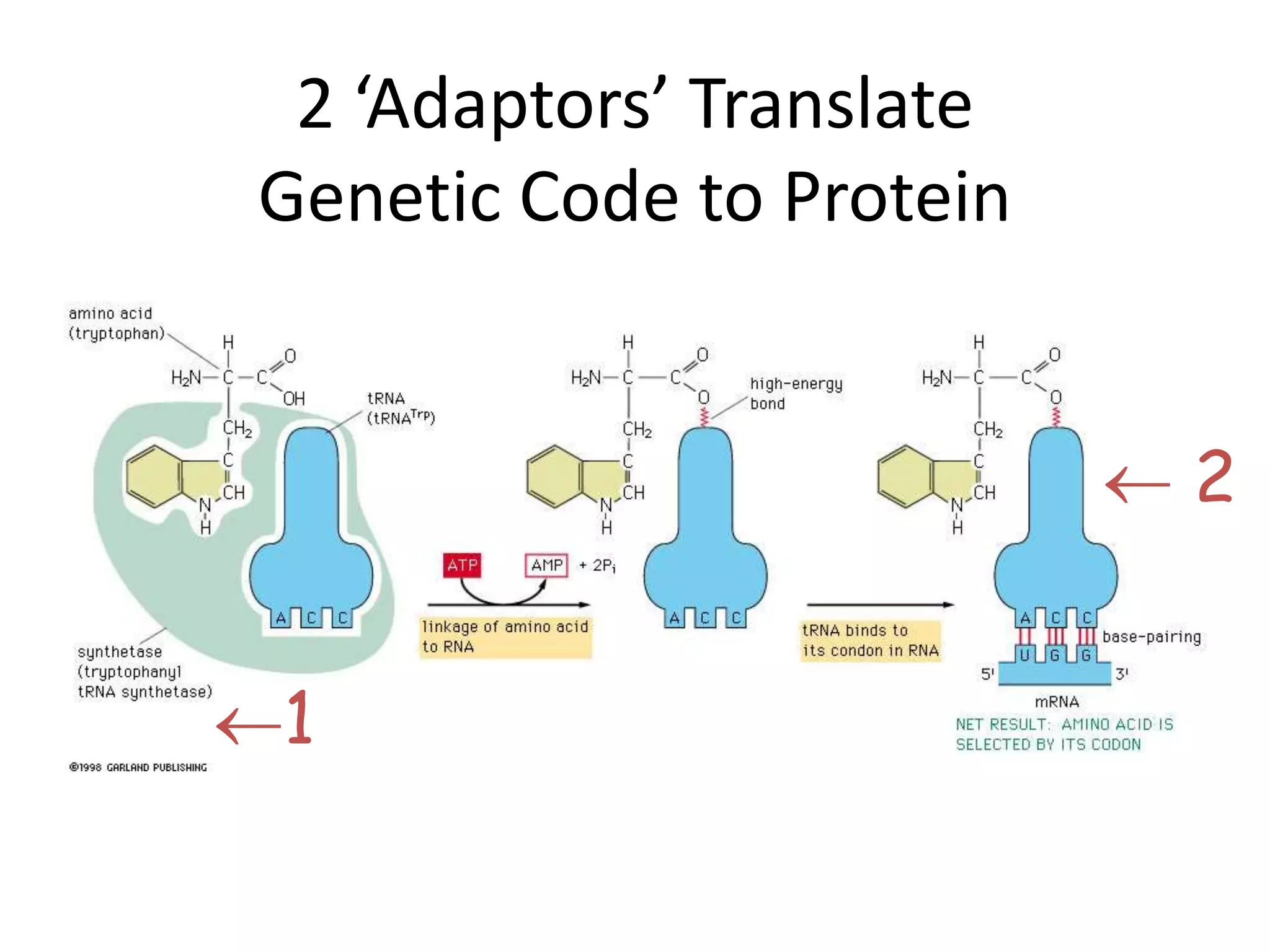
Attachment of AA to tRNA
• Aminoacyl-tRNA synthase is the enzyme
responsible for linking the amino acid to
the tRNA
• A specific enzyme for each amino acid and
not for the tRNA
2 ‘Adaptors’ Translate
Genetic Code to Protein
1
 2
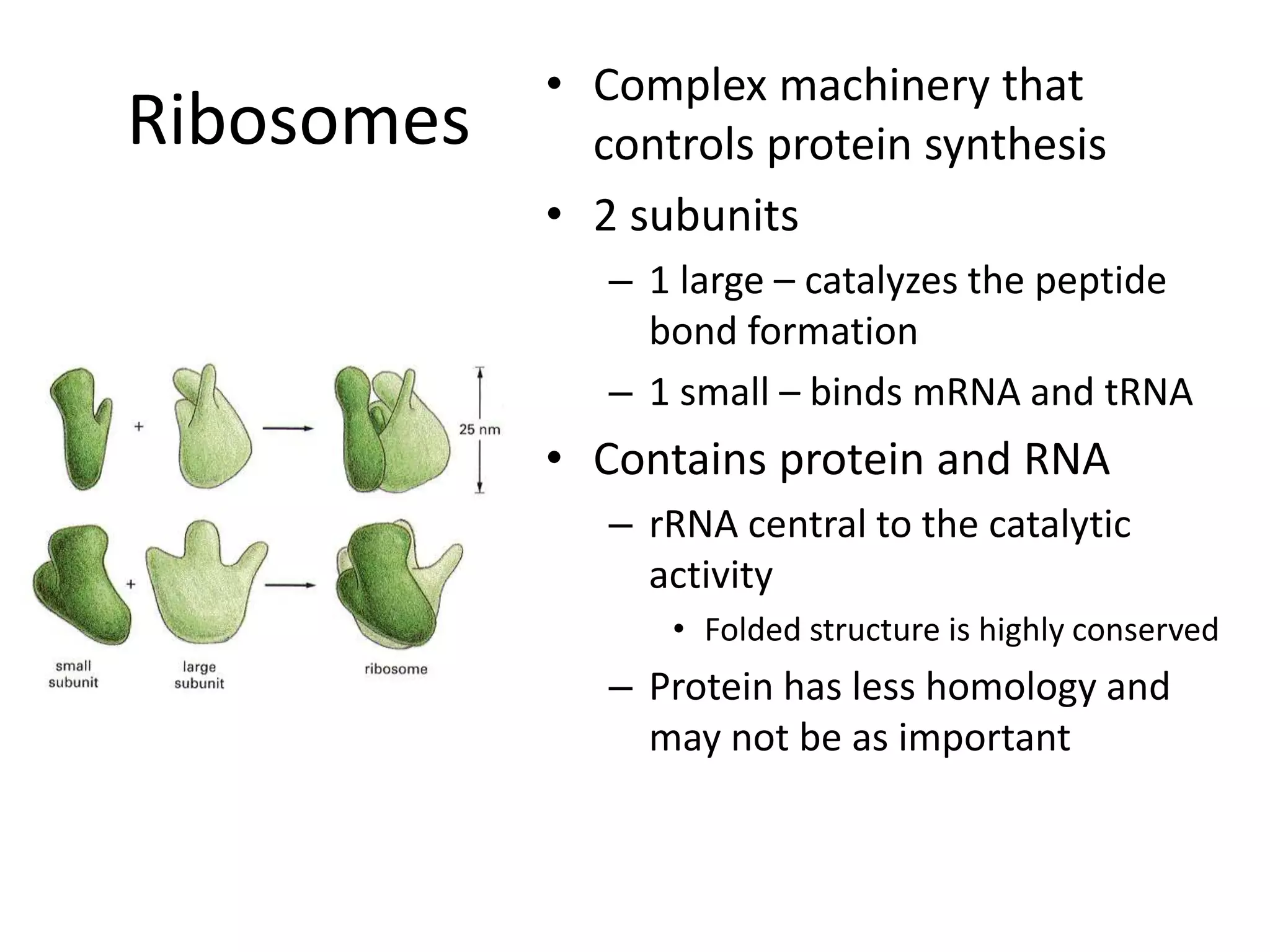
Ribosomes
• Complex machinery that
controls protein synthesis
• 2 subunits
– 1 large – catalyzes the peptide
bond formation
– 1 small – binds mRNA and tRNA
• Contains protein and RNA
– rRNA central to the catalytic
activity
• Folded structure is highly conserved
– Protein has less homology and
may not be as important
Ribosome Structures
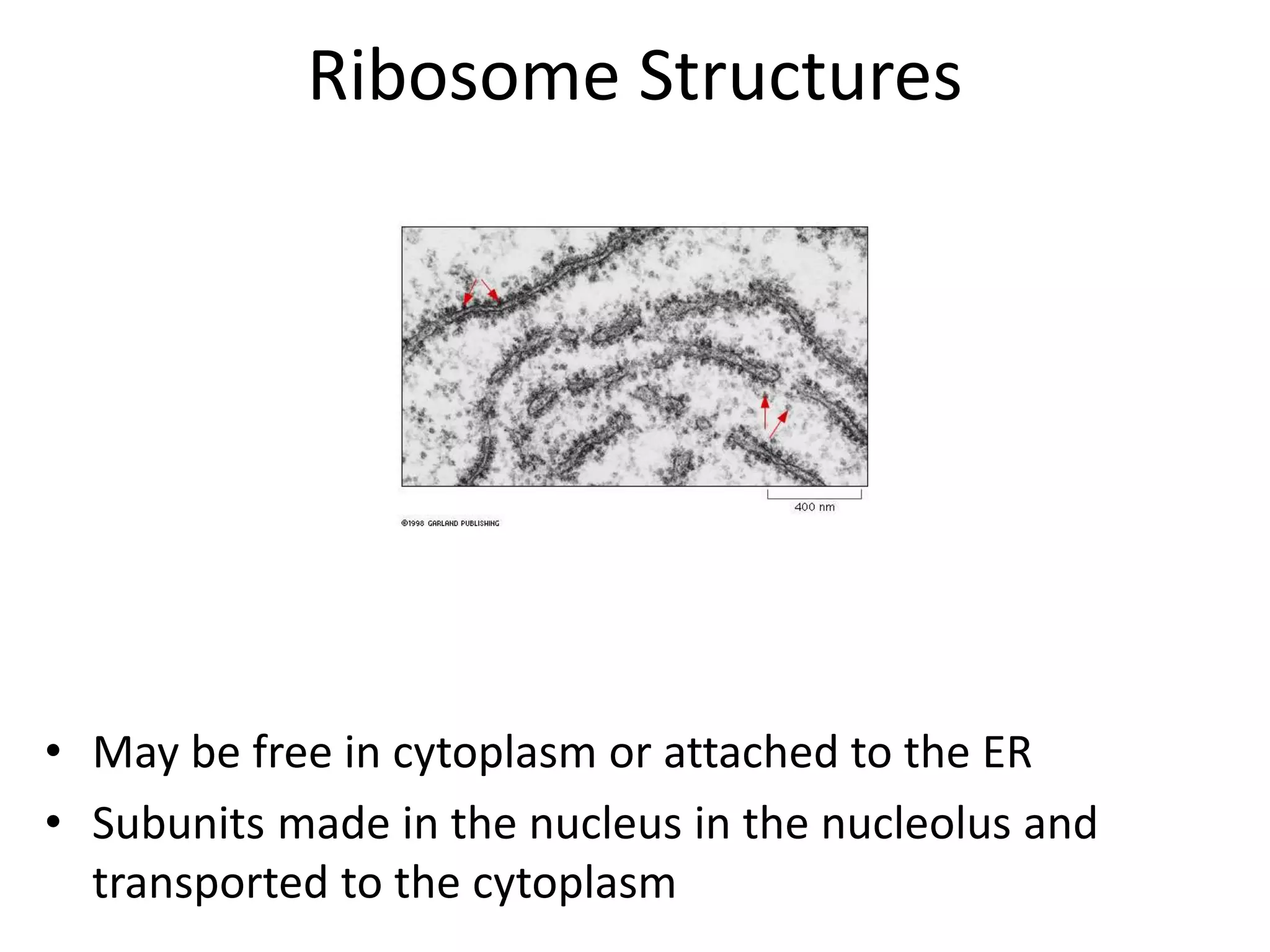
• May be free in cytoplasm or attached to the ER
• Subunits made in the nucleus in the nucleolus and
transported to the cytoplasm
Ribosomal Subunits
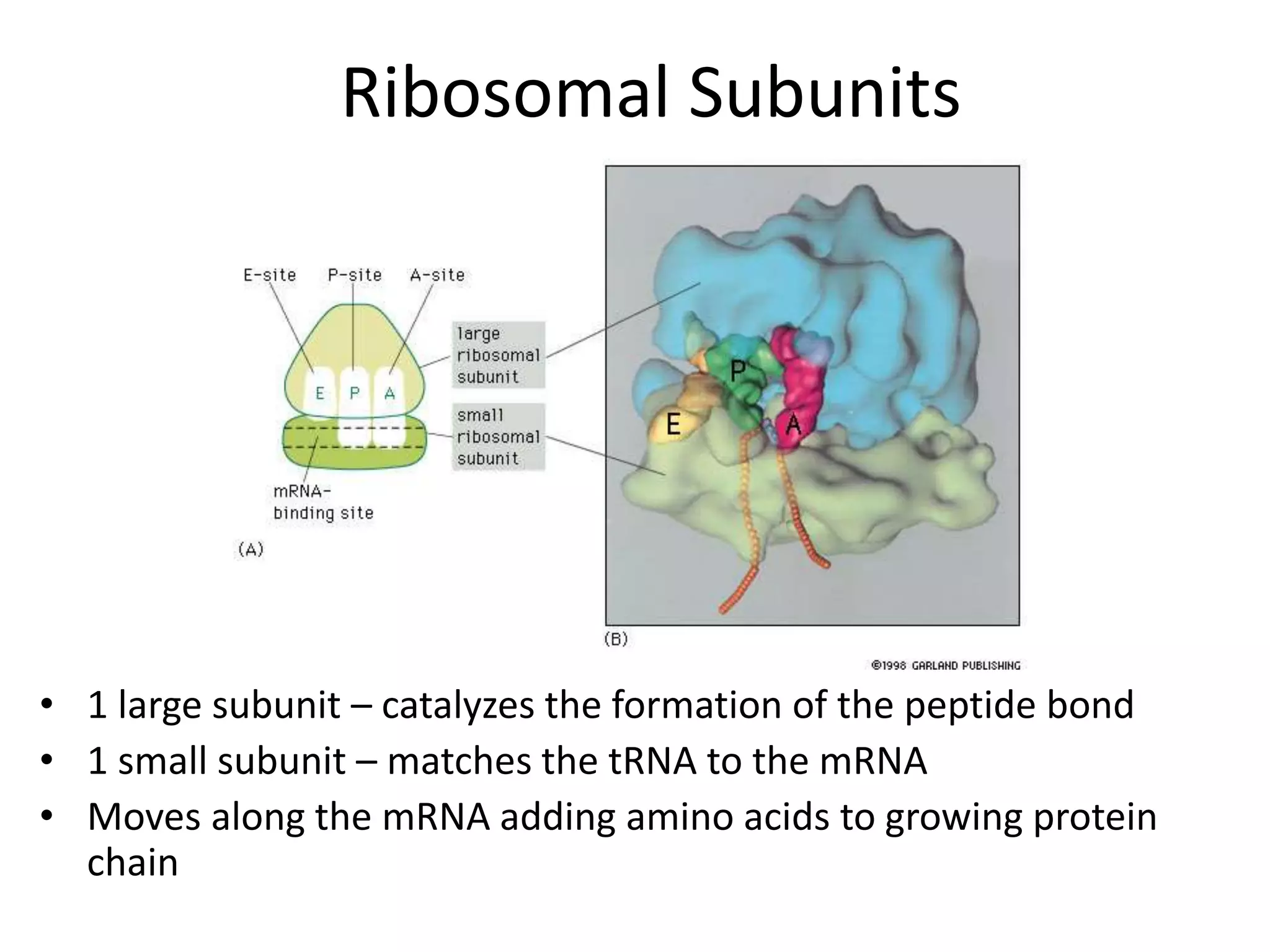
• 1 large subunit – catalyzes the formation of the peptide bond
• 1 small subunit – matches the tRNA to the mRNA
• Moves along the mRNA adding amino acids to growing protein
chain
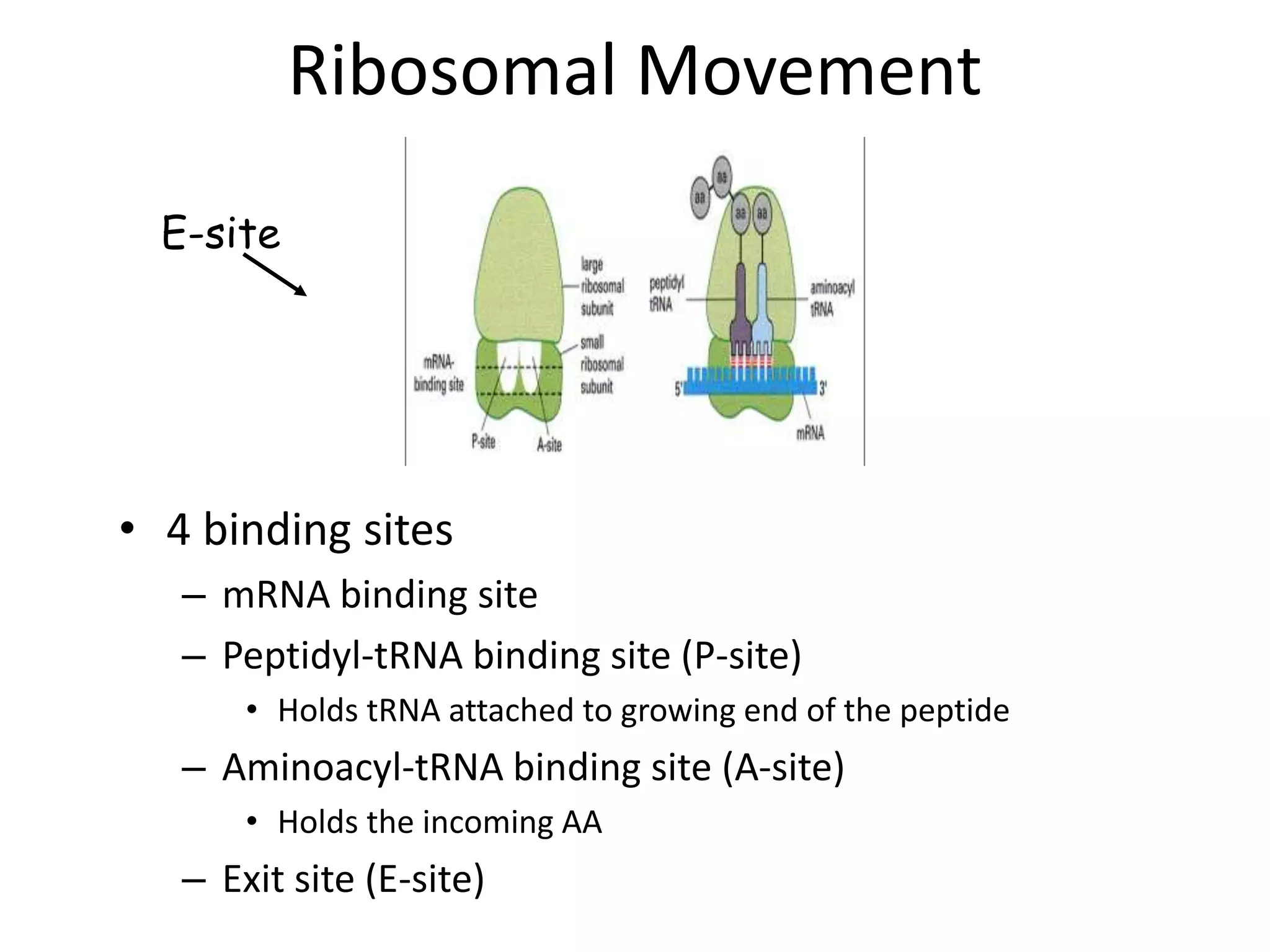
Ribosomal Movement
• 4 binding sites
– mRNA binding site
– Peptidyl-tRNA binding site (P-site)
• Holds tRNA attached to growing end of the peptide
– Aminoacyl-tRNA binding site (A-site)
• Holds the incoming AA
– Exit site (E-site)
E-site
3 Step Elongation Phase
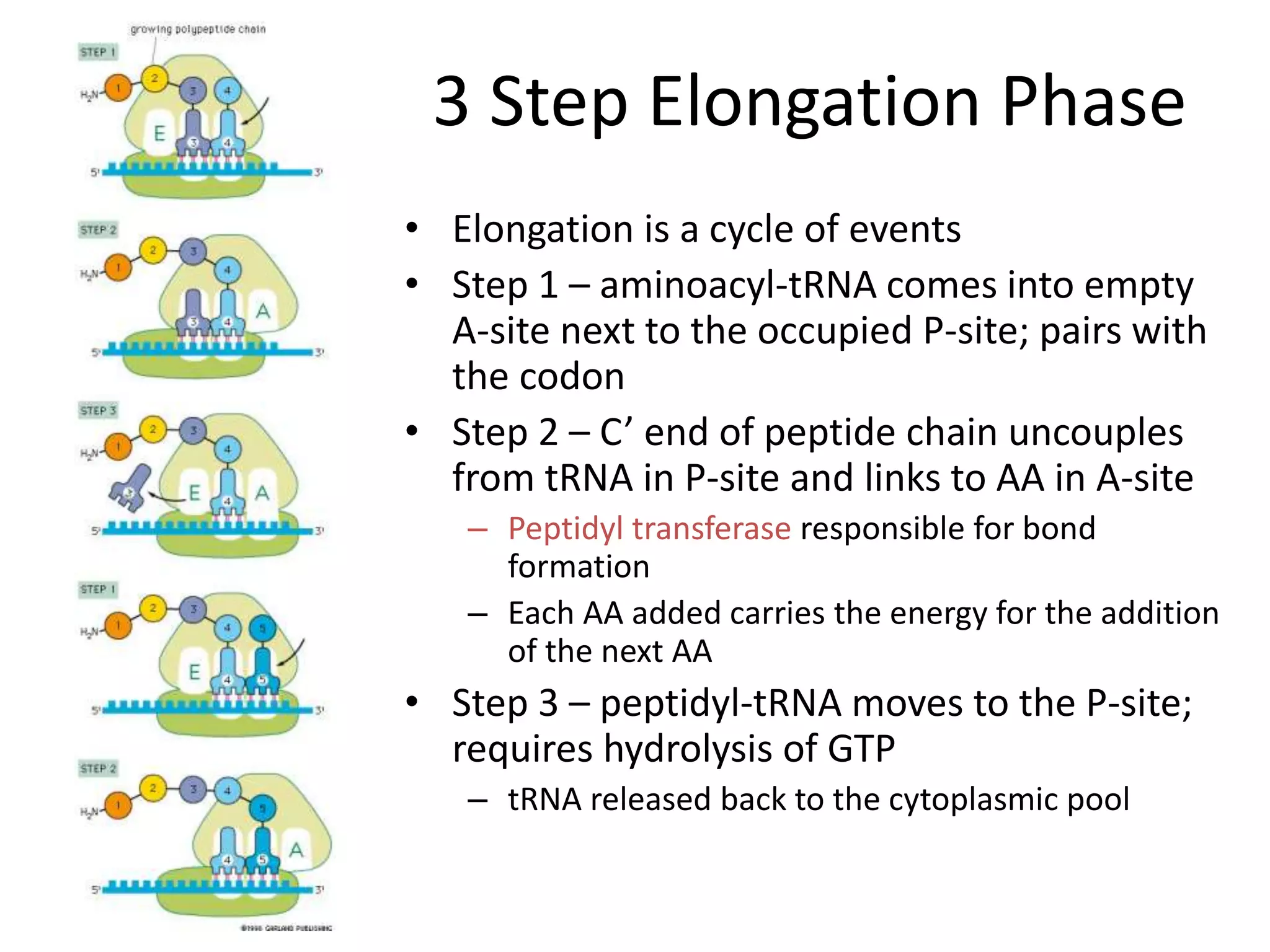
• Elongation is a cycle of events
• Step 1 – aminoacyl-tRNA comes into empty
A-site next to the occupied P-site; pairs with
the codon
• Step 2 – C’ end of peptide chain uncouples
from tRNA in P-site and links to AA in A-site
– Peptidyl transferase responsible for bond
formation
– Each AA added carries the energy for the addition
of the next AA
• Step 3 – peptidyl-tRNA moves to the P-site;
requires hydrolysis of GTP
– tRNA released back to the cytoplasmic pool
Initiation Process
• Determines whether mRNA is synthesized
and sets the reading frame that is used to
make the protein
• Initiation process brings the ribosomal
subunits together at the site where the
peptide should begin
• Initiator tRNA brings in Met
– Initiator tRNA is different than the tRNA that
adds other Met
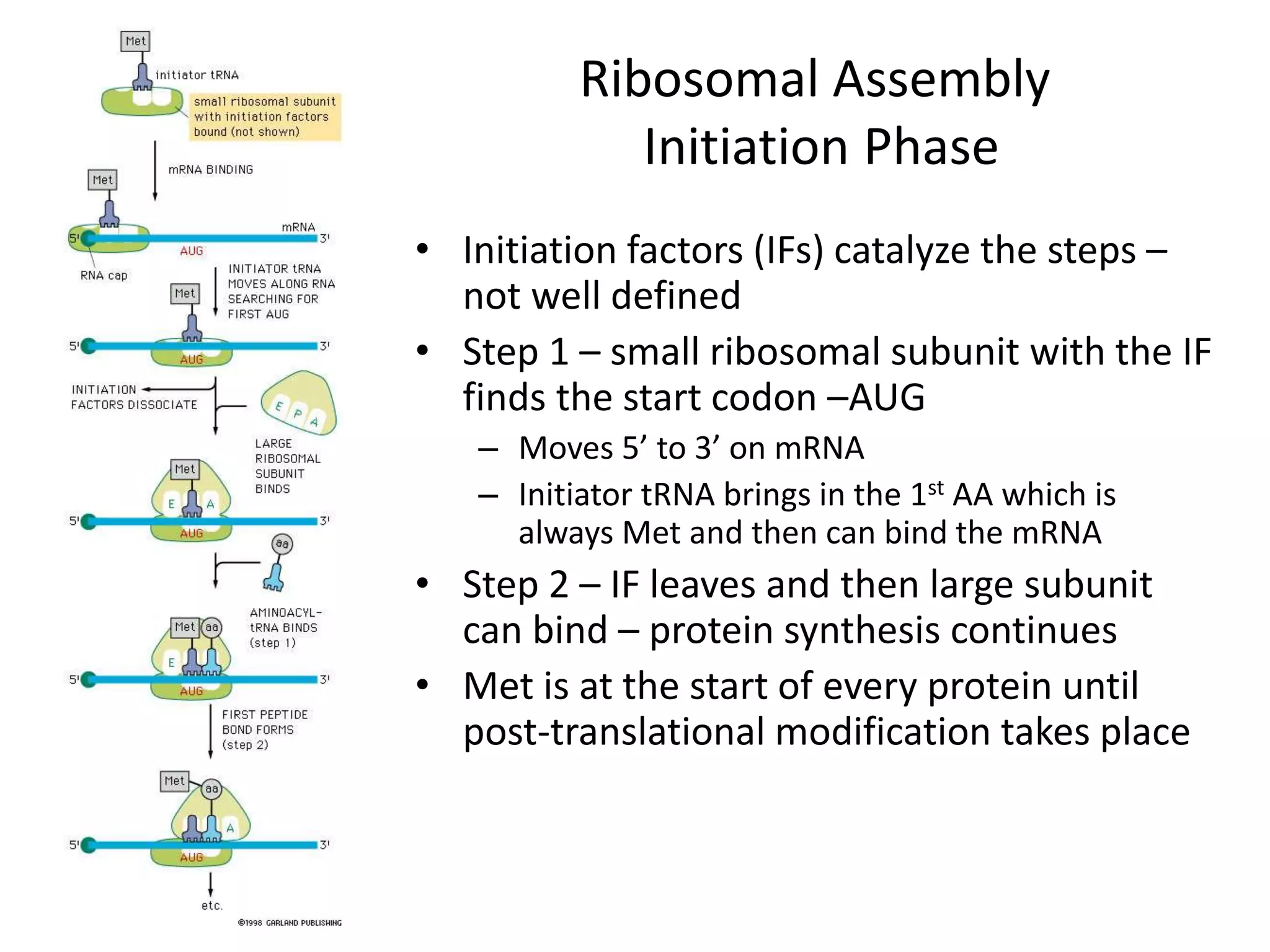
Ribosomal Assembly
Initiation Phase
• Initiation factors (IFs) catalyze the steps –
not well defined
• Step 1 – small ribosomal subunit with the IF
finds the start codon –AUG
– Moves 5’ to 3’ on mRNA
– Initiator tRNA brings in the 1st AA which is
always Met and then can bind the mRNA
• Step 2 – IF leaves and then large subunit
can bind – protein synthesis continues
• Met is at the start of every protein until
post-translational modification takes place
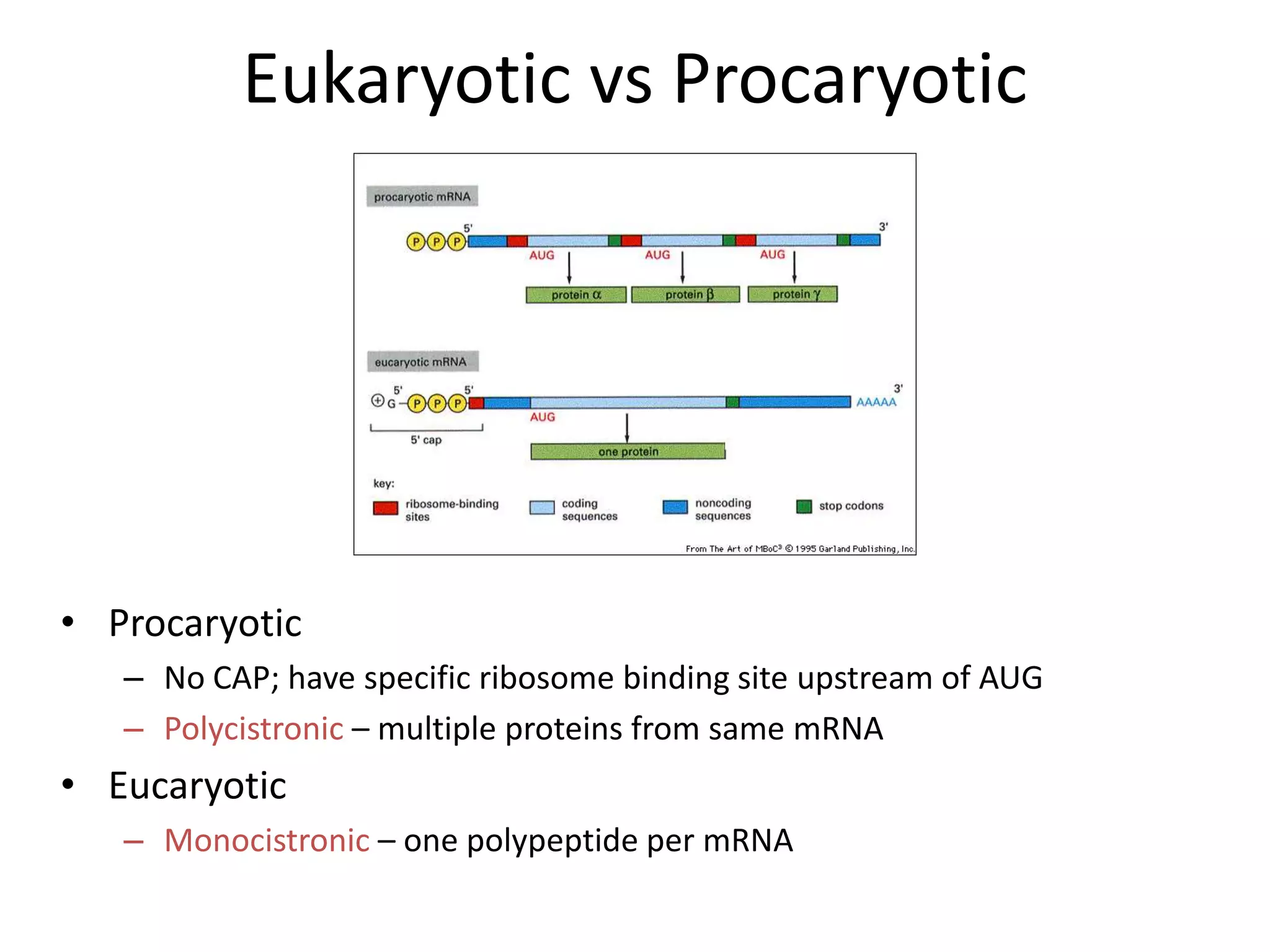
Eukaryotic vs Procaryotic
• Procaryotic
– No CAP; have specific ribosome binding site upstream of AUG
– Polycistronic – multiple proteins from same mRNA
• Eucaryotic
– Monocistronic – one polypeptide per mRNA
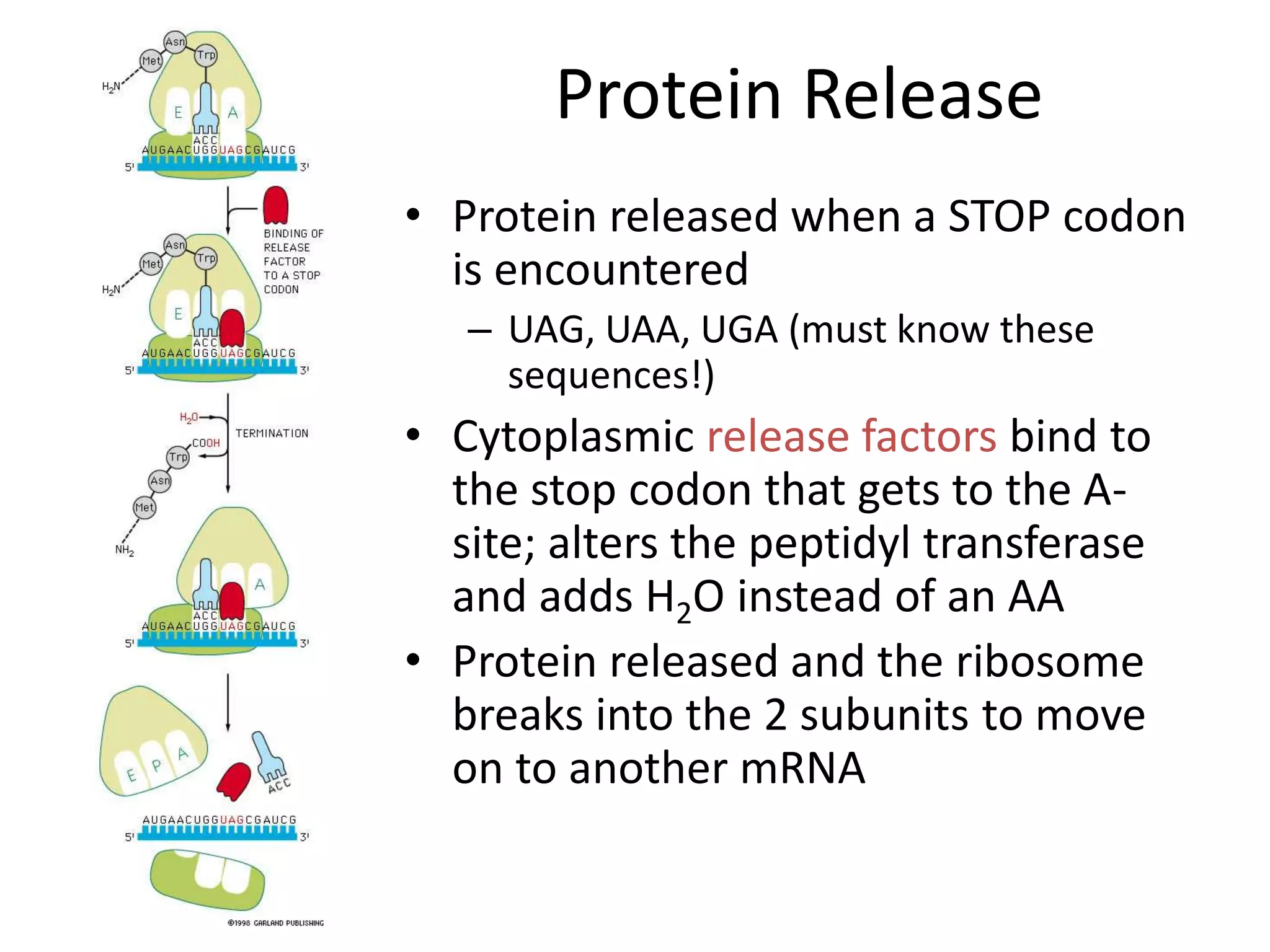
Protein Release
• Protein released when a STOP codon
is encountered
– UAG, UAA, UGA (must know these
sequences!)
• Cytoplasmic release factors bind to
the stop codon that gets to the A-
site; alters the peptidyl transferase
and adds H2O instead of an AA
• Protein released and the ribosome
breaks into the 2 subunits to move
on to another mRNA
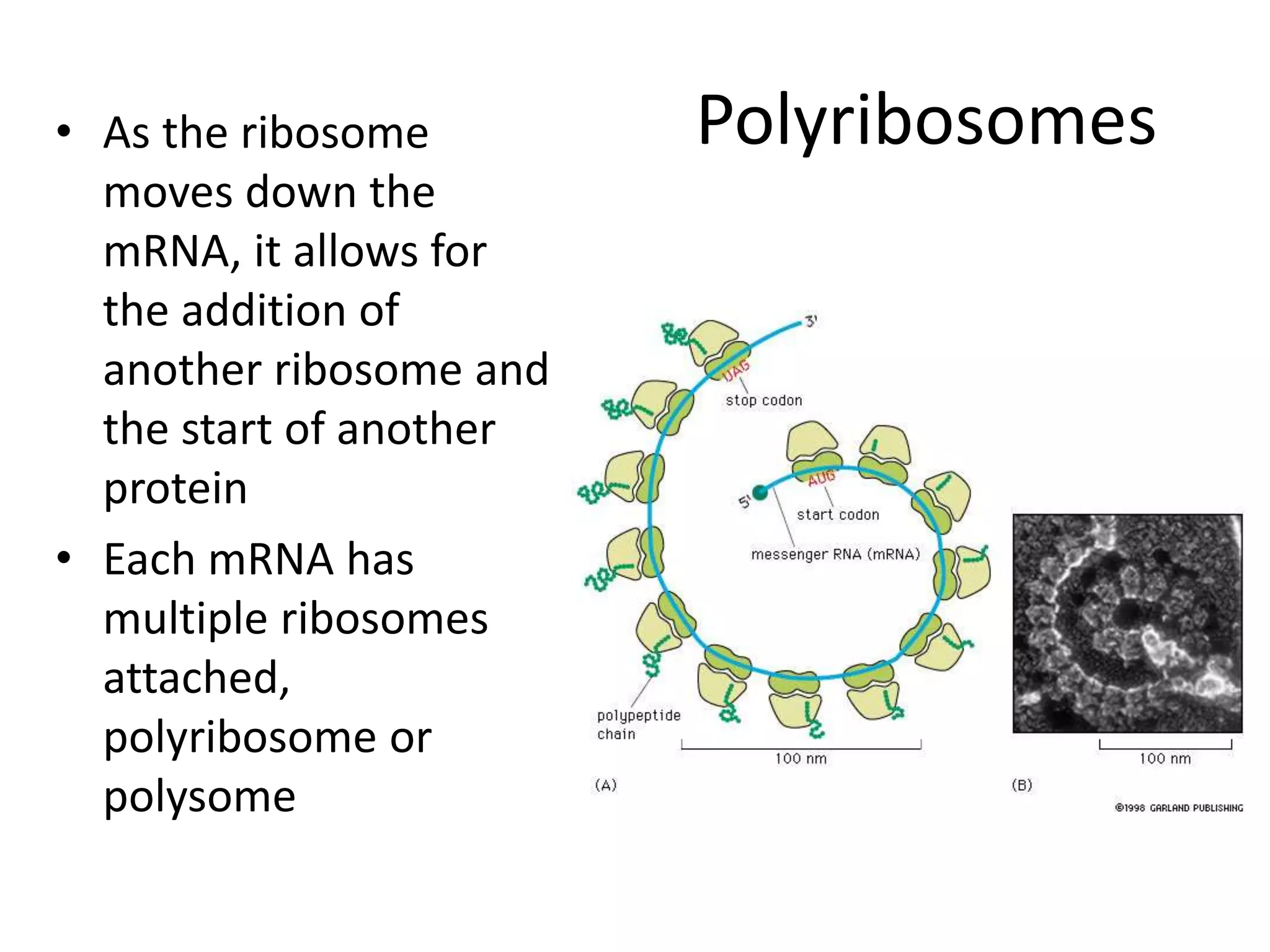
Polyribosomes
• As the ribosome
moves down the
mRNA, it allows for
the addition of
another ribosome and
the start of another
protein
• Each mRNA has
multiple ribosomes
attached,
polyribosome or
polysome
Regulation of Protein Synthesis
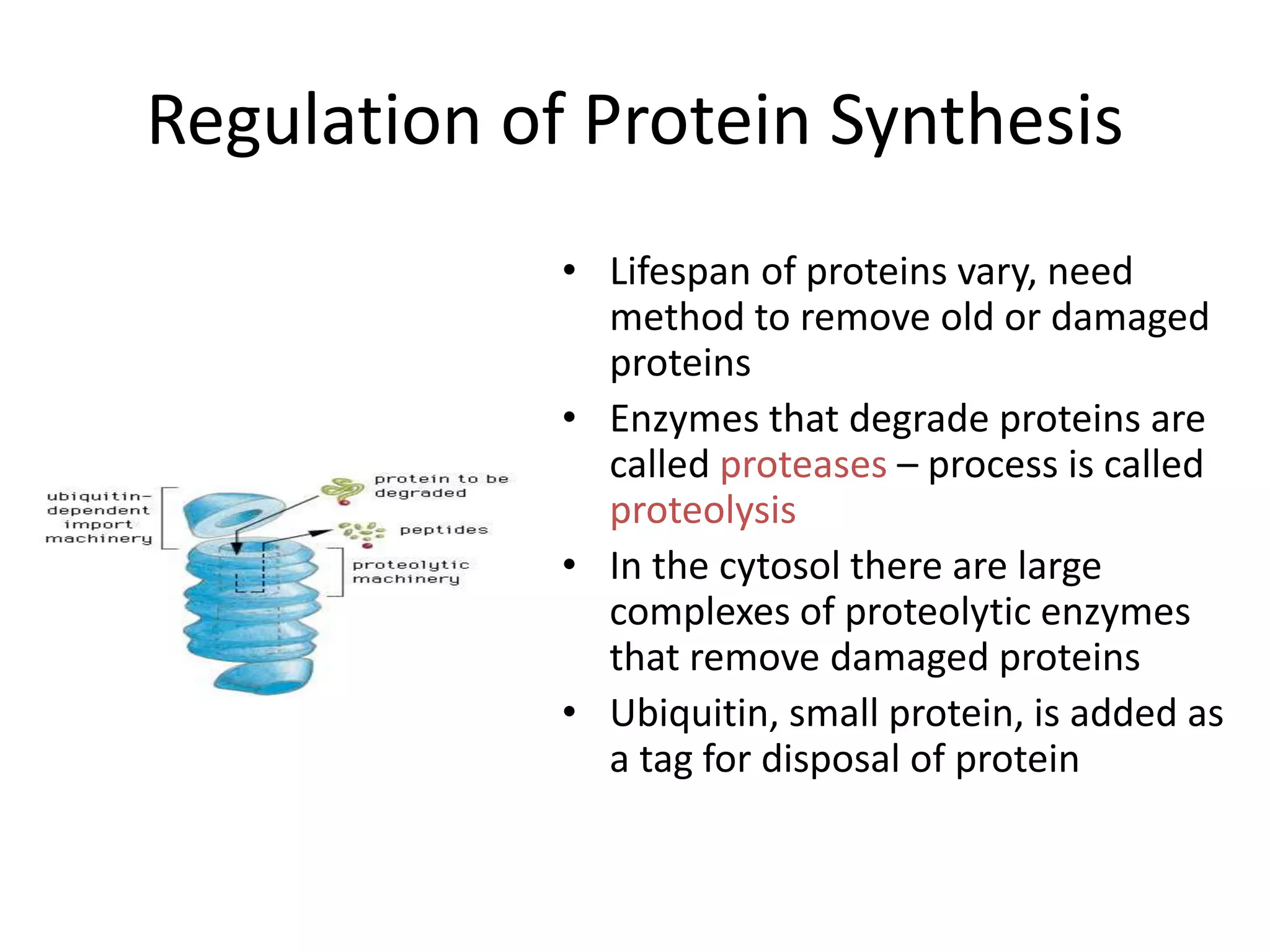
• Lifespan of proteins vary, need
method to remove old or damaged
proteins
• Enzymes that degrade proteins are
called proteases – process is called
proteolysis
• In the cytosol there are large
complexes of proteolytic enzymes
that remove damaged proteins
• Ubiquitin, small protein, is added as
a tag for disposal of protein
Protein Synthesis
• Protein synthesis takes the most energy
input of all the biosynthetic pathways
• 4 high-energy bonds required for each AA
addition
– 2 in charging the tRNA (adding AA)
– 2 in ribosomal activities (step 1 and step 3 of
elongation phase)
Summary
Ribozyme
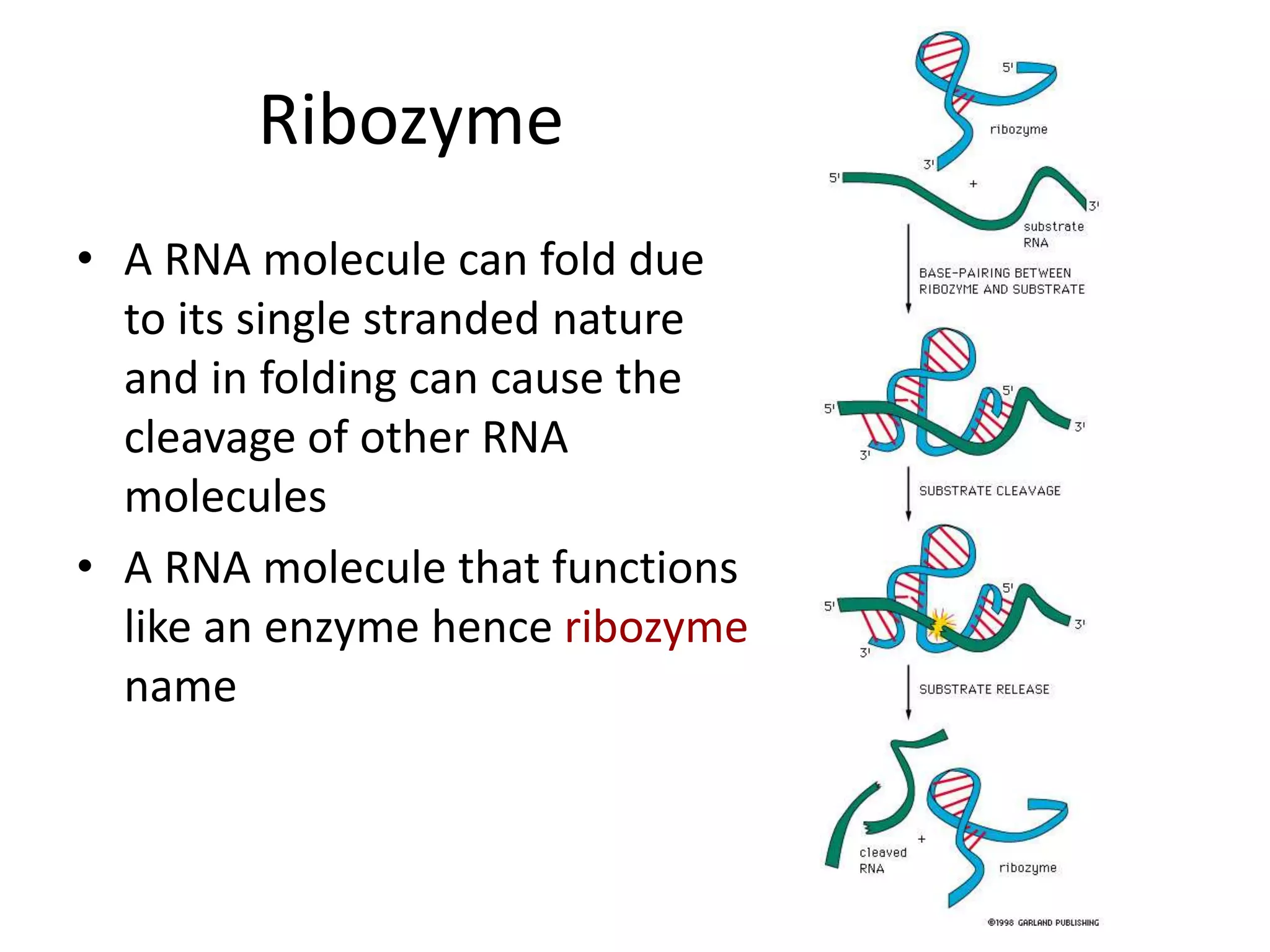
• A RNA molecule can fold due
to its single stranded nature
and in folding can cause the
cleavage of other RNA
molecules
• A RNA molecule that functions
like an enzyme hence ribozyme
name

Chapter 7 - DNA to Protein.ppt

  • 1.
  • 2.
    DNA to Protein •DNA acts as a “manager” in the process of making proteins • DNA is the template or starting sequence that is copied into RNA that is then used to make the protein
  • 3.
    Central Dogma • Onegene – one protein
  • 4.
    Central Dogma • Thisis the same for bacteria to humans • DNA is the genetic instruction or gene • DNA  RNA is called Transcription – RNA chain is called a transcript • RNA  Protein is called Translation
  • 5.
    Expression of Genes • Somegenes are transcribed in large quantities because we need large amount of this protein • Some genes are transcribed in small quantities because we need only a small amount of this protein
  • 6.
    Transcription • Copy thegene of interest into RNA which is made up of nucleotides linked by phosphodiester bonds – like DNA • RNA differs from DNA – Ribose is the sugar rather than deoxyribose – ribonucleotides – U instead of T; A, G and C the same – Single stranded • Can fold into a variety of shapes that allows RNA to have structural and catalytic functions
  • 7.
  • 8.
  • 9.
    Transcription • Similarities toDNA replication – Open and unwind a portion of the DNA – 1 strand of the DNA acts as a template – Complementary base-pairing with DNA • Differences – RNA strand does not stay paired with DNA • DNA re-coils and RNA is single stranded – RNA is shorter than DNA • RNA is several 1000 bp or shorter whereas DNA is 250 million bp long
  • 10.
    Template to Transcripts •The RNA transcript is identical to the NON- template strand with the exception of the T’s becoming U’s
  • 11.
    RNA Polymerase • Catalyzesthe formation of the phosphodiester bonds between the nucleotides (sugar to phosphate) • Uncoils the DNA, adds the nucleotide one at a time in the 5’ to 3’ fashion • Uses the energy trapped in the nucleotides themselves to form the new bonds
  • 12.
    RNA Elongation • Readstemplate 3’ to 5’ • Adds nucleotides 5’ to 3’ (5’ phosphate to 3’ hydroxyl) • Synthesis is the same as the leading strand of DNA
  • 13.
    RNA Polymerase • RNAis released so we can make many copies of the gene, usually before the first one is done – Can have multiple RNA polymerase molecules on a gene at a time
  • 14.
    Differences in DNA andRNA Polymerases • RNA polymerase adds ribonucleotides not deoxynucleotides • RNA polymerase does not have the ability to proofread what they transcribe • RNA polymerase can work without a primer • RNA will have an error 1 in every 10,000 nucleotides (DNA is 1 in 10,000,000 nucleotides)
  • 15.
    Types of RNA •messenger RNA (mRNA) – codes for proteins • ribosomal RNA (rRNA) – forms the core of the ribosomes, machinery for making proteins • transfer RNA (tRNA) – carries the amino acid for the growing protein chain
  • 16.
    DNA Transcription inBacteria • RNA polymerase must know where the start of a gene is in order to copy it • RNA polymerase has weak interactions with the DNA unless it encounters a promoter – A promoter is a specific sequence of nucleotides that indicate the start site for RNA synthesis
  • 17.
    RNA Synthesis • RNApol opens the DNA double helix and creates the template • RNA pol moves nt by nt, unwinds the DNA as it goes • Will stop when it encounters a STOP codon, RNA pol leaves, releasing the RNA strand
  • 18.
    Sigma () Factor •Part of the bacterial RNA polymerase that helps it recognize the promoter • Released after about 10 nucleotides of RNA are linked together • Rejoins with a released RNA polymerase to look for a new promoter
  • 19.
    Start and StopSequences
  • 20.
    DNA Transcribed • Thestrand of DNA transcribed is dependent on which strand the promoter is on • Once RNA polymerase is bound to promoter, no option but to transcribe the appropriate DNA strand • Genes may be adjacent to one another or on opposite strands
  • 21.
    Eukaryotic Transcription • Transcriptionoccurs in the nucleus in eukaryotes, nucleoid in bacteria • Translation occurs on ribosomes in the cytoplasm • mRNA is transported out of nucleus through the nuclear pores
  • 22.
    RNA Processing • Eukaryoticcells process the RNA in the nucleus before it is moved to the cytoplasm for protein synthesis • The RNA that is the direct copy of the DNA is the primary transcript • 2 methods used to process primary transcripts to increase the stability of mRNA being exported to the cytoplasm – RNA capping – Polyadenylation
  • 23.
    RNA Processing • RNAcapping happens at the 5’ end of the RNA, usually adds a methylgaunosine shortly after RNA polymerase makes the 5’ end of the primary transcript • Polyadenylation modifies the 3’ end of the primary transcript by the addition of a string of A’s
  • 24.
    Coding and Non-codingSequences • In bacteria, the RNA made is translated to a protein • In eukaryotic cells, the primary transcript is made of coding sequences called exons and non-coding sequences called introns • It is the exons that make up the mRNA that gets translated to a protein
  • 25.
    RNA Splicing • Responsiblefor the removal of the introns to create the mRNA • Introns contain sequences that act as cues for their removal • Carried out by small nuclear riboprotein particles (snRNPs)
  • 26.
    snRNPs • snRNPs cometogether and cut out the intron and rejoin the ends of the RNA • Intron is removed as a lariat – loop of RNA like a cowboy rope
  • 27.
    Benefits of Splicing •Allows for genetic recombination – Link exons from different genes together to create a new mRNA • Also allows for 1 primary transcript to encode for multiple proteins by rearrangement of the exons
  • 28.
  • 29.
    RNA to Protein •Translation is the process of turning mRNA into protein • Translate from one “language” (mRNA nucleotides) to a second “language” (amino acids) • Genetic code – nucleotide sequence that is translated to amino acids of the protein
  • 30.
    Degenerate DNA Code •Nucleotides read 3 at a time meaning that there are 64 combinations for a codon (set of 3 nucleotides) • Only 20 amino acids – More than 1 codon per AA – degenerate code with the exception of Met and Trp (least abundant AAs in proteins)
  • 31.
    Reading Frames • Translationcan occur in 1 of 3 possible reading frames, dependent on where decoding starts in the mRNA
  • 32.
    Transfer RNA Molecules • Translationrequires an adaptor molecule that recognizes the codon on mRNA and at a distant site carries the appropriate amino acid • Intra-strand base pairing allows for this characteristic shape • Anticodon is opposite from where the amino acid is attached
  • 33.
    Wobble Base Pairing •Due to degenerate code for amino acids some tRNA can recognize several codons because the 3rd spot can wobble or be mismatched • Allows for there only being 31 tRNA for the 61 codons
  • 34.
    Attachment of AAto tRNA • Aminoacyl-tRNA synthase is the enzyme responsible for linking the amino acid to the tRNA • A specific enzyme for each amino acid and not for the tRNA
  • 35.
    2 ‘Adaptors’ Translate GeneticCode to Protein 1  2
  • 36.
    Ribosomes • Complex machinerythat controls protein synthesis • 2 subunits – 1 large – catalyzes the peptide bond formation – 1 small – binds mRNA and tRNA • Contains protein and RNA – rRNA central to the catalytic activity • Folded structure is highly conserved – Protein has less homology and may not be as important
  • 37.
    Ribosome Structures • Maybe free in cytoplasm or attached to the ER • Subunits made in the nucleus in the nucleolus and transported to the cytoplasm
  • 38.
    Ribosomal Subunits • 1large subunit – catalyzes the formation of the peptide bond • 1 small subunit – matches the tRNA to the mRNA • Moves along the mRNA adding amino acids to growing protein chain
  • 39.
    Ribosomal Movement • 4binding sites – mRNA binding site – Peptidyl-tRNA binding site (P-site) • Holds tRNA attached to growing end of the peptide – Aminoacyl-tRNA binding site (A-site) • Holds the incoming AA – Exit site (E-site) E-site
  • 40.
    3 Step ElongationPhase • Elongation is a cycle of events • Step 1 – aminoacyl-tRNA comes into empty A-site next to the occupied P-site; pairs with the codon • Step 2 – C’ end of peptide chain uncouples from tRNA in P-site and links to AA in A-site – Peptidyl transferase responsible for bond formation – Each AA added carries the energy for the addition of the next AA • Step 3 – peptidyl-tRNA moves to the P-site; requires hydrolysis of GTP – tRNA released back to the cytoplasmic pool
  • 41.
    Initiation Process • Determineswhether mRNA is synthesized and sets the reading frame that is used to make the protein • Initiation process brings the ribosomal subunits together at the site where the peptide should begin • Initiator tRNA brings in Met – Initiator tRNA is different than the tRNA that adds other Met
  • 42.
    Ribosomal Assembly Initiation Phase •Initiation factors (IFs) catalyze the steps – not well defined • Step 1 – small ribosomal subunit with the IF finds the start codon –AUG – Moves 5’ to 3’ on mRNA – Initiator tRNA brings in the 1st AA which is always Met and then can bind the mRNA • Step 2 – IF leaves and then large subunit can bind – protein synthesis continues • Met is at the start of every protein until post-translational modification takes place
  • 43.
    Eukaryotic vs Procaryotic •Procaryotic – No CAP; have specific ribosome binding site upstream of AUG – Polycistronic – multiple proteins from same mRNA • Eucaryotic – Monocistronic – one polypeptide per mRNA
  • 44.
    Protein Release • Proteinreleased when a STOP codon is encountered – UAG, UAA, UGA (must know these sequences!) • Cytoplasmic release factors bind to the stop codon that gets to the A- site; alters the peptidyl transferase and adds H2O instead of an AA • Protein released and the ribosome breaks into the 2 subunits to move on to another mRNA
  • 45.
    Polyribosomes • As theribosome moves down the mRNA, it allows for the addition of another ribosome and the start of another protein • Each mRNA has multiple ribosomes attached, polyribosome or polysome
  • 46.
    Regulation of ProteinSynthesis • Lifespan of proteins vary, need method to remove old or damaged proteins • Enzymes that degrade proteins are called proteases – process is called proteolysis • In the cytosol there are large complexes of proteolytic enzymes that remove damaged proteins • Ubiquitin, small protein, is added as a tag for disposal of protein
  • 47.
    Protein Synthesis • Proteinsynthesis takes the most energy input of all the biosynthetic pathways • 4 high-energy bonds required for each AA addition – 2 in charging the tRNA (adding AA) – 2 in ribosomal activities (step 1 and step 3 of elongation phase)
  • 48.
  • 49.
    Ribozyme • A RNAmolecule can fold due to its single stranded nature and in folding can cause the cleavage of other RNA molecules • A RNA molecule that functions like an enzyme hence ribozyme name