RNA Isolation and Technology
Applications
By
S.Selvajeyanthi
Assistant Professor
Dept of Microbiology
Tiruppur kumaran college for women
Tirupur
Nucleic Acid Chemistry
• DNA (deoxyribonucleic acid) and RNA
(ribonucleic acid)
store and transfer genetic information in living
organisms.
• RNA:
– found in the nucleus and the cytoplasm
– key to information flow within a cell
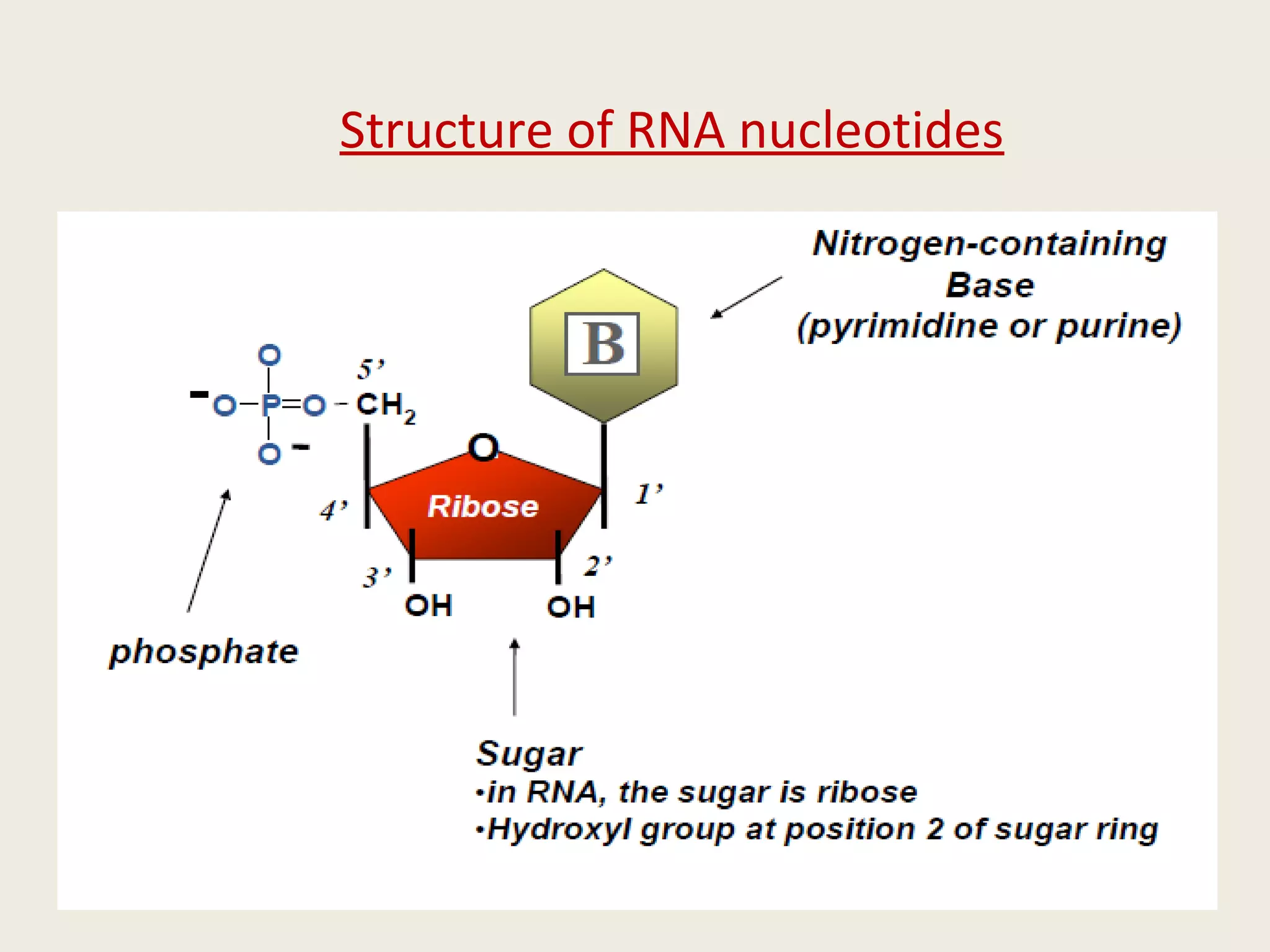
Structure of RNA nucleotides
The Central Dogma
Cellular “total” RNA
• Messenger RNA (mRNA): 1-5% Serves as a
template for protein synthesis
• Ribosomal RNA (rRNA): >80% Structural
component of ribosomes
• Transfer RNA (tRNA): 10-15% Translates
mRNA information into the appropriate amino
acid
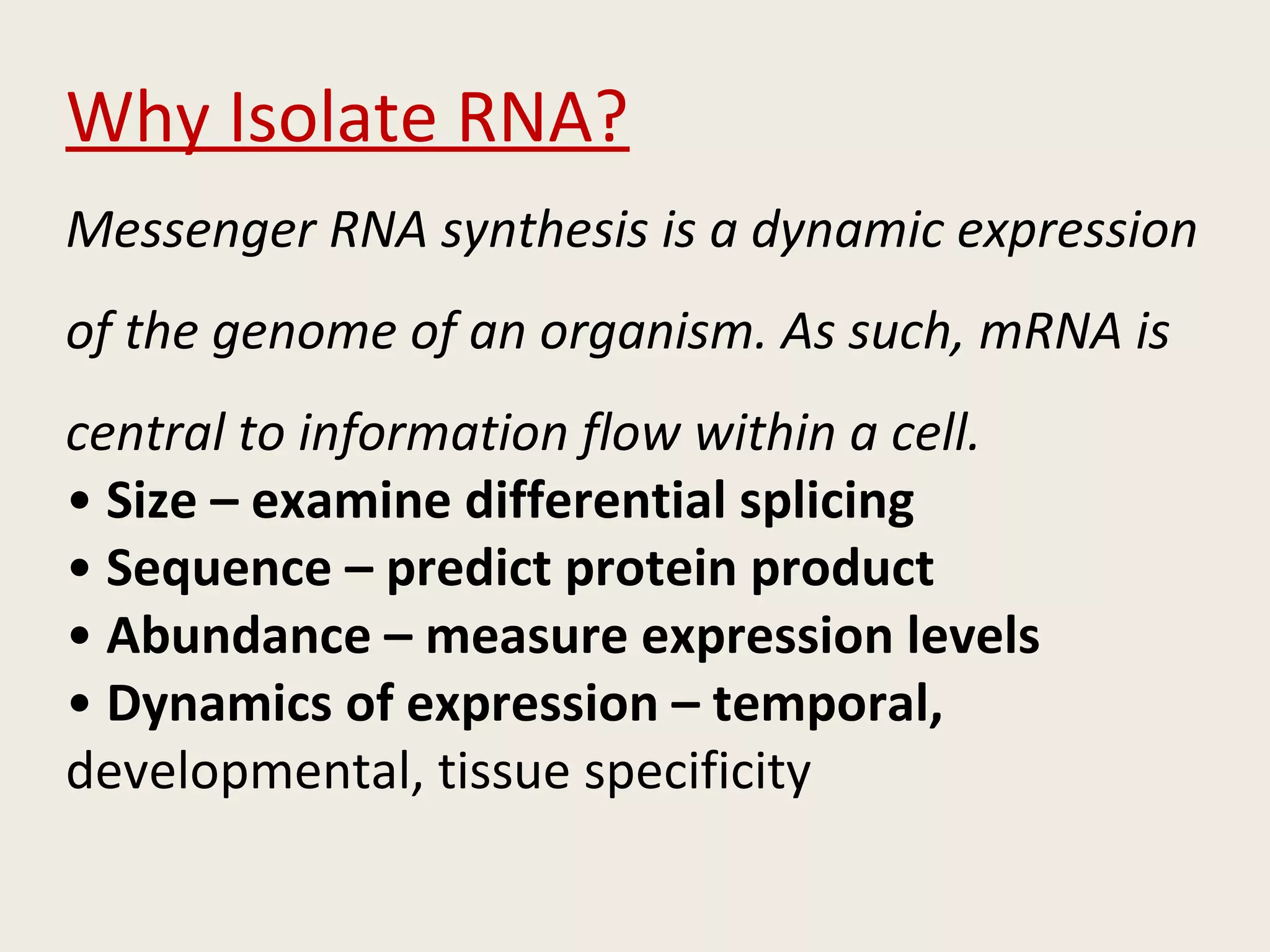
Why Isolate RNA?
Messenger RNA synthesis is a dynamic expression
of the genome of an organism. As such, mRNA is
central to information flow within a cell.
• Size – examine differential splicing
• Sequence – predict protein product
• Abundance – measure expression levels
• Dynamics of expression – temporal,
developmental, tissue specificity
RNA isolation
Tissue Cells
Break open the cell
RNA Purification
Quality
Parameters
Purity
Integrity
Quantitation of RNA
• Nucleic acids absorb UV light maximally at
260nm
• For RNA:
1 OD260 Unit = 40 μg/ml of ssRNA
• The concentration in the sample is
calculated
by using the formula:
A260 x dilution x 40 = [RNA] μg/ml
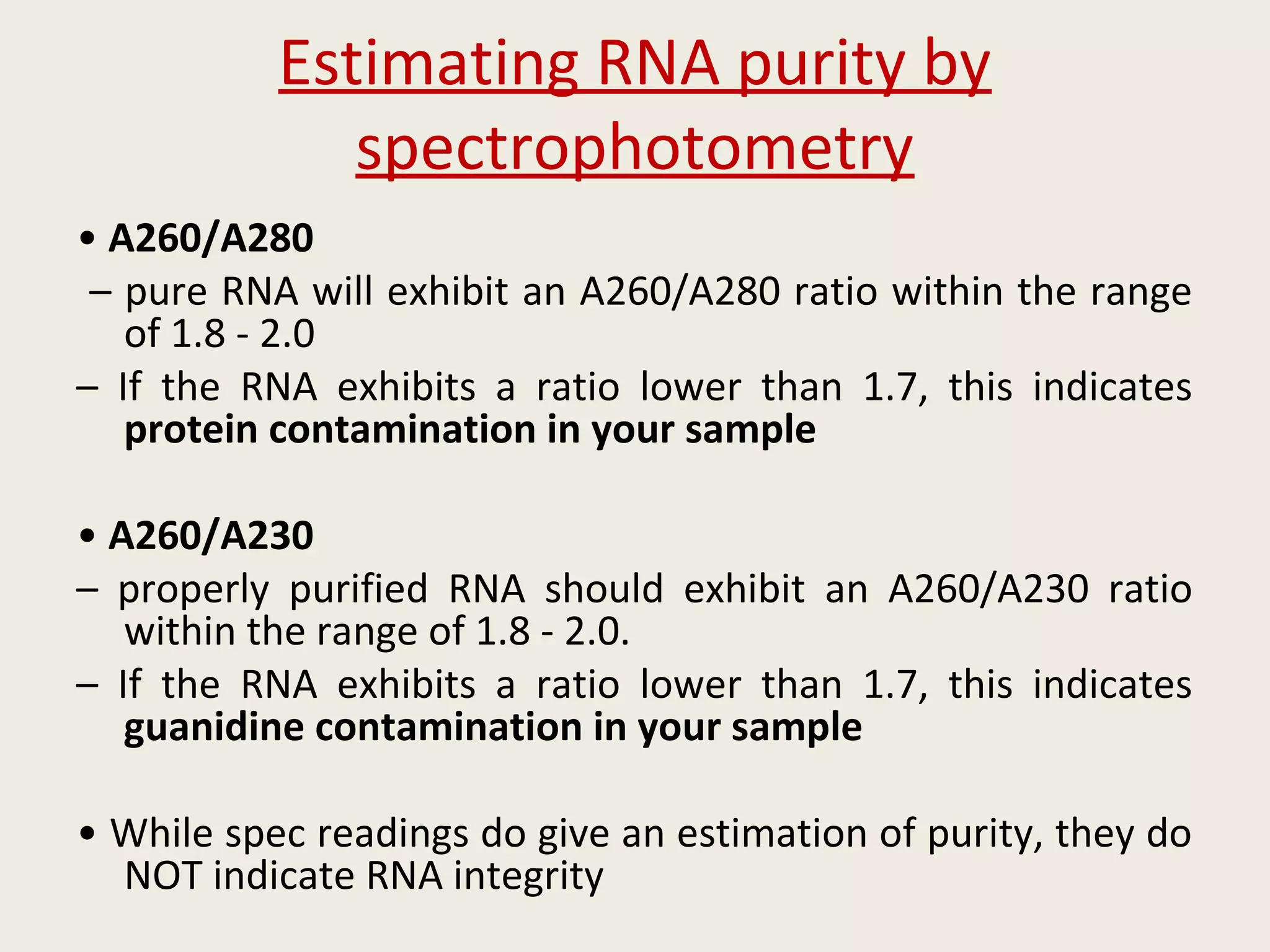
Estimating RNA purity by
spectrophotometry
• A260/A280
– pure RNA will exhibit an A260/A280 ratio within the range
of 1.8 - 2.0
– If the RNA exhibits a ratio lower than 1.7, this indicates
protein contamination in your sample
• A260/A230
– properly purified RNA should exhibit an A260/A230 ratio
within the range of 1.8 - 2.0.
– If the RNA exhibits a ratio lower than 1.7, this indicates
guanidine contamination in your sample
• While spec readings do give an estimation of purity, they do
NOT indicate RNA integrity
Applications
• Clone genes
• Expression Studies
• Northern blotting
• cDNA synthesis and gene product evaluation
• Microarray
Thank U

Isolation of RNA and its application

  • 1.
    RNA Isolation andTechnology Applications By S.Selvajeyanthi Assistant Professor Dept of Microbiology Tiruppur kumaran college for women Tirupur
  • 2.
    Nucleic Acid Chemistry •DNA (deoxyribonucleic acid) and RNA (ribonucleic acid) store and transfer genetic information in living organisms. • RNA: – found in the nucleus and the cytoplasm – key to information flow within a cell
  • 3.
    Structure of RNAnucleotides
  • 4.
  • 5.
    Cellular “total” RNA •Messenger RNA (mRNA): 1-5% Serves as a template for protein synthesis • Ribosomal RNA (rRNA): >80% Structural component of ribosomes • Transfer RNA (tRNA): 10-15% Translates mRNA information into the appropriate amino acid
  • 6.
    Why Isolate RNA? MessengerRNA synthesis is a dynamic expression of the genome of an organism. As such, mRNA is central to information flow within a cell. • Size – examine differential splicing • Sequence – predict protein product • Abundance – measure expression levels • Dynamics of expression – temporal, developmental, tissue specificity
  • 7.
    RNA isolation Tissue Cells Breakopen the cell RNA Purification Quality Parameters Purity Integrity
  • 8.
    Quantitation of RNA •Nucleic acids absorb UV light maximally at 260nm • For RNA: 1 OD260 Unit = 40 μg/ml of ssRNA • The concentration in the sample is calculated by using the formula: A260 x dilution x 40 = [RNA] μg/ml
  • 9.
    Estimating RNA purityby spectrophotometry • A260/A280 – pure RNA will exhibit an A260/A280 ratio within the range of 1.8 - 2.0 – If the RNA exhibits a ratio lower than 1.7, this indicates protein contamination in your sample • A260/A230 – properly purified RNA should exhibit an A260/A230 ratio within the range of 1.8 - 2.0. – If the RNA exhibits a ratio lower than 1.7, this indicates guanidine contamination in your sample • While spec readings do give an estimation of purity, they do NOT indicate RNA integrity
  • 10.
    Applications • Clone genes •Expression Studies • Northern blotting • cDNA synthesis and gene product evaluation • Microarray Thank U