 Transcription is a process in which ribonucleic
acid (RNA) is synthesized from DNA.
 Gene refers to the functional unit of DNA that
can be transcribed.
 The genetic information stored in DNA is
expressed through RNA.
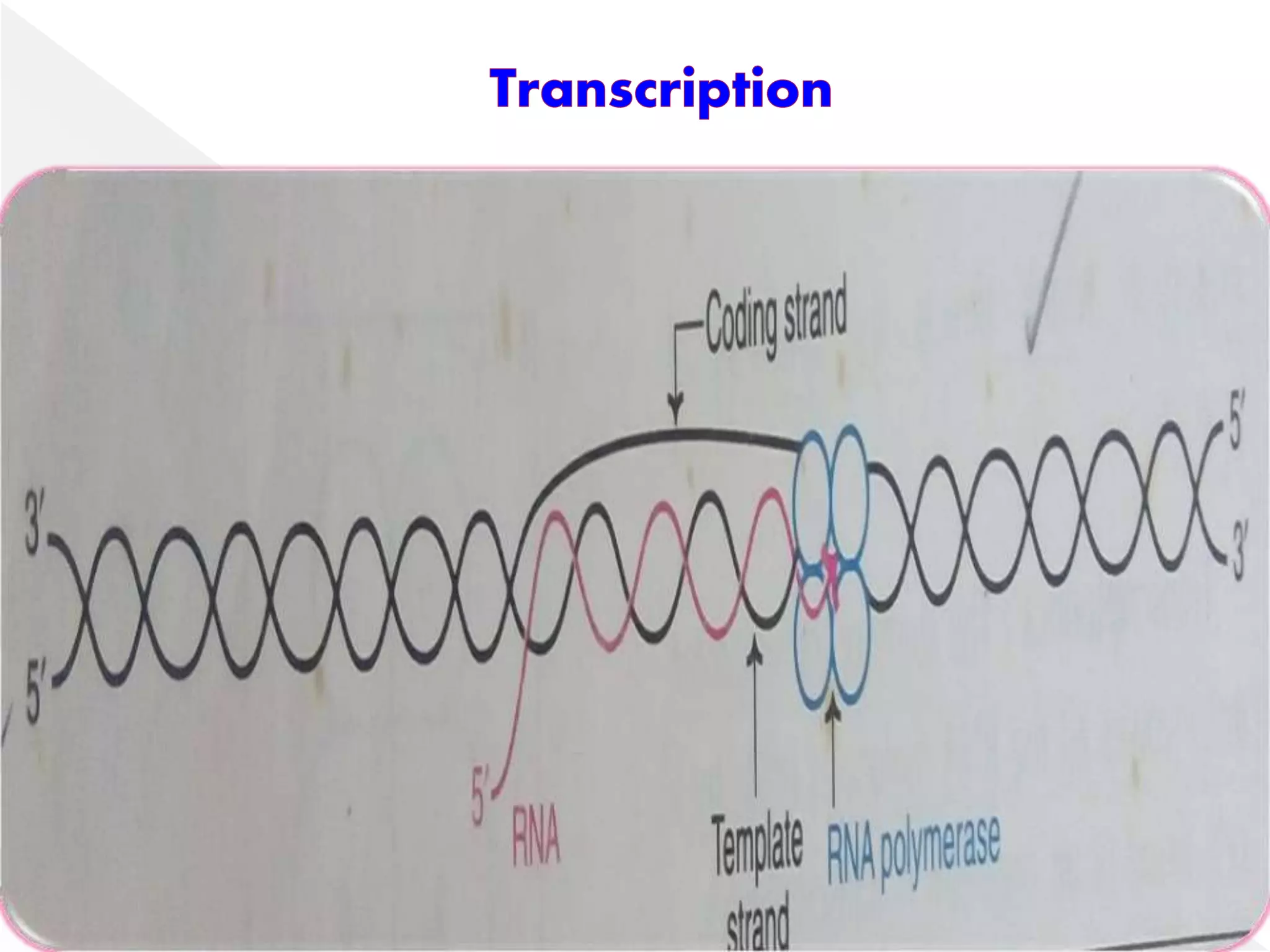
 One of the two strands of DNA serves as a
template (non-coding strand or sense strand)
& produces working copies of RNA molecule.
 The other DNA strand which does not
participate in transcription is referred to as
coding strand or antisense strand (frequently
referred to as coding strand since with the
exception of T for U, primary mRNA contains
codons with the same base sequence.
 The entire molecule of DNA is not expressed
in transcription.
 RNAs are synthesized only for some selected
regions of DNA.
 For certain other regions of DNA, there may
not be any transcription at all.
 The product formed in transcription is
referred to as primary transcript.
 The primary RNA transcripts are inactive.
 They undergo certain alterations (splicing,
terminal additions, base modifications etc.)
commonly known as post-transcriptional
modifications, to produce functionally active
RNA molecules.
 A single enzyme-DNA dependent RNA
polymerase or RNA polymerase synthesizes all
the RNAs in prokaryotes.
 RNA polymerase of E. coli is a complex
holoenzyme (mol wt.465 kDa) with 5 polypeptide
subunits - 2α, 1β & 1β′ & 1 sigma (s) factor.
 The enzyme without sigma factor is core
enzyme (α2ββ′)
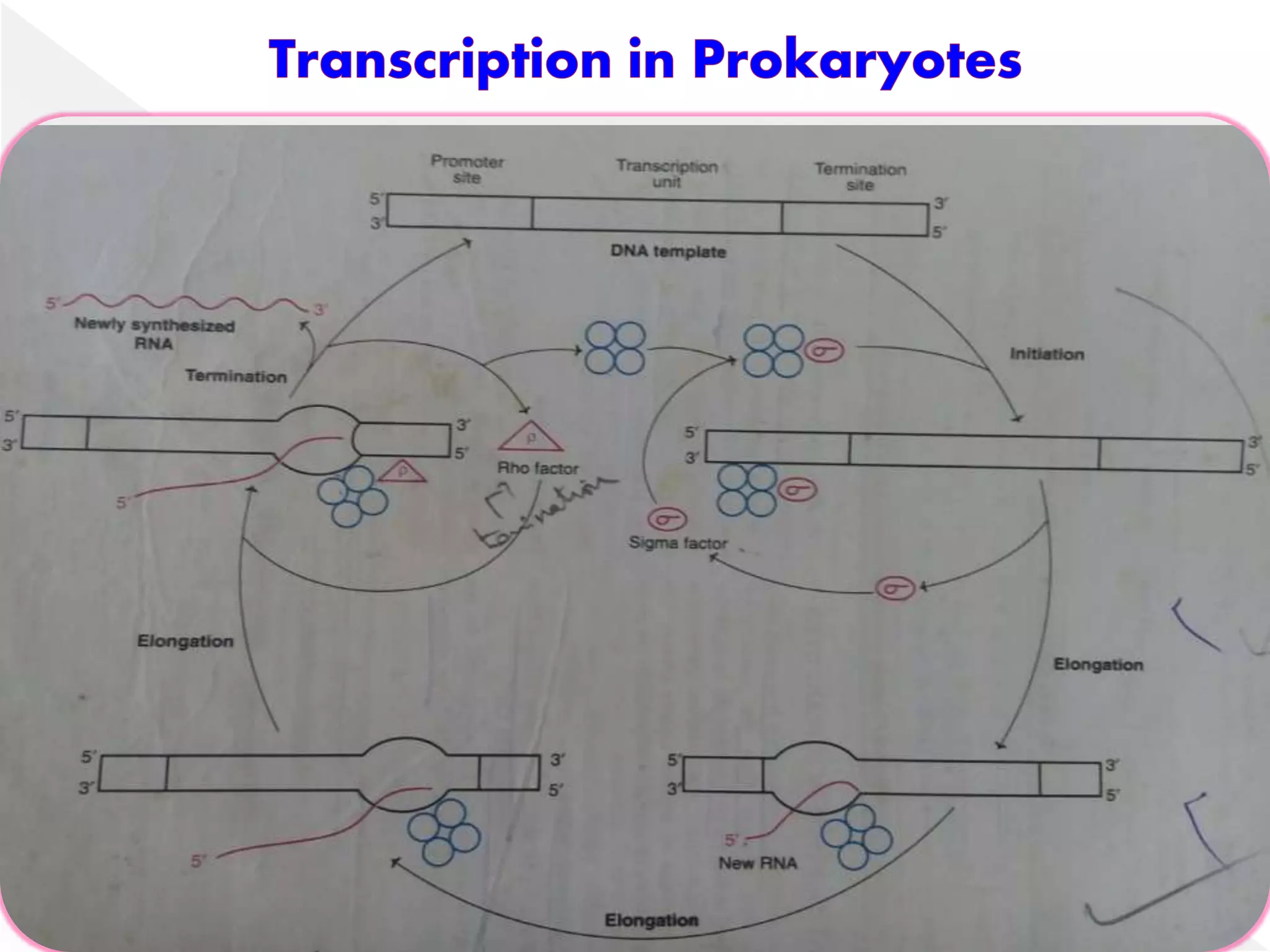
 Transcription involves three different stages-
initiation, elongation & termination.
 Initiation:
 The binding of the enzyme RNA polymerase
to DNA is the prerequisite for the
transcription to start.
 The specific region on the DNA where the
enzyme binds is known as promoter region.
 There are two base sequences on the coding
DNA strand which the sigma factor of RNA
polymerase can recognize for initiation of
transcription.
 Pribnow box (TATA box):
 This consists of 6 nucleotide bases (TATAAT),
located on the left side about 10 bases away
(upstream) from the starting point of
transcription.
 The '-35' sequence:
 This is the second recognition site in the
promote region of DNA.
 It contains a base sequence TTGACA, which is
located about 35 bases (upstream, hence - 35)
away on the left side from the site of
transcription start.
 As the holoenzyme, RNA polymerase
recognizes the promoter region, the sigma
factor is released & transcription proceeds.
 RNA is synthesized from 5' end to 3' end (5'-3')
antiparallel to the DNA template.
 RNA polymerase utilizes ribonucleotide
triphosphates (ATP, GTP, CTP & UTP) for the
formation of RNA.
 For the addition of each nucleotide to the
growing chain, a pyrophosphate moiety is
released.
 The sequence of nucleotide bases in the
mRNA is complementary to the template
DNA strand.
 It is identical to that of coding strand except
that RNA contains U in place of T in DNA.
 RNA polymerase differs from DNA
polymerase in two aspects.
 No primer is required for RNA polymerase &
this enzyme does not possess endo – or
exonuclease activity.
 Due to lack of proof-reading activity, RNA
polymerase has no ability to repair the
mistakes in the RNA synthesized.
 The process of transcription stops by
termination signals.
 Two types of termination are identified.
 Rho (p) dependent termination.
 Rho (p) independent termination.
 A specific protein – ρ factor, binds to growing
RNA (& not to RNA polymerase) or weakly to
DNA, & in the bound state it acts as ATPase &
terminates transcription & releases RNA.
 The ρ factor is also responsible for the
dissociation of RNA polymerase from DNA.
 This is due to the formation of hairpins of
newly synthesized RNA.
 This occurs due to the presence of
palindromes.
 A palindrome is a word that reads a like
forward & backward. e.g. madam, rotor.
 The presence of palindromes in the base
sequence of DNA templates (same when
read in opposite direction) in the termination.
 As a result of this, the newly synthesized
RNA folds to form hairpins (due to
complementary base pairing) that cause
termination of transcription.
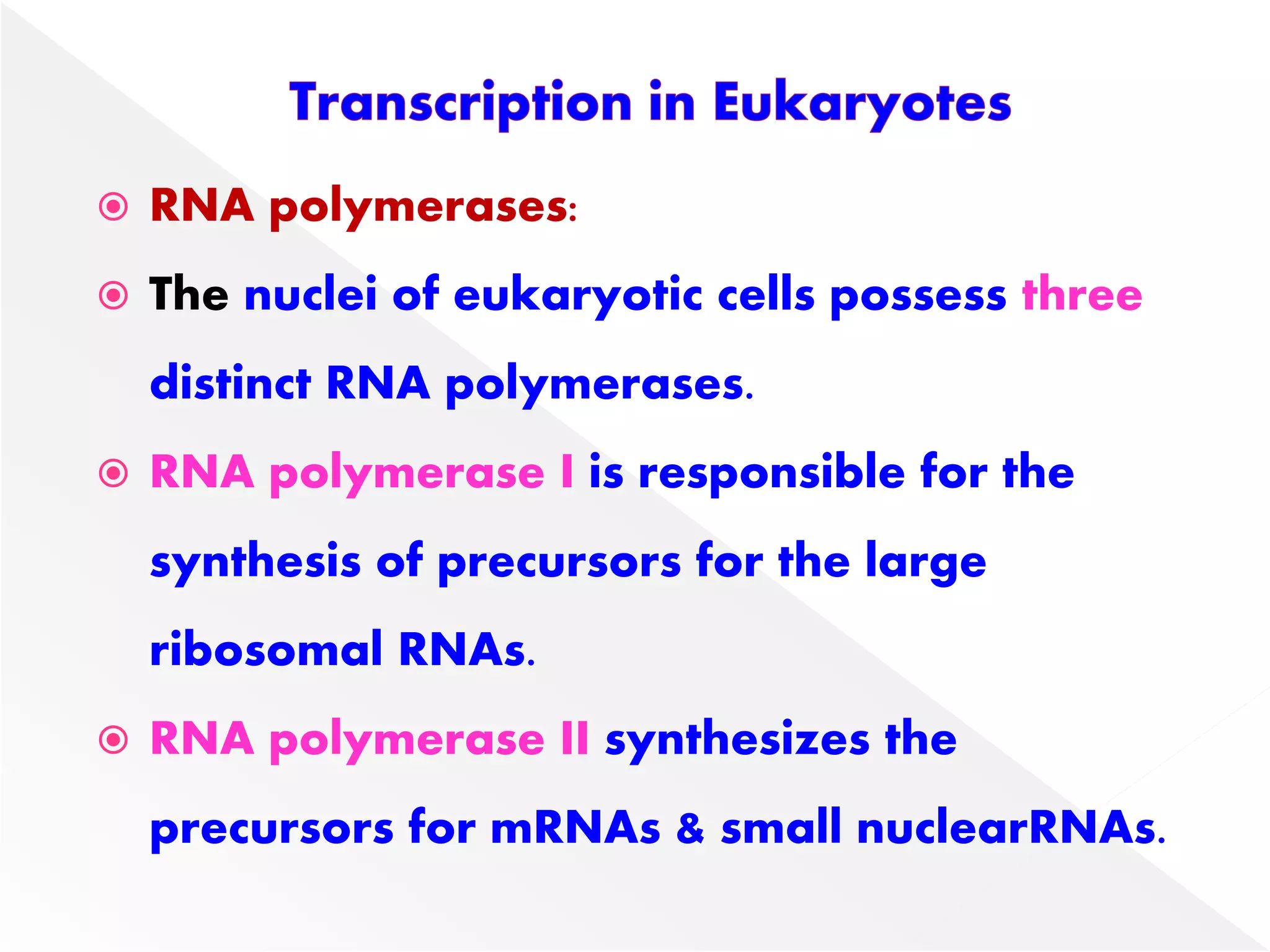
 RNA polymerases:
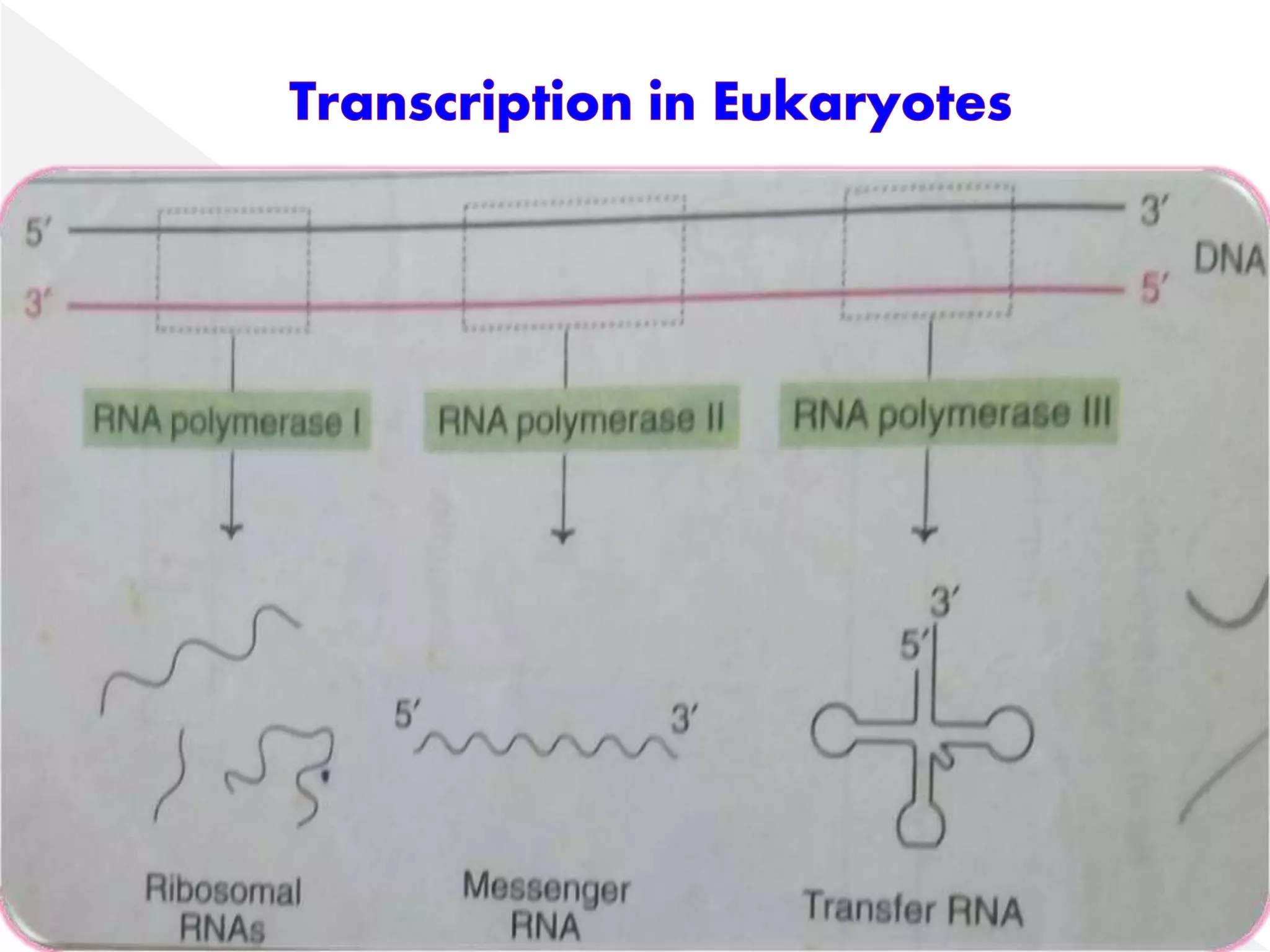
 The nuclei of eukaryotic cells possess three
distinct RNA polymerases.
 RNA polymerase I is responsible for the
synthesis of precursors for the large
ribosomal RNAs.
 RNA polymerase II synthesizes the
precursors for mRNAs & small nuclearRNAs.
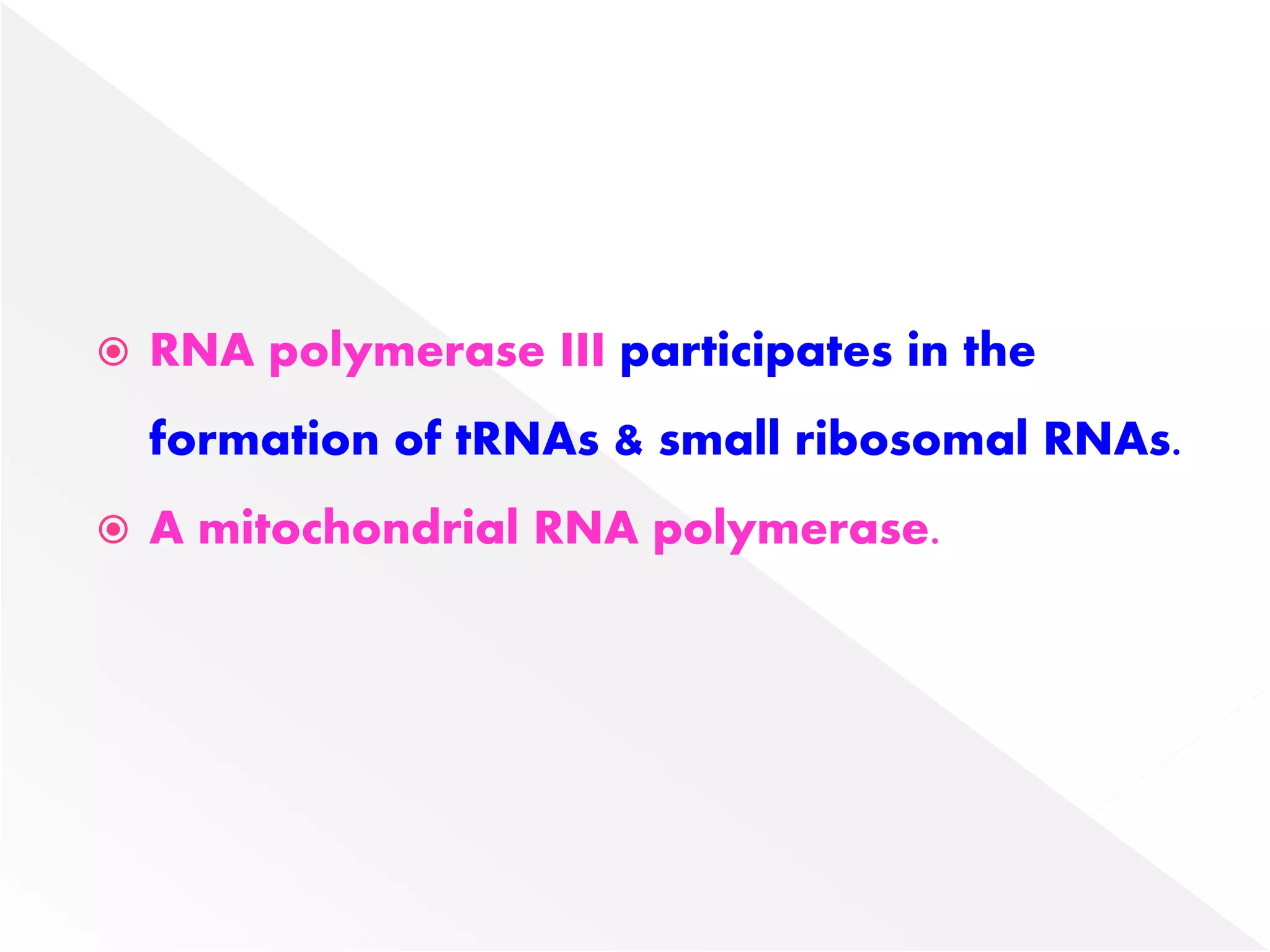
 RNA polymerase III participates in the
formation of tRNAs & small ribosomal RNAs.
 A mitochondrial RNA polymerase.
 In eukaryotes, a sequence of DNA bases
which is almost identical to pribnow box of
prokaryotes.
 This sequence, known as Hogness box (or
TATA box), is located on the left about 25
nucleotides away (upstream) from the
starting site of mRNA synthesis.
 There also exists another site of recognition
between 70 & 80 nucleotides upstream from
the start of transcription.
 This second site is referred to as CAAT box.
 One of these two sites (or sometimes both)
helps RNA polymerase II to recognize the
requisite sequence on DNA for transcription.
1. Chromatin containing the promoter
sequence made accessible to the
transcription machinery.
2. Binding of transcription factors (TFs) to DNA
sequences in the promoter region.
3. Stimulation of transcription by enhancers.
 A large number of transcription factors
interact with eukaryotic promoter regions.
 In humans, about six transcription factors
have been identified (TFllD, TFllA, TFllB, TFllF,
TFllE, TFIIH).
 The TFs bind to each other & in turn to the
enzyme RNA polymerase.
 Enhancer can increase gene expression by
about 100 fold.
 This is made possible by binding of
enhancers to transcription factors to form
activators.
 The chromatin forms a loop that allows the
promoter & enhancer to be close together in
space to facilitate transcription.
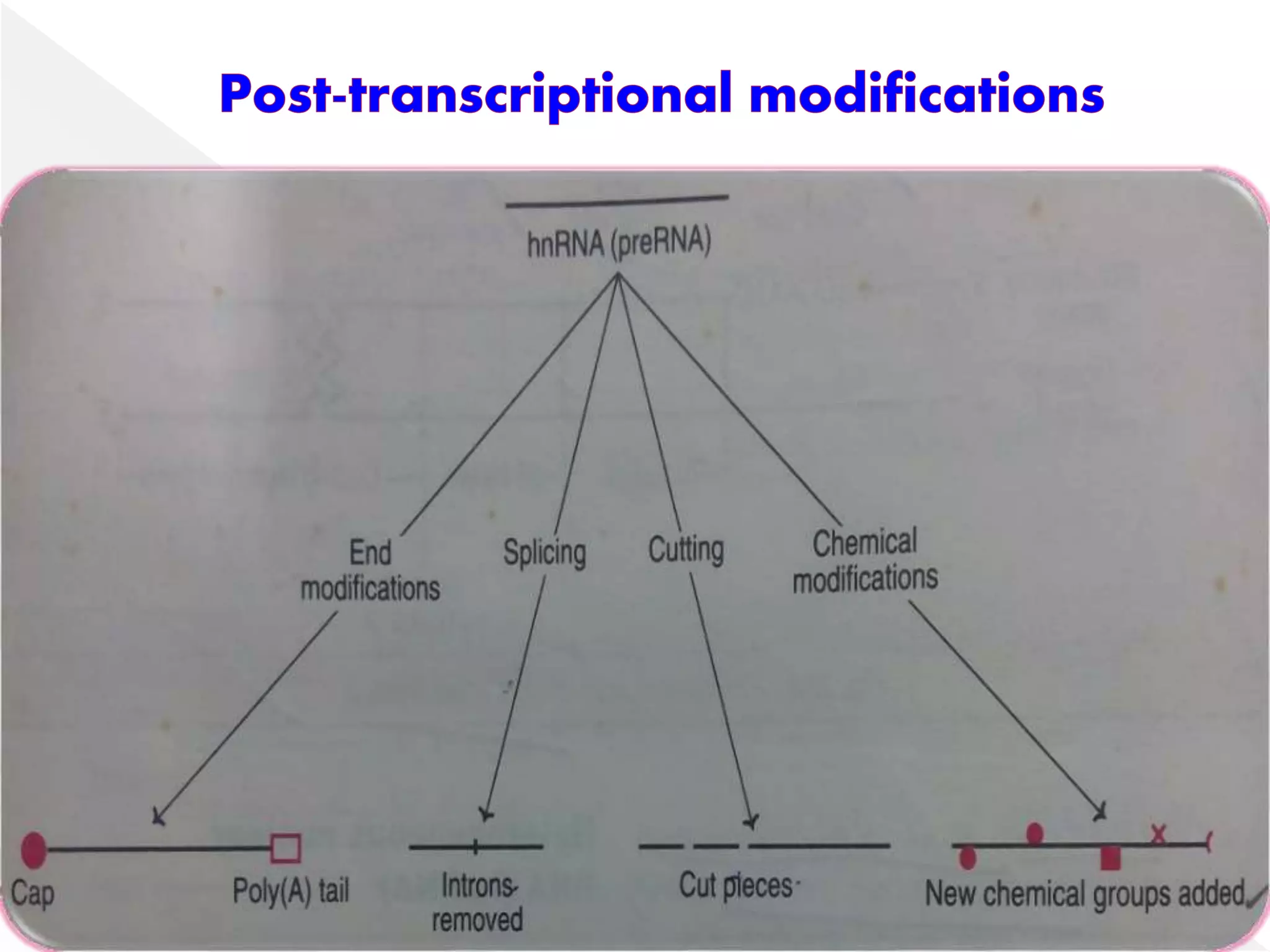
 The primary mRNA transcript produced by
RNA polymerase Il in eukaryotes is often
referred to as heterogeneous nuclear RNA
(hnRNA).
 This is then processed to produce mRNA
needed for protein synthesis.
 The primary transcripts undergo many
alterations-terminal base additions, base
modifications, splicing etc, which are
collectively referred to as post-
transcriptional modifications.
 This process is required to convert the RNAs
into the active forms.
 A group of enzymes – ribonucleases are
responsible for the processing of tRNAs &
rRNAs of both prokaryotes & eukaryotes.
 The prokaryotic mRNA synthesized in
transcription is almost similar to the
functional mRNA.
 In contrast, eukaryotic mRNA (i.e. hnRNA)
undergoes extensive post-transcriptional
changes.
 The 5′ capping:
 The 5′ end of mRNA is capped with 7-
methylguanosine by an unusual 5'-5'
triphosphate linkage.
 SAM is the donor of methyl group.
 This cap is required for translation, besides
stabilizing the structure of mRNA.
 Poly-A tail:
 A large number of eukaryotic mRNAs possess
an adenine nucleotide chain at the 3'-end.
 Poly-A tail is not produced during
transcription.
 It is later added to stabilize mRNA.
 Poly-A chain gets reduced as the mRNA enters
cytosol.
 Introns & their removal:
 Introns are the intervening nucleotide
sequences in mRNA which do not code for
proteins.
 Exons of mRNA possess genetic code and
are responsible for protein synthesis.
 The removal of introns is promoted by small
nuclear ribo-nucleoprotein particles (snRNPs).
 snRNPs (pronounced as snurps) are formed
by the association of small nuclear RNA
(snRNA) with proteins.
 Spliceosome is used to represent the snRNP
association with hnRNA at the exon-intron
junction.
 Post-transcriptional modifications of mRNA
occur in the nucleus.
 The mature RNA then enters the cytosol to
perform its function (translation).
 Faulty splicing may result in diseases.
 Example is one type of β-thalassemia.
 Mutation that results in a nucleotide change
at an exon-intron junction.
 The result is a diminished or lack of synthesis
of β-chain of hemoglobin
 All the tRNAs of prokaryotes & eukaryotes
undergo post-transcriptional modification.
 These include trimming, converting the
existing bases into unusual ones & addition
of CCA nucleotides to 3' terminal end of
tRNAs.
 The preribosomal RNAs originally
synthesized are converted to ribosomal
RNAs by a series of post-transcriptional
changes.
 Actinomycin D:
 This is also known as dactinomycin.
 It is synthesized by Streptomyces.
 Actinomycin D binds with DNA template
strand & blocks the movement of RNA
polymerase.
 This was the very first antibiotic used for the
treatment of tumors.
 Rifampin:
 It is an antibiotic widely used for the
treatment of tuberculosis and leprosy.
 Rifampin binds with the β-subunit of
prokaryotic RNA polymerase & inhibits its
activity.
 α-Amanitin:
 It is a toxin produced by mushroom,
Amanita phalloides.
 This mushroom is delicious in taste but
poisonous due to the toxin α-amanitin which
tightly binds with RNA polymerase II of
eukaryotes & inhibits transcription.
 Retroviruses possess RNA as the genetic
material.
 These viruses cause cancers in animals,
hence known as oncogenic.
 They are actually found in the
transformed cells of the tumors.
 The enzyme RNA dependent DNA
polymerase or reverse transcriptase is
responsible for formation of DNA from RNA.
 This DNA is complementary (cDNA) to viral
RNA and can be transmitted into host DNA.
 Synthesis of cDNA from mRNA:
 The DNA expresses the genetic information
in the form of RNA.
 The mRNA determines the amino acid
sequence in a protein.
 The mRNA can be utilized as a template for
the synthesis of double-stranded
complementary DNA (cDNA) by using the
enzyme reverse transcriptase.
 This cDNA can be used as a probe to identify
the sequence of DNA in genes.
 Textbook of Biochemistry – U Satyanarayana
TRANSCRIPTION & POST-TRANSCRIPTIONAL MODIFICATIONS

TRANSCRIPTION & POST-TRANSCRIPTIONAL MODIFICATIONS

  • 2.
     Transcription isa process in which ribonucleic acid (RNA) is synthesized from DNA.  Gene refers to the functional unit of DNA that can be transcribed.  The genetic information stored in DNA is expressed through RNA.  One of the two strands of DNA serves as a template (non-coding strand or sense strand) & produces working copies of RNA molecule.
  • 3.
     The otherDNA strand which does not participate in transcription is referred to as coding strand or antisense strand (frequently referred to as coding strand since with the exception of T for U, primary mRNA contains codons with the same base sequence.
  • 4.
     The entiremolecule of DNA is not expressed in transcription.  RNAs are synthesized only for some selected regions of DNA.  For certain other regions of DNA, there may not be any transcription at all.  The product formed in transcription is referred to as primary transcript.
  • 5.
     The primaryRNA transcripts are inactive.  They undergo certain alterations (splicing, terminal additions, base modifications etc.) commonly known as post-transcriptional modifications, to produce functionally active RNA molecules.
  • 6.
     A singleenzyme-DNA dependent RNA polymerase or RNA polymerase synthesizes all the RNAs in prokaryotes.  RNA polymerase of E. coli is a complex holoenzyme (mol wt.465 kDa) with 5 polypeptide subunits - 2α, 1β & 1β′ & 1 sigma (s) factor.  The enzyme without sigma factor is core enzyme (α2ββ′)
  • 7.
     Transcription involvesthree different stages- initiation, elongation & termination.  Initiation:  The binding of the enzyme RNA polymerase to DNA is the prerequisite for the transcription to start.  The specific region on the DNA where the enzyme binds is known as promoter region.
  • 8.
     There aretwo base sequences on the coding DNA strand which the sigma factor of RNA polymerase can recognize for initiation of transcription.  Pribnow box (TATA box):  This consists of 6 nucleotide bases (TATAAT), located on the left side about 10 bases away (upstream) from the starting point of transcription.
  • 9.
     The '-35'sequence:  This is the second recognition site in the promote region of DNA.  It contains a base sequence TTGACA, which is located about 35 bases (upstream, hence - 35) away on the left side from the site of transcription start.
  • 11.
     As theholoenzyme, RNA polymerase recognizes the promoter region, the sigma factor is released & transcription proceeds.  RNA is synthesized from 5' end to 3' end (5'-3') antiparallel to the DNA template.  RNA polymerase utilizes ribonucleotide triphosphates (ATP, GTP, CTP & UTP) for the formation of RNA.
  • 12.
     For theaddition of each nucleotide to the growing chain, a pyrophosphate moiety is released.  The sequence of nucleotide bases in the mRNA is complementary to the template DNA strand.  It is identical to that of coding strand except that RNA contains U in place of T in DNA.
  • 13.
     RNA polymerasediffers from DNA polymerase in two aspects.  No primer is required for RNA polymerase & this enzyme does not possess endo – or exonuclease activity.  Due to lack of proof-reading activity, RNA polymerase has no ability to repair the mistakes in the RNA synthesized.
  • 14.
     The processof transcription stops by termination signals.  Two types of termination are identified.  Rho (p) dependent termination.  Rho (p) independent termination.
  • 15.
     A specificprotein – ρ factor, binds to growing RNA (& not to RNA polymerase) or weakly to DNA, & in the bound state it acts as ATPase & terminates transcription & releases RNA.  The ρ factor is also responsible for the dissociation of RNA polymerase from DNA.
  • 16.
     This isdue to the formation of hairpins of newly synthesized RNA.  This occurs due to the presence of palindromes.  A palindrome is a word that reads a like forward & backward. e.g. madam, rotor.
  • 17.
     The presenceof palindromes in the base sequence of DNA templates (same when read in opposite direction) in the termination.  As a result of this, the newly synthesized RNA folds to form hairpins (due to complementary base pairing) that cause termination of transcription.
  • 19.
     RNA polymerases: The nuclei of eukaryotic cells possess three distinct RNA polymerases.  RNA polymerase I is responsible for the synthesis of precursors for the large ribosomal RNAs.  RNA polymerase II synthesizes the precursors for mRNAs & small nuclearRNAs.
  • 20.
     RNA polymeraseIII participates in the formation of tRNAs & small ribosomal RNAs.  A mitochondrial RNA polymerase.
  • 22.
     In eukaryotes,a sequence of DNA bases which is almost identical to pribnow box of prokaryotes.  This sequence, known as Hogness box (or TATA box), is located on the left about 25 nucleotides away (upstream) from the starting site of mRNA synthesis.
  • 23.
     There alsoexists another site of recognition between 70 & 80 nucleotides upstream from the start of transcription.  This second site is referred to as CAAT box.  One of these two sites (or sometimes both) helps RNA polymerase II to recognize the requisite sequence on DNA for transcription.
  • 24.
    1. Chromatin containingthe promoter sequence made accessible to the transcription machinery. 2. Binding of transcription factors (TFs) to DNA sequences in the promoter region. 3. Stimulation of transcription by enhancers.
  • 25.
     A largenumber of transcription factors interact with eukaryotic promoter regions.  In humans, about six transcription factors have been identified (TFllD, TFllA, TFllB, TFllF, TFllE, TFIIH).  The TFs bind to each other & in turn to the enzyme RNA polymerase.
  • 26.
     Enhancer canincrease gene expression by about 100 fold.  This is made possible by binding of enhancers to transcription factors to form activators.  The chromatin forms a loop that allows the promoter & enhancer to be close together in space to facilitate transcription.
  • 27.
     The primarymRNA transcript produced by RNA polymerase Il in eukaryotes is often referred to as heterogeneous nuclear RNA (hnRNA).  This is then processed to produce mRNA needed for protein synthesis.
  • 28.
     The primarytranscripts undergo many alterations-terminal base additions, base modifications, splicing etc, which are collectively referred to as post- transcriptional modifications.  This process is required to convert the RNAs into the active forms.
  • 29.
     A groupof enzymes – ribonucleases are responsible for the processing of tRNAs & rRNAs of both prokaryotes & eukaryotes.  The prokaryotic mRNA synthesized in transcription is almost similar to the functional mRNA.  In contrast, eukaryotic mRNA (i.e. hnRNA) undergoes extensive post-transcriptional changes.
  • 31.
     The 5′capping:  The 5′ end of mRNA is capped with 7- methylguanosine by an unusual 5'-5' triphosphate linkage.  SAM is the donor of methyl group.  This cap is required for translation, besides stabilizing the structure of mRNA.
  • 32.
     Poly-A tail: A large number of eukaryotic mRNAs possess an adenine nucleotide chain at the 3'-end.  Poly-A tail is not produced during transcription.  It is later added to stabilize mRNA.  Poly-A chain gets reduced as the mRNA enters cytosol.
  • 33.
     Introns &their removal:  Introns are the intervening nucleotide sequences in mRNA which do not code for proteins.  Exons of mRNA possess genetic code and are responsible for protein synthesis.
  • 34.
     The removalof introns is promoted by small nuclear ribo-nucleoprotein particles (snRNPs).  snRNPs (pronounced as snurps) are formed by the association of small nuclear RNA (snRNA) with proteins.  Spliceosome is used to represent the snRNP association with hnRNA at the exon-intron junction.
  • 35.
     Post-transcriptional modificationsof mRNA occur in the nucleus.  The mature RNA then enters the cytosol to perform its function (translation).
  • 36.
     Faulty splicingmay result in diseases.  Example is one type of β-thalassemia.  Mutation that results in a nucleotide change at an exon-intron junction.  The result is a diminished or lack of synthesis of β-chain of hemoglobin
  • 37.
     All thetRNAs of prokaryotes & eukaryotes undergo post-transcriptional modification.  These include trimming, converting the existing bases into unusual ones & addition of CCA nucleotides to 3' terminal end of tRNAs.
  • 38.
     The preribosomalRNAs originally synthesized are converted to ribosomal RNAs by a series of post-transcriptional changes.
  • 39.
     Actinomycin D: This is also known as dactinomycin.  It is synthesized by Streptomyces.  Actinomycin D binds with DNA template strand & blocks the movement of RNA polymerase.  This was the very first antibiotic used for the treatment of tumors.
  • 40.
     Rifampin:  Itis an antibiotic widely used for the treatment of tuberculosis and leprosy.  Rifampin binds with the β-subunit of prokaryotic RNA polymerase & inhibits its activity.
  • 41.
     α-Amanitin:  Itis a toxin produced by mushroom, Amanita phalloides.  This mushroom is delicious in taste but poisonous due to the toxin α-amanitin which tightly binds with RNA polymerase II of eukaryotes & inhibits transcription.
  • 43.
     Retroviruses possessRNA as the genetic material.  These viruses cause cancers in animals, hence known as oncogenic.  They are actually found in the transformed cells of the tumors.
  • 44.
     The enzymeRNA dependent DNA polymerase or reverse transcriptase is responsible for formation of DNA from RNA.  This DNA is complementary (cDNA) to viral RNA and can be transmitted into host DNA.  Synthesis of cDNA from mRNA:  The DNA expresses the genetic information in the form of RNA.
  • 45.
     The mRNAdetermines the amino acid sequence in a protein.  The mRNA can be utilized as a template for the synthesis of double-stranded complementary DNA (cDNA) by using the enzyme reverse transcriptase.  This cDNA can be used as a probe to identify the sequence of DNA in genes.
  • 46.
     Textbook ofBiochemistry – U Satyanarayana