Genetic Code
Dr. Rachana Choudhary
Department of Microbiology
Shri Shankaracharya Mahavidyalaya Junwani , Bhilai
SYNOPSIS
• Introduction
• Discovery
• Characteristics Of Genetic Code
• Wobble Hypothesis
• Codon Assignment
• Genetic Code In Mutation
• Conclusion
• References
INTRODUCTION
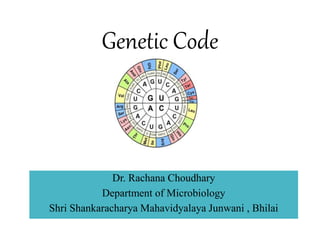
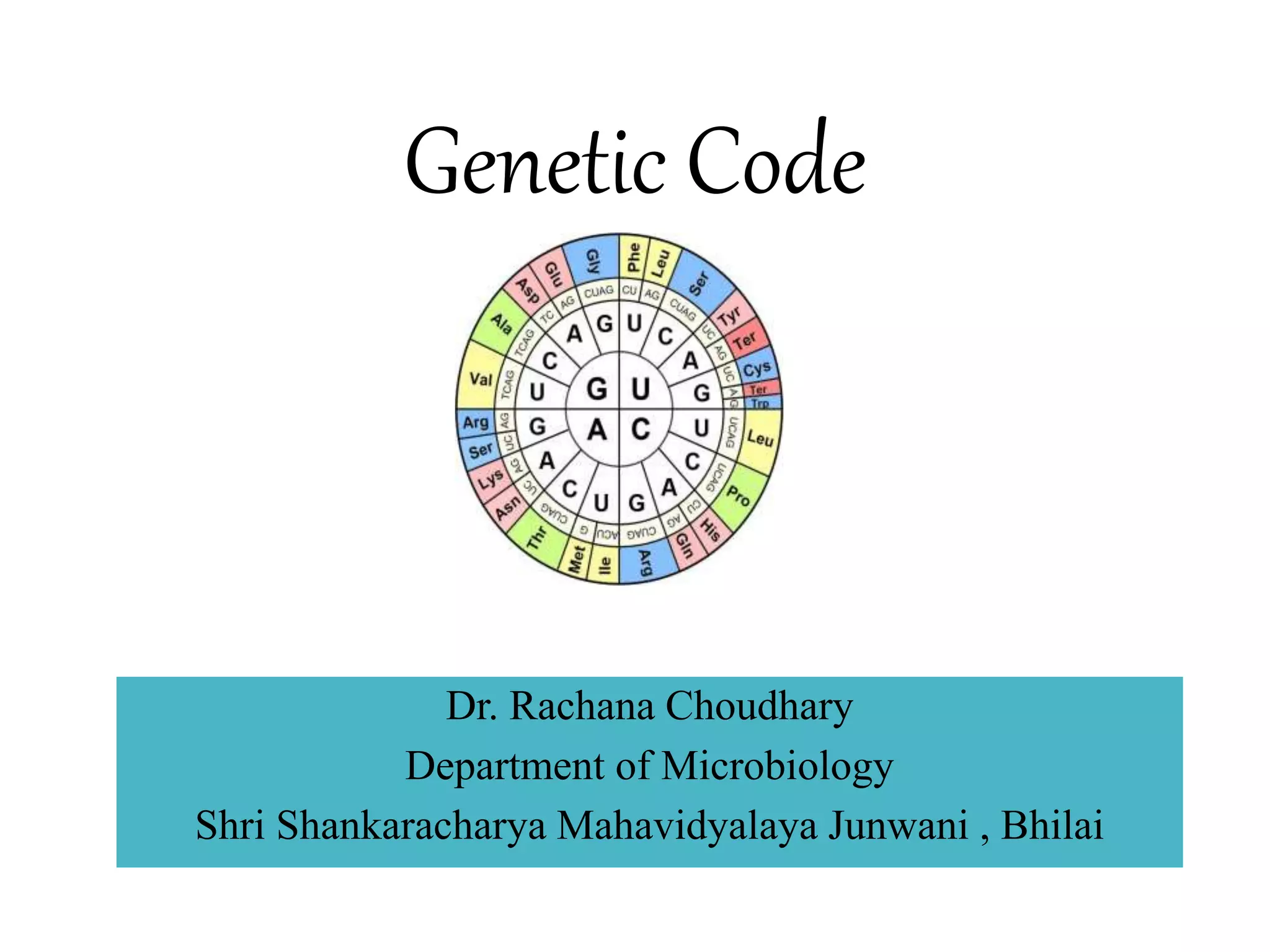
The genetic code is the set of rules by which
information encoded within genetic material (DNA or
mRNA sequences) is translated into proteins by living
cells.
‘Genetic code’ determines a protein's amino acid sequence.
The set of all the codons that specify the 20 amino acids
is termed as the genetic code
Discovery
 A code of 3 nucleotides could code for a maximum of
43 = 64 amino acids
 The Crick, Brenner et al. experiment first demonstrated
that codons consist of three DNA bases.
 Marshall Nirenberg and Heinrich J. Matthaei were the
first to elucidate the nature of a codon in 1961 at the
National Institutes of Health.
 Har Gobind Khorana identified the rest of the genetic
code.
 Robert W. Holley determined the structure of transfer RNA
(tRNA), the adapter molecule that facilitates the process
of translating RNA into protein.
 Nirenberg and Philip Leder revealed the triplet nature of
the genetic code and deciphered the codons of the
standard genetic code.
 Leder and Nirenberg were able to determine the
sequences of 54 out of 64 codons in their experiments.
 In 1968, Khorana, Holley and Nirenberg received the
Nobel Prize in Physiology or Medicine for their work.
CODON
 The code defines how sequences of nucleotide triplets,
called codons, specify which amino acid will be added
next during protein synthesis.
 The number and the sequence of bases in mRNA
specifying an amino acid is known as a codon.
 The set of bases in tRNA which base pair with a
codon of mRNA is known as anti-codon.
 Codons are written in 5’ 3’ direction,
where as anticodons are usually written in 3’ 5’
direction.
Characteristics of Genetic Code
1. The Code is Triplet.
2. The Code is Degenerate
3. The Code is Non-overlapping
4. The Code is Comma Less.
5. The Code is Non – Ambiguous
6. The Code is Universal.
7. Chain Initiation & Chain Termination Codon
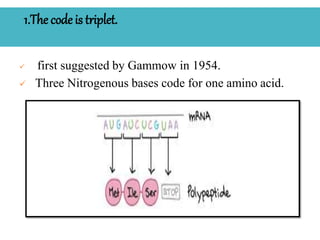
1.The code is triplet.
 first suggested by Gammow in 1954.
 Three Nitrogenous bases code for one amino acid.
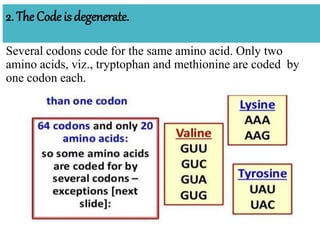
2. The Code isdegenerate.
Several codons code for the same amino acid. Only two
amino acids, viz., tryptophan and methionine are coded by
one codon each.
 9 amino acids are coded by 2 codons each, 1amino acid
(isoleucine) by 3 codons each, 5 amino acids by 4
codons each and 3 amino acids by 6 codons each. This
type of redundancy of genetic code is called
degeneracy of genetic code.
 Such a system provides protection to the organisms
against many harmful mutations.
 If 1 base of codon is mutated, there are other codons,
which will code for the same amino acid and thus there
will be no alteration in polypeptide chain.
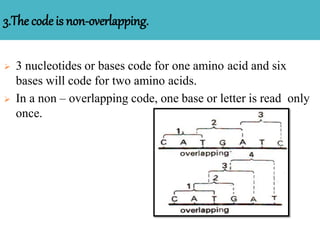
3.The codeis non-overlapping.
 3 nucleotides or bases code for one amino acid and six
bases will code for two amino acids.
 In a non – overlapping code, one base or letter is read only
once.
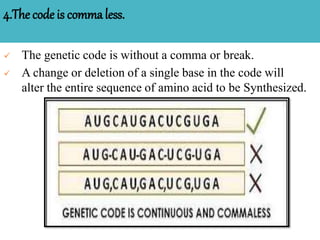
4.The code is commaless.
 The genetic code is without a comma or break.
 A change or deletion of a single base in the code will
alter the entire sequence of amino acid to be Synthesized.
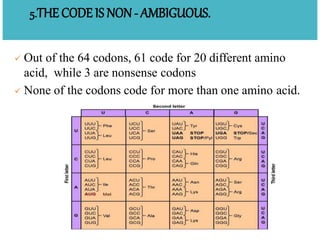
5.THE CODE IS NON-AMBIGUOUS.
 Out of the 64 codons, 61 code for 20 different amino
acid, while 3 are nonsense codons
 None of the codons code for more than one amino acid.
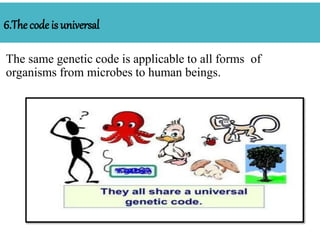
6.Thecodeis universal
The same genetic code is applicable to all forms of
organisms from microbes to human beings.
7.Chain Initiation &
Chain Termination Codon
Chain Initiation Codon (Start Codon)
• The most common start codon is AUG, which is read as
methionine or, in bacteria, as N formyl methionine.
• AUG & GUG are known as start codon as it starts the
synthesis of polypeptide chain.
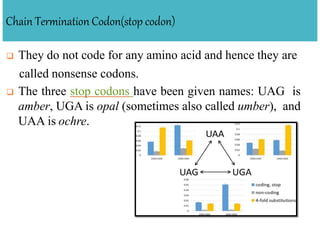
Chain Termination Codon(stop codon)
 They do not code for any amino acid and hence they are
called nonsense codons.
 The three stop codons have been given names: UAG is
amber, UGA is opal (sometimes also called umber), and
UAA is ochre.
Wobble hypothesis:
The first two bases on the codon are usually the important
ones, the third base may be in some cases one of the four
bases and the triplet would still code for the same amino
acid as long as the first two bases are the same and have
the same sequence. This concept is known as the Wobble
hypothesis.
Codon Assignment
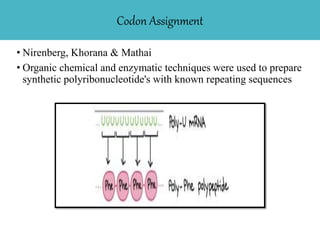
• Nirenberg, Khorana & Mathai
• Organic chemical and enzymatic techniques were used to prepare
synthetic polyribonucleotide's with known repeating sequences
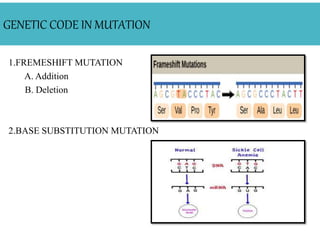
GENETIC CODE IN MUTATION
1.FREMESHIFT MUTATION
A. Addition
B. Deletion
2.BASE SUBSTITUTION MUTATION
CONCLUSION
Despite these differences all known species codes are very
similar to each other and the coding mechanism is the
same for all organisms. Three base codons, ribosomes,
t-RNA reading the code in the same direction & translating
the code 3 letters at a time into sequence of amino acids
References
• FOUNDAMENTAL OF BIOCHEMISTRY by J.L. jAIN
• TEXTBOOK OF BIOCHEMISTRY BY U. SATYNARAYAN
• PRINCIPLES OF BIOCHEMISTRY BY LEHNINGER
• GENETICS BY P.K. GUPTA
• TEXTBOOK OF Microbiology by dubey & Maheshwari
• GOOGLE SEARCH
THANK YOU

Genetic code

  • 1.
    Genetic Code Dr. RachanaChoudhary Department of Microbiology Shri Shankaracharya Mahavidyalaya Junwani , Bhilai
  • 2.
    SYNOPSIS • Introduction • Discovery •Characteristics Of Genetic Code • Wobble Hypothesis • Codon Assignment • Genetic Code In Mutation • Conclusion • References
  • 3.
    INTRODUCTION The genetic codeis the set of rules by which information encoded within genetic material (DNA or mRNA sequences) is translated into proteins by living cells. ‘Genetic code’ determines a protein's amino acid sequence. The set of all the codons that specify the 20 amino acids is termed as the genetic code
  • 4.
    Discovery  A codeof 3 nucleotides could code for a maximum of 43 = 64 amino acids  The Crick, Brenner et al. experiment first demonstrated that codons consist of three DNA bases.  Marshall Nirenberg and Heinrich J. Matthaei were the first to elucidate the nature of a codon in 1961 at the National Institutes of Health.  Har Gobind Khorana identified the rest of the genetic code.  Robert W. Holley determined the structure of transfer RNA (tRNA), the adapter molecule that facilitates the process of translating RNA into protein.
  • 5.
     Nirenberg andPhilip Leder revealed the triplet nature of the genetic code and deciphered the codons of the standard genetic code.  Leder and Nirenberg were able to determine the sequences of 54 out of 64 codons in their experiments.  In 1968, Khorana, Holley and Nirenberg received the Nobel Prize in Physiology or Medicine for their work.
  • 6.
    CODON  The codedefines how sequences of nucleotide triplets, called codons, specify which amino acid will be added next during protein synthesis.  The number and the sequence of bases in mRNA specifying an amino acid is known as a codon.  The set of bases in tRNA which base pair with a codon of mRNA is known as anti-codon.  Codons are written in 5’ 3’ direction, where as anticodons are usually written in 3’ 5’ direction.
  • 7.
    Characteristics of GeneticCode 1. The Code is Triplet. 2. The Code is Degenerate 3. The Code is Non-overlapping 4. The Code is Comma Less. 5. The Code is Non – Ambiguous 6. The Code is Universal. 7. Chain Initiation & Chain Termination Codon
  • 8.
    1.The code istriplet.  first suggested by Gammow in 1954.  Three Nitrogenous bases code for one amino acid.
  • 9.
    2. The Codeisdegenerate. Several codons code for the same amino acid. Only two amino acids, viz., tryptophan and methionine are coded by one codon each.
  • 10.
     9 aminoacids are coded by 2 codons each, 1amino acid (isoleucine) by 3 codons each, 5 amino acids by 4 codons each and 3 amino acids by 6 codons each. This type of redundancy of genetic code is called degeneracy of genetic code.  Such a system provides protection to the organisms against many harmful mutations.  If 1 base of codon is mutated, there are other codons, which will code for the same amino acid and thus there will be no alteration in polypeptide chain.
  • 11.
    3.The codeis non-overlapping. 3 nucleotides or bases code for one amino acid and six bases will code for two amino acids.  In a non – overlapping code, one base or letter is read only once.
  • 12.
    4.The code iscommaless.  The genetic code is without a comma or break.  A change or deletion of a single base in the code will alter the entire sequence of amino acid to be Synthesized.
  • 13.
    5.THE CODE ISNON-AMBIGUOUS.  Out of the 64 codons, 61 code for 20 different amino acid, while 3 are nonsense codons  None of the codons code for more than one amino acid.
  • 14.
    6.Thecodeis universal The samegenetic code is applicable to all forms of organisms from microbes to human beings.
  • 15.
    7.Chain Initiation & ChainTermination Codon Chain Initiation Codon (Start Codon) • The most common start codon is AUG, which is read as methionine or, in bacteria, as N formyl methionine. • AUG & GUG are known as start codon as it starts the synthesis of polypeptide chain.
  • 16.
    Chain Termination Codon(stopcodon)  They do not code for any amino acid and hence they are called nonsense codons.  The three stop codons have been given names: UAG is amber, UGA is opal (sometimes also called umber), and UAA is ochre.
  • 17.
    Wobble hypothesis: The firsttwo bases on the codon are usually the important ones, the third base may be in some cases one of the four bases and the triplet would still code for the same amino acid as long as the first two bases are the same and have the same sequence. This concept is known as the Wobble hypothesis.
  • 18.
    Codon Assignment • Nirenberg,Khorana & Mathai • Organic chemical and enzymatic techniques were used to prepare synthetic polyribonucleotide's with known repeating sequences
  • 19.
    GENETIC CODE INMUTATION 1.FREMESHIFT MUTATION A. Addition B. Deletion 2.BASE SUBSTITUTION MUTATION
  • 20.
    CONCLUSION Despite these differencesall known species codes are very similar to each other and the coding mechanism is the same for all organisms. Three base codons, ribosomes, t-RNA reading the code in the same direction & translating the code 3 letters at a time into sequence of amino acids
  • 21.
    References • FOUNDAMENTAL OFBIOCHEMISTRY by J.L. jAIN • TEXTBOOK OF BIOCHEMISTRY BY U. SATYNARAYAN • PRINCIPLES OF BIOCHEMISTRY BY LEHNINGER • GENETICS BY P.K. GUPTA • TEXTBOOK OF Microbiology by dubey & Maheshwari • GOOGLE SEARCH
  • 22.