V. Magendira Mani
Assistant Professor,
PG & Research Department of Biochemistry,
Islamiah College (Autonomous),
Vaniyambadi,
Vellore District – 6357512,
Tamilnadu, India.
magendiramani@rediffmail.com
Also available at
https://tvuni.academia.edu/mvinayagam
EUKARYOTIC DNA REPLICATION
DNA replication is the process of producing two
identical replicas from one original DNA molecule.
This biological process occurs in all living organisms
and is the basis for biological inheritance. DNA is
made up of two strands and each strand of the original
DNA molecule serves as template for the production
of the complementary strand, a process referred to as
semiconservative replication. The fundamental
mechanism of eukaryotic replication is same as
prokaryotic DNA Replication but some variation also
there.
The replications in eukaryotes are more complex. Because
DNA molecule of eukaryote
Eukaryotic genomes are quite complex
Considerably larger than bacterial DNA
Organized into complex nucleoprotein structure
(chromatin)
Essential features of DNA replication are the same in
prokaryotes and eukaryotes, Similarities of prokaryotes and
eukaryotic replication
Replication process is fundamentally similar in both
prokaryotes and eukaryotes. Process that are similar Include
Formation of replication fork
Simi conservative replication
Movement of replication fork bidirectional
Primer synthesis
Okazaki fragment synthesis in lagging strand
Primer removal
Gap bridging between newly synthesized DNA
fragments.
Difference between prokaryotic and eukaryotic replication
Overall process of eukaryotic replication is bit more complex.
Important differences are due to
• Larger size of eukaryotic DNA (105-106 Kb) compared to
prokaryotic DNA 15x103 kb in E.Coli
• Distinct package of eukaryotic DNA in the term of
chromatin
• Slower rate of fork movement in eukaryotes
For DNA to become available to DNA polymerase,
nucleotide must dissemble. This step slows the Rate of fork
movement.
Replication rate:
Prokaryotes: An E.Coli replication fork progresses at
approximately 1000 bp / sec.
Eukaryotes: Replication rate ten times slower than
prokaryotes 50 nucleotides / sec.
Enzymes and proteins required for eukaryotic DNA
replication
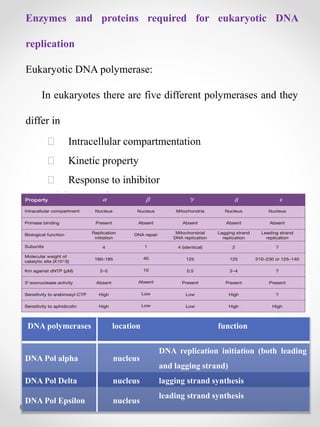
Eukaryotic DNA polymerase:
In eukaryotes there are five different polymerases and they
differ in
Intracellular compartmentation
Kinetic property
Response to inhibitor
DNA polymerases location function
DNA Pol alpha nucleus
DNA replication initiation (both leading
and lagging strand)
DNA Pol Delta nucleus lagging strand synthesis
DNA Pol Epsilon nucleus
leading strand synthesis
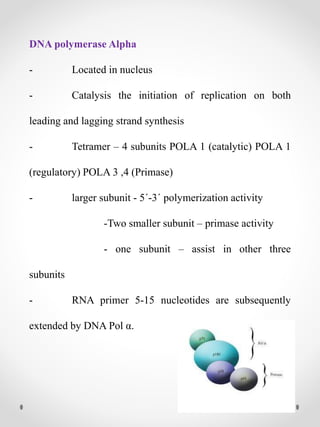
DNA polymerase Alpha
- Located in nucleus
- Catalysis the initiation of replication on both
leading and lagging strand synthesis
- Tetramer – 4 subunits POLA 1 (catalytic) POLA 1
(regulatory) POLA 3 ,4 (Primase)
- larger subunit - 5´-3´ polymerization activity
-Two smaller subunit – primase activity
- one subunit – assist in other three
subunits
- RNA primer 5-15 nucleotides are subsequently
extended by DNA Pol α.
DNA polymerase Delta
- Located in nucleus
- Catalyzes the synthesis of lagging strand
- Having four subunits – POLD 1,2,3,4
- larger subunits catalyzes 5´-3´ polymerization
activity
- Smaller subunits catalyzes 3´-5´ exonuclease
activity (proof reading activity)
- High processivity when interacting with PCNA
(Proliferating cell nuclear antigen).
PCNA
- Molecular weight 25,000; PCNA is important for both
DNA synthesis and DNA repair
- Multimeric protein
- Found in large amount in nuclei of proliferating
cells.
- Act as “clamp” to keep DNA pol δ from
dissociating off the leading DNA strand. “Clamp”
consist of 3 PCNA molecules each containing two
topologically identical domains that are tightly associated to
form closed ring.
- PCNA helps hold DNA polymerase epsilon (Pol ε)
to DNA.
- DNA pol δ improves fidelity of replication by a
factor of 102 due to its proof reading action. It contributes in
limiting the rates of overall error to 10-9 to 10-12.
- DNA Pol δ is also associated with helicase activity.
DNA polymerase Epsilon - Є
located in nucleus
Having four subunits – POLE 1, (Catalytic) 2,3,4
(subunits)
associated with - 5´- 3´ polymerization activity
5’- 3’ exonuclease activity (to
remove RNA primer)
3’- 5’ exonuclease activity (to proof
read)
DNA pol Є catalyzes the repair mechanism and
catalyzes the removal of primer and filing the
primer gap in Okazaki fragments.
Replicating factor A/ Replicating protein A
(RPA/RFA)
RPA/ RFA are similar to single strand binding
protein. They bind to SS DNA and prevent the re-
annealing of parental DNA.
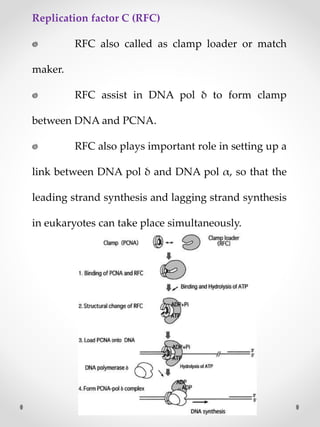
Replication factor C (RFC)
RFC also called as clamp loader or match
maker.
RFC assist in DNA pol δ to form clamp
between DNA and PCNA.
RFC also plays important role in setting up a
link between DNA pol δ and DNA pol α, so that the
leading strand synthesis and lagging strand synthesis
in eukaryotes can take place simultaneously.
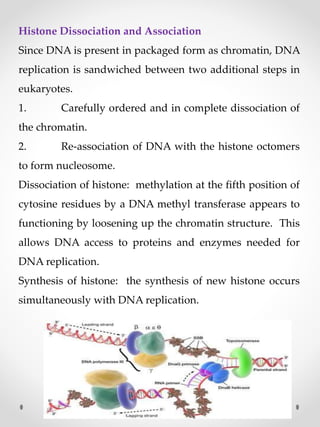
Histone Dissociation and Association
Since DNA is present in packaged form as chromatin, DNA
replication is sandwiched between two additional steps in
eukaryotes.
1. Carefully ordered and in complete dissociation of
the chromatin.
2. Re-association of DNA with the histone octomers
to form nucleosome.
Dissociation of histone: methylation at the fifth position of
cytosine residues by a DNA methyl transferase appears to
functioning by loosening up the chromatin structure. This
allows DNA access to proteins and enzymes needed for
DNA replication.
Synthesis of histone: the synthesis of new histone occurs
simultaneously with DNA replication.
SEQUENTIAL STEPS IN EUKARYOTIC DNA
REPLICATION
DNA replication is a very complicated process that
involves several enzymes and other proteins. It
occurs in following stages
• Pre-initiation
• Initiation
• Elongation
• Termination
• Telomerase function
PRE-INITIATION
Actually during pre-initiation stage, replicator selection occurs.
Replicator selection is the process of identifying the sequences
that will direct the initiation of replication and occur in G1
phase (prior to S phase). This process leads to the assembly of a
multiprotein complex at each replicator in the genome. Origin
activation only occurs after cells enter S phase and triggers the
Replicator – associated protein complex to initiate DNA
unwinding and DNA polymerase recruitment.
Replicator selection is mediated by the formation of pre-
replicative complexes (pre-RCs). The first step in the
formation of the pre-RC is the recognition of the replicator
by the eukaryotic initiator, ORC (Origin recognition
Complex). Once ORC is bound, it recruits two helicase
loading proteins (cell division cycle protein - Cdc6 and
Cdtl). Together, ORC and the loading proteins recruit a
protein that is thought to be the eukaryotic replication
fork helicase (the Mem 2-7 complex). Formation of the
pre-RC does not lead to the immediate unwinding of
origin DNA or the recruitment of DNA polymerases.
Instead the pre-RCs that are formed during Gl are only
activated to initiate replication after cells pass from the Gl
to the S phase of the cell cycle.
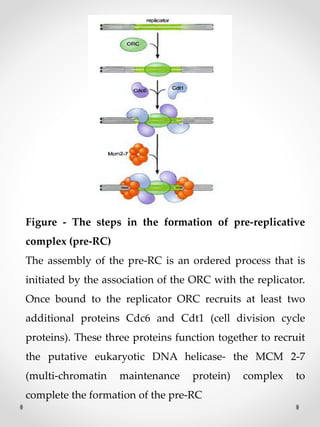
Figure - The steps in the formation of pre-replicative
complex (pre-RC)
The assembly of the pre-RC is an ordered process that is
initiated by the association of the ORC with the replicator.
Once bound to the replicator ORC recruits at least two
additional proteins Cdc6 and Cdt1 (cell division cycle
proteins). These three proteins function together to recruit
the putative eukaryotic DNA helicase- the MCM 2-7
(multi-chromatin maintenance protein) complex to
complete the formation of the pre-RC
INITIATION
ARS (Autonomously Replicating Sequences)
In eukaryotes the DNA replication is initiated at
specific site known as ARS
(Autonomously Replication Sequences) or replicators.
ARS (Origin of chromosome in eukaryotes) contains
- A central core sequence which contains highly
conserved 11 bp sequence (AT rich sequence)
- Flanking sequences.
ARS – is 100- 150 long (generally it span about 150 bp)
There are multiple origins in eukaryotes. Eg: yeast
contains 400 ARS. The multiple origins are spaced 30 -300
kb apart. The sequence between two origins of replication
is called replicons. An average human chromosome
contains as many as 100 replicons and replication may
proceed simultaneously at as many as 200 forks.
- The central core sequence contains 11 bp
elements known as “ARS consensus sequence” rich in AT
pair (It is similar to AT rich 13 mers present in E.Coli Ori
C). It is also called as ORE (Origin replication element)
- The flanking sequences consist of overlapping
sequence that include varients of core sequences
ORE (Origin Replicating Element) and ORC (Origin
Recognition Complex)
At the origin there is an association of sequence
specified – ds DNA binding sequence.
ORE (11 bp sequence in core sequence) binds to a set
of proteins (DNA pol α, DNA pol δ, RFC, PCNA,
RFA, SSB and helicase) collectively called as ORC
Origin Recognition Complex
ORC is a multimeric protein. Initiation of replication
in all eukaryotes requires this multimeric subunit
protein (ORC) which binds to several sequences
within the replicator.
DUE (DNA Unwinding Element)
ORE located adjacent to approximately 80 bp AT
rich sequence that is easy to unwind. This is called
DUE (DNA Unwinding Element) Binding of ORC to
ORE causes unwinding at DUE.
Events in replication fork:
When ORC (DNA pol α, DNA pol δ, RFC, RFA,
PCNA, SSB helicase into the origin of replication
especially at ORE, the DNA synthesis is initiated.
The replication fork moves bi-directionally and
replication proceeds simultaneously as many as 200
forks.
Formation of replication fork:
The replication fork in eukaryotes consists of four
components that form in the following sequence.
DNA helicase and DNA pol δ (due to its associated
helicase activity) unwinds short segment of parental
DNA at 80 bp AT rich sequence called DUE (DNA
unwinding elements) which is located adjacent to ORE.
DNA pol α initiated the synthesis of RNA primer. (DNA
pol α is also having primase activity) The primer is
approximately 10 bp.
DNA pol ε in lagging strand and DNA pol δ in leading
strand initiates the daughter strand synthesis.
SSB and RFA bind to SS DNA and prevent re-annealing
of SS DNA.
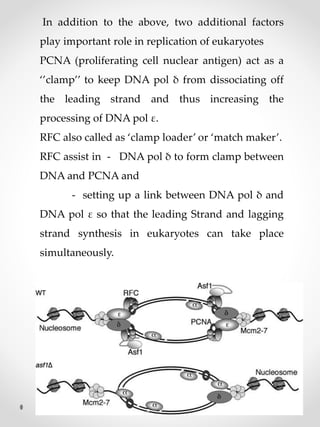
In addition to the above, two additional factors
play important role in replication of eukaryotes
PCNA (proliferating cell nuclear antigen) act as a
‘’clamp’’ to keep DNA pol δ from dissociating off
the leading strand and thus increasing the
processing of DNA pol ε.
RFC also called as ‘clamp loader’ or ‘match maker’.
RFC assist in - DNA pol δ to form clamp between
DNA and PCNA and
- setting up a link between DNA pol δ and
DNA pol ε so that the leading Strand and lagging
strand synthesis in eukaryotes can take place
simultaneously.
Rate of Replication fork Movement
The rate of replication fork movement in eukaryote
(approximately 50 nucleotide /sec) is only one tenth that
observed in E.Coli at this rate, replication of an average
human chromosome proceeding from a single origin
would take more than 500 hours. Instead of that,
replication of human chromosome proceeds bi-
directionally from multiple origins spaced 30-300 kb
apart and completed within an hour.
DNA sequence between two origins of replication is
called replicons. An average chromosome contains
nearly 100 replicons and thus replication proceeds
simultaneously at as many as 200 forks.
ELONGATION
During elongation, an enzyme called DNA polymerase
adds DNA nucleotides to the 3' end of the newly
synthesized polynucleotide strand. The template
strand specifies which of the four DNA nucleotides (A,
T, C, or G) is added at each position along the new
chain. Only the nucleotide complementary to the
template nucleotide at that position is added to the
new strand. For example, when DNA polymerase
meets an adenosine nucleotide on the template strand,
it adds a thymidine to the 3' end of the newly
synthesized strand, and then moves to the next
nucleotide on the template strand. This process will
continue until the DNA polymerase reaches the end of
the template strand.
All newly synthesized polynucleotide strands must be
initiated by a specialized RNA polymerase called
primase. Primase initiates polynucleotide synthesis and
by creating a short RNA polynucleotide strand
complementary to template DNA strand. This short
stretch of RNA nucleotides is called the primer. Once
RNA primer has been synthesized at the template DNA,
primase exits, and DNA polymerase extends the new
strand with nucleotides complementary to the template
DNA. Eventually, the RNA nucleotides in the primer are
removed and replaced with DNA nucleotides. Once DNA
replication is finished, the daughter molecules are made
entirely of continuous DNA nucleotides, with no RNA
portions.
The Leading and Lagging Strands
DNA polymerase can only synthesize new strands in the
5' to 3' direction. Therefore, the two newly synthesized
strands grow in opposite directions because the
template strands at each replication fork are antiparallel.
The "leading strand" is synthesized continuously toward
the replication fork as helicase unwinds the template
double stranded DNA.
The "lagging strand" is synthesized in the direction away
from the replication fork and away from the DNA
helicase unwinds. This lagging strand is synthesized in
pieces because the DNA polymerase can only synthesize
in the 5' to 3' direction, and so it constantly encounters
the previously synthesized new strand. The pieces are
called Okazaki fragments, and each fragment begins
with its own RNA primer.
Leading strand synthesis:
- Leading strand synthesis is initiated upon RNA
primer, synthesized by the primase subunit of DNA pol α.
The RNA primer contains 10-15 nucleotides.
- Then DNA pol α adds a stretch of DNA to the
primer.
- At this point replication factor C (RFC) carries out a
process called polymerase switching.
- RFC removes DNA pol α and assembles PCNA in
the region of primer strand terminus.
- Then DNA pol epsilon binds to PCNA and carries
out highly processive leading strand synthesis due to its 5’-
3’ polymerization activity.
- After the addition of several nucleotides in the
daughter strand, primer is removed. DNA pol Є due to its
5’-3’ exonuclease activity removes the primer and the gap is
filled by the same DNA pol Є due to its 5’-3’ polymerization
activity.
- Then the nick is sealed by DNA ligase.
- DNA pol δ improves the fidelity of replication due to its
proof reading activity.
Lagging strand synthesis:
Lagging strand synthesis of Okazaki fragment initiated same
way as leading strand synthesis. An Okazaki fragment
contains 150-200 nucleotides.
RNA primer is synthesised by DNA pol α due to its primase
activity.
The primer is then extended by DNA pol delta due to its 5’-3’
polymerization activity (lagging strand synthesis), using
deoxy ribonucleotides (dNTPs).
Priming is a frequent event in lagging strand synthesis with
RNA primers placed every 50 or 80 nucleotides.
All but one of the ribonucleotides in RNA primer is removed
by RNase H1.
Then exonuclease activity of FEN 1/ RTH 1 complex removes
the one remaining nucleotide.
The gap is filled by DNA pol Є by its 5’-3’ polymerase activity.
DNA ligase joins the Okazaki fragment of the growing DNA
strand.
Combined activity of DNA pol delta and DNA pol
epsilon:-
Looping of lagging strand allows a combined polymerase
delta and polymerase epsilon asymmetric dimer to
assemble and elongate both leading and lagging strands in
the same overall direction of fork movement.
TERMINATION
When the replication forks meet each other, then
termination occurs. It will result in the formation of two
duplex DNA. Even though replication terminated, 5’ end
of telomeric part of the newly synthesized DNA found to
have shorter DNA strand than the template parent strand.
This shortage corrected by the action of telomerase enzyme
and then only the actual replication completed.
TELOMERES
Eukaryotic chromosomes are linear. The ends of
chromosomes have specialized structures known as
‘Telomeres’.
Telomeres are – short (5-8 bp)
- tandem repeated and
- GC rich nucleotide sequence.
- Telomeres form protective cap 7-12 kbp long in
the ends of chromosome. Telomeres are necessary for
chromosome maintenance and stability. They are
responsible for maintaining chromosome integrity by
protecting against DNA degradation and
rearrangement.
Problem in the completion of replication of lagging
strand:
- Linear genomes including those of several
viruses as well as the chromosomes of eukaryotic cells
force a special problem completion of replication of the
lagging strand.
- Excision of an RNA primer from the 5’ end of a
linear molecule would leave a gap (primer gap). This
gap cannot be filled by DNA polymerase action, because
of the absence of a primer terminus to extend. If the
DNA could not be replicated, the chromosome would
shorten a bit with each round of replication.
- This problem has been solved by Telomerase.
Telomerase:
- Telomerase is ribonucleoprotein. It contains a
RNA component which has repeat of 9 to 30
nucleotides long. This RNA component serves as the
template for the synthesis of telomeric repeats at the
parental DNA ends.
- Telomerase is a RNA dependent DNA
polymerase with a RNA component.
Telomerase uses the
- 3’ end of parental DNA strand as primer,
- RNA component of telomerase as template,
- adds successive telomeric repeats to the parental
DNA strand at its 3’ end due to its 5’-3’ RNA
dependent DNA polymerase activity.
Regeneration of telomeres:
Telomeric DNA consists of simple tandemly repeated
sequences like those shown as below:
Telomeric repeats sequence at 5’end
-
Organism Repeat
Human AGGGTT
Higher plant AGGGTTT
Algae AGGGTTTT
protozoan GGGGTTTT
Yeast GGGT
These sequences are repeatedly added to the 3’ termini of
chromosomal DNAs by ‘Telomerase’. Telomerase
uses its RNA component as template and parental DNA as
primer. Then by its RNA dependent DNA polymerase
activity it repeatedly adds telomeric sequences to the 3’
termini of parental DNA.
- Then the telomerase is released.
- Finally the RNA primer, (of telomerase) is bound
near the lagging strand and it is extended by DNA
polymerase. Thus the lagging strand synthesis is completed.
In Linear eukaryotic chromosome, once the first primer
on each strand is remove, then it appears that there is
no way to fill in the gaps, since DNA cannot be
extended in the 3′–>5′ direction and there is no 3′ end
upstream available as there would be in a circle DNA.
If this were actually the situation, the DNA strand
would get shorter every time they replicated and genes
would be lost forever.
Elizabeth Blackburn and her colleagues have provided
the answer to fill up the gaps with the help of enzyme
telomerase. So, that the genes at the ends, are
conserved. Telomerase is a ribonucleoprotein (RNP)
i.e. it has RNA with repetitive sequence. Repetitive
sequence varies depending upon the species example
Tetrahymena thermophilia RNA has AACCCC
sequence and in Oxytrica it has AAAACCCC.
Telomerase otherwise known as modified Reverse
Transcriptase. In human, the RNA template contains
AAUCCC repeats. This enzyme was also known as
telomere terminal transferase..
.
The 3′-end of the lagging strand template basepairs with a
unique region of the telomerase associated RNA.
Hybridization facilitated by the match between the
sequence at the 3′-end of telomere and the sequence at the
3′-end of the RNA. The telomerase catalytic site then adds
deoxy ribonucleotides using RNA molecule as a template,
this reverse transcription proceeds to position 35 of the
RNA template. Telomerase then translocates to the new
3′-end by pairing with RNA template and it continues
reverse transcription. When the G-rich strand sufficiently
long, Primase can make an RNA primer, complementary
to the 3′-end of the telomere’s G-rich strand. DNA
polymerase uses the newly made primer to prime
synthesis of DNA to fill in the remaining gap on the
progeny DNA. The primer is removed and the nick
between fragments sealed by DNA ligase
V. Magendira Mani
Assistant Professor,
PG & Research Department of Biochemistry,
Islamiah College (Autonomous),
Vaniyambadi,
Vellore District – 6357512,
Tamilnadu, India.
magendiramani@rediffmail.com ;
vinayagam magendiramani@academia.edu
https://tvuni.academia.edu/mvinayagam

Eukaryotic DNA replication

  • 1.
    V. Magendira Mani AssistantProfessor, PG & Research Department of Biochemistry, Islamiah College (Autonomous), Vaniyambadi, Vellore District – 6357512, Tamilnadu, India. magendiramani@rediffmail.com Also available at https://tvuni.academia.edu/mvinayagam
  • 2.
    EUKARYOTIC DNA REPLICATION DNAreplication is the process of producing two identical replicas from one original DNA molecule. This biological process occurs in all living organisms and is the basis for biological inheritance. DNA is made up of two strands and each strand of the original DNA molecule serves as template for the production of the complementary strand, a process referred to as semiconservative replication. The fundamental mechanism of eukaryotic replication is same as prokaryotic DNA Replication but some variation also there.
  • 3.
    The replications ineukaryotes are more complex. Because DNA molecule of eukaryote Eukaryotic genomes are quite complex Considerably larger than bacterial DNA Organized into complex nucleoprotein structure (chromatin) Essential features of DNA replication are the same in prokaryotes and eukaryotes, Similarities of prokaryotes and eukaryotic replication Replication process is fundamentally similar in both prokaryotes and eukaryotes. Process that are similar Include Formation of replication fork Simi conservative replication Movement of replication fork bidirectional Primer synthesis Okazaki fragment synthesis in lagging strand Primer removal Gap bridging between newly synthesized DNA fragments.
  • 4.
    Difference between prokaryoticand eukaryotic replication Overall process of eukaryotic replication is bit more complex. Important differences are due to • Larger size of eukaryotic DNA (105-106 Kb) compared to prokaryotic DNA 15x103 kb in E.Coli • Distinct package of eukaryotic DNA in the term of chromatin • Slower rate of fork movement in eukaryotes For DNA to become available to DNA polymerase, nucleotide must dissemble. This step slows the Rate of fork movement. Replication rate: Prokaryotes: An E.Coli replication fork progresses at approximately 1000 bp / sec. Eukaryotes: Replication rate ten times slower than prokaryotes 50 nucleotides / sec.
  • 5.
    Enzymes and proteinsrequired for eukaryotic DNA replication Eukaryotic DNA polymerase: In eukaryotes there are five different polymerases and they differ in Intracellular compartmentation Kinetic property Response to inhibitor DNA polymerases location function DNA Pol alpha nucleus DNA replication initiation (both leading and lagging strand) DNA Pol Delta nucleus lagging strand synthesis DNA Pol Epsilon nucleus leading strand synthesis
  • 6.
    DNA polymerase Alpha -Located in nucleus - Catalysis the initiation of replication on both leading and lagging strand synthesis - Tetramer – 4 subunits POLA 1 (catalytic) POLA 1 (regulatory) POLA 3 ,4 (Primase) - larger subunit - 5´-3´ polymerization activity -Two smaller subunit – primase activity - one subunit – assist in other three subunits - RNA primer 5-15 nucleotides are subsequently extended by DNA Pol α.
  • 7.
    DNA polymerase Delta -Located in nucleus - Catalyzes the synthesis of lagging strand - Having four subunits – POLD 1,2,3,4 - larger subunits catalyzes 5´-3´ polymerization activity - Smaller subunits catalyzes 3´-5´ exonuclease activity (proof reading activity) - High processivity when interacting with PCNA (Proliferating cell nuclear antigen).
  • 8.
    PCNA - Molecular weight25,000; PCNA is important for both DNA synthesis and DNA repair - Multimeric protein - Found in large amount in nuclei of proliferating cells. - Act as “clamp” to keep DNA pol δ from dissociating off the leading DNA strand. “Clamp” consist of 3 PCNA molecules each containing two topologically identical domains that are tightly associated to form closed ring. - PCNA helps hold DNA polymerase epsilon (Pol ε) to DNA. - DNA pol δ improves fidelity of replication by a factor of 102 due to its proof reading action. It contributes in limiting the rates of overall error to 10-9 to 10-12. - DNA Pol δ is also associated with helicase activity.
  • 9.
    DNA polymerase Epsilon- Є located in nucleus Having four subunits – POLE 1, (Catalytic) 2,3,4 (subunits) associated with - 5´- 3´ polymerization activity 5’- 3’ exonuclease activity (to remove RNA primer) 3’- 5’ exonuclease activity (to proof read) DNA pol Є catalyzes the repair mechanism and catalyzes the removal of primer and filing the primer gap in Okazaki fragments. Replicating factor A/ Replicating protein A (RPA/RFA) RPA/ RFA are similar to single strand binding protein. They bind to SS DNA and prevent the re- annealing of parental DNA.
  • 10.
    Replication factor C(RFC) RFC also called as clamp loader or match maker. RFC assist in DNA pol δ to form clamp between DNA and PCNA. RFC also plays important role in setting up a link between DNA pol δ and DNA pol α, so that the leading strand synthesis and lagging strand synthesis in eukaryotes can take place simultaneously.
  • 11.
    Histone Dissociation andAssociation Since DNA is present in packaged form as chromatin, DNA replication is sandwiched between two additional steps in eukaryotes. 1. Carefully ordered and in complete dissociation of the chromatin. 2. Re-association of DNA with the histone octomers to form nucleosome. Dissociation of histone: methylation at the fifth position of cytosine residues by a DNA methyl transferase appears to functioning by loosening up the chromatin structure. This allows DNA access to proteins and enzymes needed for DNA replication. Synthesis of histone: the synthesis of new histone occurs simultaneously with DNA replication.
  • 12.
    SEQUENTIAL STEPS INEUKARYOTIC DNA REPLICATION DNA replication is a very complicated process that involves several enzymes and other proteins. It occurs in following stages • Pre-initiation • Initiation • Elongation • Termination • Telomerase function PRE-INITIATION Actually during pre-initiation stage, replicator selection occurs. Replicator selection is the process of identifying the sequences that will direct the initiation of replication and occur in G1 phase (prior to S phase). This process leads to the assembly of a multiprotein complex at each replicator in the genome. Origin activation only occurs after cells enter S phase and triggers the Replicator – associated protein complex to initiate DNA unwinding and DNA polymerase recruitment.
  • 13.
    Replicator selection ismediated by the formation of pre- replicative complexes (pre-RCs). The first step in the formation of the pre-RC is the recognition of the replicator by the eukaryotic initiator, ORC (Origin recognition Complex). Once ORC is bound, it recruits two helicase loading proteins (cell division cycle protein - Cdc6 and Cdtl). Together, ORC and the loading proteins recruit a protein that is thought to be the eukaryotic replication fork helicase (the Mem 2-7 complex). Formation of the pre-RC does not lead to the immediate unwinding of origin DNA or the recruitment of DNA polymerases. Instead the pre-RCs that are formed during Gl are only activated to initiate replication after cells pass from the Gl to the S phase of the cell cycle.
  • 14.
    Figure - Thesteps in the formation of pre-replicative complex (pre-RC) The assembly of the pre-RC is an ordered process that is initiated by the association of the ORC with the replicator. Once bound to the replicator ORC recruits at least two additional proteins Cdc6 and Cdt1 (cell division cycle proteins). These three proteins function together to recruit the putative eukaryotic DNA helicase- the MCM 2-7 (multi-chromatin maintenance protein) complex to complete the formation of the pre-RC
  • 15.
    INITIATION ARS (Autonomously ReplicatingSequences) In eukaryotes the DNA replication is initiated at specific site known as ARS (Autonomously Replication Sequences) or replicators. ARS (Origin of chromosome in eukaryotes) contains - A central core sequence which contains highly conserved 11 bp sequence (AT rich sequence) - Flanking sequences.
  • 16.
    ARS – is100- 150 long (generally it span about 150 bp) There are multiple origins in eukaryotes. Eg: yeast contains 400 ARS. The multiple origins are spaced 30 -300 kb apart. The sequence between two origins of replication is called replicons. An average human chromosome contains as many as 100 replicons and replication may proceed simultaneously at as many as 200 forks. - The central core sequence contains 11 bp elements known as “ARS consensus sequence” rich in AT pair (It is similar to AT rich 13 mers present in E.Coli Ori C). It is also called as ORE (Origin replication element) - The flanking sequences consist of overlapping sequence that include varients of core sequences
  • 17.
    ORE (Origin ReplicatingElement) and ORC (Origin Recognition Complex) At the origin there is an association of sequence specified – ds DNA binding sequence. ORE (11 bp sequence in core sequence) binds to a set of proteins (DNA pol α, DNA pol δ, RFC, PCNA, RFA, SSB and helicase) collectively called as ORC Origin Recognition Complex ORC is a multimeric protein. Initiation of replication in all eukaryotes requires this multimeric subunit protein (ORC) which binds to several sequences within the replicator.
  • 18.
    DUE (DNA UnwindingElement) ORE located adjacent to approximately 80 bp AT rich sequence that is easy to unwind. This is called DUE (DNA Unwinding Element) Binding of ORC to ORE causes unwinding at DUE. Events in replication fork: When ORC (DNA pol α, DNA pol δ, RFC, RFA, PCNA, SSB helicase into the origin of replication especially at ORE, the DNA synthesis is initiated. The replication fork moves bi-directionally and replication proceeds simultaneously as many as 200 forks.
  • 19.
    Formation of replicationfork: The replication fork in eukaryotes consists of four components that form in the following sequence. DNA helicase and DNA pol δ (due to its associated helicase activity) unwinds short segment of parental DNA at 80 bp AT rich sequence called DUE (DNA unwinding elements) which is located adjacent to ORE. DNA pol α initiated the synthesis of RNA primer. (DNA pol α is also having primase activity) The primer is approximately 10 bp. DNA pol ε in lagging strand and DNA pol δ in leading strand initiates the daughter strand synthesis. SSB and RFA bind to SS DNA and prevent re-annealing of SS DNA.
  • 20.
    In addition tothe above, two additional factors play important role in replication of eukaryotes PCNA (proliferating cell nuclear antigen) act as a ‘’clamp’’ to keep DNA pol δ from dissociating off the leading strand and thus increasing the processing of DNA pol ε. RFC also called as ‘clamp loader’ or ‘match maker’. RFC assist in - DNA pol δ to form clamp between DNA and PCNA and - setting up a link between DNA pol δ and DNA pol ε so that the leading Strand and lagging strand synthesis in eukaryotes can take place simultaneously.
  • 21.
    Rate of Replicationfork Movement The rate of replication fork movement in eukaryote (approximately 50 nucleotide /sec) is only one tenth that observed in E.Coli at this rate, replication of an average human chromosome proceeding from a single origin would take more than 500 hours. Instead of that, replication of human chromosome proceeds bi- directionally from multiple origins spaced 30-300 kb apart and completed within an hour. DNA sequence between two origins of replication is called replicons. An average chromosome contains nearly 100 replicons and thus replication proceeds simultaneously at as many as 200 forks.
  • 22.
    ELONGATION During elongation, anenzyme called DNA polymerase adds DNA nucleotides to the 3' end of the newly synthesized polynucleotide strand. The template strand specifies which of the four DNA nucleotides (A, T, C, or G) is added at each position along the new chain. Only the nucleotide complementary to the template nucleotide at that position is added to the new strand. For example, when DNA polymerase meets an adenosine nucleotide on the template strand, it adds a thymidine to the 3' end of the newly synthesized strand, and then moves to the next nucleotide on the template strand. This process will continue until the DNA polymerase reaches the end of the template strand.
  • 24.
    All newly synthesizedpolynucleotide strands must be initiated by a specialized RNA polymerase called primase. Primase initiates polynucleotide synthesis and by creating a short RNA polynucleotide strand complementary to template DNA strand. This short stretch of RNA nucleotides is called the primer. Once RNA primer has been synthesized at the template DNA, primase exits, and DNA polymerase extends the new strand with nucleotides complementary to the template DNA. Eventually, the RNA nucleotides in the primer are removed and replaced with DNA nucleotides. Once DNA replication is finished, the daughter molecules are made entirely of continuous DNA nucleotides, with no RNA portions.
  • 25.
    The Leading andLagging Strands DNA polymerase can only synthesize new strands in the 5' to 3' direction. Therefore, the two newly synthesized strands grow in opposite directions because the template strands at each replication fork are antiparallel. The "leading strand" is synthesized continuously toward the replication fork as helicase unwinds the template double stranded DNA. The "lagging strand" is synthesized in the direction away from the replication fork and away from the DNA helicase unwinds. This lagging strand is synthesized in pieces because the DNA polymerase can only synthesize in the 5' to 3' direction, and so it constantly encounters the previously synthesized new strand. The pieces are called Okazaki fragments, and each fragment begins with its own RNA primer.
  • 26.
    Leading strand synthesis: -Leading strand synthesis is initiated upon RNA primer, synthesized by the primase subunit of DNA pol α. The RNA primer contains 10-15 nucleotides. - Then DNA pol α adds a stretch of DNA to the primer. - At this point replication factor C (RFC) carries out a process called polymerase switching. - RFC removes DNA pol α and assembles PCNA in the region of primer strand terminus. - Then DNA pol epsilon binds to PCNA and carries out highly processive leading strand synthesis due to its 5’- 3’ polymerization activity. - After the addition of several nucleotides in the daughter strand, primer is removed. DNA pol Є due to its 5’-3’ exonuclease activity removes the primer and the gap is filled by the same DNA pol Є due to its 5’-3’ polymerization activity. - Then the nick is sealed by DNA ligase. - DNA pol δ improves the fidelity of replication due to its proof reading activity.
  • 27.
    Lagging strand synthesis: Laggingstrand synthesis of Okazaki fragment initiated same way as leading strand synthesis. An Okazaki fragment contains 150-200 nucleotides. RNA primer is synthesised by DNA pol α due to its primase activity. The primer is then extended by DNA pol delta due to its 5’-3’ polymerization activity (lagging strand synthesis), using deoxy ribonucleotides (dNTPs). Priming is a frequent event in lagging strand synthesis with RNA primers placed every 50 or 80 nucleotides. All but one of the ribonucleotides in RNA primer is removed by RNase H1. Then exonuclease activity of FEN 1/ RTH 1 complex removes the one remaining nucleotide. The gap is filled by DNA pol Є by its 5’-3’ polymerase activity. DNA ligase joins the Okazaki fragment of the growing DNA strand.
  • 29.
    Combined activity ofDNA pol delta and DNA pol epsilon:- Looping of lagging strand allows a combined polymerase delta and polymerase epsilon asymmetric dimer to assemble and elongate both leading and lagging strands in the same overall direction of fork movement. TERMINATION When the replication forks meet each other, then termination occurs. It will result in the formation of two duplex DNA. Even though replication terminated, 5’ end of telomeric part of the newly synthesized DNA found to have shorter DNA strand than the template parent strand. This shortage corrected by the action of telomerase enzyme and then only the actual replication completed.
  • 30.
    TELOMERES Eukaryotic chromosomes arelinear. The ends of chromosomes have specialized structures known as ‘Telomeres’. Telomeres are – short (5-8 bp) - tandem repeated and - GC rich nucleotide sequence. - Telomeres form protective cap 7-12 kbp long in the ends of chromosome. Telomeres are necessary for chromosome maintenance and stability. They are responsible for maintaining chromosome integrity by protecting against DNA degradation and rearrangement.
  • 31.
    Problem in thecompletion of replication of lagging strand: - Linear genomes including those of several viruses as well as the chromosomes of eukaryotic cells force a special problem completion of replication of the lagging strand. - Excision of an RNA primer from the 5’ end of a linear molecule would leave a gap (primer gap). This gap cannot be filled by DNA polymerase action, because of the absence of a primer terminus to extend. If the DNA could not be replicated, the chromosome would shorten a bit with each round of replication. - This problem has been solved by Telomerase.
  • 32.
    Telomerase: - Telomerase isribonucleoprotein. It contains a RNA component which has repeat of 9 to 30 nucleotides long. This RNA component serves as the template for the synthesis of telomeric repeats at the parental DNA ends. - Telomerase is a RNA dependent DNA polymerase with a RNA component. Telomerase uses the - 3’ end of parental DNA strand as primer, - RNA component of telomerase as template, - adds successive telomeric repeats to the parental DNA strand at its 3’ end due to its 5’-3’ RNA dependent DNA polymerase activity.
  • 33.
    Regeneration of telomeres: TelomericDNA consists of simple tandemly repeated sequences like those shown as below: Telomeric repeats sequence at 5’end - Organism Repeat Human AGGGTT Higher plant AGGGTTT Algae AGGGTTTT protozoan GGGGTTTT Yeast GGGT These sequences are repeatedly added to the 3’ termini of chromosomal DNAs by ‘Telomerase’. Telomerase uses its RNA component as template and parental DNA as primer. Then by its RNA dependent DNA polymerase activity it repeatedly adds telomeric sequences to the 3’ termini of parental DNA. - Then the telomerase is released. - Finally the RNA primer, (of telomerase) is bound near the lagging strand and it is extended by DNA polymerase. Thus the lagging strand synthesis is completed.
  • 34.
    In Linear eukaryoticchromosome, once the first primer on each strand is remove, then it appears that there is no way to fill in the gaps, since DNA cannot be extended in the 3′–>5′ direction and there is no 3′ end upstream available as there would be in a circle DNA. If this were actually the situation, the DNA strand would get shorter every time they replicated and genes would be lost forever.
  • 35.
    Elizabeth Blackburn andher colleagues have provided the answer to fill up the gaps with the help of enzyme telomerase. So, that the genes at the ends, are conserved. Telomerase is a ribonucleoprotein (RNP) i.e. it has RNA with repetitive sequence. Repetitive sequence varies depending upon the species example Tetrahymena thermophilia RNA has AACCCC sequence and in Oxytrica it has AAAACCCC. Telomerase otherwise known as modified Reverse Transcriptase. In human, the RNA template contains AAUCCC repeats. This enzyme was also known as telomere terminal transferase.. .
  • 36.
    The 3′-end ofthe lagging strand template basepairs with a unique region of the telomerase associated RNA. Hybridization facilitated by the match between the sequence at the 3′-end of telomere and the sequence at the 3′-end of the RNA. The telomerase catalytic site then adds deoxy ribonucleotides using RNA molecule as a template, this reverse transcription proceeds to position 35 of the RNA template. Telomerase then translocates to the new 3′-end by pairing with RNA template and it continues reverse transcription. When the G-rich strand sufficiently long, Primase can make an RNA primer, complementary to the 3′-end of the telomere’s G-rich strand. DNA polymerase uses the newly made primer to prime synthesis of DNA to fill in the remaining gap on the progeny DNA. The primer is removed and the nick between fragments sealed by DNA ligase
  • 37.
    V. Magendira Mani AssistantProfessor, PG & Research Department of Biochemistry, Islamiah College (Autonomous), Vaniyambadi, Vellore District – 6357512, Tamilnadu, India. magendiramani@rediffmail.com ; vinayagam magendiramani@academia.edu https://tvuni.academia.edu/mvinayagam