RNA & Protein Synthesis
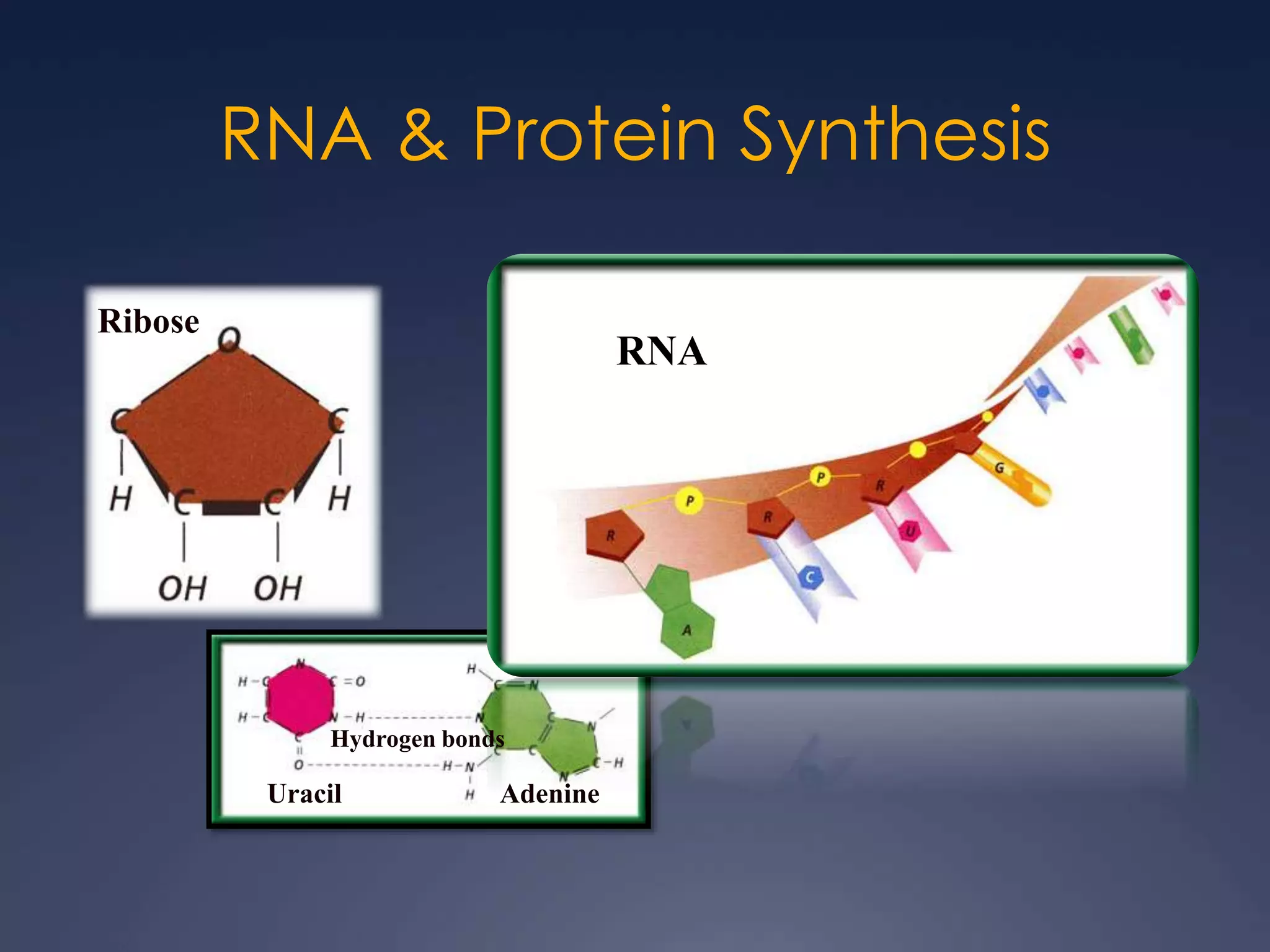
Uracil
Hydrogen bonds
Adenine
Ribose
RNA
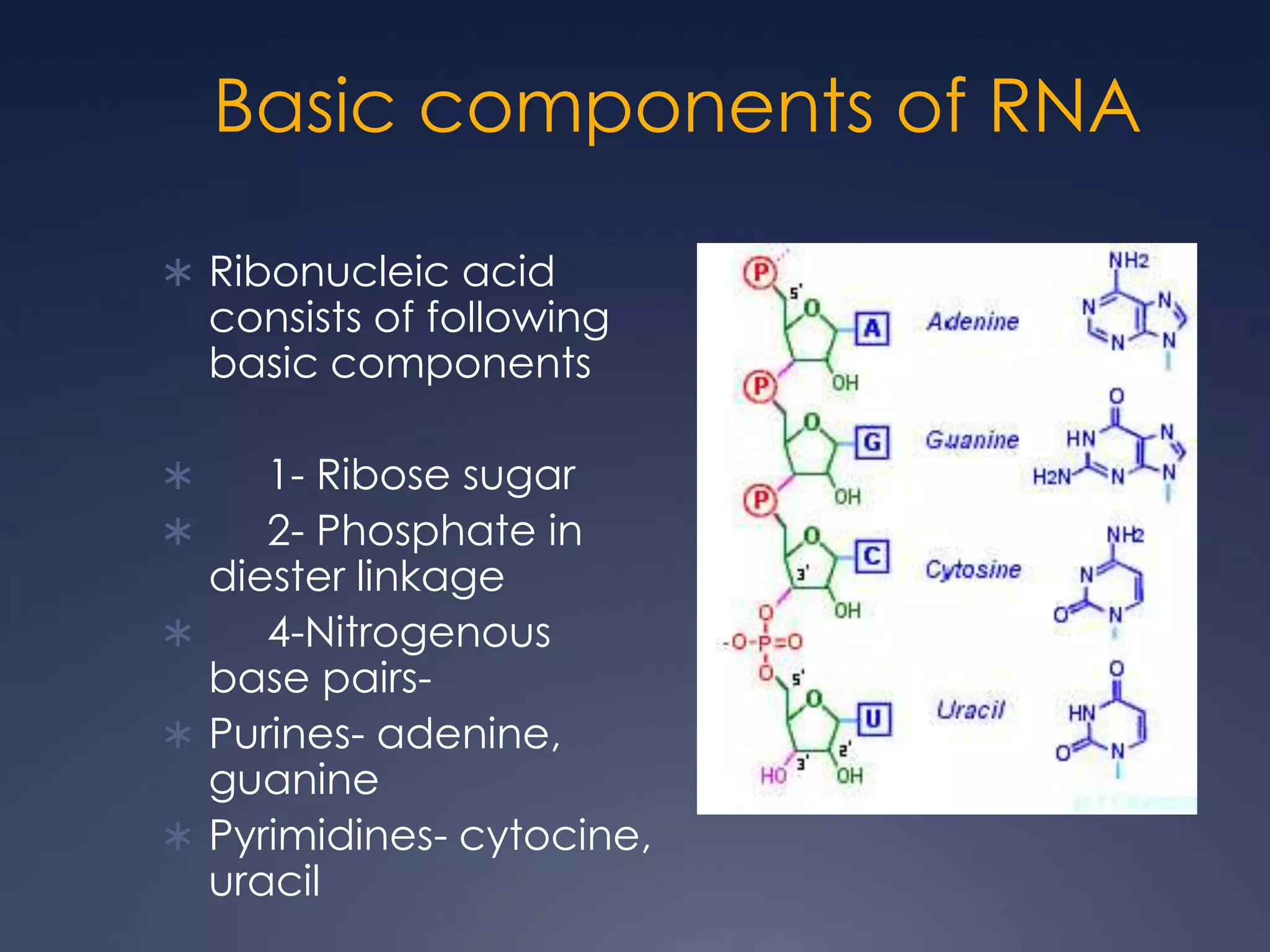
Basic components of RNA
 Ribonucleic acid
consists of following
basic components
 1- Ribose sugar
 2- Phosphate in
diester linkage
 4-Nitrogenous
base pairs-
 Purines- adenine,
guanine
 Pyrimidines- cytocine,
uracil
Primary structure of RNA
 Although there are
multiple types of RNA
molecules, the basic
structure of all RNA is
similar.
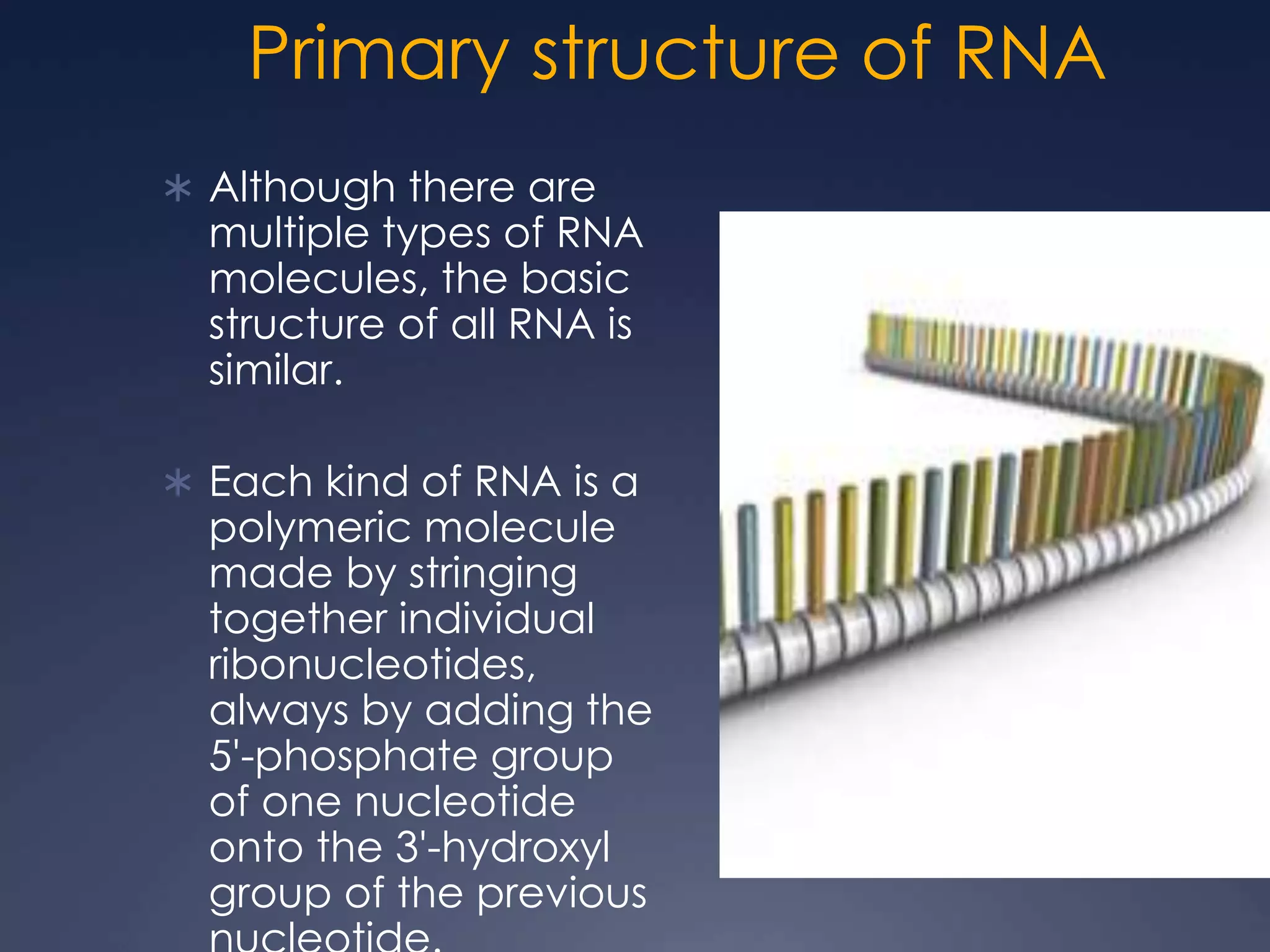
 Each kind of RNA is a
polymeric molecule
made by stringing
together individual
ribonucleotides,
always by adding the
5'-phosphate group
of one nucleotide
onto the 3'-hydroxyl
group of the previous
Secondary structure of RNA
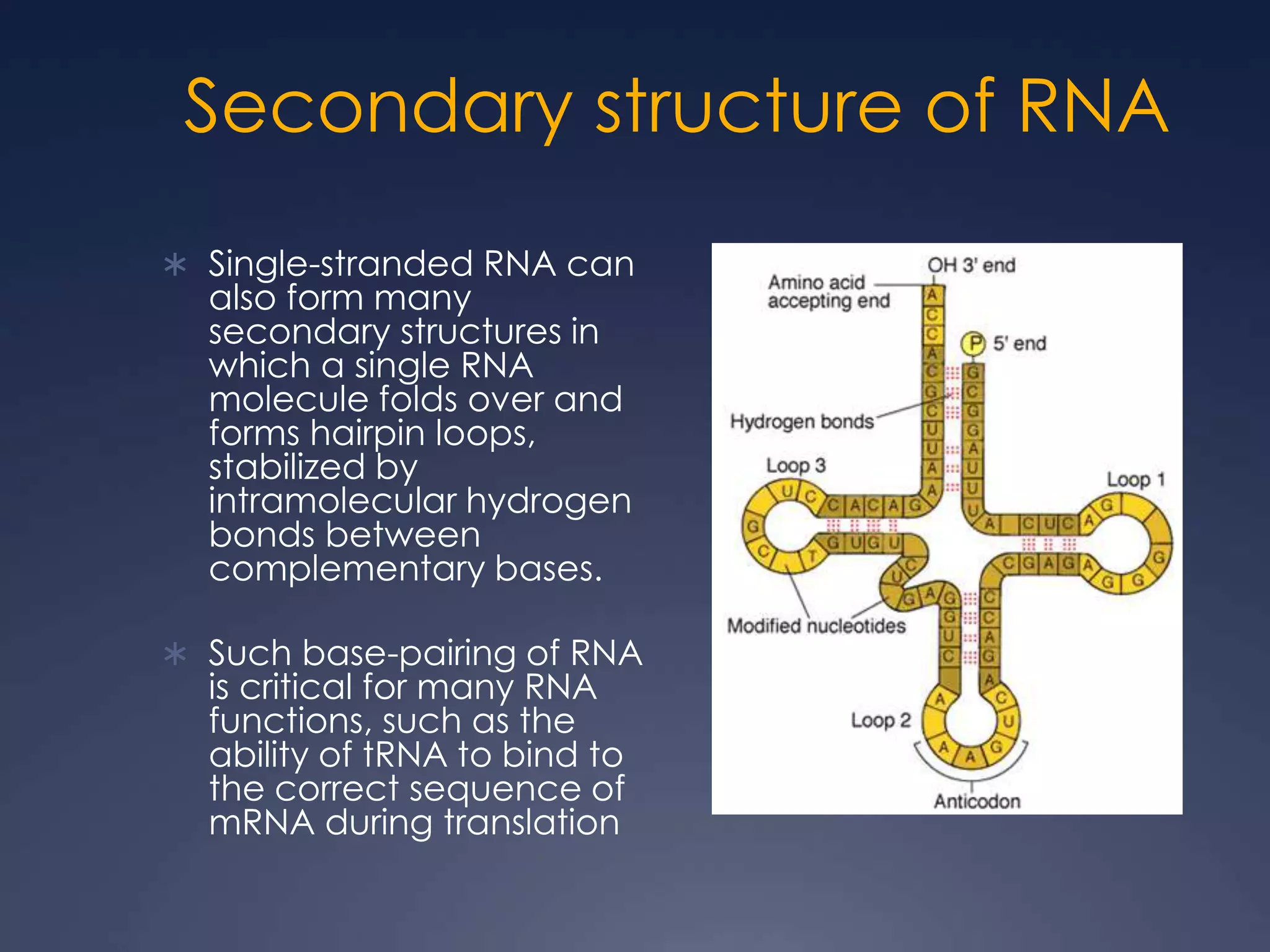
 Single-stranded RNA can
also form many
secondary structures in
which a single RNA
molecule folds over and
forms hairpin loops,
stabilized by
intramolecular hydrogen
bonds between
complementary bases.
 Such base-pairing of RNA
is critical for many RNA
functions, such as the
ability of tRNA to bind to
the correct sequence of
mRNA during translation
DNA can replicate or
undergo transcription
 Replication-it is process by which DNA copies itself
to produce identical daughter molecules of DNA.
DNA is the reserve bank of genetic information.
 Transcription-transcription results in the formation
of one single-stranded RNA molecule.
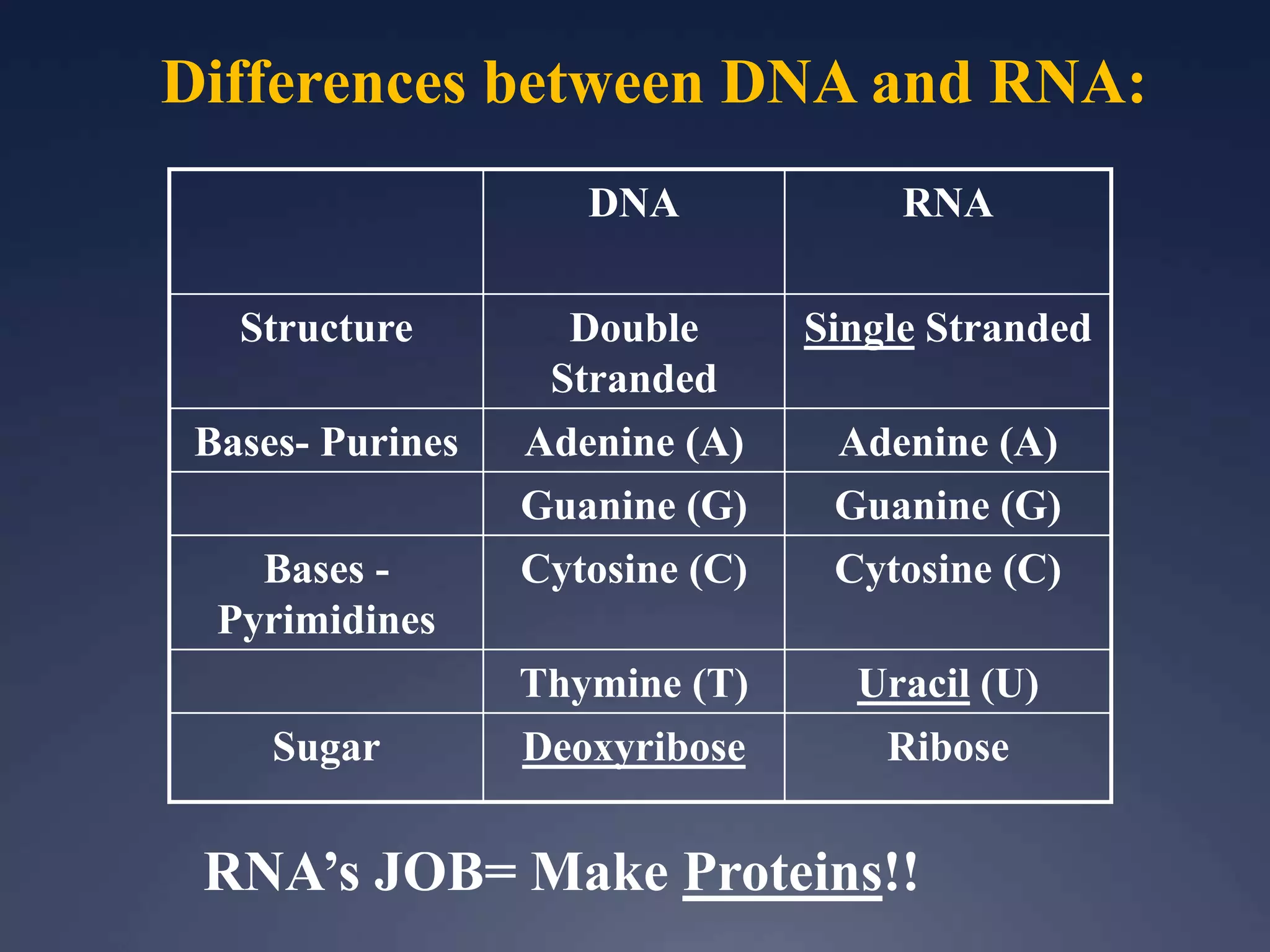
DNA RNA
Structure Double
Stranded
Single Stranded
Bases- Purines Adenine (A) Adenine (A)
Guanine (G) Guanine (G)
Bases -
Pyrimidines
Cytosine (C) Cytosine (C)
Thymine (T) Uracil (U)
Sugar Deoxyribose Ribose
Differences between DNA and RNA:
RNA’s JOB= Make Proteins!!
Types of RNA
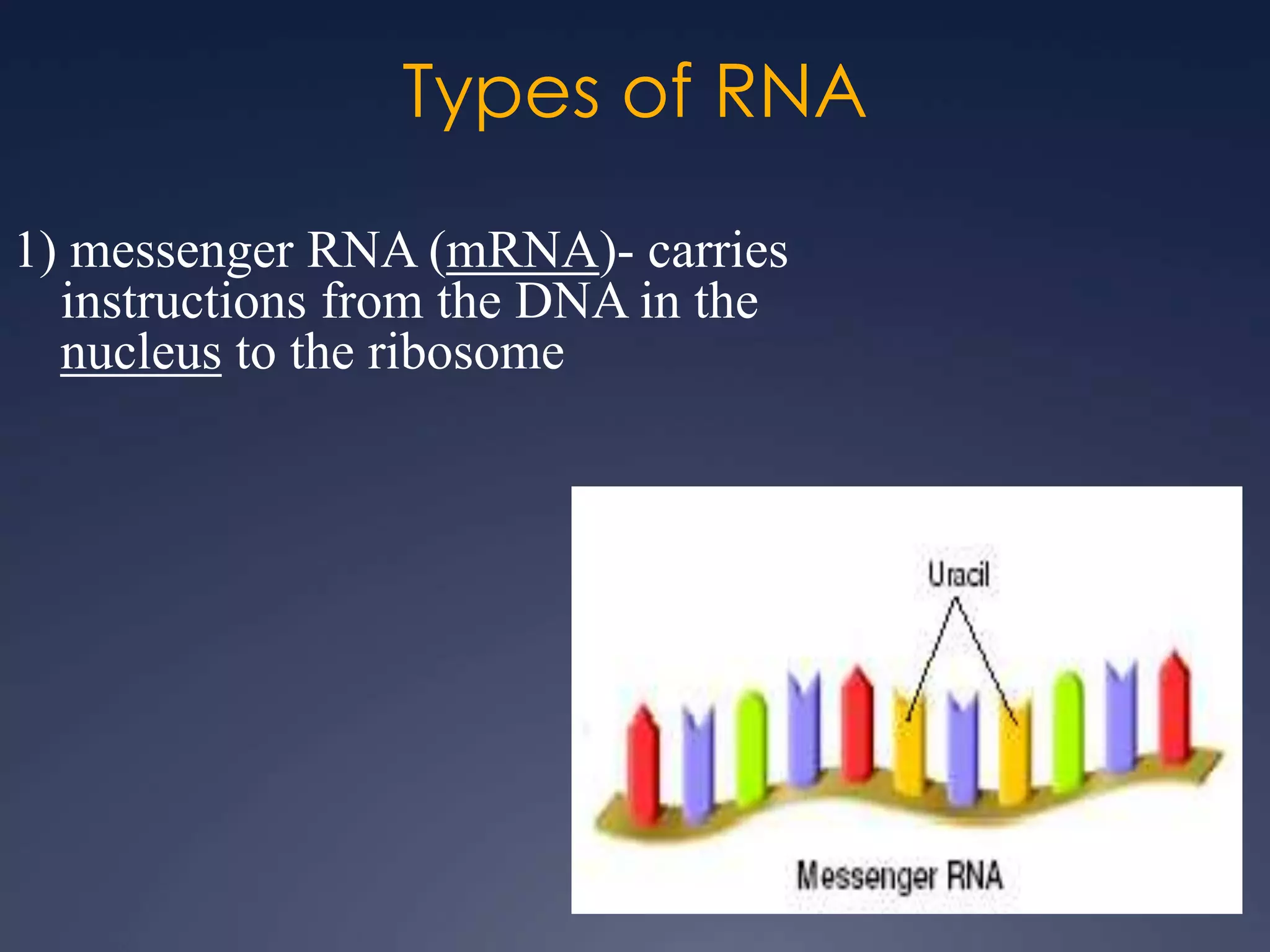
1) messenger RNA (mRNA)- carries
instructions from the DNA in the
nucleus to the ribosome
Types of RNA
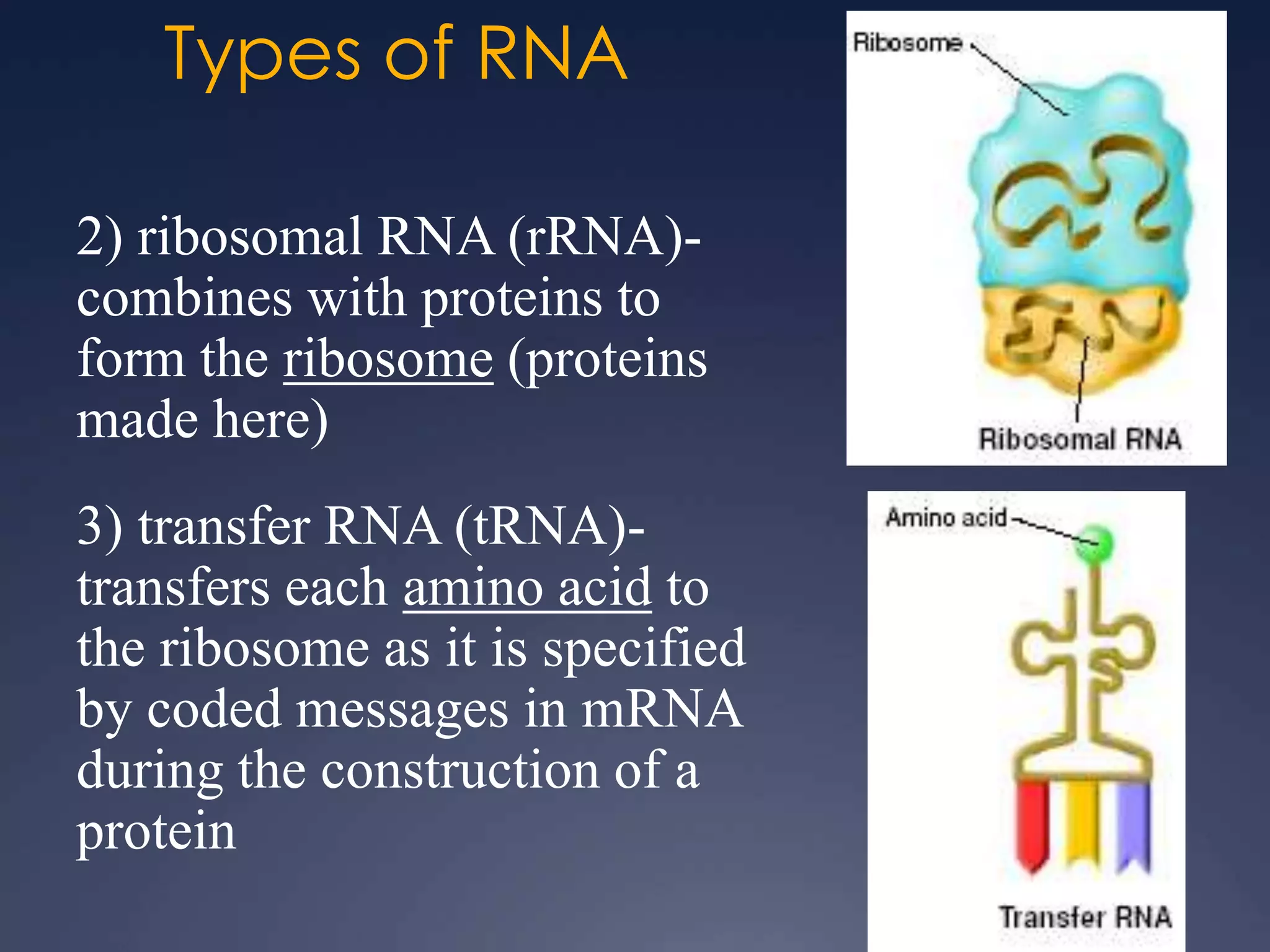
2) ribosomal RNA (rRNA)-
combines with proteins to
form the ribosome (proteins
made here)
3) transfer RNA (tRNA)-
transfers each amino acid to
the ribosome as it is specified
by coded messages in mRNA
during the construction of a
protein
Types of RNA
 4 ) snRNA – small nuclear RNA
 5) snoRNA- small nucleolar RNA
 6) scRNA- small cytoplasmic RNA
 7) micro- RNAs,miRNA, small interfering RNAs
 Present in eukaryotes only.
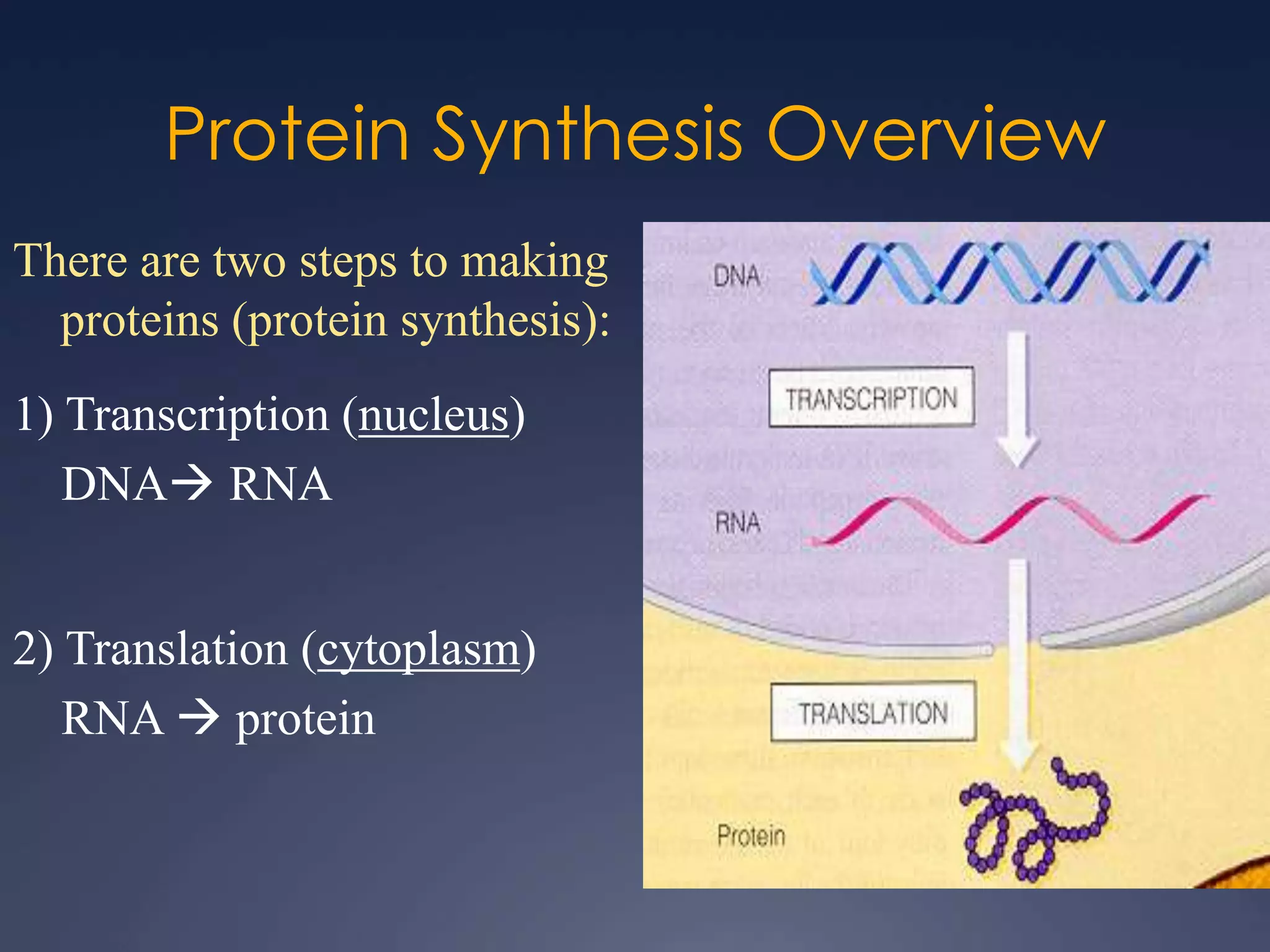
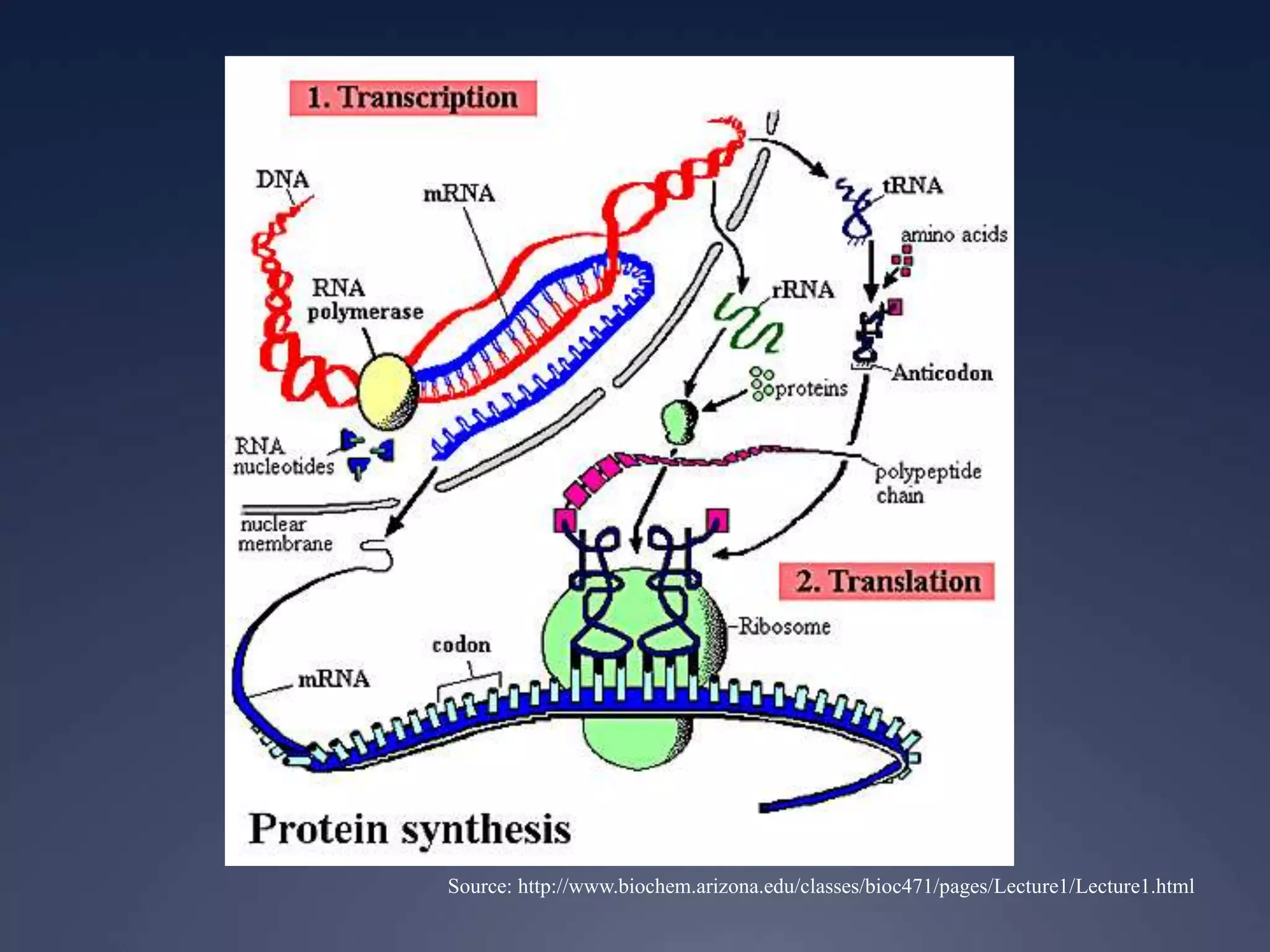
Protein Synthesis Overview
There are two steps to making
proteins (protein synthesis):
1) Transcription (nucleus)
DNA RNA
2) Translation (cytoplasm)
RNA  protein
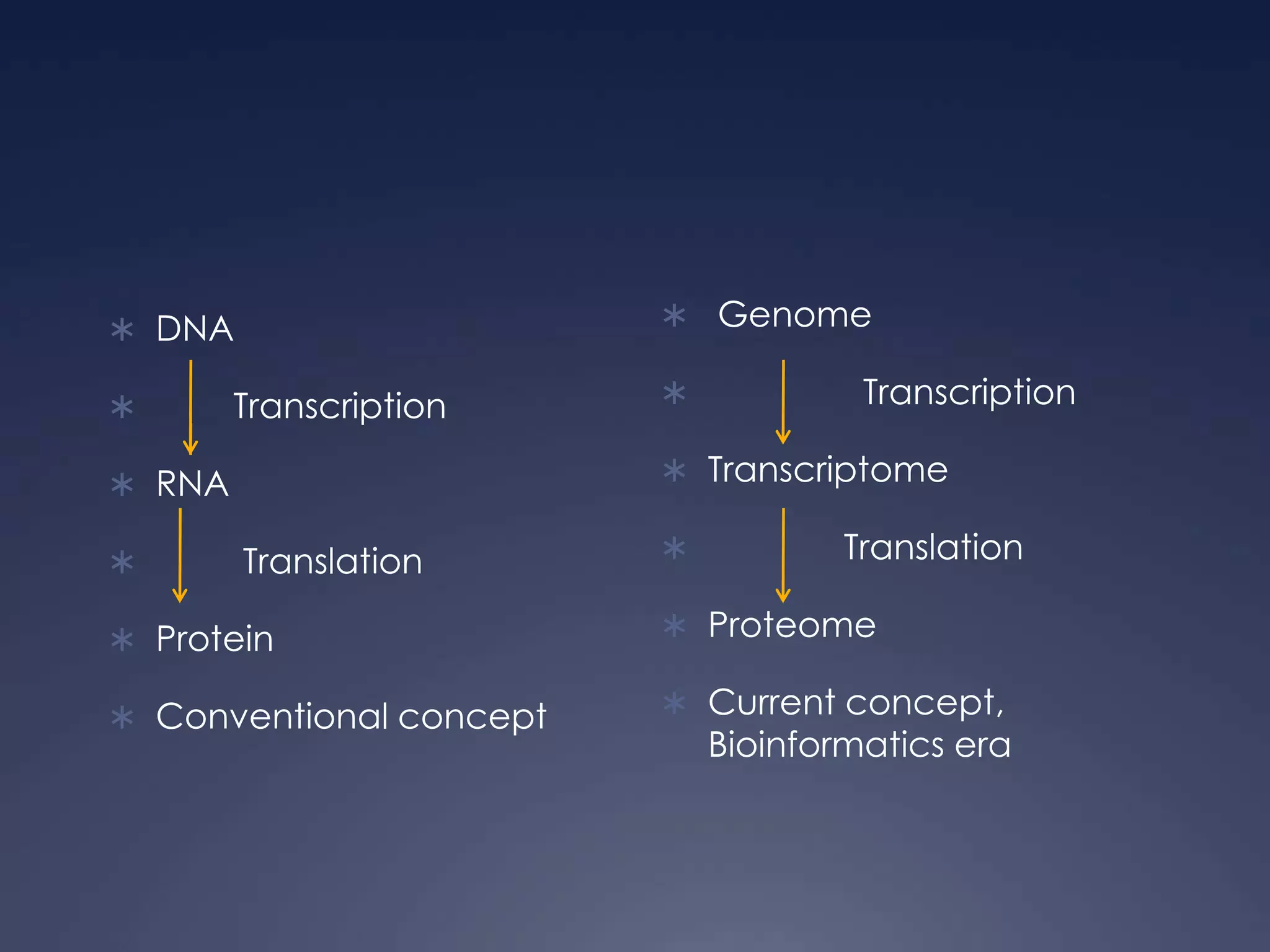
 DNA
 Transcription
 RNA
 Translation
 Protein
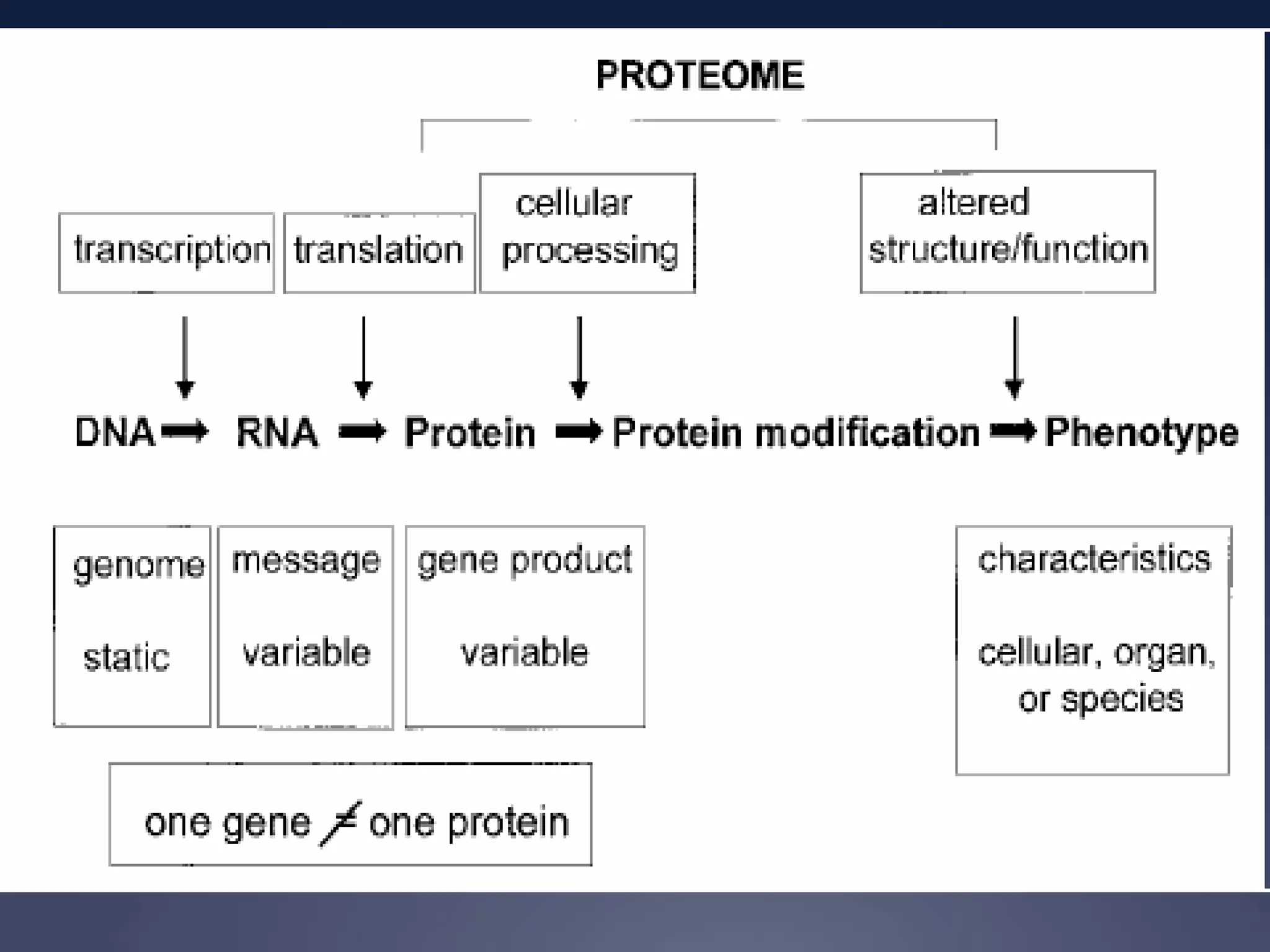
 Conventional concept
 Genome
 Transcription
 Transcriptome
 Translation
 Proteome
 Current concept,
Bioinformatics era
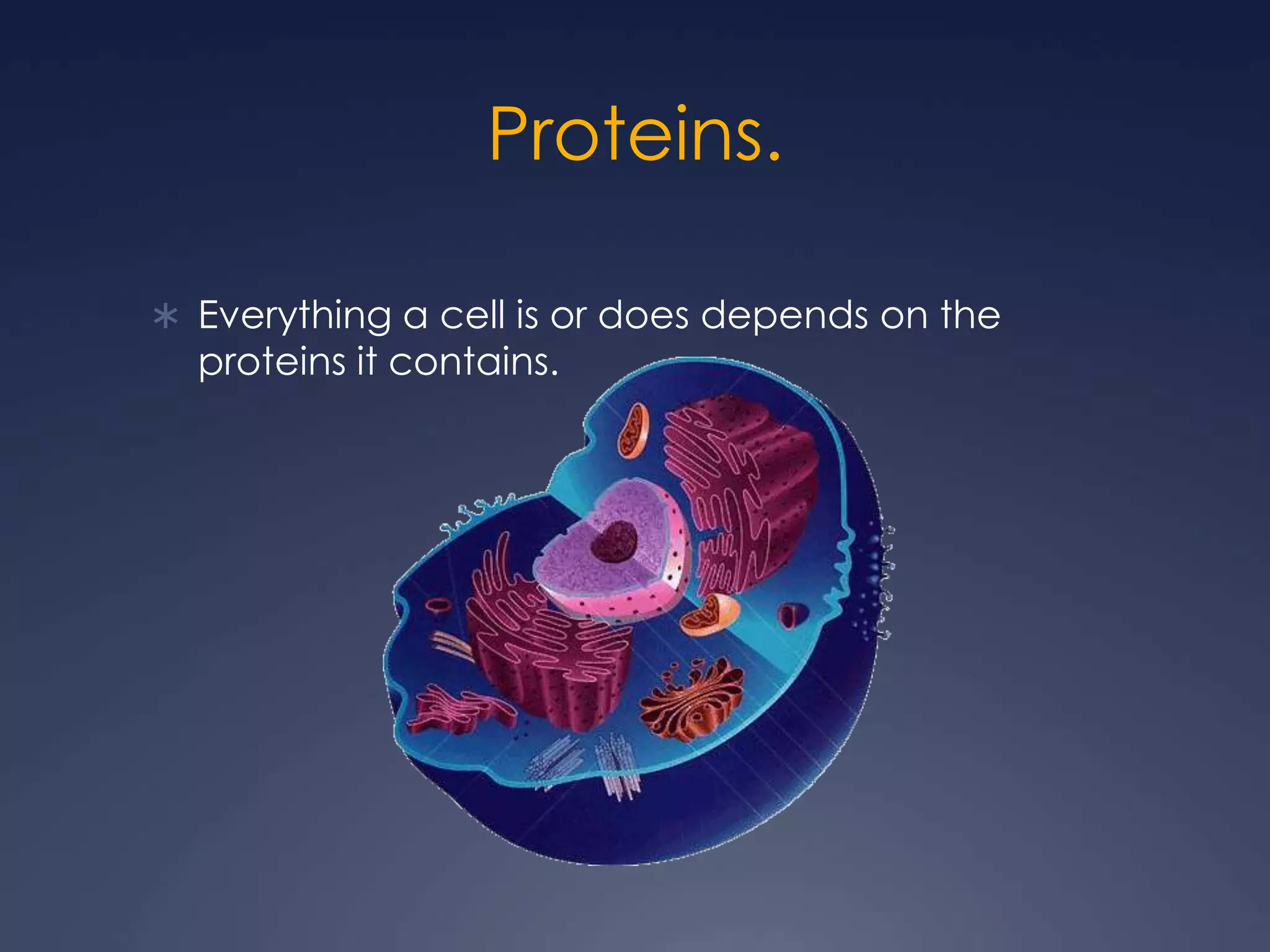
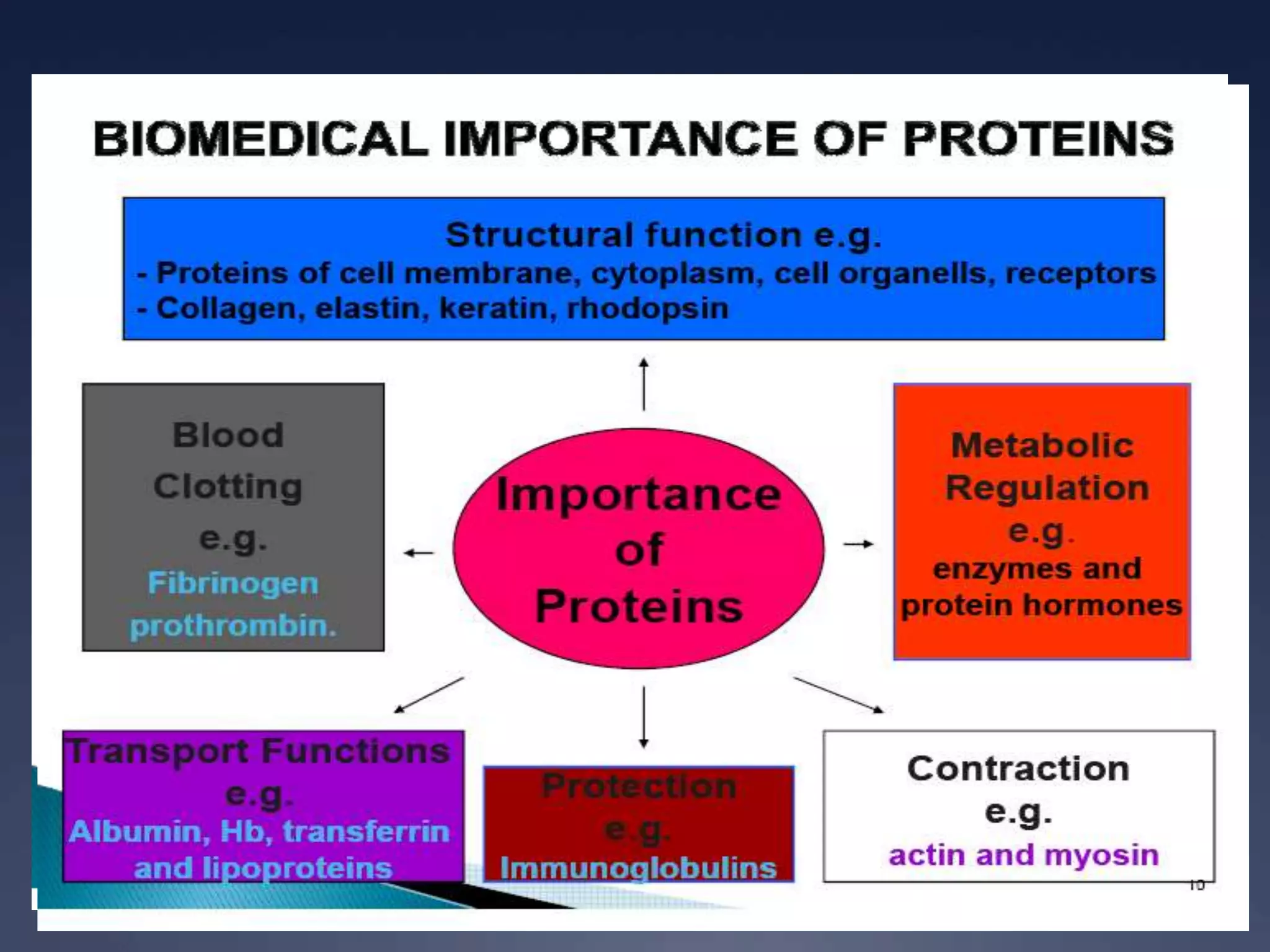
Proteins.
 Everything a cell is or does depends on the
proteins it contains.
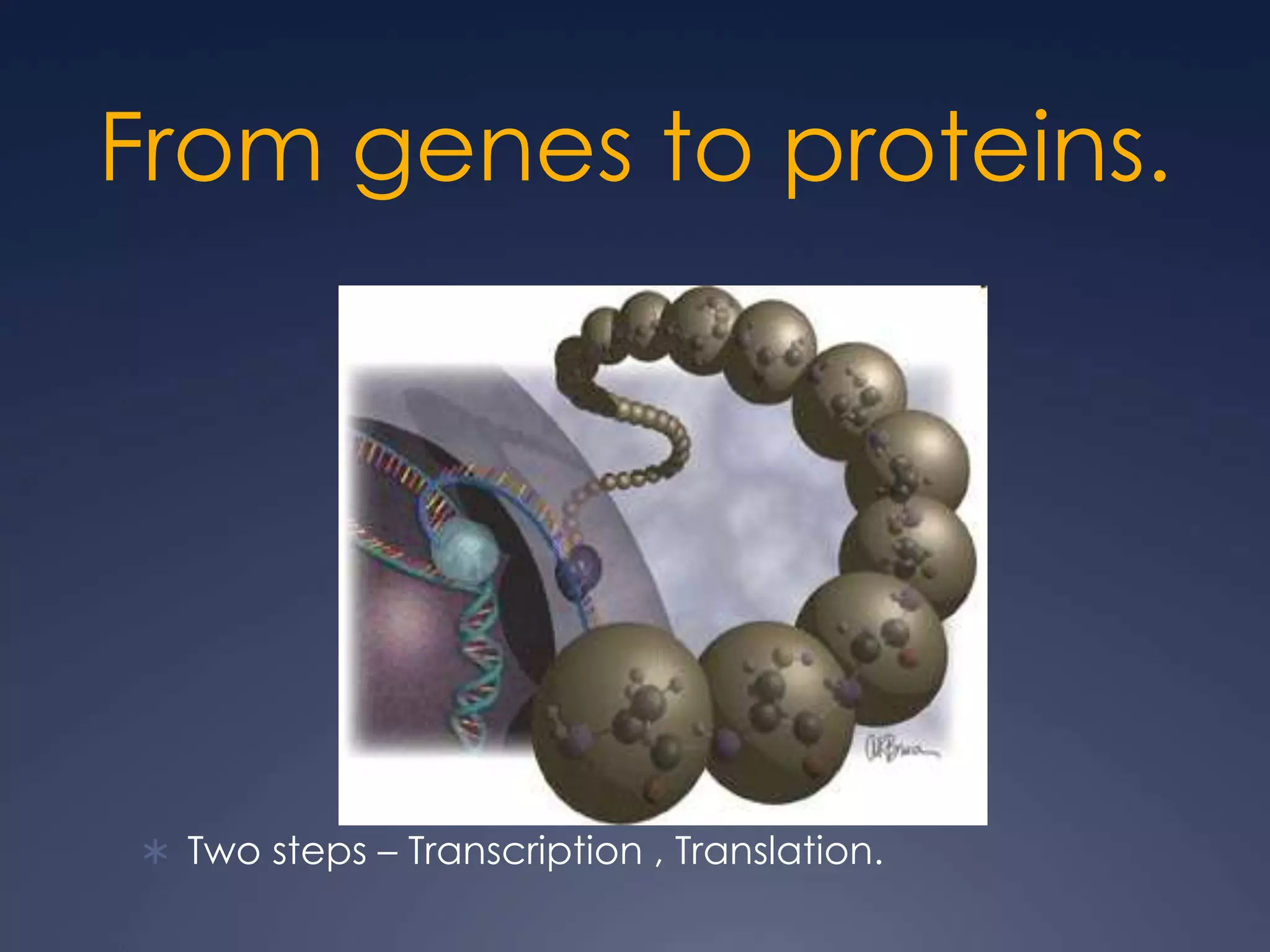
From genes to proteins.
 Two steps – Transcription , Translation.
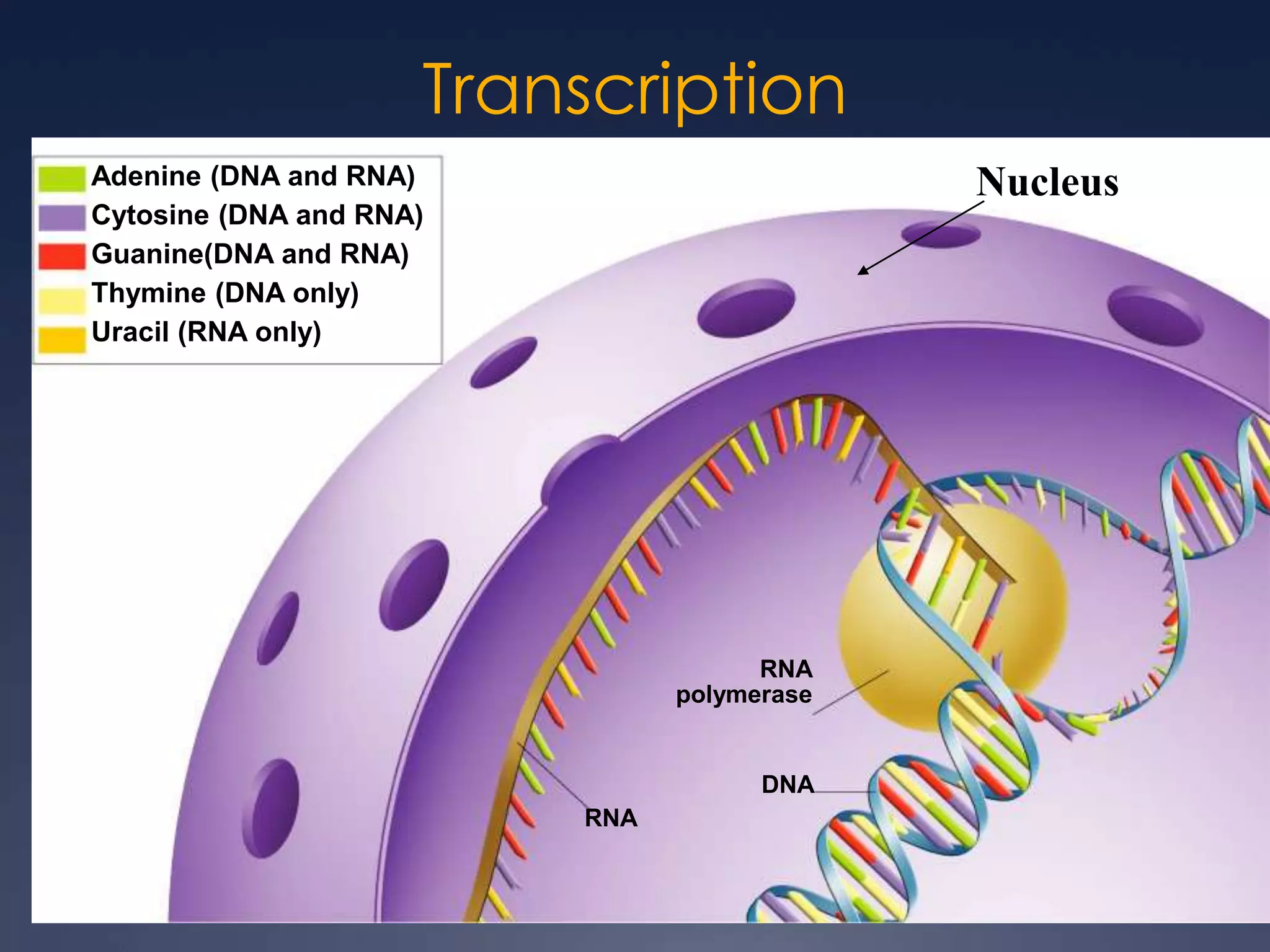
Transcription
RNA
DNA
RNA
polymerase
Adenine (DNA and RNA)
Cytosine (DNA and RNA)
Guanine(DNA and RNA)
Thymine (DNA only)
Uracil (RNA only)
Nucleus
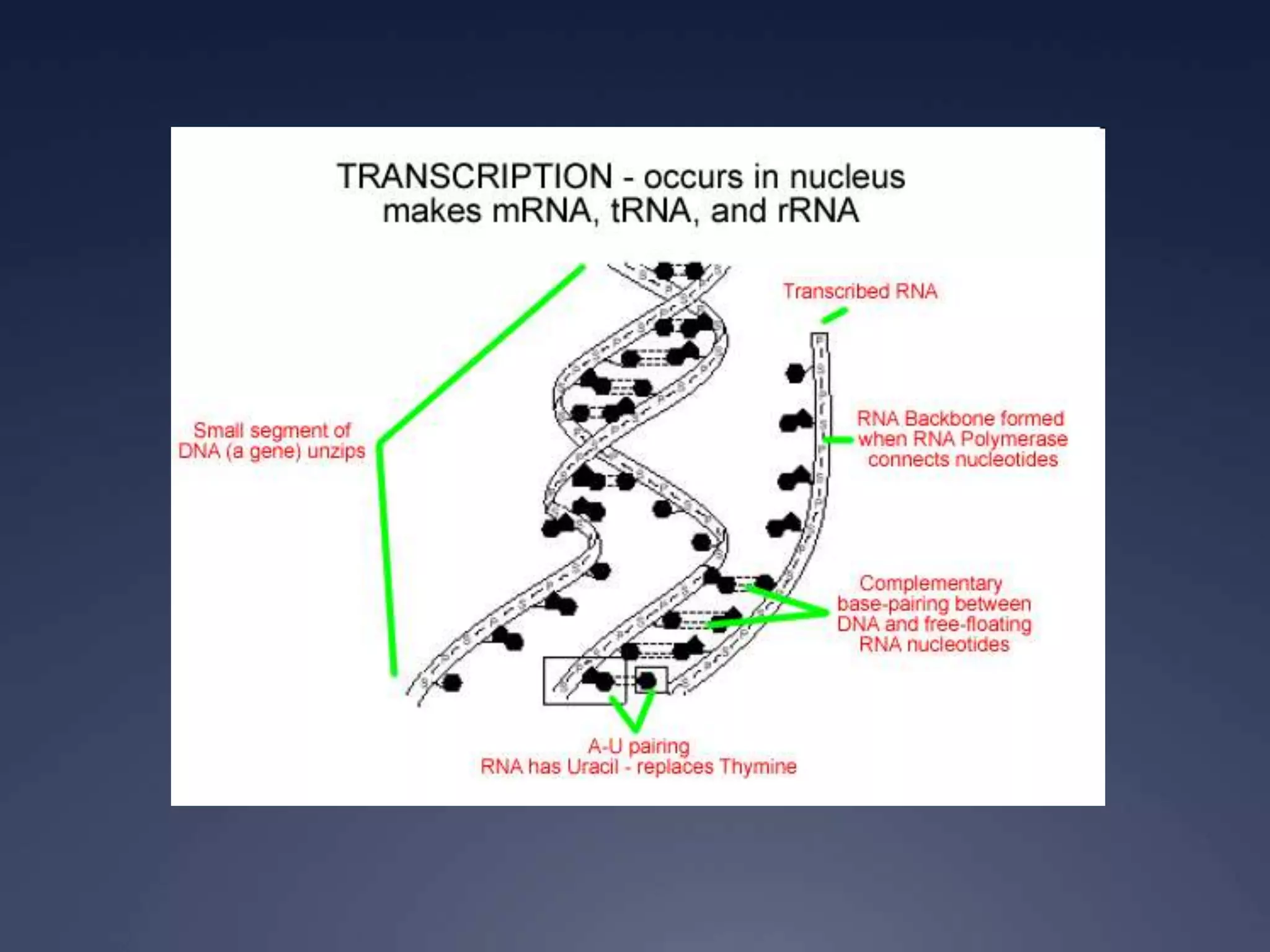
TRANSCRIPTION
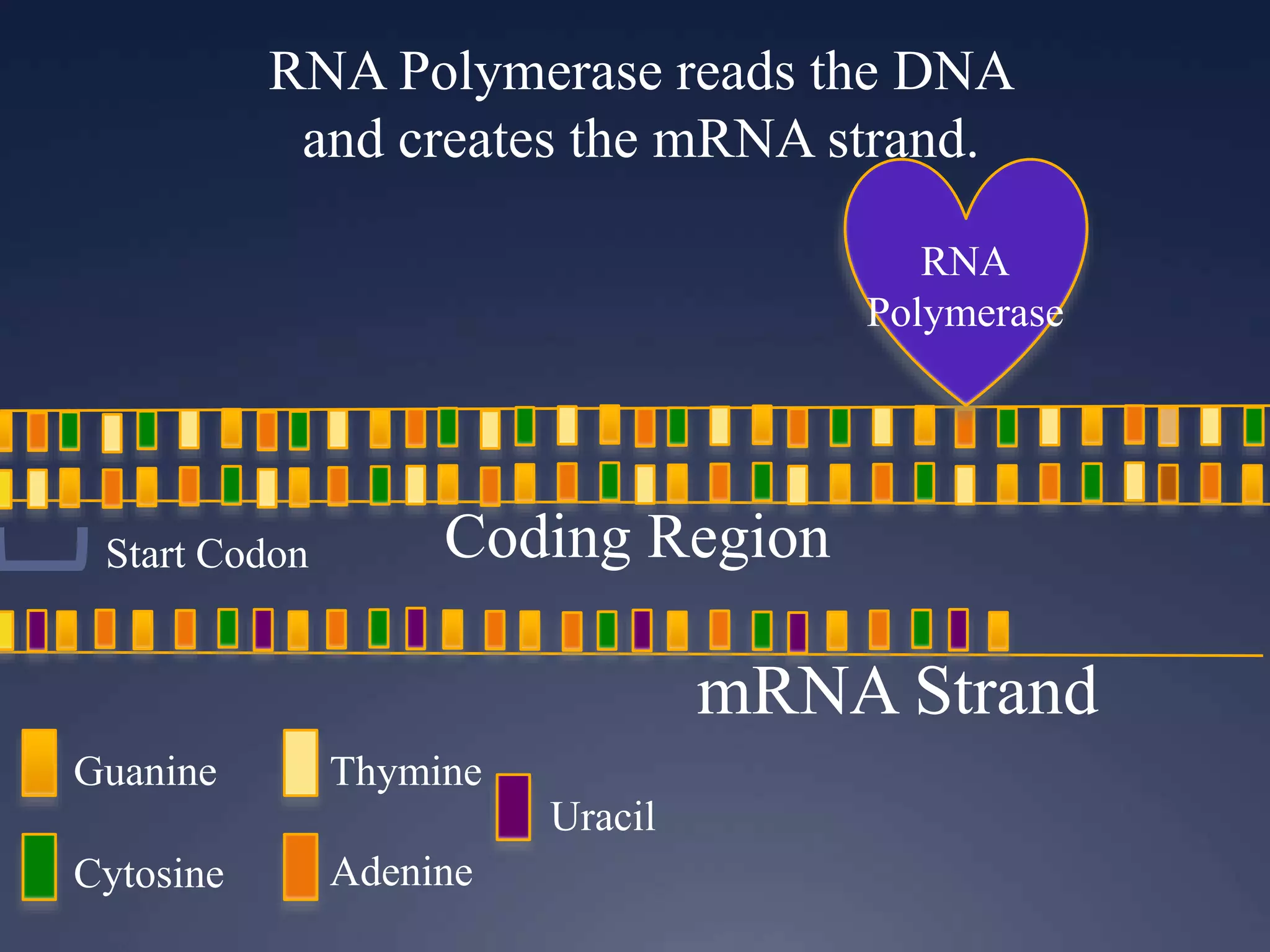
 It is a process by which RNA is synthesize from
DNA. The genetic information stored in DNA is
expressed through RNA.
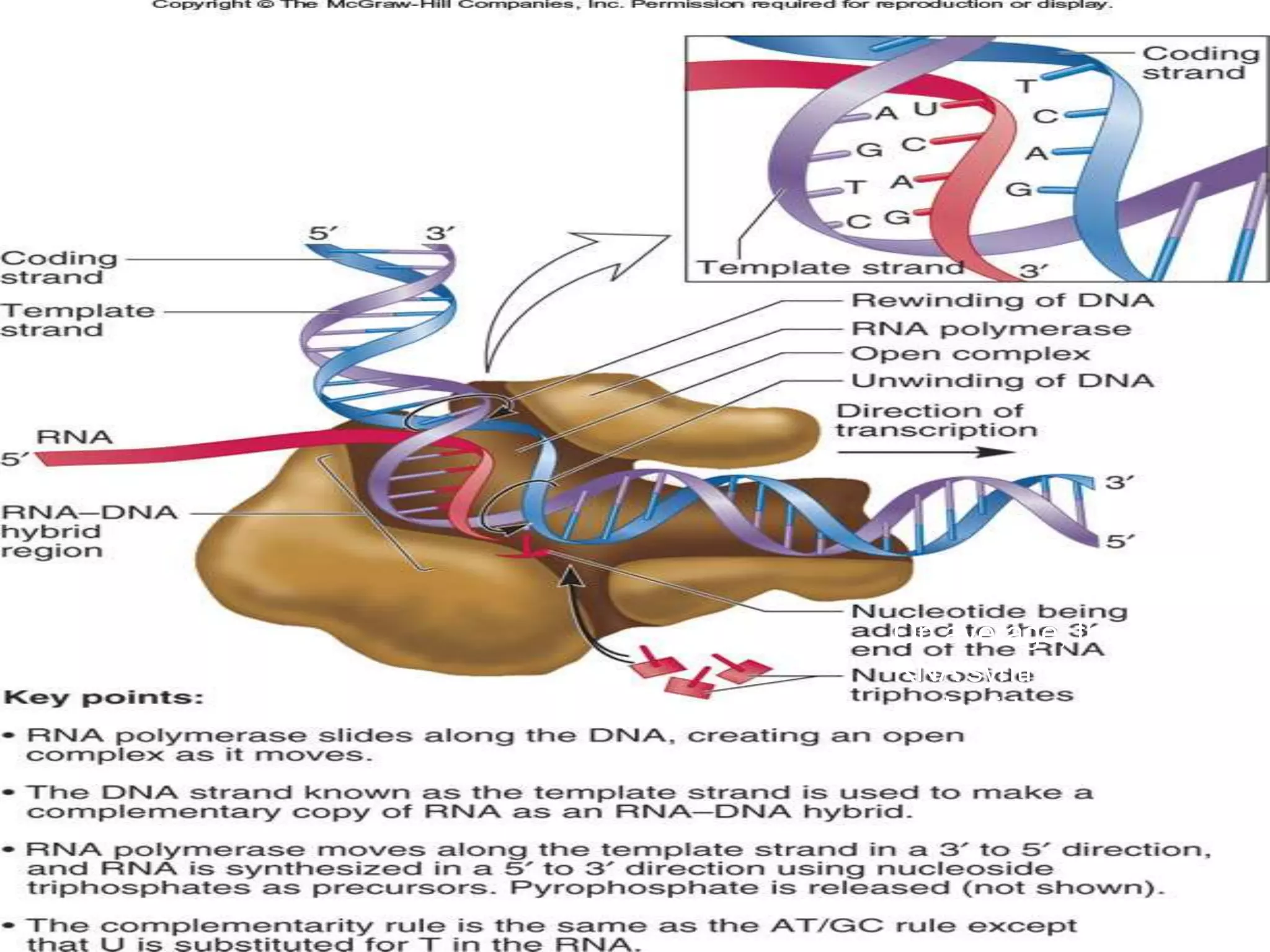
 One of the two strands of DNA serves as
Template and produces working copies of RNA
molecules. The other DNA strand which does not
participate in in transcription is referred to as
coding strand or sense strand or non-template
strand.
Transcription
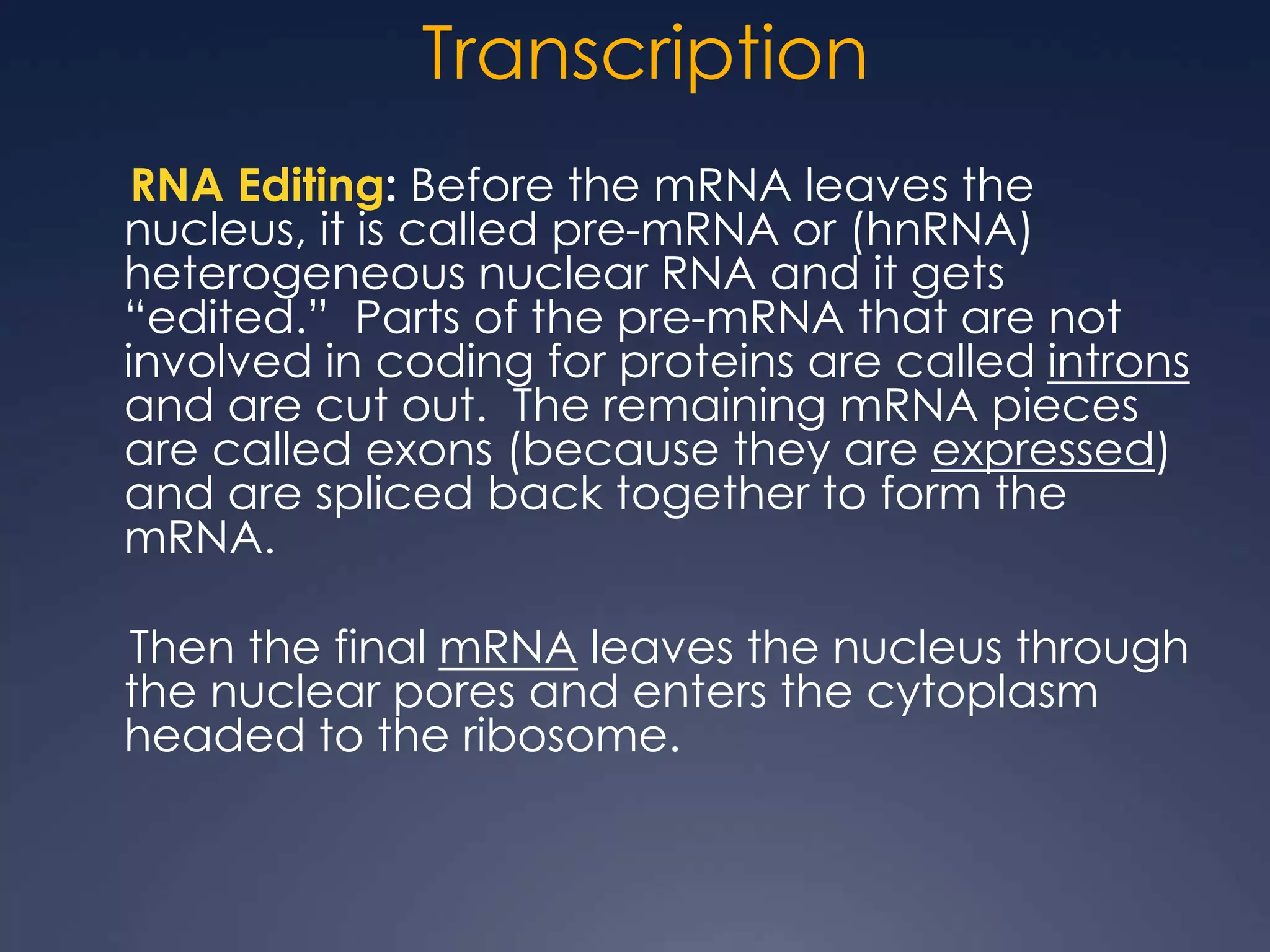
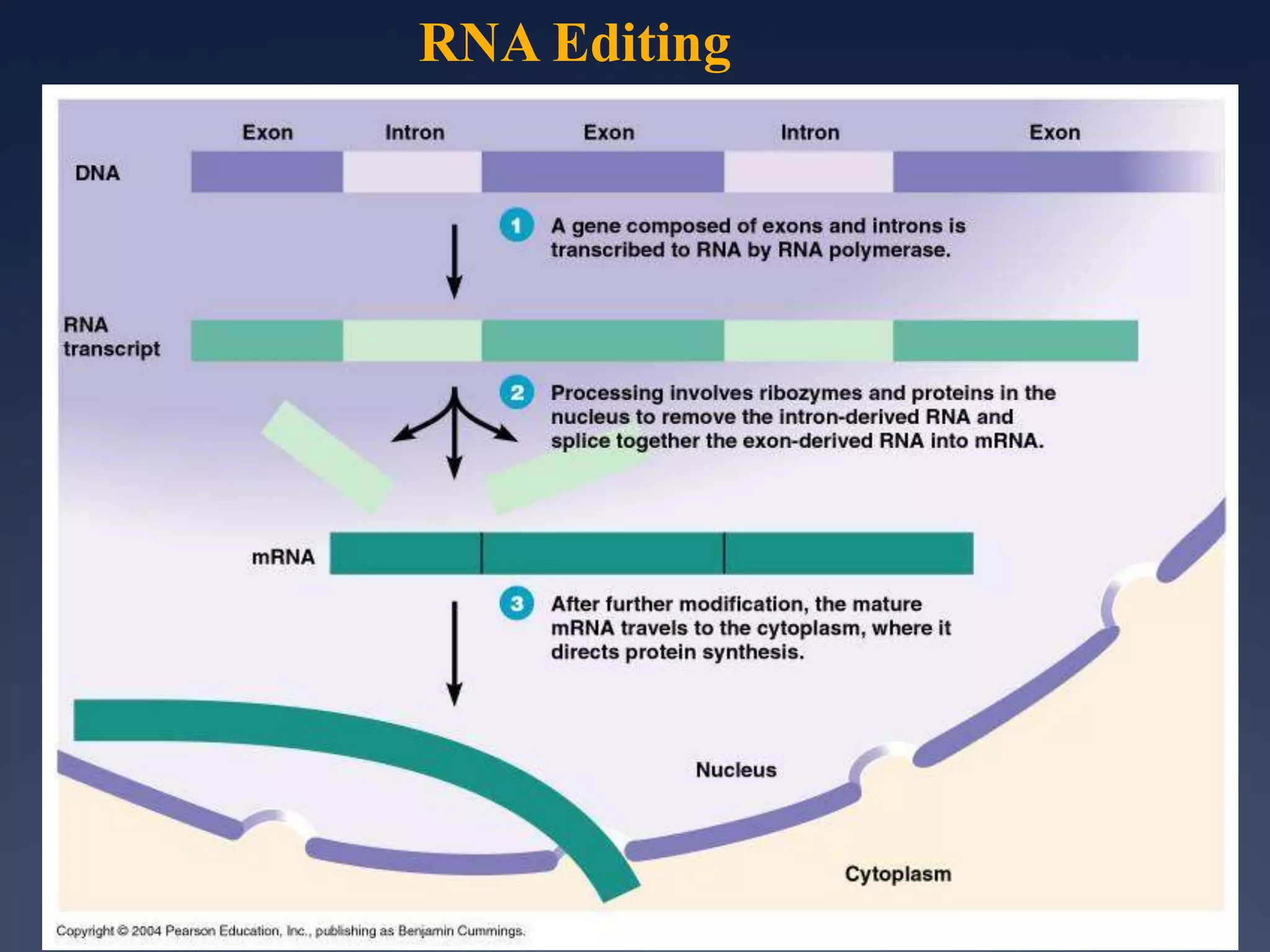
RNA Editing: Before the mRNA leaves the
nucleus, it is called pre-mRNA or (hnRNA)
heterogeneous nuclear RNA and it gets
“edited.” Parts of the pre-mRNA that are not
involved in coding for proteins are called introns
and are cut out. The remaining mRNA pieces
are called exons (because they are expressed)
and are spliced back together to form the
mRNA.
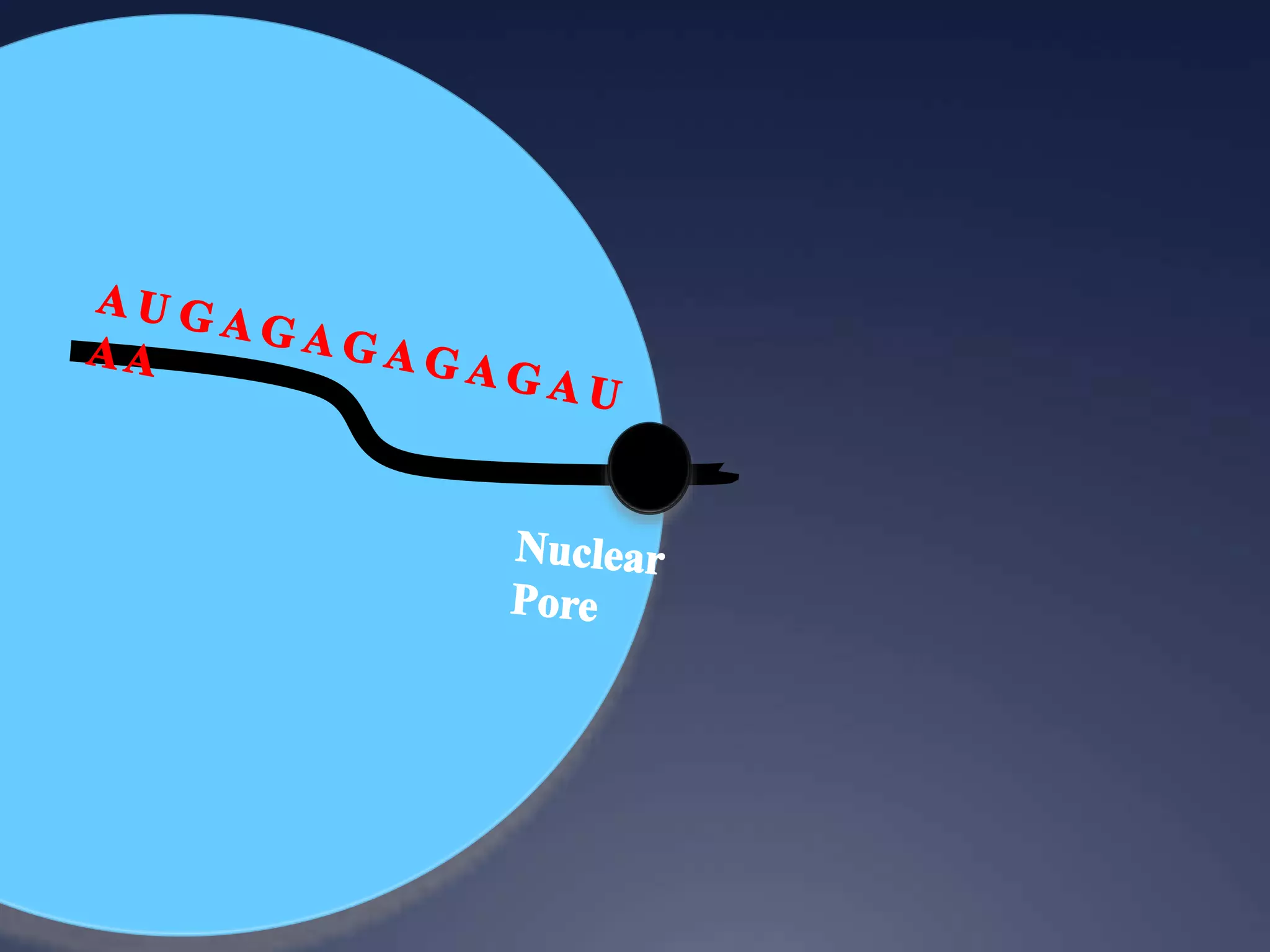
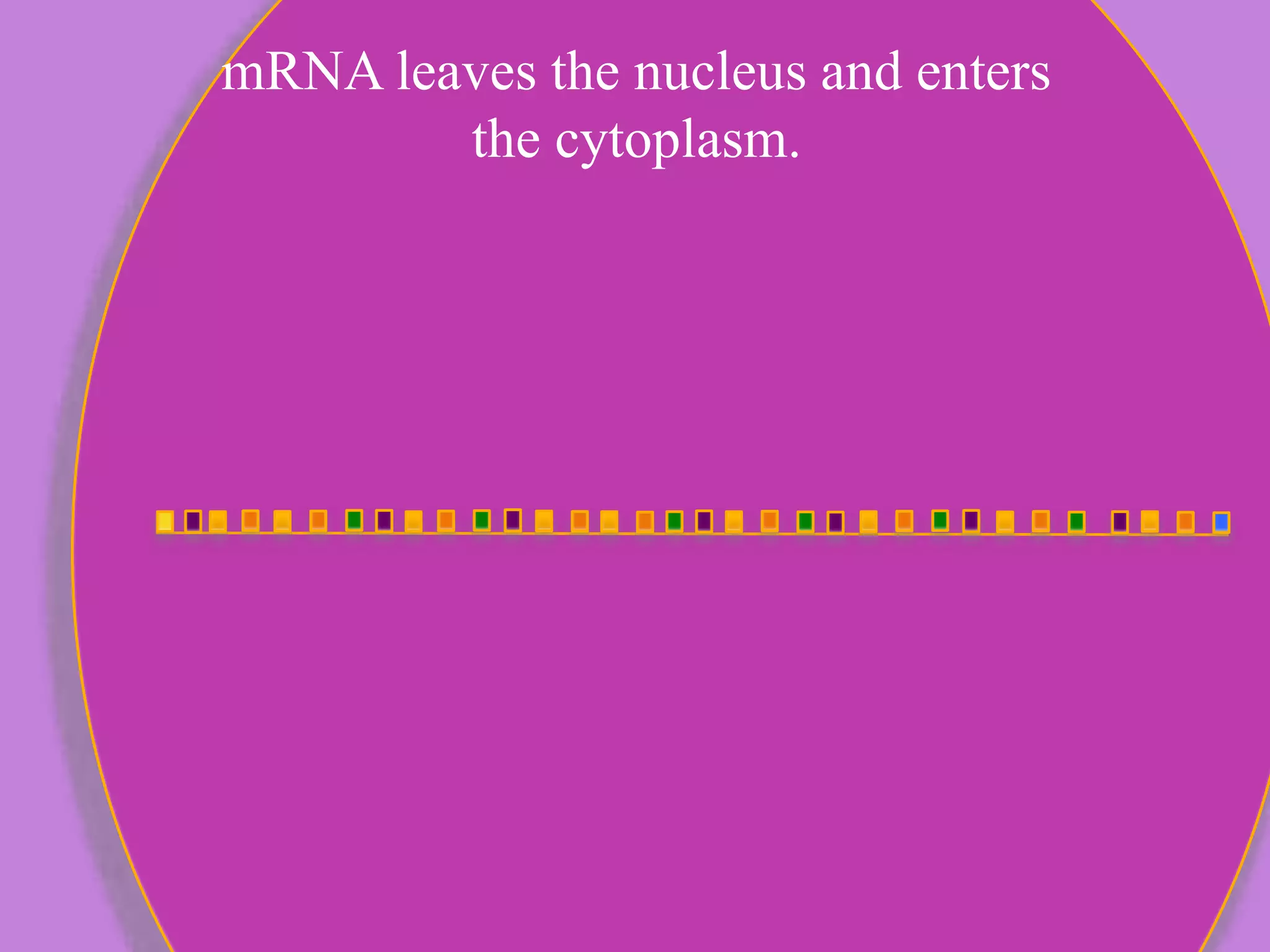
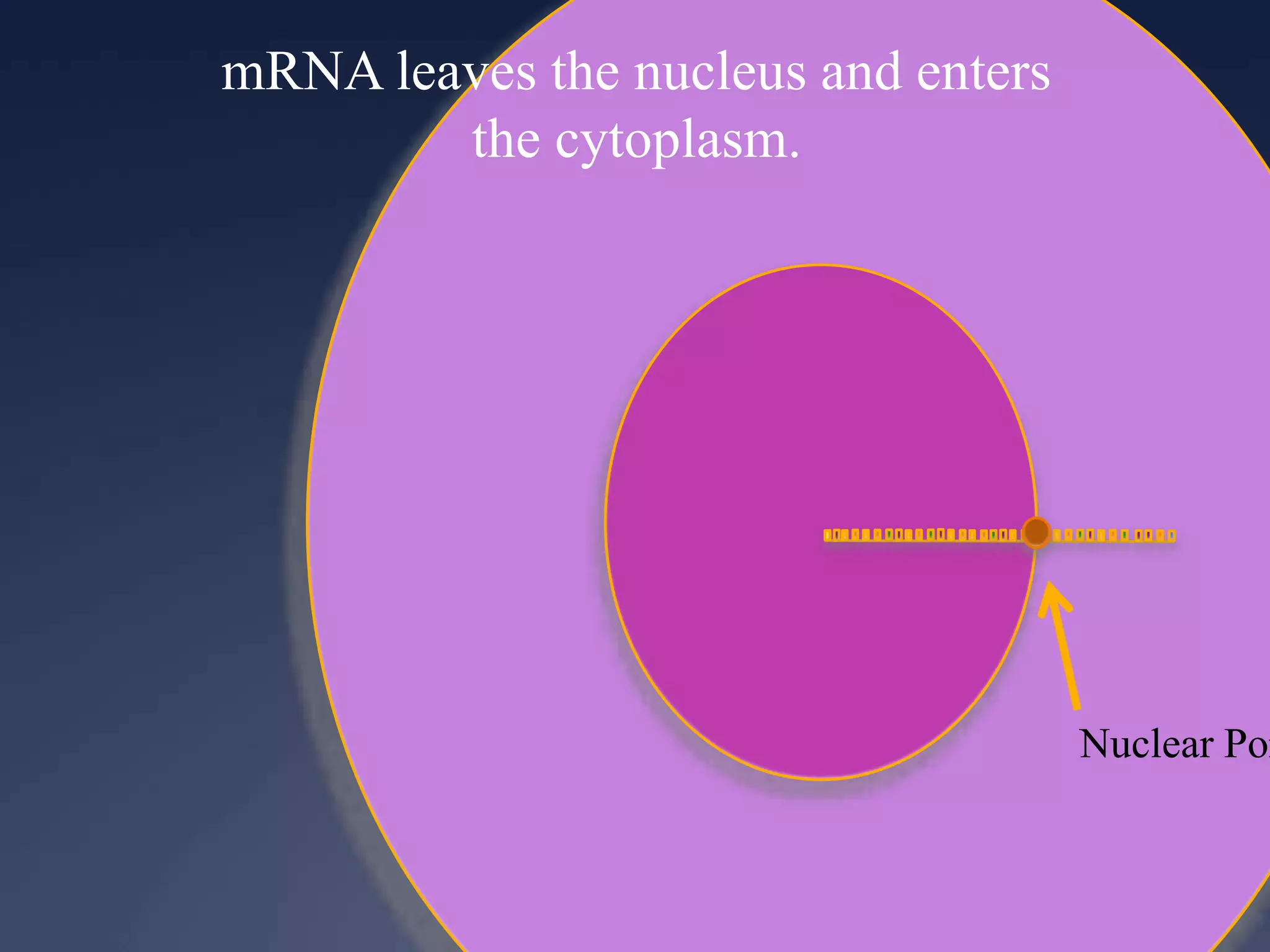
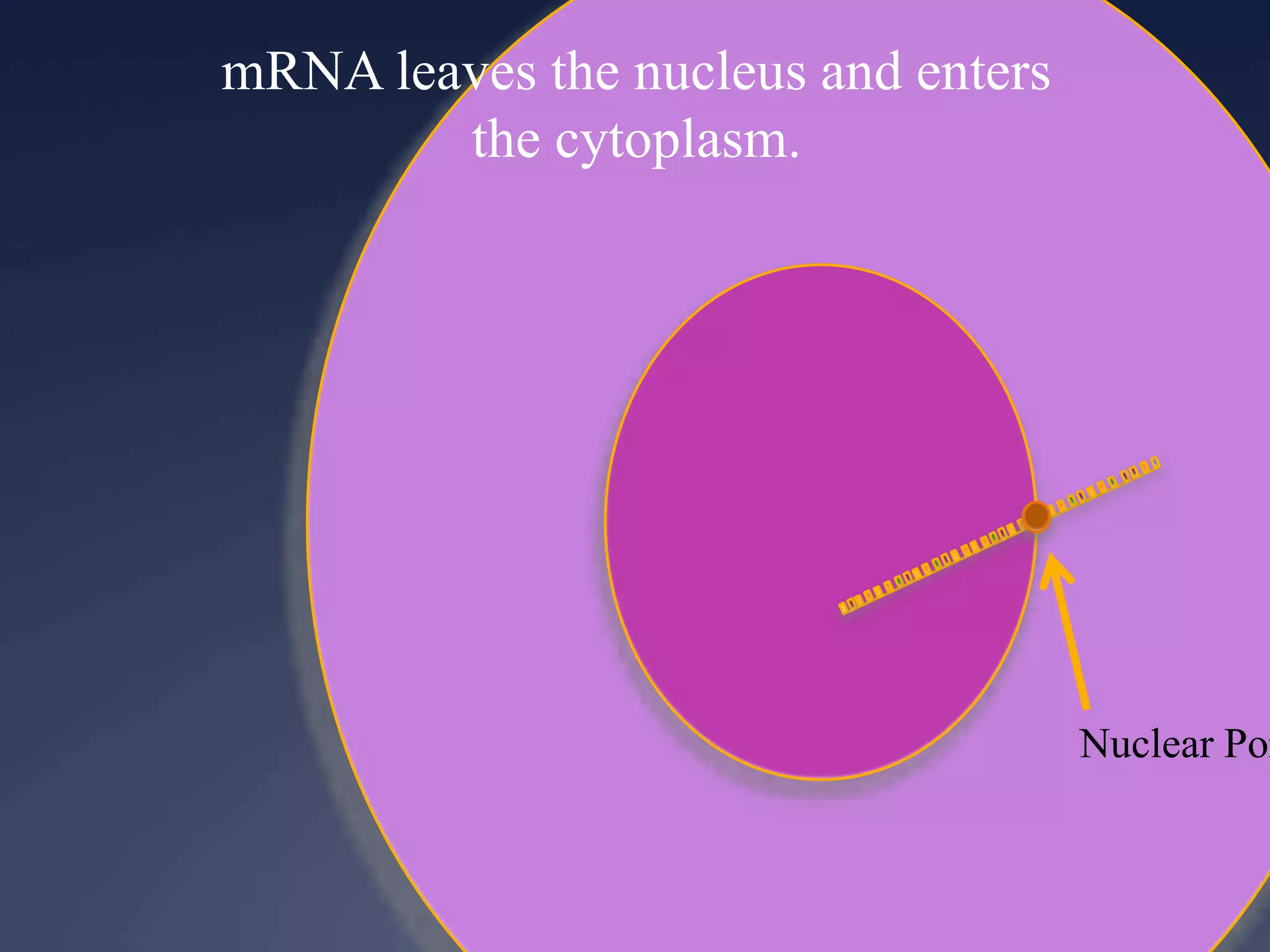
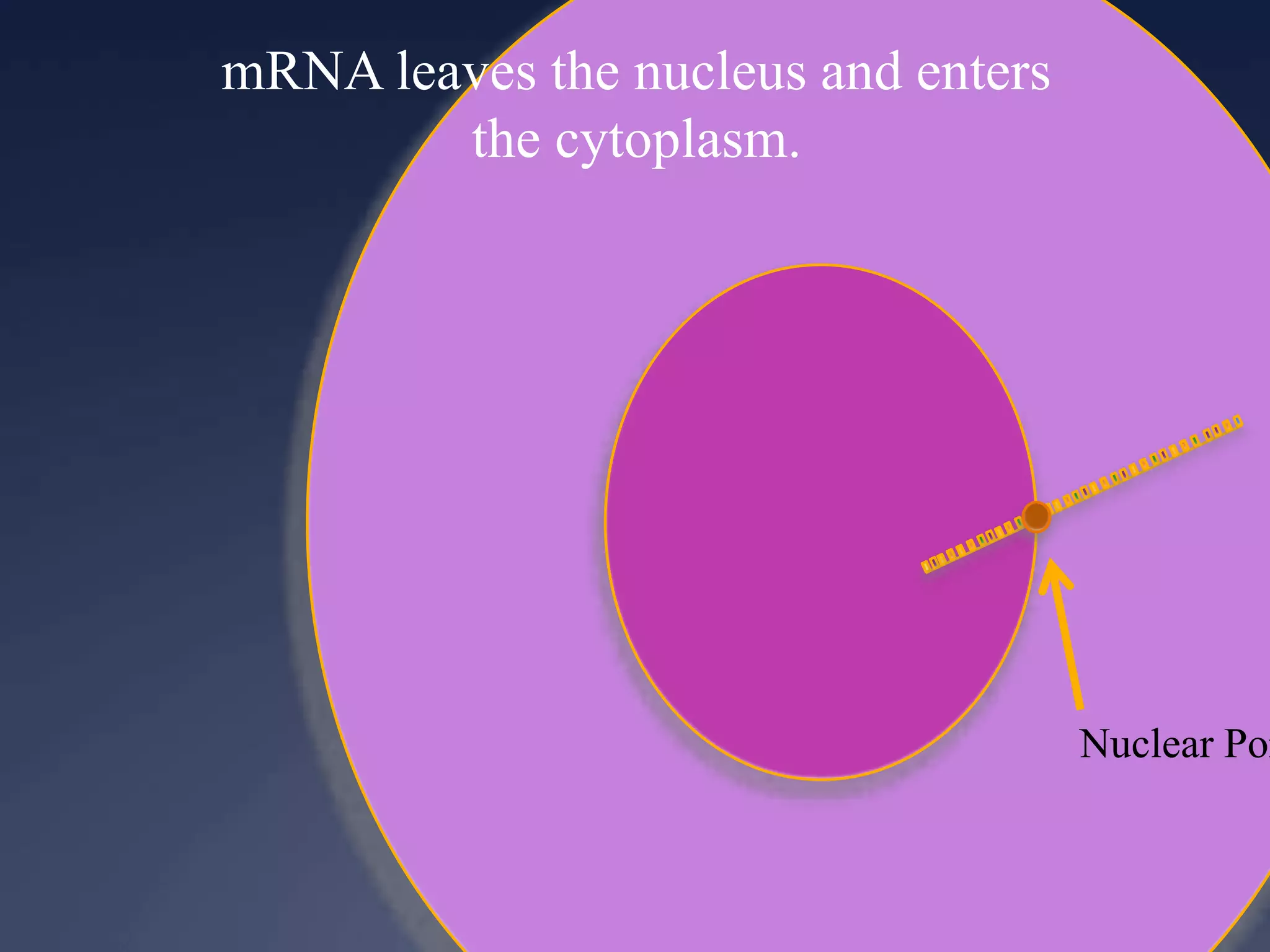
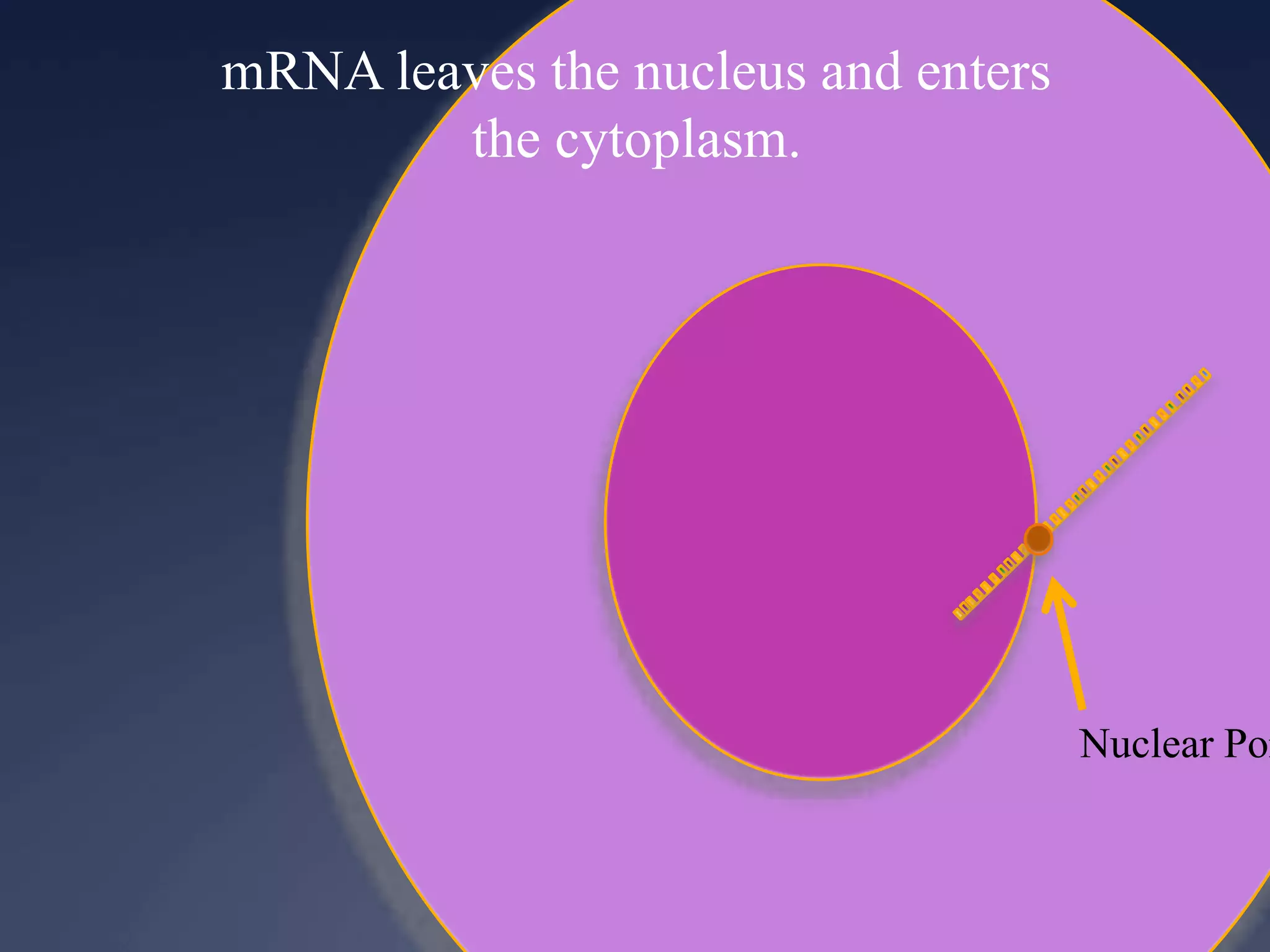
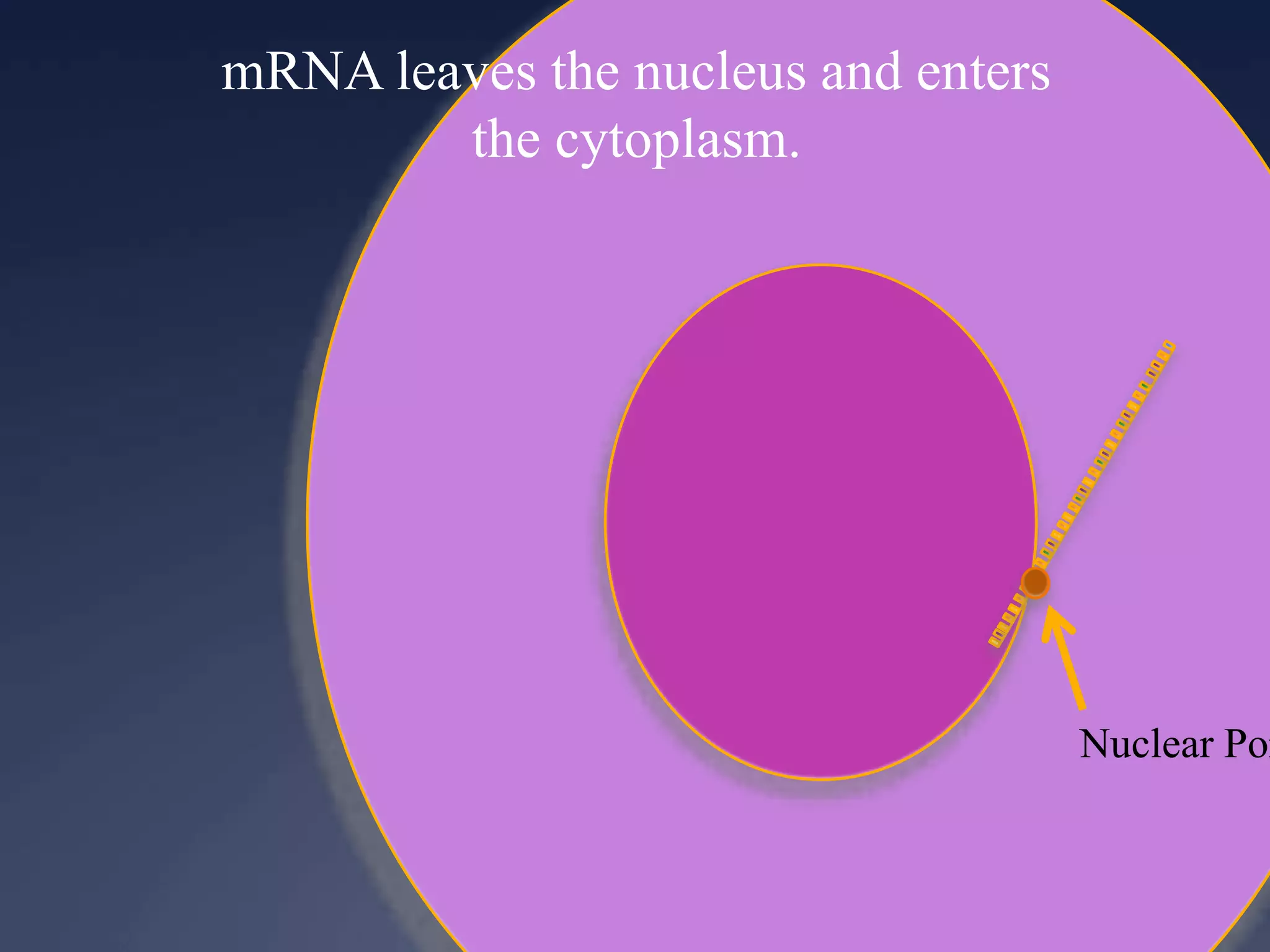
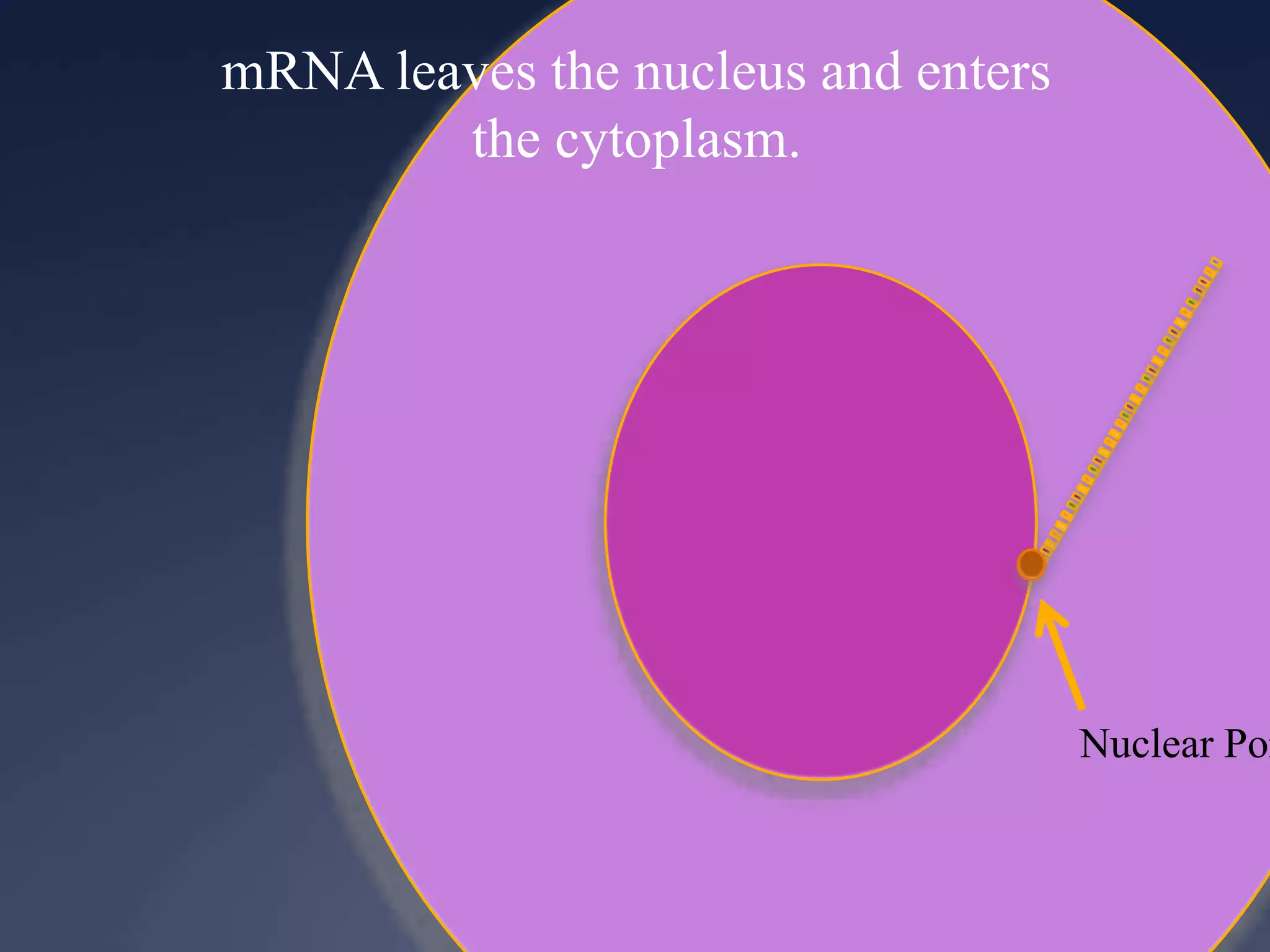
Then the final mRNA leaves the nucleus through
the nuclear pores and enters the cytoplasm
headed to the ribosome.
Transcription
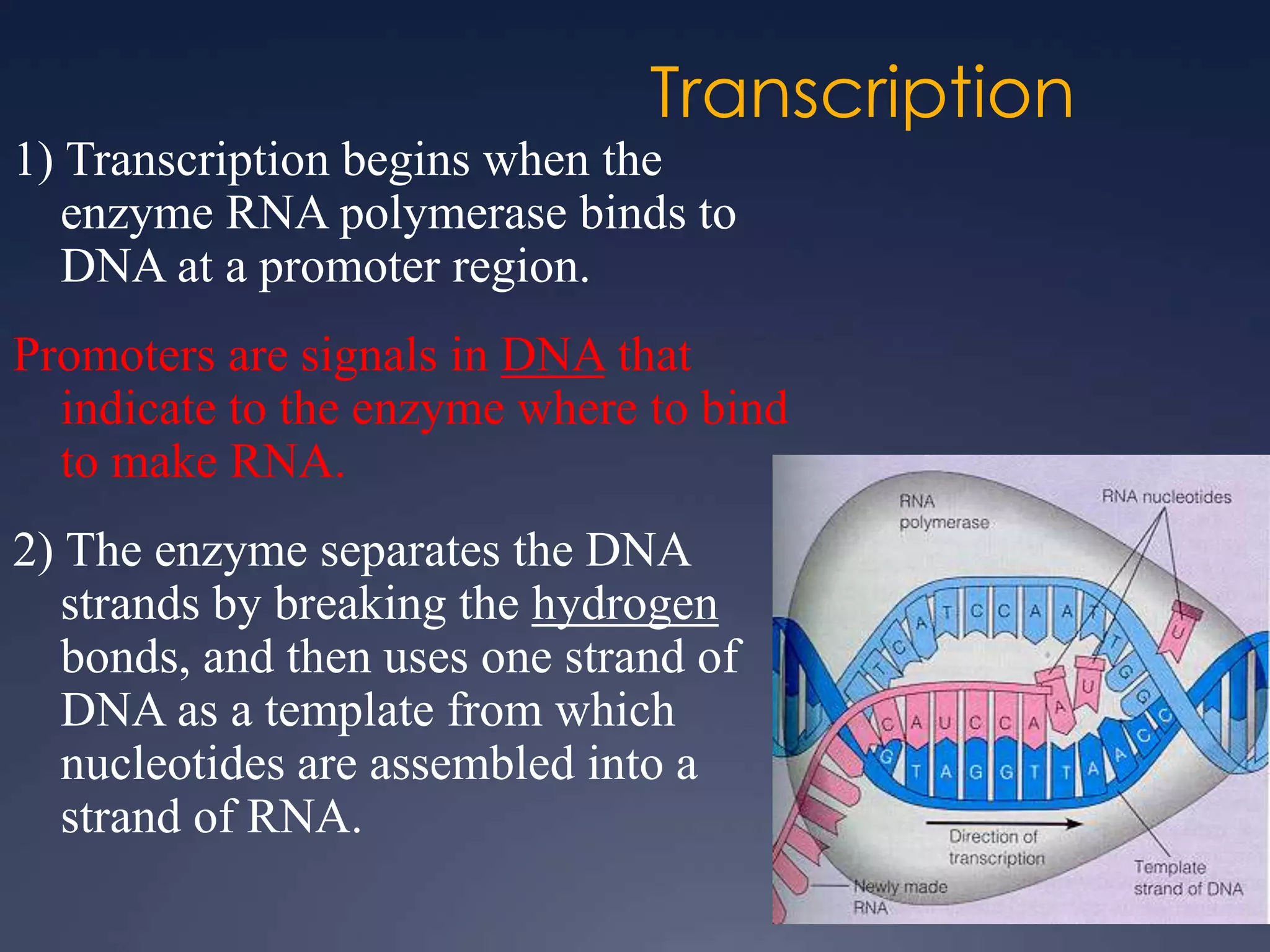
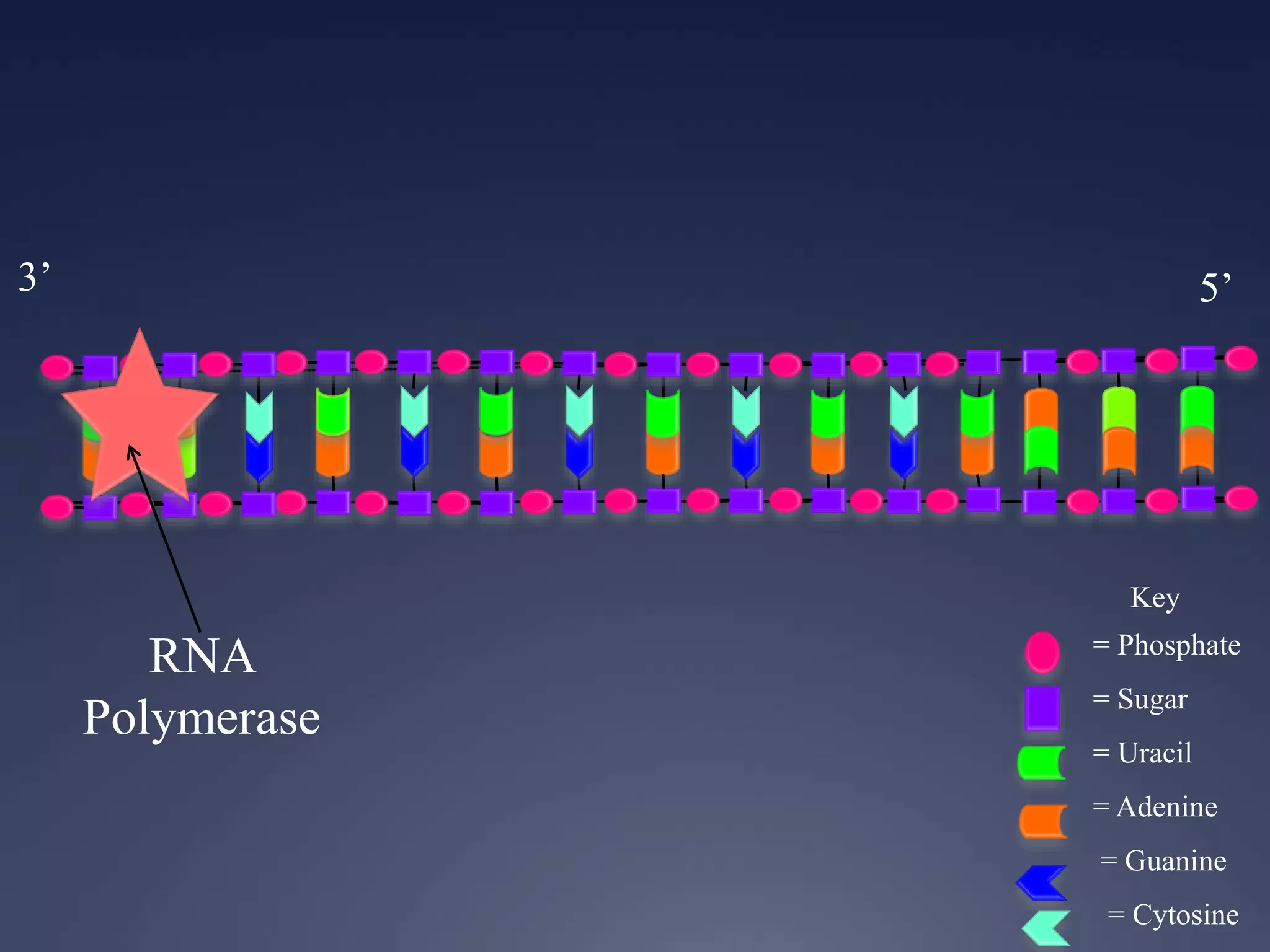
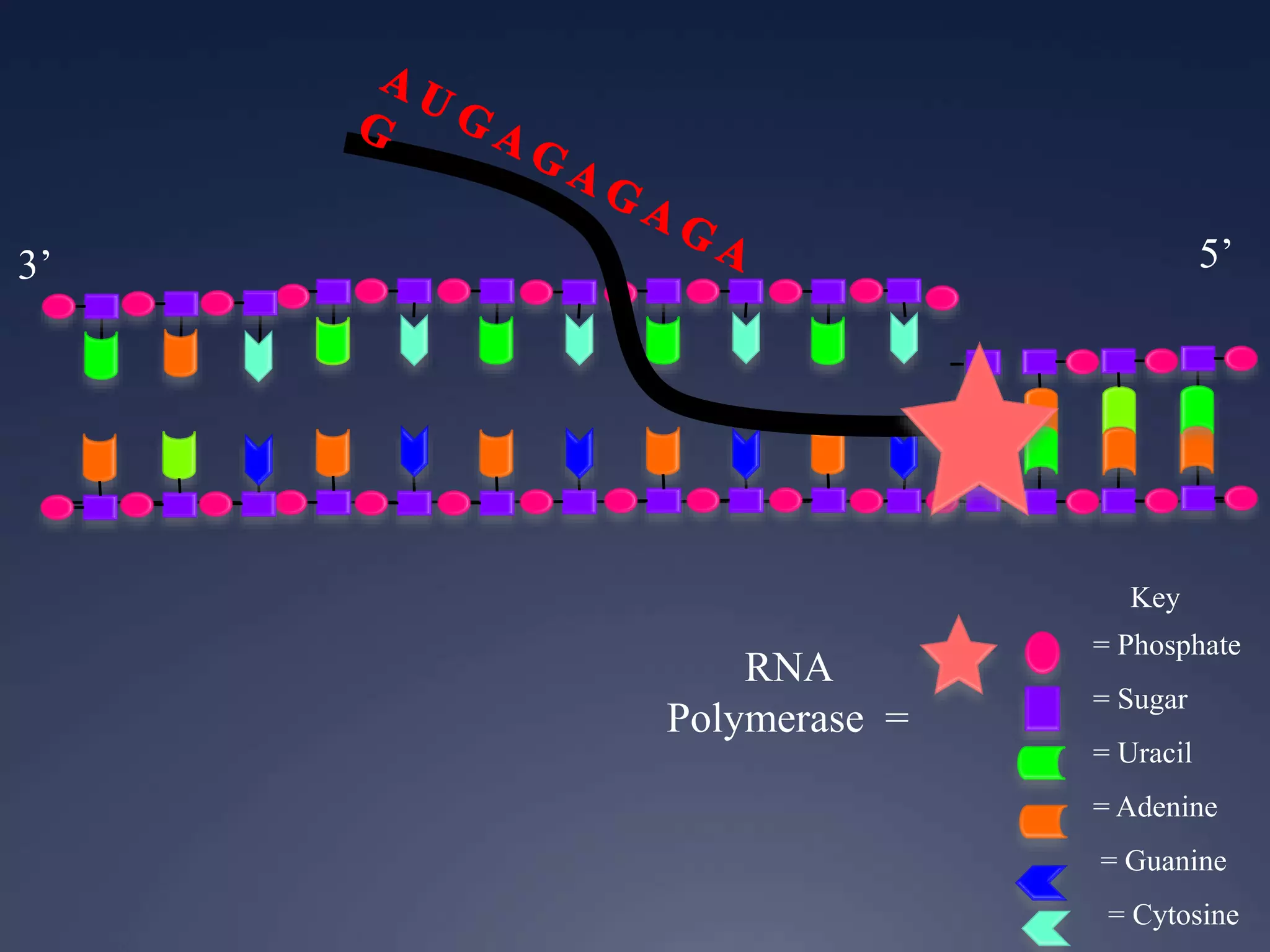
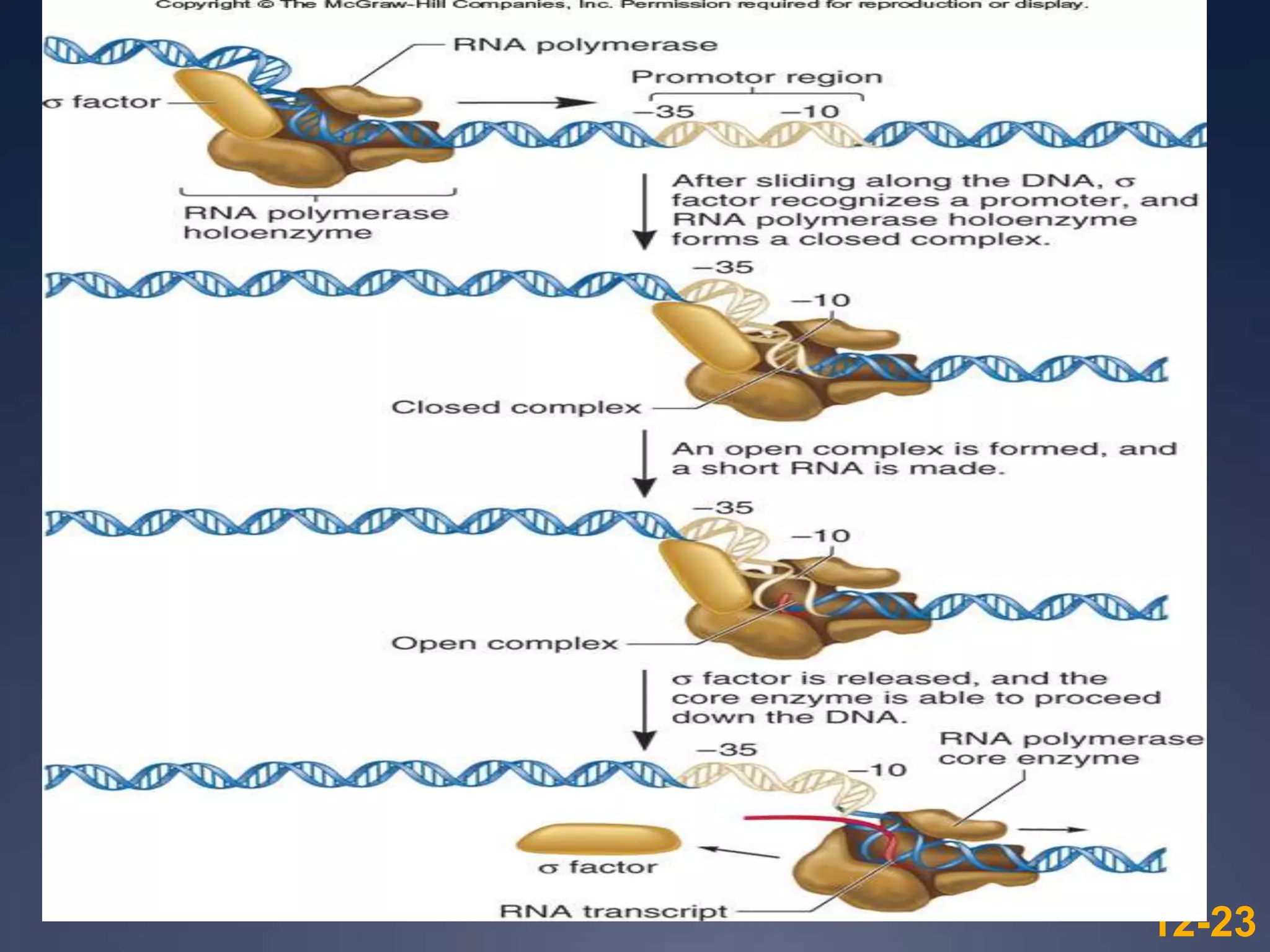
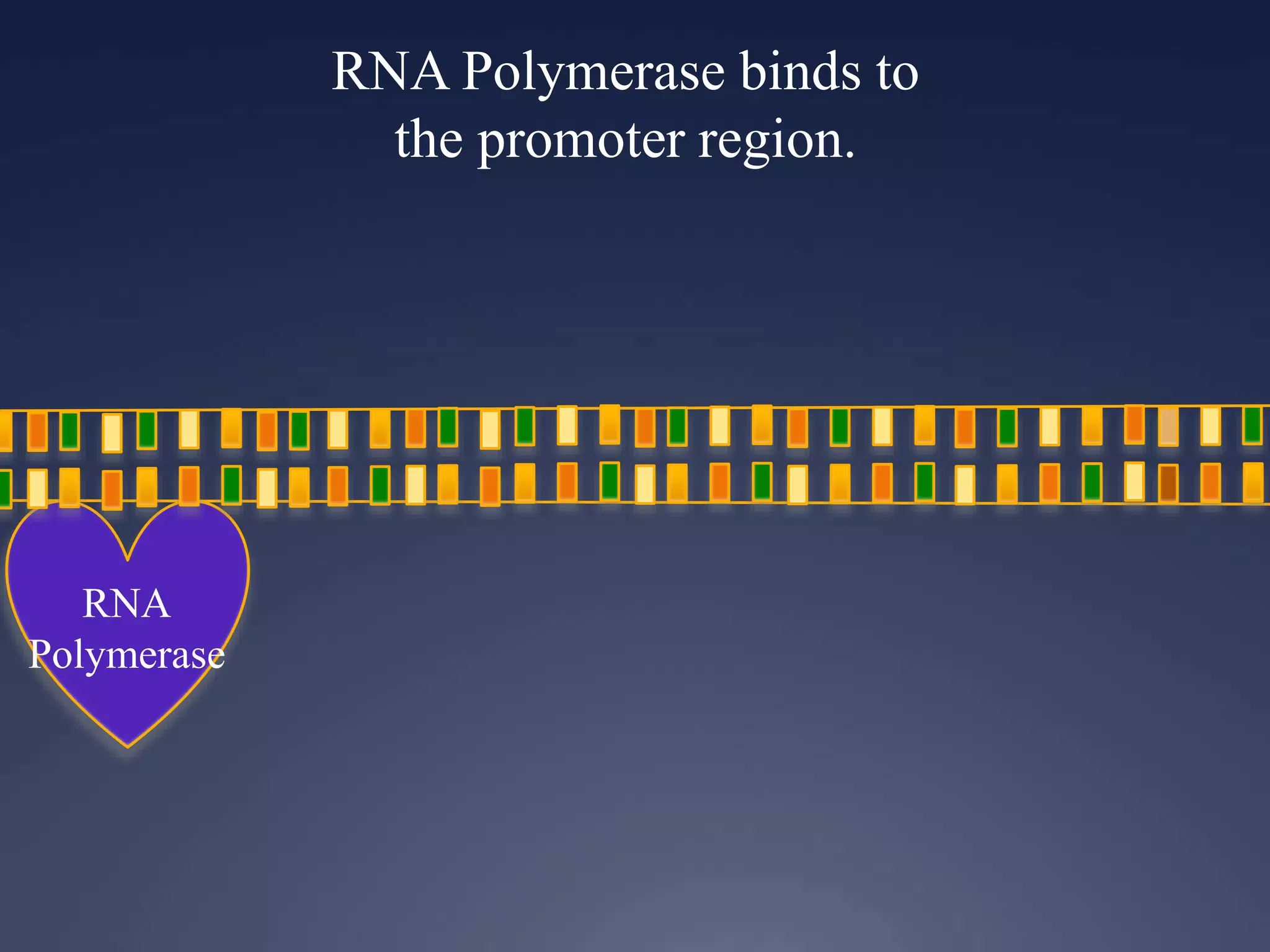
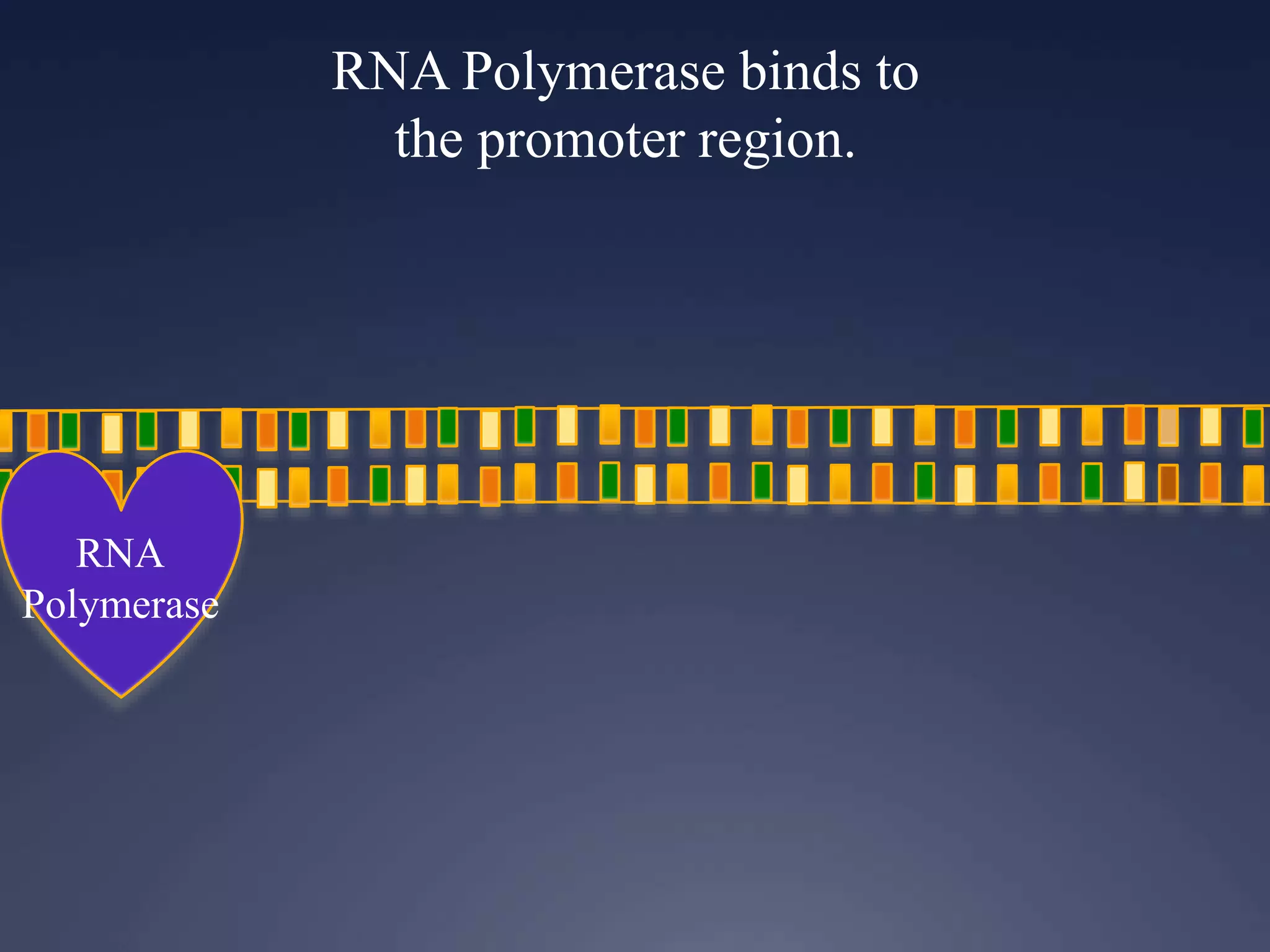
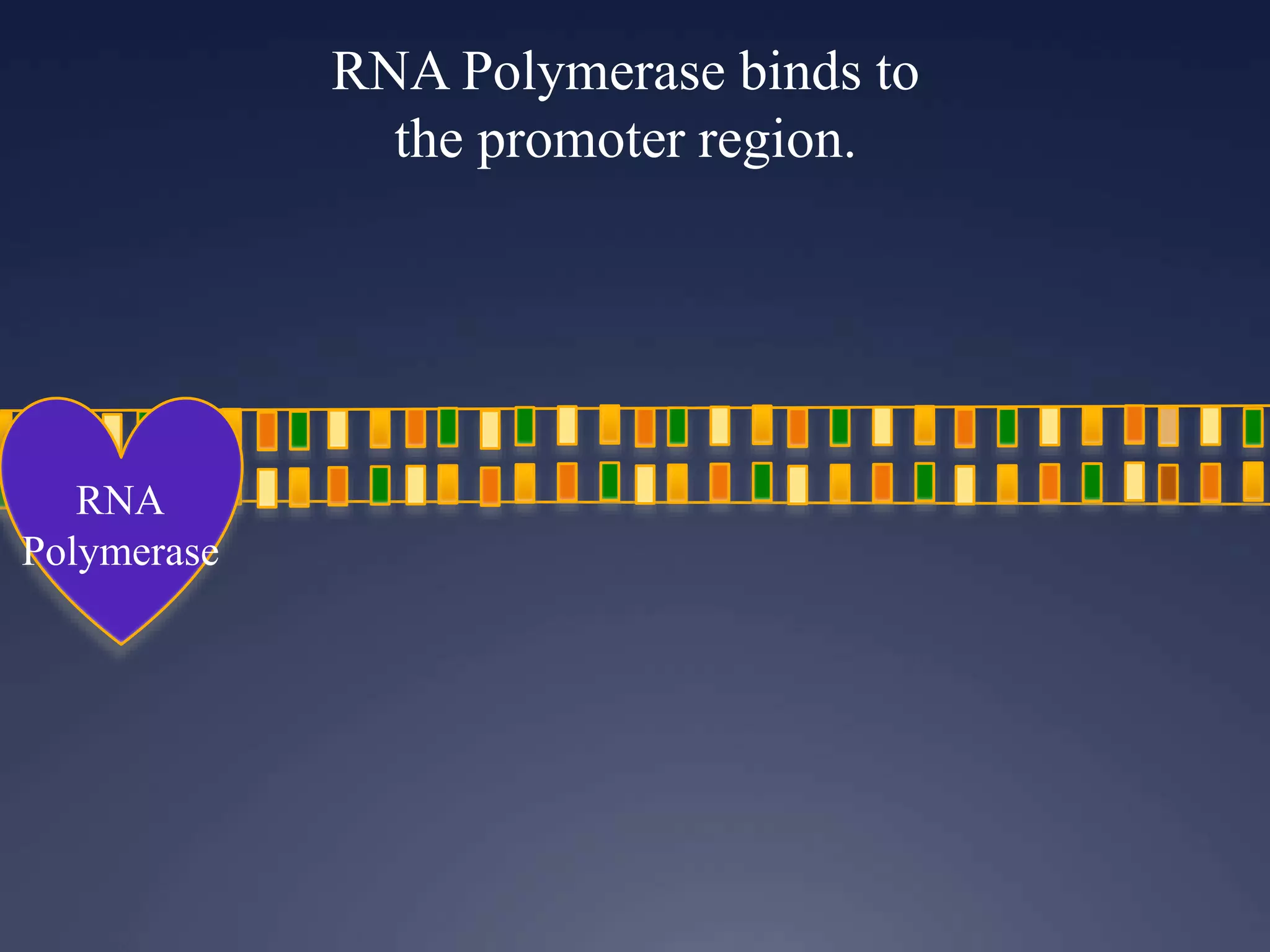
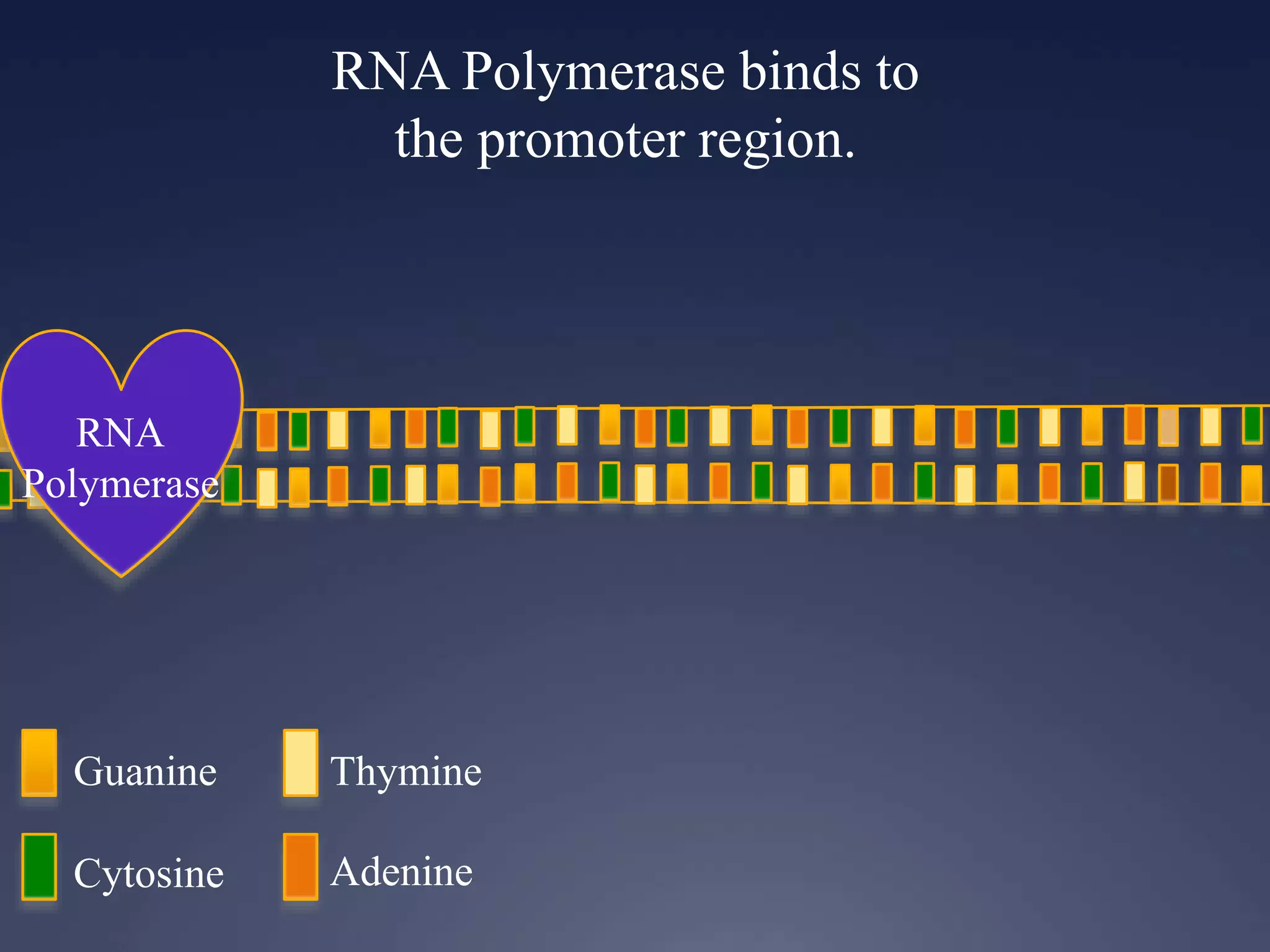
1) Transcription begins when the
enzyme RNA polymerase binds to
DNA at a promoter region.
Promoters are signals in DNA that
indicate to the enzyme where to bind
to make RNA.
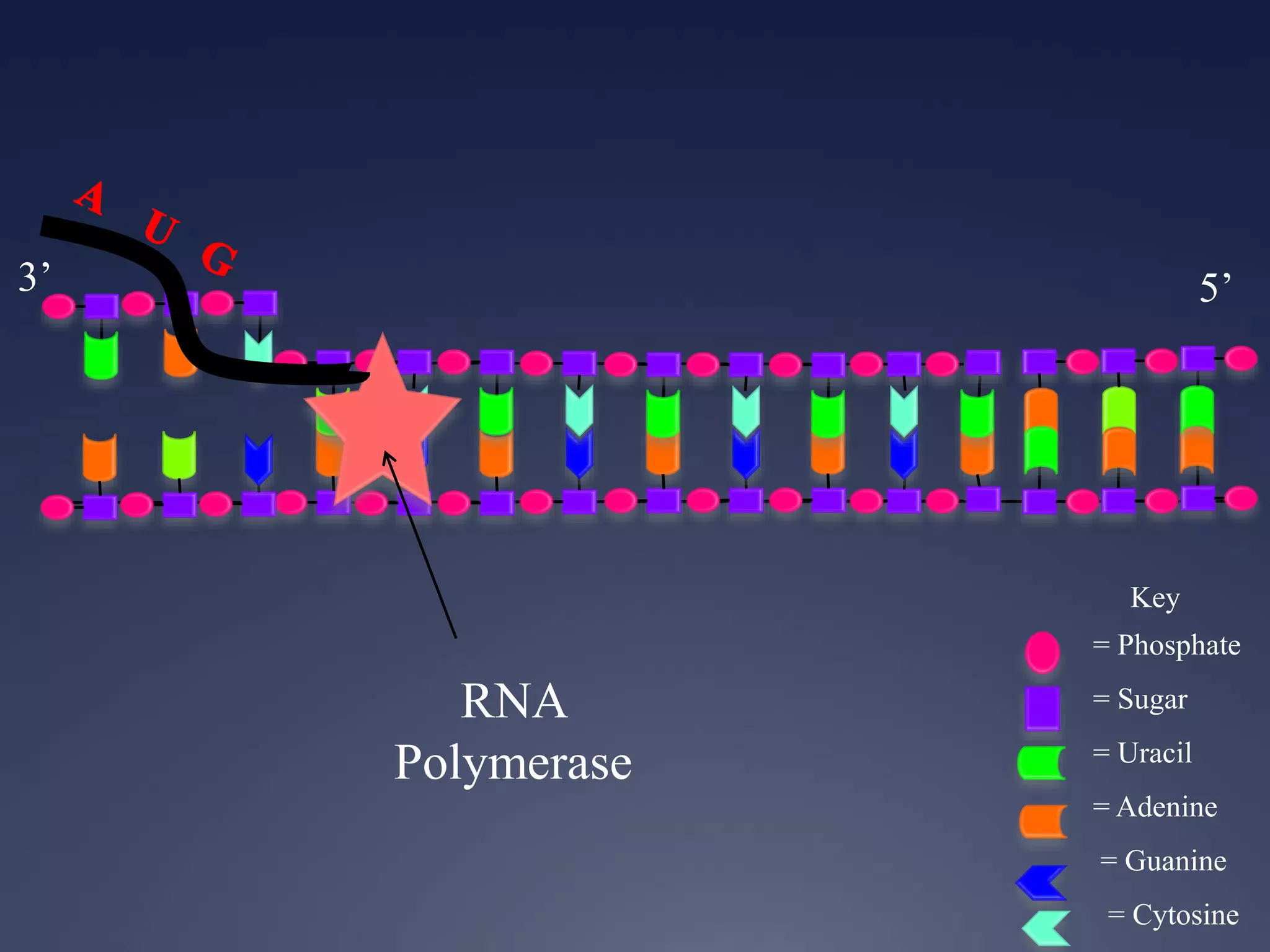
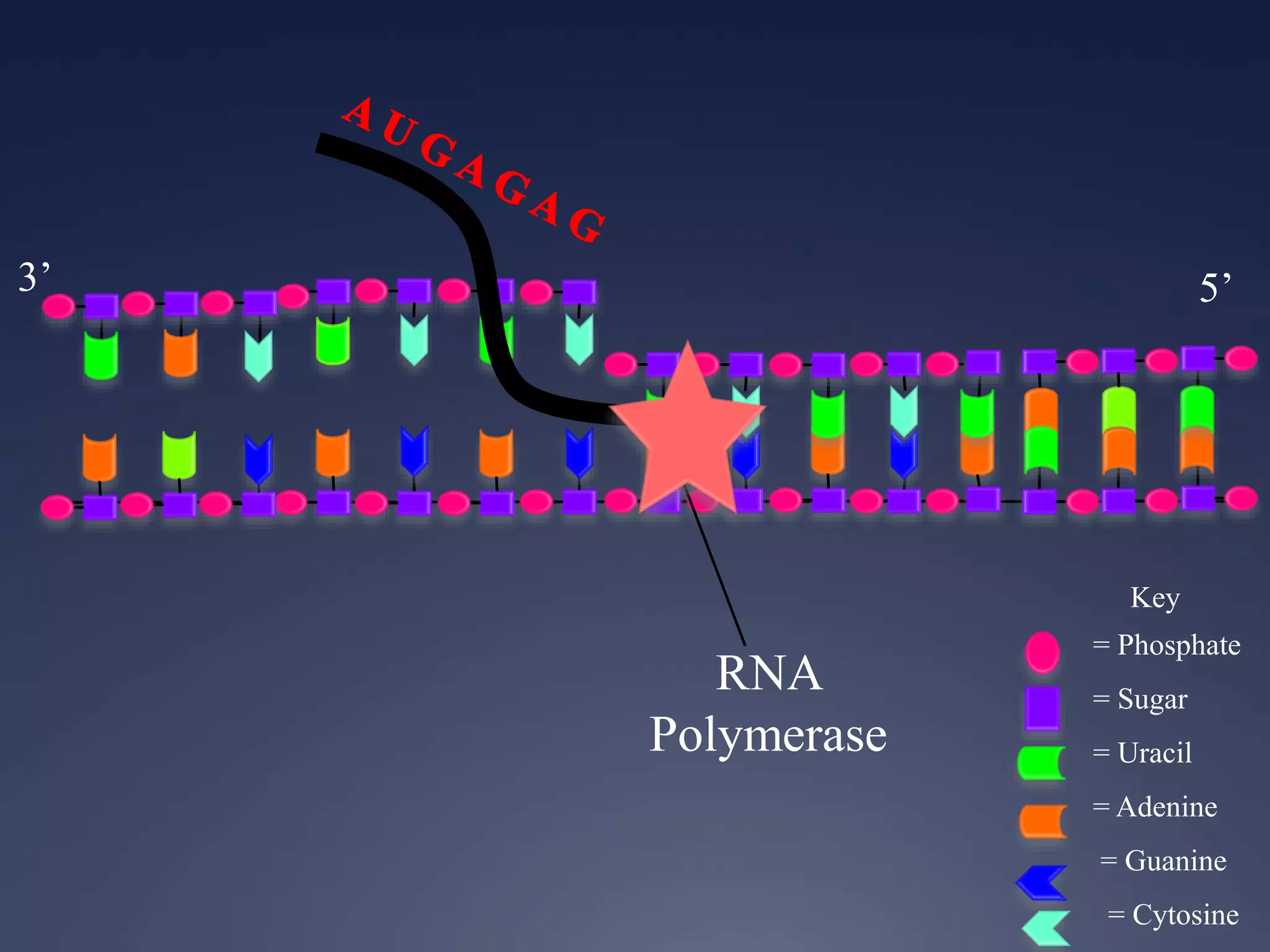
2) The enzyme separates the DNA
strands by breaking the hydrogen
bonds, and then uses one strand of
DNA as a template from which
nucleotides are assembled into a
strand of RNA.
Transcription
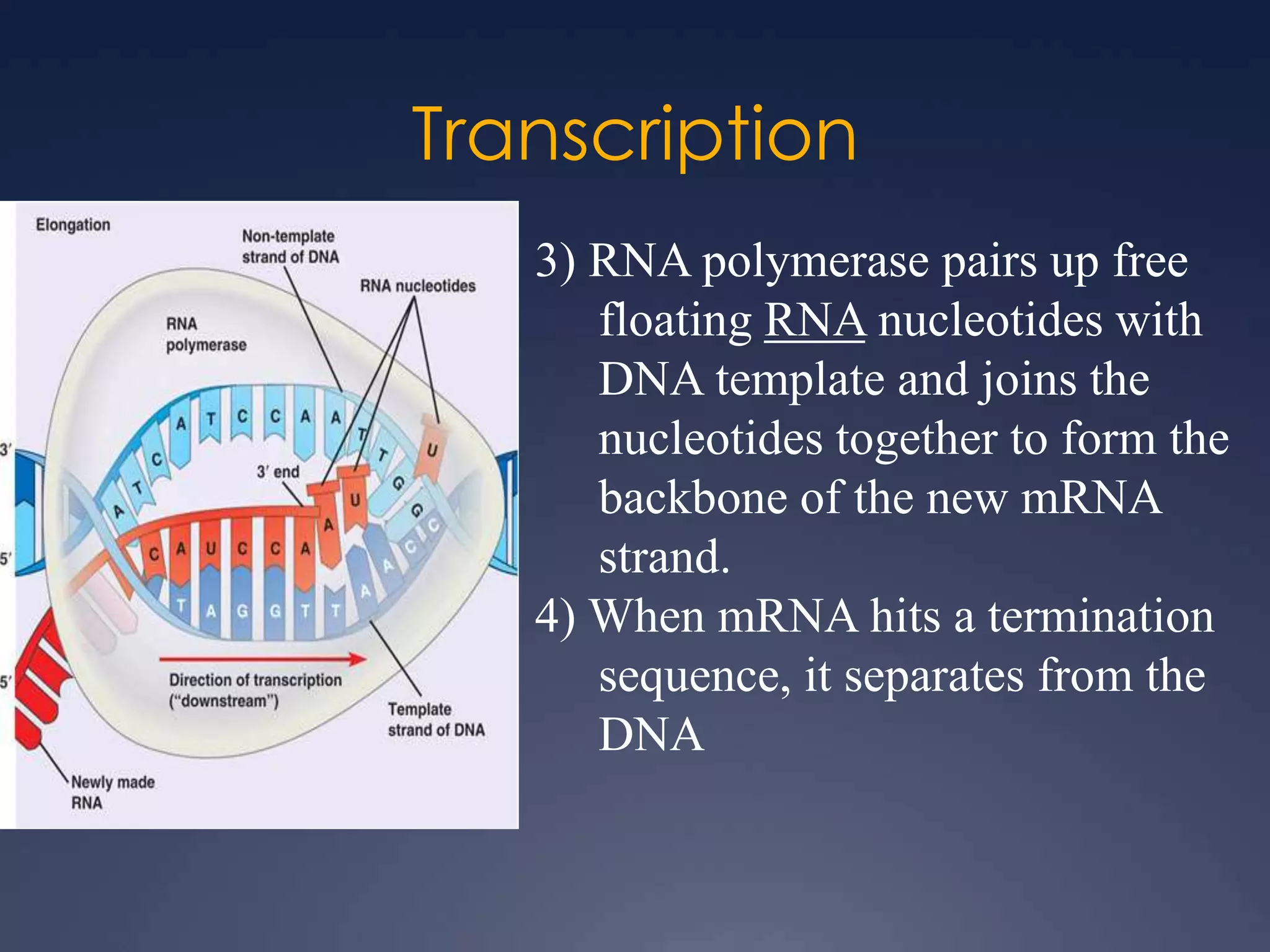
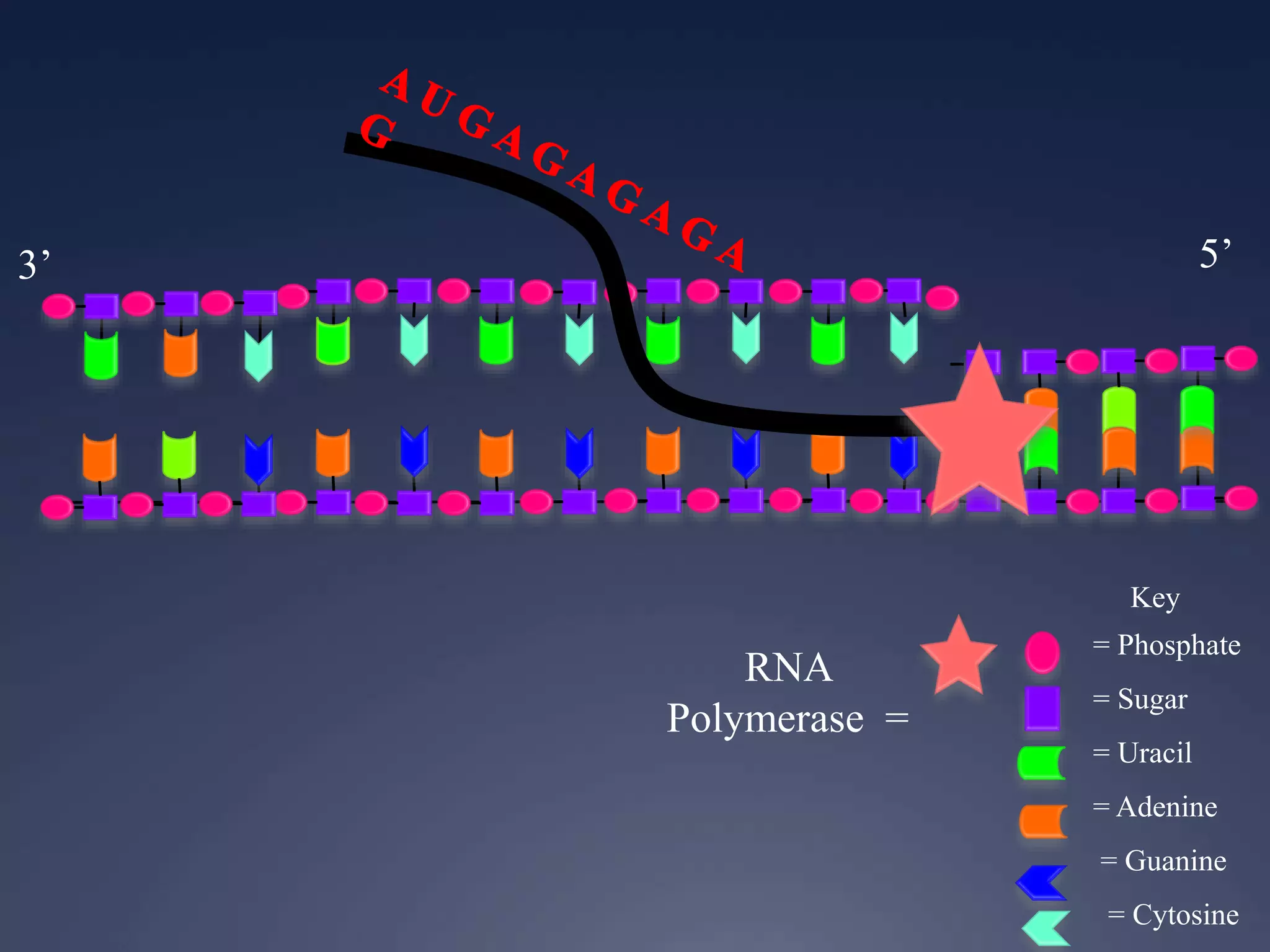
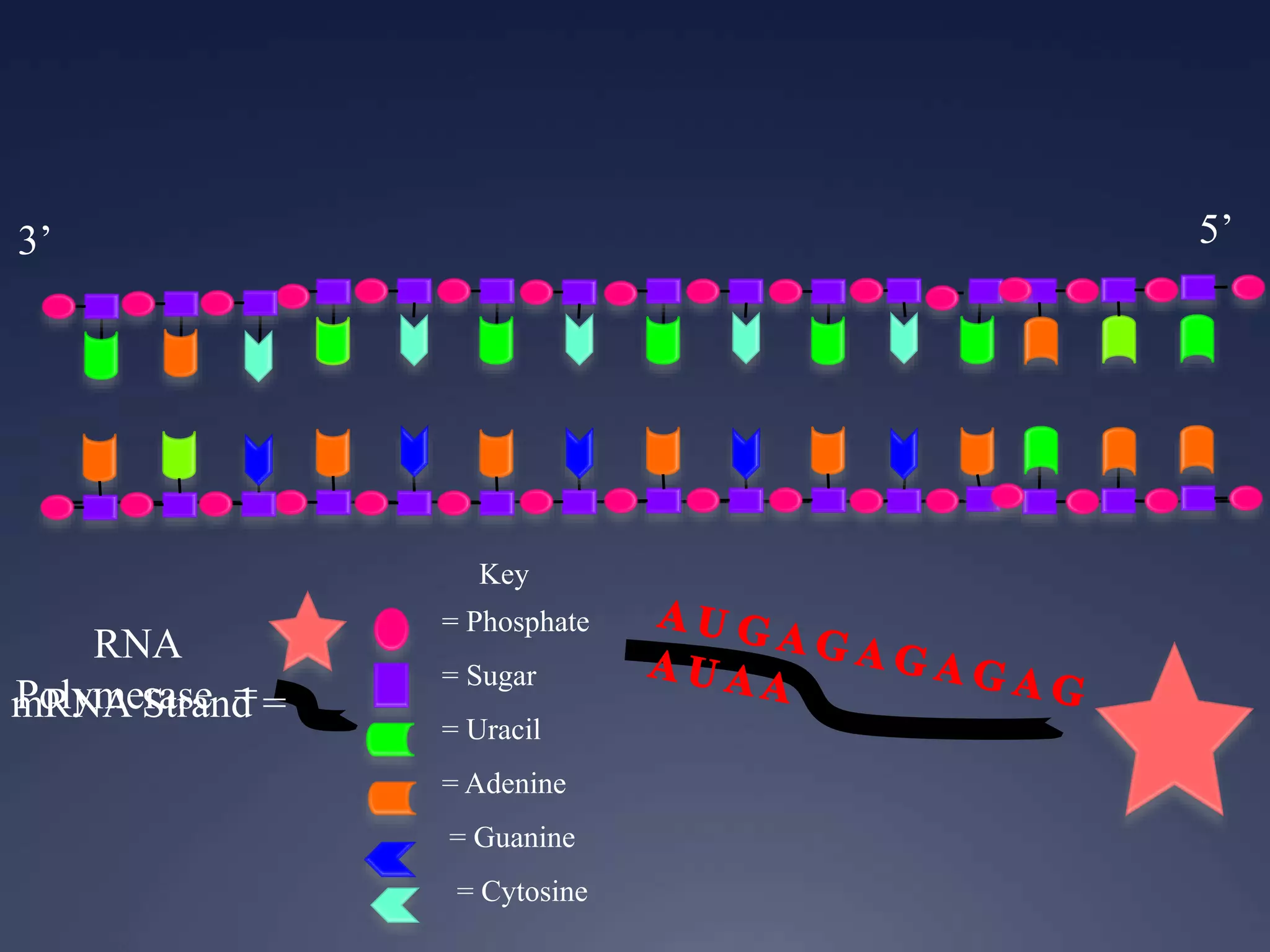
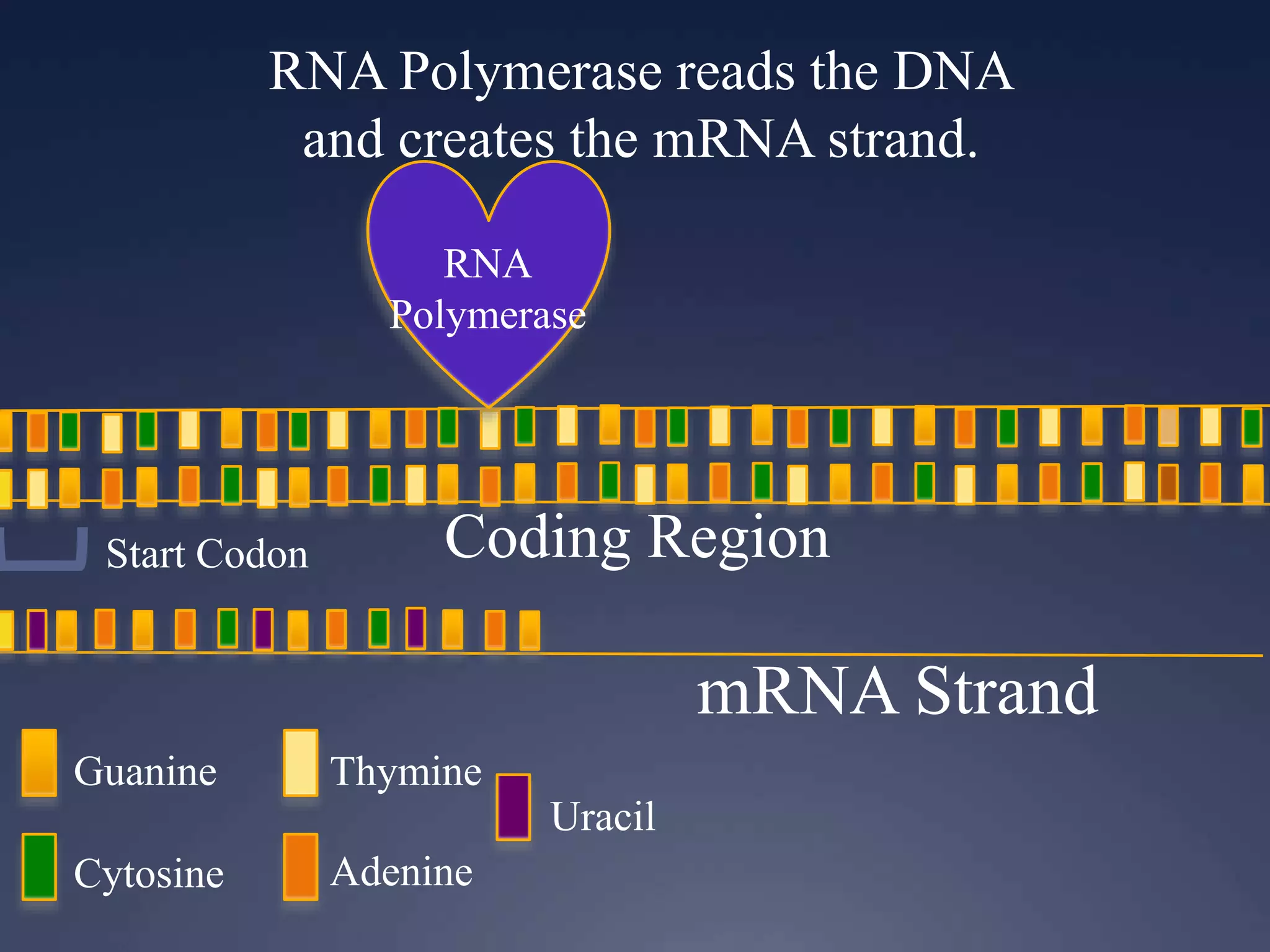
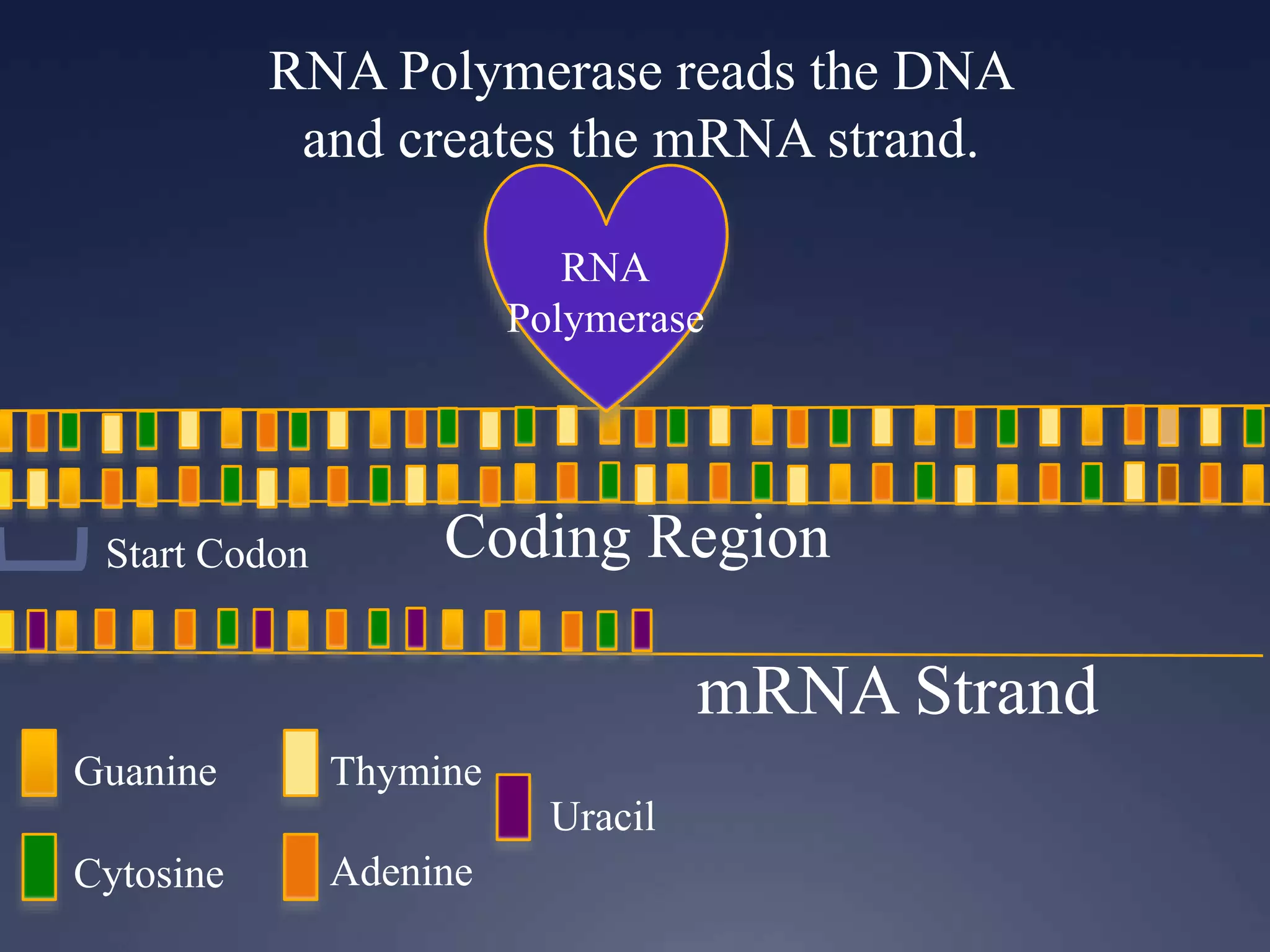
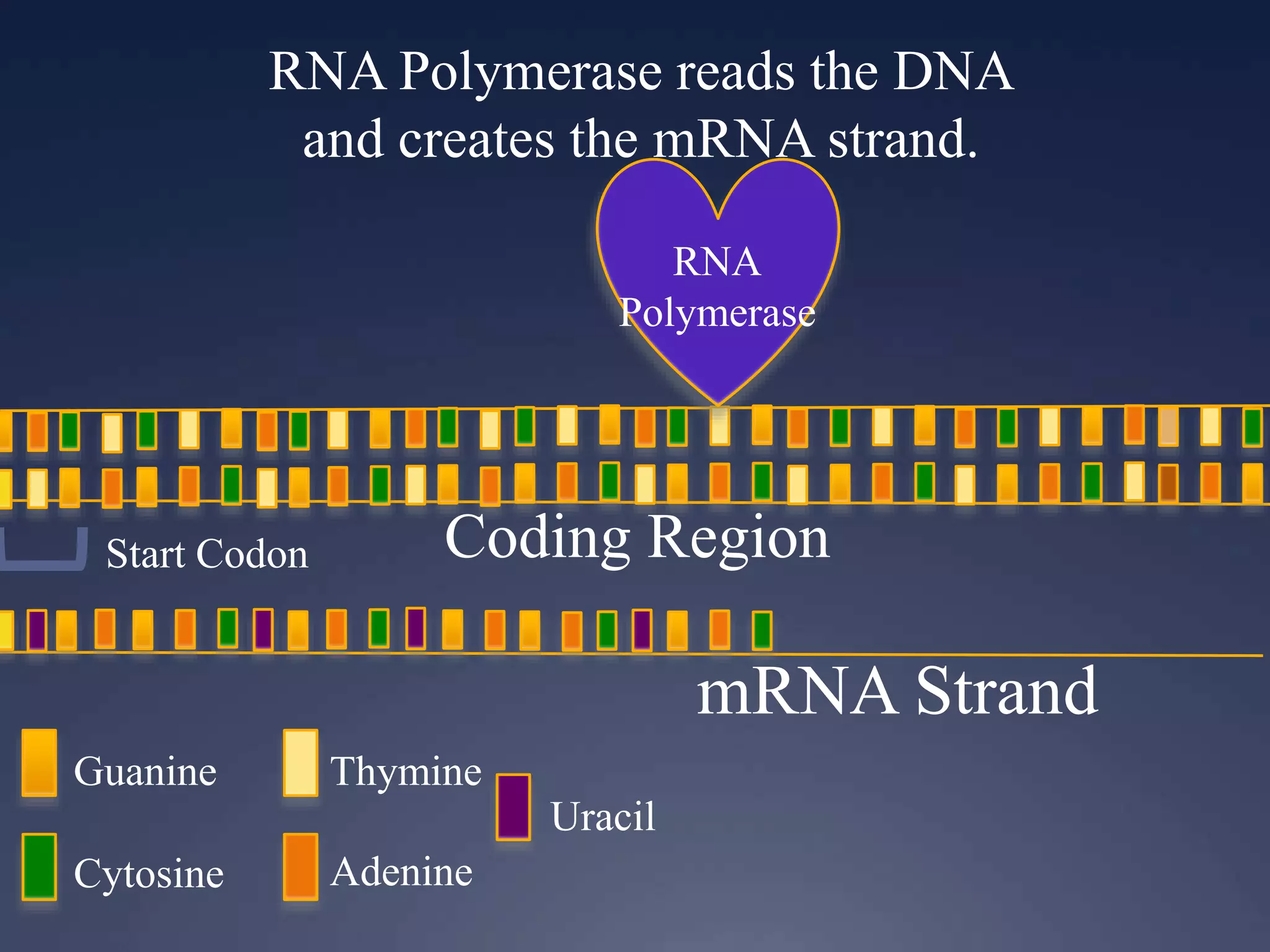
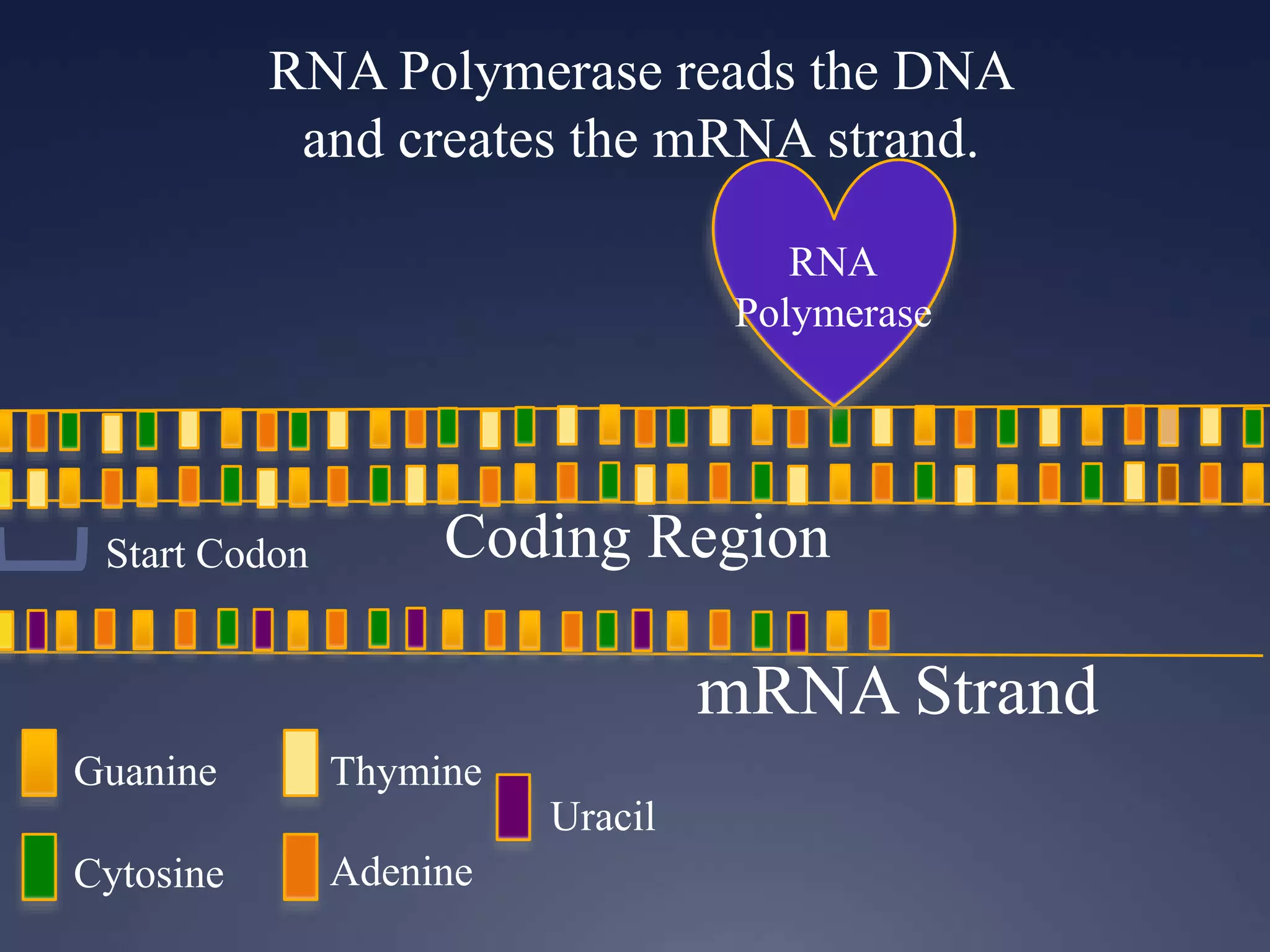
3) RNA polymerase pairs up free
floating RNA nucleotides with
DNA template and joins the
nucleotides together to form the
backbone of the new mRNA
strand.
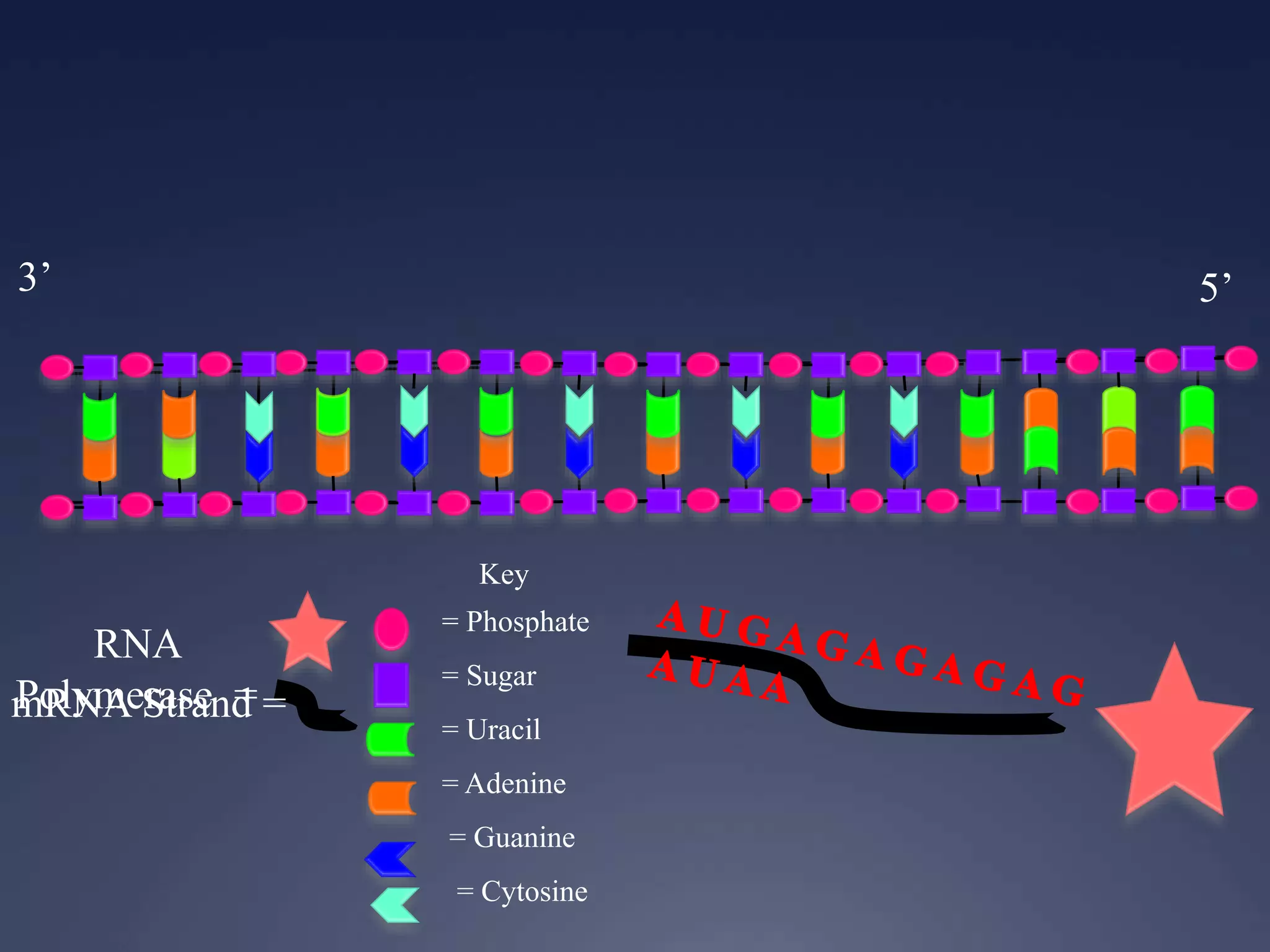
4) When mRNA hits a termination
sequence, it separates from the
DNA
Steps of transcription
 Initiation
 Elongation
 Termination
 post – transcriptional modifications
 The RNAs produced during transcription are
called primary mRNA transcripts. They undergo
many alterations- terminal base additions, base
modifications, splicing etc. This process is
required to convert RNA into active form.
Enzyme involved mainly is - ribonucleases.
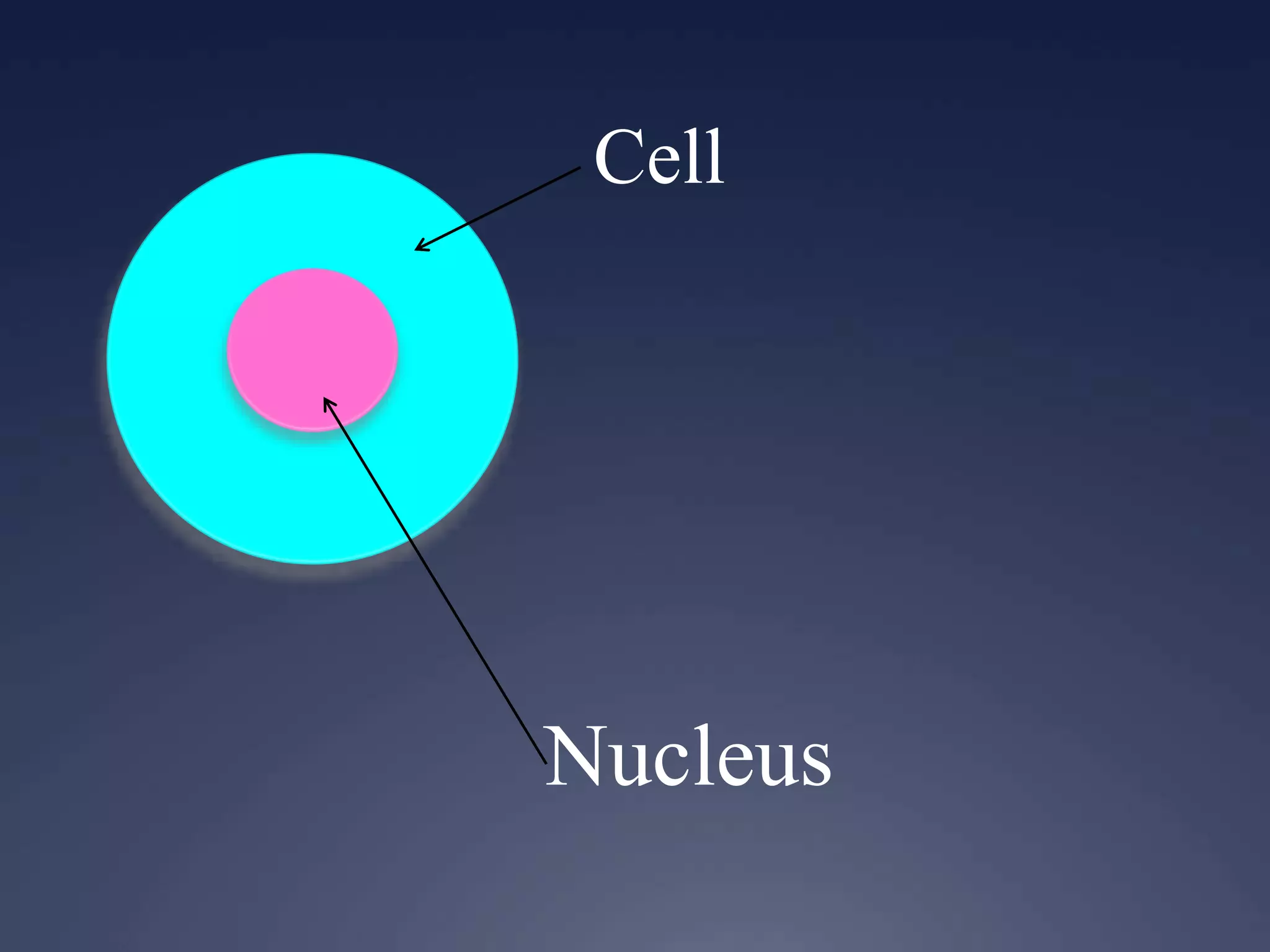
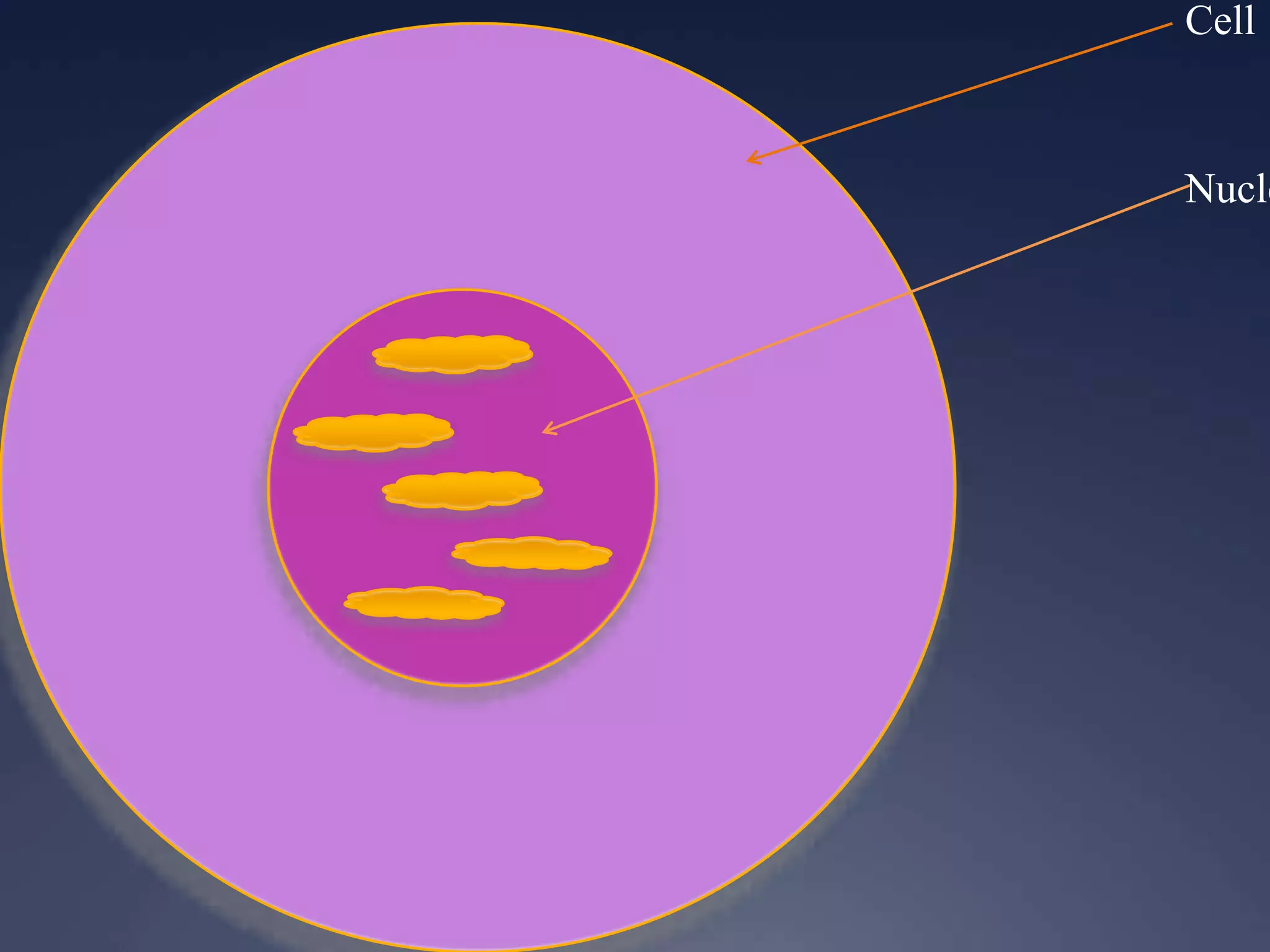
Cell
Nucleus
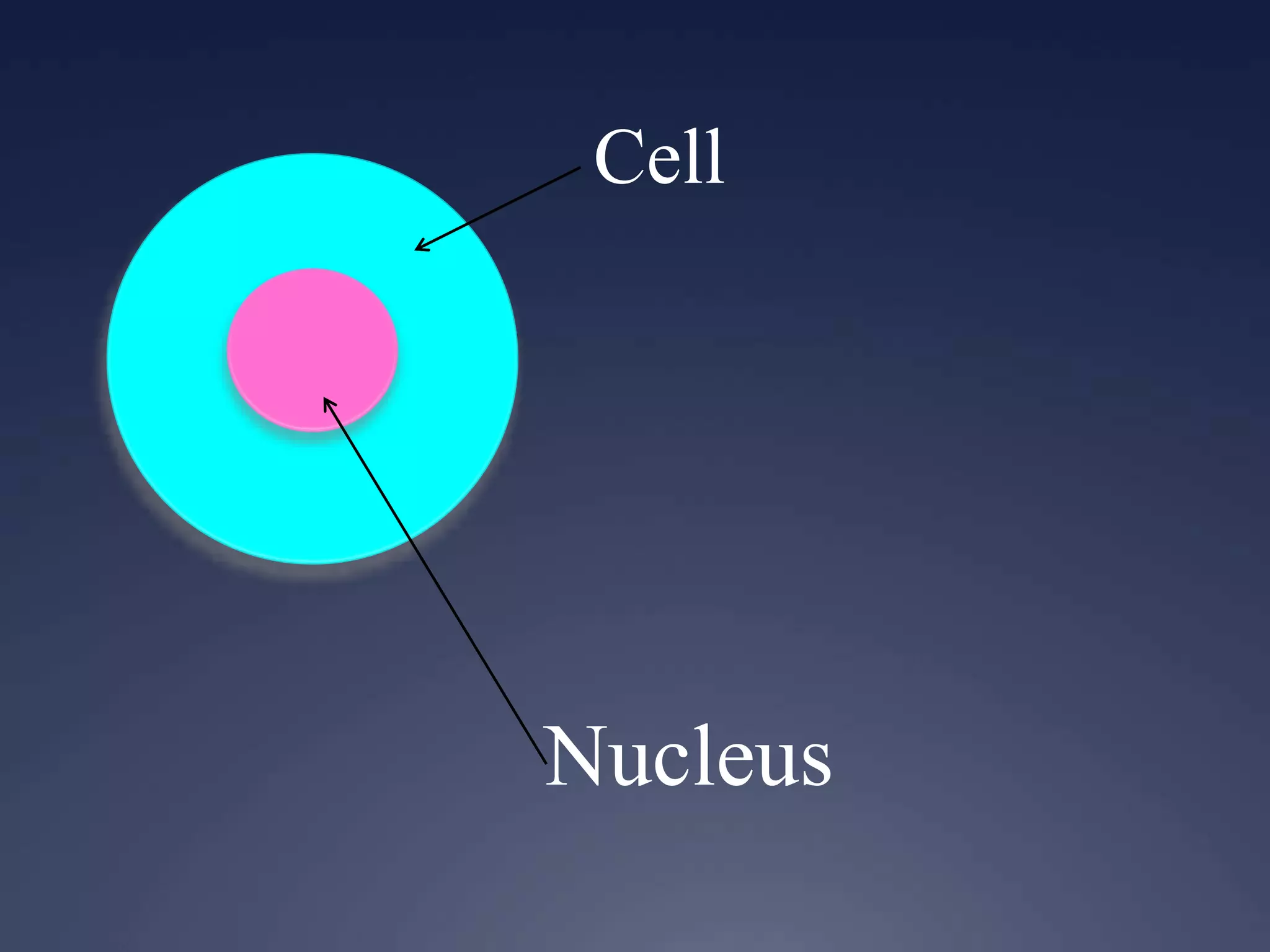
Cell
Nucleus
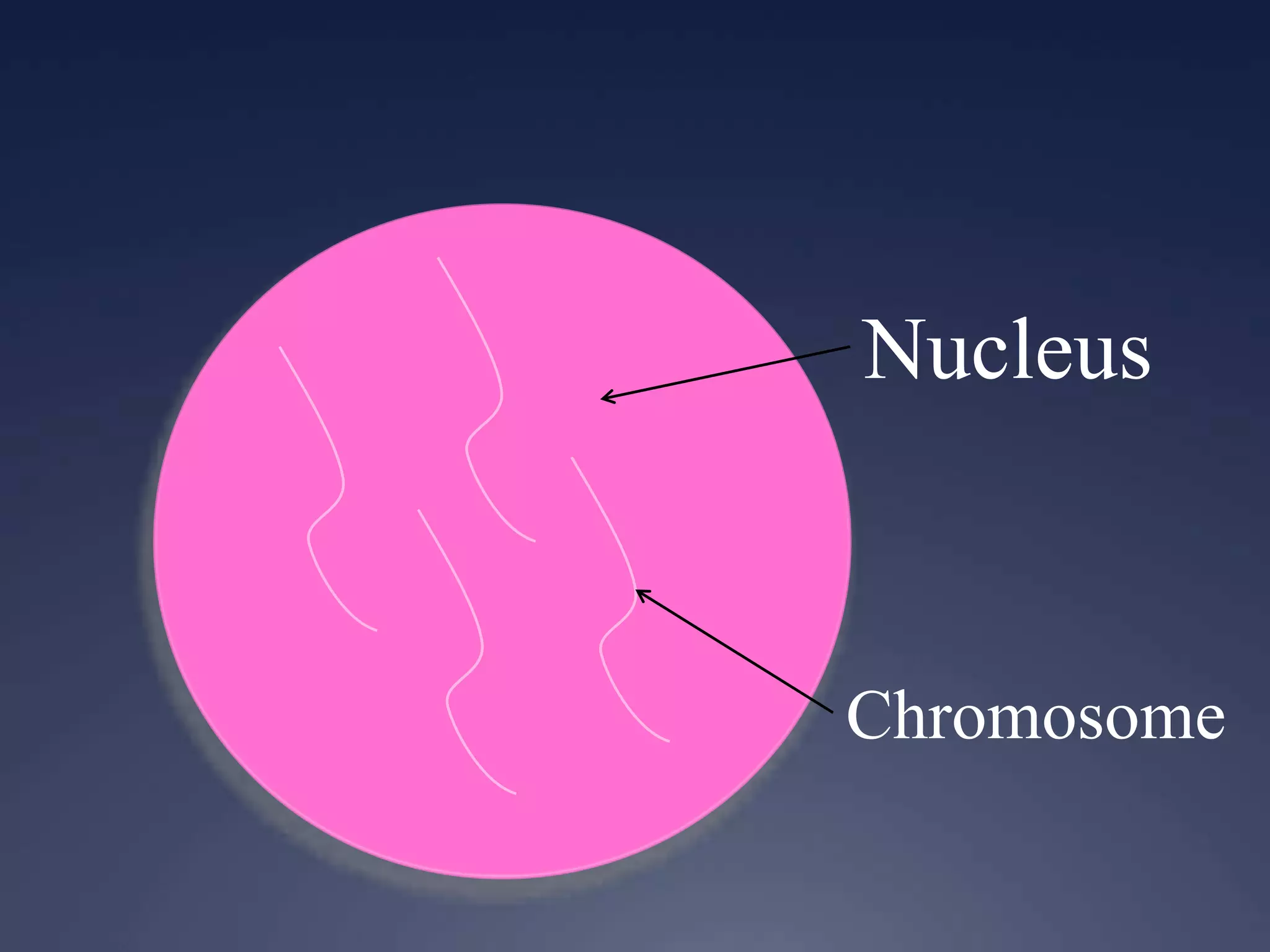
Nucleus
Chromosome
Key
= Phosphate
= Sugar
= Uracil
= Adenine
= Guanine
= Cytosine
RNA
Polymerase
3’ 5’
Key
= Phosphate
= Sugar
= Uracil
= Adenine
= Guanine
= Cytosine
RNA
Polymerase
3’ 5’
Key
= Phosphate
= Sugar
= Uracil
= Adenine
= Guanine
= Cytosine
RNA
Polymerase
3’ 5’
Key
= Phosphate
= Sugar
= Uracil
= Adenine
= Guanine
= Cytosine
RNA
Polymerase =
3’ 5’
Key
= Phosphate
= Sugar
= Uracil
= Adenine
= Guanine
= Cytosine
RNA
Polymerase =
3’ 5’
Key
= Phosphate
= Sugar
= Uracil
= Adenine
= Guanine
= Cytosine
RNA
Polymerase =
3’ 5’
mRNA Strand =
Key
= Phosphate
= Sugar
= Uracil
= Adenine
= Guanine
= Cytosine
RNA
Polymerase =mRNA Strand =
3’ 5’
On average rate of RNA
synthesis is about 43
nucleotides per second .
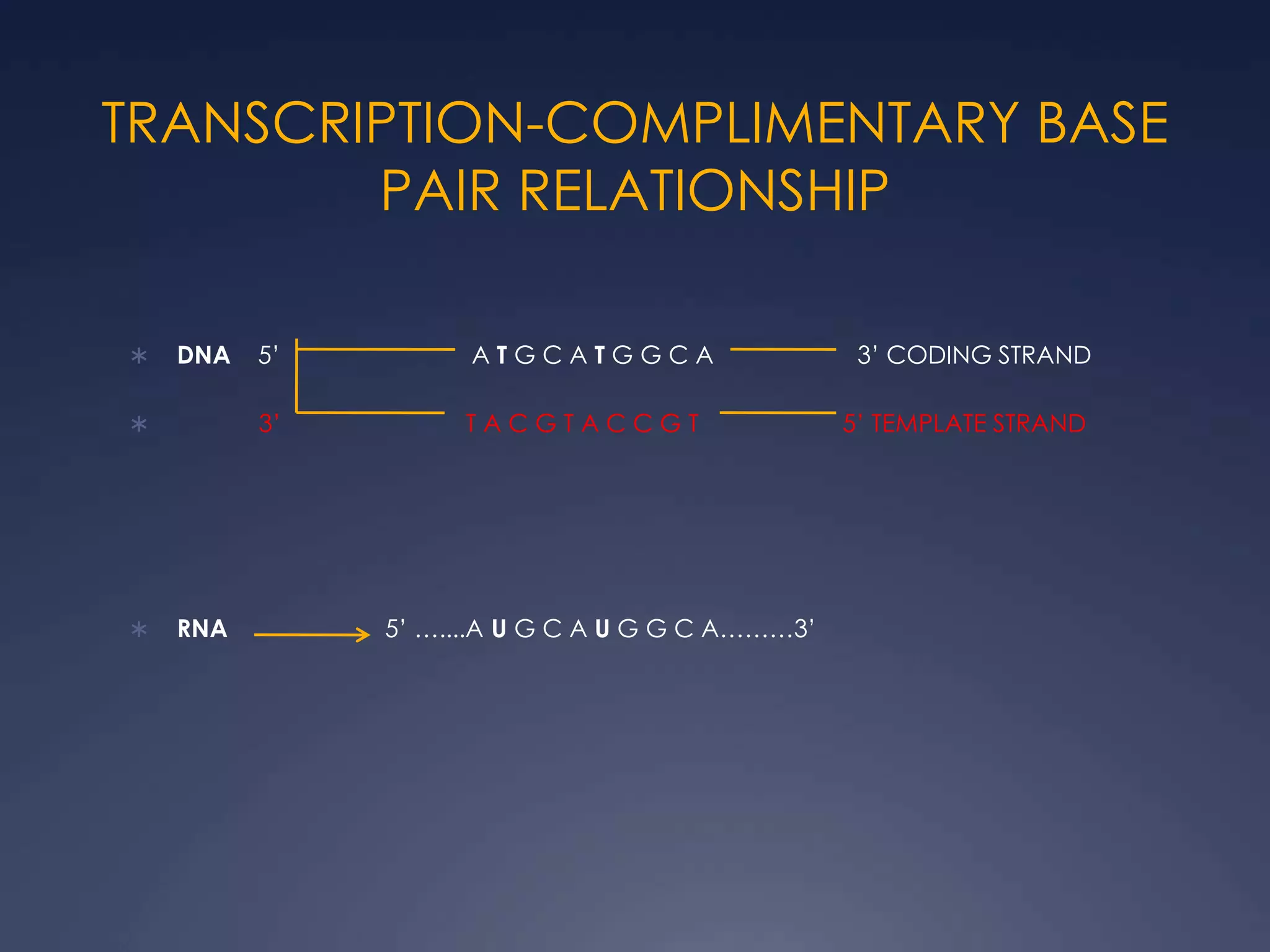
TRANSCRIPTION-COMPLIMENTARY BASE
PAIR RELATIONSHIP
 DNA 5’ A T G C A T G G C A 3’ CODING STRAND
 3’ T A C G T A C C G T 5’ TEMPLATE STRAND
 RNA 5’ …....A U G C A U G G C A………3’
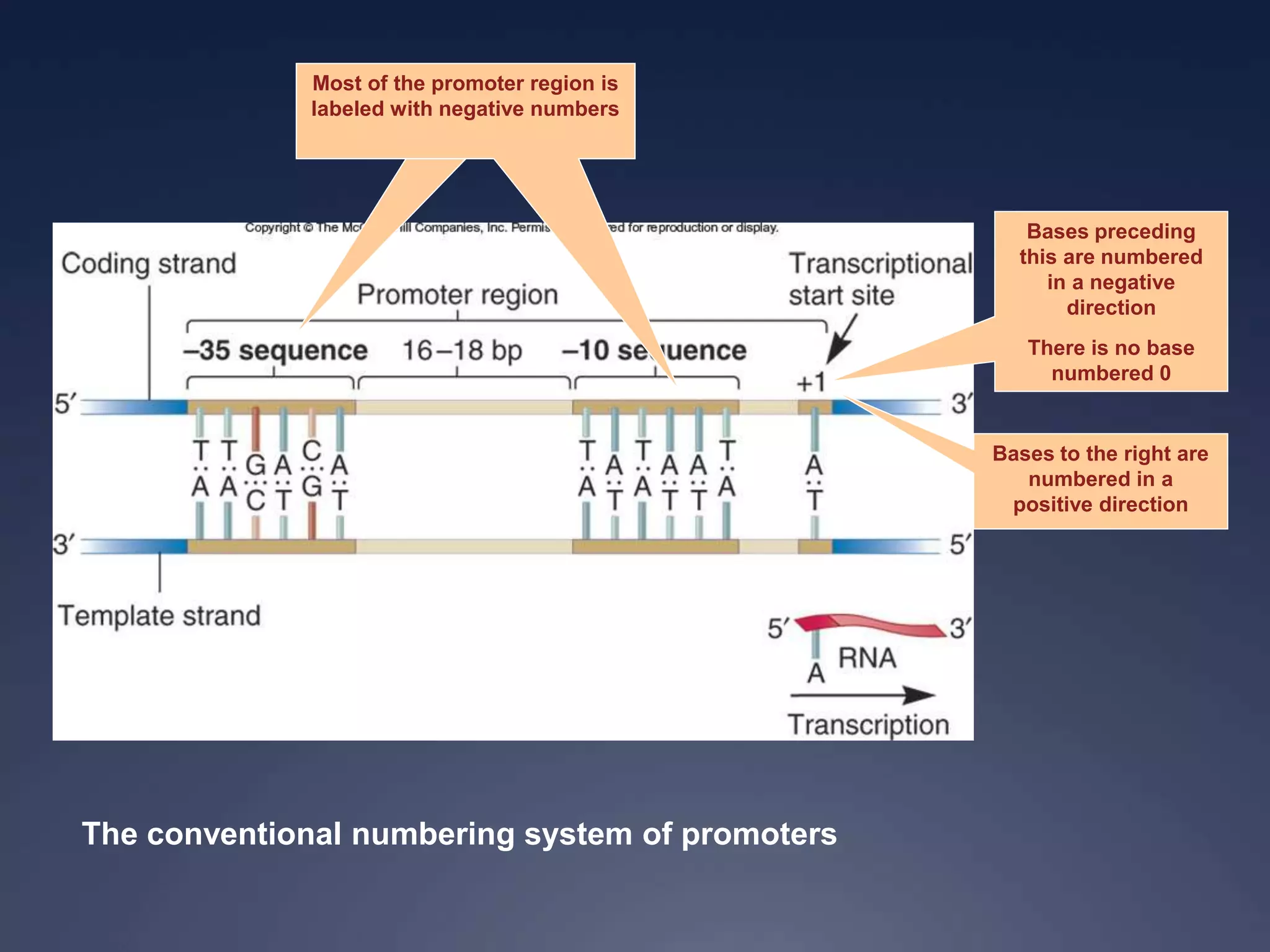
The conventional numbering system of promoters
Bases preceding
this are numbered
in a negative
direction
There is no base
numbered 0
Bases to the right are
numbered in a
positive direction
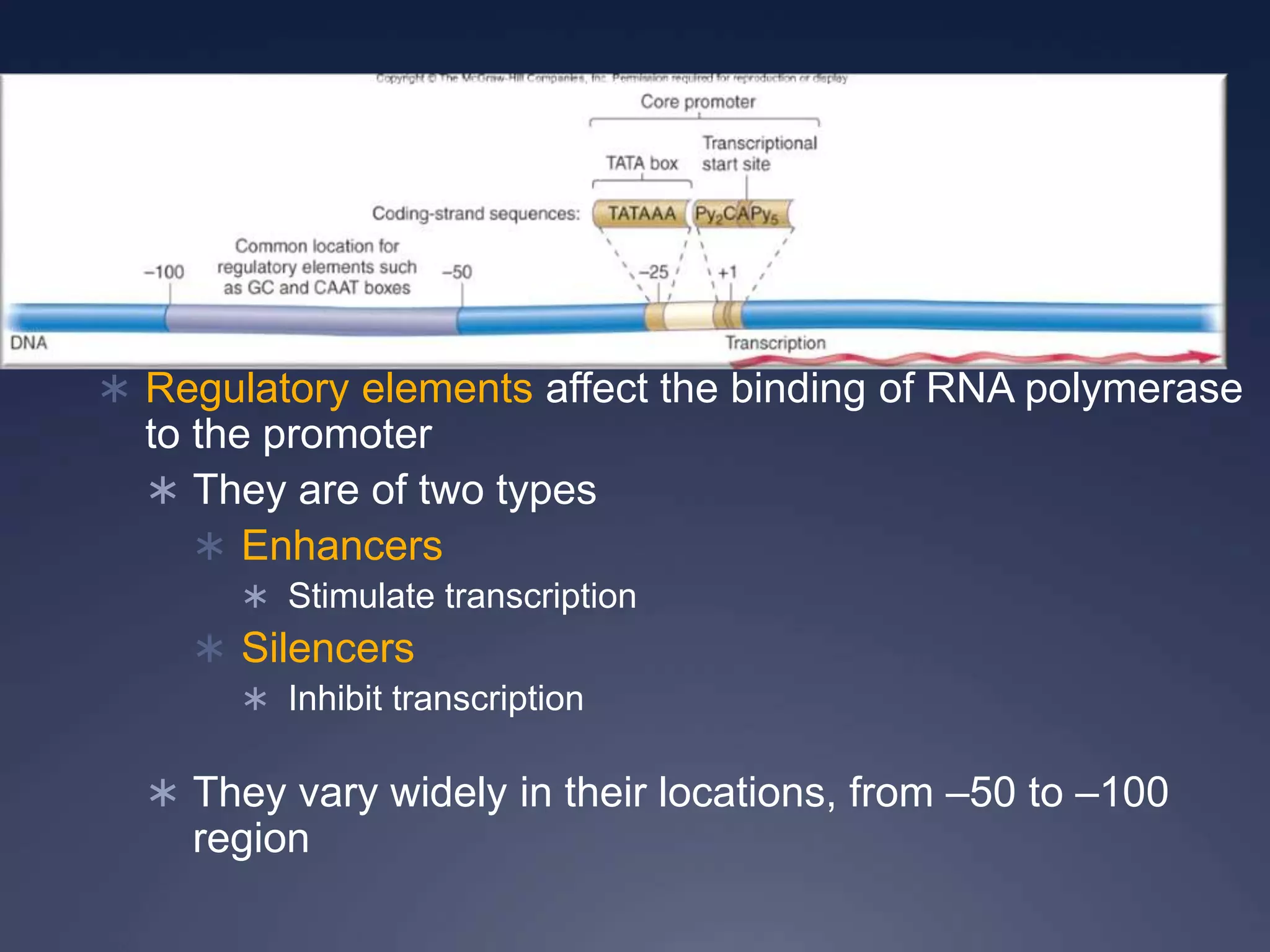
Most of the promoter region is
labeled with negative numbers
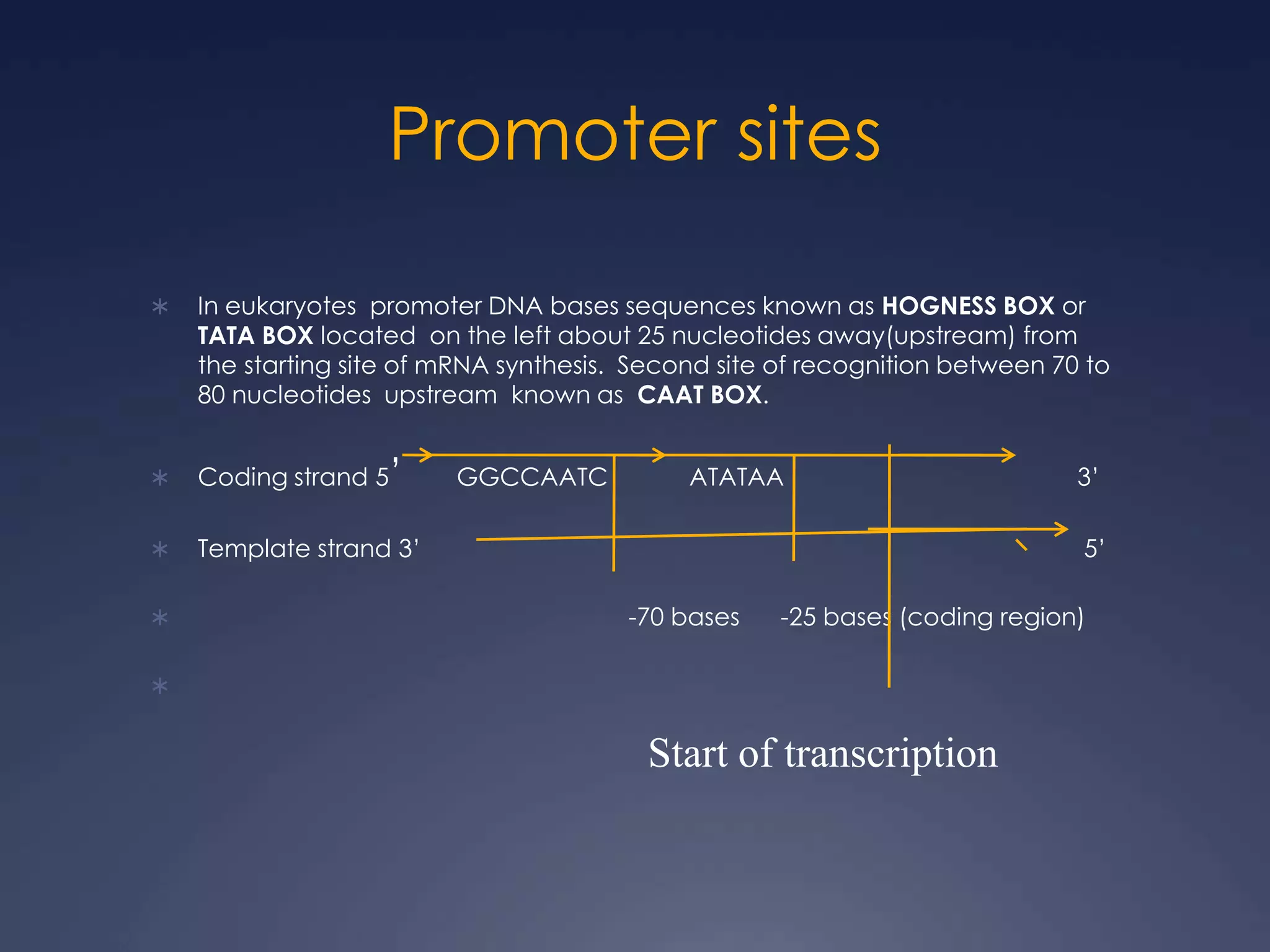
Promoter sites
 In eukaryotes promoter DNA bases sequences known as HOGNESS BOX or
TATA BOX located on the left about 25 nucleotides away(upstream) from
the starting site of mRNA synthesis. Second site of recognition between 70 to
80 nucleotides upstream known as CAAT BOX.
 Coding strand 5’ GGCCAATC ATATAA 3’
 Template strand 3’ 5’
 -70 bases -25 bases (coding region)

Start of transcription
Copyright ©The McGraw-Hill Companies, Inc. Permission required for reproduction or display
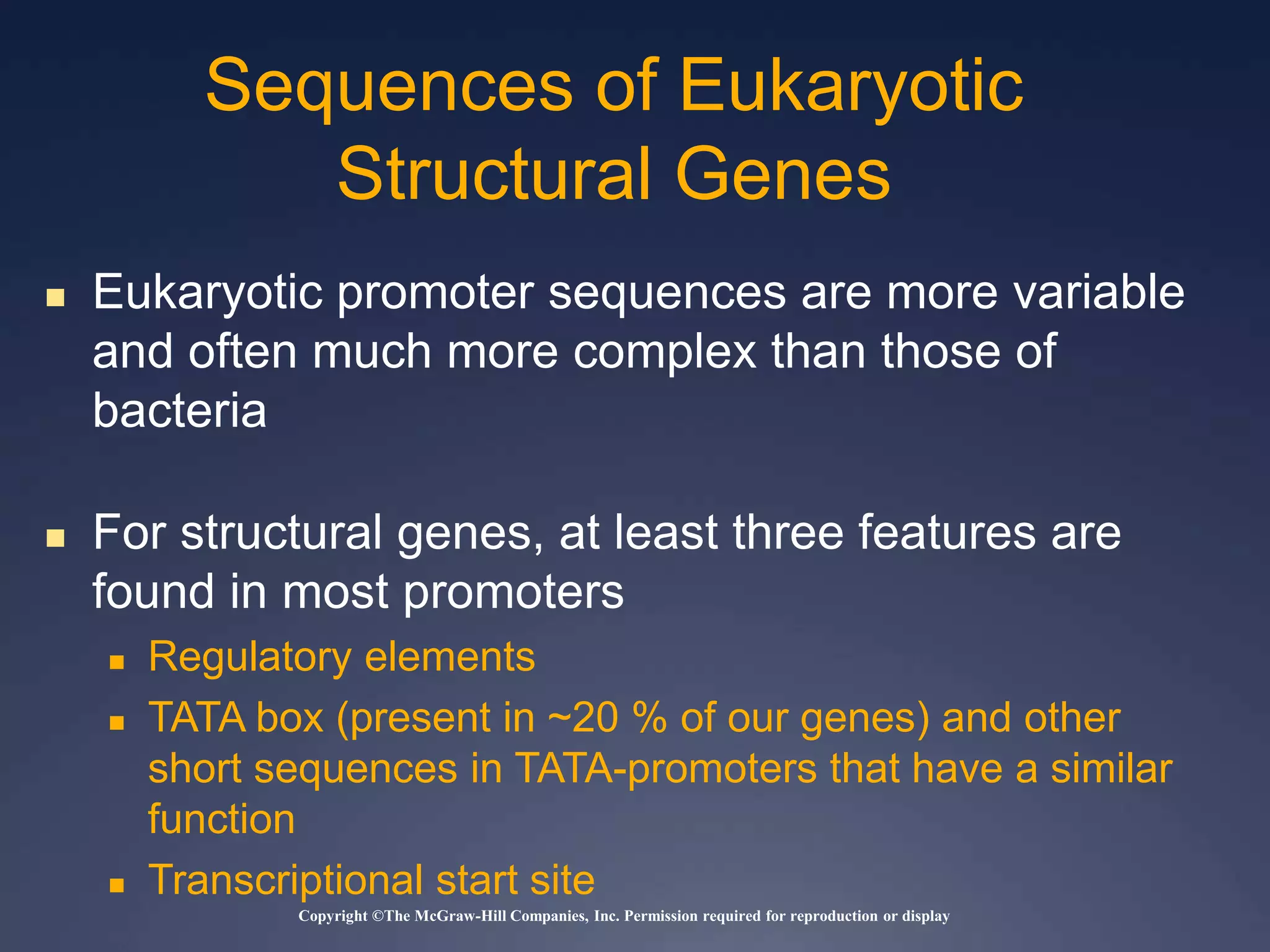
 Eukaryotic promoter sequences are more variable
and often much more complex than those of
bacteria
 For structural genes, at least three features are
found in most promoters
 Regulatory elements
 TATA box (present in ~20 % of our genes) and other
short sequences in TATA-promoters that have a similar
function
 Transcriptional start site
Sequences of Eukaryotic
Structural Genes
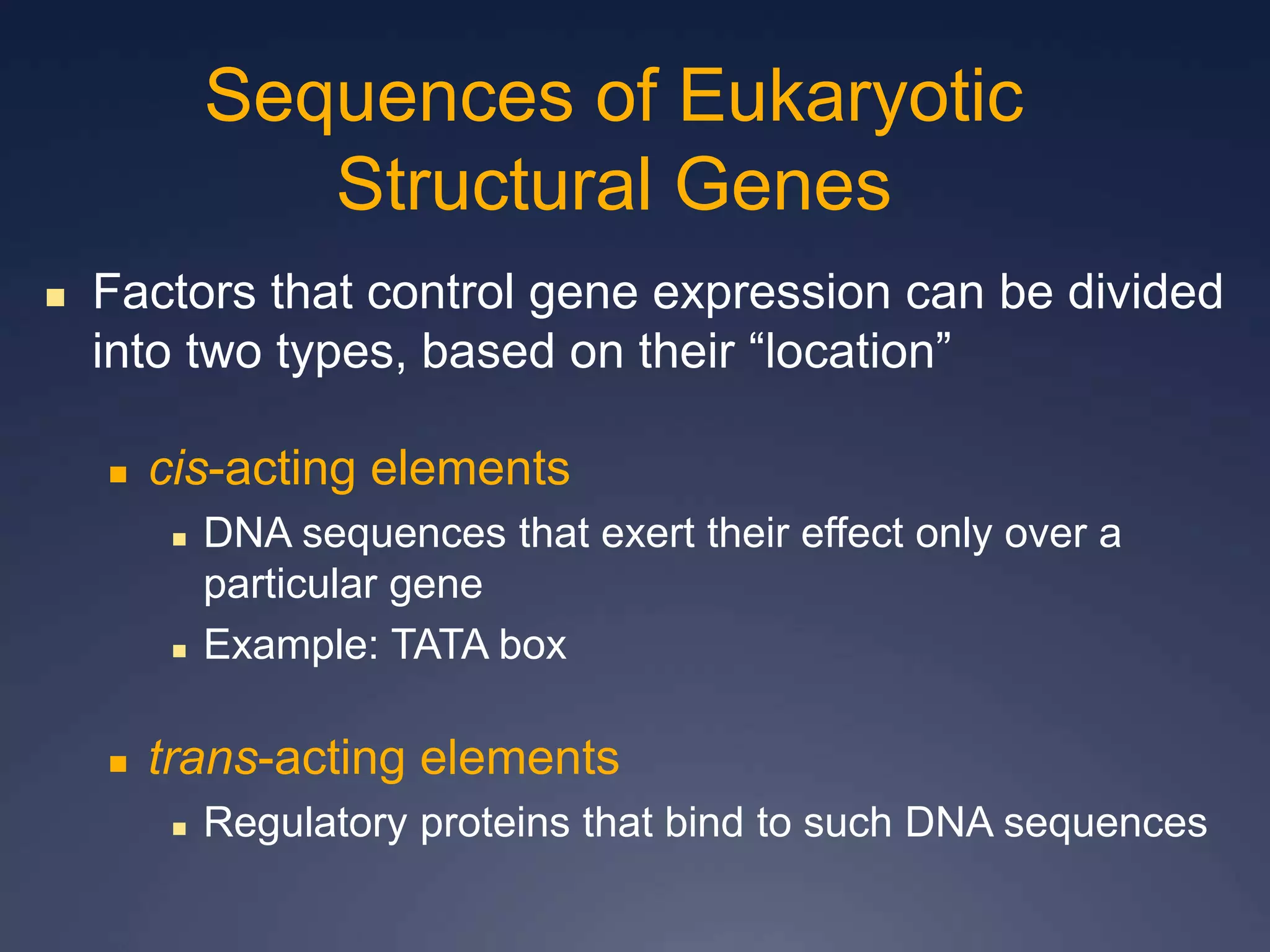
 Factors that control gene expression can be divided
into two types, based on their “location”
 cis-acting elements
 DNA sequences that exert their effect only over a
particular gene
 Example: TATA box
 trans-acting elements
 Regulatory proteins that bind to such DNA sequences
Sequences of Eukaryotic
Structural Genes
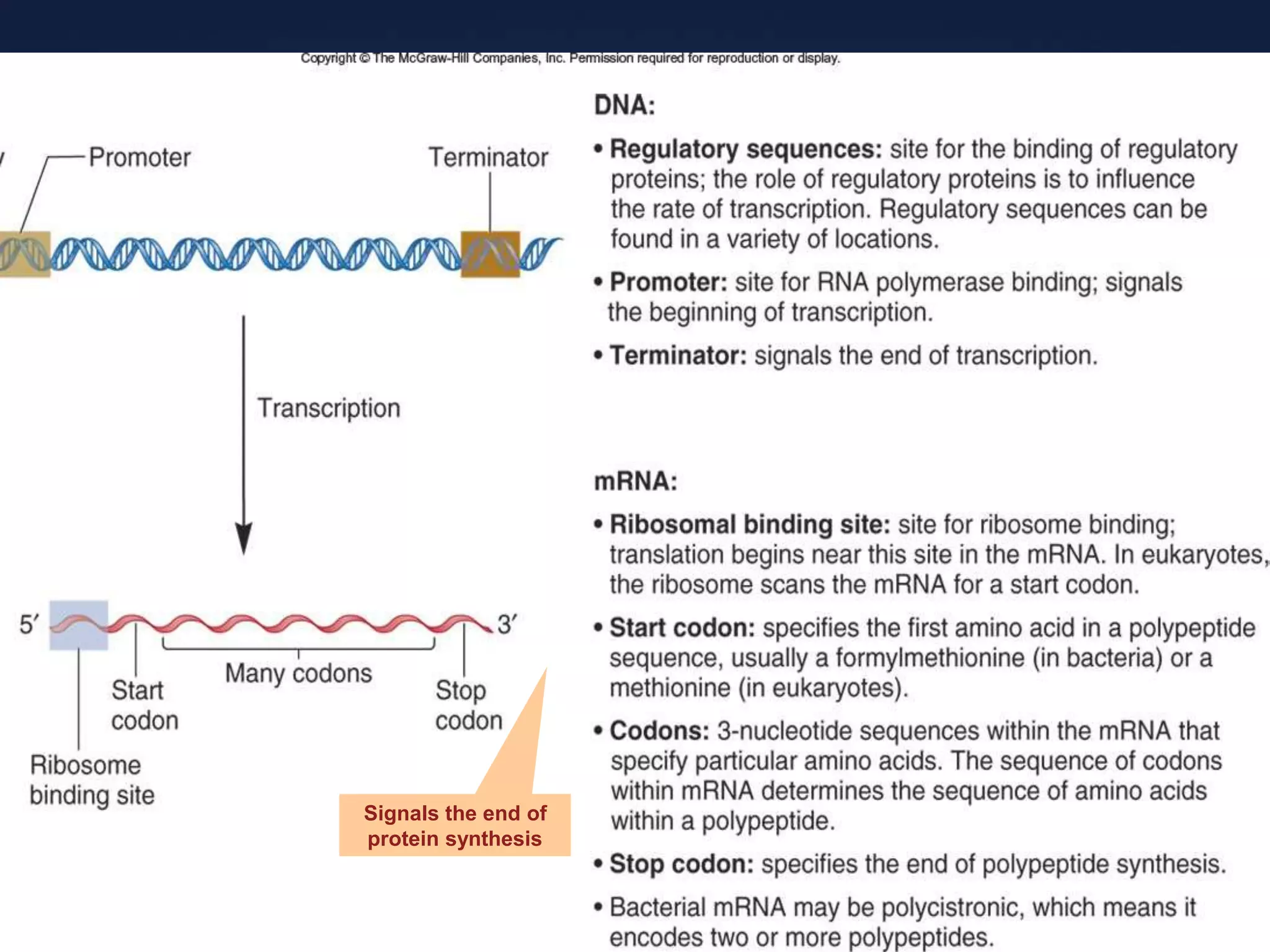
Signals the end of
protein synthesis
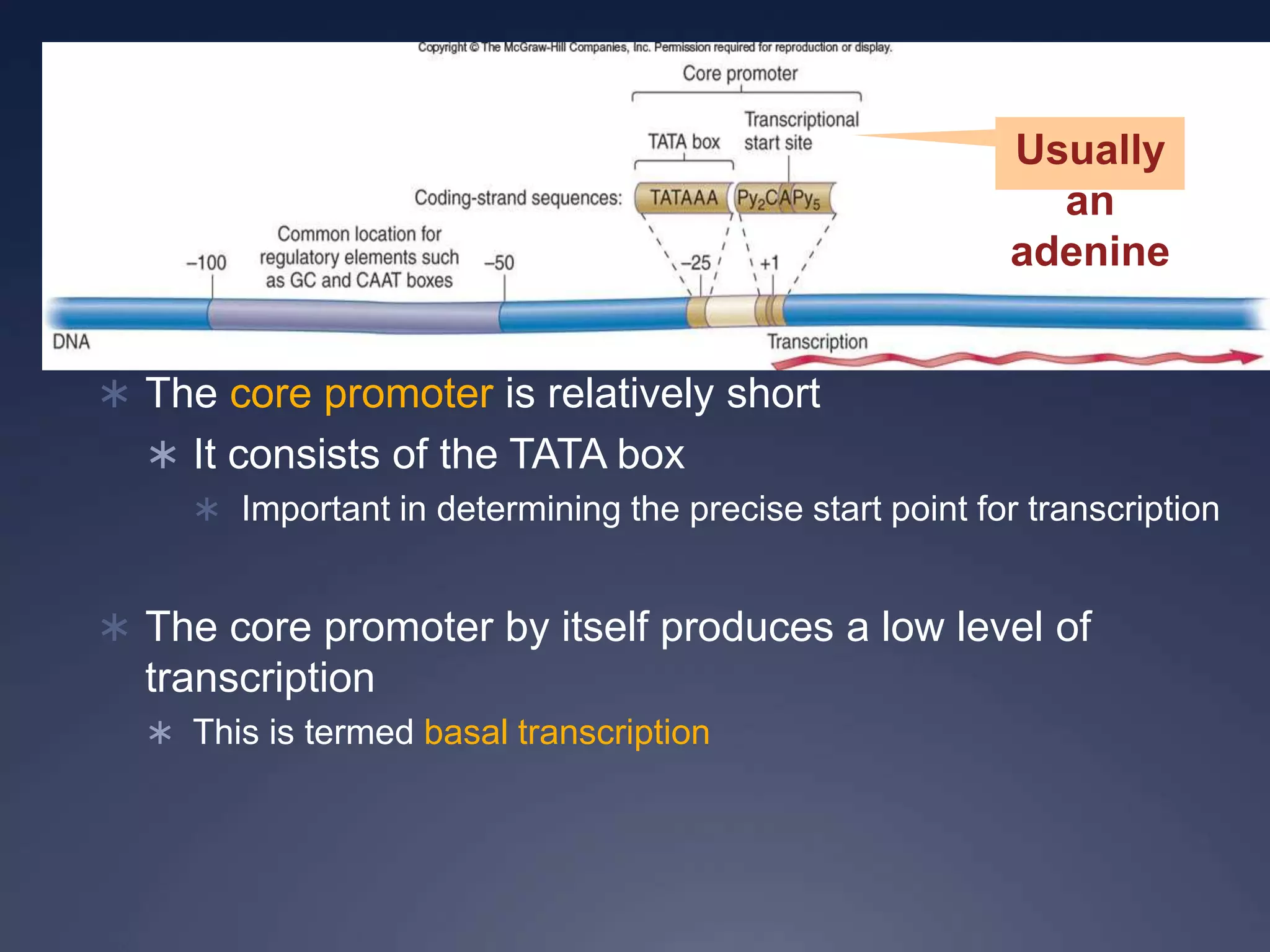
Usually
an
adenine
 The core promoter is relatively short
 It consists of the TATA box
 Important in determining the precise start point for transcription
 The core promoter by itself produces a low level of
transcription
 This is termed basal transcription
 Regulatory elements affect the binding of RNA polymerase
to the promoter
 They are of two types
 Enhancers
 Stimulate transcription
 Silencers
 Inhibit transcription
 They vary widely in their locations, from –50 to –100
region
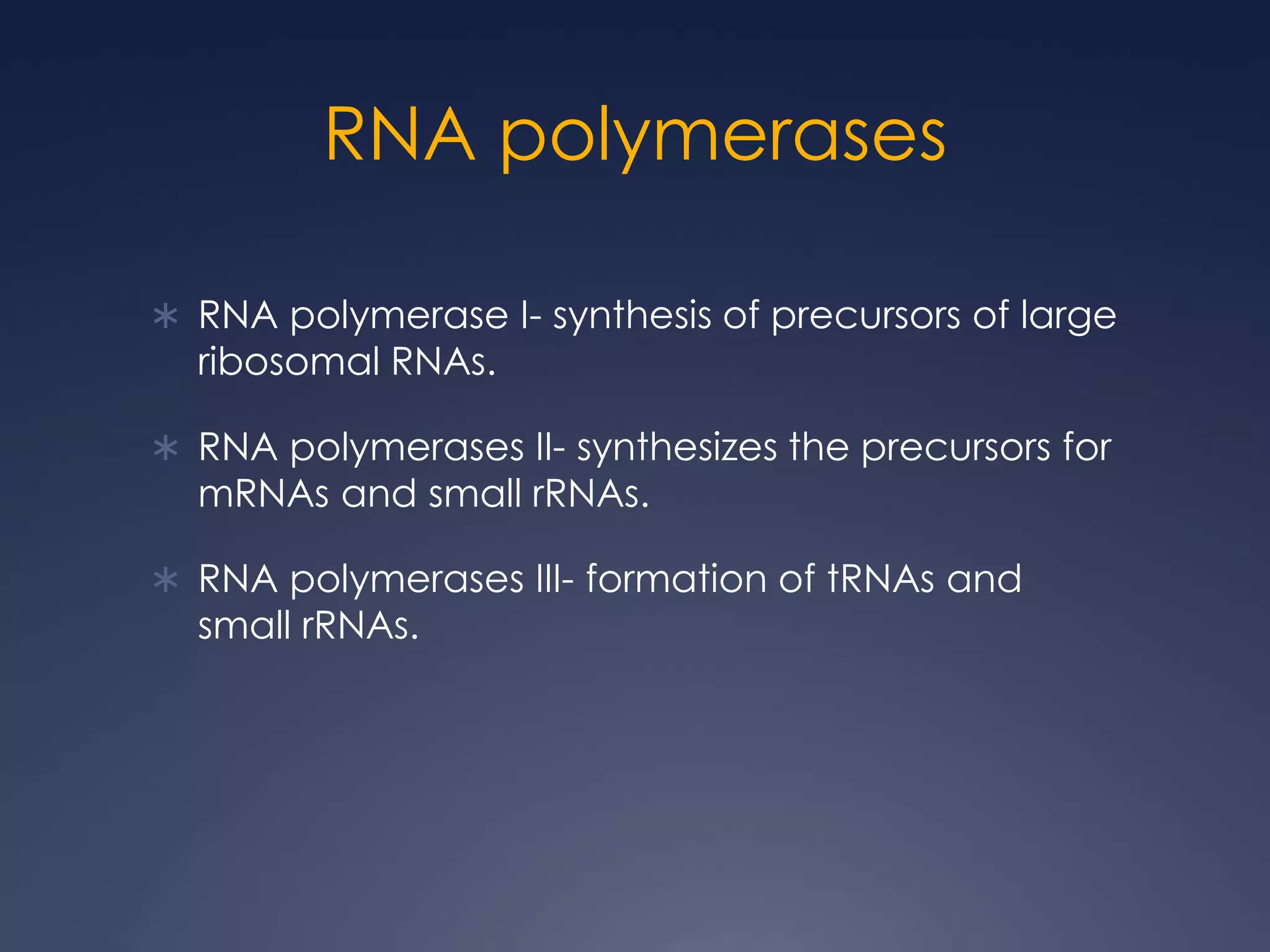
RNA polymerases
 RNA polymerase I- synthesis of precursors of large
ribosomal RNAs.
 RNA polymerases II- synthesizes the precursors for
mRNAs and small rRNAs.
 RNA polymerases III- formation of tRNAs and
small rRNAs.
Copyright ©The McGraw-Hill Companies, Inc. Permission required for reproduction or display
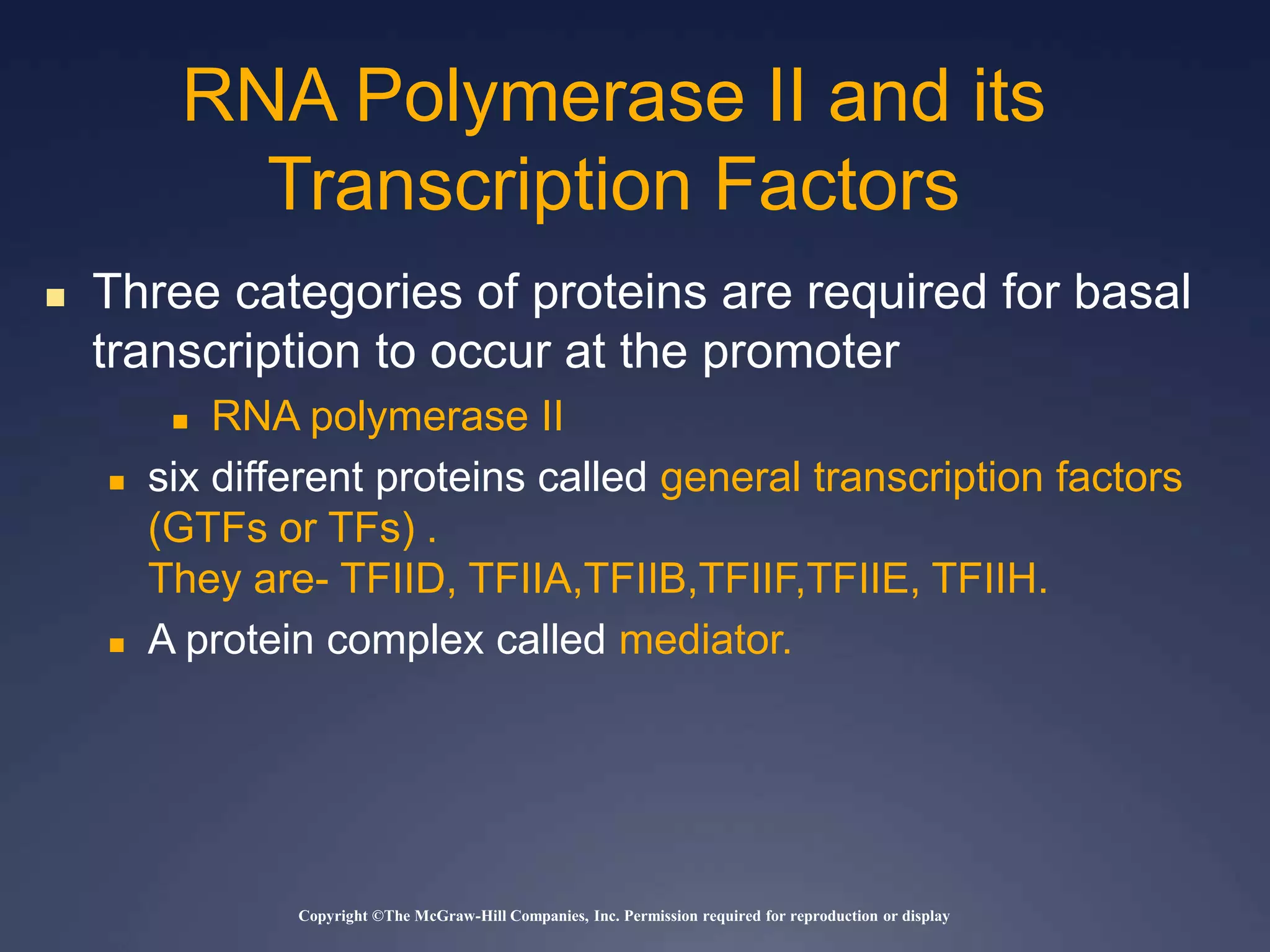
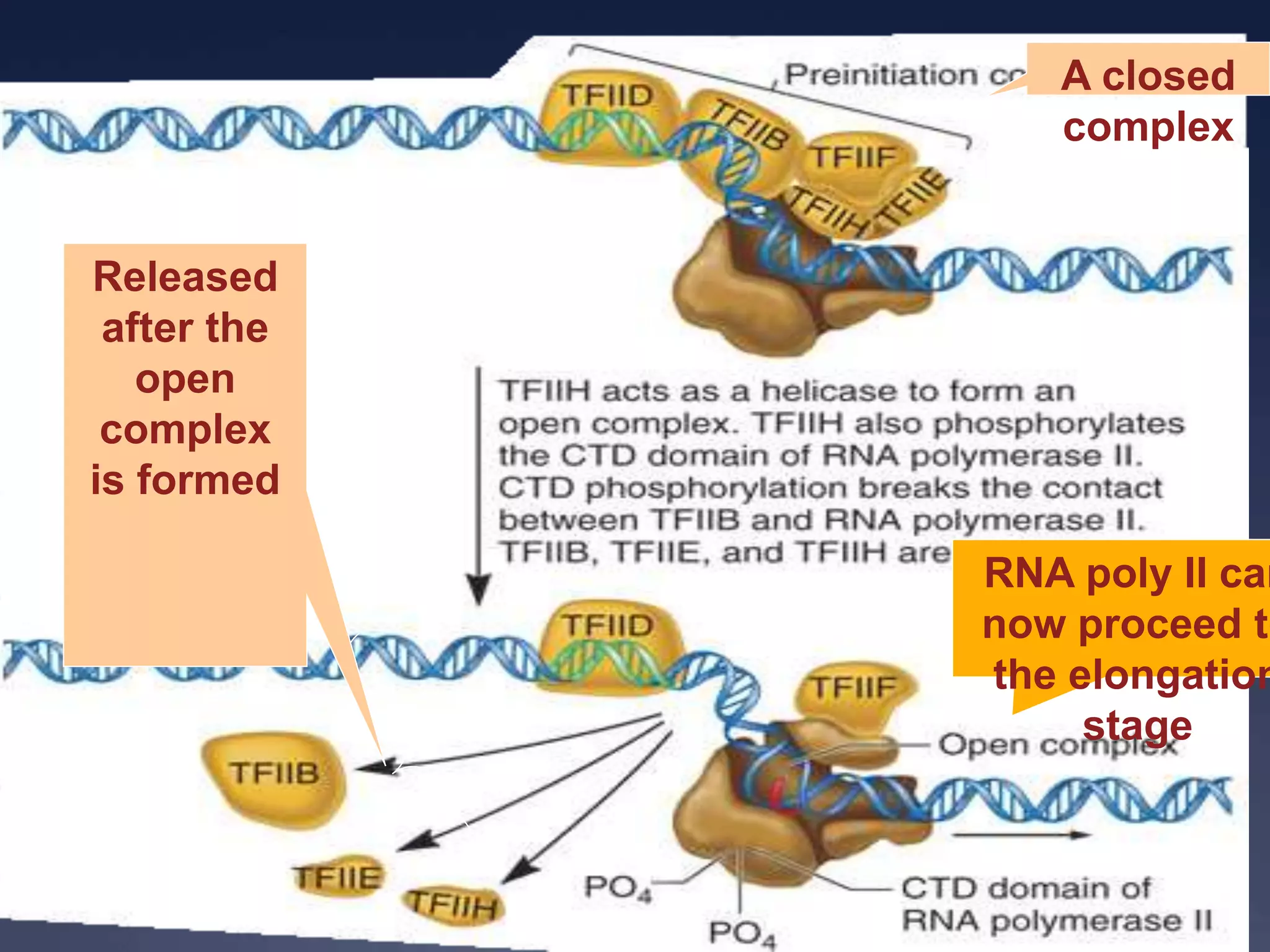
 Three categories of proteins are required for basal
transcription to occur at the promoter
 RNA polymerase II
 six different proteins called general transcription factors
(GTFs or TFs) .
They are- TFIID, TFIIA,TFIIB,TFIIF,TFIIE, TFIIH.
 A protein complex called mediator.
RNA Polymerase II and its
Transcription Factors
Copyright ©The McGraw-Hill Companies, Inc. Permission required for reproduction or display
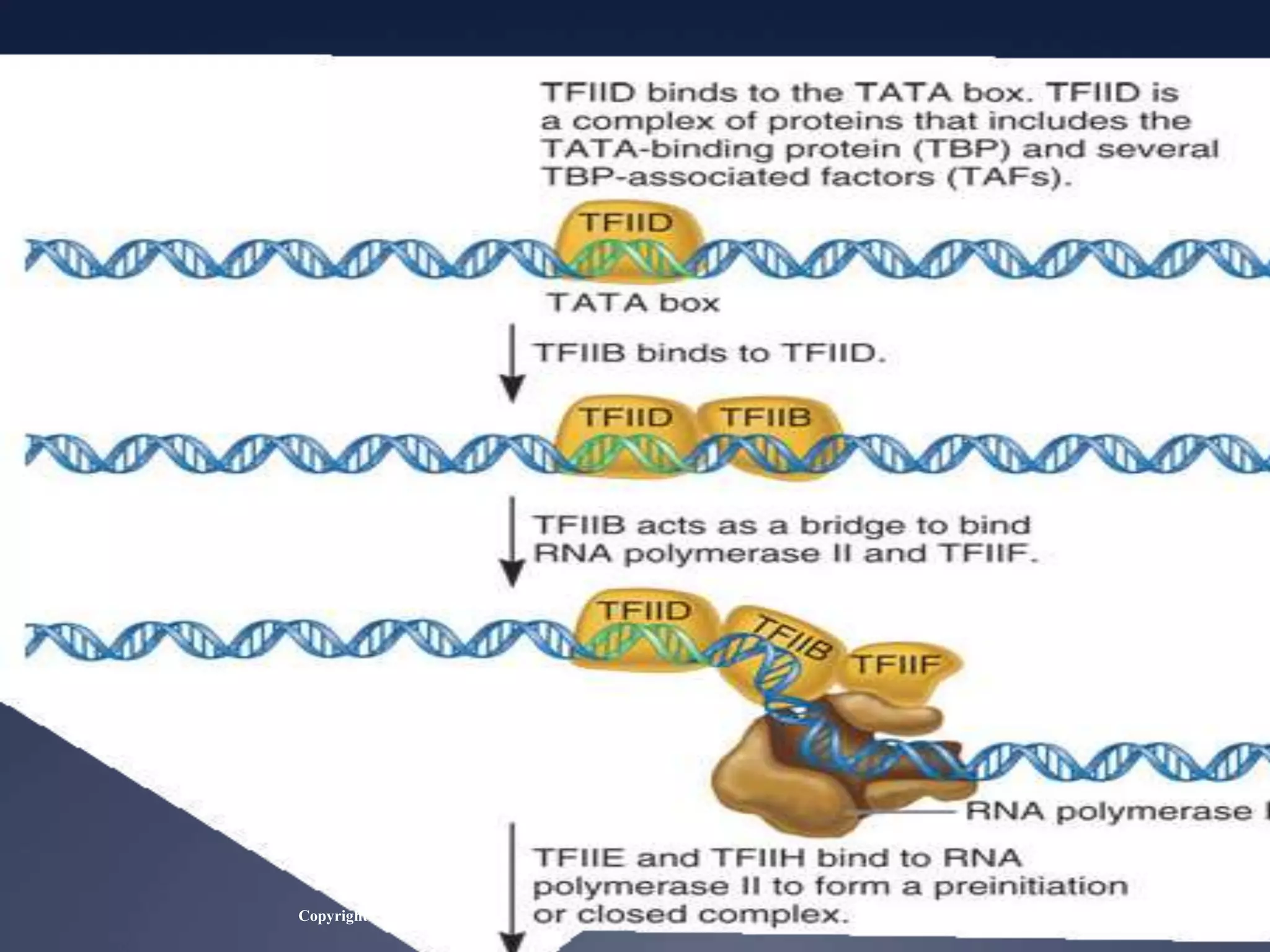
A closed
complex
Released
after the
open
complex
is formed
RNA poly II can
now proceed to
the elongation
stage
12-23
Figure 12.7
12-26
Similar to the
synthesis of DNA
via DNA polymerase
Figure 12.8
On average, the rate of
RNA synthesis is about 43
nucleotides per second!
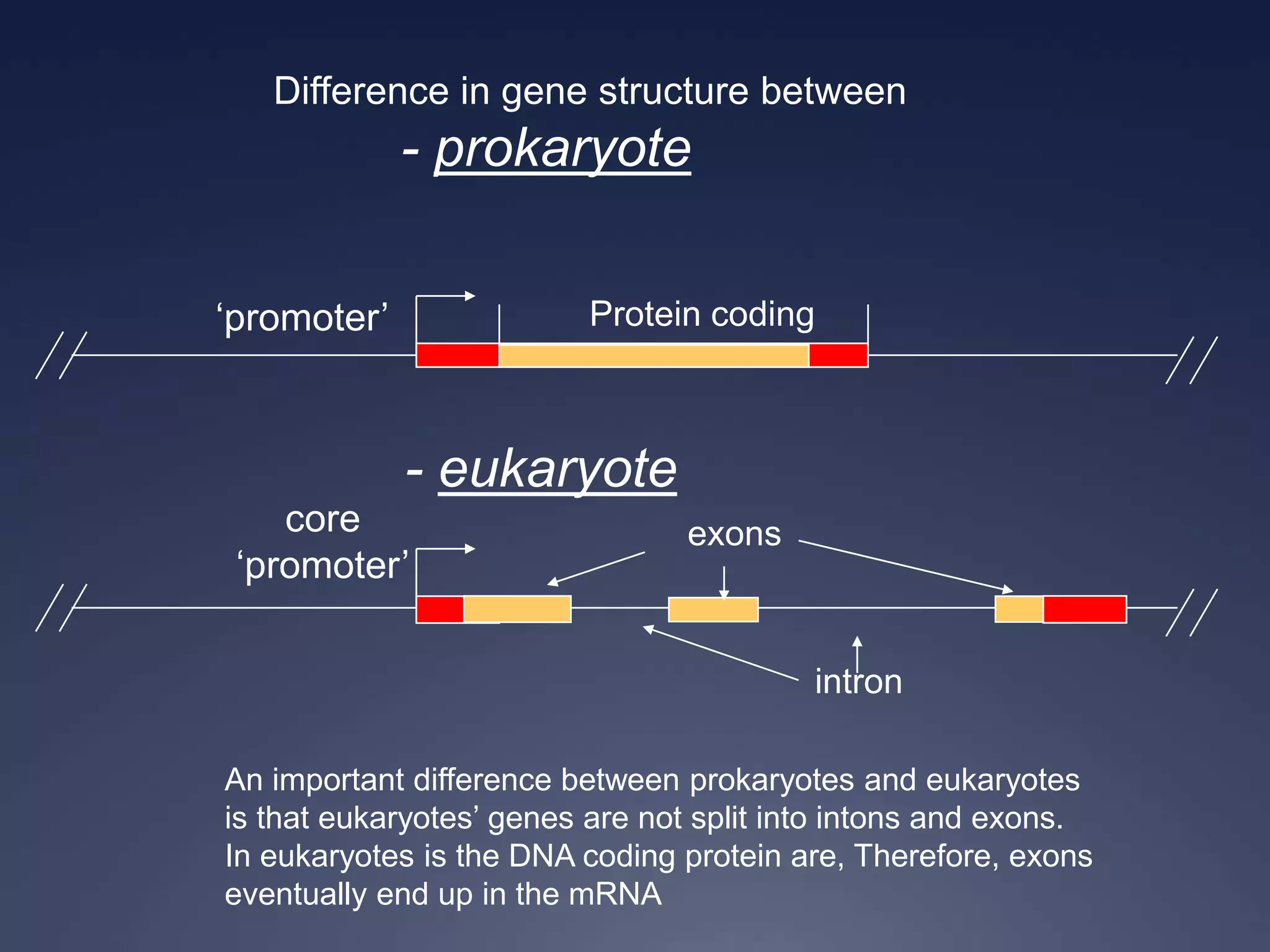
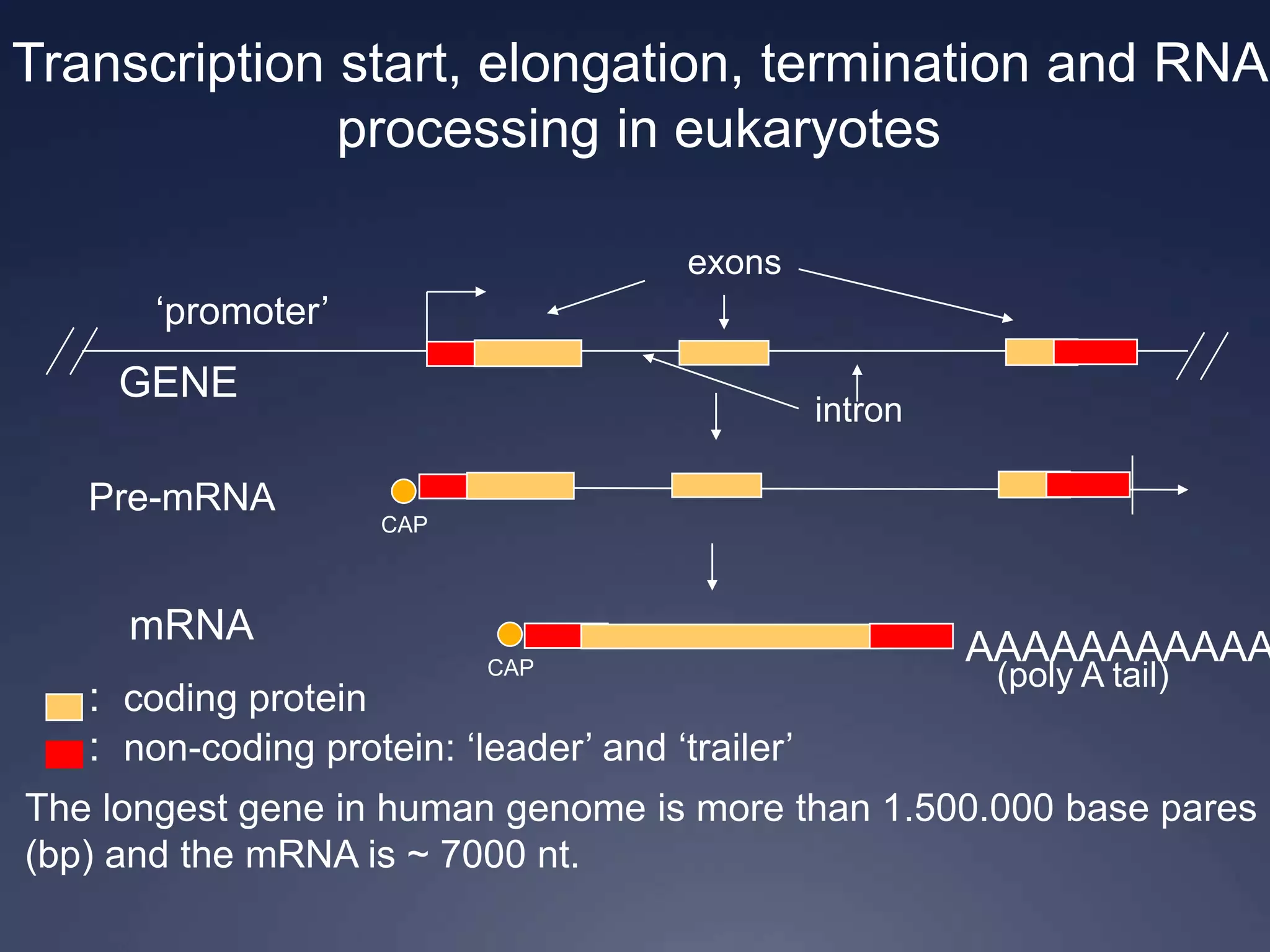
‘promoter’ Protein coding
Difference in gene structure between
- prokaryote
- eukaryote
core
‘promoter’
An important difference between prokaryotes and eukaryotes
is that eukaryotes’ genes are not split into intons and exons.
In eukaryotes is the DNA coding protein are, Therefore, exons
eventually end up in the mRNA
intron
exons
Pre-mRNA
Transcription start, elongation, termination and RNA
processing in eukaryotes
: coding protein
: non-coding protein: ‘leader’ and ‘trailer’
CAP
CAP (poly A tail)
The longest gene in human genome is more than 1.500.000 base pares
(bp) and the mRNA is ~ 7000 nt.
‘promoter’
intron
exons
GENE
mRNA
AAAAAAAAAAA
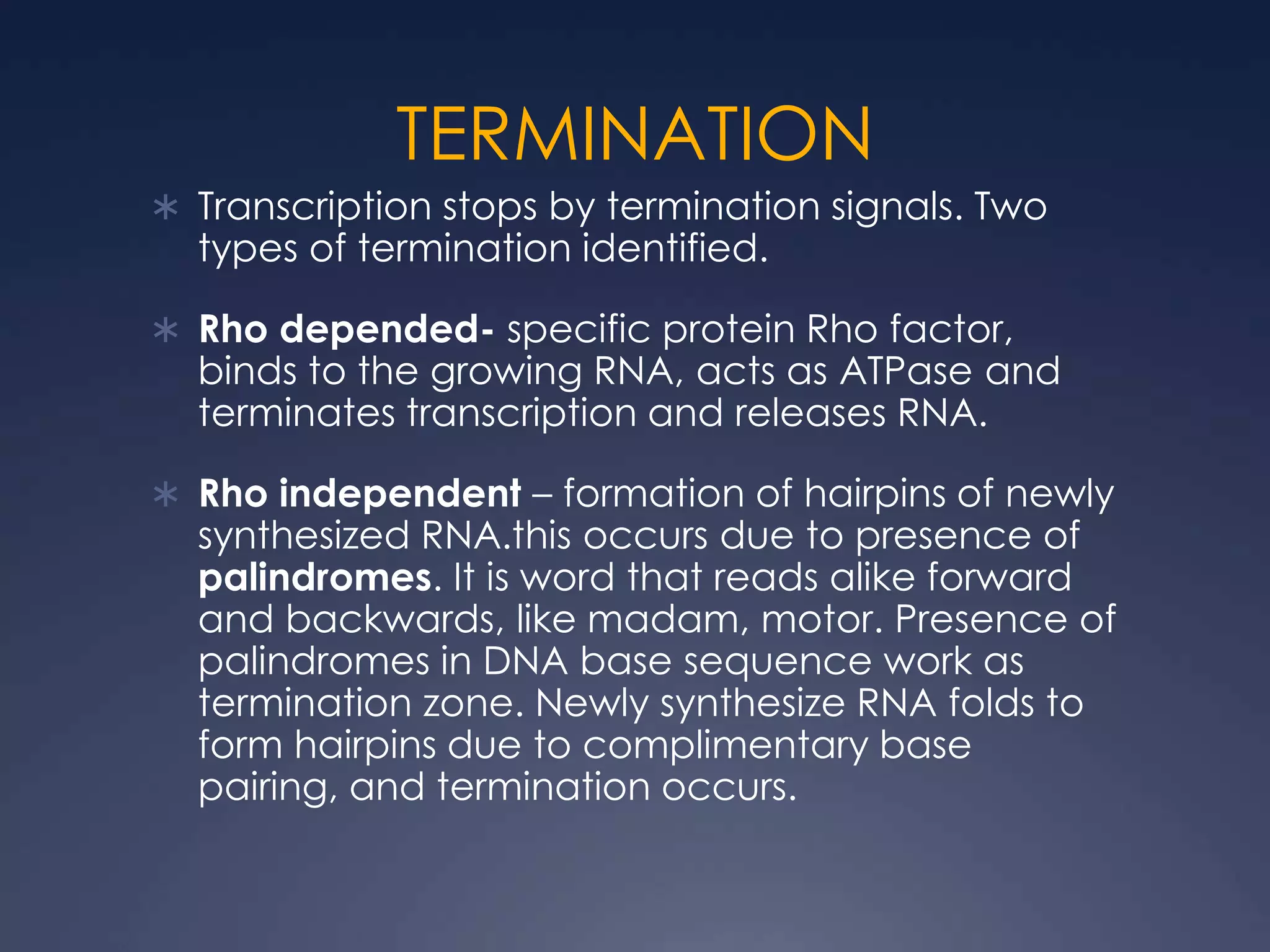
TERMINATION
 Transcription stops by termination signals. Two
types of termination identified.
 Rho depended- specific protein Rho factor,
binds to the growing RNA, acts as ATPase and
terminates transcription and releases RNA.
 Rho independent – formation of hairpins of newly
synthesized RNA.this occurs due to presence of
palindromes. It is word that reads alike forward
and backwards, like madam, motor. Presence of
palindromes in DNA base sequence work as
termination zone. Newly synthesize RNA folds to
form hairpins due to complimentary base
pairing, and termination occurs.
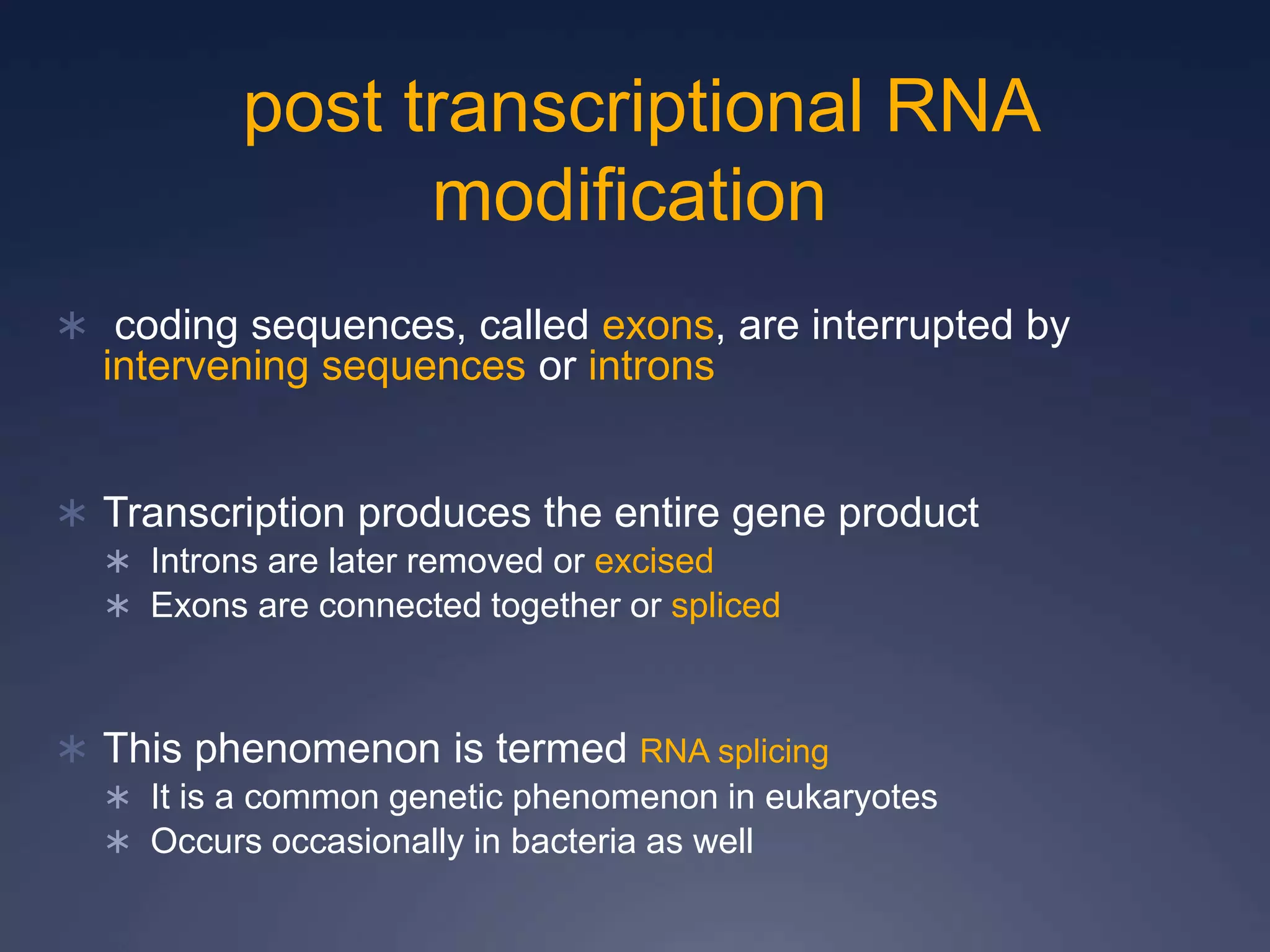
 coding sequences, called exons, are interrupted by
intervening sequences or introns
 Transcription produces the entire gene product
 Introns are later removed or excised
 Exons are connected together or spliced
 This phenomenon is termed RNA splicing
 It is a common genetic phenomenon in eukaryotes
 Occurs occasionally in bacteria as well
post transcriptional RNA
modification
 Aside from splicing, RNA transcripts can be modified
in several ways
 For example
 Trimming of rRNA and tRNA transcripts
 5’ Capping and 3’ polyA tailing of mRNA transcripts
y
RNA MODIFICATION
RNA Editing
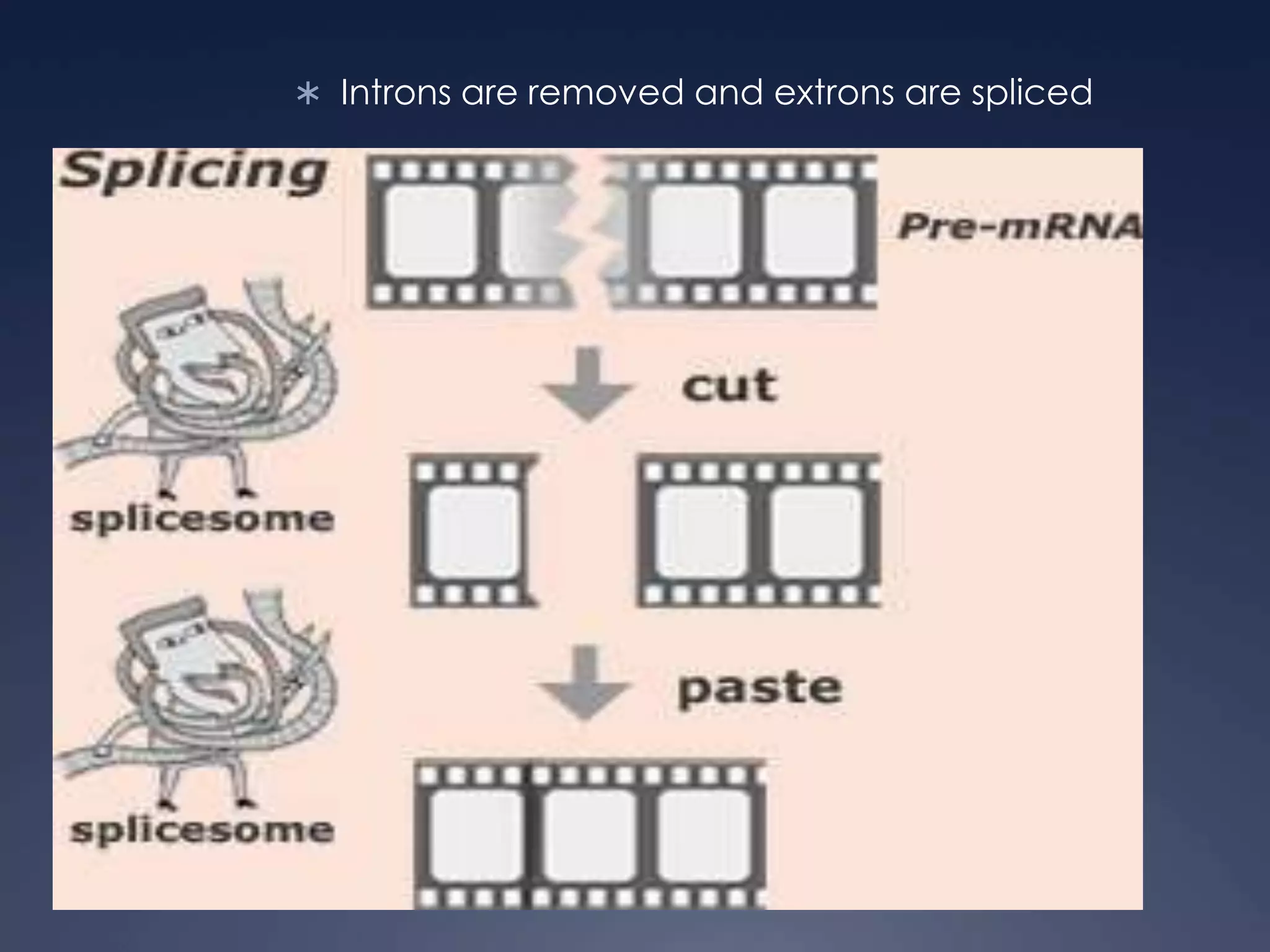
 Introns are removed and extrons are spliced
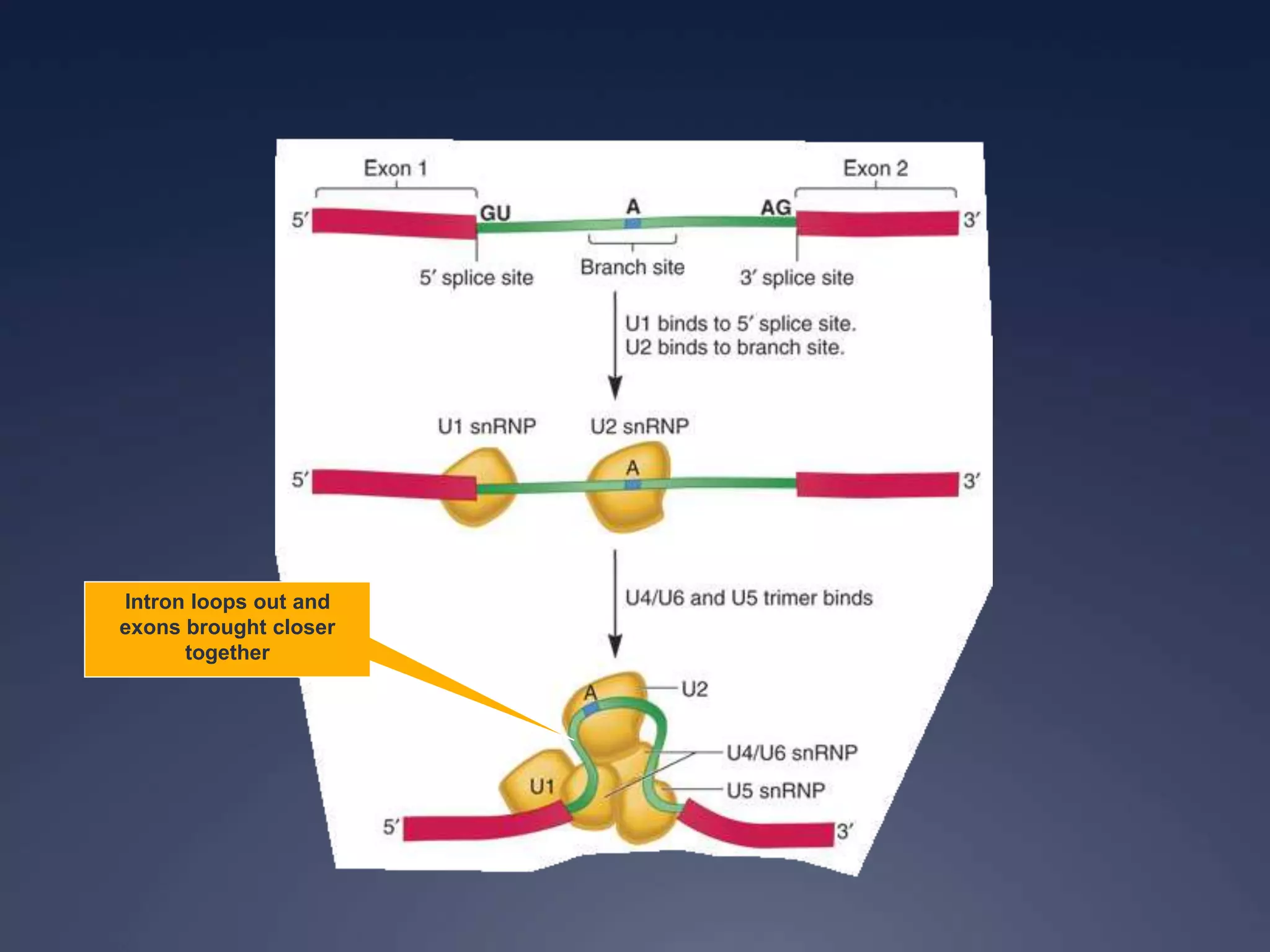
 The spliceosome is a large complex that splices
pre-mRNA
 It is composed of several subunits known as
snRNPs (pronounced “snurps”)
 Each snRNP contains small nuclear RNA and a set of
proteins. Or small nuclear ribonucloprotein particle.
Types of snRNPs are U1,U2,U3,U4,U5,U6.
Pre-mRNA Splicing
 The subunits of a spliceosome carry out several
functions
 1. Bind to an intron sequence and precisely recognize
the intron-exon boundaries
 2. Hold the pre-mRNA in the correct configuration
 3. Catalyze the chemical reactions that remove introns
and covalently link exons
Pre-mRNA Splicing
Intron loops out and
exons brought closer
together
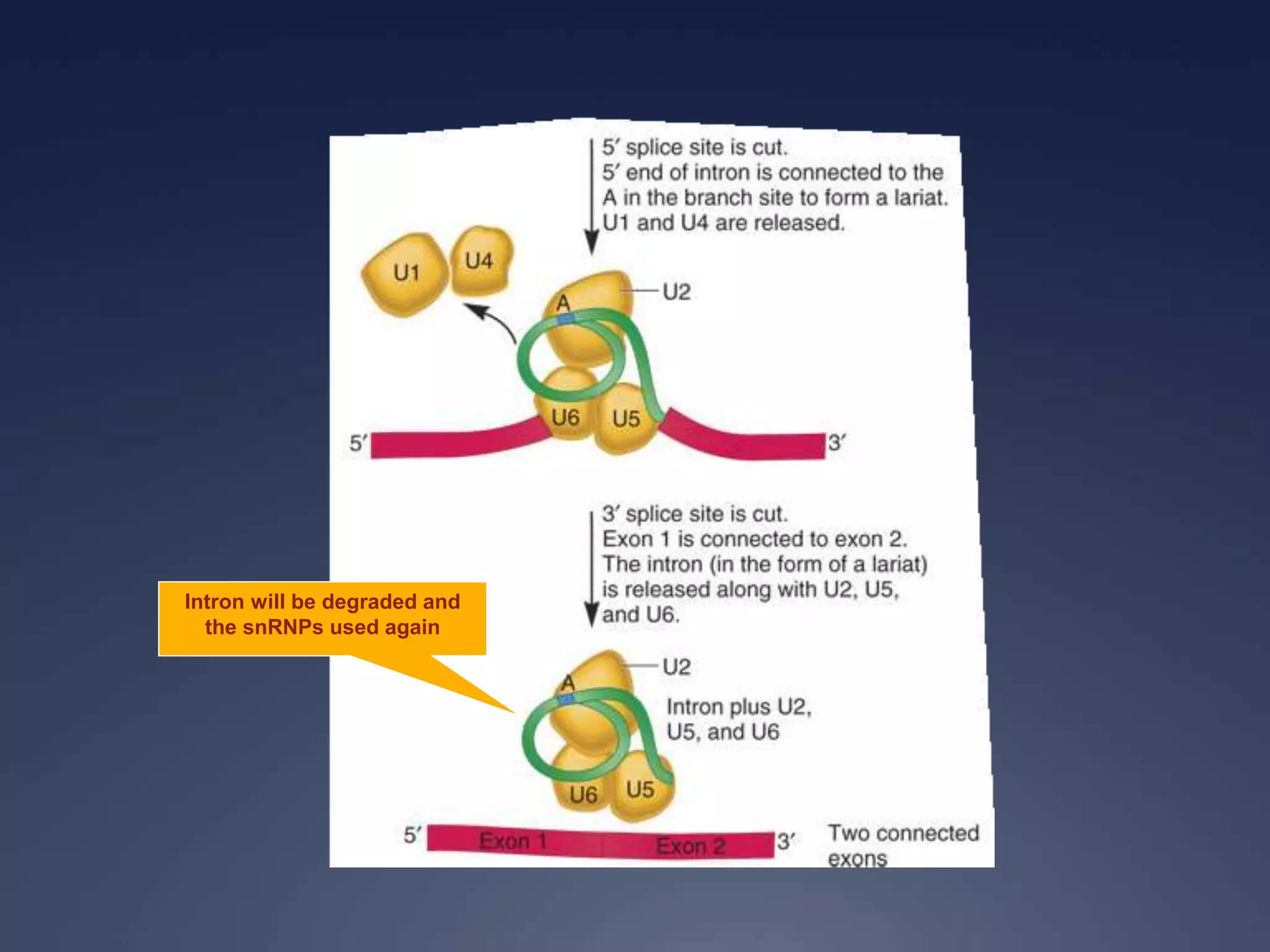
Intron will be degraded and
the snRNPs used again
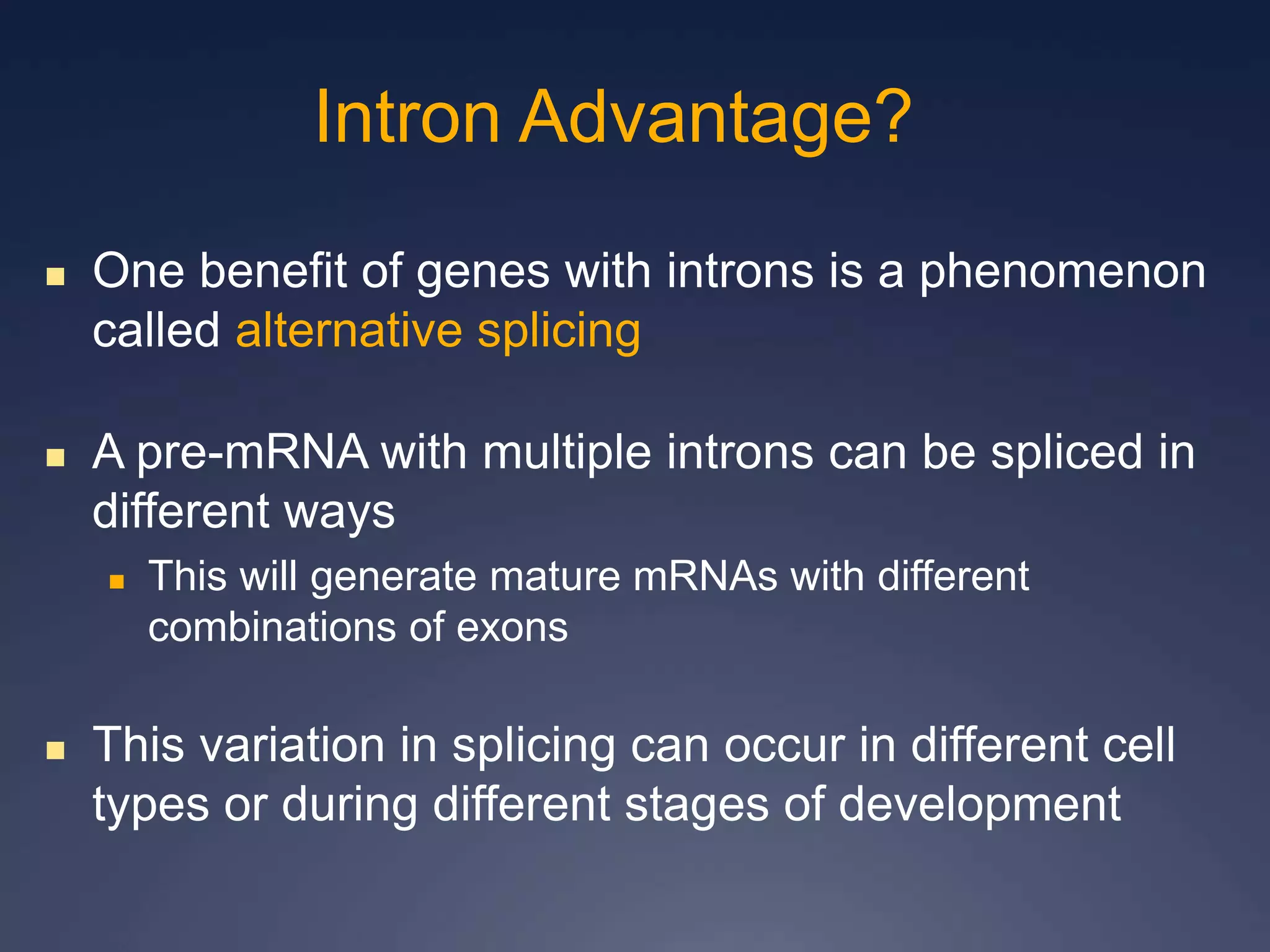
 One benefit of genes with introns is a phenomenon
called alternative splicing
 A pre-mRNA with multiple introns can be spliced in
different ways
 This will generate mature mRNAs with different
combinations of exons
 This variation in splicing can occur in different cell
types or during different stages of development
Intron Advantage?
 The biological advantage of alternative splicing is
that two (or more) polypeptides can be derived
from a single gene
 This allows an organism to carry fewer genes in its
genome
Intron Advantage?
 Most mature mRNAs have a 7-methyl guanosine
covalently attached at their 5’ end
 This event is known as capping
 Capping occurs as the pre-mRNA is being
synthesized by RNA pol II
 Usually when the transcript is only 20 to 25 bases long
Capping: marking 5’ends of mRNAs
 The 7-methylguanosine cap structure is recognized
by cap-binding proteins
 Cap-binding proteins play roles in the
 Movement of some RNAs into the cytoplasm
 Early stages of translation
 Splicing of introns
Function of Capping
 Most mature mRNAs have a string of adenine
nucleotides at their 3’ ends
 This is termed the polyA tail
 The polyA tail is not encoded in the gene sequence
 It is added enzymatically after the gene is completely
transcribed
The 3’ end of a mRNA: Tailing
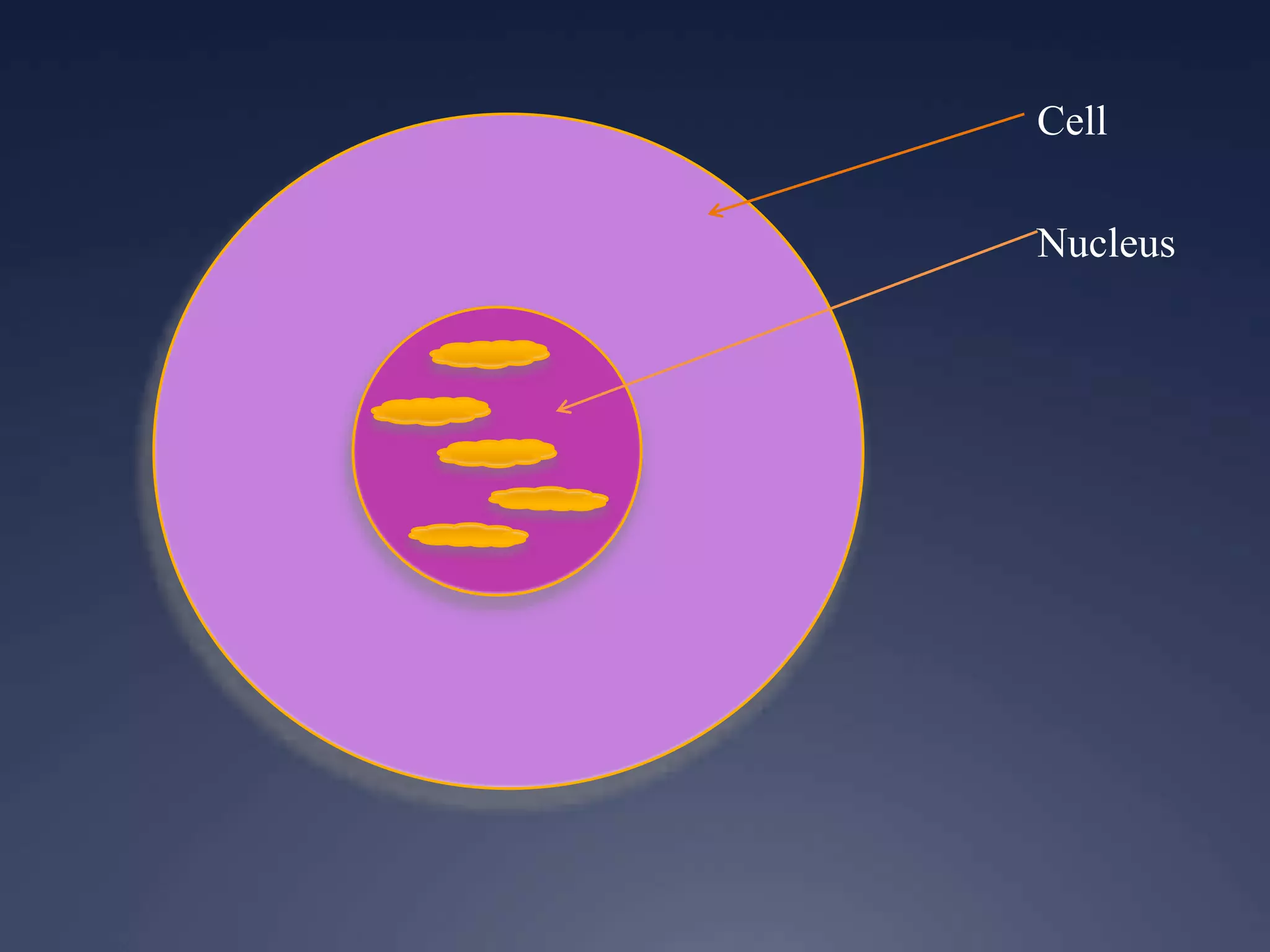
Cell
Nucleus
Cell
Nucle
RNA
Polymerase
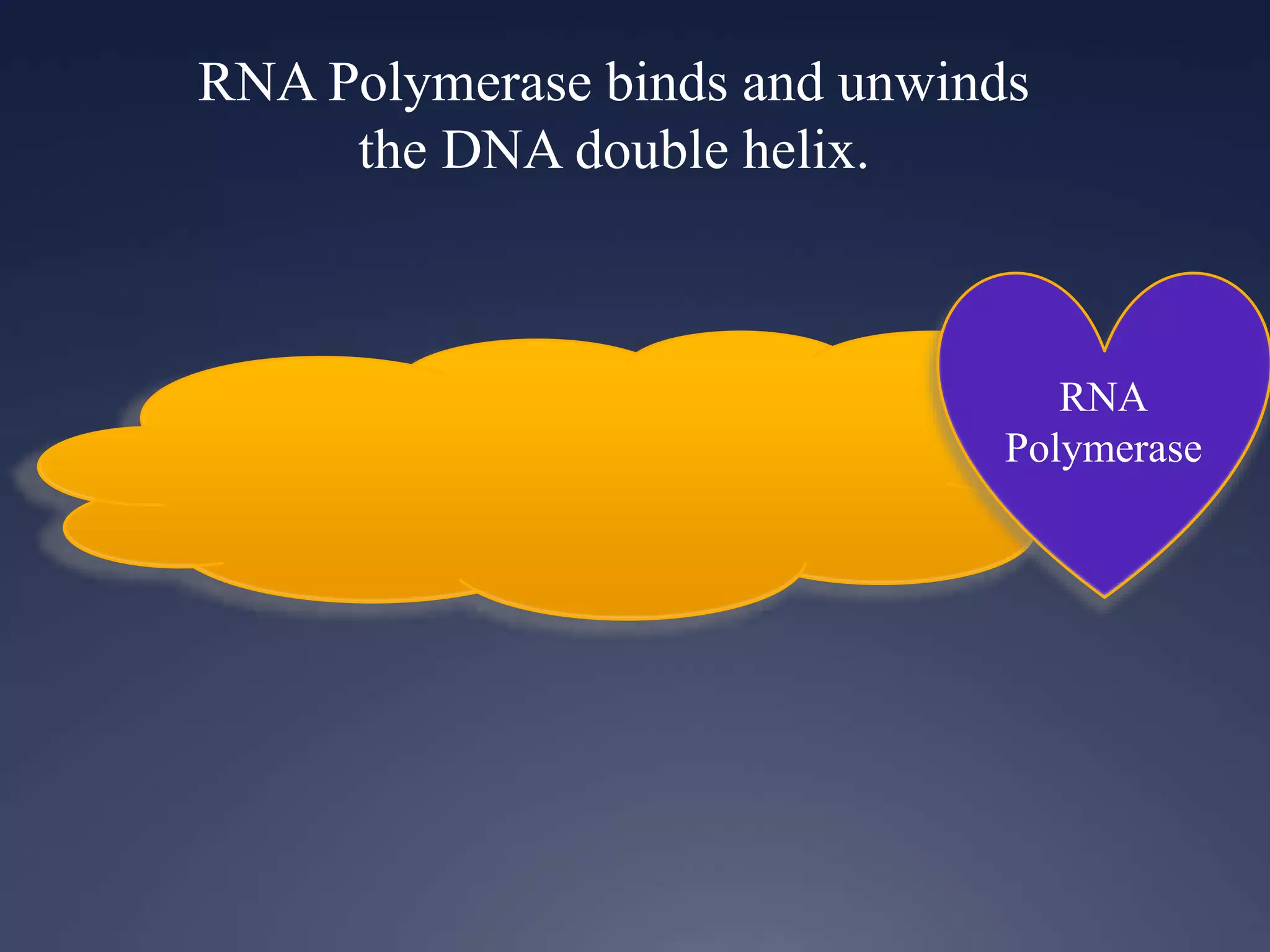
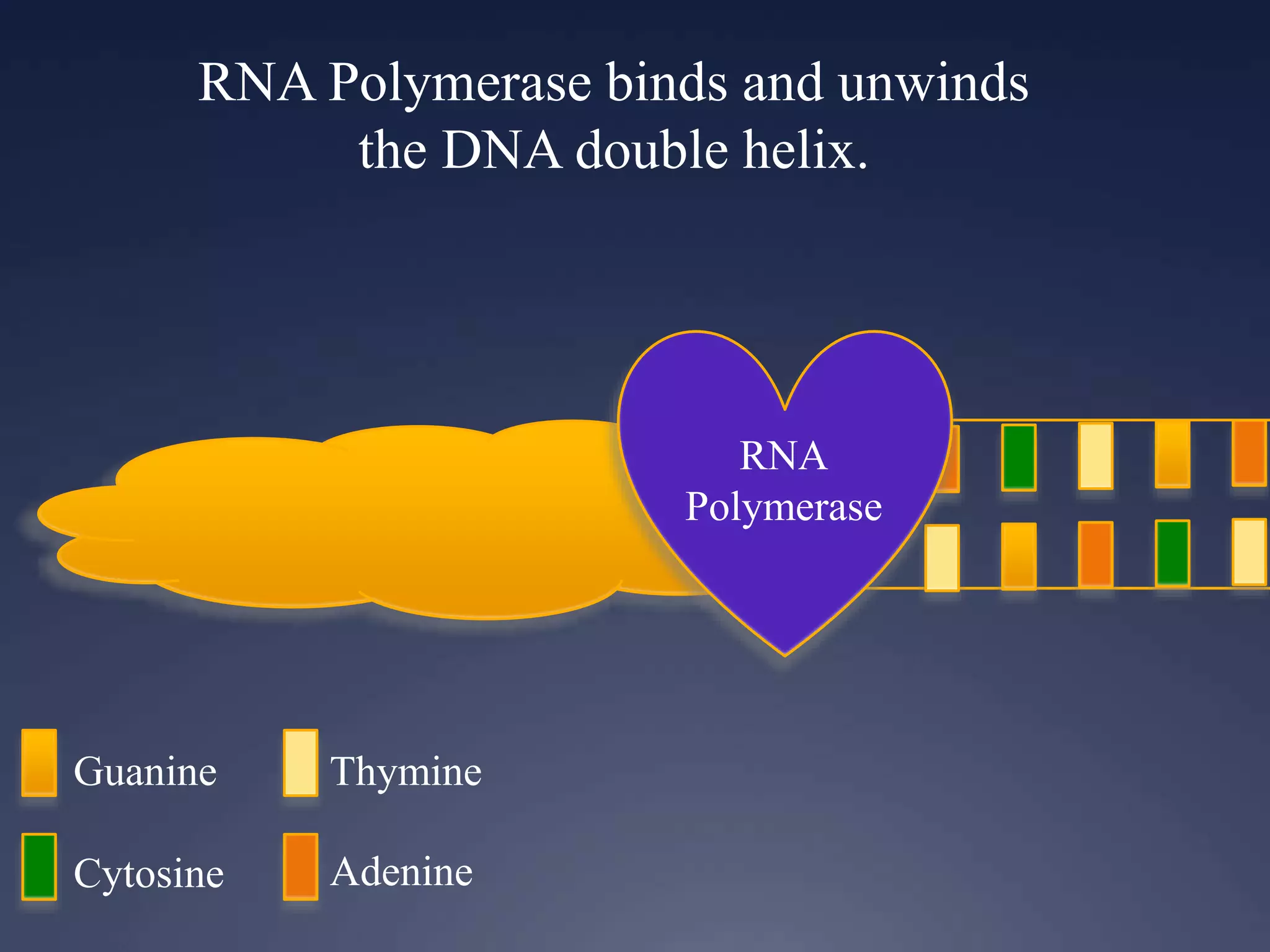
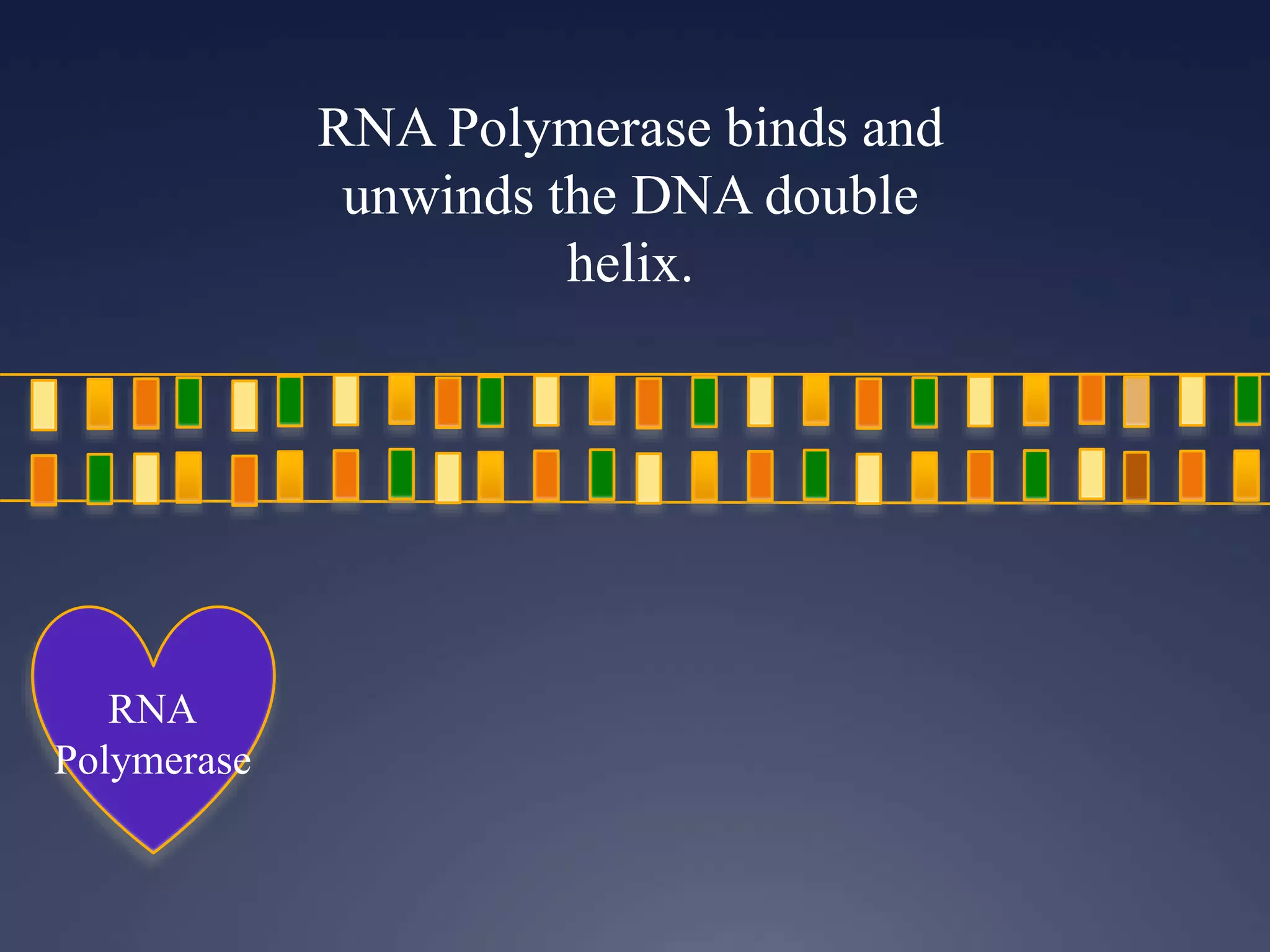
RNA Polymerase binds and unwinds
the DNA double helix.
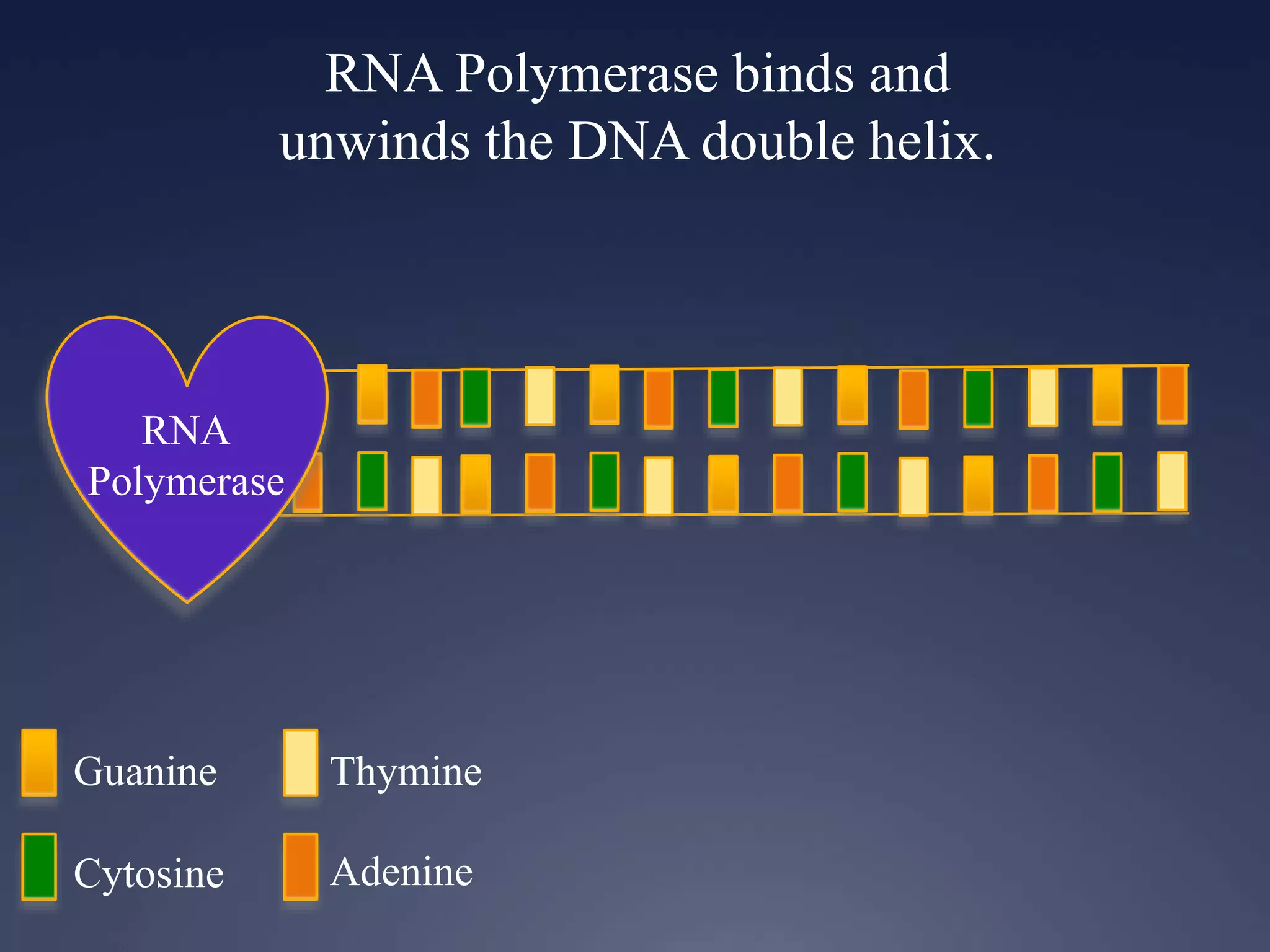
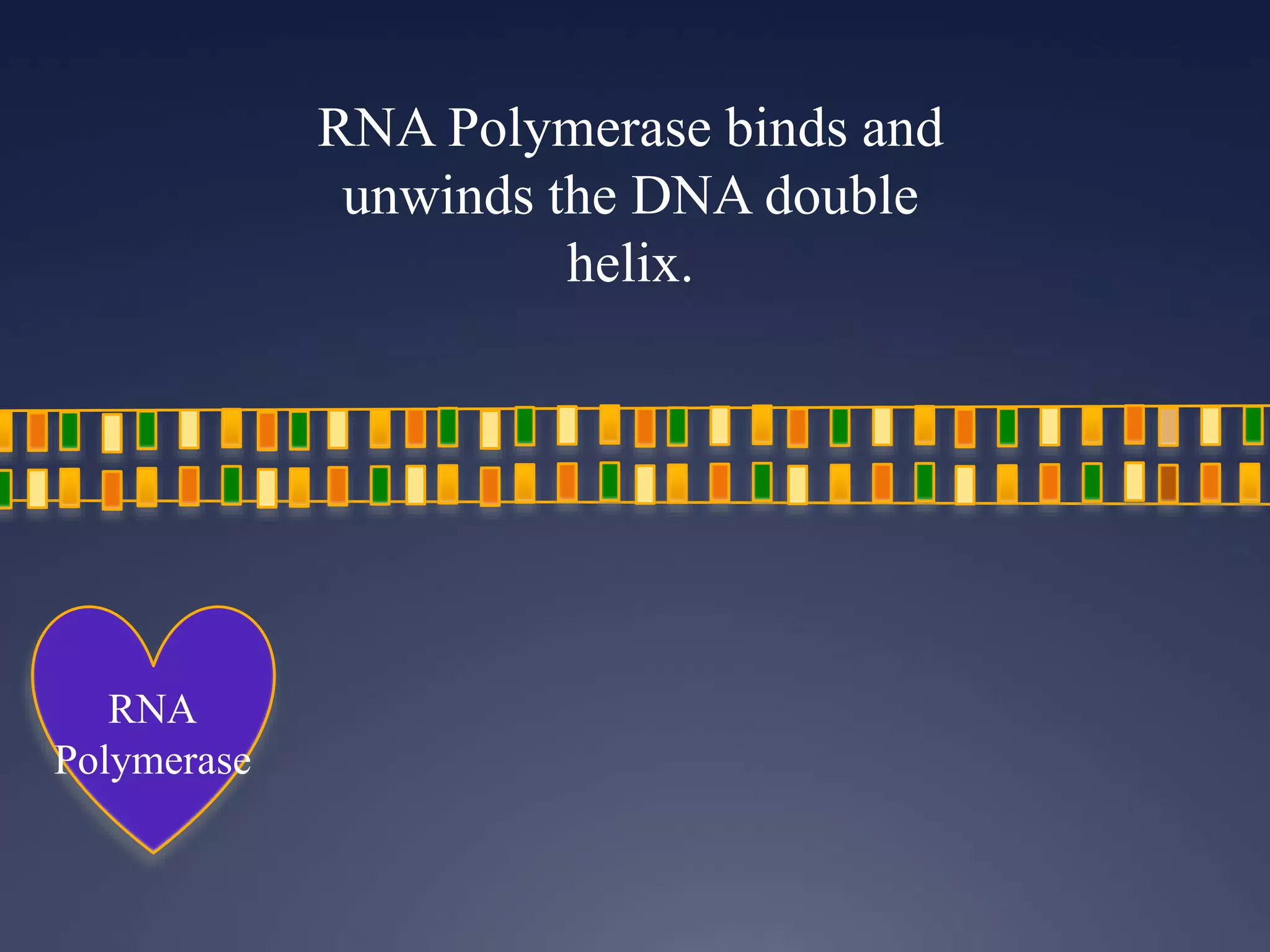
RNA Polymerase binds and unwinds
the DNA double helix.
RNA
Polymerase
Guanine
Cytosine
Thymine
Adenine
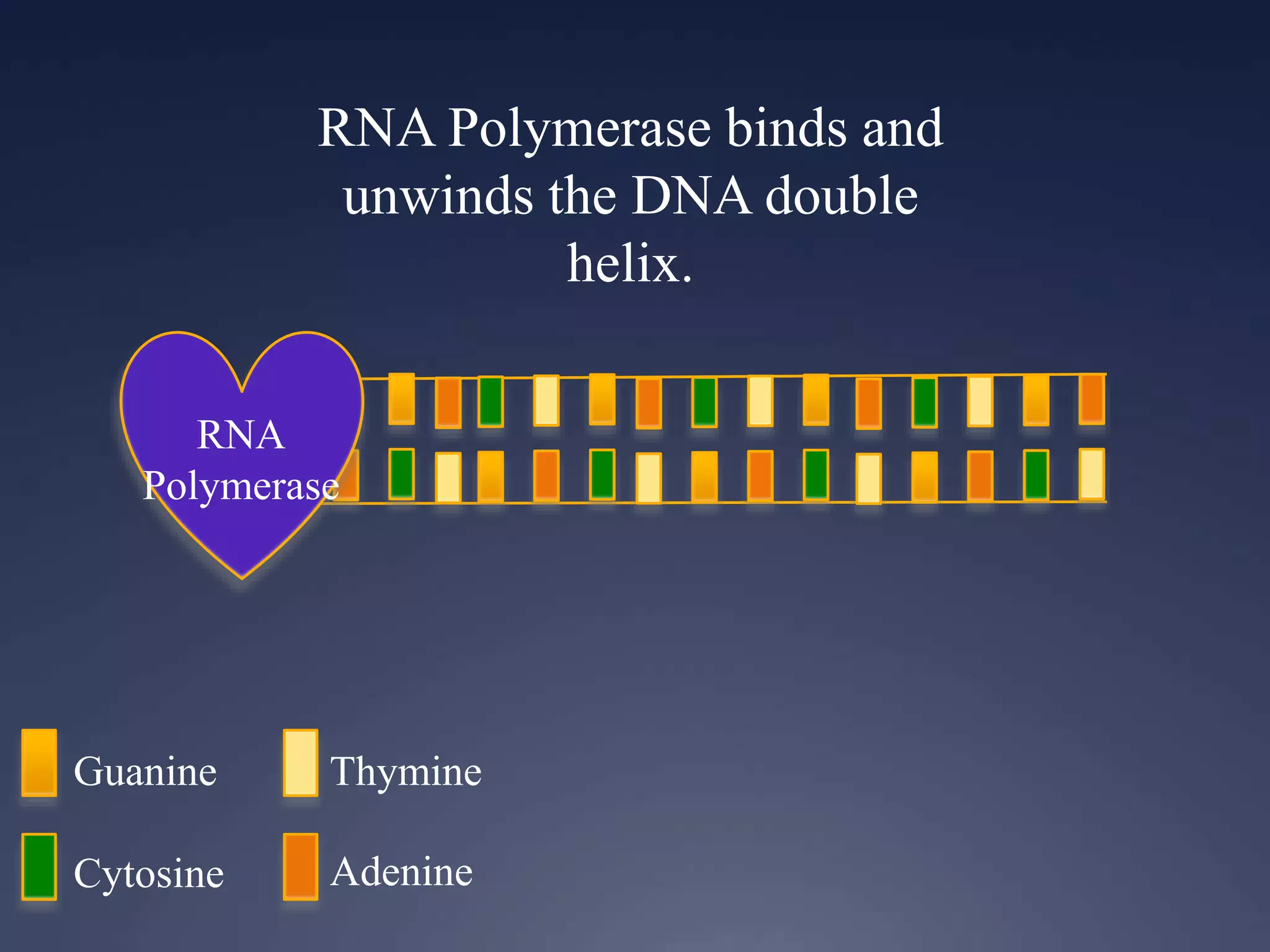
RNA Polymerase binds and
unwinds the DNA double helix.
RNA
Polymerase
Guanine
Cytosine
Thymine
Adenine
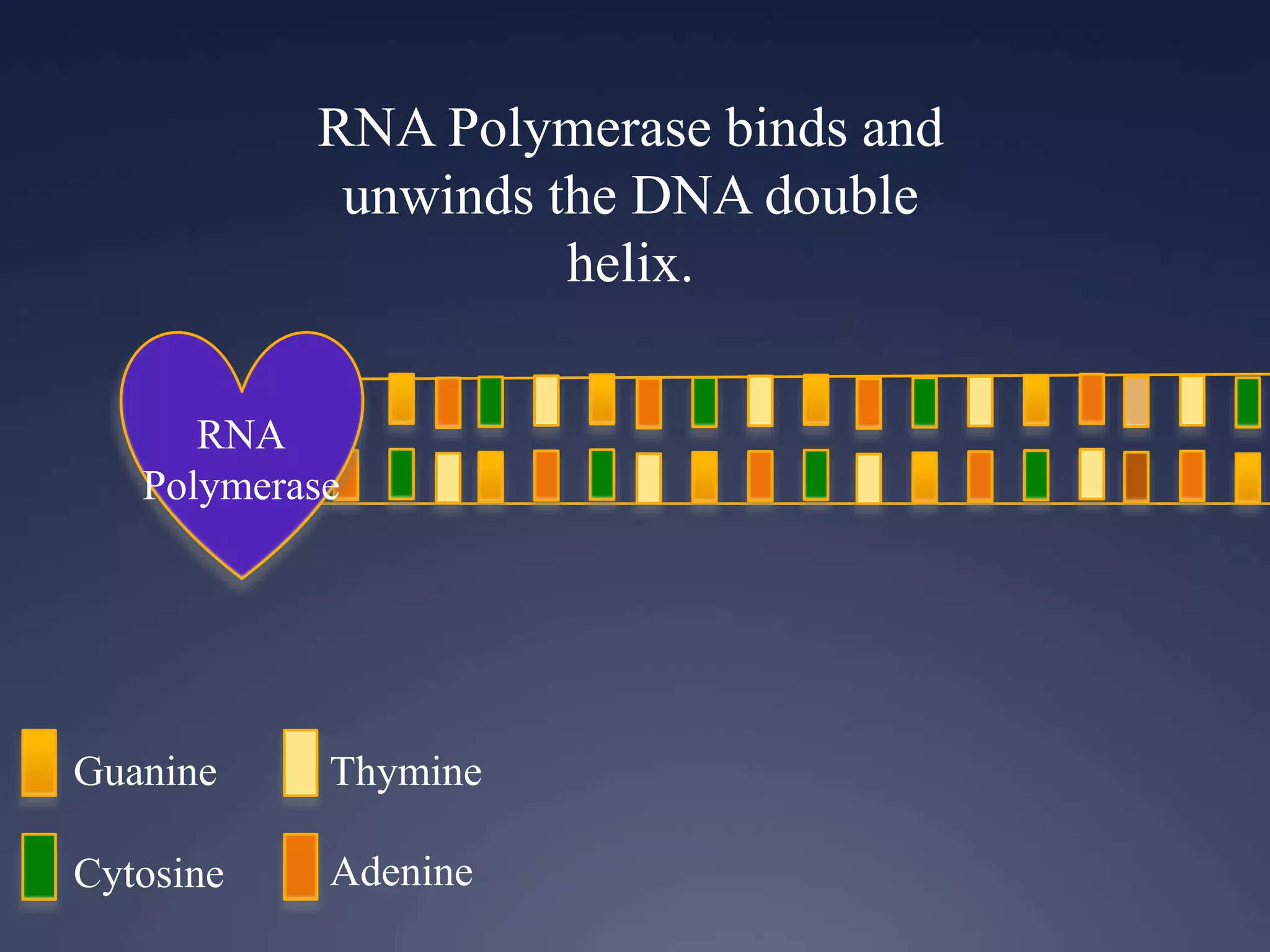
RNA Polymerase binds and
unwinds the DNA double
helix.
RNA
Polymerase
Guanine
Cytosine
Thymine
Adenine
RNA Polymerase binds and
unwinds the DNA double
helix.
RNA
Polymerase
Guanine
Cytosine
Thymine
Adenine
RNA Polymerase binds and
unwinds the DNA double
helix.
RNA
Polymerase
RNA Polymerase binds and
unwinds the DNA double
helix.
RNA
Polymerase
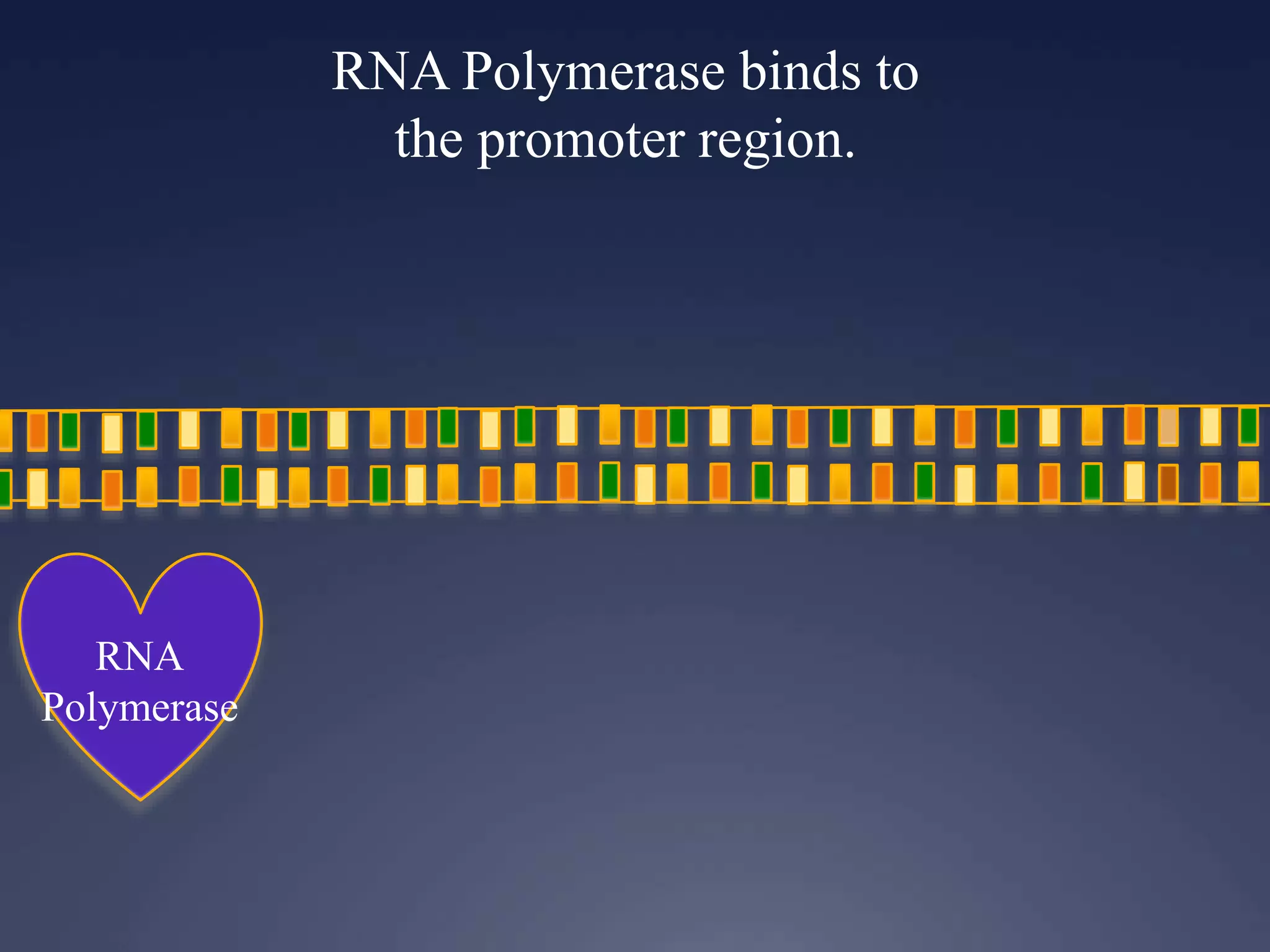
RNA Polymerase binds to
the promoter region.
RNA
Polymerase
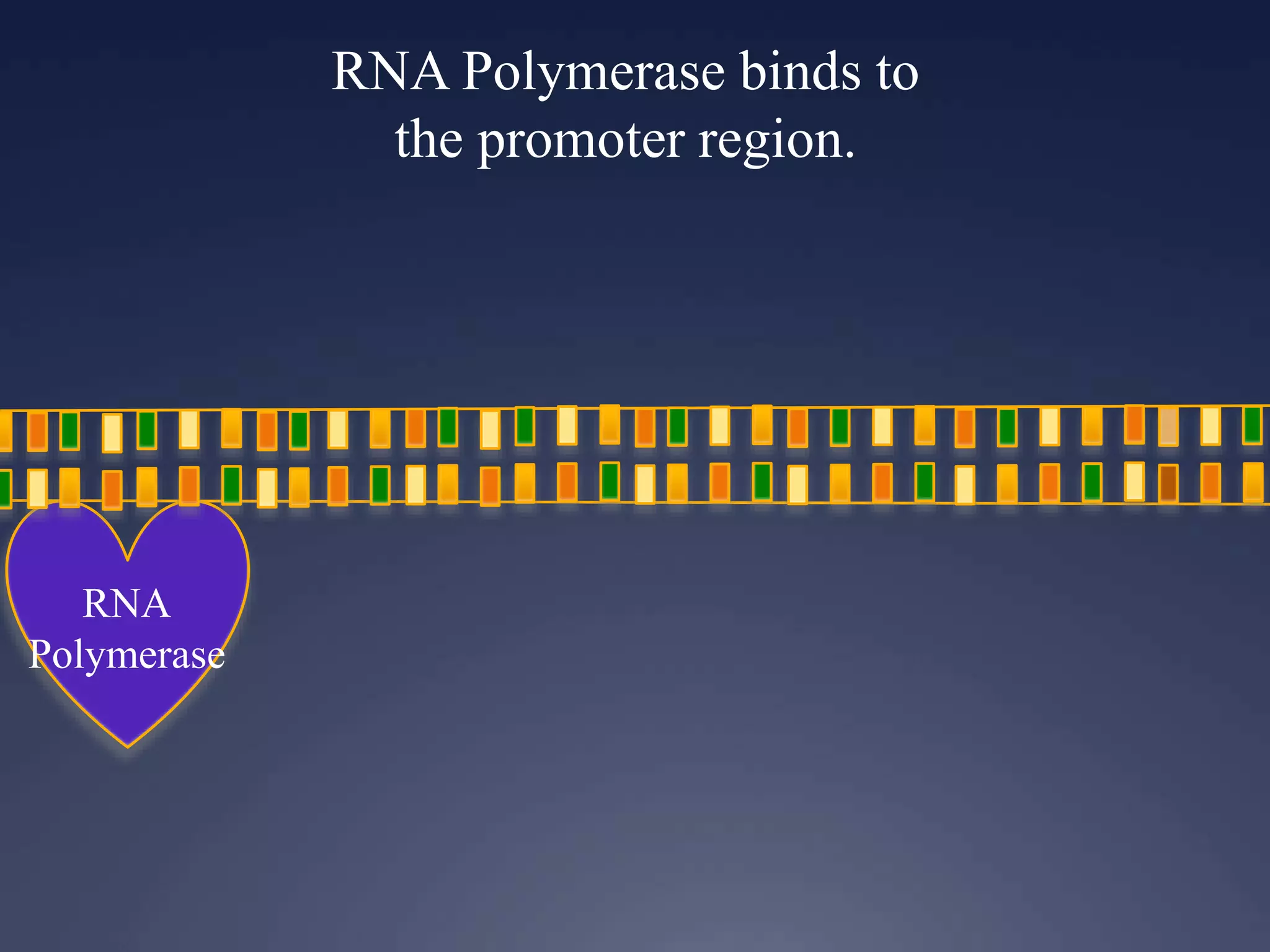
RNA Polymerase binds to
the promoter region.
RNA
Polymerase
RNA Polymerase binds to
the promoter region.
RNA
Polymerase
RNA Polymerase binds to
the promoter region.
RNA
Polymerase
RNA Polymerase binds to
the promoter region.
RNA
Polymerase
RNA Polymerase binds to
the promoter region.
RNA
Polymerase
Guanine
Cytosine
Thymine
Adenine
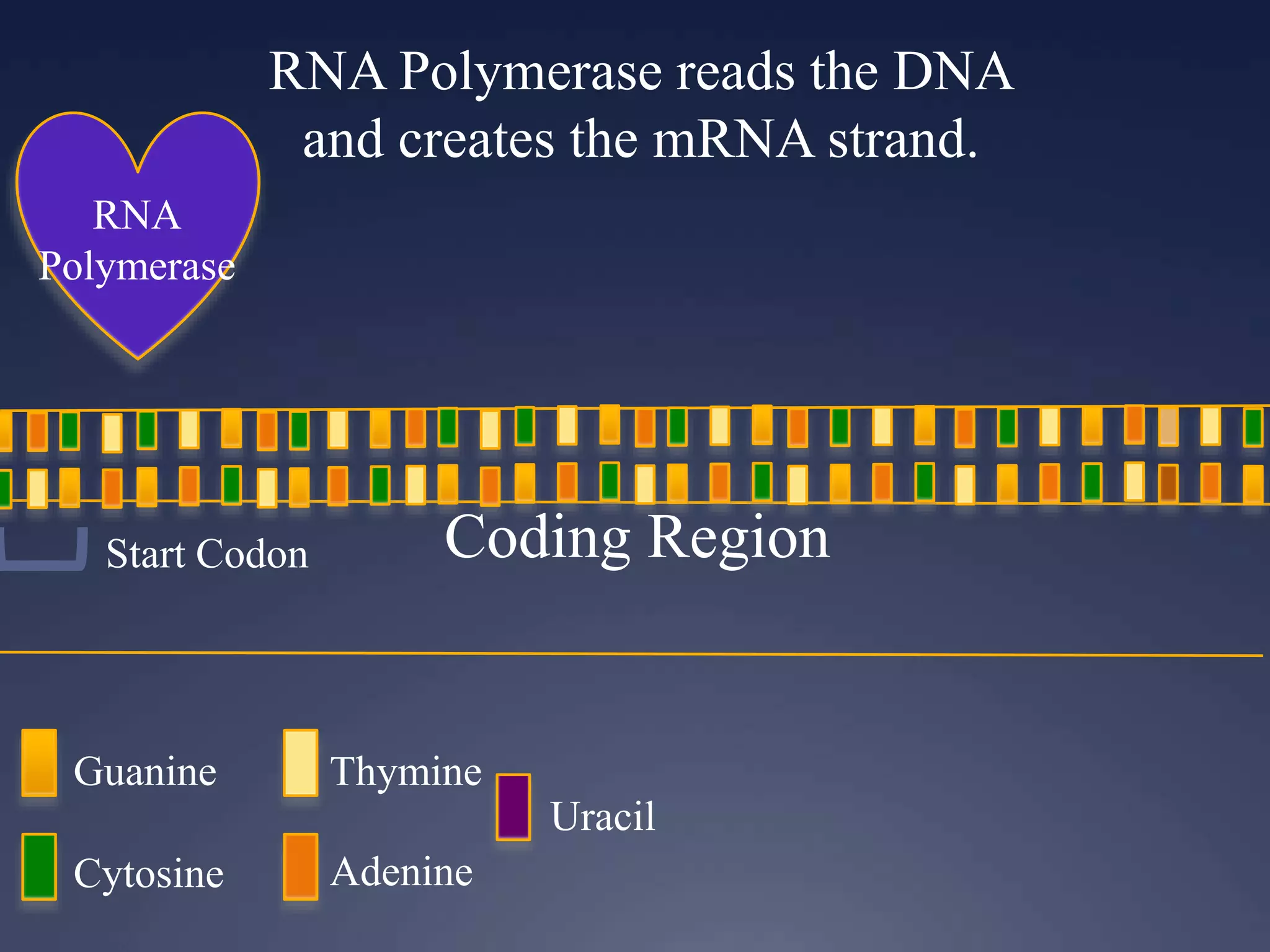
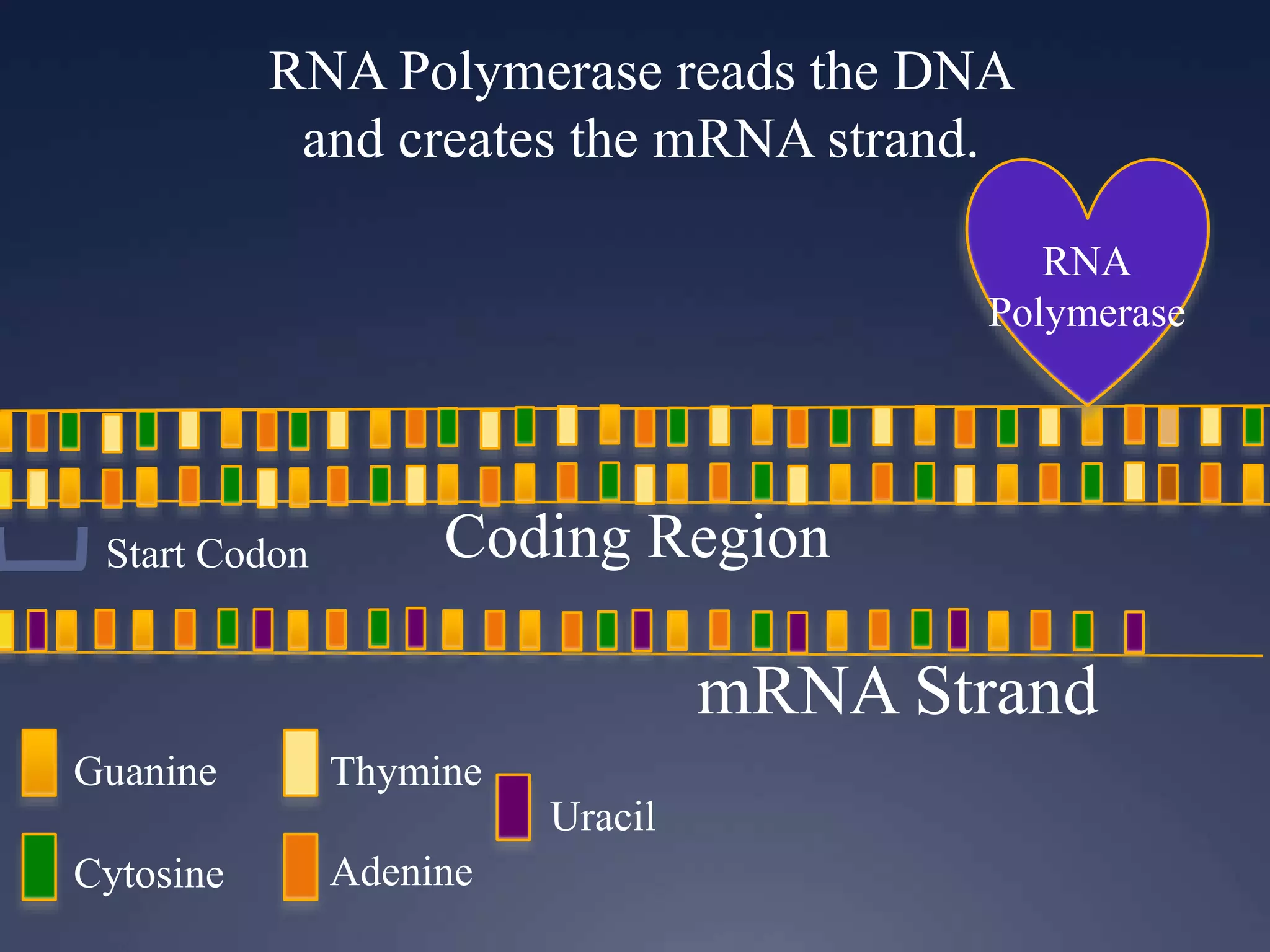
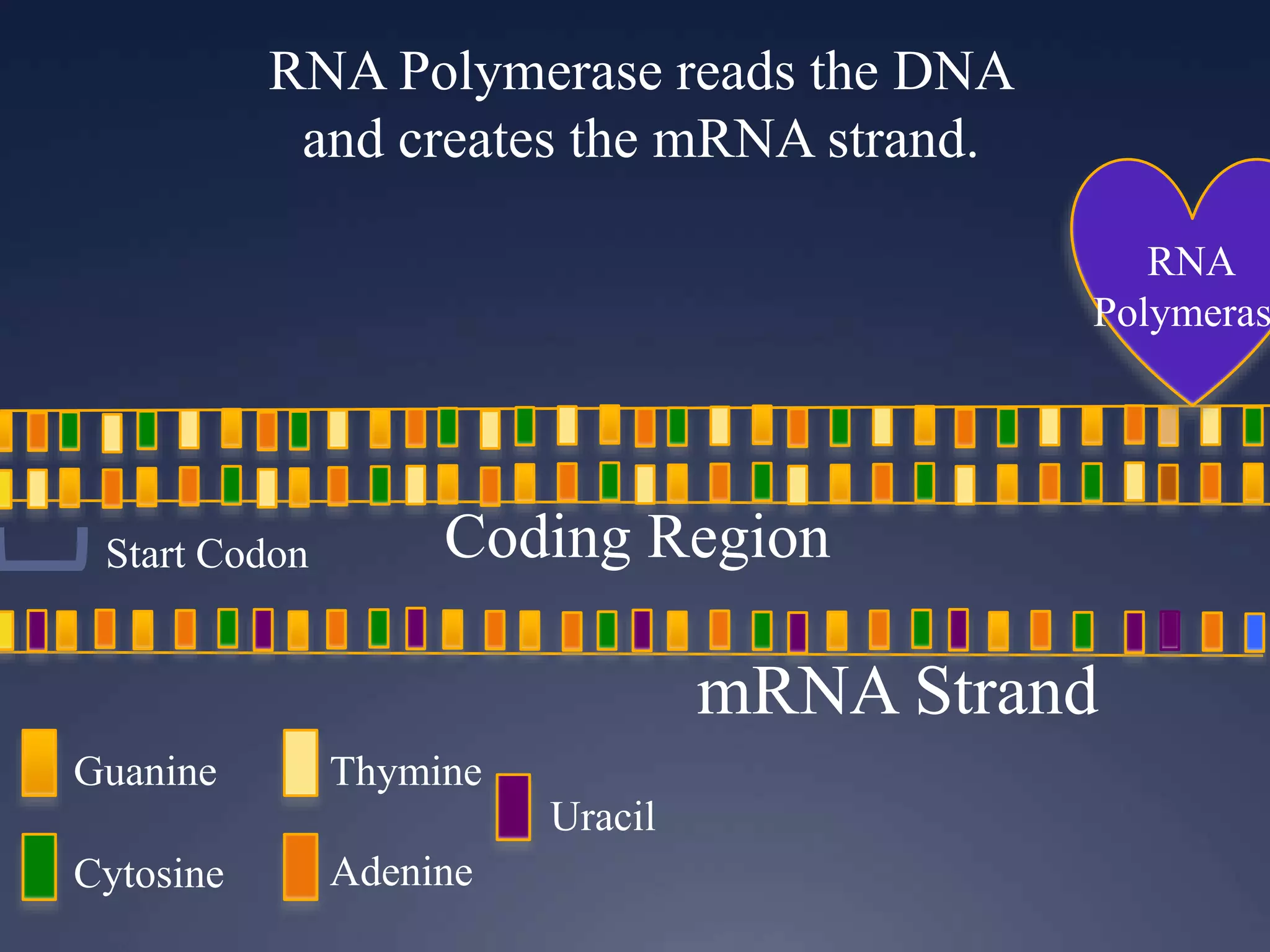
RNA Polymerase reads the DNA
and creates the mRNA strand.
RNA
Polymerase
Guanine
Cytosine
Thymine
Adenine
Uracil
Start Codon Coding Region
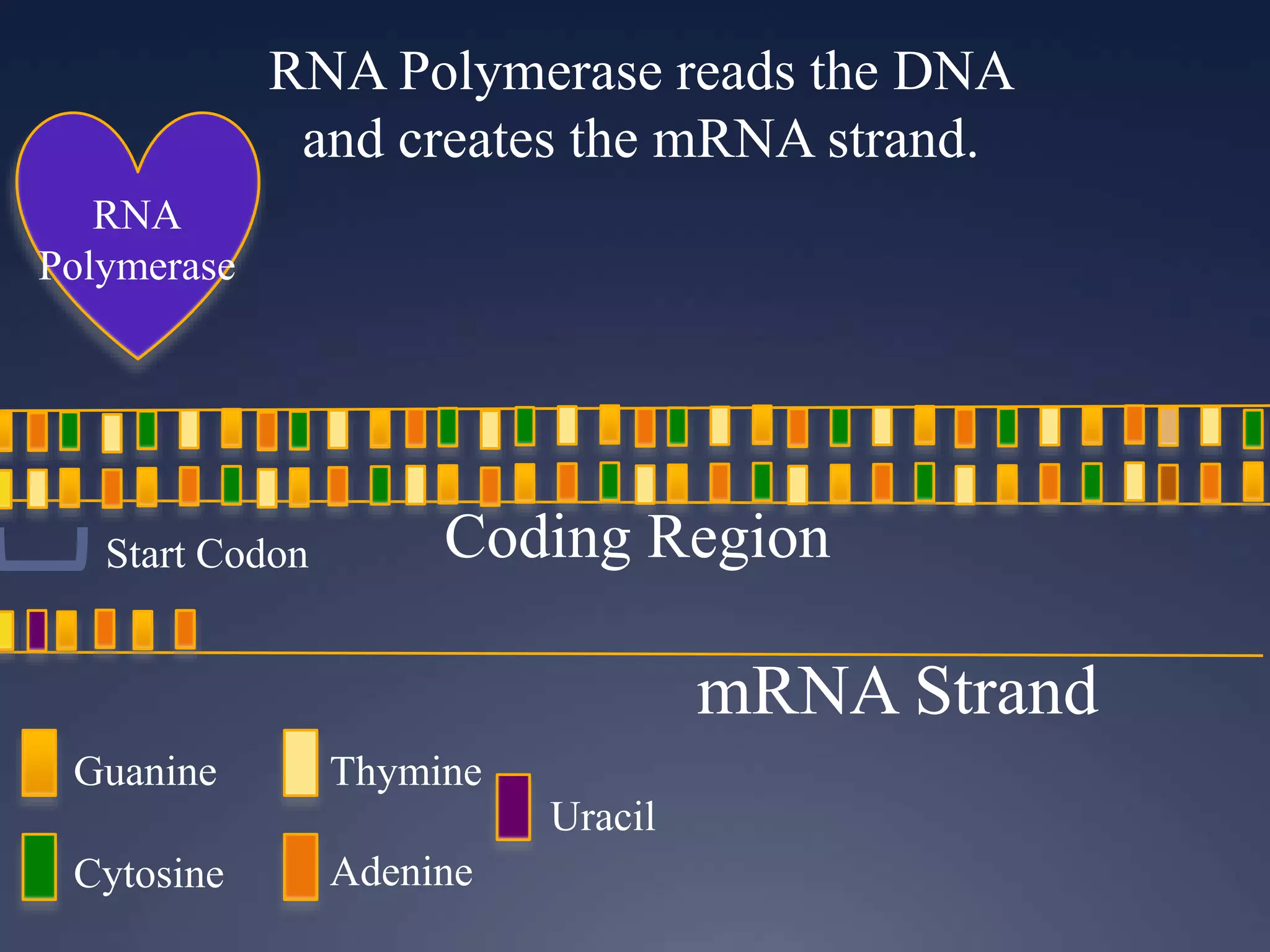
RNA Polymerase reads the DNA
and creates the mRNA strand.
RNA
Polymerase
Guanine
Cytosine
Thymine
Adenine
Uracil
Start Codon Coding Region
mRNA Strand
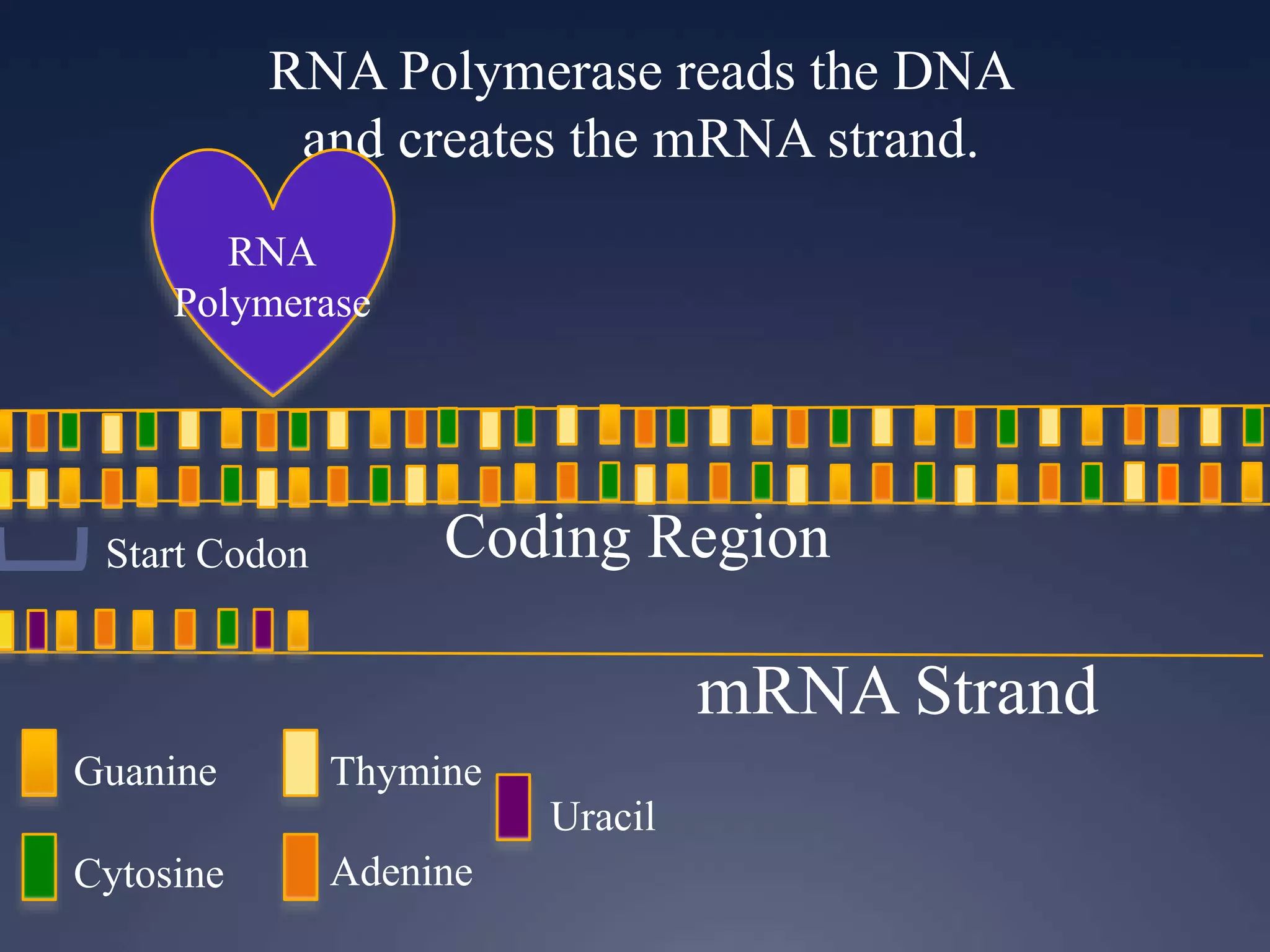
RNA Polymerase reads the DNA
and creates the mRNA strand.
RNA
Polymerase
Guanine
Cytosine
Thymine
Adenine
Uracil
Start Codon Coding Region
mRNA Strand
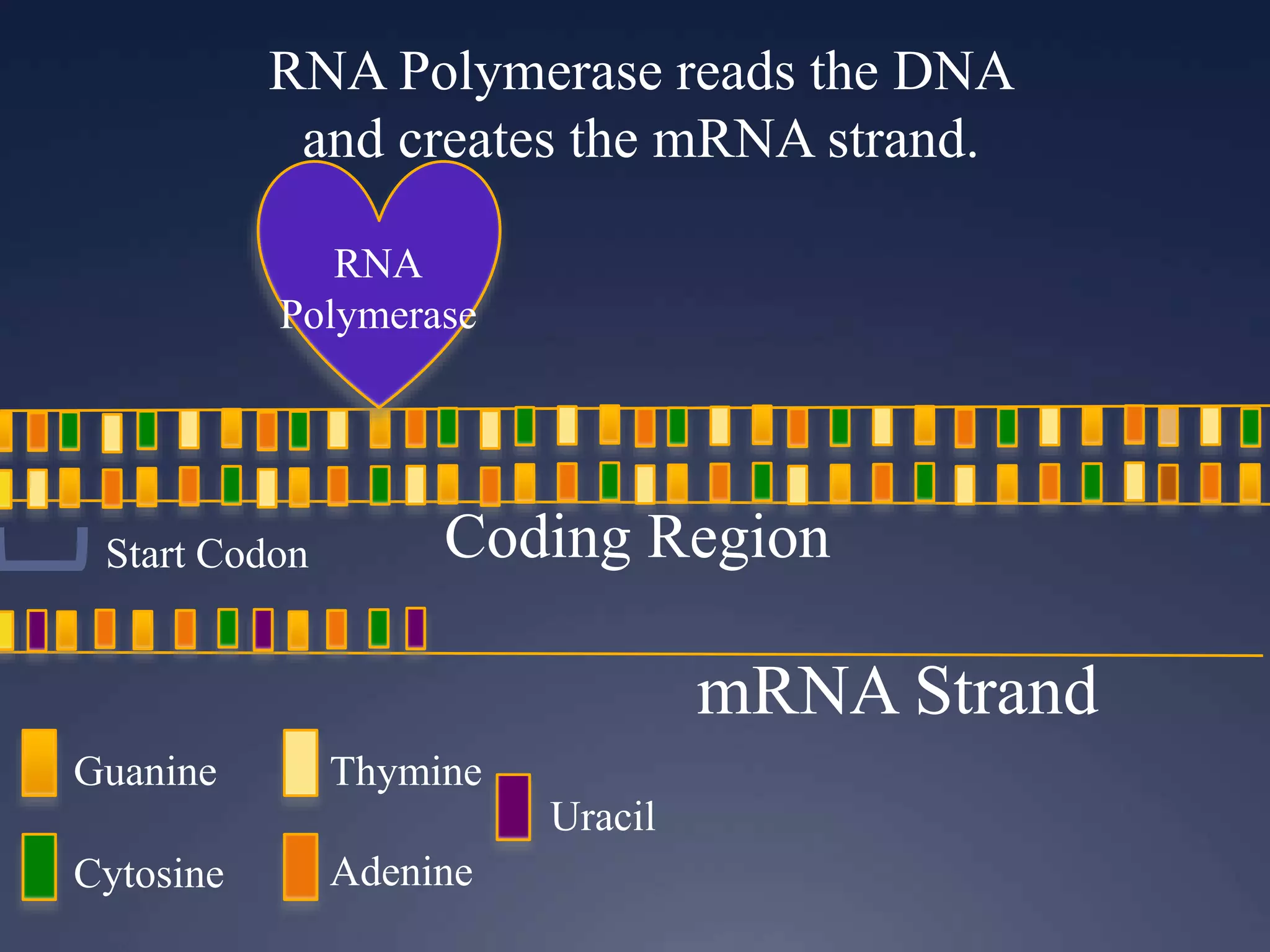
RNA Polymerase reads the DNA
and creates the mRNA strand.
RNA
Polymerase
Guanine
Cytosine
Thymine
Adenine
Uracil
Start Codon Coding Region
mRNA Strand
RNA Polymerase reads the DNA
and creates the mRNA strand.
RNA
Polymerase
Guanine
Cytosine
Thymine
Adenine
Uracil
Start Codon Coding Region
mRNA Strand
RNA Polymerase reads the DNA
and creates the mRNA strand.
RNA
Polymerase
Guanine
Cytosine
Thymine
Adenine
Uracil
Start Codon Coding Region
mRNA Strand
RNA Polymerase reads the DNA
and creates the mRNA strand.
RNA
Polymerase
Guanine
Cytosine
Thymine
Adenine
Uracil
Start Codon Coding Region
mRNA Strand
RNA Polymerase reads the DNA
and creates the mRNA strand.
RNA
Polymerase
Guanine
Cytosine
Thymine
Adenine
Uracil
Start Codon Coding Region
mRNA Strand
RNA Polymerase reads the DNA
and creates the mRNA strand.
RNA
Polymerase
Guanine
Cytosine
Thymine
Adenine
Uracil
Start Codon Coding Region
mRNA Strand
RNA Polymerase reads the DNA
and creates the mRNA strand.
RNA
Polymerase
Guanine
Cytosine
Thymine
Adenine
Uracil
Start Codon Coding Region
mRNA Strand
RNA Polymerase reads the DNA
and creates the mRNA strand.
RNA
Polymeras
Guanine
Cytosine
Thymine
Adenine
Uracil
Start Codon Coding Region
mRNA Strand
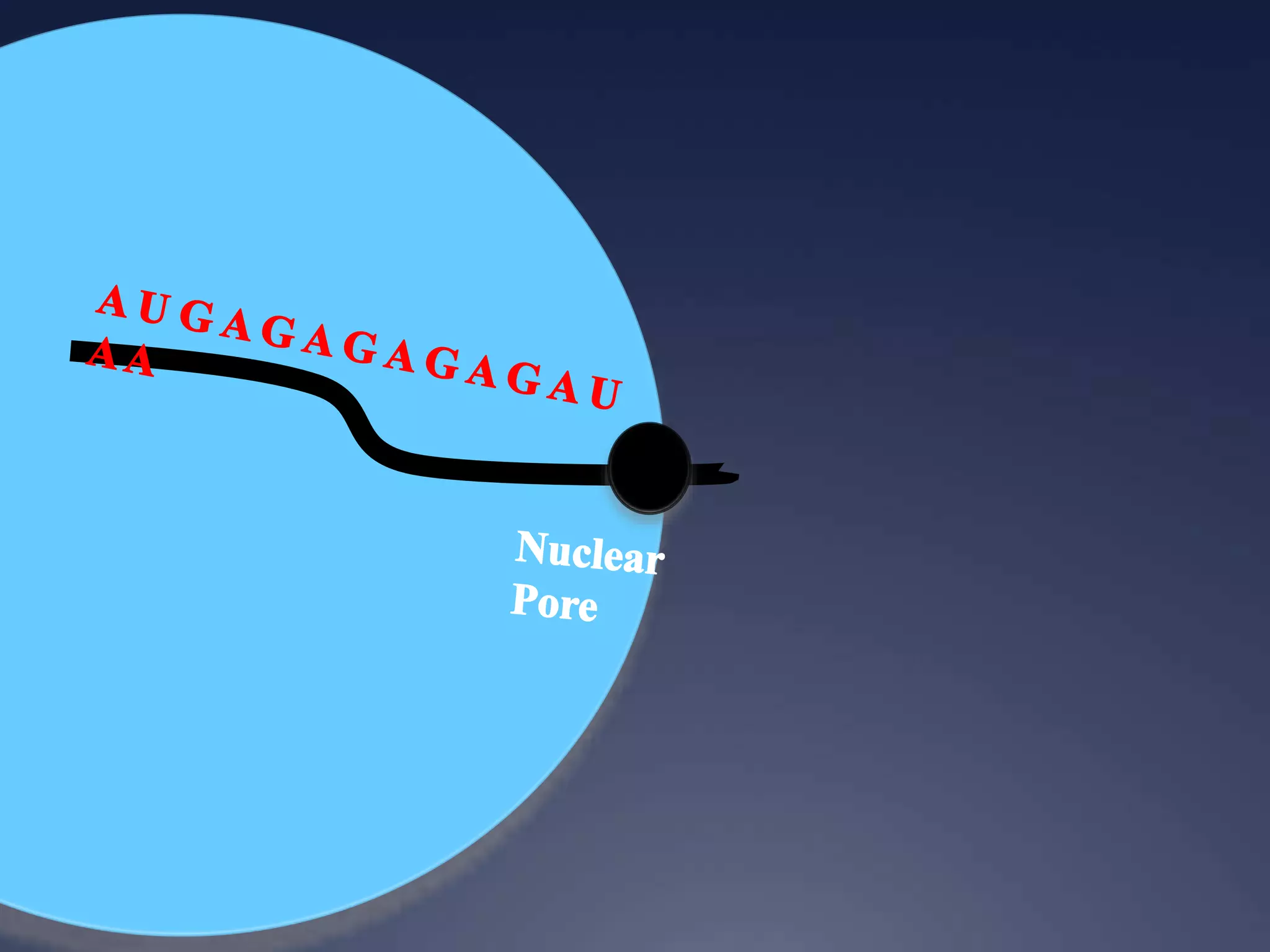
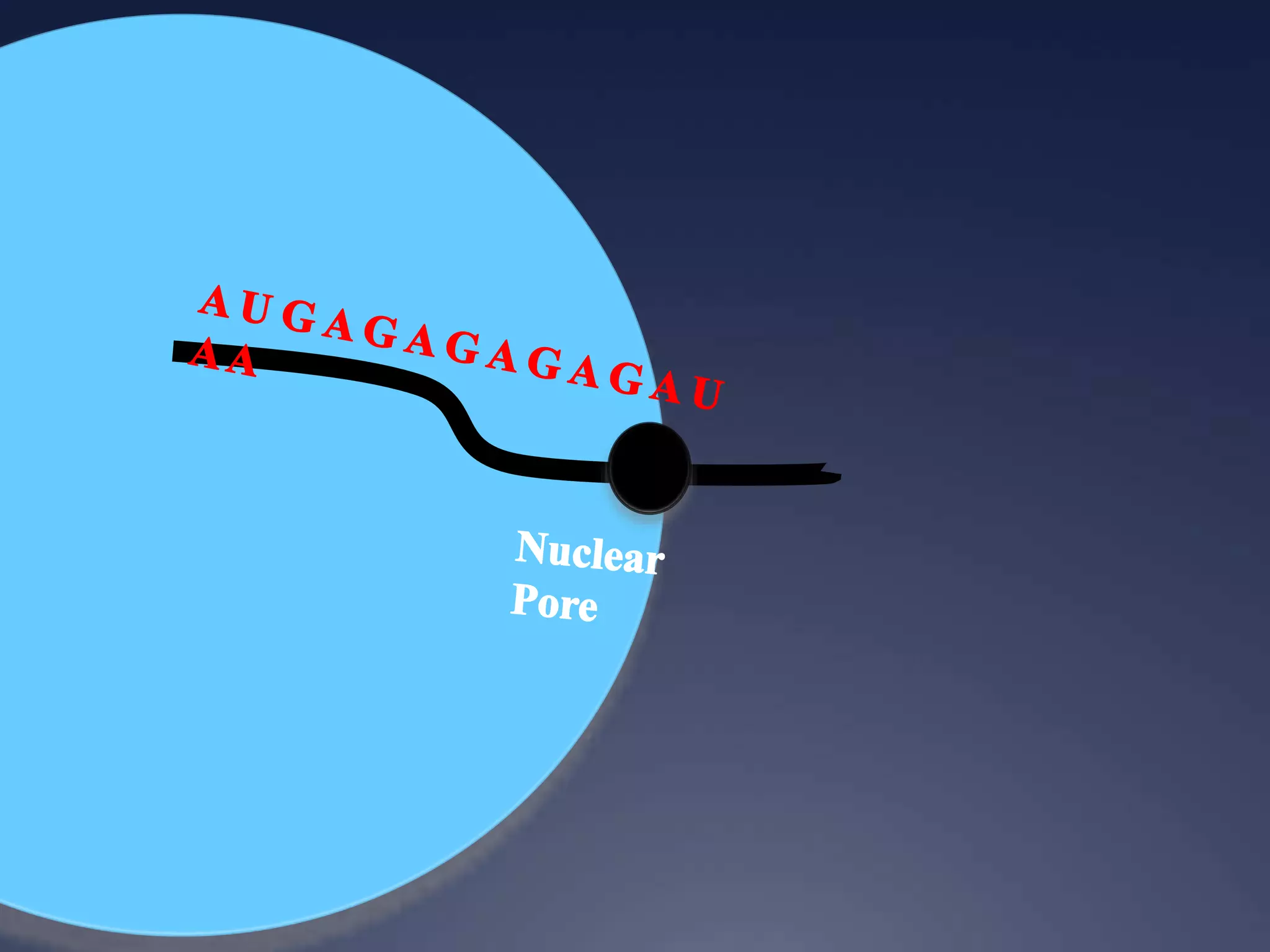
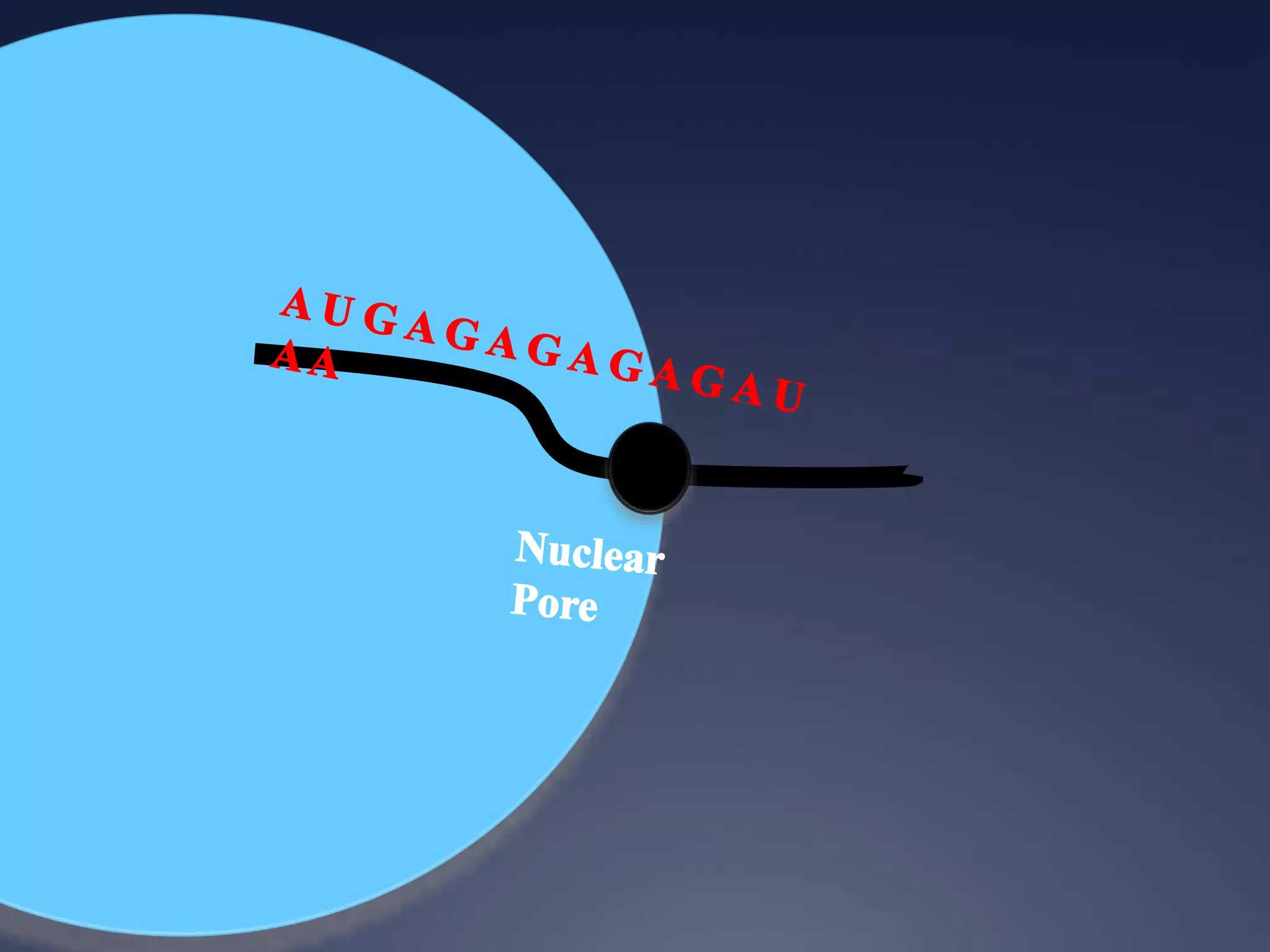
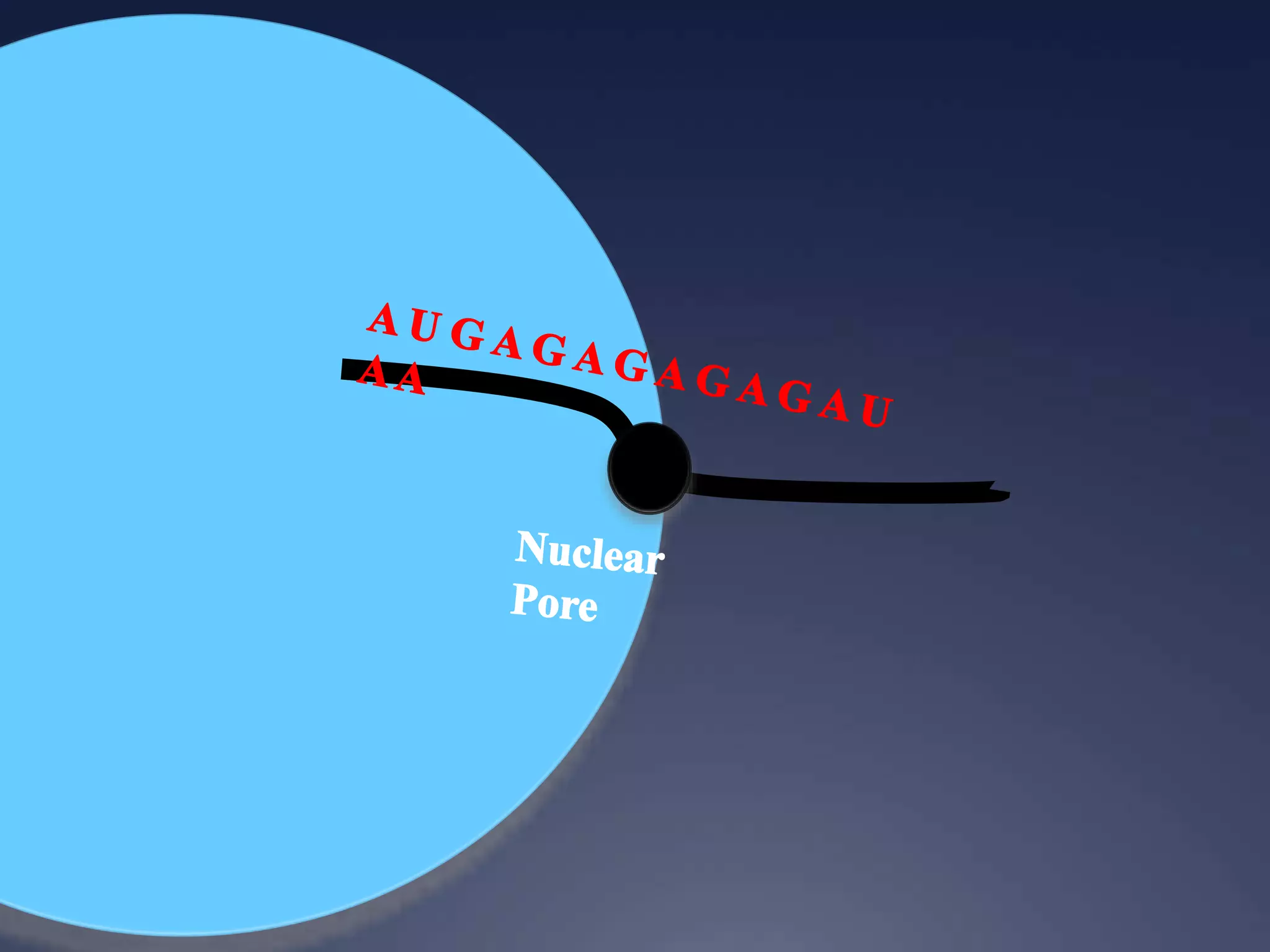
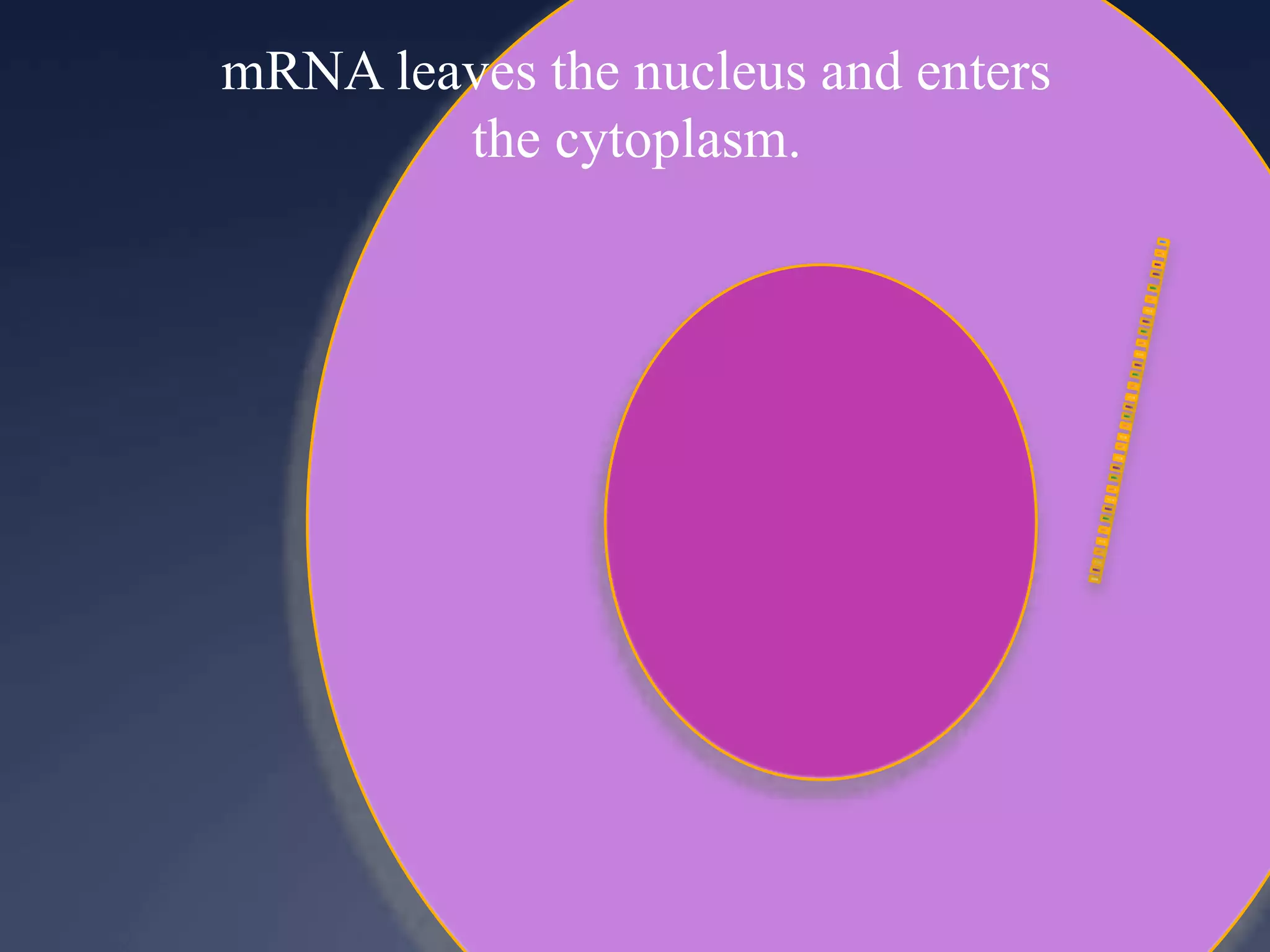
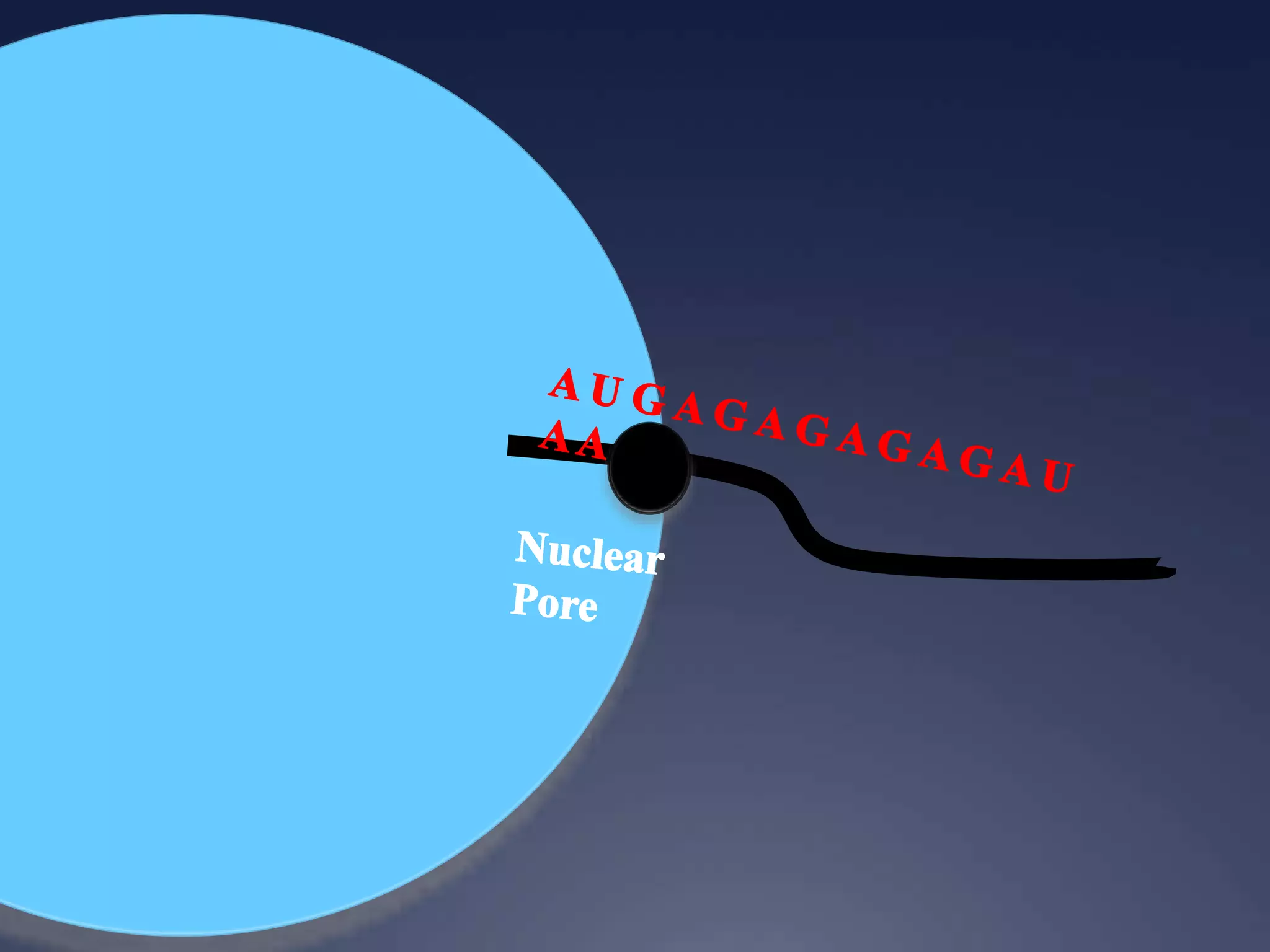
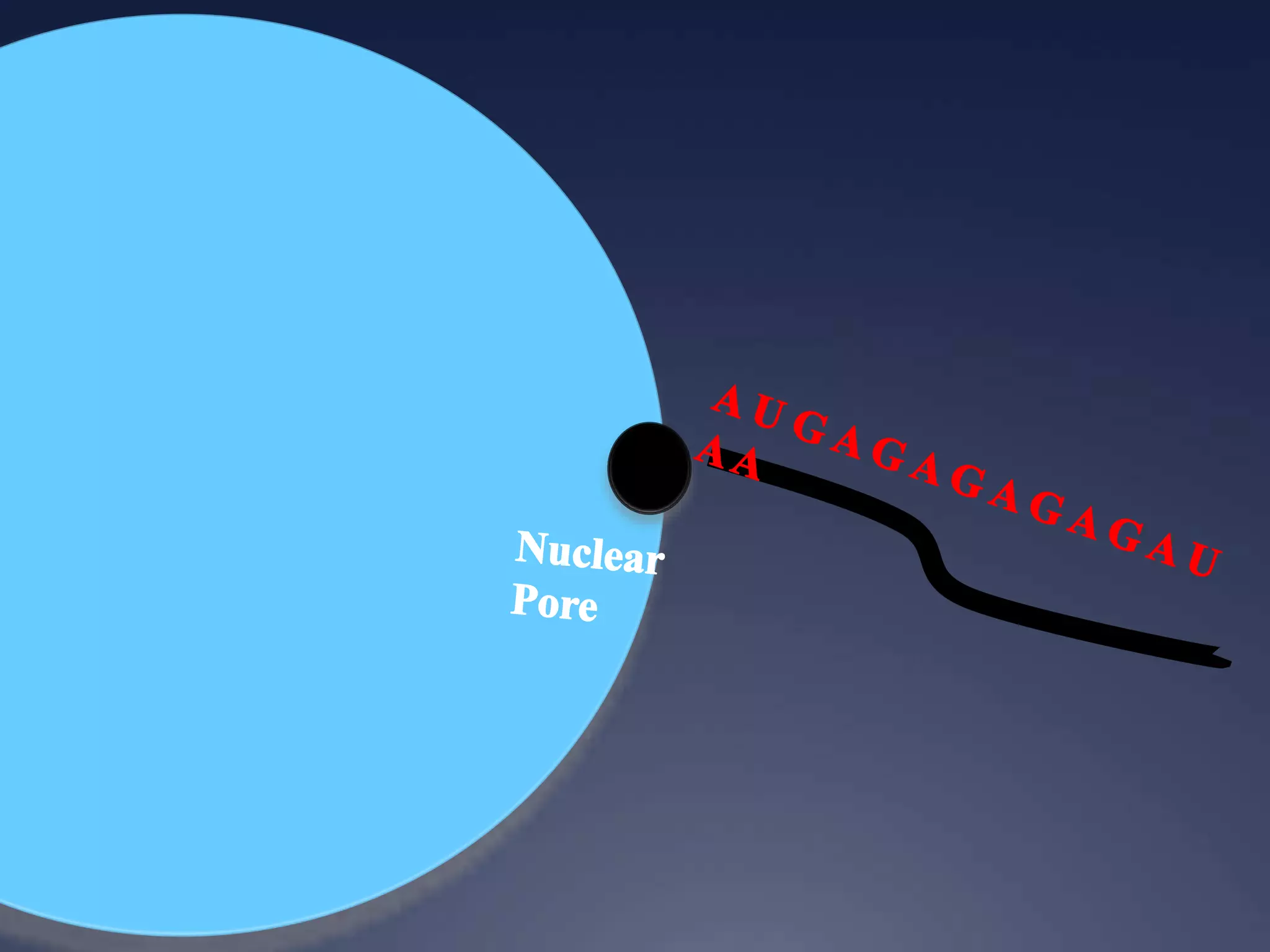
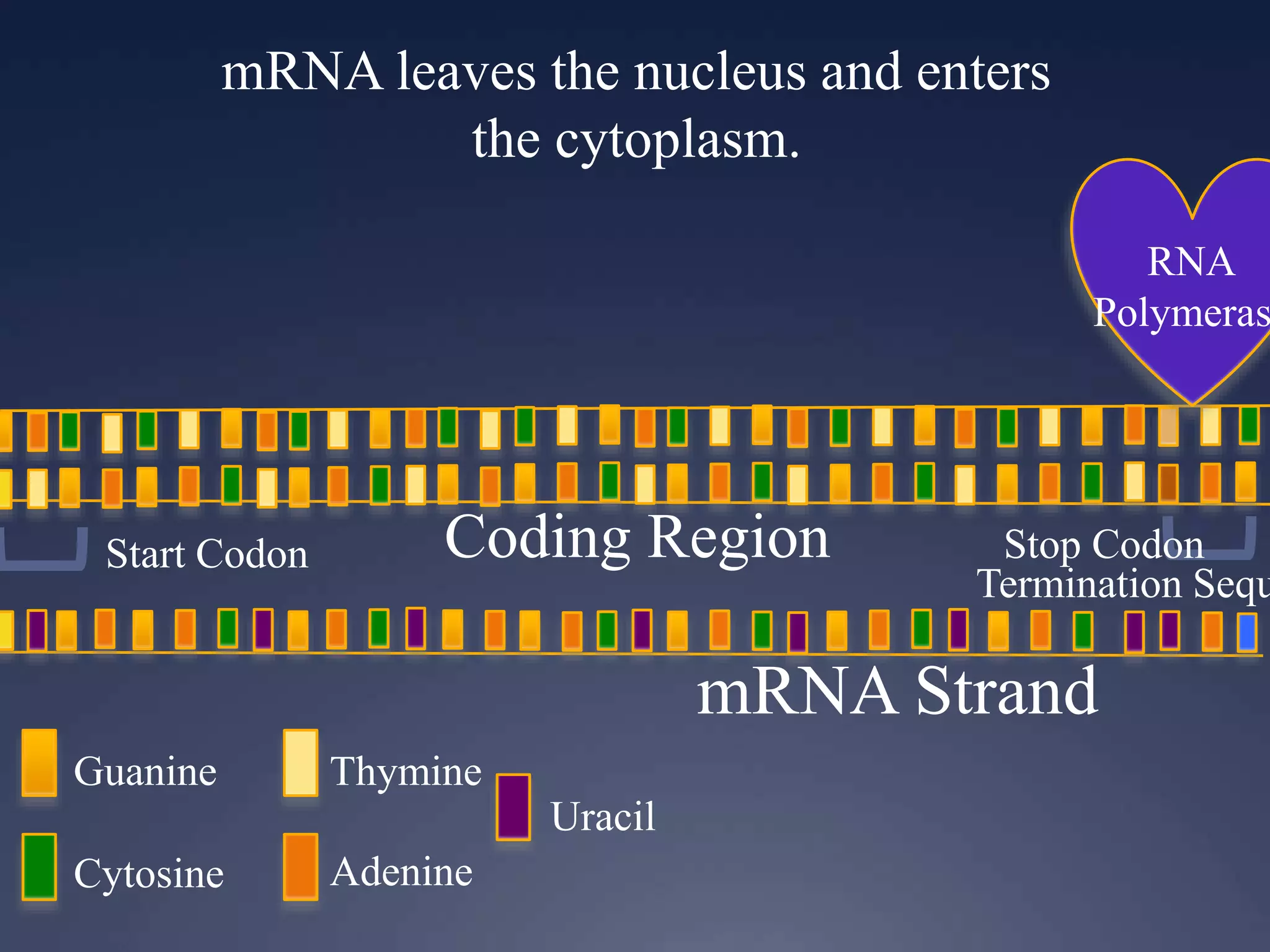
mRNA leaves the nucleus and enters
the cytoplasm.
RNA
Polymeras
Guanine
Cytosine
Thymine
Adenine
Uracil
Start Codon Stop CodonCoding Region
mRNA Strand
Termination Sequ
mRNA leaves the nucleus and enters
the cytoplasm.
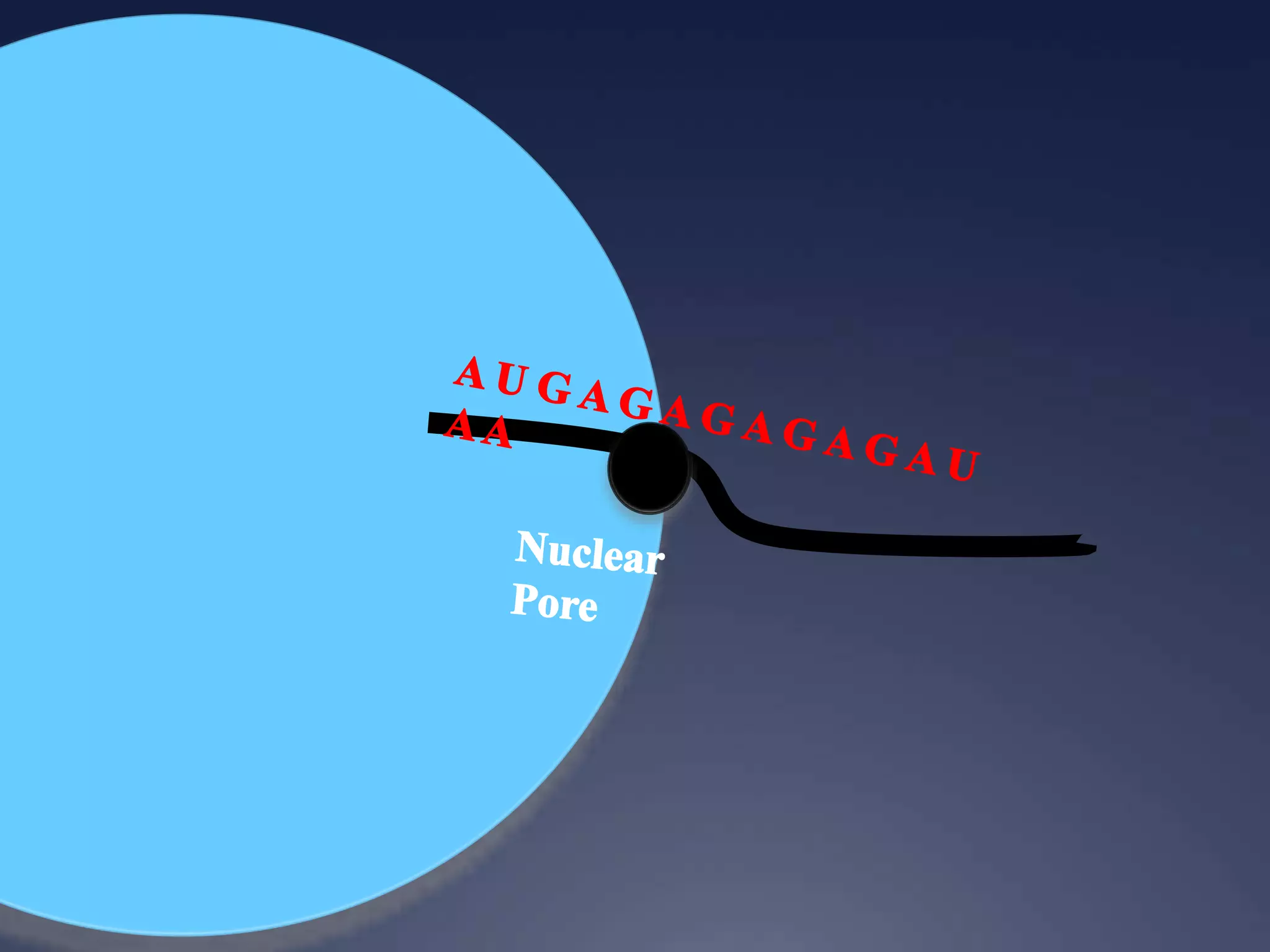
mRNA leaves the nucleus and enters
the cytoplasm.
Nuclear Por
mRNA leaves the nucleus and enters
the cytoplasm.
Nuclear Por
mRNA leaves the nucleus and enters
the cytoplasm.
Nuclear Por
mRNA leaves the nucleus and enters
the cytoplasm.
Nuclear Por
mRNA leaves the nucleus and enters
the cytoplasm.
Nuclear Por
mRNA leaves the nucleus and enters
the cytoplasm.
Nuclear Por
mRNA leaves the nucleus and enters
the cytoplasm.
The Genetic Code
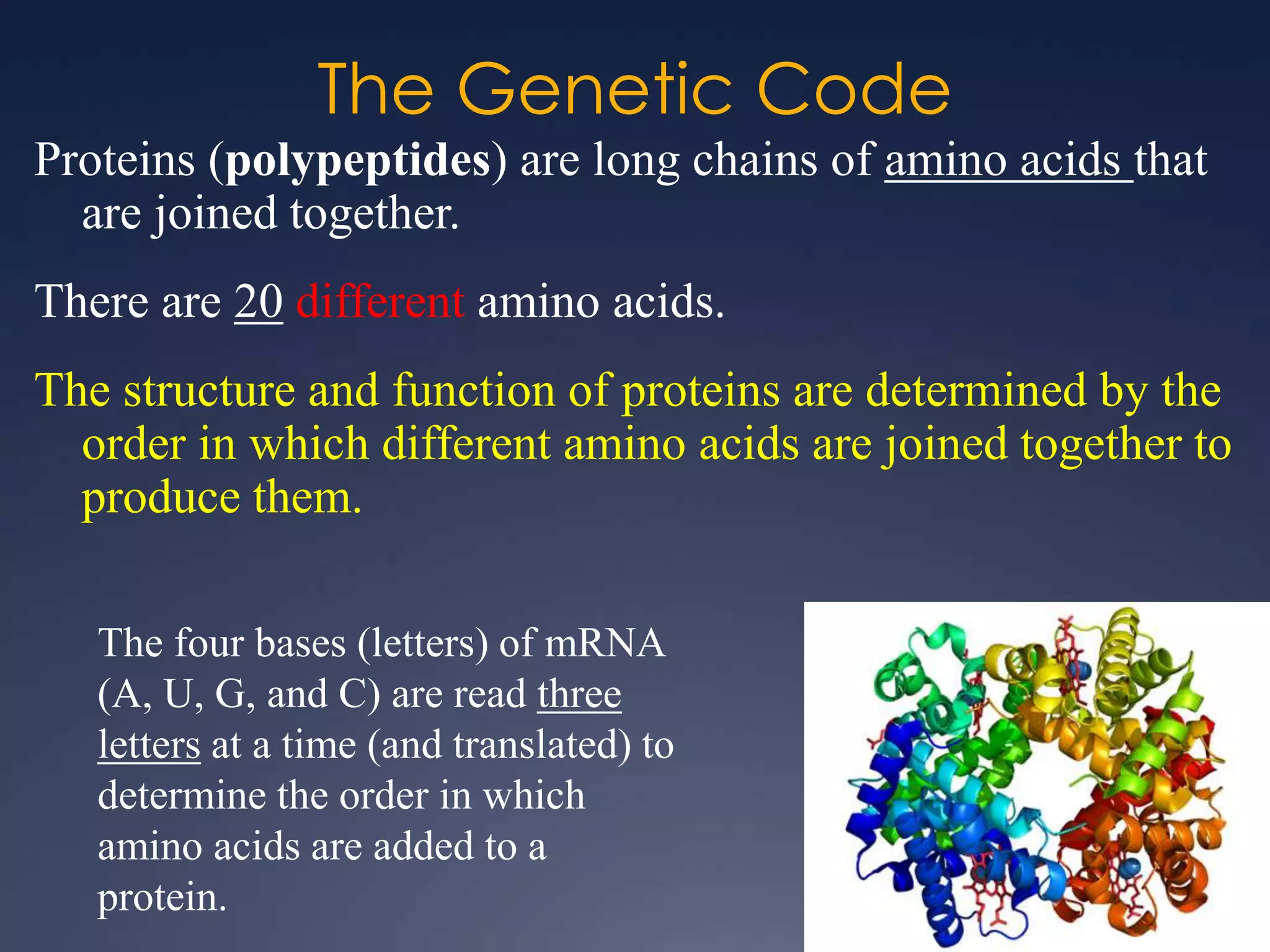
Proteins (polypeptides) are long chains of amino acids that
are joined together.
There are 20 different amino acids.
The structure and function of proteins are determined by the
order in which different amino acids are joined together to
produce them.
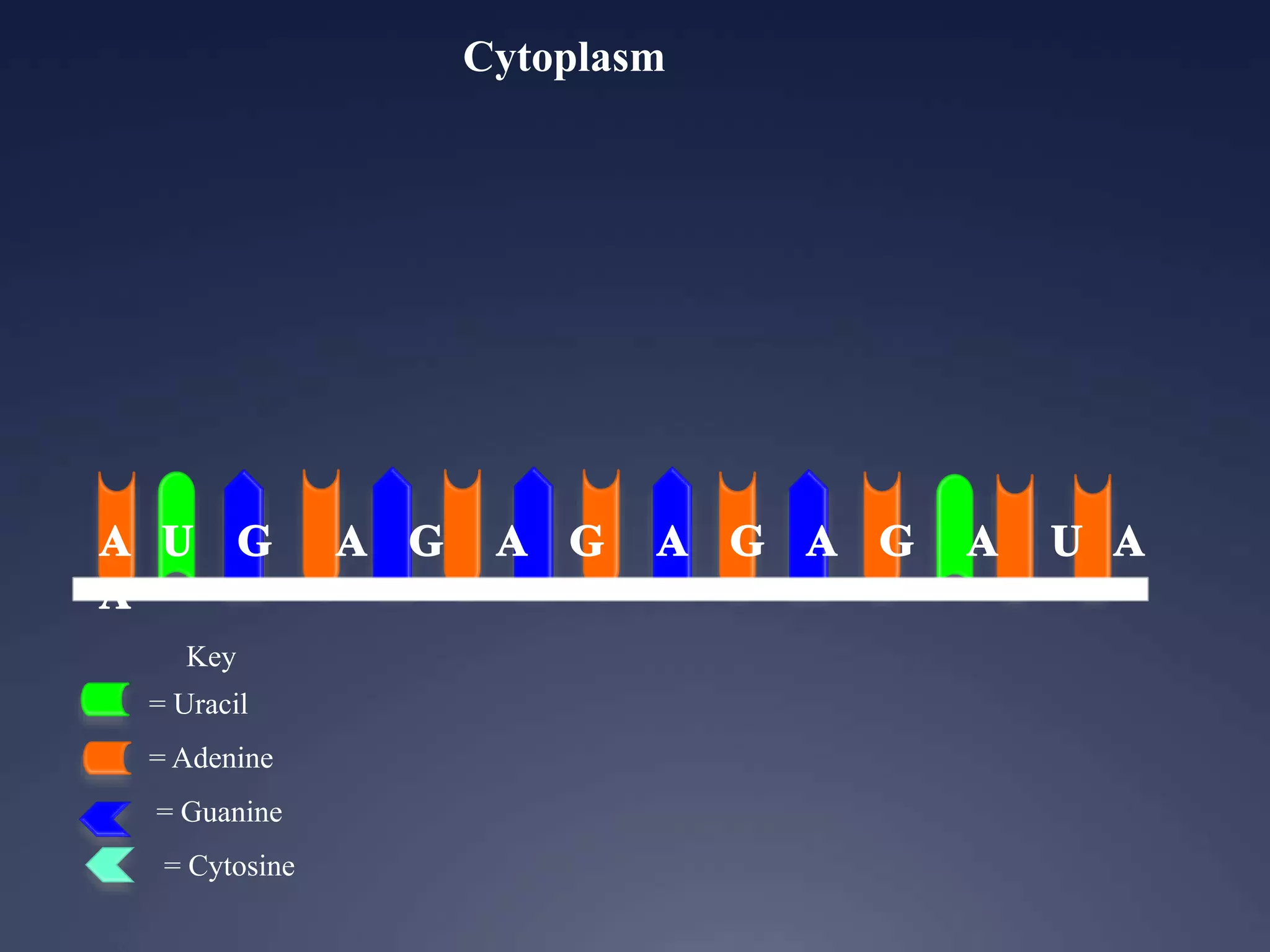
The four bases (letters) of mRNA
(A, U, G, and C) are read three
letters at a time (and translated) to
determine the order in which
amino acids are added to a
protein.
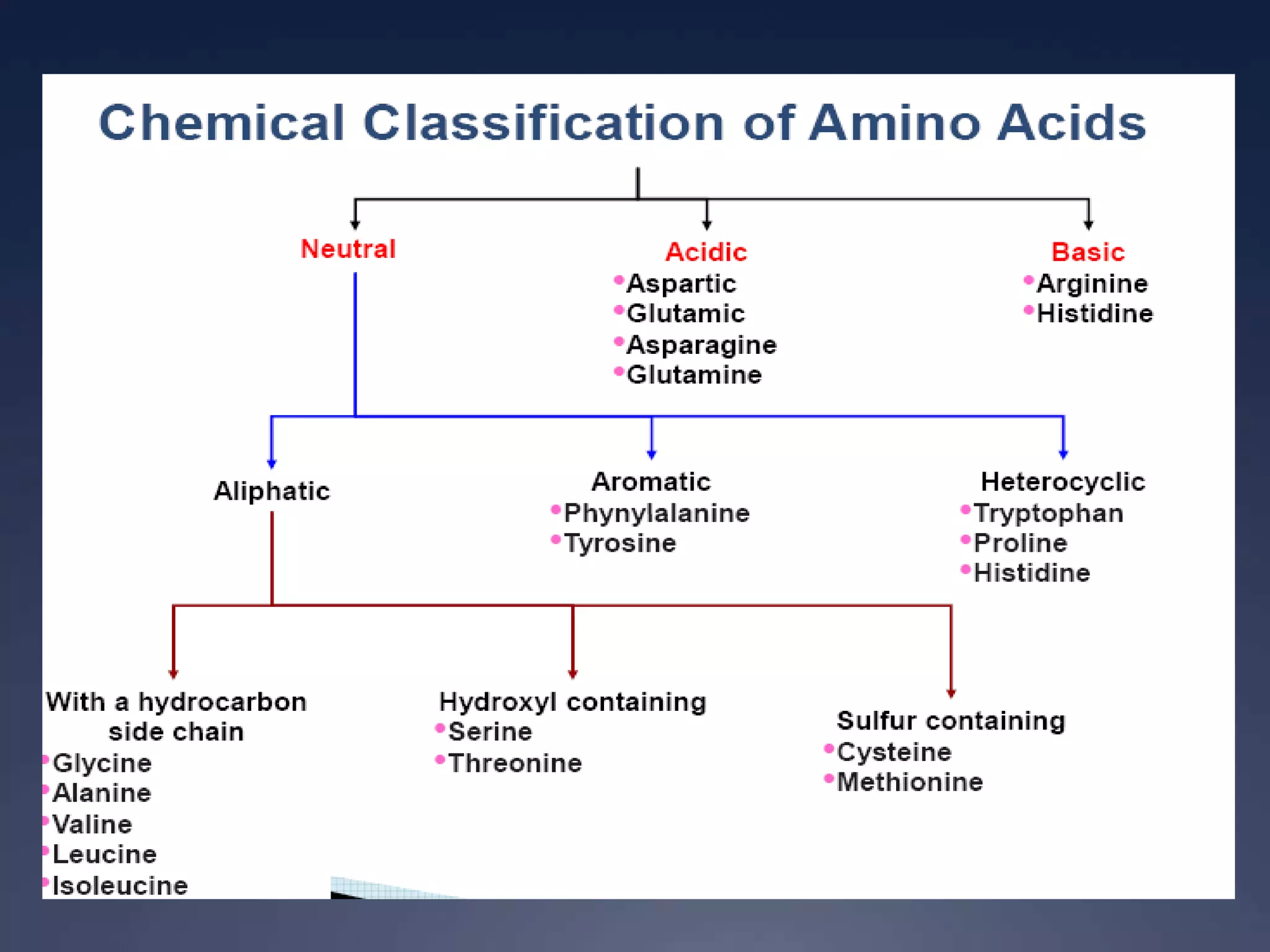
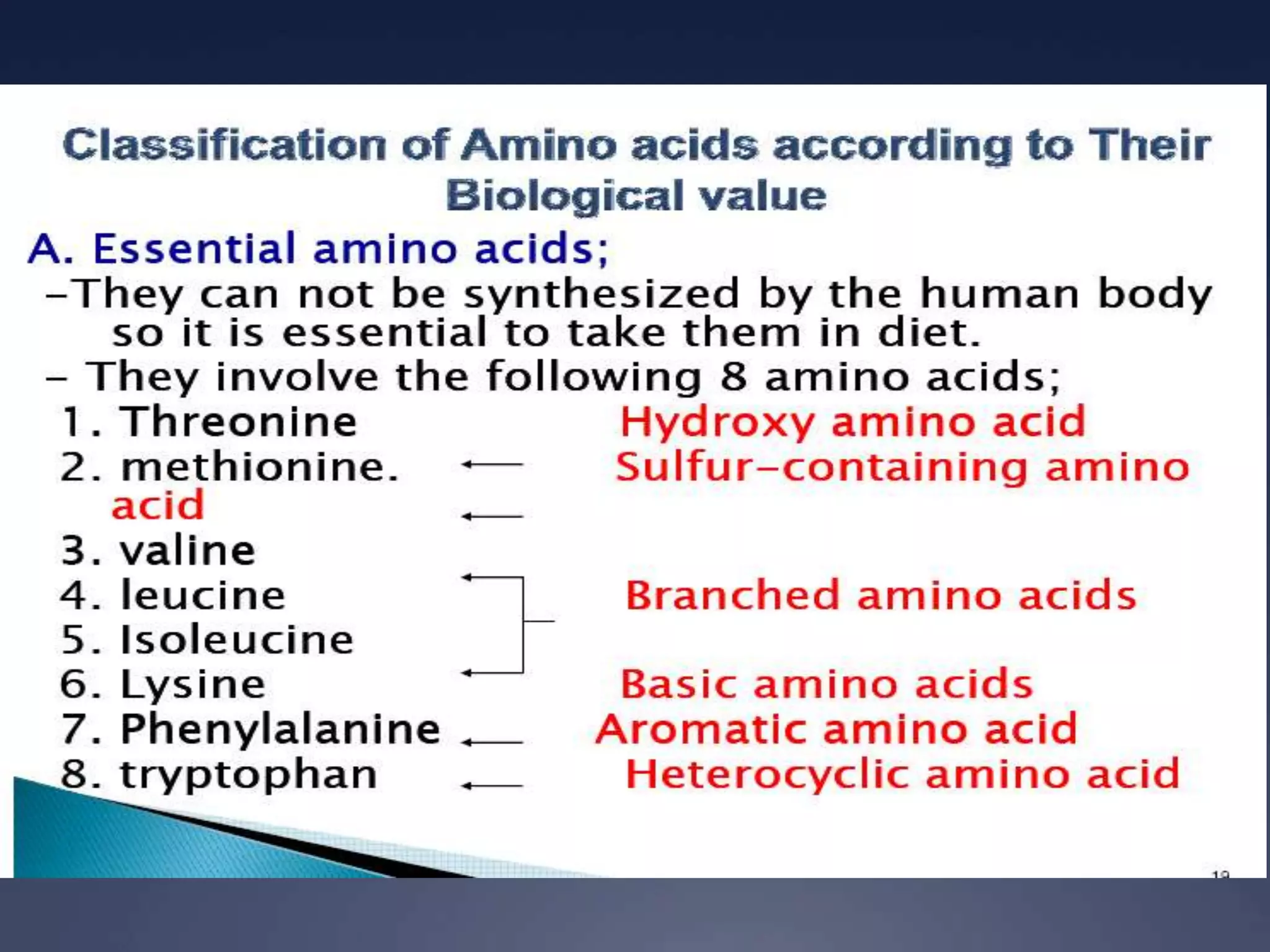
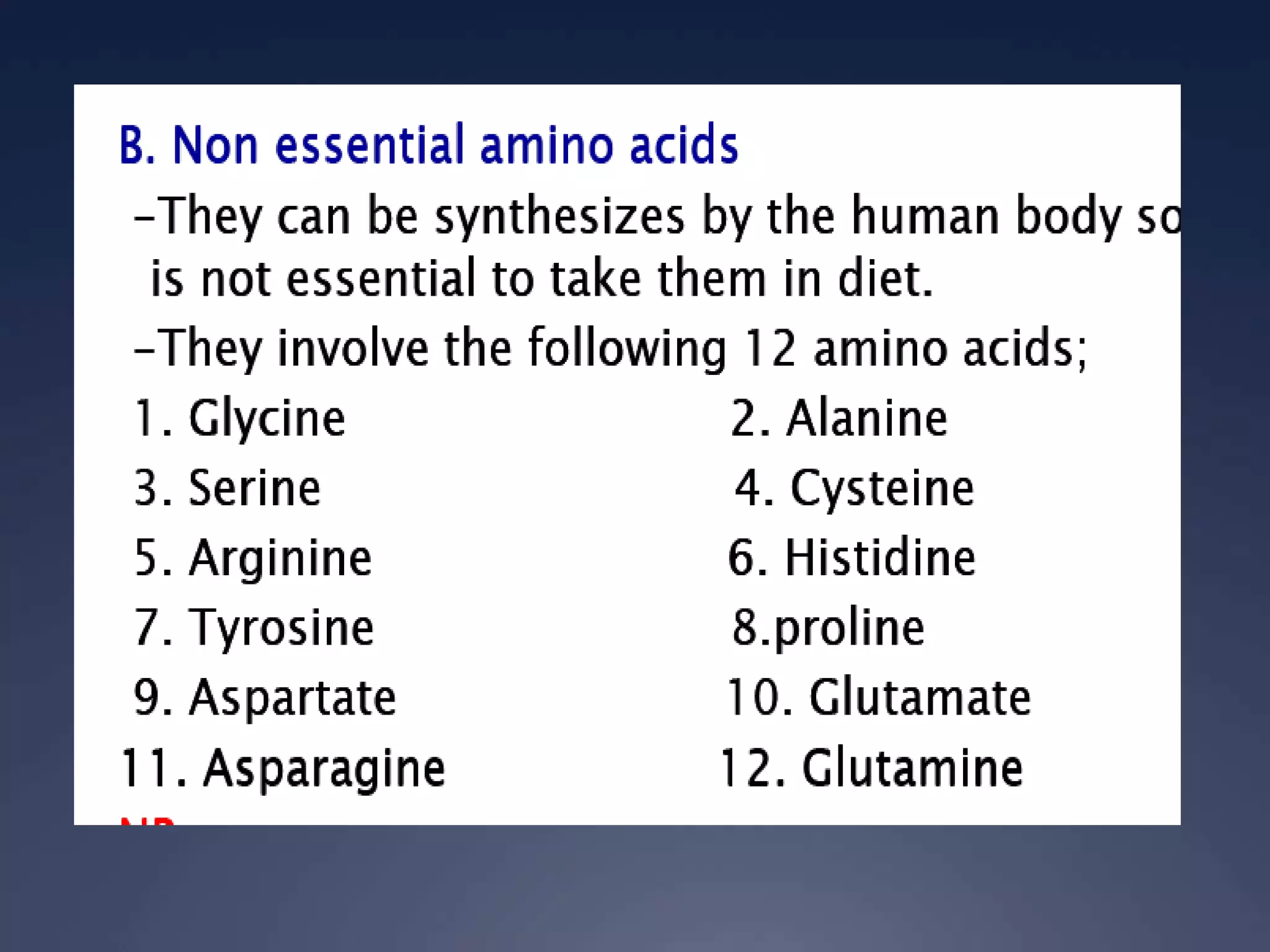
AMINO ACIDS
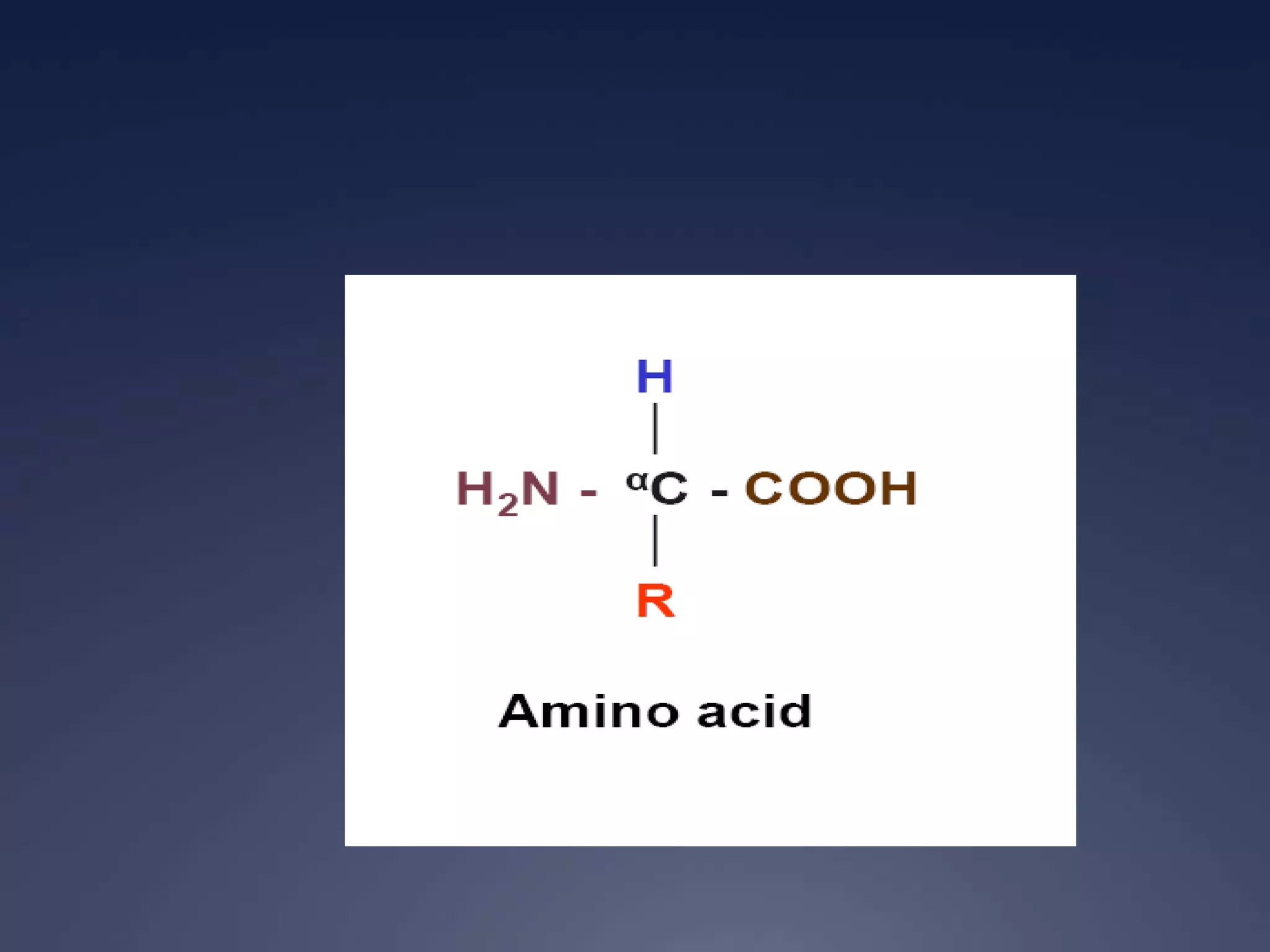
 Amino acids are organic solvents.
 Have two functional groups –NH₂ and
-COOH group.
 The amino group is basic while carboxylic group is
acidic in nature.
 Soluble in water but insoluble in organic solvents e.g.
chloroform,acetone,ether,etc.
 All amino acids which make up proteins are L-α-
aminoacids.
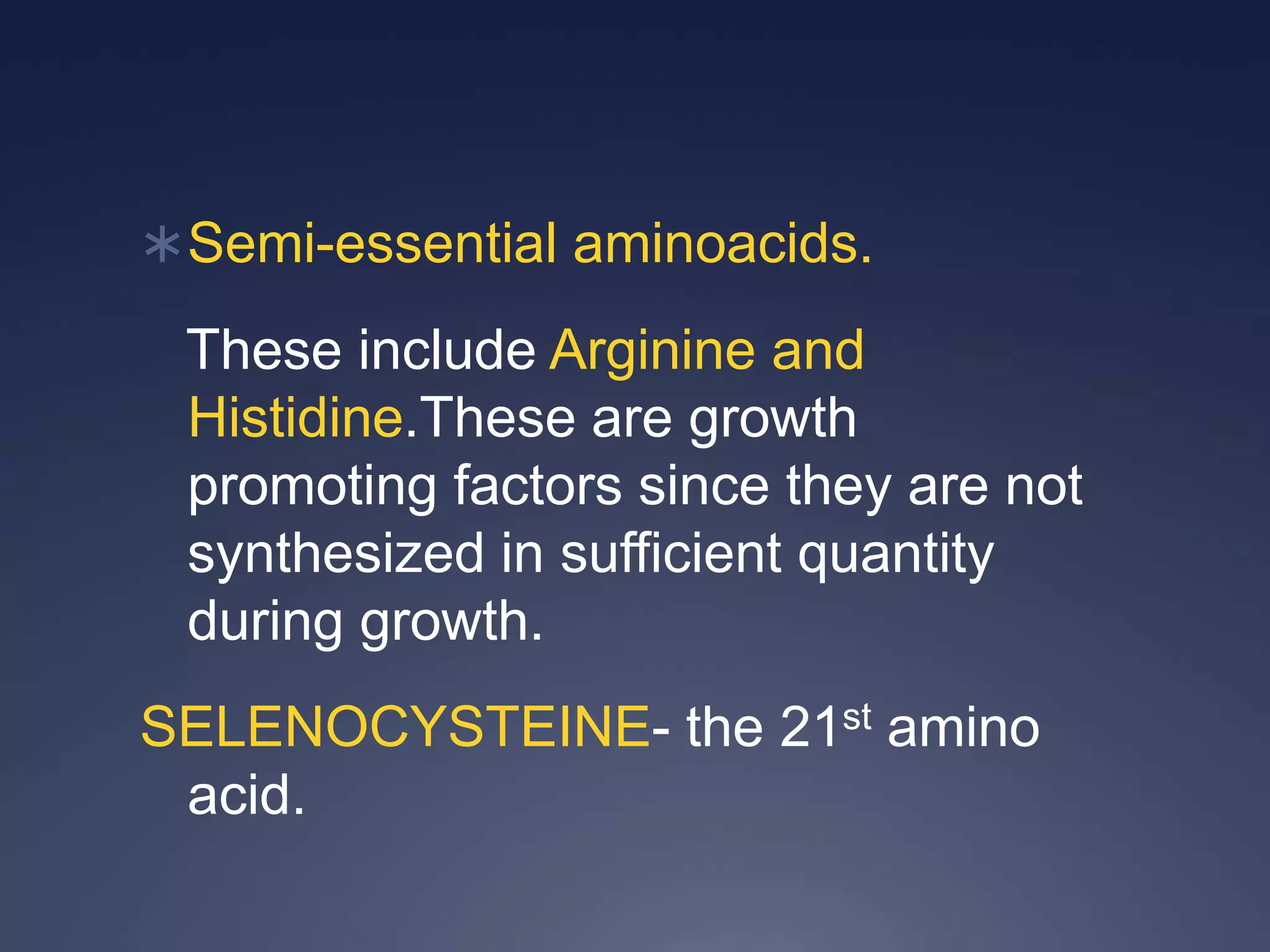
Semi-essential aminoacids.
These include Arginine and
Histidine.These are growth
promoting factors since they are not
synthesized in sufficient quantity
during growth.
SELENOCYSTEINE- the 21st amino
acid.
The Genetic Code
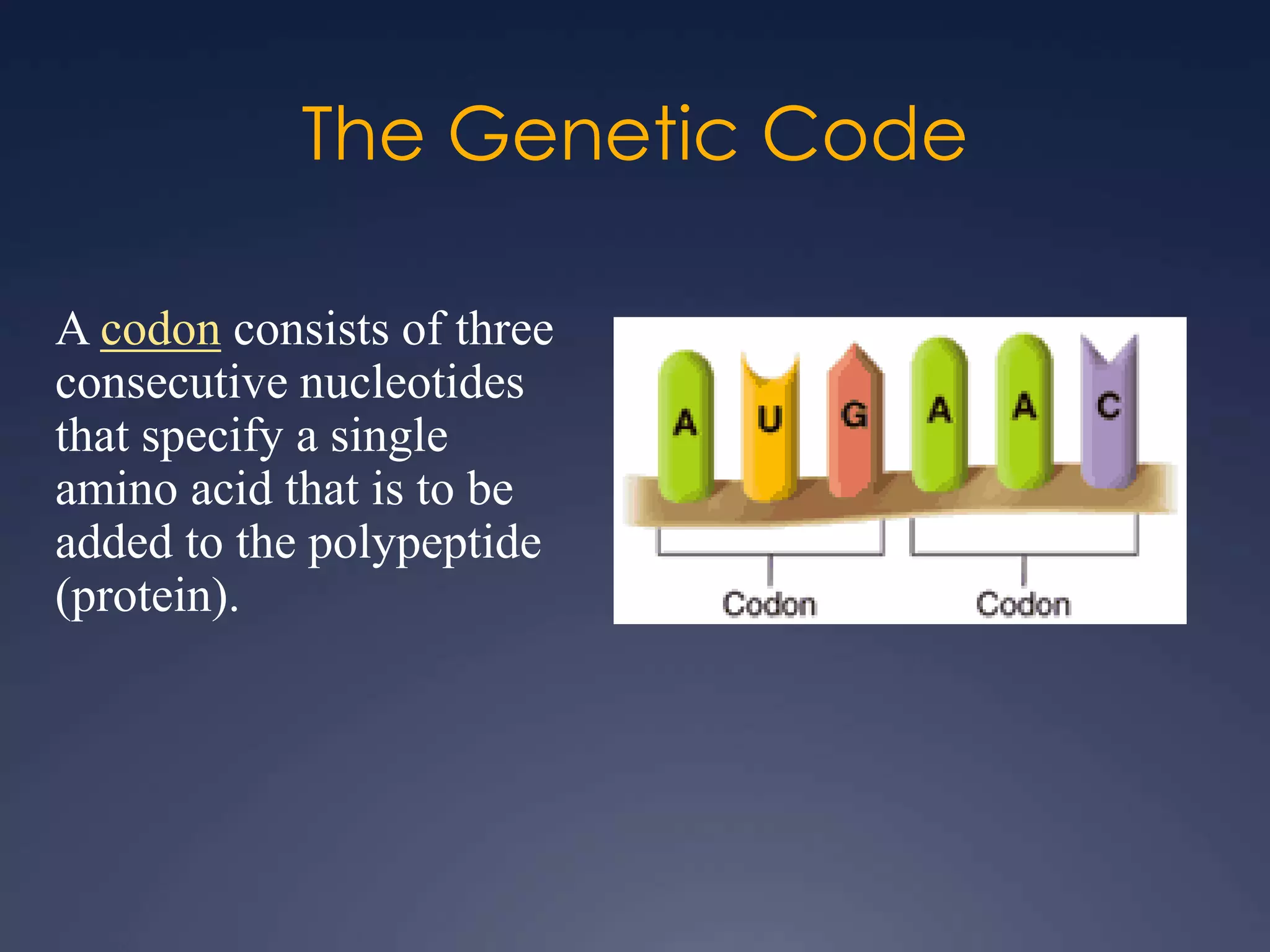
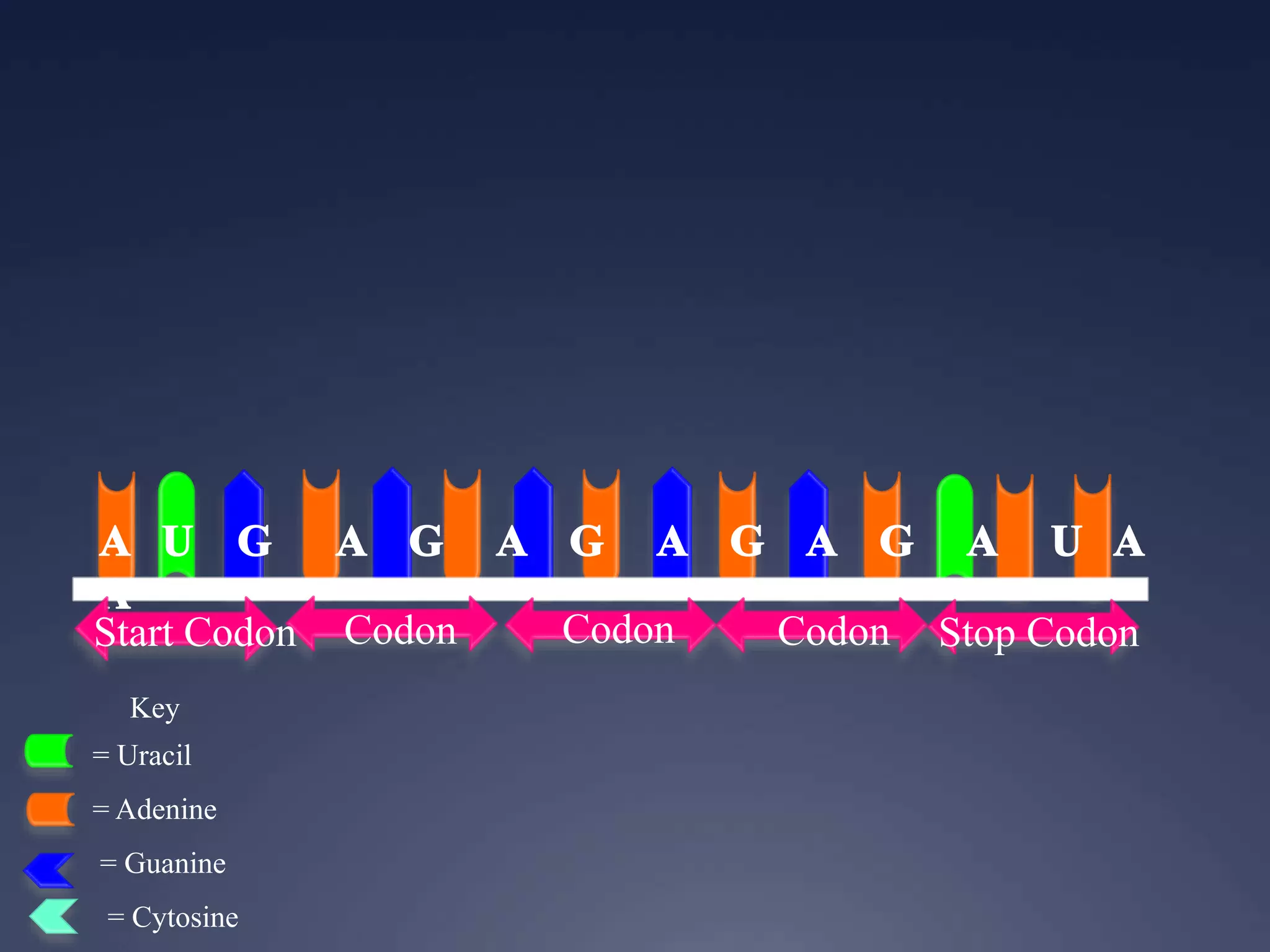
A codon consists of three
consecutive nucleotides
that specify a single
amino acid that is to be
added to the polypeptide
(protein).
The
Codon
Table
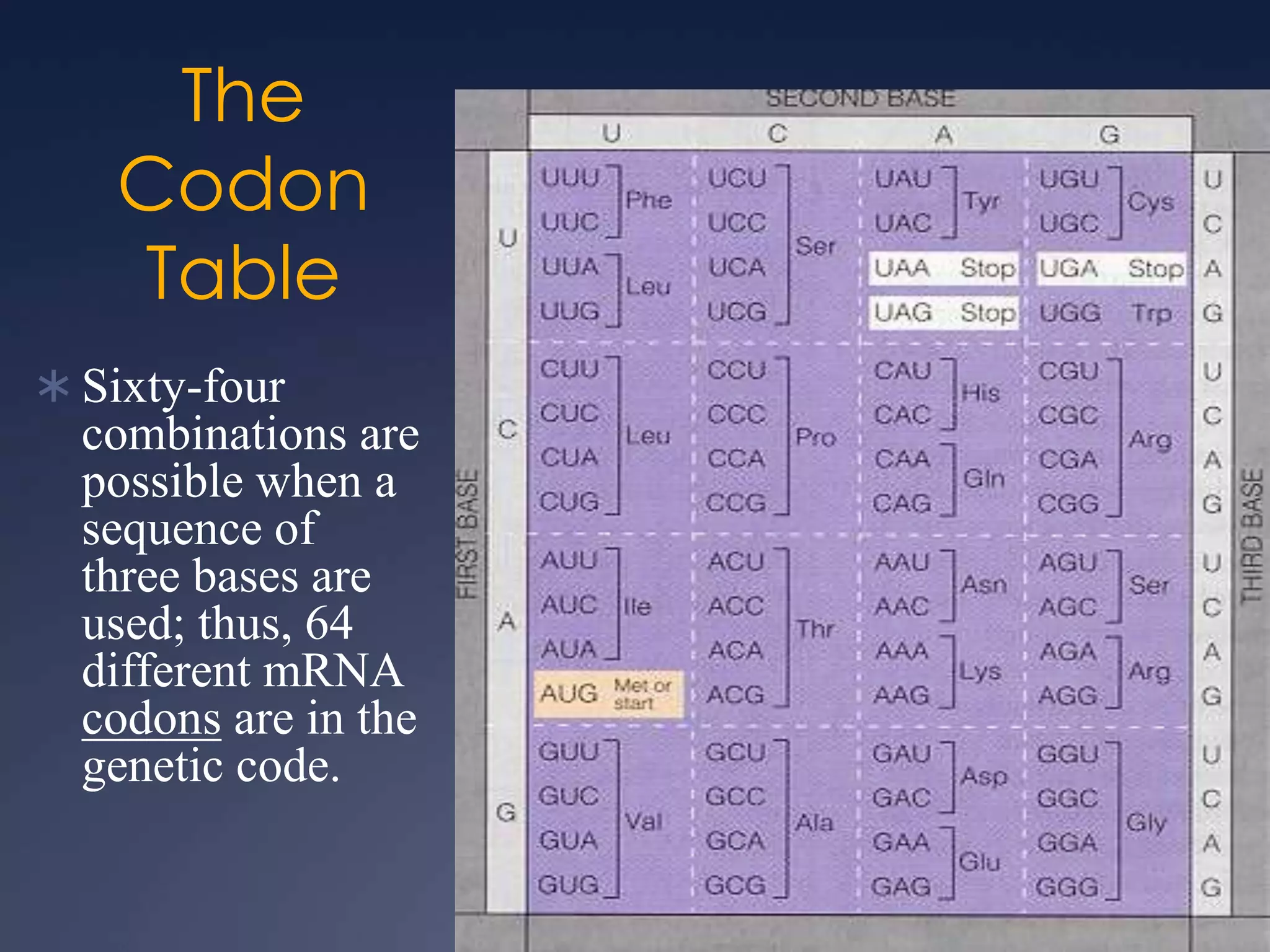
 Sixty-four
combinations are
possible when a
sequence of
three bases are
used; thus, 64
different mRNA
codons are in the
genetic code.
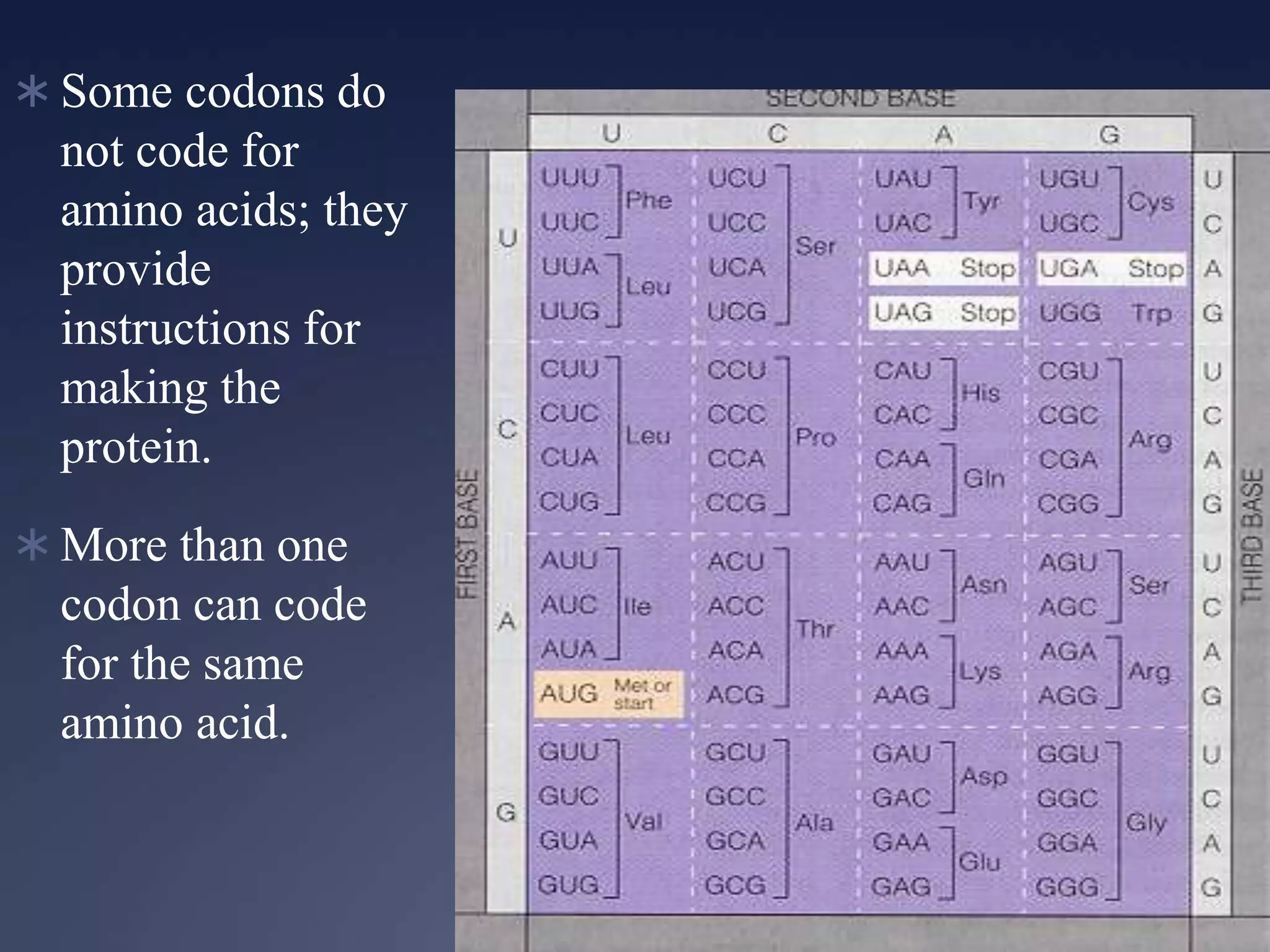
 Some codons do
not code for
amino acids; they
provide
instructions for
making the
protein.
 More than one
codon can code
for the same
amino acid.
All organisms use the same genetic
code (A,T,C,G).
This provides evidence that all
life on Earth evolved from a
common origin.
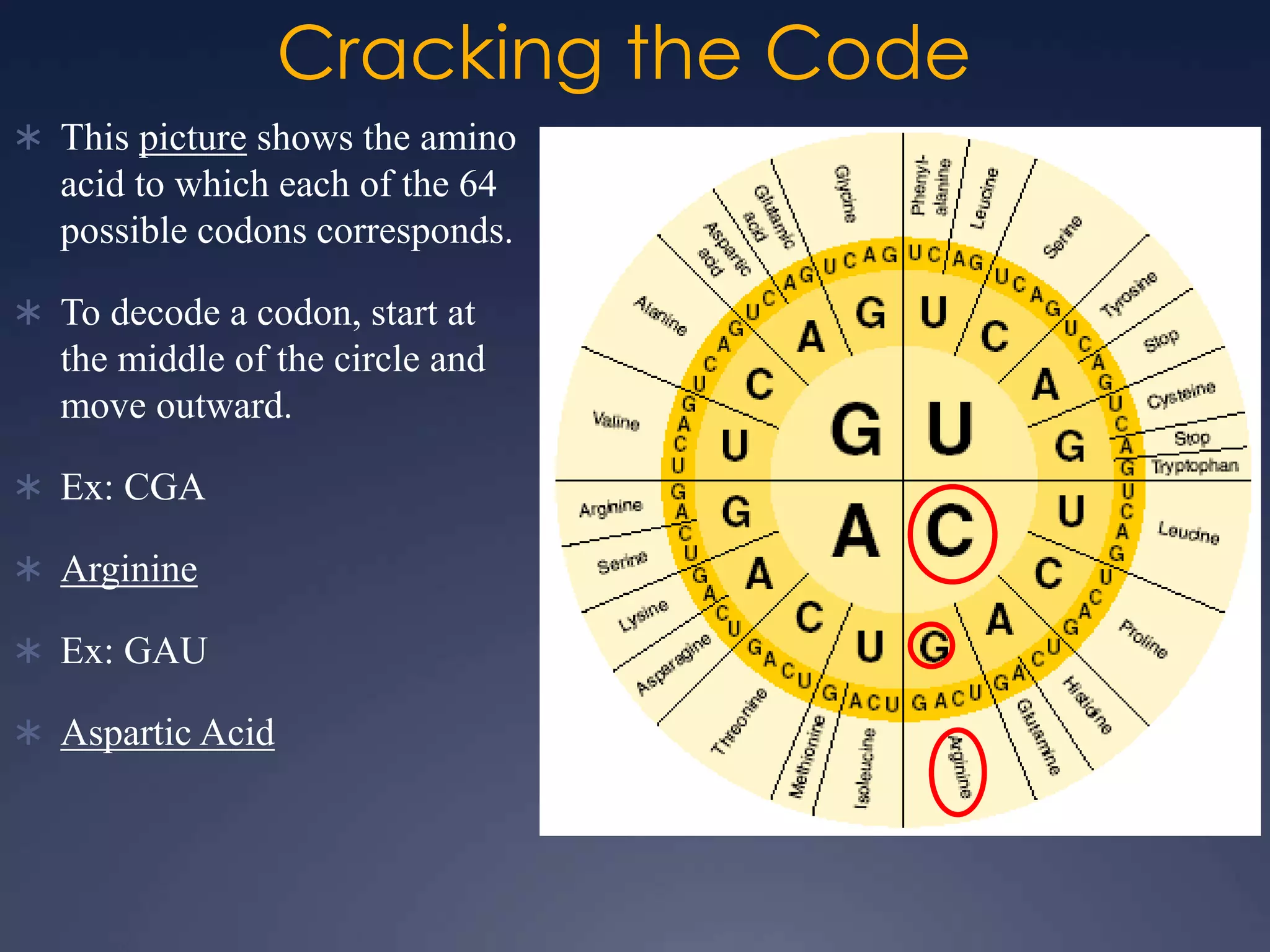
Cracking the Code
 This picture shows the amino
acid to which each of the 64
possible codons corresponds.
 To decode a codon, start at
the middle of the circle and
move outward.
 Ex: CGA
 Arginine
 Ex: GAU
 Aspartic Acid
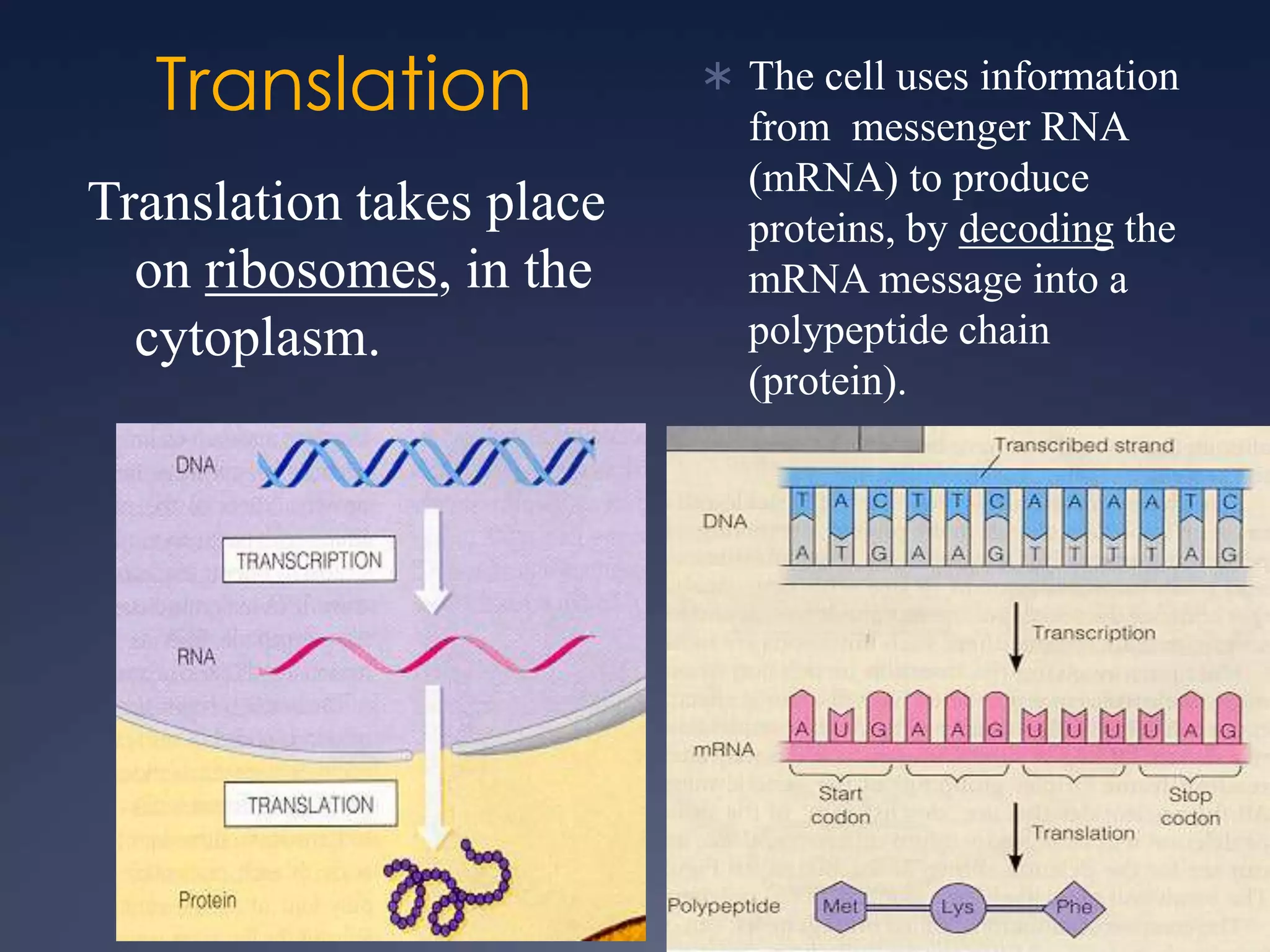
Translation
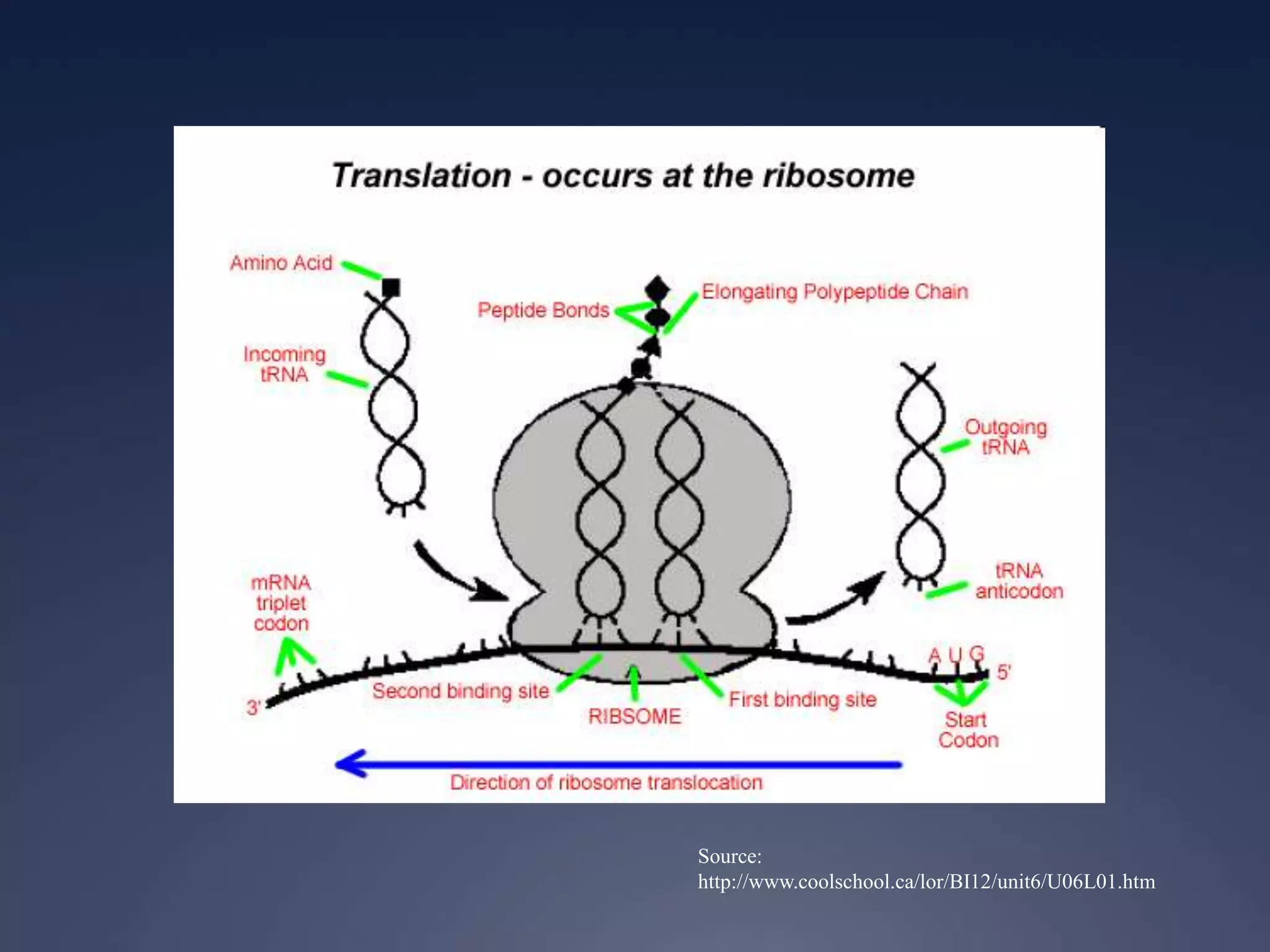
Translation takes place
on ribosomes, in the
cytoplasm.
 The cell uses information
from messenger RNA
(mRNA) to produce
proteins, by decoding the
mRNA message into a
polypeptide chain
(protein).
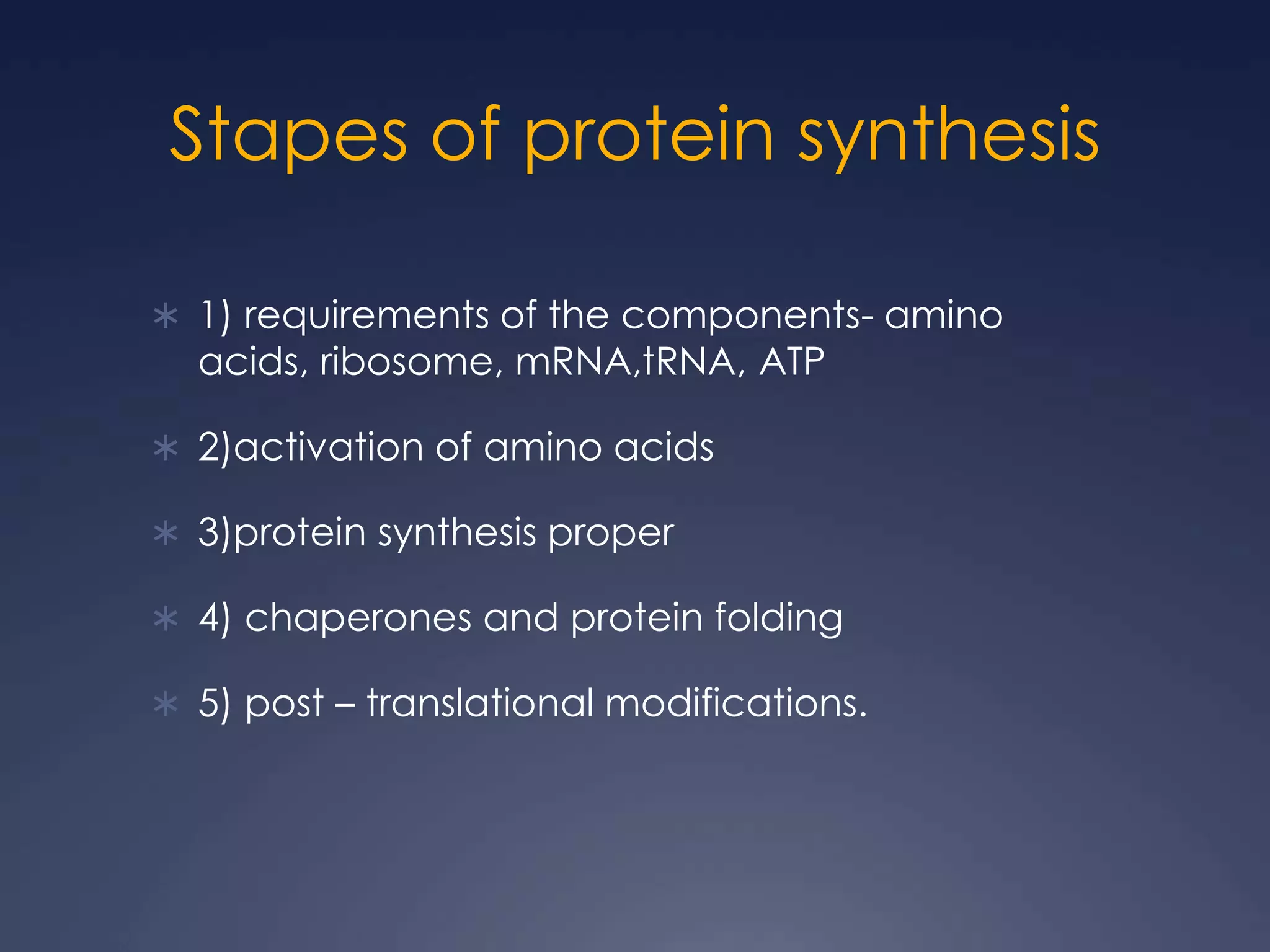
Stapes of protein synthesis
 1) requirements of the components- amino
acids, ribosome, mRNA,tRNA, ATP
 2)activation of amino acids
 3)protein synthesis proper
 4) chaperones and protein folding
 5) post – translational modifications.
Source:
http://www.coolschool.ca/lor/BI12/unit6/U06L01.htm
Key
= Uracil
= Adenine
= Guanine
= Cytosine
Cytoplasm
Key
= Uracil
= Adenine
= Guanine
= Cytosine
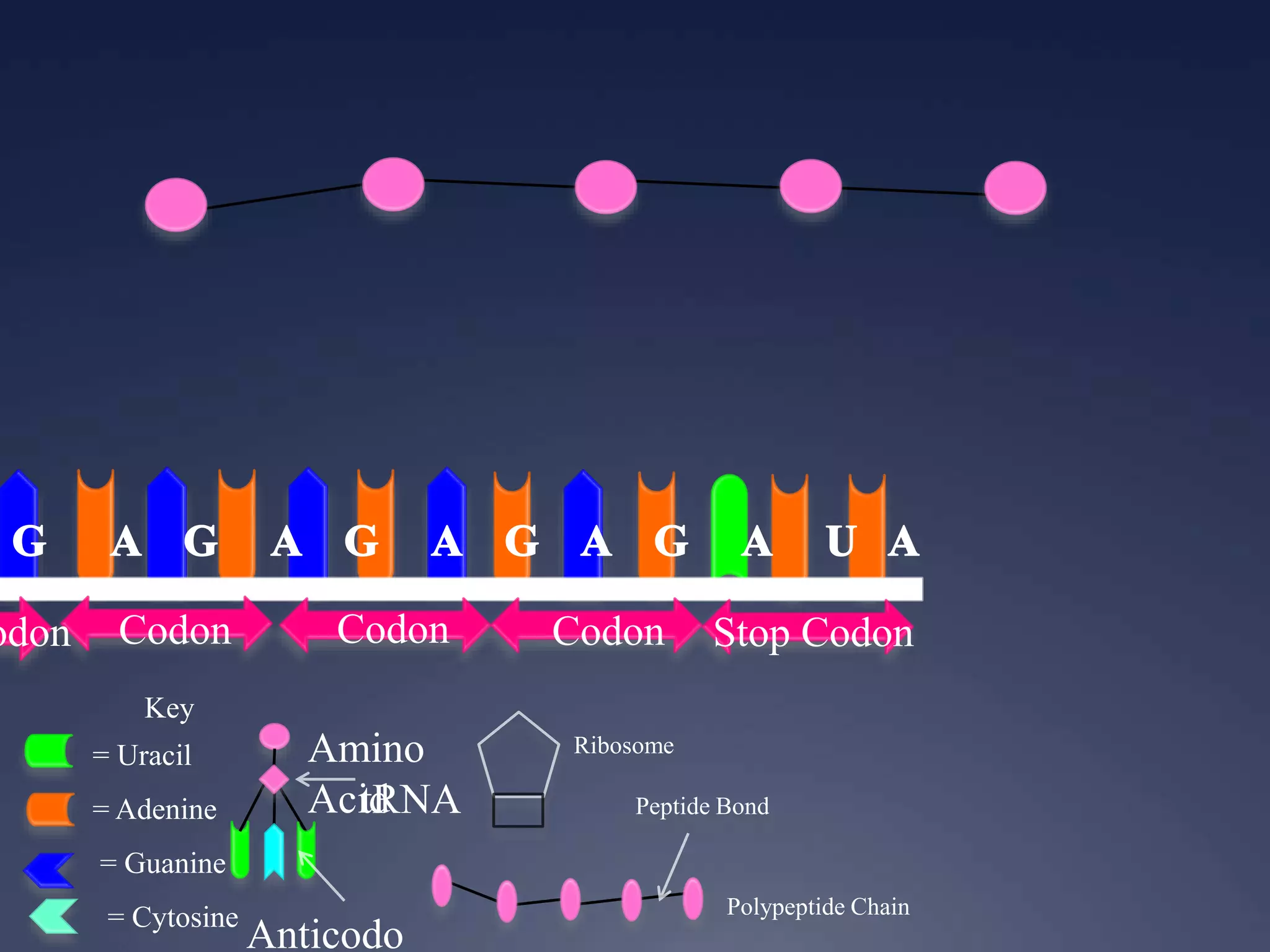
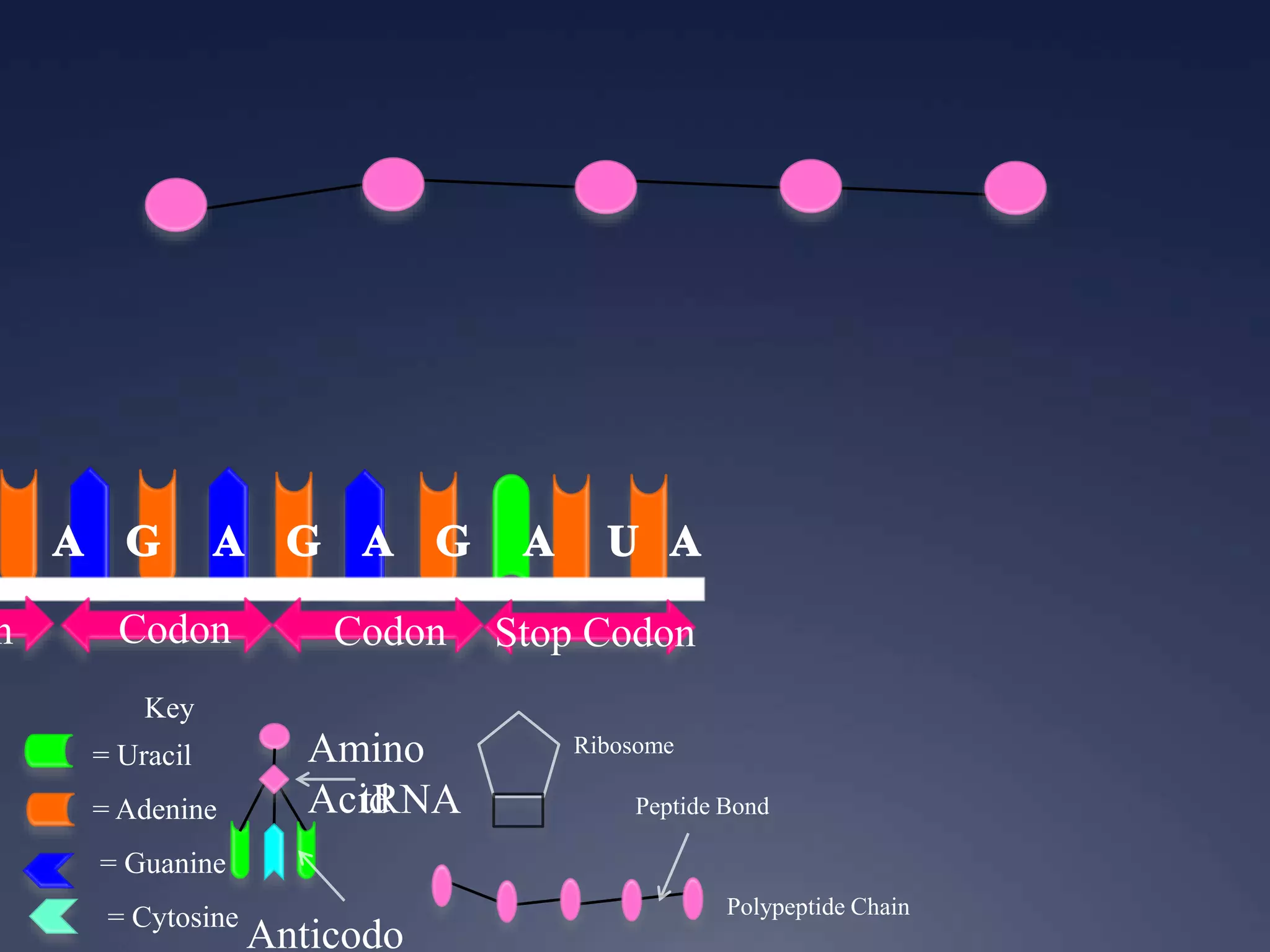
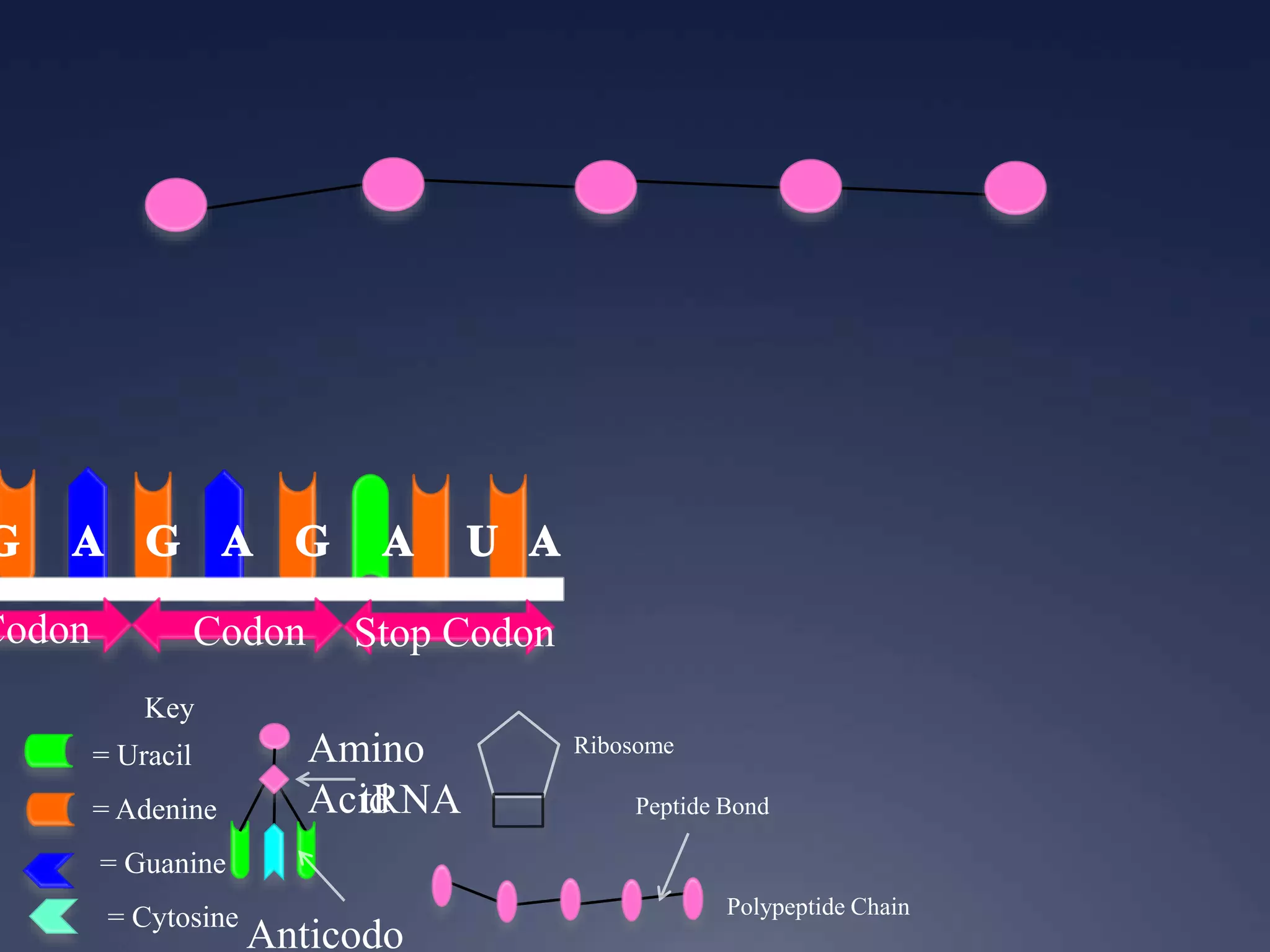
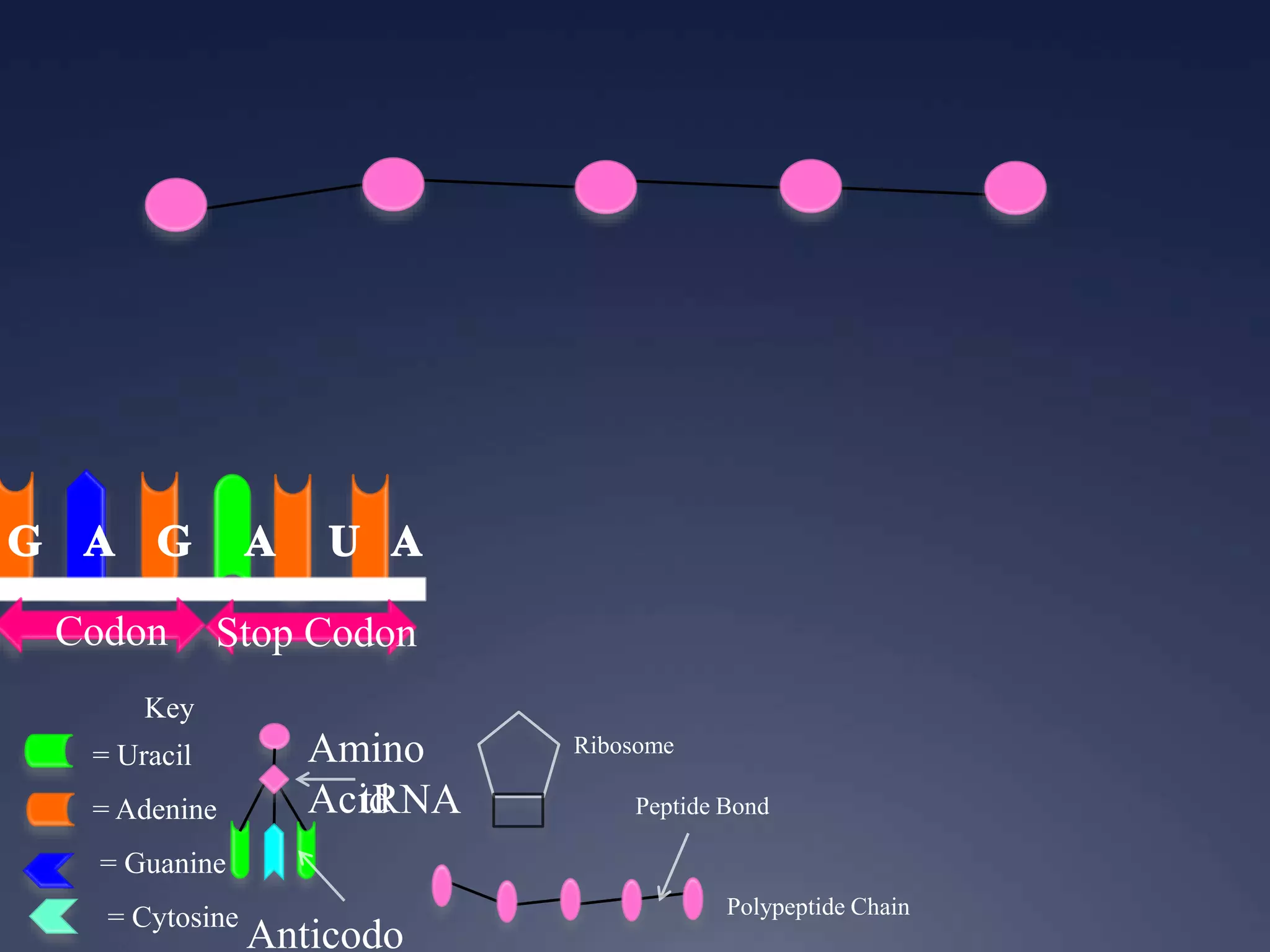
Start Codon Codon Codon Codon Stop Codon
Key
= Uracil
= Adenine
= Guanine
= Cytosine
Start Codon Codon Codon Codon Stop Codon
Key
= Uracil
= Adenine
= Guanine
= Cytosine
Start Codon Codon Codon Codon Stop Codon
Key
= Uracil
= Adenine
= Guanine
= Cytosine
Start Codon Codon Codon Codon Stop Codon
Ribosome
Anticodo
Amino
AcidtRNA
Key
= Uracil
= Adenine
= Guanine
= Cytosine
Start Codon Codon Codon Codon Stop Codon
Ribosome
Anticodo
Amino
AcidtRNA
Key
= Uracil
= Adenine
= Guanine
= Cytosine
Start Codon Codon Codon Codon Stop Codon
Ribosome
Anticodo
Amino
AcidtRNA
Key
= Uracil
= Adenine
= Guanine
= Cytosine
Start Codon Codon Codon Codon Stop Codon
Ribosome
Amino
AcidtRNA
Key
= Uracil
= Adenine
= Guanine
= Cytosine
Start Codon Codon Codon Codon Stop Codon
Ribosome
Amino
AcidtRNA
Key
= Uracil
= Adenine
= Guanine
= Cytosine
Start Codon Codon Codon Codon Stop Codon
Ribosome
Amino
AcidtRNA
Key
= Uracil
= Adenine
= Guanine
= Cytosine
Start Codon Codon Codon Codon Stop Codon
Ribosome
Amino
AcidtRNA
Key
= Uracil
= Adenine
= Guanine
= Cytosine
Start Codon Codon Codon Codon Stop Codon
Ribosome
Amino
AcidtRNA
Key
= Uracil
= Adenine
= Guanine
= Cytosine
Start Codon Codon Codon Codon Stop Codon
Ribosome
Anticodo
Amino
AcidtRNA
Polypeptide Chain
Peptide Bond
Key
= Uracil
= Adenine
= Guanine
= Cytosine
Start Codon Codon Codon Codon Stop Codon
Ribosome
Anticodo
Amino
AcidtRNA
Polypeptide Chain
Peptide Bond
Key
= Uracil
= Adenine
= Guanine
= Cytosine
tart Codon Codon Codon Codon Stop Codon
Ribosome
Anticodo
Amino
AcidtRNA
Polypeptide Chain
Peptide Bond
Key
= Uracil
= Adenine
= Guanine
= Cytosine
odon Codon Codon Codon Stop Codon
Ribosome
Anticodo
Amino
AcidtRNA
Polypeptide Chain
Peptide Bond
Key
= Uracil
= Adenine
= Guanine
= Cytosine
n Codon Codon Stop Codon
Ribosome
Anticodo
Amino
AcidtRNA
Polypeptide Chain
Peptide Bond
Key
= Uracil
= Adenine
= Guanine
= Cytosine
Codon Codon Stop Codon
Ribosome
Anticodo
Amino
AcidtRNA
Polypeptide Chain
Peptide Bond
Key
= Uracil
= Adenine
= Guanine
= Cytosine
Codon Stop Codon
Ribosome
Anticodo
Amino
AcidtRNA
Polypeptide Chain
Peptide Bond
Key
= Uracil
= Adenine
= Guanine
= Cytosine
on Stop Codon
Ribosome
Anticodo
Amino
AcidtRNA
Polypeptide Chain
Peptide Bond
Key
= Uracil
= Adenine
= Guanine
= Cytosine
on Stop Codon
Ribosome
Anticodo
Amino
AcidtRNA
Polypeptide Chain
Peptide Bond
Key
= Uracil
= Adenine
= Guanine
= Cytosine
Ribosome
Anticodo
Amino
AcidtRNA
Polypeptide Chain
Peptide Bond
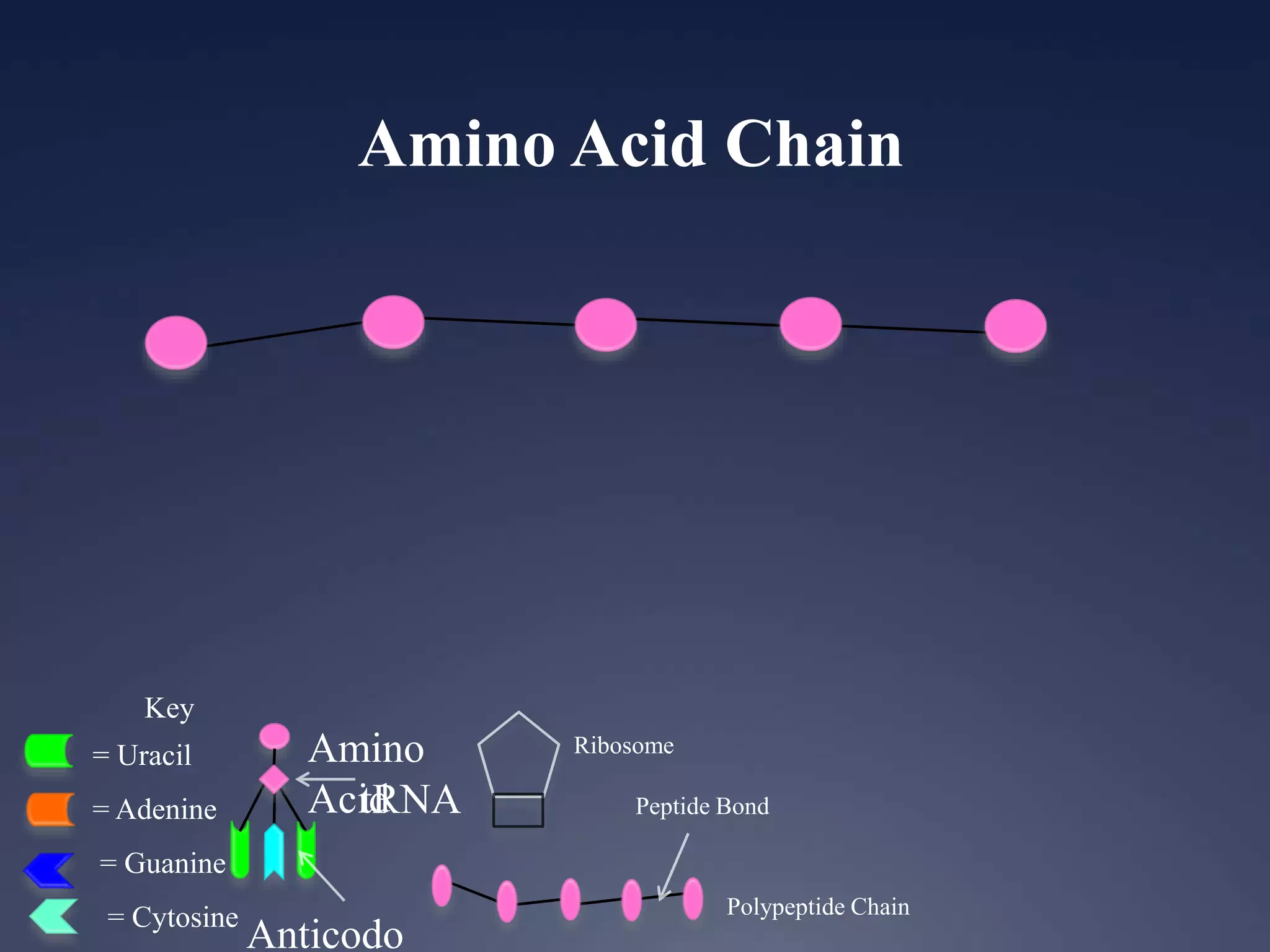
Amino Acid Chain
Key
= Uracil
= Adenine
= Guanine
= Cytosine
Ribosome
Anticodo
Amino
AcidtRNA
Polypeptide Chain
Peptide Bond
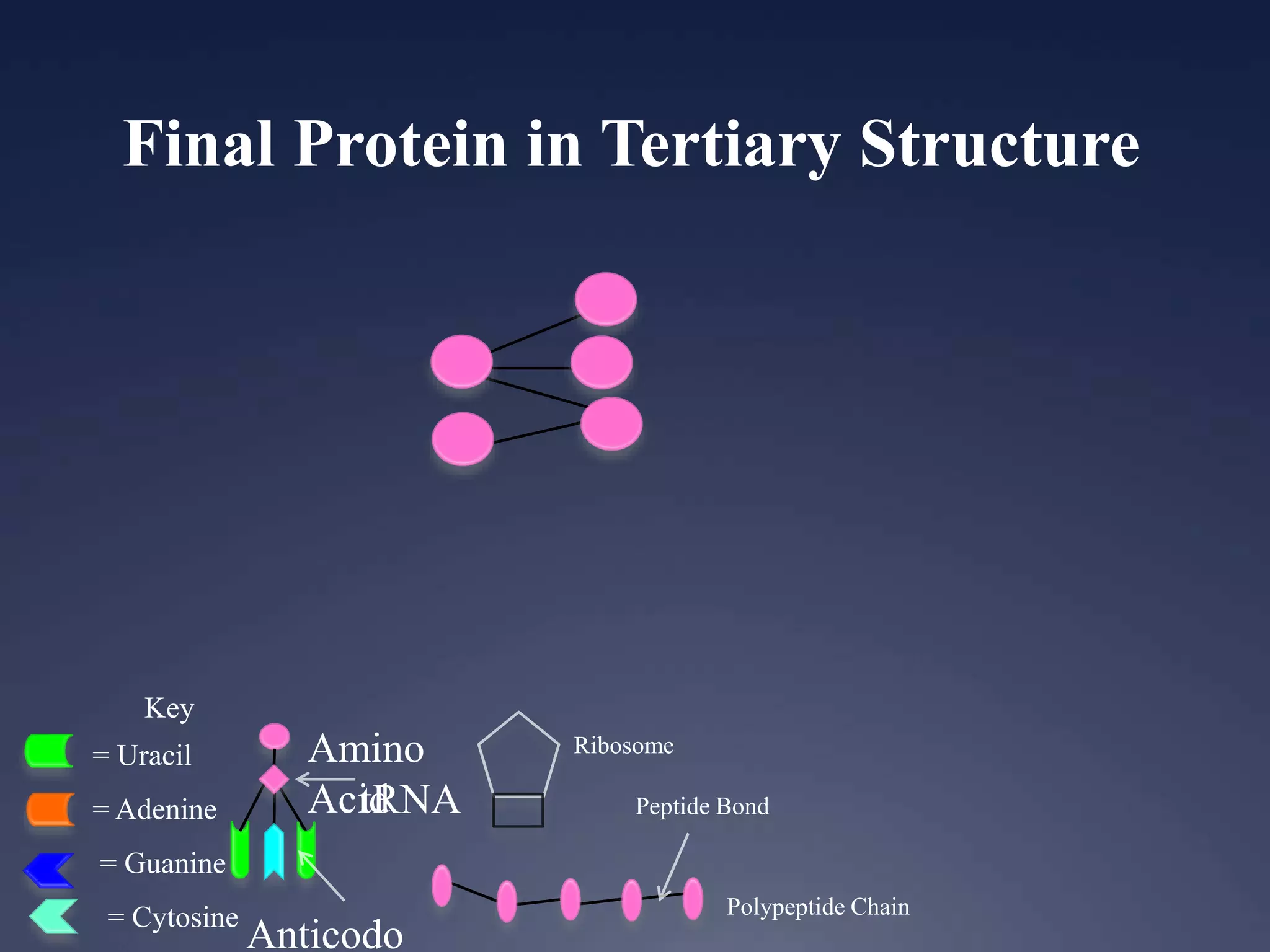
Final Protein in Tertiary Structure
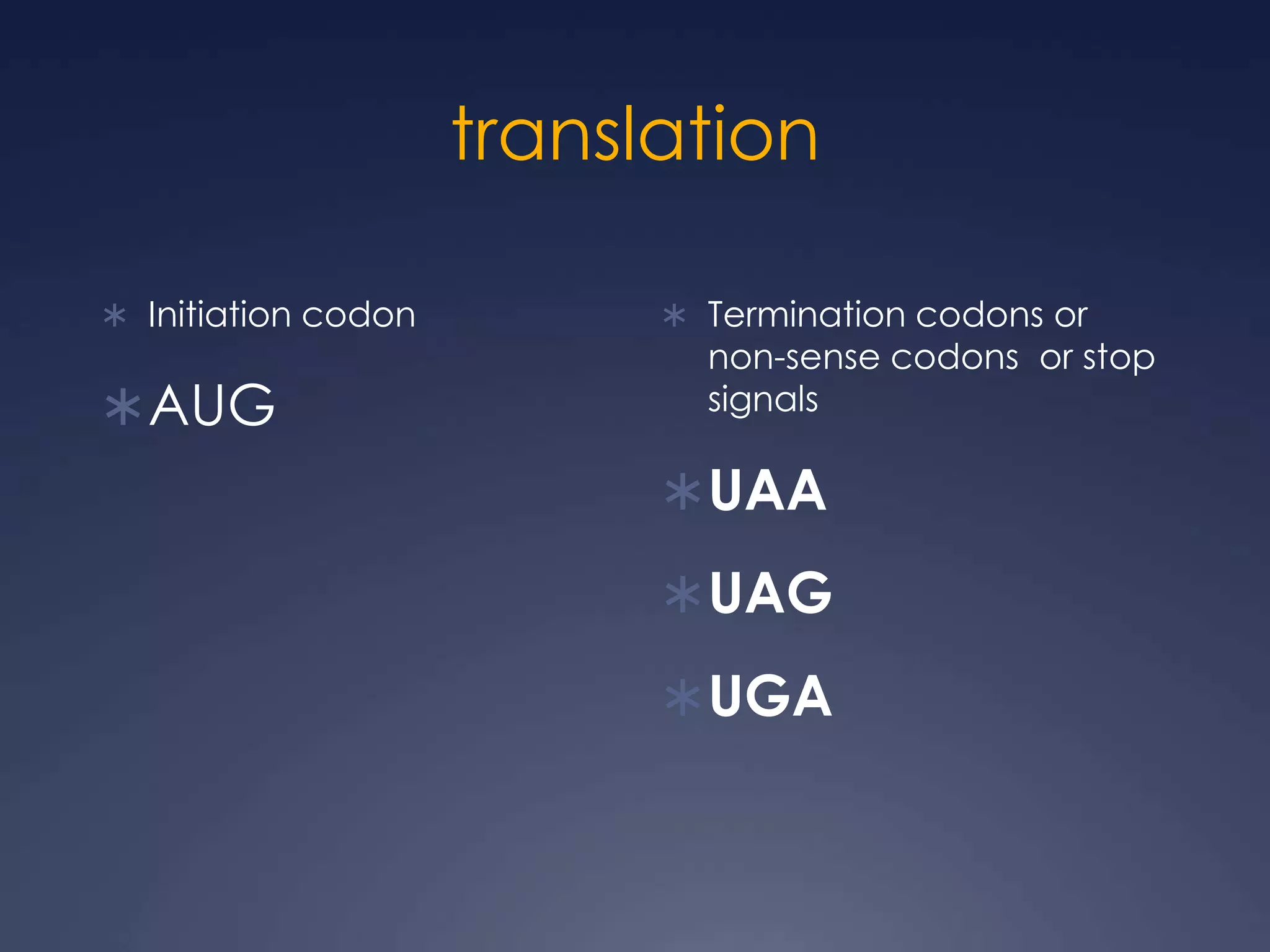
translation
 Initiation codon
AUG
 Termination codons or
non-sense codons or stop
signals
UAA
UAG
UGA
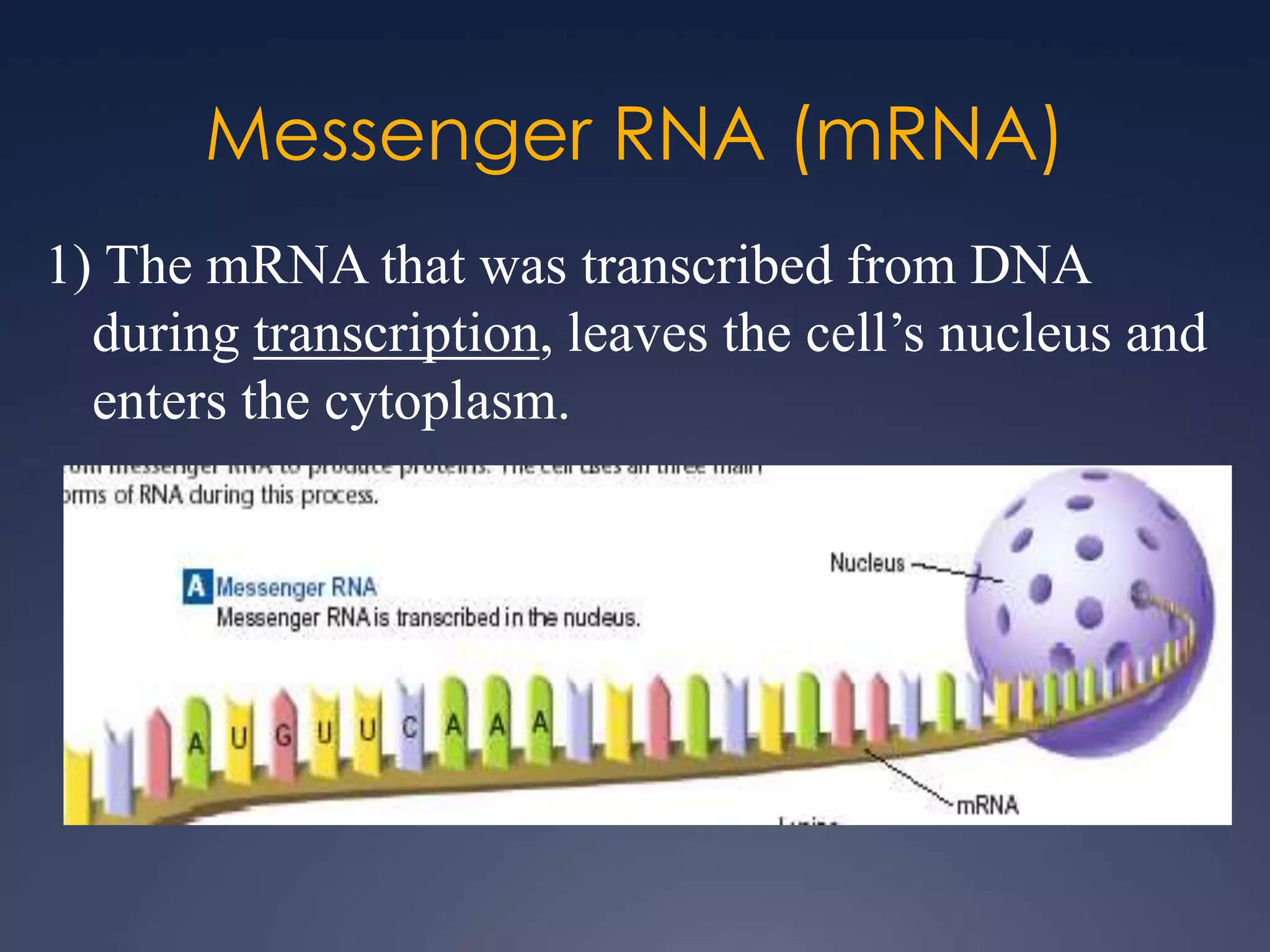
Messenger RNA (mRNA)
1) The mRNA that was transcribed from DNA
during transcription, leaves the cell’s nucleus and
enters the cytoplasm.
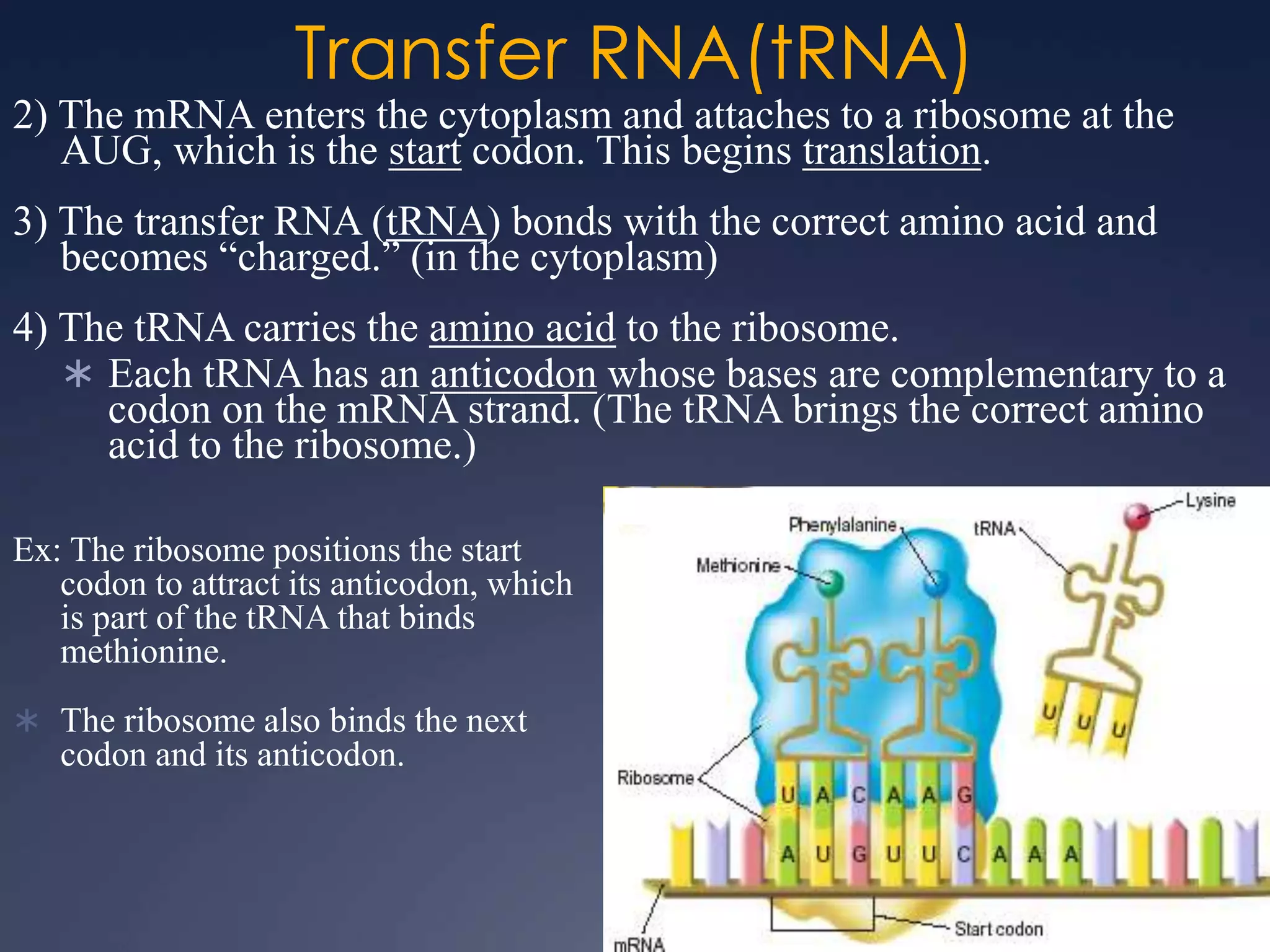
Transfer RNA(tRNA)
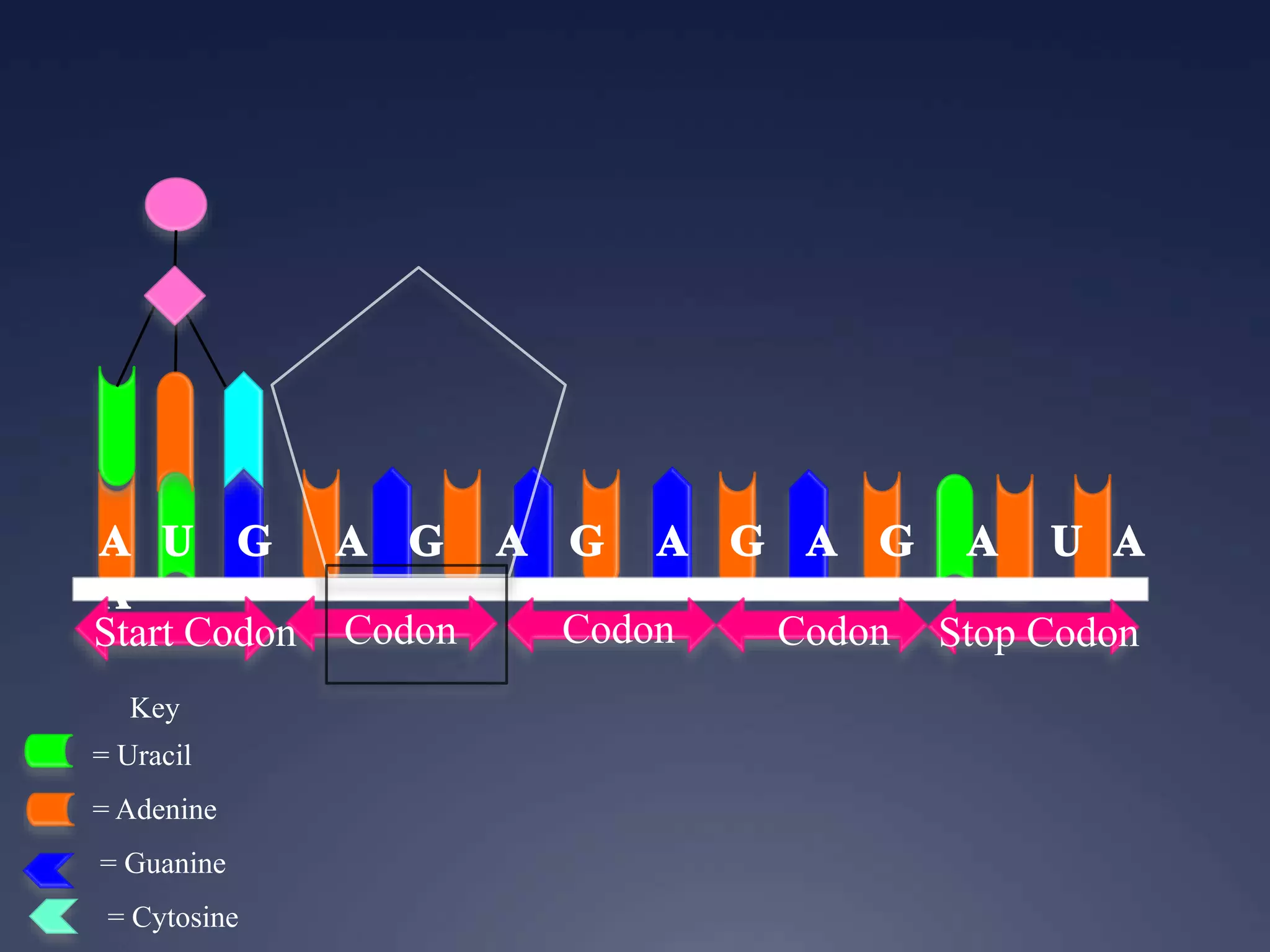
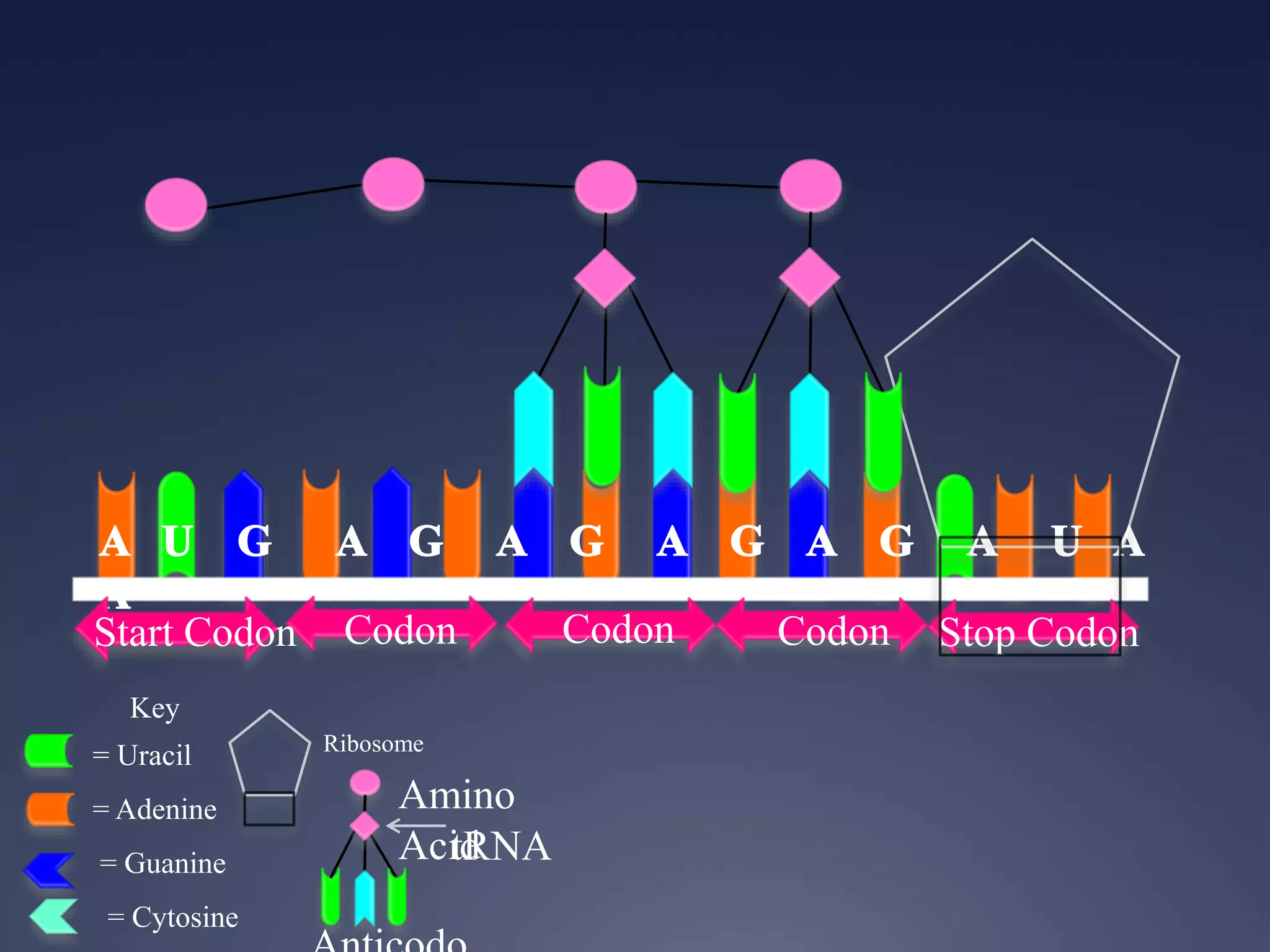
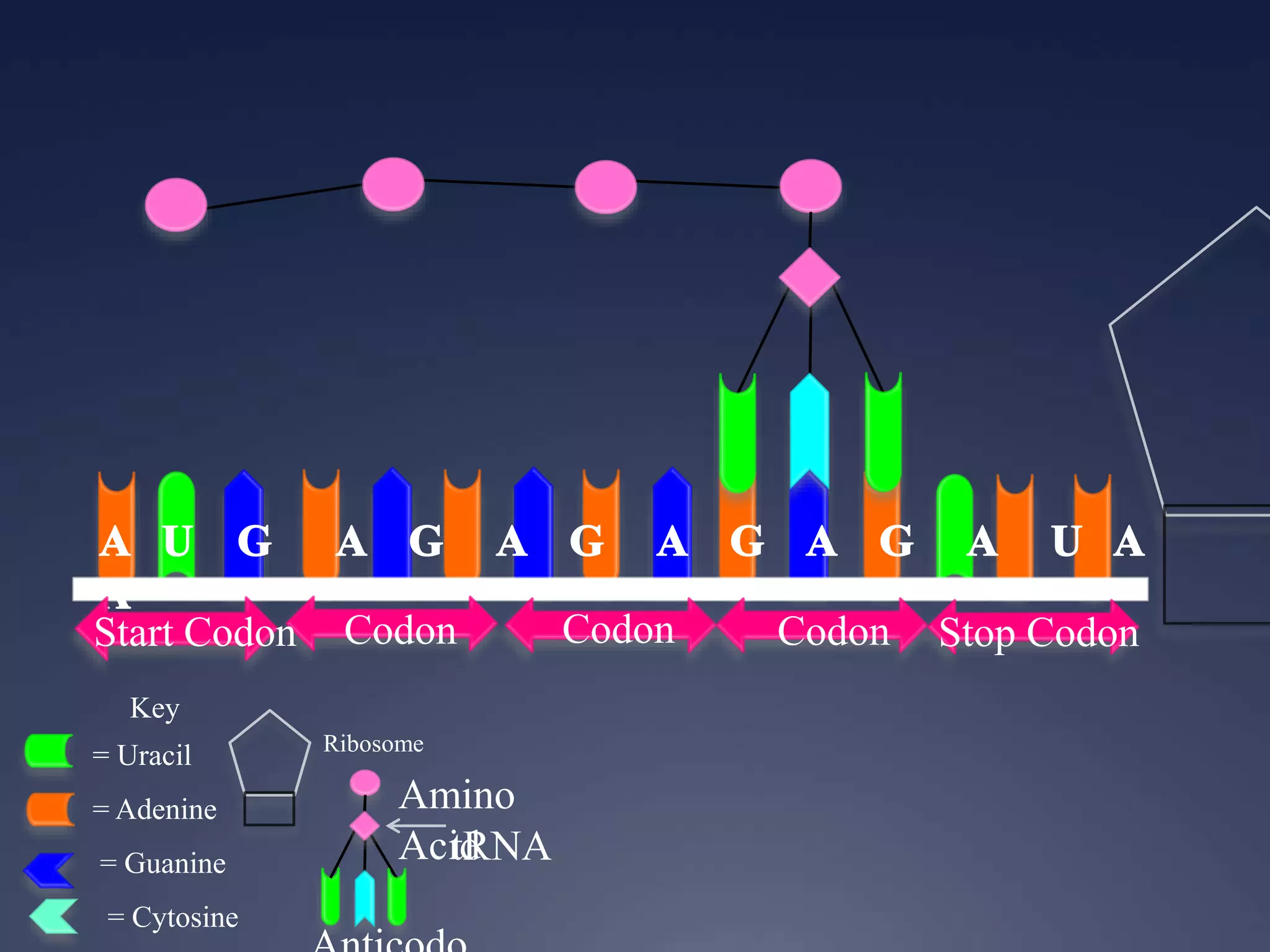
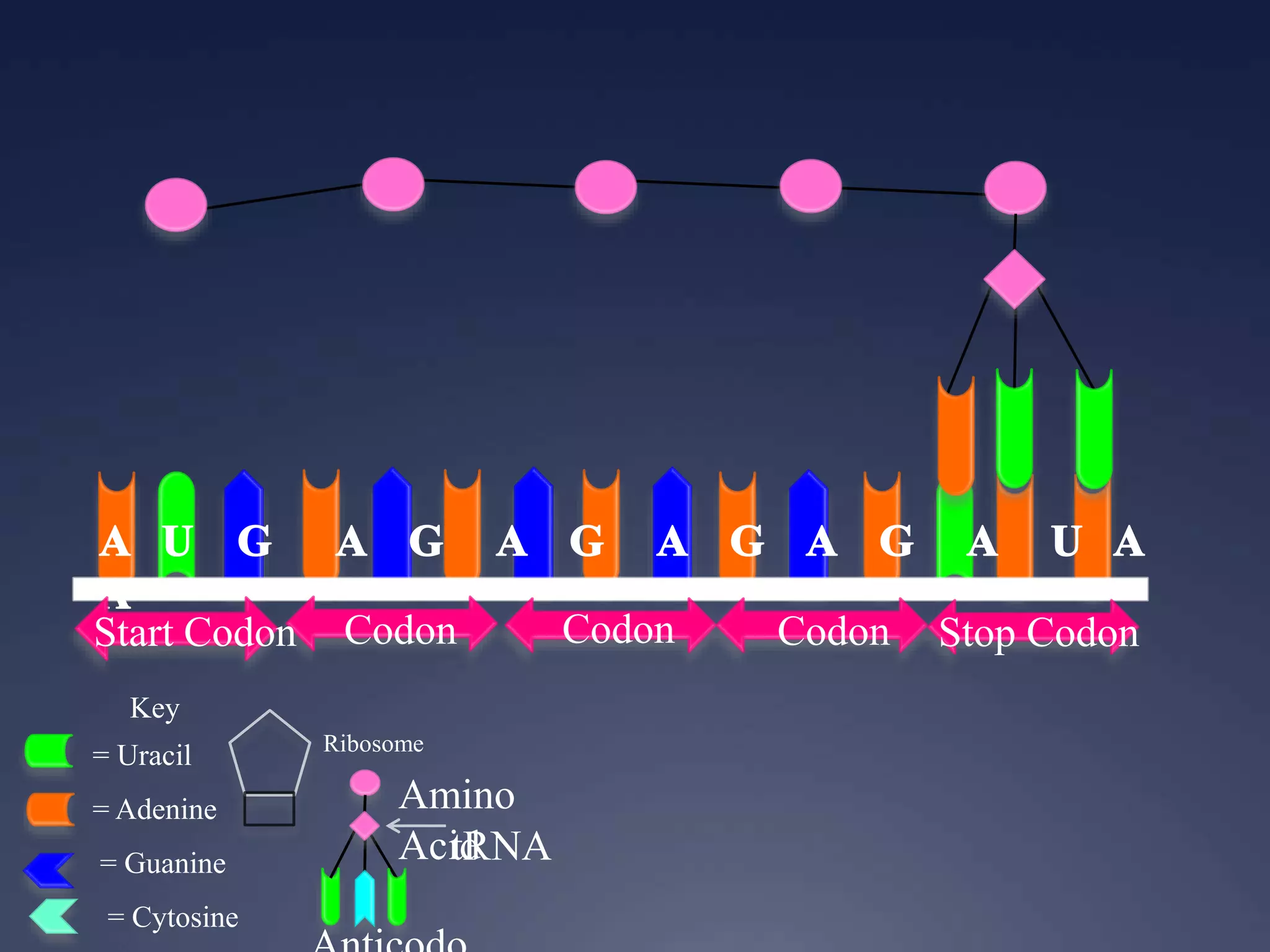
2) The mRNA enters the cytoplasm and attaches to a ribosome at the
AUG, which is the start codon. This begins translation.
3) The transfer RNA (tRNA) bonds with the correct amino acid and
becomes “charged.” (in the cytoplasm)
4) The tRNA carries the amino acid to the ribosome.
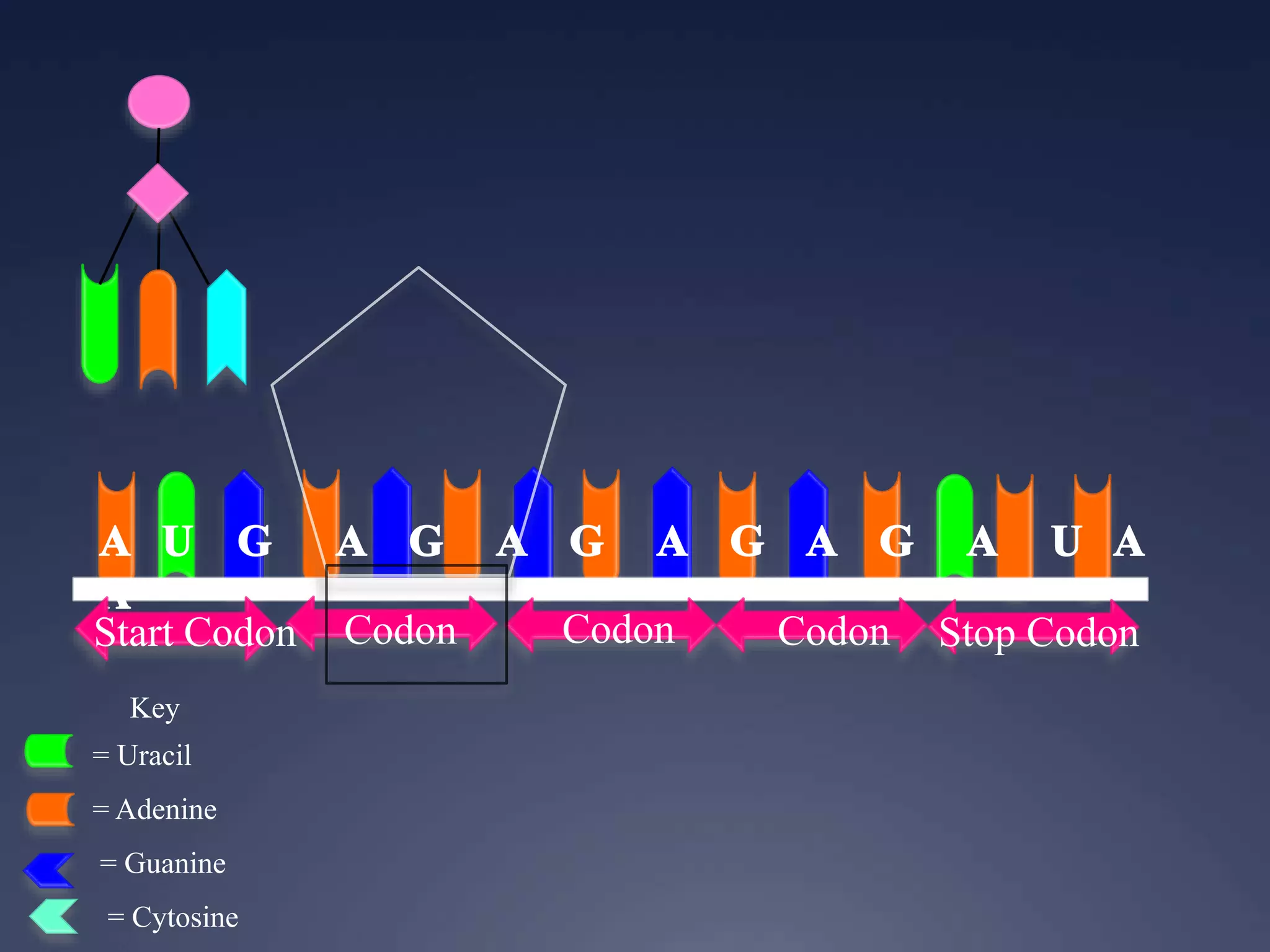
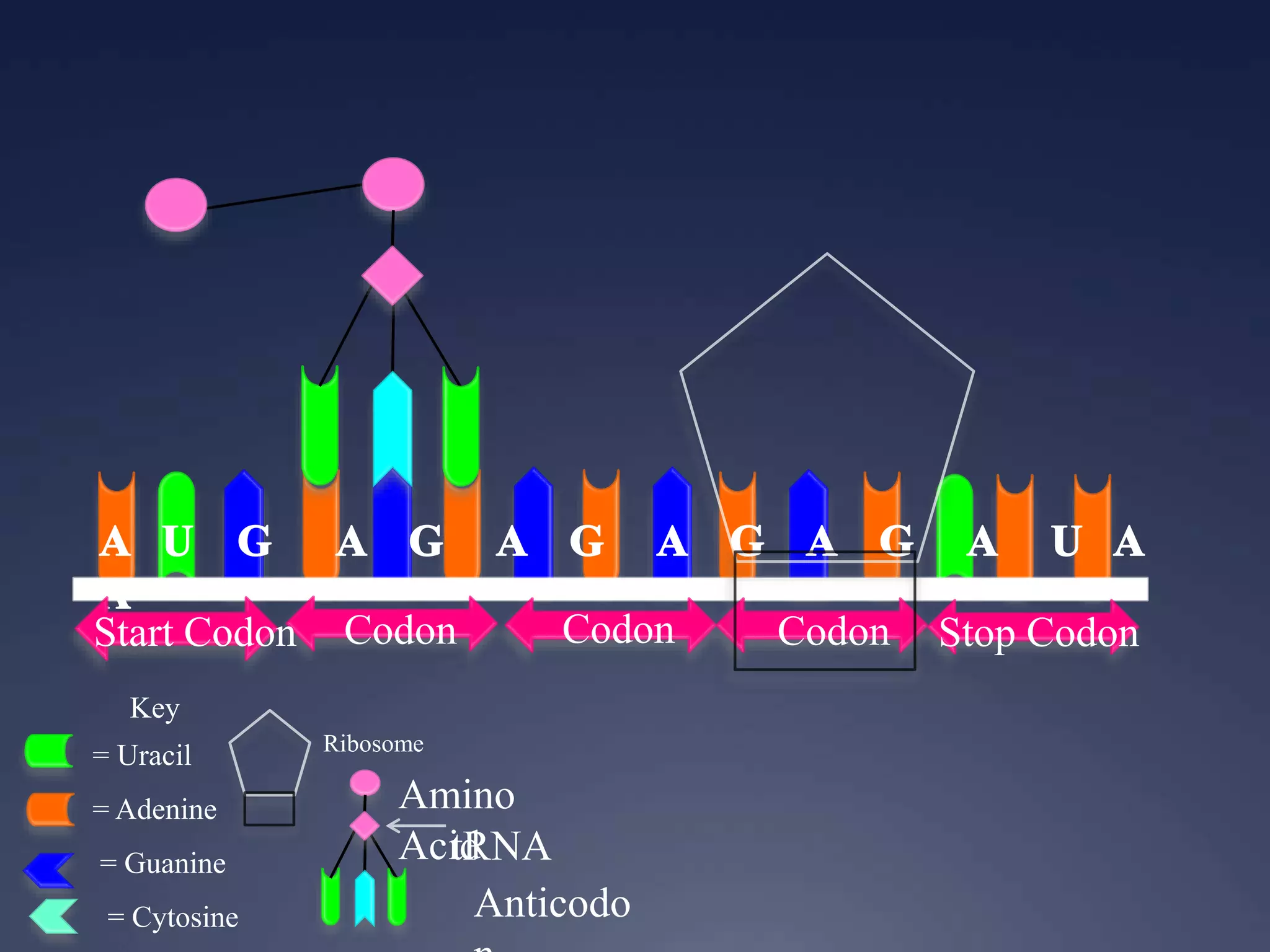
 Each tRNA has an anticodon whose bases are complementary to a
codon on the mRNA strand. (The tRNA brings the correct amino
acid to the ribosome.)
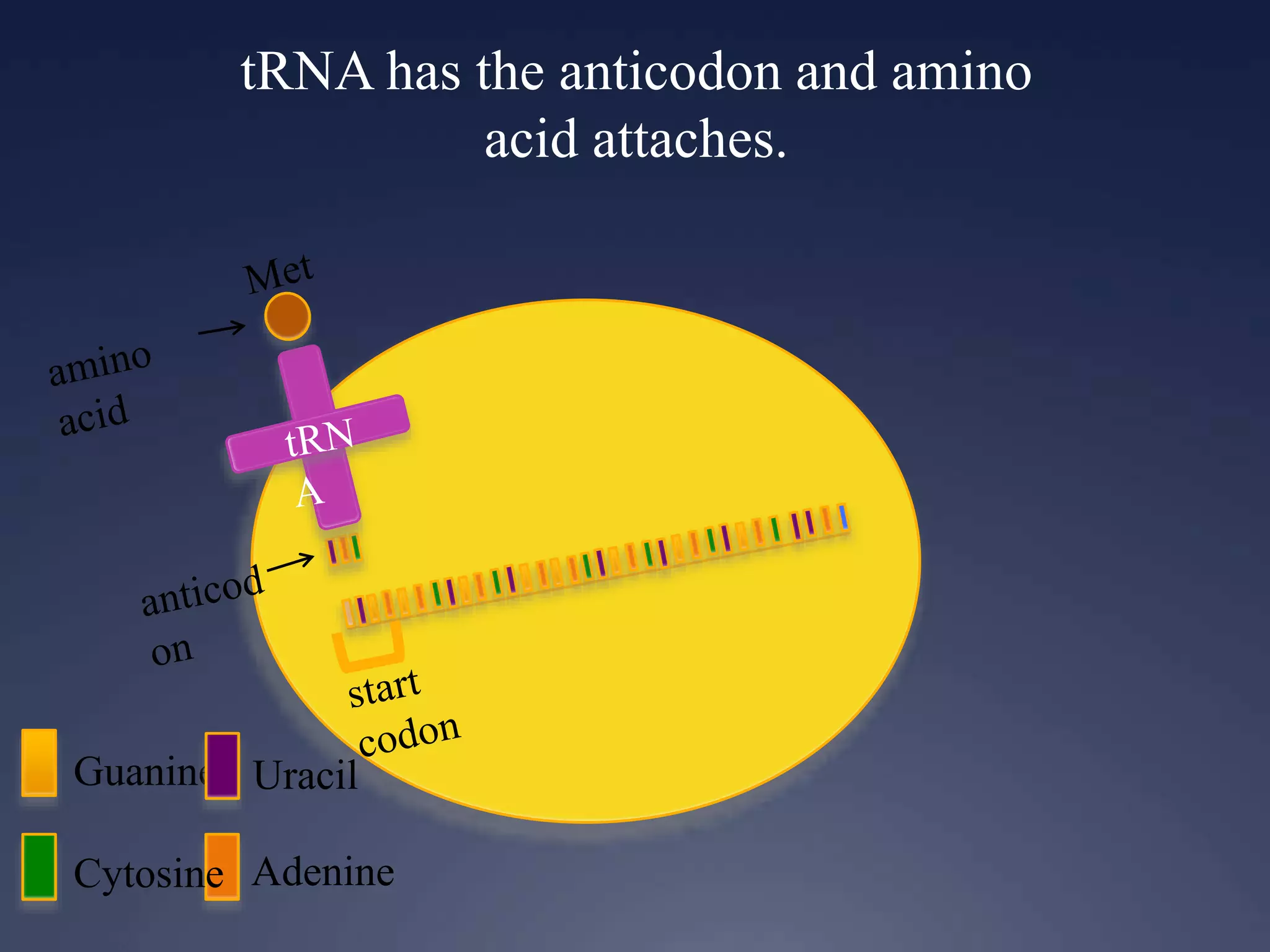
Ex: The ribosome positions the start
codon to attract its anticodon, which
is part of the tRNA that binds
methionine.
 The ribosome also binds the next
codon and its anticodon.
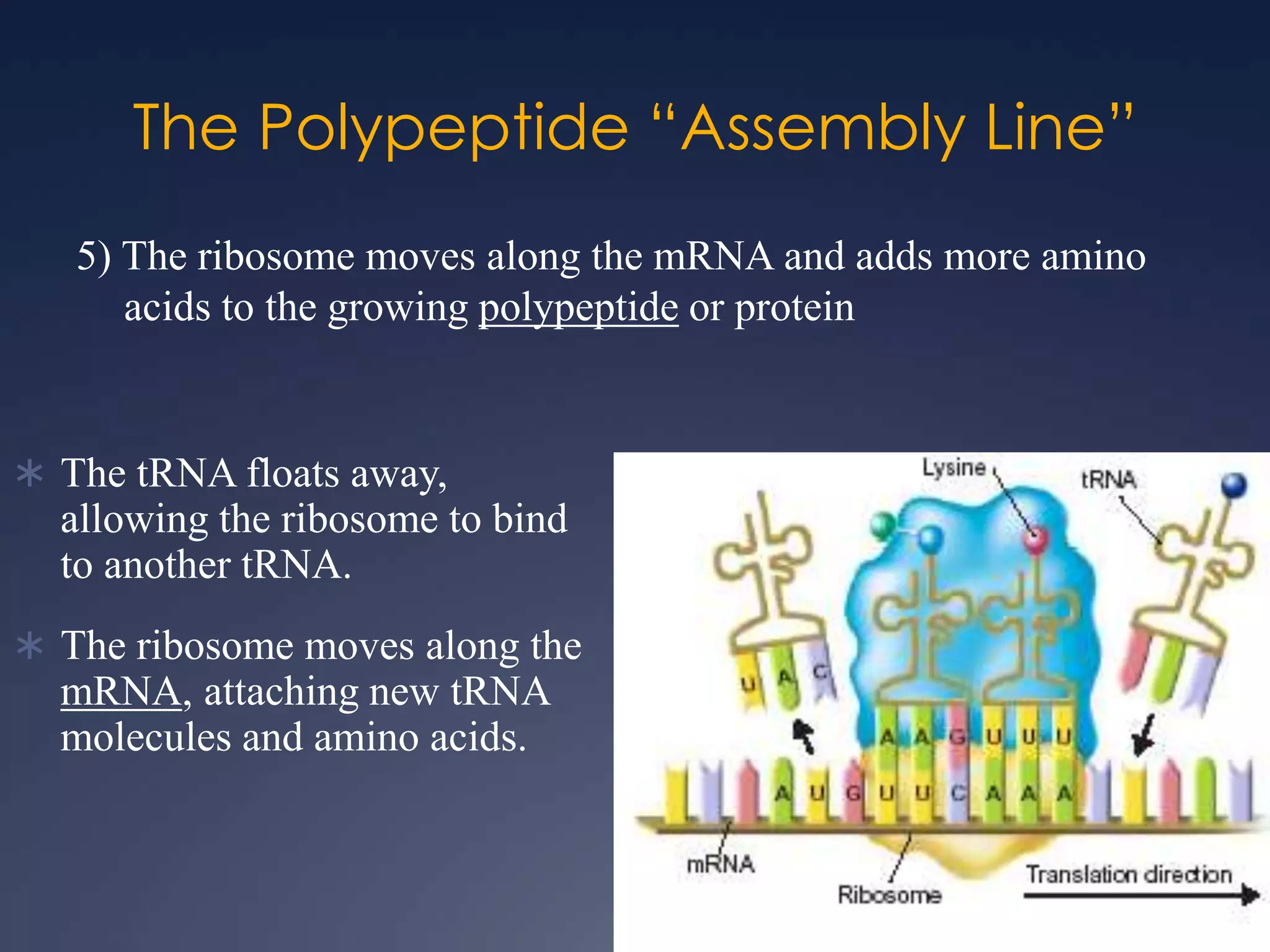
The Polypeptide “Assembly Line”
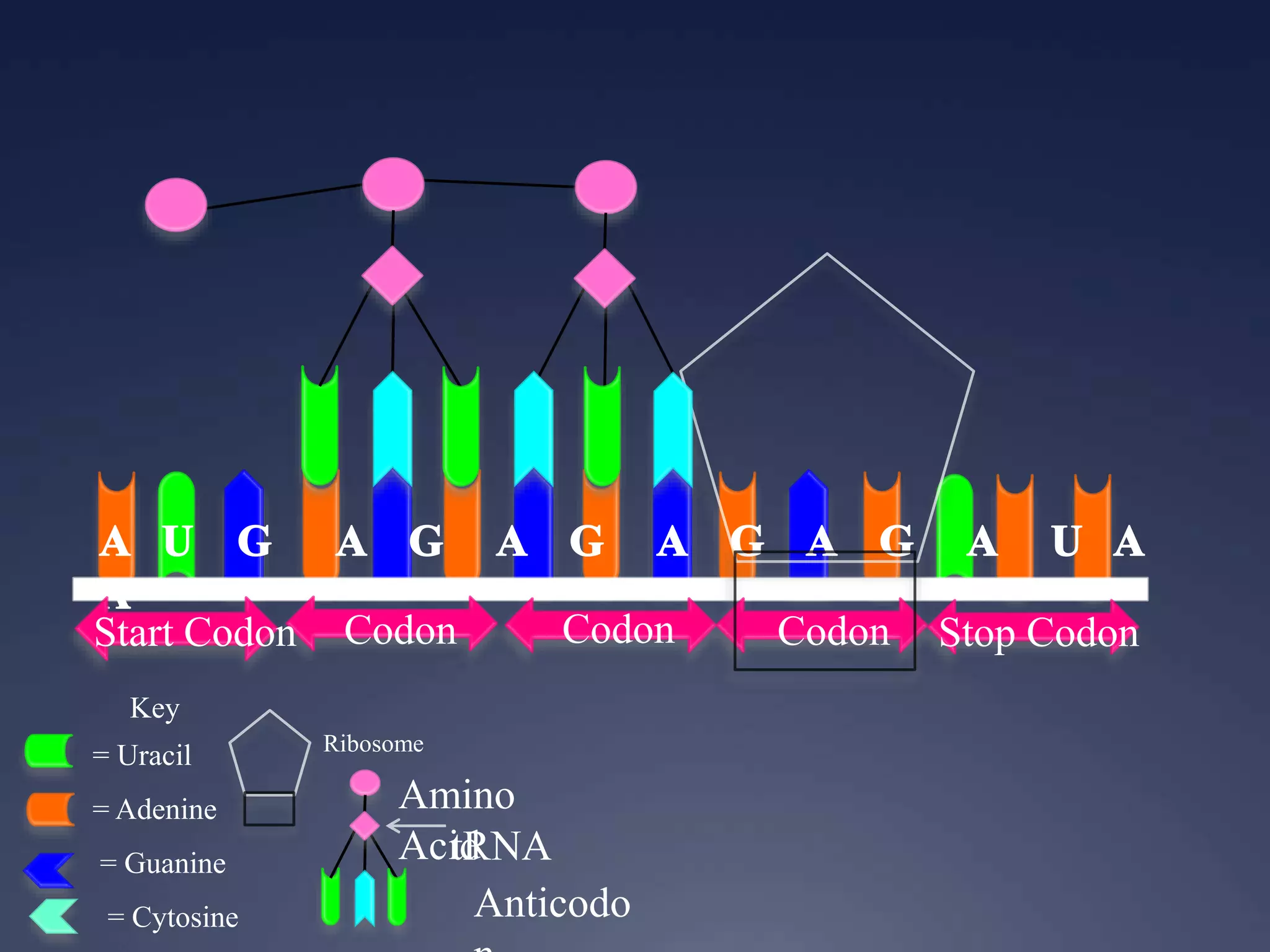
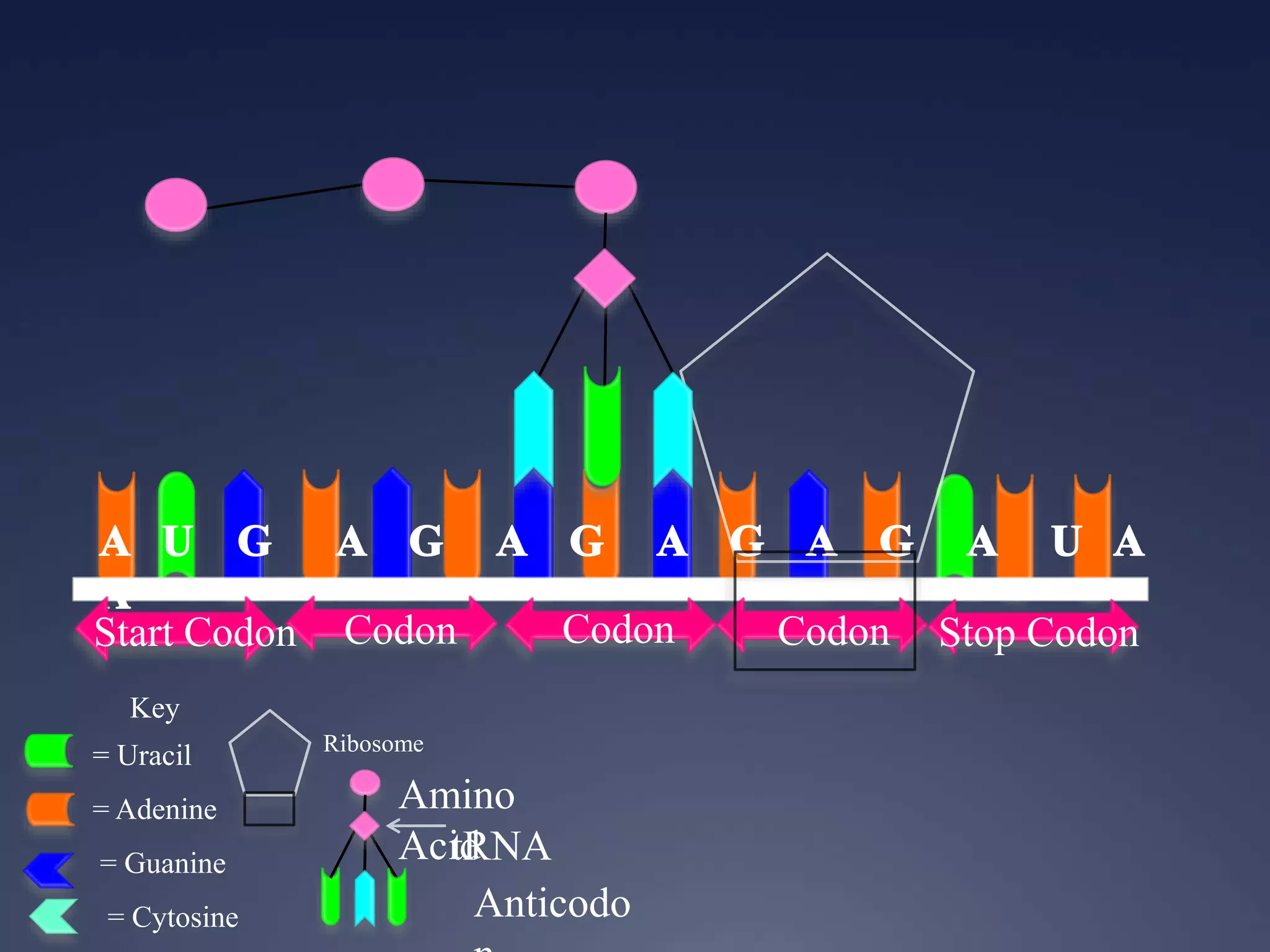
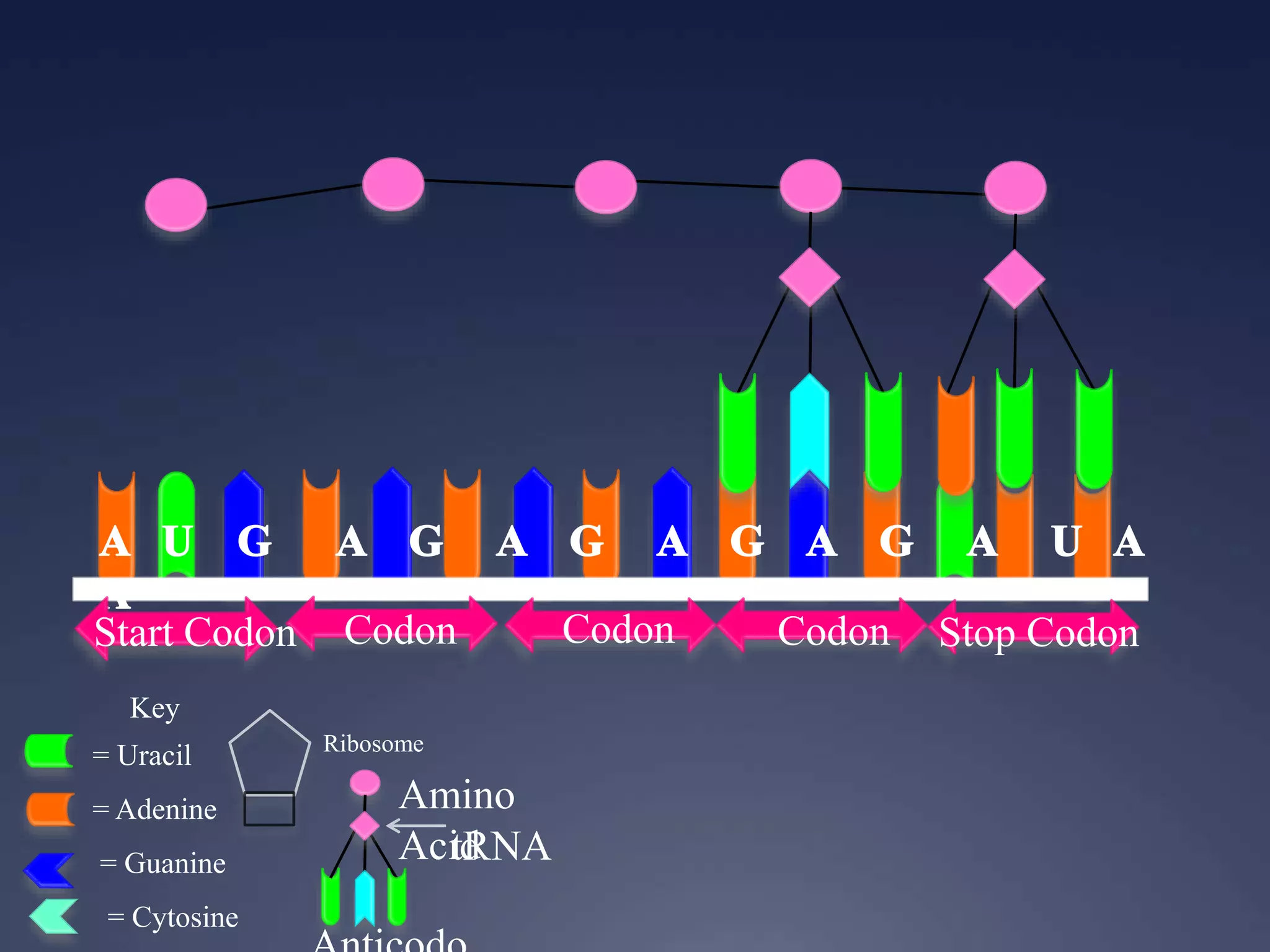
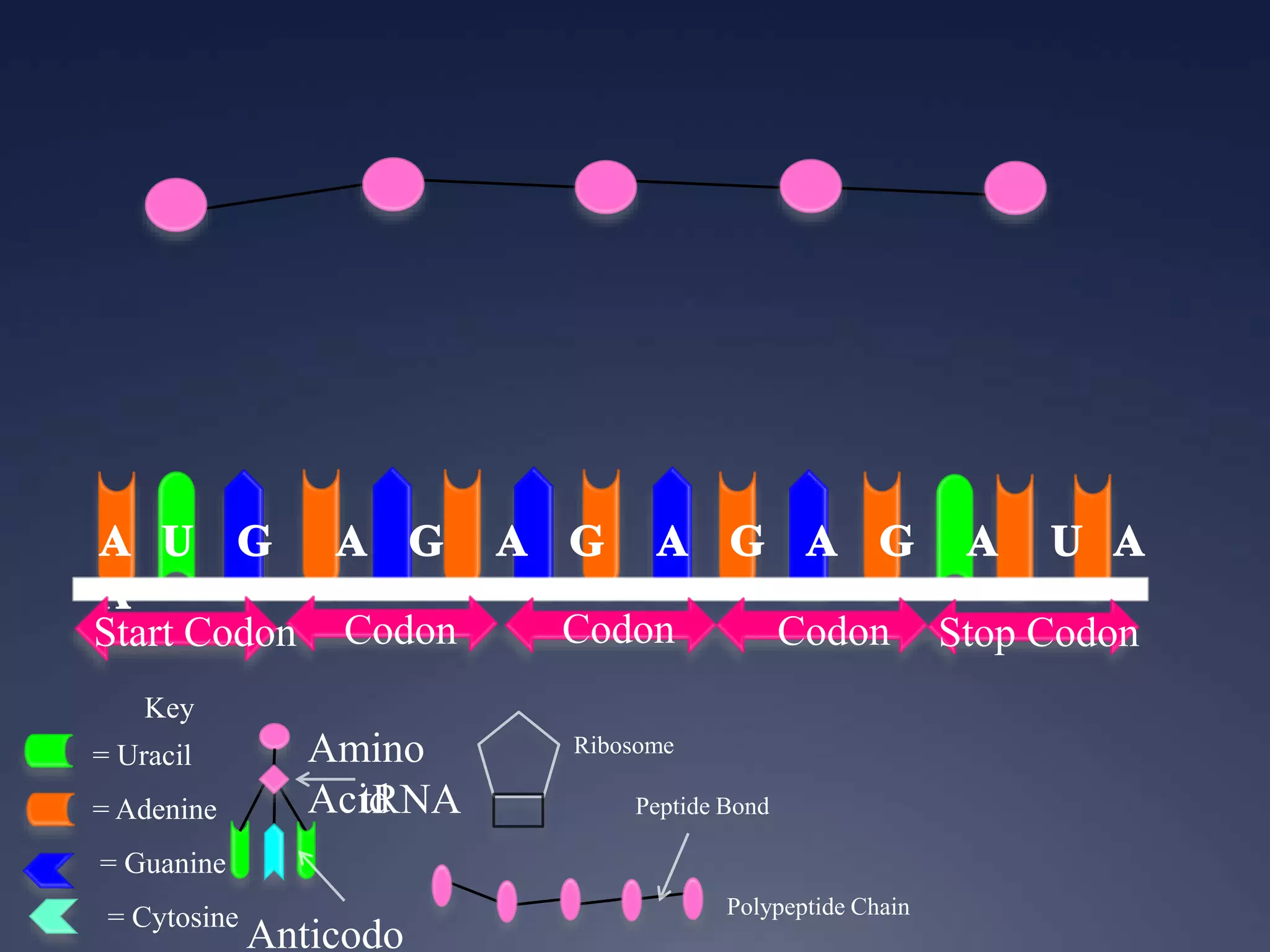
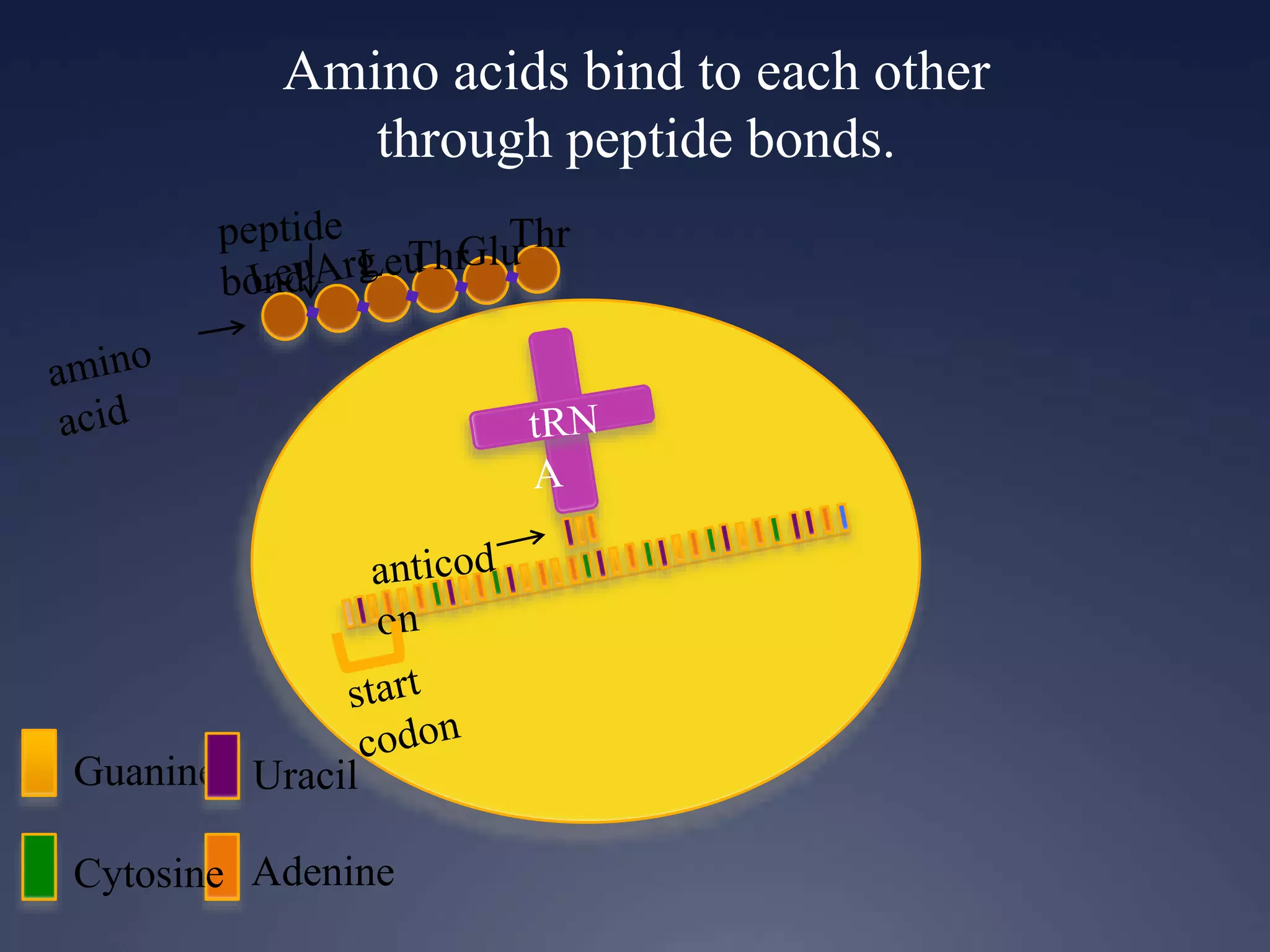
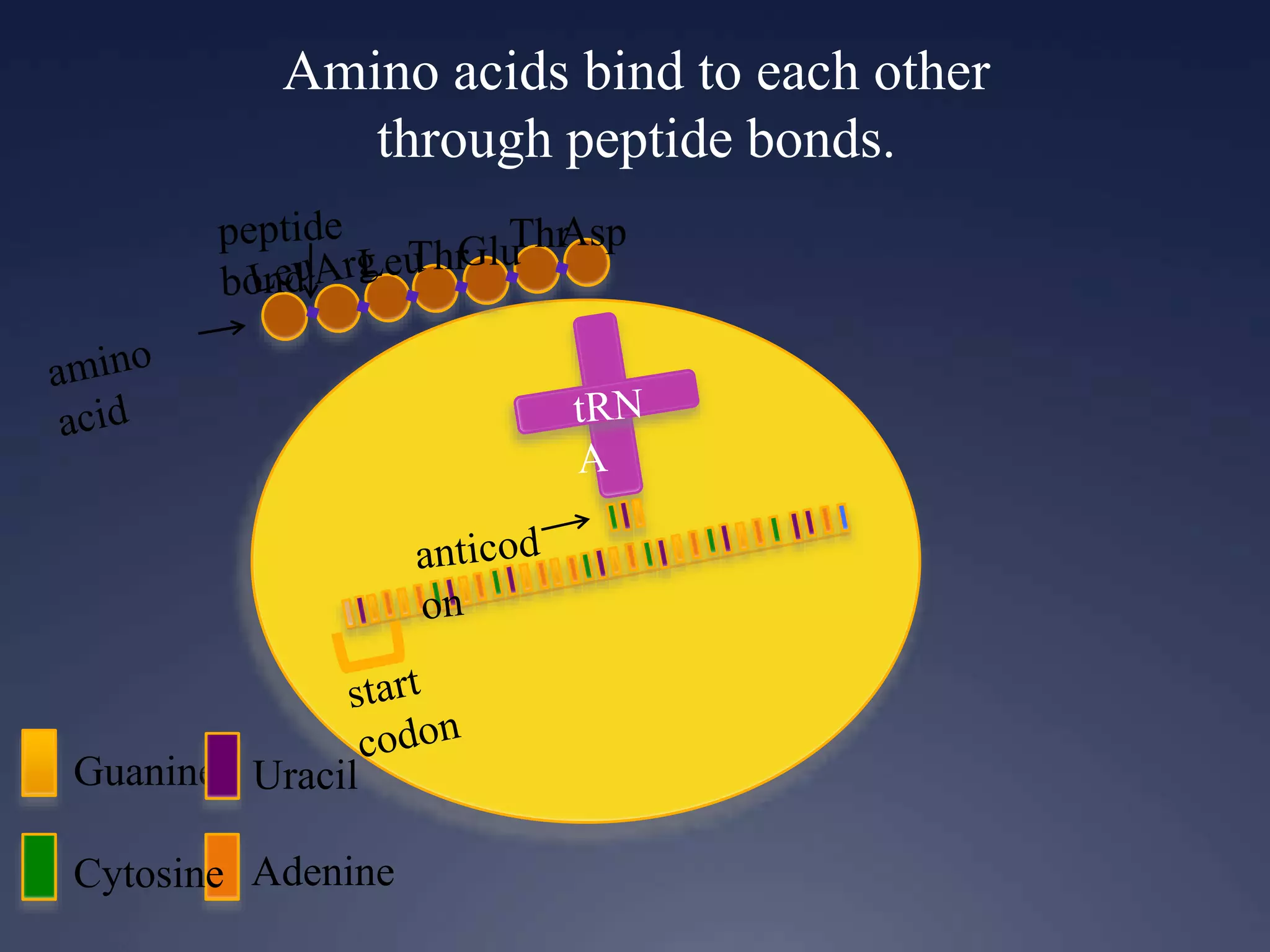
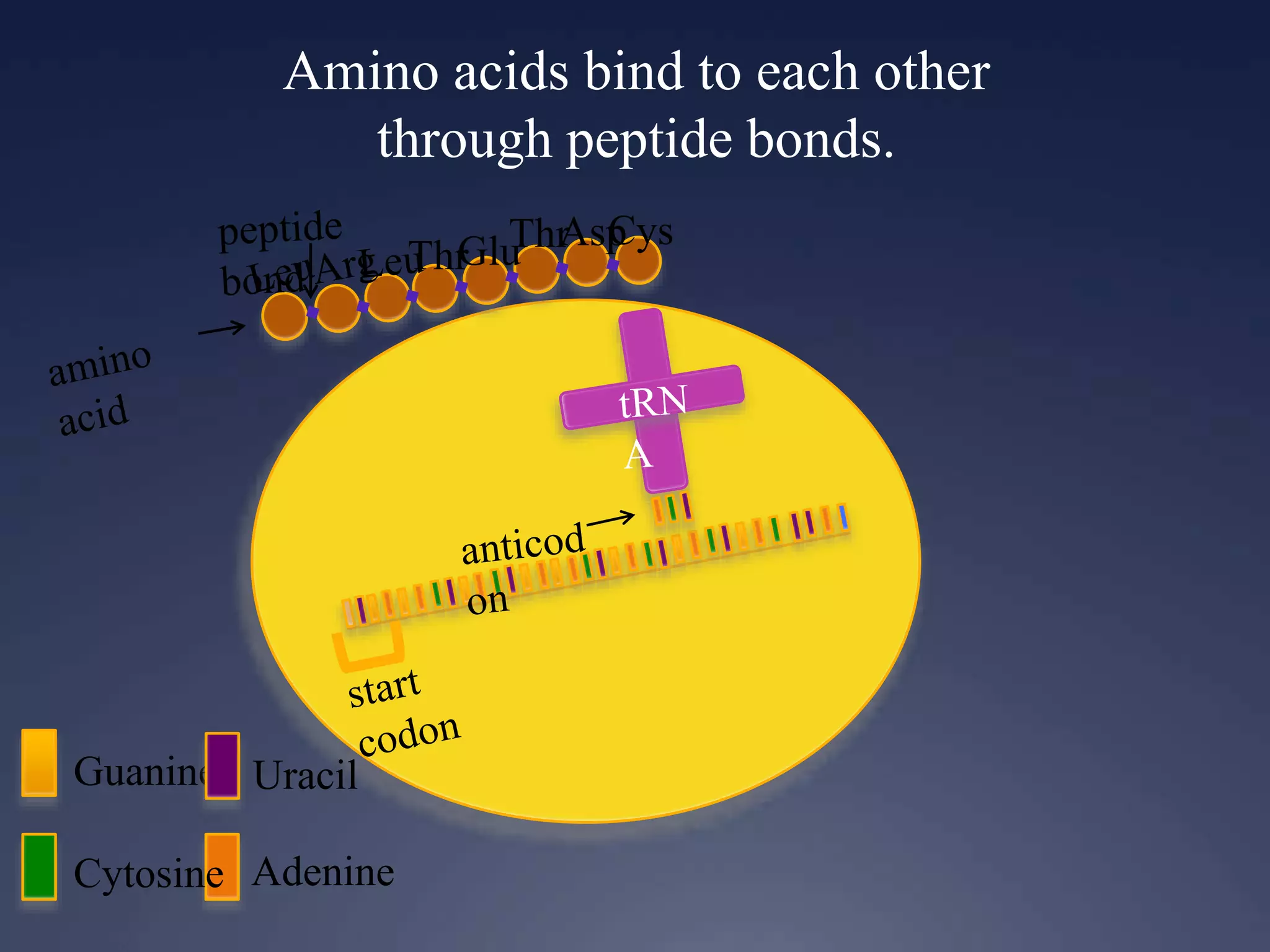
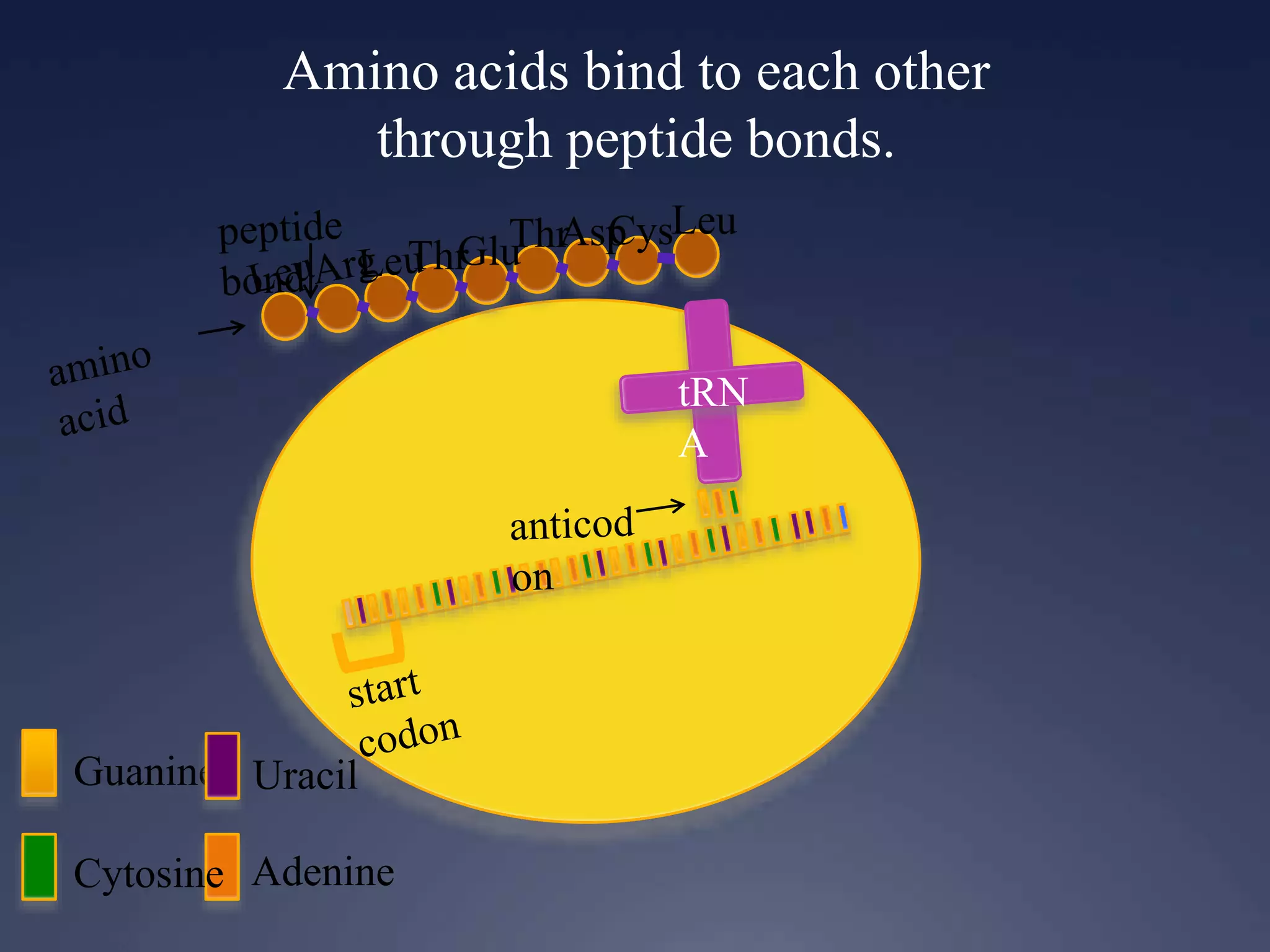
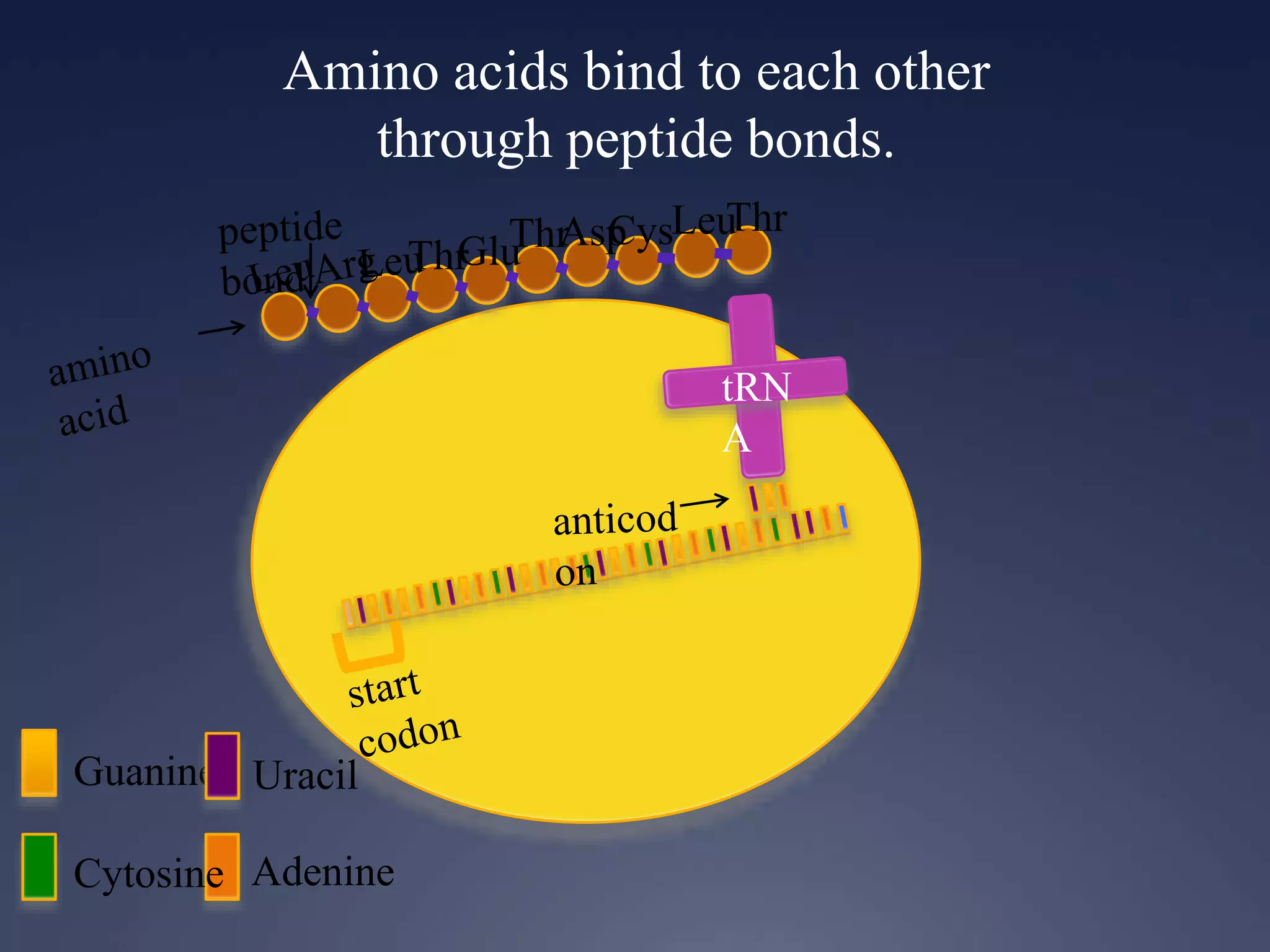
5) The ribosome moves along the mRNA and adds more amino
acids to the growing polypeptide or protein
 The tRNA floats away,
allowing the ribosome to bind
to another tRNA.
 The ribosome moves along the
mRNA, attaching new tRNA
molecules and amino acids.
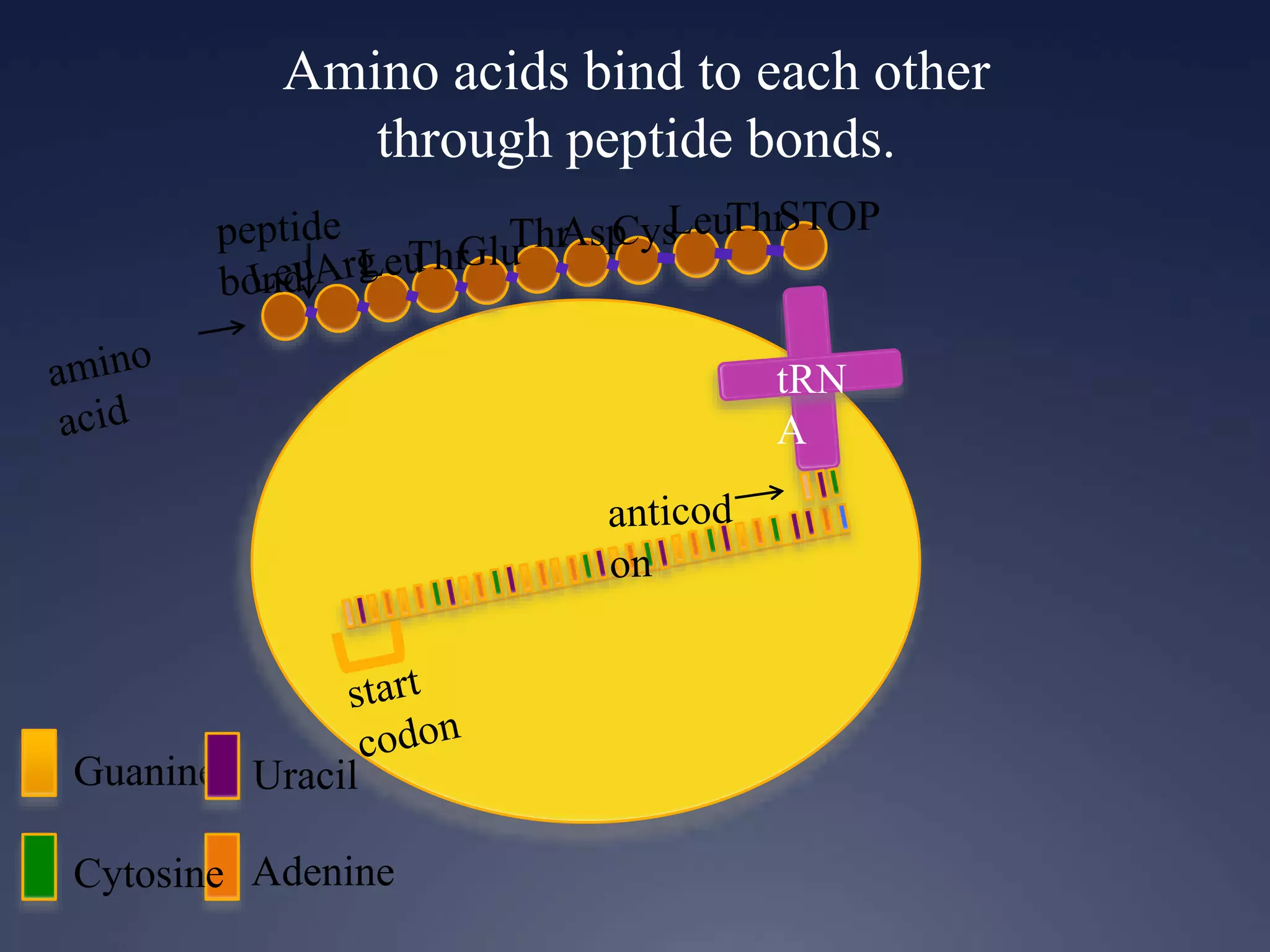
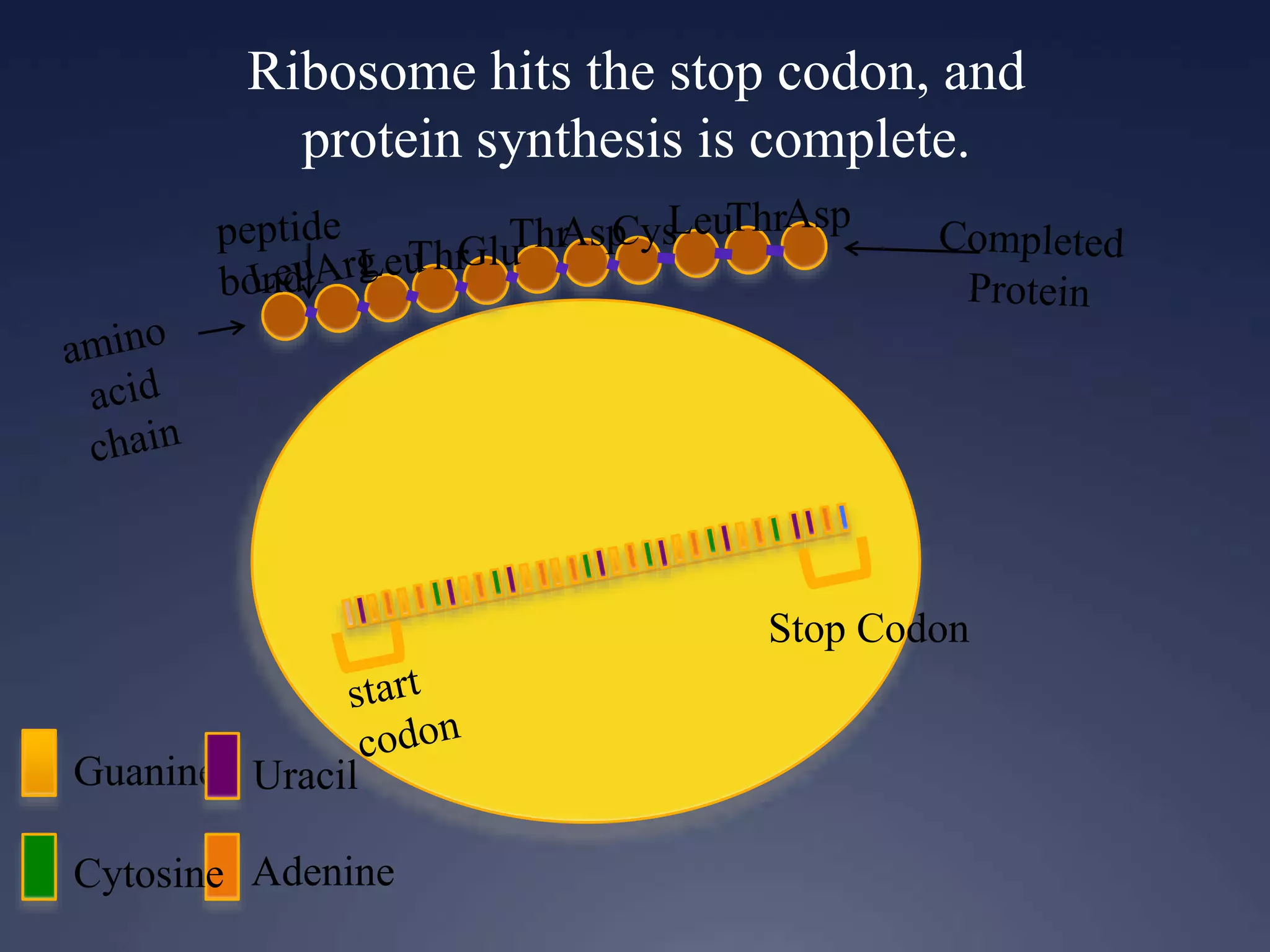
Completing the Polypeptide
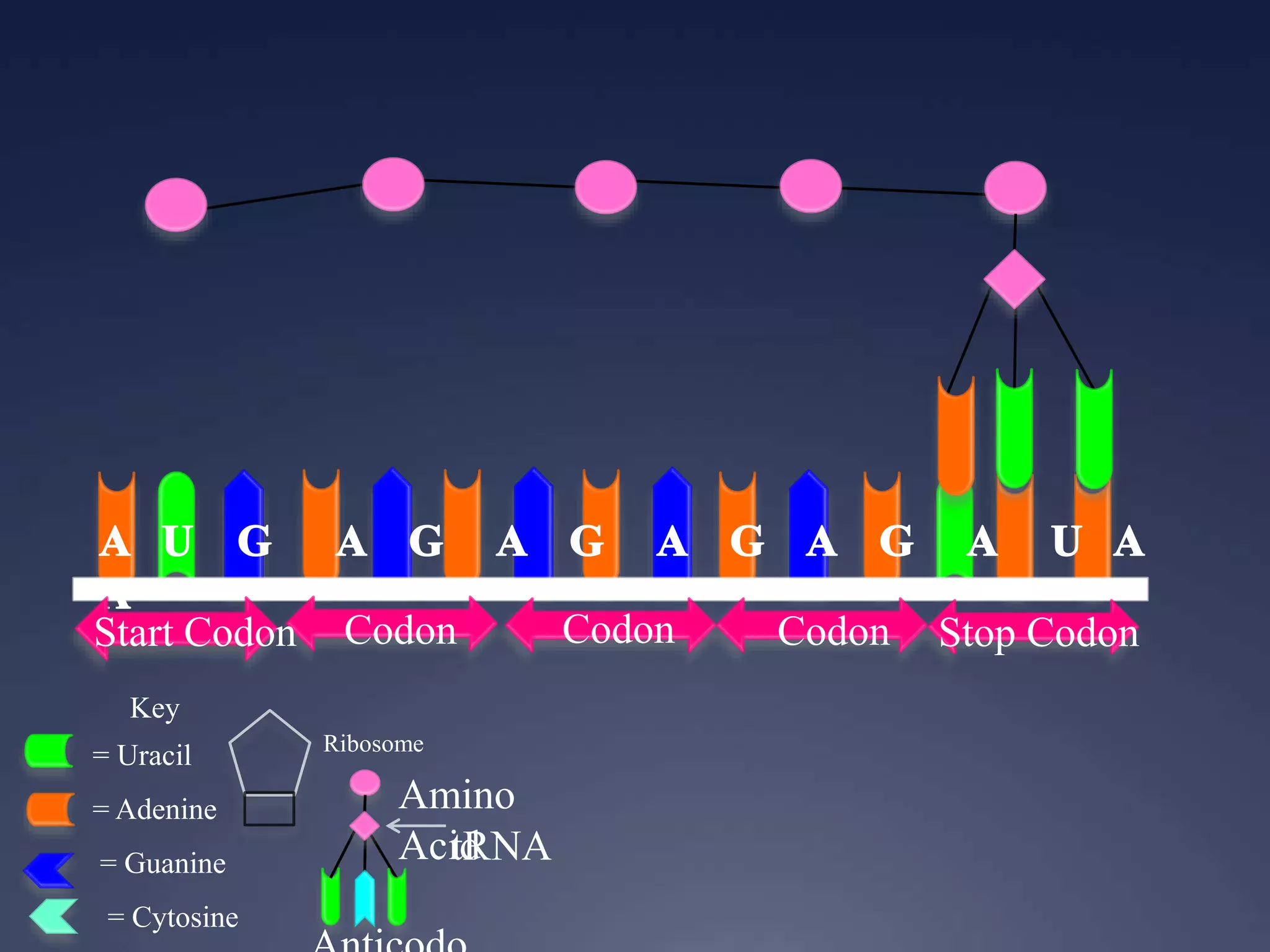
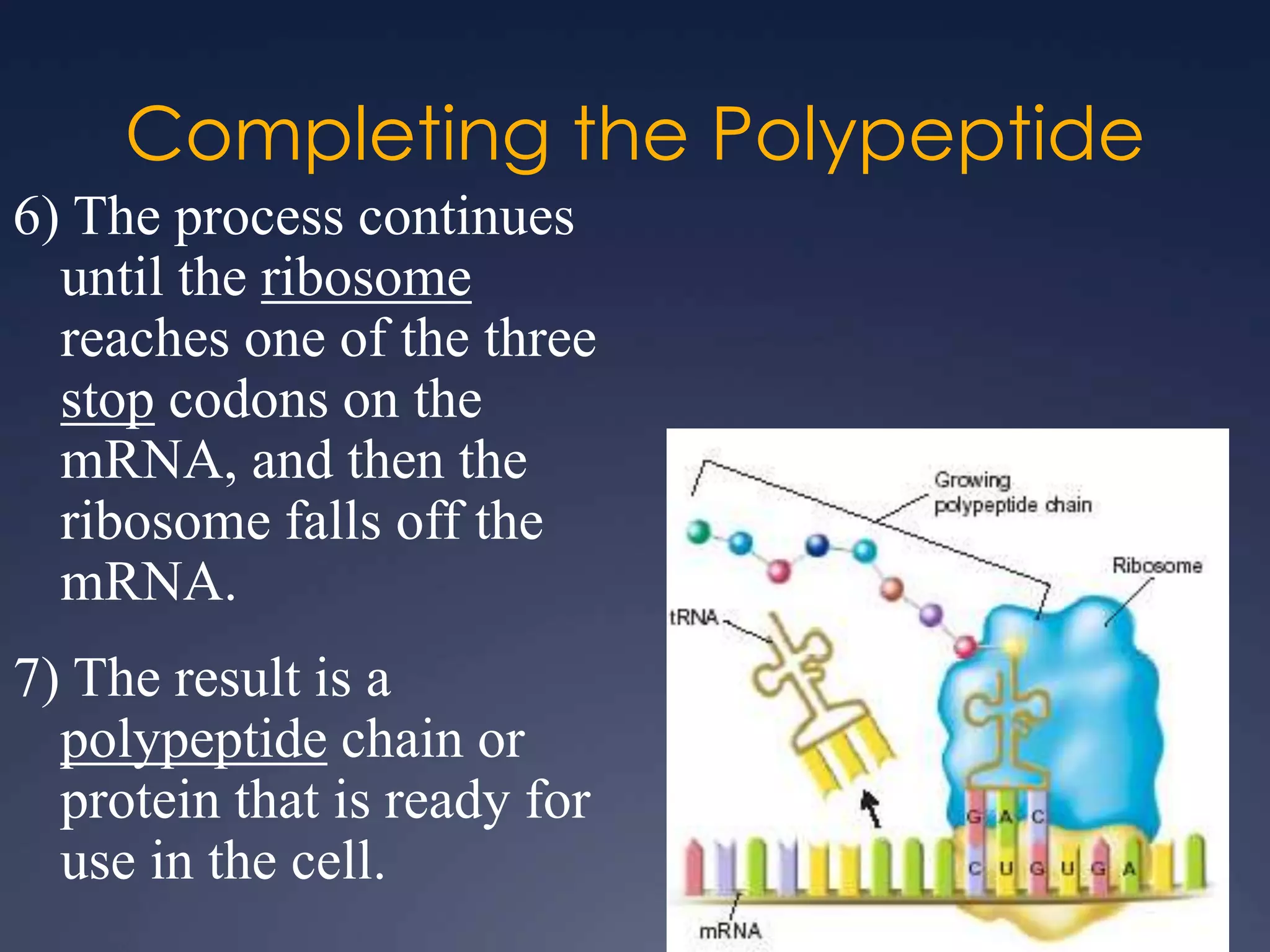
6) The process continues
until the ribosome
reaches one of the three
stop codons on the
mRNA, and then the
ribosome falls off the
mRNA.
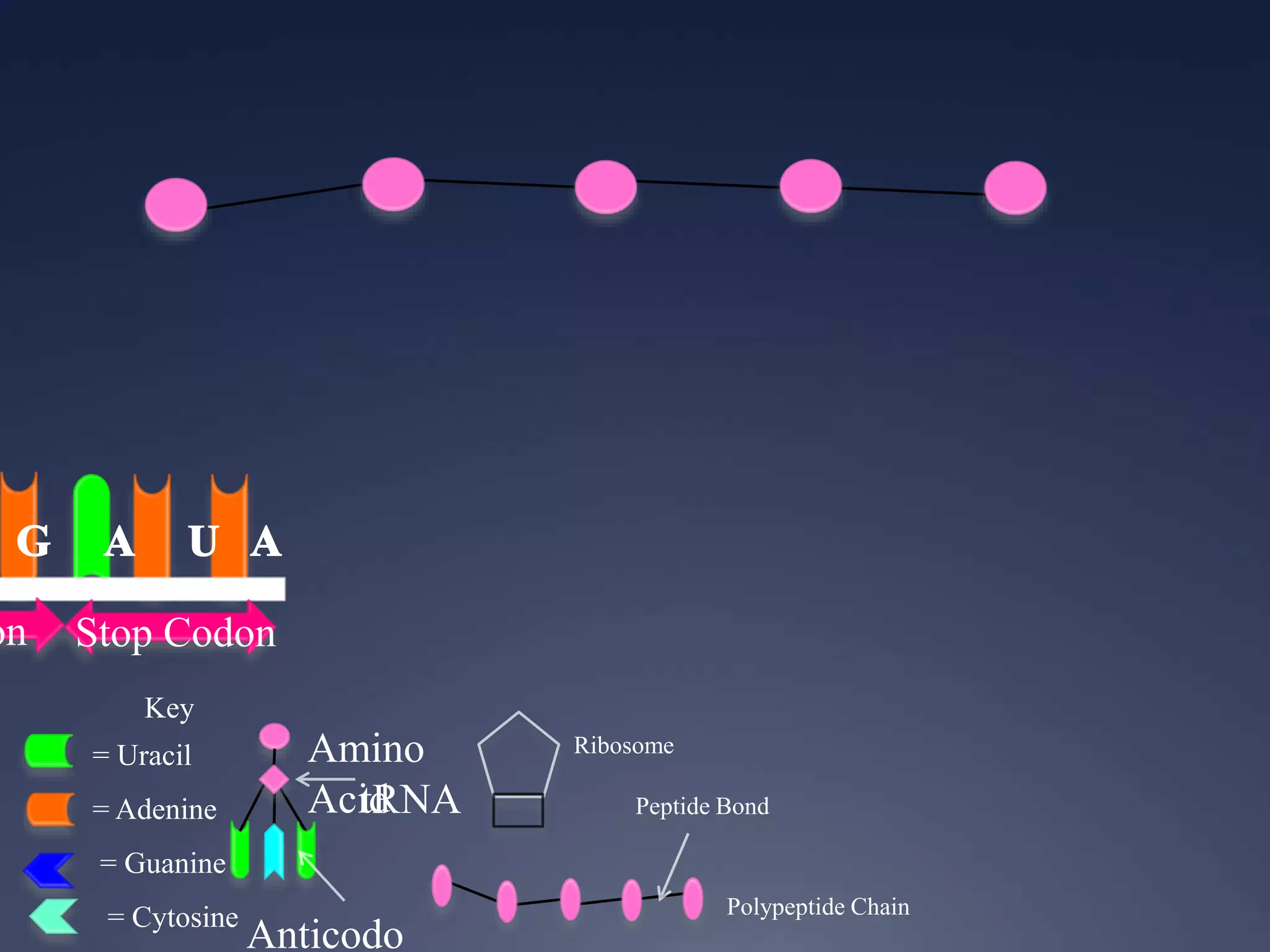
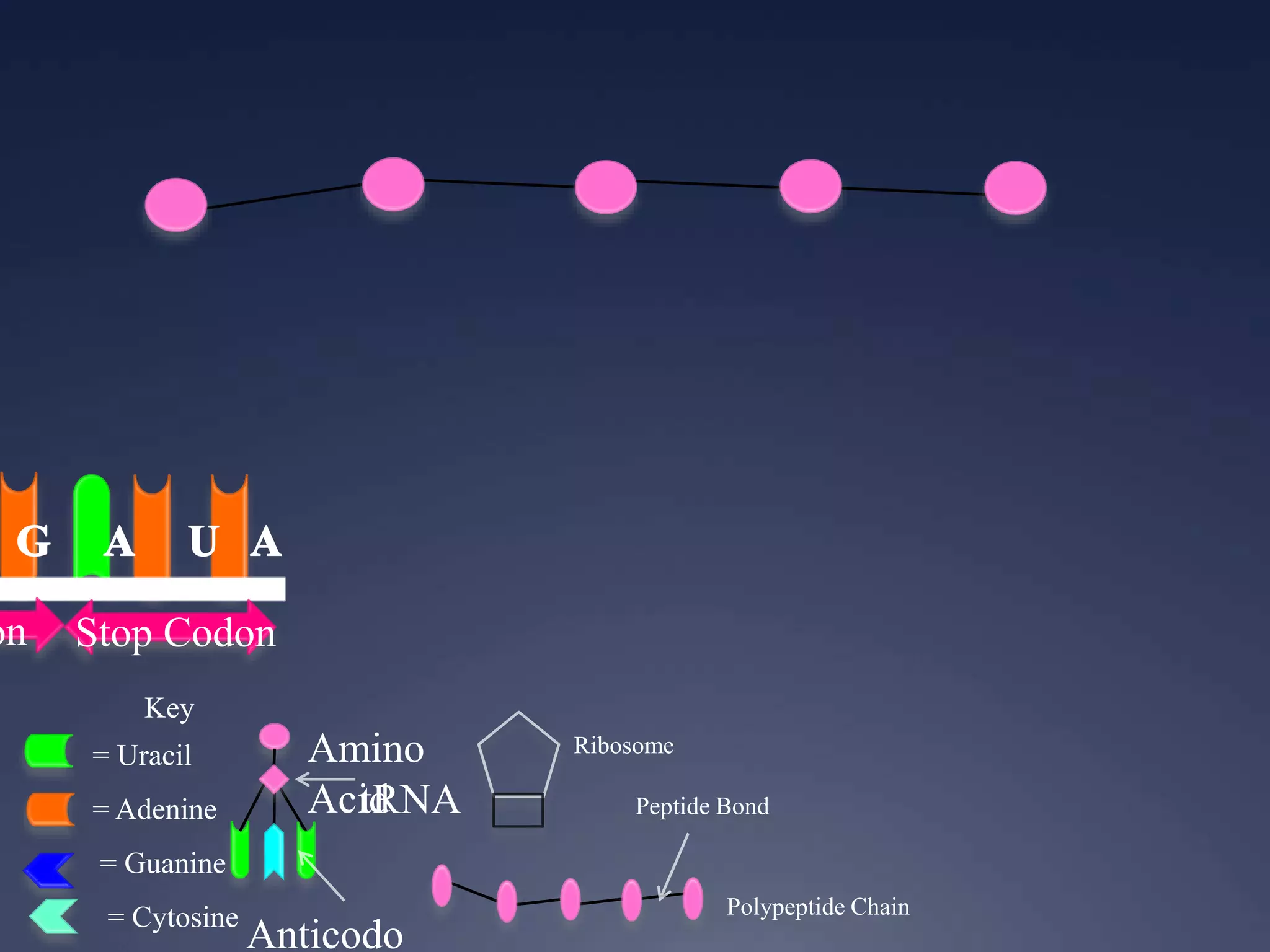
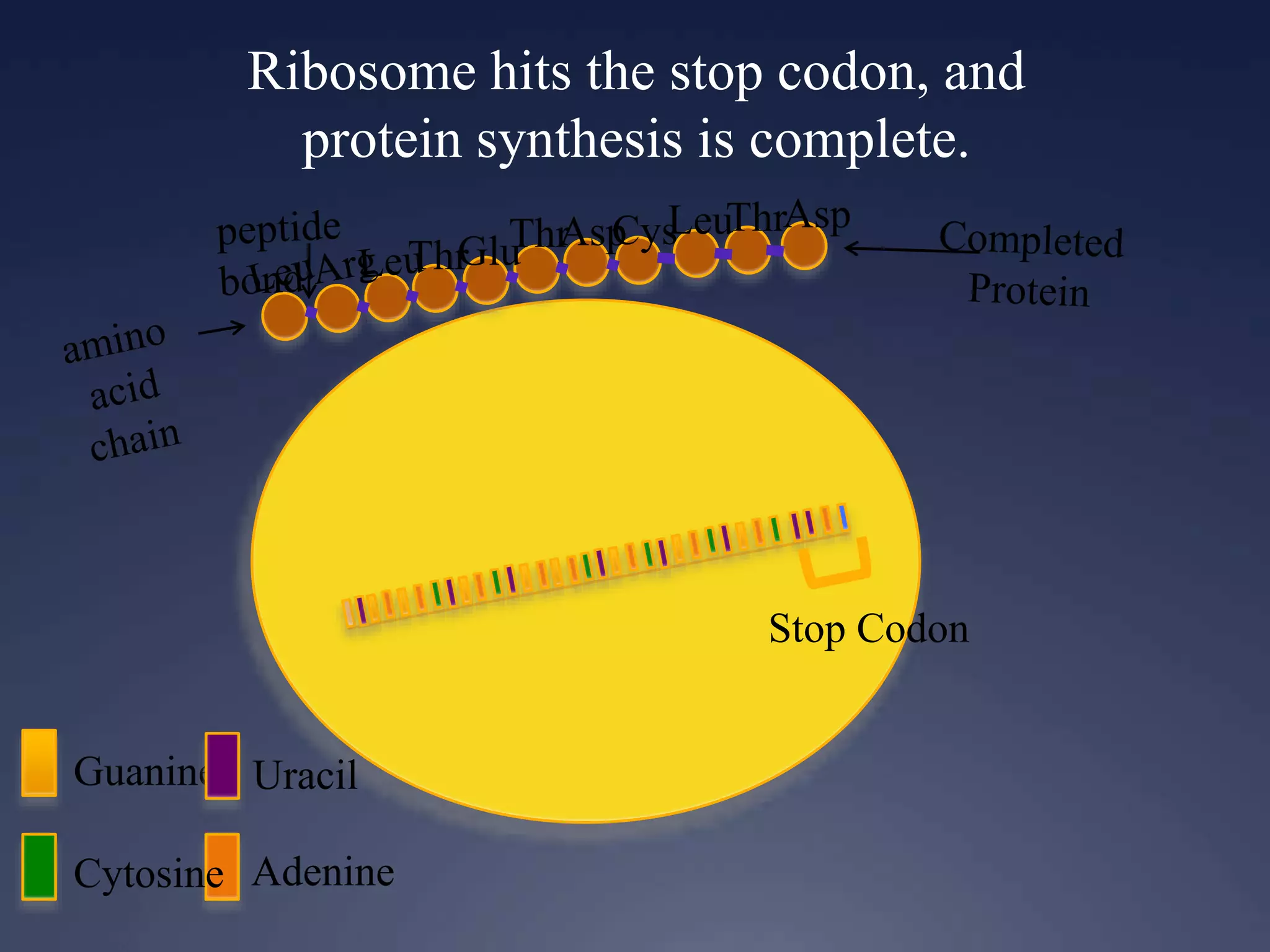
7) The result is a
polypeptide chain or
protein that is ready for
use in the cell.
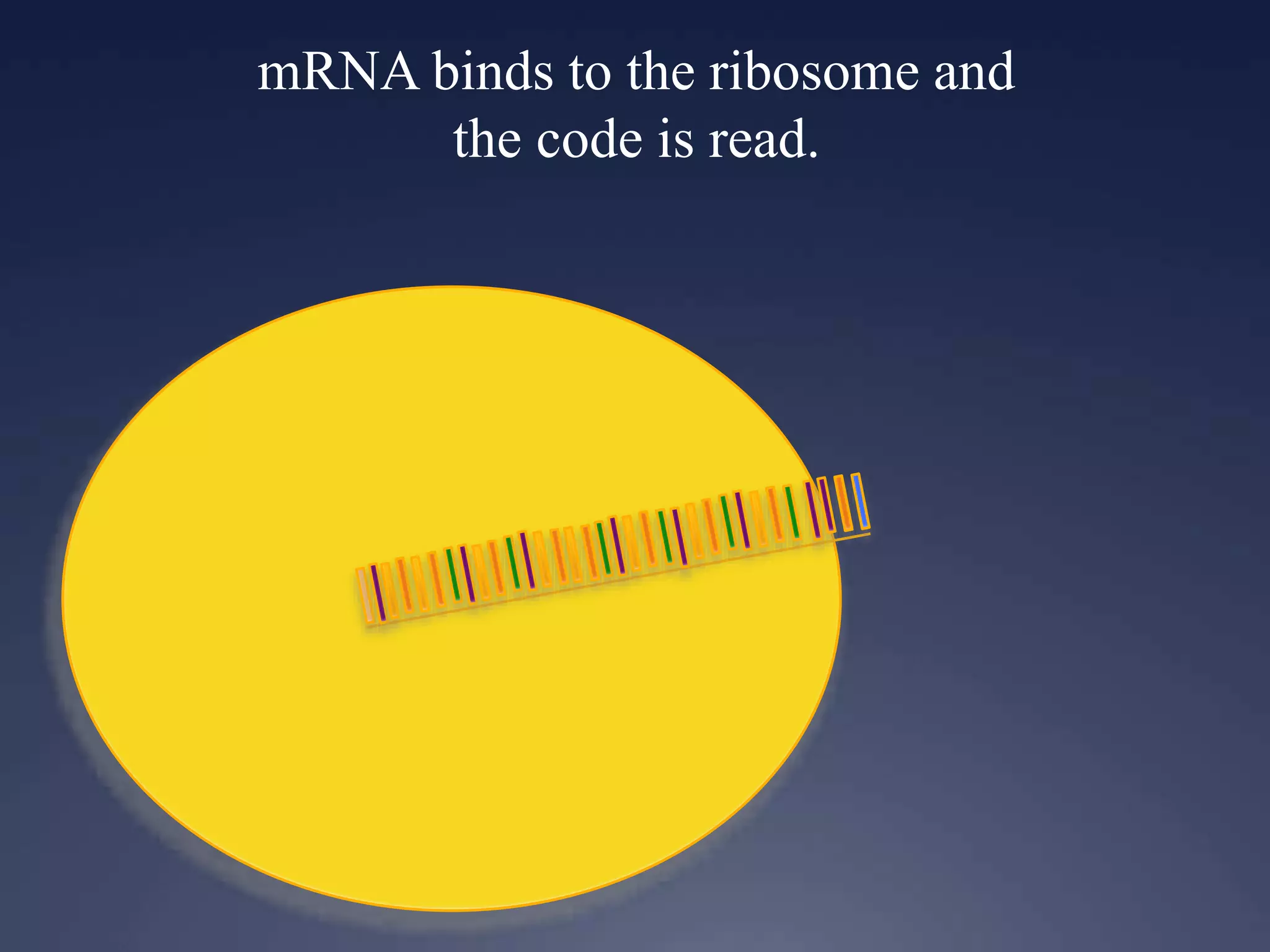
mRNA binds to the ribosome and
the code is read.
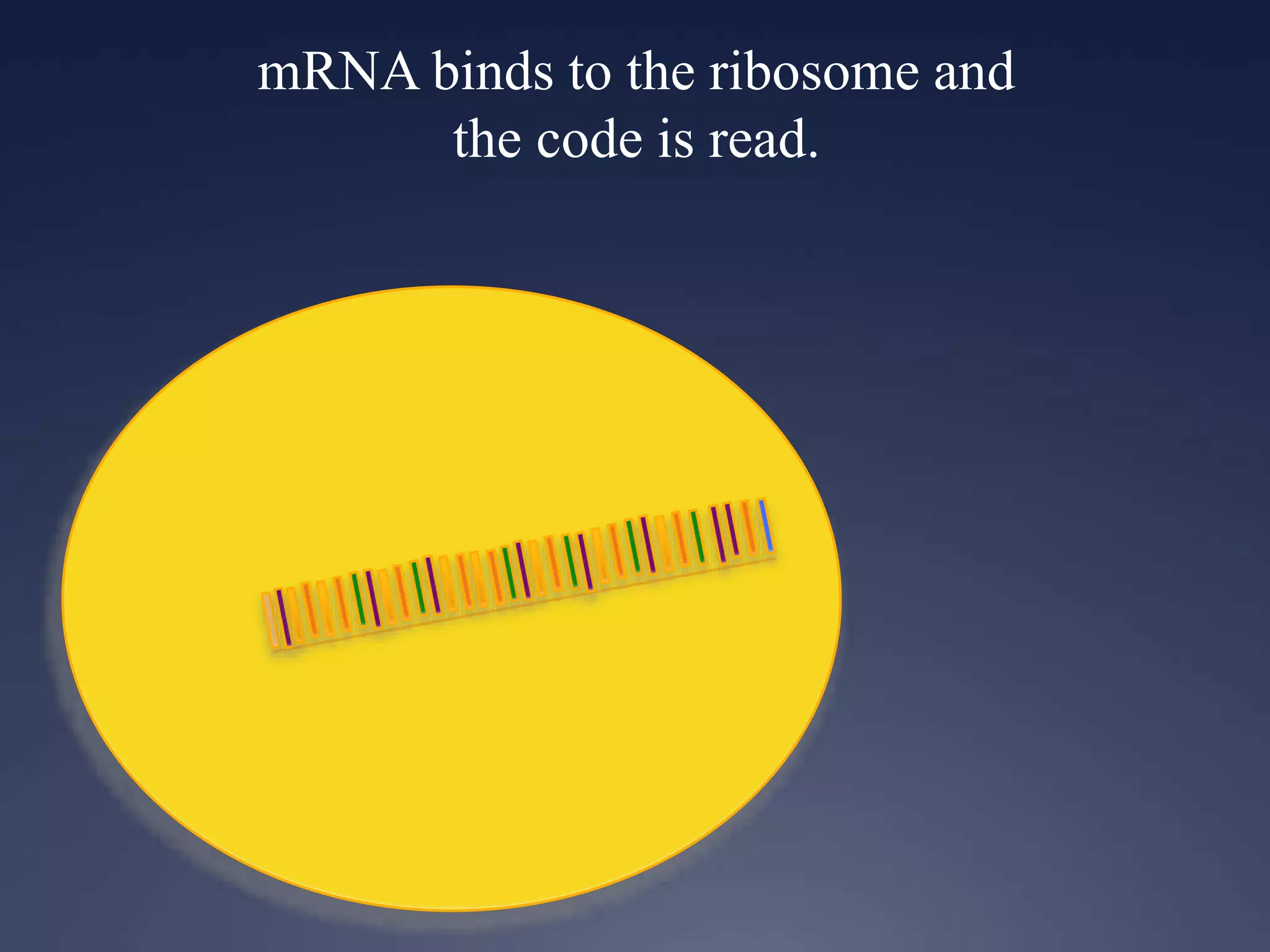
mRNA binds to the ribosome and
the code is read.
tRNA has the anticodon and amino
acid attaches.
Guanine
Cytosine Adenine
Uracil
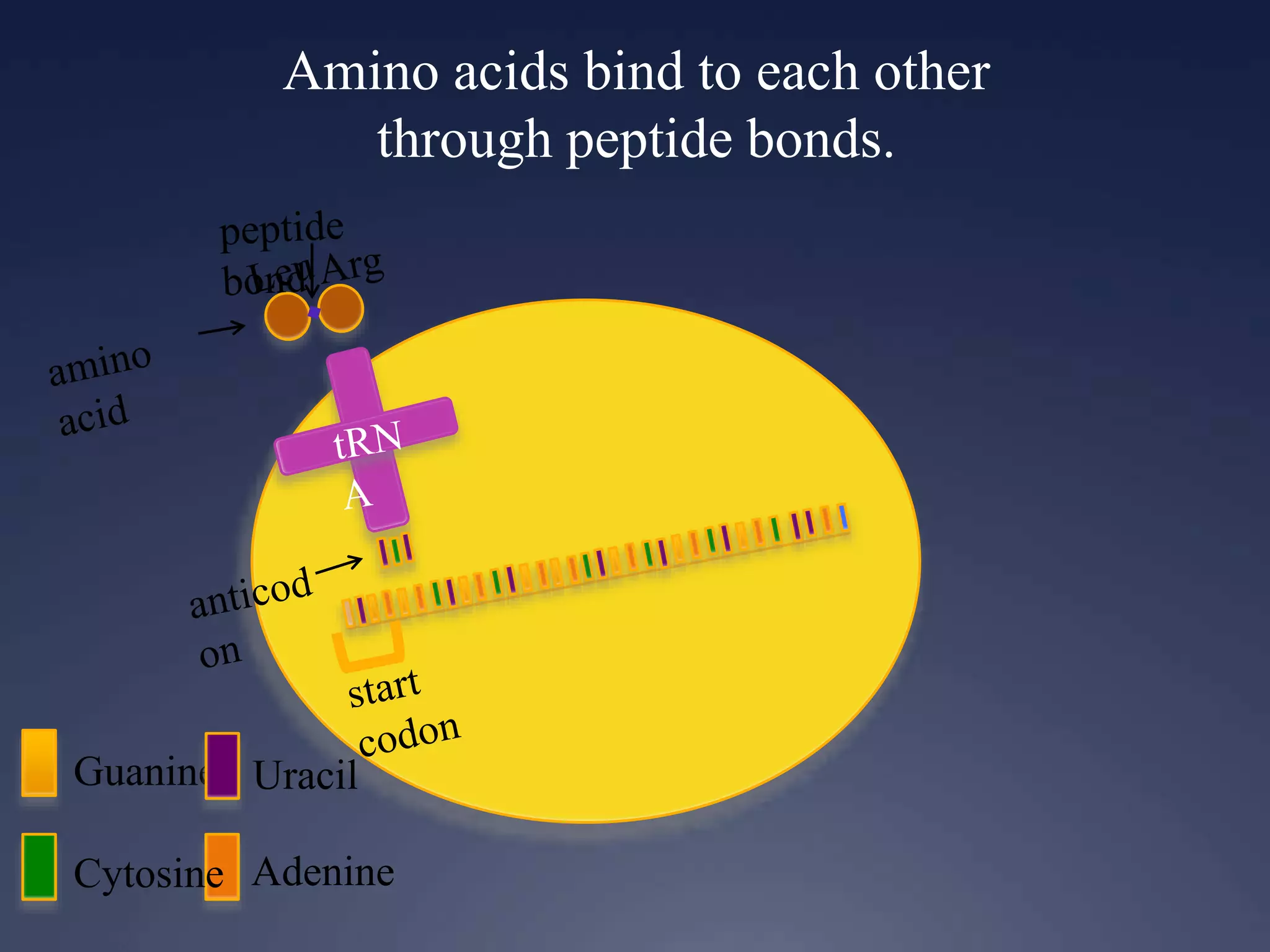
Amino acids bind to each other
through peptide bonds.
Guanine
Cytosine Adenine
Uracil
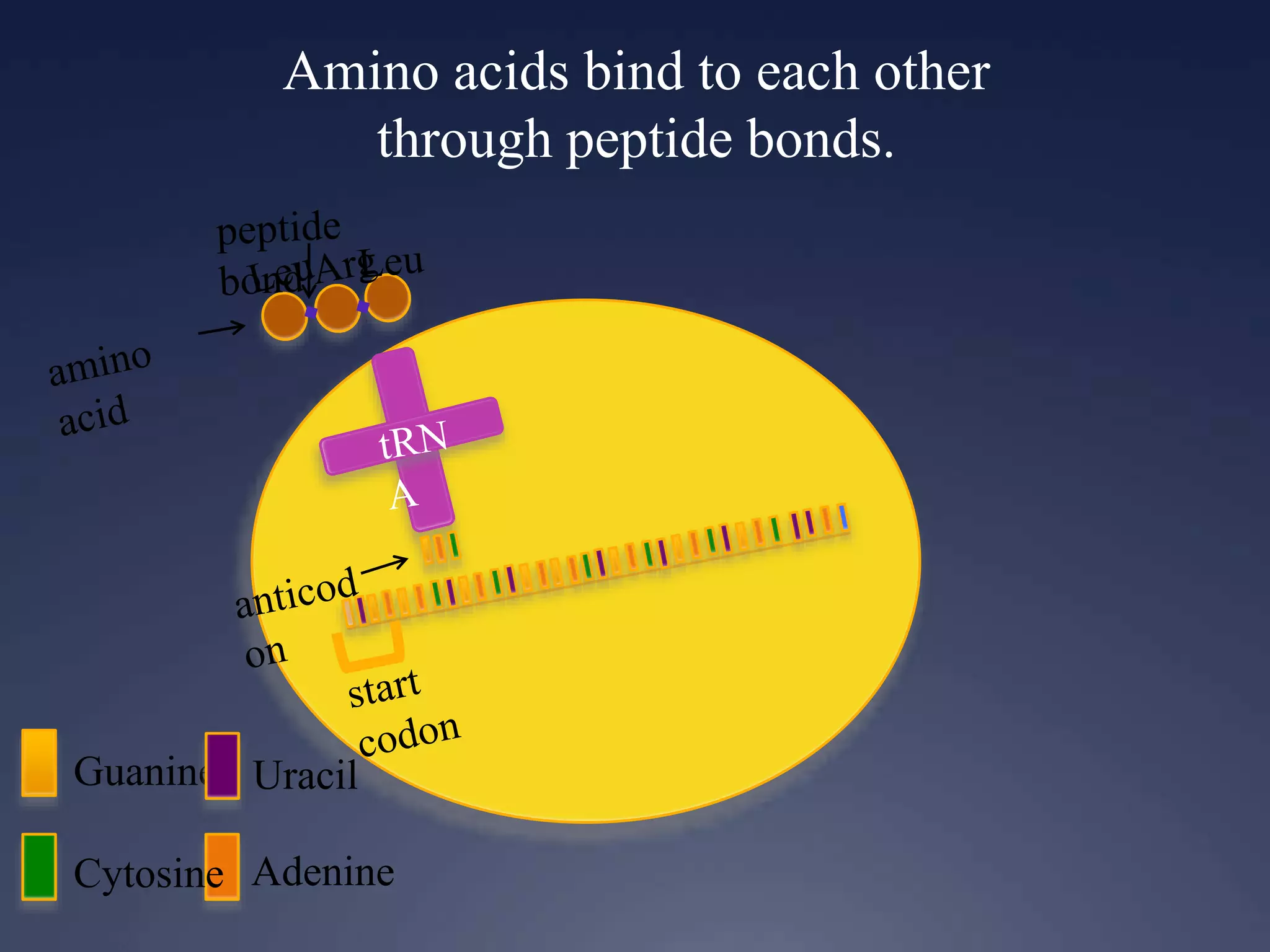
Amino acids bind to each other
through peptide bonds.
Guanine
Cytosine Adenine
Uracil
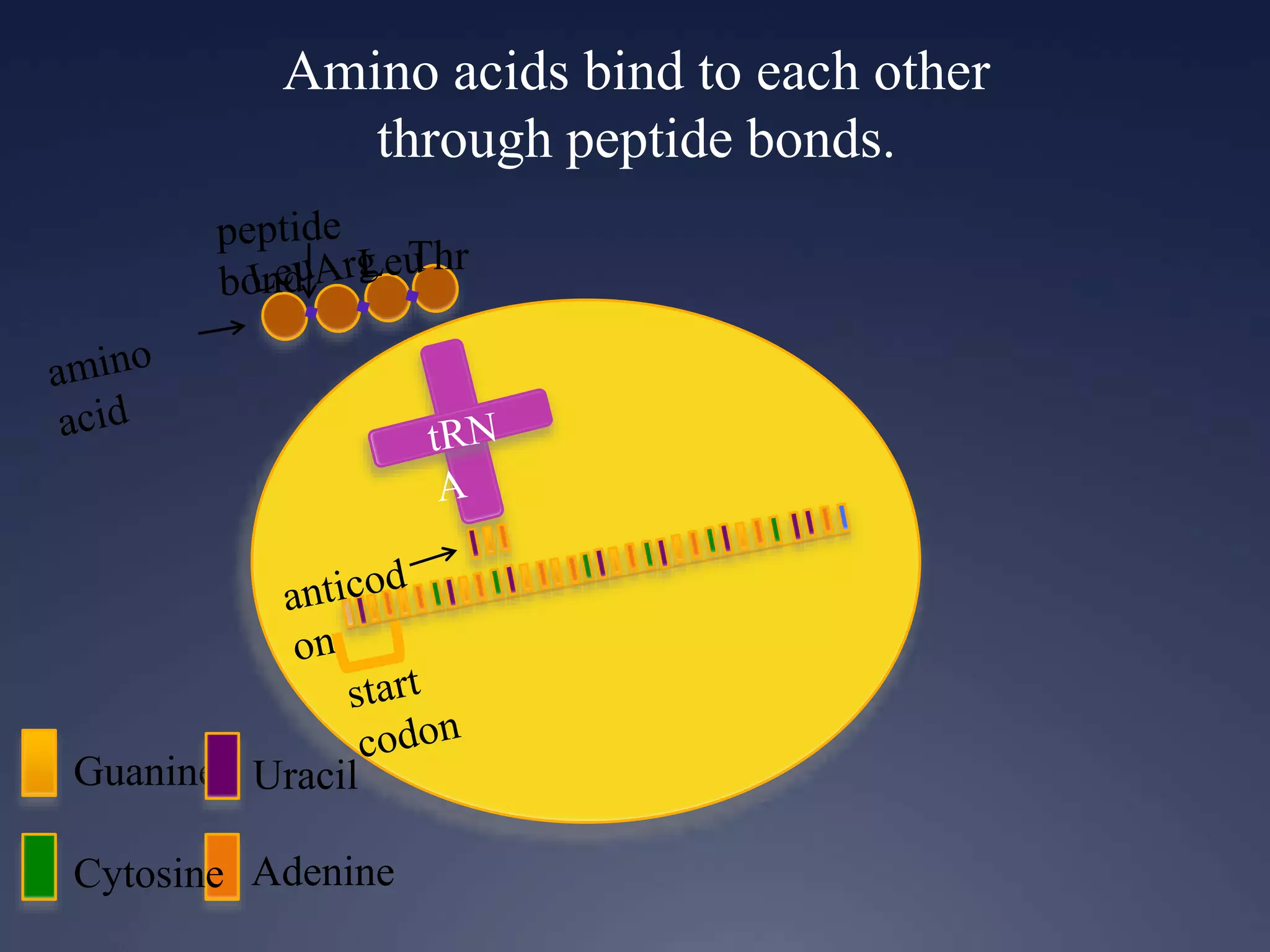
Amino acids bind to each other
through peptide bonds.
Guanine
Cytosine Adenine
Uracil
Thr
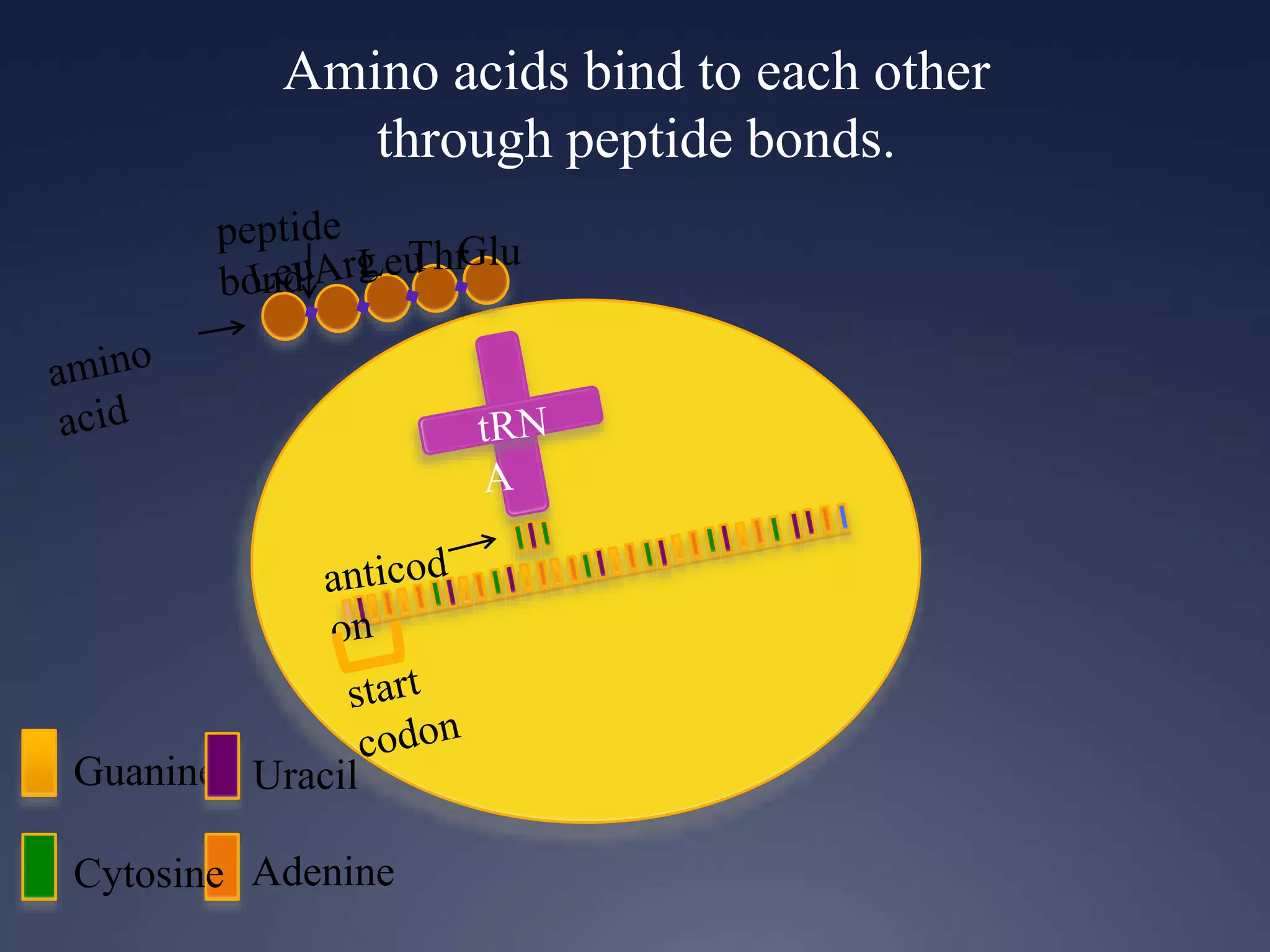
Amino acids bind to each other
through peptide bonds.
Guanine
Cytosine Adenine
Uracil
ThrGlu
Amino acids bind to each other
through peptide bonds.
Guanine
Cytosine Adenine
Uracil
ThrGluThr
Amino acids bind to each other
through peptide bonds.
Guanine
Cytosine Adenine
Uracil
ThrGluThrAsp
Amino acids bind to each other
through peptide bonds.
Guanine
Cytosine Adenine
Uracil
ThrGluThrAspCys
Amino acids bind to each other
through peptide bonds.
Guanine
Cytosine Adenine
Uracil
ThrGluThrAspCysLeu
Amino acids bind to each other
through peptide bonds.
Guanine
Cytosine Adenine
Uracil
ThrGluThrAspCysLeuThr
Amino acids bind to each other
through peptide bonds.
Guanine
Cytosine Adenine
Uracil
ThrGluThrAspCysLeuThrSTOP
Ribosome hits the stop codon, and
protein synthesis is complete.
Guanine
Cytosine Adenine
Uracil
ThrGluThrAspCysLeuThrAsp
Stop Codon
Ribosome hits the stop codon, and
protein synthesis is complete.
Guanine
Cytosine Adenine
Uracil
ThrGluThrAspCysLeuThrAsp
Stop Codon
Ribosome hits the stop codon, and
protein synthesis is complete.
Guanine
Cytosine Adenine
Uracil
ThrGluThrAspCysLeuThrAsp
Stop Codon
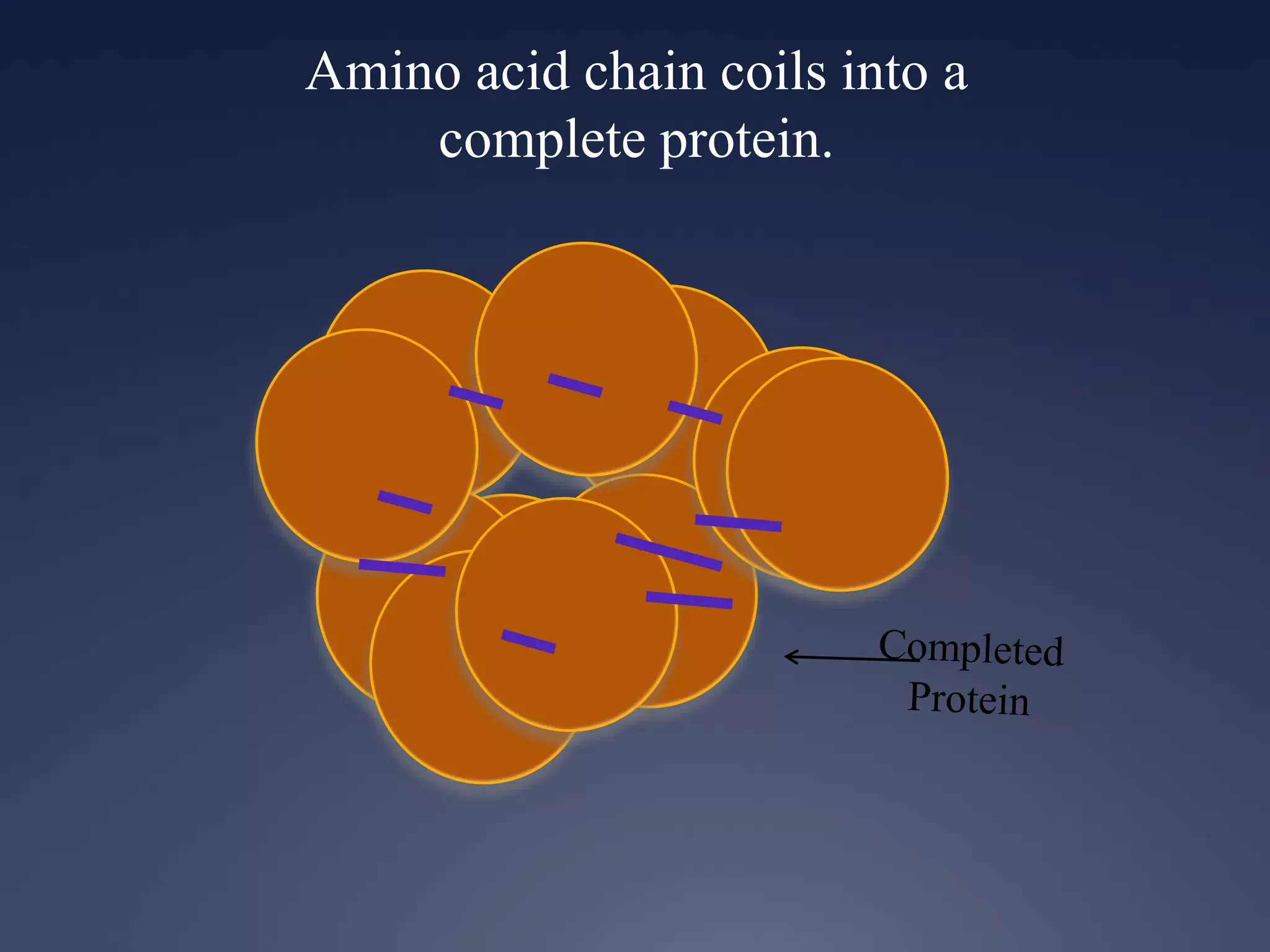
Amino acid chain coils into a
complete protein.
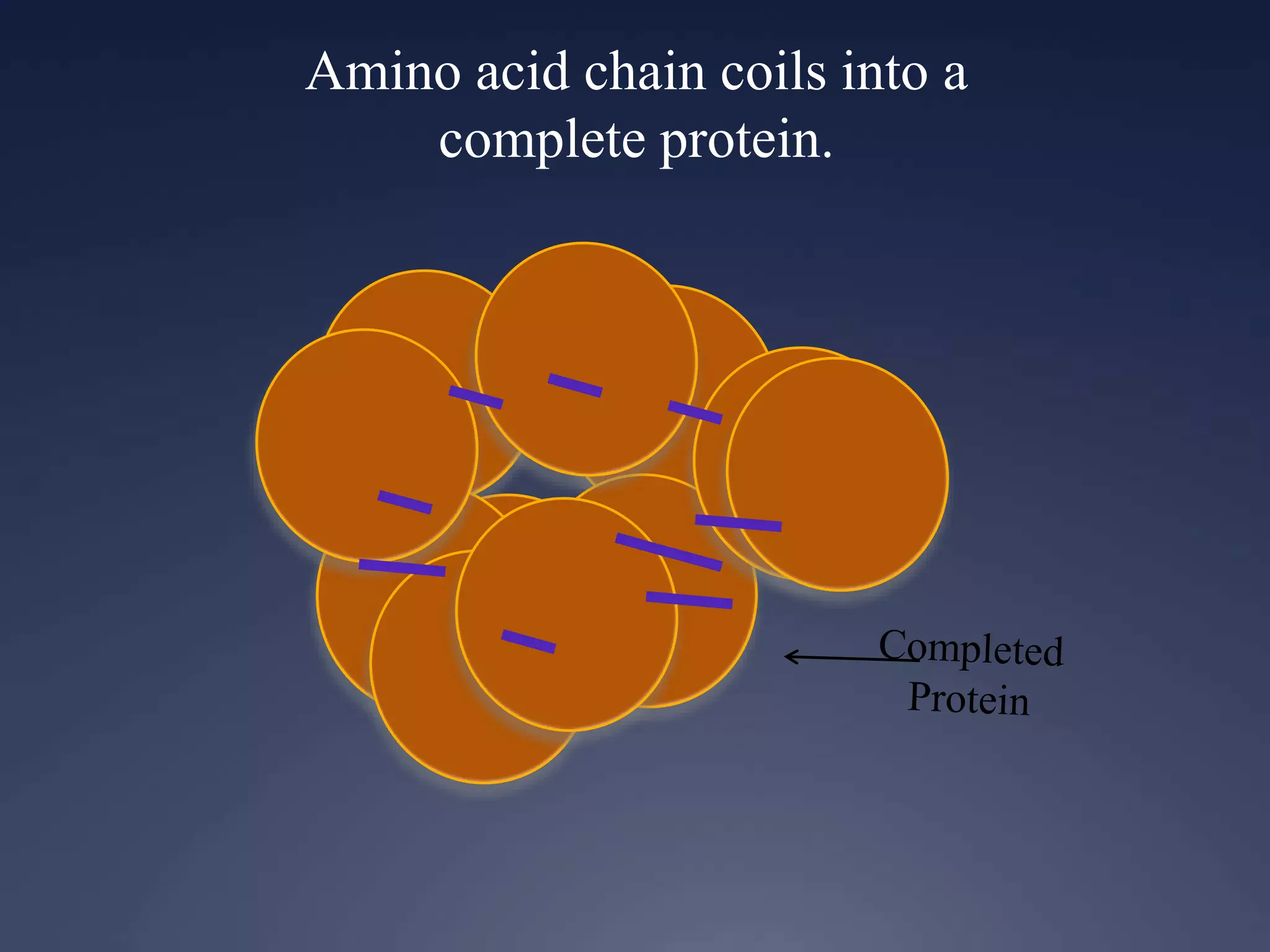
Amino acid chain coils into a
complete protein.
Source: http://www.biochem.arizona.edu/classes/bioc471/pages/Lecture1/Lecture1.html
RNA and Protein Synthesis

RNA and Protein Synthesis

  • 1.
    RNA & ProteinSynthesis Uracil Hydrogen bonds Adenine Ribose RNA
  • 2.
    Basic components ofRNA  Ribonucleic acid consists of following basic components  1- Ribose sugar  2- Phosphate in diester linkage  4-Nitrogenous base pairs-  Purines- adenine, guanine  Pyrimidines- cytocine, uracil
  • 3.
    Primary structure ofRNA  Although there are multiple types of RNA molecules, the basic structure of all RNA is similar.  Each kind of RNA is a polymeric molecule made by stringing together individual ribonucleotides, always by adding the 5'-phosphate group of one nucleotide onto the 3'-hydroxyl group of the previous
  • 4.
    Secondary structure ofRNA  Single-stranded RNA can also form many secondary structures in which a single RNA molecule folds over and forms hairpin loops, stabilized by intramolecular hydrogen bonds between complementary bases.  Such base-pairing of RNA is critical for many RNA functions, such as the ability of tRNA to bind to the correct sequence of mRNA during translation
  • 5.
    DNA can replicateor undergo transcription  Replication-it is process by which DNA copies itself to produce identical daughter molecules of DNA. DNA is the reserve bank of genetic information.  Transcription-transcription results in the formation of one single-stranded RNA molecule.
  • 6.
    DNA RNA Structure Double Stranded SingleStranded Bases- Purines Adenine (A) Adenine (A) Guanine (G) Guanine (G) Bases - Pyrimidines Cytosine (C) Cytosine (C) Thymine (T) Uracil (U) Sugar Deoxyribose Ribose Differences between DNA and RNA: RNA’s JOB= Make Proteins!!
  • 7.
    Types of RNA 1)messenger RNA (mRNA)- carries instructions from the DNA in the nucleus to the ribosome
  • 8.
    Types of RNA 2)ribosomal RNA (rRNA)- combines with proteins to form the ribosome (proteins made here) 3) transfer RNA (tRNA)- transfers each amino acid to the ribosome as it is specified by coded messages in mRNA during the construction of a protein
  • 9.
    Types of RNA 4 ) snRNA – small nuclear RNA  5) snoRNA- small nucleolar RNA  6) scRNA- small cytoplasmic RNA  7) micro- RNAs,miRNA, small interfering RNAs  Present in eukaryotes only.
  • 10.
    Protein Synthesis Overview Thereare two steps to making proteins (protein synthesis): 1) Transcription (nucleus) DNA RNA 2) Translation (cytoplasm) RNA  protein
  • 11.
     DNA  Transcription RNA  Translation  Protein  Conventional concept  Genome  Transcription  Transcriptome  Translation  Proteome  Current concept, Bioinformatics era
  • 12.
    Proteins.  Everything acell is or does depends on the proteins it contains.
  • 14.
    From genes toproteins.  Two steps – Transcription , Translation.
  • 15.
    Transcription RNA DNA RNA polymerase Adenine (DNA andRNA) Cytosine (DNA and RNA) Guanine(DNA and RNA) Thymine (DNA only) Uracil (RNA only) Nucleus
  • 16.
    TRANSCRIPTION  It isa process by which RNA is synthesize from DNA. The genetic information stored in DNA is expressed through RNA.  One of the two strands of DNA serves as Template and produces working copies of RNA molecules. The other DNA strand which does not participate in in transcription is referred to as coding strand or sense strand or non-template strand.
  • 17.
    Transcription RNA Editing: Beforethe mRNA leaves the nucleus, it is called pre-mRNA or (hnRNA) heterogeneous nuclear RNA and it gets “edited.” Parts of the pre-mRNA that are not involved in coding for proteins are called introns and are cut out. The remaining mRNA pieces are called exons (because they are expressed) and are spliced back together to form the mRNA. Then the final mRNA leaves the nucleus through the nuclear pores and enters the cytoplasm headed to the ribosome.
  • 18.
    Transcription 1) Transcription beginswhen the enzyme RNA polymerase binds to DNA at a promoter region. Promoters are signals in DNA that indicate to the enzyme where to bind to make RNA. 2) The enzyme separates the DNA strands by breaking the hydrogen bonds, and then uses one strand of DNA as a template from which nucleotides are assembled into a strand of RNA.
  • 19.
    Transcription 3) RNA polymerasepairs up free floating RNA nucleotides with DNA template and joins the nucleotides together to form the backbone of the new mRNA strand. 4) When mRNA hits a termination sequence, it separates from the DNA
  • 20.
    Steps of transcription Initiation  Elongation  Termination  post – transcriptional modifications  The RNAs produced during transcription are called primary mRNA transcripts. They undergo many alterations- terminal base additions, base modifications, splicing etc. This process is required to convert RNA into active form. Enzyme involved mainly is - ribonucleases.
  • 22.
  • 23.
  • 24.
  • 25.
    Key = Phosphate = Sugar =Uracil = Adenine = Guanine = Cytosine RNA Polymerase 3’ 5’
  • 26.
    Key = Phosphate = Sugar =Uracil = Adenine = Guanine = Cytosine RNA Polymerase 3’ 5’
  • 27.
    Key = Phosphate = Sugar =Uracil = Adenine = Guanine = Cytosine RNA Polymerase 3’ 5’
  • 28.
    Key = Phosphate = Sugar =Uracil = Adenine = Guanine = Cytosine RNA Polymerase = 3’ 5’
  • 29.
    Key = Phosphate = Sugar =Uracil = Adenine = Guanine = Cytosine RNA Polymerase = 3’ 5’
  • 30.
    Key = Phosphate = Sugar =Uracil = Adenine = Guanine = Cytosine RNA Polymerase = 3’ 5’ mRNA Strand =
  • 31.
    Key = Phosphate = Sugar =Uracil = Adenine = Guanine = Cytosine RNA Polymerase =mRNA Strand = 3’ 5’
  • 40.
    On average rateof RNA synthesis is about 43 nucleotides per second .
  • 41.
    TRANSCRIPTION-COMPLIMENTARY BASE PAIR RELATIONSHIP DNA 5’ A T G C A T G G C A 3’ CODING STRAND  3’ T A C G T A C C G T 5’ TEMPLATE STRAND  RNA 5’ …....A U G C A U G G C A………3’
  • 42.
    The conventional numberingsystem of promoters Bases preceding this are numbered in a negative direction There is no base numbered 0 Bases to the right are numbered in a positive direction Most of the promoter region is labeled with negative numbers
  • 43.
    Promoter sites  Ineukaryotes promoter DNA bases sequences known as HOGNESS BOX or TATA BOX located on the left about 25 nucleotides away(upstream) from the starting site of mRNA synthesis. Second site of recognition between 70 to 80 nucleotides upstream known as CAAT BOX.  Coding strand 5’ GGCCAATC ATATAA 3’  Template strand 3’ 5’  -70 bases -25 bases (coding region)  Start of transcription
  • 44.
    Copyright ©The McGraw-HillCompanies, Inc. Permission required for reproduction or display  Eukaryotic promoter sequences are more variable and often much more complex than those of bacteria  For structural genes, at least three features are found in most promoters  Regulatory elements  TATA box (present in ~20 % of our genes) and other short sequences in TATA-promoters that have a similar function  Transcriptional start site Sequences of Eukaryotic Structural Genes
  • 45.
     Factors thatcontrol gene expression can be divided into two types, based on their “location”  cis-acting elements  DNA sequences that exert their effect only over a particular gene  Example: TATA box  trans-acting elements  Regulatory proteins that bind to such DNA sequences Sequences of Eukaryotic Structural Genes
  • 46.
    Signals the endof protein synthesis
  • 47.
    Usually an adenine  The corepromoter is relatively short  It consists of the TATA box  Important in determining the precise start point for transcription  The core promoter by itself produces a low level of transcription  This is termed basal transcription
  • 48.
     Regulatory elementsaffect the binding of RNA polymerase to the promoter  They are of two types  Enhancers  Stimulate transcription  Silencers  Inhibit transcription  They vary widely in their locations, from –50 to –100 region
  • 49.
    RNA polymerases  RNApolymerase I- synthesis of precursors of large ribosomal RNAs.  RNA polymerases II- synthesizes the precursors for mRNAs and small rRNAs.  RNA polymerases III- formation of tRNAs and small rRNAs.
  • 50.
    Copyright ©The McGraw-HillCompanies, Inc. Permission required for reproduction or display  Three categories of proteins are required for basal transcription to occur at the promoter  RNA polymerase II  six different proteins called general transcription factors (GTFs or TFs) . They are- TFIID, TFIIA,TFIIB,TFIIF,TFIIE, TFIIH.  A protein complex called mediator. RNA Polymerase II and its Transcription Factors
  • 51.
    Copyright ©The McGraw-HillCompanies, Inc. Permission required for reproduction or display
  • 52.
    A closed complex Released after the open complex isformed RNA poly II can now proceed to the elongation stage
  • 53.
  • 54.
    12-26 Similar to the synthesisof DNA via DNA polymerase Figure 12.8 On average, the rate of RNA synthesis is about 43 nucleotides per second!
  • 55.
    ‘promoter’ Protein coding Differencein gene structure between - prokaryote - eukaryote core ‘promoter’ An important difference between prokaryotes and eukaryotes is that eukaryotes’ genes are not split into intons and exons. In eukaryotes is the DNA coding protein are, Therefore, exons eventually end up in the mRNA intron exons
  • 56.
    Pre-mRNA Transcription start, elongation,termination and RNA processing in eukaryotes : coding protein : non-coding protein: ‘leader’ and ‘trailer’ CAP CAP (poly A tail) The longest gene in human genome is more than 1.500.000 base pares (bp) and the mRNA is ~ 7000 nt. ‘promoter’ intron exons GENE mRNA AAAAAAAAAAA
  • 57.
    TERMINATION  Transcription stopsby termination signals. Two types of termination identified.  Rho depended- specific protein Rho factor, binds to the growing RNA, acts as ATPase and terminates transcription and releases RNA.  Rho independent – formation of hairpins of newly synthesized RNA.this occurs due to presence of palindromes. It is word that reads alike forward and backwards, like madam, motor. Presence of palindromes in DNA base sequence work as termination zone. Newly synthesize RNA folds to form hairpins due to complimentary base pairing, and termination occurs.
  • 58.
     coding sequences,called exons, are interrupted by intervening sequences or introns  Transcription produces the entire gene product  Introns are later removed or excised  Exons are connected together or spliced  This phenomenon is termed RNA splicing  It is a common genetic phenomenon in eukaryotes  Occurs occasionally in bacteria as well post transcriptional RNA modification
  • 59.
     Aside fromsplicing, RNA transcripts can be modified in several ways  For example  Trimming of rRNA and tRNA transcripts  5’ Capping and 3’ polyA tailing of mRNA transcripts y RNA MODIFICATION
  • 60.
  • 61.
     Introns areremoved and extrons are spliced
  • 62.
     The spliceosomeis a large complex that splices pre-mRNA  It is composed of several subunits known as snRNPs (pronounced “snurps”)  Each snRNP contains small nuclear RNA and a set of proteins. Or small nuclear ribonucloprotein particle. Types of snRNPs are U1,U2,U3,U4,U5,U6. Pre-mRNA Splicing
  • 63.
     The subunitsof a spliceosome carry out several functions  1. Bind to an intron sequence and precisely recognize the intron-exon boundaries  2. Hold the pre-mRNA in the correct configuration  3. Catalyze the chemical reactions that remove introns and covalently link exons Pre-mRNA Splicing
  • 64.
    Intron loops outand exons brought closer together
  • 65.
    Intron will bedegraded and the snRNPs used again
  • 66.
     One benefitof genes with introns is a phenomenon called alternative splicing  A pre-mRNA with multiple introns can be spliced in different ways  This will generate mature mRNAs with different combinations of exons  This variation in splicing can occur in different cell types or during different stages of development Intron Advantage?
  • 67.
     The biologicaladvantage of alternative splicing is that two (or more) polypeptides can be derived from a single gene  This allows an organism to carry fewer genes in its genome Intron Advantage?
  • 68.
     Most maturemRNAs have a 7-methyl guanosine covalently attached at their 5’ end  This event is known as capping  Capping occurs as the pre-mRNA is being synthesized by RNA pol II  Usually when the transcript is only 20 to 25 bases long Capping: marking 5’ends of mRNAs
  • 69.
     The 7-methylguanosinecap structure is recognized by cap-binding proteins  Cap-binding proteins play roles in the  Movement of some RNAs into the cytoplasm  Early stages of translation  Splicing of introns Function of Capping
  • 70.
     Most maturemRNAs have a string of adenine nucleotides at their 3’ ends  This is termed the polyA tail  The polyA tail is not encoded in the gene sequence  It is added enzymatically after the gene is completely transcribed The 3’ end of a mRNA: Tailing
  • 71.
  • 72.
  • 75.
    RNA Polymerase RNA Polymerase bindsand unwinds the DNA double helix.
  • 76.
    RNA Polymerase bindsand unwinds the DNA double helix. RNA Polymerase Guanine Cytosine Thymine Adenine
  • 77.
    RNA Polymerase bindsand unwinds the DNA double helix. RNA Polymerase Guanine Cytosine Thymine Adenine
  • 78.
    RNA Polymerase bindsand unwinds the DNA double helix. RNA Polymerase Guanine Cytosine Thymine Adenine
  • 79.
    RNA Polymerase bindsand unwinds the DNA double helix. RNA Polymerase Guanine Cytosine Thymine Adenine
  • 80.
    RNA Polymerase bindsand unwinds the DNA double helix. RNA Polymerase
  • 81.
    RNA Polymerase bindsand unwinds the DNA double helix. RNA Polymerase
  • 82.
    RNA Polymerase bindsto the promoter region. RNA Polymerase
  • 83.
    RNA Polymerase bindsto the promoter region. RNA Polymerase
  • 84.
    RNA Polymerase bindsto the promoter region. RNA Polymerase
  • 85.
    RNA Polymerase bindsto the promoter region. RNA Polymerase
  • 86.
    RNA Polymerase bindsto the promoter region. RNA Polymerase
  • 87.
    RNA Polymerase bindsto the promoter region. RNA Polymerase Guanine Cytosine Thymine Adenine
  • 88.
    RNA Polymerase readsthe DNA and creates the mRNA strand. RNA Polymerase Guanine Cytosine Thymine Adenine Uracil Start Codon Coding Region
  • 89.
    RNA Polymerase readsthe DNA and creates the mRNA strand. RNA Polymerase Guanine Cytosine Thymine Adenine Uracil Start Codon Coding Region mRNA Strand
  • 90.
    RNA Polymerase readsthe DNA and creates the mRNA strand. RNA Polymerase Guanine Cytosine Thymine Adenine Uracil Start Codon Coding Region mRNA Strand
  • 91.
    RNA Polymerase readsthe DNA and creates the mRNA strand. RNA Polymerase Guanine Cytosine Thymine Adenine Uracil Start Codon Coding Region mRNA Strand
  • 92.
    RNA Polymerase readsthe DNA and creates the mRNA strand. RNA Polymerase Guanine Cytosine Thymine Adenine Uracil Start Codon Coding Region mRNA Strand
  • 93.
    RNA Polymerase readsthe DNA and creates the mRNA strand. RNA Polymerase Guanine Cytosine Thymine Adenine Uracil Start Codon Coding Region mRNA Strand
  • 94.
    RNA Polymerase readsthe DNA and creates the mRNA strand. RNA Polymerase Guanine Cytosine Thymine Adenine Uracil Start Codon Coding Region mRNA Strand
  • 95.
    RNA Polymerase readsthe DNA and creates the mRNA strand. RNA Polymerase Guanine Cytosine Thymine Adenine Uracil Start Codon Coding Region mRNA Strand
  • 96.
    RNA Polymerase readsthe DNA and creates the mRNA strand. RNA Polymerase Guanine Cytosine Thymine Adenine Uracil Start Codon Coding Region mRNA Strand
  • 97.
    RNA Polymerase readsthe DNA and creates the mRNA strand. RNA Polymerase Guanine Cytosine Thymine Adenine Uracil Start Codon Coding Region mRNA Strand
  • 98.
    RNA Polymerase readsthe DNA and creates the mRNA strand. RNA Polymeras Guanine Cytosine Thymine Adenine Uracil Start Codon Coding Region mRNA Strand
  • 99.
    mRNA leaves thenucleus and enters the cytoplasm. RNA Polymeras Guanine Cytosine Thymine Adenine Uracil Start Codon Stop CodonCoding Region mRNA Strand Termination Sequ
  • 100.
    mRNA leaves thenucleus and enters the cytoplasm.
  • 101.
    mRNA leaves thenucleus and enters the cytoplasm. Nuclear Por
  • 102.
    mRNA leaves thenucleus and enters the cytoplasm. Nuclear Por
  • 103.
    mRNA leaves thenucleus and enters the cytoplasm. Nuclear Por
  • 104.
    mRNA leaves thenucleus and enters the cytoplasm. Nuclear Por
  • 105.
    mRNA leaves thenucleus and enters the cytoplasm. Nuclear Por
  • 106.
    mRNA leaves thenucleus and enters the cytoplasm. Nuclear Por
  • 107.
    mRNA leaves thenucleus and enters the cytoplasm.
  • 108.
    The Genetic Code Proteins(polypeptides) are long chains of amino acids that are joined together. There are 20 different amino acids. The structure and function of proteins are determined by the order in which different amino acids are joined together to produce them. The four bases (letters) of mRNA (A, U, G, and C) are read three letters at a time (and translated) to determine the order in which amino acids are added to a protein.
  • 109.
    AMINO ACIDS  Aminoacids are organic solvents.  Have two functional groups –NH₂ and -COOH group.  The amino group is basic while carboxylic group is acidic in nature.  Soluble in water but insoluble in organic solvents e.g. chloroform,acetone,ether,etc.  All amino acids which make up proteins are L-α- aminoacids.
  • 114.
    Semi-essential aminoacids. These includeArginine and Histidine.These are growth promoting factors since they are not synthesized in sufficient quantity during growth. SELENOCYSTEINE- the 21st amino acid.
  • 115.
    The Genetic Code Acodon consists of three consecutive nucleotides that specify a single amino acid that is to be added to the polypeptide (protein).
  • 116.
    The Codon Table  Sixty-four combinations are possiblewhen a sequence of three bases are used; thus, 64 different mRNA codons are in the genetic code.
  • 117.
     Some codonsdo not code for amino acids; they provide instructions for making the protein.  More than one codon can code for the same amino acid.
  • 118.
    All organisms usethe same genetic code (A,T,C,G). This provides evidence that all life on Earth evolved from a common origin.
  • 120.
    Cracking the Code This picture shows the amino acid to which each of the 64 possible codons corresponds.  To decode a codon, start at the middle of the circle and move outward.  Ex: CGA  Arginine  Ex: GAU  Aspartic Acid
  • 121.
    Translation Translation takes place onribosomes, in the cytoplasm.  The cell uses information from messenger RNA (mRNA) to produce proteins, by decoding the mRNA message into a polypeptide chain (protein).
  • 122.
    Stapes of proteinsynthesis  1) requirements of the components- amino acids, ribosome, mRNA,tRNA, ATP  2)activation of amino acids  3)protein synthesis proper  4) chaperones and protein folding  5) post – translational modifications.
  • 123.
  • 124.
    Key = Uracil = Adenine =Guanine = Cytosine Cytoplasm
  • 125.
    Key = Uracil = Adenine =Guanine = Cytosine Start Codon Codon Codon Codon Stop Codon
  • 126.
    Key = Uracil = Adenine =Guanine = Cytosine Start Codon Codon Codon Codon Stop Codon
  • 127.
    Key = Uracil = Adenine =Guanine = Cytosine Start Codon Codon Codon Codon Stop Codon
  • 128.
    Key = Uracil = Adenine =Guanine = Cytosine Start Codon Codon Codon Codon Stop Codon Ribosome Anticodo Amino AcidtRNA
  • 129.
    Key = Uracil = Adenine =Guanine = Cytosine Start Codon Codon Codon Codon Stop Codon Ribosome Anticodo Amino AcidtRNA
  • 130.
    Key = Uracil = Adenine =Guanine = Cytosine Start Codon Codon Codon Codon Stop Codon Ribosome Anticodo Amino AcidtRNA
  • 131.
    Key = Uracil = Adenine =Guanine = Cytosine Start Codon Codon Codon Codon Stop Codon Ribosome Amino AcidtRNA
  • 132.
    Key = Uracil = Adenine =Guanine = Cytosine Start Codon Codon Codon Codon Stop Codon Ribosome Amino AcidtRNA
  • 133.
    Key = Uracil = Adenine =Guanine = Cytosine Start Codon Codon Codon Codon Stop Codon Ribosome Amino AcidtRNA
  • 134.
    Key = Uracil = Adenine =Guanine = Cytosine Start Codon Codon Codon Codon Stop Codon Ribosome Amino AcidtRNA
  • 135.
    Key = Uracil = Adenine =Guanine = Cytosine Start Codon Codon Codon Codon Stop Codon Ribosome Amino AcidtRNA
  • 136.
    Key = Uracil = Adenine =Guanine = Cytosine Start Codon Codon Codon Codon Stop Codon Ribosome Anticodo Amino AcidtRNA Polypeptide Chain Peptide Bond
  • 137.
    Key = Uracil = Adenine =Guanine = Cytosine Start Codon Codon Codon Codon Stop Codon Ribosome Anticodo Amino AcidtRNA Polypeptide Chain Peptide Bond
  • 138.
    Key = Uracil = Adenine =Guanine = Cytosine tart Codon Codon Codon Codon Stop Codon Ribosome Anticodo Amino AcidtRNA Polypeptide Chain Peptide Bond
  • 139.
    Key = Uracil = Adenine =Guanine = Cytosine odon Codon Codon Codon Stop Codon Ribosome Anticodo Amino AcidtRNA Polypeptide Chain Peptide Bond
  • 140.
    Key = Uracil = Adenine =Guanine = Cytosine n Codon Codon Stop Codon Ribosome Anticodo Amino AcidtRNA Polypeptide Chain Peptide Bond
  • 141.
    Key = Uracil = Adenine =Guanine = Cytosine Codon Codon Stop Codon Ribosome Anticodo Amino AcidtRNA Polypeptide Chain Peptide Bond
  • 142.
    Key = Uracil = Adenine =Guanine = Cytosine Codon Stop Codon Ribosome Anticodo Amino AcidtRNA Polypeptide Chain Peptide Bond
  • 143.
    Key = Uracil = Adenine =Guanine = Cytosine on Stop Codon Ribosome Anticodo Amino AcidtRNA Polypeptide Chain Peptide Bond
  • 144.
    Key = Uracil = Adenine =Guanine = Cytosine on Stop Codon Ribosome Anticodo Amino AcidtRNA Polypeptide Chain Peptide Bond
  • 145.
    Key = Uracil = Adenine =Guanine = Cytosine Ribosome Anticodo Amino AcidtRNA Polypeptide Chain Peptide Bond Amino Acid Chain
  • 146.
    Key = Uracil = Adenine =Guanine = Cytosine Ribosome Anticodo Amino AcidtRNA Polypeptide Chain Peptide Bond Final Protein in Tertiary Structure
  • 147.
    translation  Initiation codon AUG Termination codons or non-sense codons or stop signals UAA UAG UGA
  • 148.
    Messenger RNA (mRNA) 1)The mRNA that was transcribed from DNA during transcription, leaves the cell’s nucleus and enters the cytoplasm.
  • 149.
    Transfer RNA(tRNA) 2) ThemRNA enters the cytoplasm and attaches to a ribosome at the AUG, which is the start codon. This begins translation. 3) The transfer RNA (tRNA) bonds with the correct amino acid and becomes “charged.” (in the cytoplasm) 4) The tRNA carries the amino acid to the ribosome.  Each tRNA has an anticodon whose bases are complementary to a codon on the mRNA strand. (The tRNA brings the correct amino acid to the ribosome.) Ex: The ribosome positions the start codon to attract its anticodon, which is part of the tRNA that binds methionine.  The ribosome also binds the next codon and its anticodon.
  • 150.
    The Polypeptide “AssemblyLine” 5) The ribosome moves along the mRNA and adds more amino acids to the growing polypeptide or protein  The tRNA floats away, allowing the ribosome to bind to another tRNA.  The ribosome moves along the mRNA, attaching new tRNA molecules and amino acids.
  • 151.
    Completing the Polypeptide 6)The process continues until the ribosome reaches one of the three stop codons on the mRNA, and then the ribosome falls off the mRNA. 7) The result is a polypeptide chain or protein that is ready for use in the cell.
  • 152.
    mRNA binds tothe ribosome and the code is read.
  • 153.
    mRNA binds tothe ribosome and the code is read.
  • 154.
    tRNA has theanticodon and amino acid attaches. Guanine Cytosine Adenine Uracil
  • 155.
    Amino acids bindto each other through peptide bonds. Guanine Cytosine Adenine Uracil
  • 156.
    Amino acids bindto each other through peptide bonds. Guanine Cytosine Adenine Uracil
  • 157.
    Amino acids bindto each other through peptide bonds. Guanine Cytosine Adenine Uracil Thr
  • 158.
    Amino acids bindto each other through peptide bonds. Guanine Cytosine Adenine Uracil ThrGlu
  • 159.
    Amino acids bindto each other through peptide bonds. Guanine Cytosine Adenine Uracil ThrGluThr
  • 160.
    Amino acids bindto each other through peptide bonds. Guanine Cytosine Adenine Uracil ThrGluThrAsp
  • 161.
    Amino acids bindto each other through peptide bonds. Guanine Cytosine Adenine Uracil ThrGluThrAspCys
  • 162.
    Amino acids bindto each other through peptide bonds. Guanine Cytosine Adenine Uracil ThrGluThrAspCysLeu
  • 163.
    Amino acids bindto each other through peptide bonds. Guanine Cytosine Adenine Uracil ThrGluThrAspCysLeuThr
  • 164.
    Amino acids bindto each other through peptide bonds. Guanine Cytosine Adenine Uracil ThrGluThrAspCysLeuThrSTOP
  • 165.
    Ribosome hits thestop codon, and protein synthesis is complete. Guanine Cytosine Adenine Uracil ThrGluThrAspCysLeuThrAsp Stop Codon
  • 166.
    Ribosome hits thestop codon, and protein synthesis is complete. Guanine Cytosine Adenine Uracil ThrGluThrAspCysLeuThrAsp Stop Codon
  • 167.
    Ribosome hits thestop codon, and protein synthesis is complete. Guanine Cytosine Adenine Uracil ThrGluThrAspCysLeuThrAsp Stop Codon
  • 168.
    Amino acid chaincoils into a complete protein.
  • 169.
    Amino acid chaincoils into a complete protein.
  • 170.