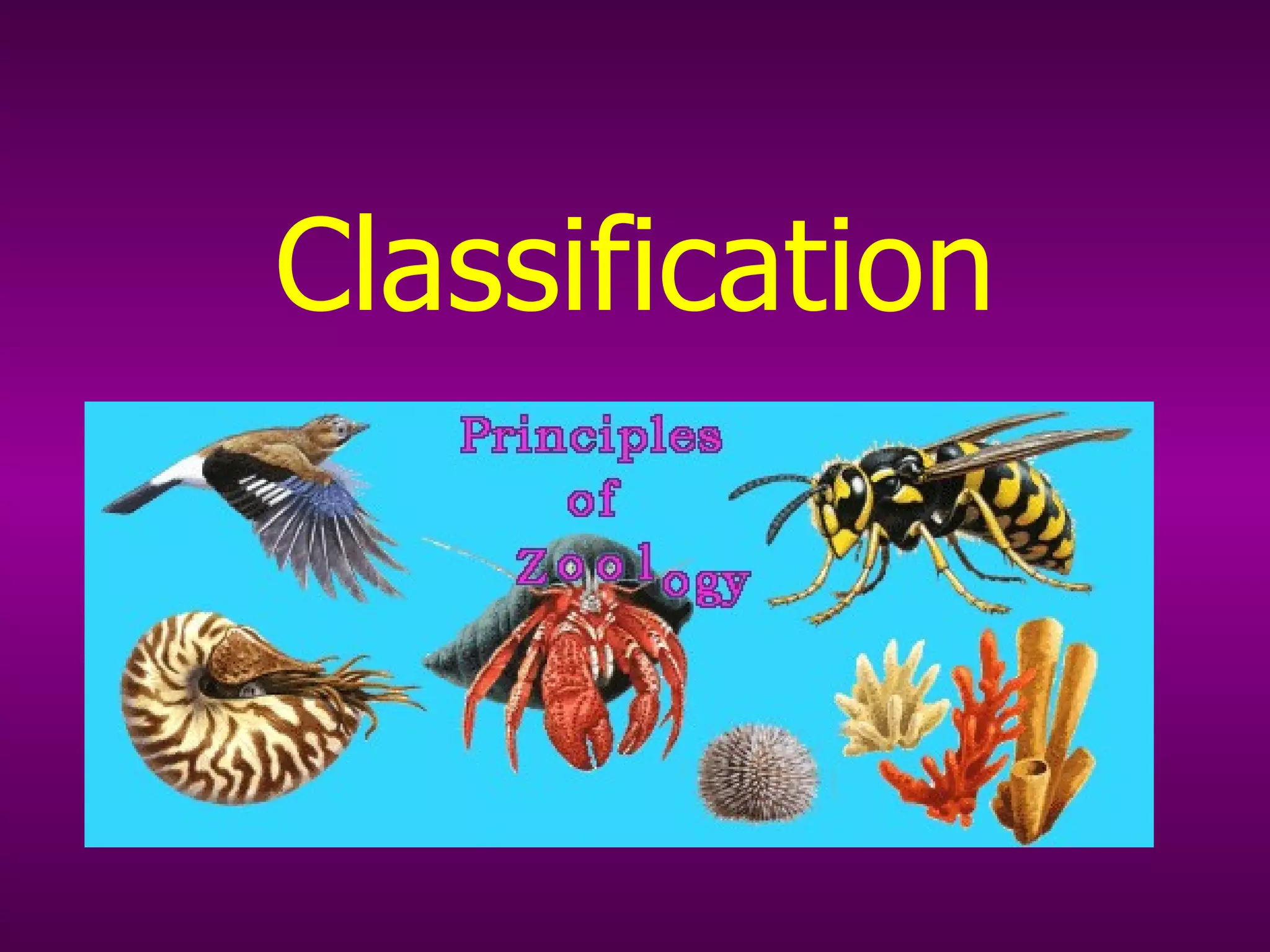
Classification
The Need for Order Evolution has produced enormous diversity  1.4 million species described Scientists need a method to order organisms logically, to understand relationships between organisms Taxonomy  : The science of classifying organisms on the basis of their similarities
Systematics The study of biological diversity in an evolutionary context. Connects classification to phylogeny Classification based on evolutionary history Traditional taxonomy employed a hierarchical system of classification Modern phylogenetic systemics is based on  cladistic analysis Systematics allows us to infer phylogeny from molecular data
The  History of Taxonomy Aristotle, a Greek philosopher, proposed one of the first systems - 350 B.C. Divided living thing into 2 groups:  plants & animals Further divided animals by habitat and behavior & plants by size and structure This system was used for 2000 years Produced many errors based on what we know now By mid-1700’s naturalists were discovering many new life forms.  Because different scientists used different principles to classify, understanding & communication was difficult
Linnaeus Carolus Linnaeus a Swedish Botanist mid 1700’s proposed a system of classification Organisms with similar structures should be placed in the same taxonomic group.  We still use Linnaeus’s basic system  Linnaean system has 2 main features: A 2 part name for each species A hierarchical classification into broader & broader groups.
Binomial Nomenclature Use of common names can lead to confusion Examples:  mountain lion, puma, cougar = same animal starfish, jellyfish, silverfish = misleading relationships  Linnaeus suggested use of scientific names Scientific name = genus + species  genus is capitalized, species is not Called  binomial nomenclature   bi=2 Genus and species names are generally Latin
The Species Linnaeus’s smallest taxonomic group was the  species Similar  species  were grouped in a larger category,  genus . Similar genera were grouped into a  family , then  order ,  class ,  phylum ,  kingdom Example:  dogs, wolves & jackals are different species, but the same genus
Defining a Species The most basic grouping used in biological classification.  A species differs from other similar organisms in at least one characteristic  Cannot interbreed freely with other species to produce fertile offspring. Species evolve and change, so definition is not always sharp
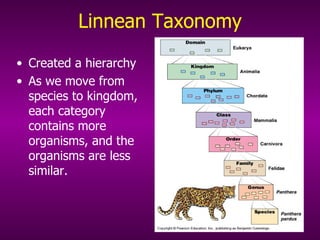
Linnean Taxonomy Created a hierarchy As we move from species to kingdom, each category contains more organisms, and the organisms are less similar.
The Linnaean Hierarchy MOST SPECIFIC   FEWEST ORGANISMS   Species   Genus   Family   Order   Class   Phylum   Kingdom   [Domain] LEAST SPECIFIC    MOST ORGANISMS
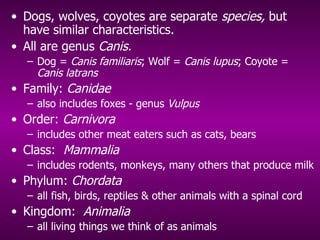
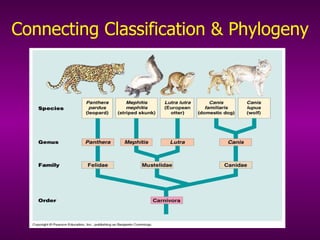
Dogs, wolves, coyotes are separate  species,  but have similar characteristics.  All are genus  Canis.  Dog =  Canis familiaris ; Wolf =  Canis lupus ; Coyote =  Canis latrans Family:  Canidae   also includes foxes - genus  Vulpus Order:  Carnivora   includes other meat eaters such as cats, bears Class:  Mammalia   includes rodents, monkeys, many others that produce milk Phylum:  Chordata   all fish, birds, reptiles & other animals with a spinal cord Kingdom:  Animalia   all living things we think of as animals
The Kingdom Often the first level of classification The Domain is an even broader taxonomic level now embraced by many scientists Linnaeus proposed a system with 2 kingdoms: Autotrophs   organisms that produce their own food   (the plant kingdom) Hetertrophs   organisms that depend on others for food (animal kingdom) As we have been able to explore the microscopic world and examine cell structure this was not sufficient
Cell Types All living things are made of cells Cells help us understand relationships between organisms Based on cell structure, organisms were classified as  prokaryotes  or  eukaryotes Prokaryotes :  bacteria - earliest living cells no nucleus or membrane enclosed organelles, rigid cell wall no mitosis Eukaryotes   usually larger have a nucleus and other membrane enclosed organelles DNA organized in chromosomes cell division includes mitosis
The Five Kingdom System The first modern classification system recognized 5 kingdoms All prokaryotes were kingdom  Prokaryotae   (or  Monera ) Eukaryotes  were divided into 4 kingdoms: Plantae ,  Animalia ,  Fungi ,  Protista
The Six Kingdom System Further study of bacteria (kingdom  Prokaryotae ) show  there are really two distinct groups So we now use a 6 kingdom system An updated version of the 5 kingdom system Divides prokaryotes into 2 kingdoms: Archebacteria :  ancient bacteria Eubacteria :  true bacteria
The Prokaryote Debate More recent analysis of prokaryotes has shown that these two groups of bacteria are very different: The  Eubacteria   Include five clades: proteobacteria, chlamydia, spirochetes, gram-positive bacteria, cyanobacteria The  Archebacteria   Include euryarchaeota, crenarchaeota Confined to extreme environments  Similar to early earth More closely related to eukaryotes than to modern bacteria Led to addition of a taxonomic level broader than the kingdom: the domain Three domains:  bacteria, archaea, eukarya
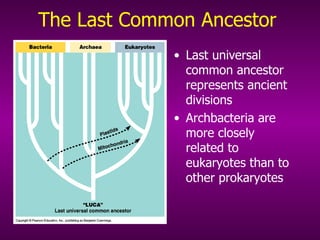
The Last Common Ancestor Last universal common ancestor represents ancient divisions Archbacteria are more closely related to eukaryotes than to other prokaryotes
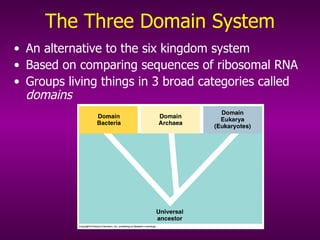
The Three Domain System An alternative to the six kingdom system Based on comparing sequences of ribosomal RNA Groups living things in 3 broad categories called  domains
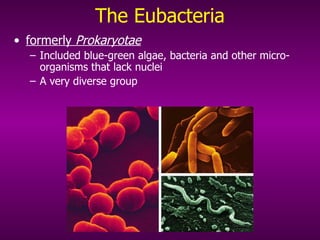
The Eubacteria formerly  Prokaryotae Included blue-green algae, bacteria and other micro-organisms that lack nuclei A very diverse group
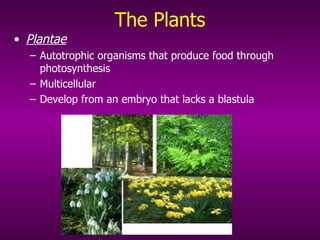
The Plants Plantae   Autotrophic organisms that produce food through photosynthesis Multicellular Develop from an embryo that lacks a blastula
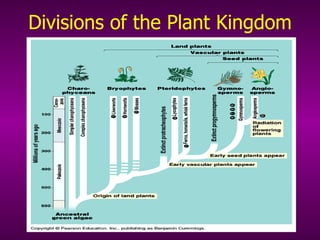
Divisions of the Plant Kingdom
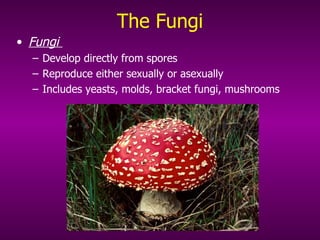
The Fungi Fungi  Develop directly from spores Reproduce either sexually or asexually Includes yeasts, molds, bracket fungi, mushrooms
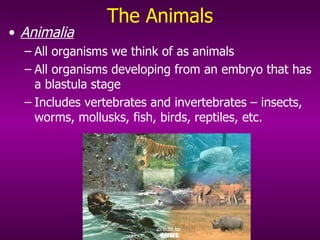
The Animals Animalia   All organisms we think of as animals All organisms developing from an embryo that has a blastula stage Includes vertebrates and invertebrates – insects, worms, mollusks, fish, birds, reptiles, etc.
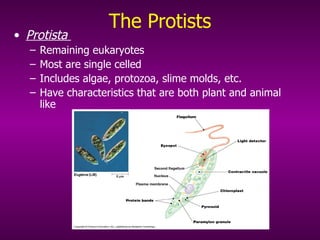
The Protists Protista  Remaining eukaryotes Most are single celled Includes algae, protozoa, slime molds, etc. Have characteristics that are both plant and animal like
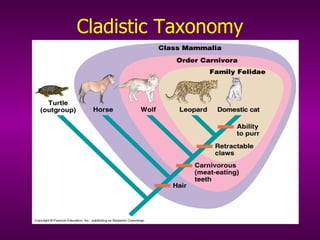
Cladistic Analysis Attempts to build trees expressing phylogenetic relationships This type of tree =  cladogram A tree constructed from a series of dichotomies (choices) 2-way branching points Each branch point represents the divergence of 2 species from a common ancestor Sequence of branching symbolizes chronology Each evolutionary line in cladogram =  clade A monophyletic group Consists of an ancestral species and all its descendants
Connecting Classification & Phylogeny
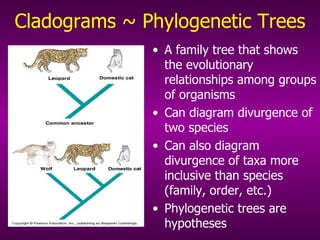
Cladograms ~ Phylogenetic Trees A family tree that shows the evolutionary relationships among groups of organisms Can diagram divurgence of two species Can also diagram divurgence of taxa more inclusive than species (family, order, etc.) Phylogenetic trees are hypotheses
Cladistic Taxonomy
Basis of Classification Classification is based on  homologies  similarities that indicate related ancestry Structural homologies   similarities of structure  example: limb pattern of reptiles, birds, mammals. Fossil record Modern organisms Biochemical homologies   similarities of body substances (e.g. blood) or molecules (e.g. DNA).  These are recent tools and have helped clarify some classification problems Taxonomic classification is not permanent with new evidence, can change
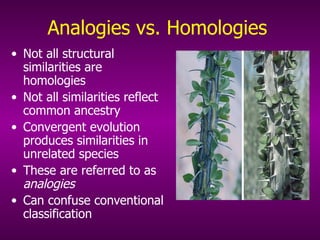
Analogies vs. Homologies Not all structural similarities are homologies Not all similarities reflect common ancestry Convergent evolution produces similarities in unrelated species These are referred to as  analogies Can confuse conventional classification
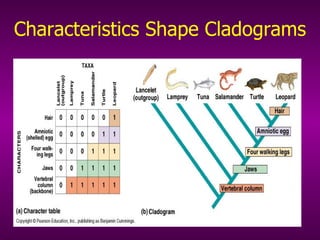
Shared Derived Characteristics Study of common characteristics can be used to create a cladogram Shared  derived characteristics  establish evolutionary relationships Derived character: a feature that evolved only within the group under consideration
Characteristics Shape Cladograms
Molecular Data Can infer phylogeny from molecular data The more recently two species branched from a common ancestor, the more similar the DNA Rates of change of DNA over evolutionary time vary from one part of the genome to another Different sequences are studied in determining closer relationships than those used for more distant relationships.
The Principle of Parsimony The simplest explanation that accounts for all of the available data is the best answer Occam’s razor Construct phylogentic trees that represent the smallest number of evolutionary changes
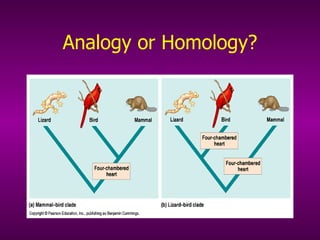
Phylogenetic Trees are Hypotheses Competing evidence or ideas can yield different results Tree “A” places the bird & mammal on a clade that excludes the lizard Tree “A” interprets the 4 chambered hearts of birds and mammals as homologous This is the most parsimonious hypothesis Tree “B” places the bird & lizard in a clade The 4 chambered hearts of birds and mammals are analogous Evidence actually supports “B” Birds & lizards are closer than birds & mammals
Analogy or Homology?
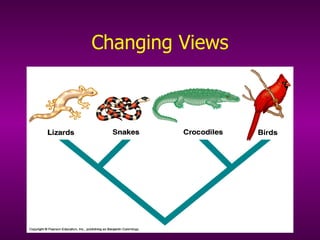
Taxonomy is Subject to Change Systematics and molecular evidence are changing classification In traditional vertebrate taxonomy, crocodiles snakes, lizards, and other reptiles are grouped together in the class Reptilia Birds are placed in a separate class, Aves Newer methodologies show that crocodiles are more closely related to birds than to lizards or snakes Class Reptillia in its traditional form is paraphyletic, not monophyletic
Changing Views

Classification

  • 1.
  • 2.
    The Need forOrder Evolution has produced enormous diversity 1.4 million species described Scientists need a method to order organisms logically, to understand relationships between organisms Taxonomy : The science of classifying organisms on the basis of their similarities
  • 3.
    Systematics The studyof biological diversity in an evolutionary context. Connects classification to phylogeny Classification based on evolutionary history Traditional taxonomy employed a hierarchical system of classification Modern phylogenetic systemics is based on cladistic analysis Systematics allows us to infer phylogeny from molecular data
  • 4.
    The Historyof Taxonomy Aristotle, a Greek philosopher, proposed one of the first systems - 350 B.C. Divided living thing into 2 groups: plants & animals Further divided animals by habitat and behavior & plants by size and structure This system was used for 2000 years Produced many errors based on what we know now By mid-1700’s naturalists were discovering many new life forms. Because different scientists used different principles to classify, understanding & communication was difficult
  • 5.
    Linnaeus Carolus Linnaeusa Swedish Botanist mid 1700’s proposed a system of classification Organisms with similar structures should be placed in the same taxonomic group. We still use Linnaeus’s basic system Linnaean system has 2 main features: A 2 part name for each species A hierarchical classification into broader & broader groups.
  • 6.
    Binomial Nomenclature Useof common names can lead to confusion Examples: mountain lion, puma, cougar = same animal starfish, jellyfish, silverfish = misleading relationships Linnaeus suggested use of scientific names Scientific name = genus + species genus is capitalized, species is not Called binomial nomenclature bi=2 Genus and species names are generally Latin
  • 7.
    The Species Linnaeus’ssmallest taxonomic group was the species Similar species were grouped in a larger category, genus . Similar genera were grouped into a family , then order , class , phylum , kingdom Example: dogs, wolves & jackals are different species, but the same genus
  • 8.
    Defining a SpeciesThe most basic grouping used in biological classification. A species differs from other similar organisms in at least one characteristic Cannot interbreed freely with other species to produce fertile offspring. Species evolve and change, so definition is not always sharp
  • 9.
    Linnean Taxonomy Createda hierarchy As we move from species to kingdom, each category contains more organisms, and the organisms are less similar.
  • 10.
    The Linnaean HierarchyMOST SPECIFIC FEWEST ORGANISMS Species Genus Family Order Class Phylum Kingdom [Domain] LEAST SPECIFIC MOST ORGANISMS
  • 11.
    Dogs, wolves, coyotesare separate species, but have similar characteristics. All are genus Canis. Dog = Canis familiaris ; Wolf = Canis lupus ; Coyote = Canis latrans Family: Canidae also includes foxes - genus Vulpus Order: Carnivora includes other meat eaters such as cats, bears Class: Mammalia includes rodents, monkeys, many others that produce milk Phylum: Chordata all fish, birds, reptiles & other animals with a spinal cord Kingdom: Animalia all living things we think of as animals
  • 12.
    The Kingdom Oftenthe first level of classification The Domain is an even broader taxonomic level now embraced by many scientists Linnaeus proposed a system with 2 kingdoms: Autotrophs organisms that produce their own food (the plant kingdom) Hetertrophs organisms that depend on others for food (animal kingdom) As we have been able to explore the microscopic world and examine cell structure this was not sufficient
  • 13.
    Cell Types Allliving things are made of cells Cells help us understand relationships between organisms Based on cell structure, organisms were classified as prokaryotes or eukaryotes Prokaryotes : bacteria - earliest living cells no nucleus or membrane enclosed organelles, rigid cell wall no mitosis Eukaryotes usually larger have a nucleus and other membrane enclosed organelles DNA organized in chromosomes cell division includes mitosis
  • 14.
    The Five KingdomSystem The first modern classification system recognized 5 kingdoms All prokaryotes were kingdom Prokaryotae (or Monera ) Eukaryotes were divided into 4 kingdoms: Plantae , Animalia , Fungi , Protista
  • 15.
    The Six KingdomSystem Further study of bacteria (kingdom Prokaryotae ) show there are really two distinct groups So we now use a 6 kingdom system An updated version of the 5 kingdom system Divides prokaryotes into 2 kingdoms: Archebacteria : ancient bacteria Eubacteria : true bacteria
  • 16.
    The Prokaryote DebateMore recent analysis of prokaryotes has shown that these two groups of bacteria are very different: The Eubacteria Include five clades: proteobacteria, chlamydia, spirochetes, gram-positive bacteria, cyanobacteria The Archebacteria Include euryarchaeota, crenarchaeota Confined to extreme environments Similar to early earth More closely related to eukaryotes than to modern bacteria Led to addition of a taxonomic level broader than the kingdom: the domain Three domains: bacteria, archaea, eukarya
  • 17.
    The Last CommonAncestor Last universal common ancestor represents ancient divisions Archbacteria are more closely related to eukaryotes than to other prokaryotes
  • 18.
    The Three DomainSystem An alternative to the six kingdom system Based on comparing sequences of ribosomal RNA Groups living things in 3 broad categories called domains
  • 19.
    The Eubacteria formerly Prokaryotae Included blue-green algae, bacteria and other micro-organisms that lack nuclei A very diverse group
  • 20.
    The Plants Plantae Autotrophic organisms that produce food through photosynthesis Multicellular Develop from an embryo that lacks a blastula
  • 21.
    Divisions of thePlant Kingdom
  • 22.
    The Fungi Fungi Develop directly from spores Reproduce either sexually or asexually Includes yeasts, molds, bracket fungi, mushrooms
  • 23.
    The Animals Animalia All organisms we think of as animals All organisms developing from an embryo that has a blastula stage Includes vertebrates and invertebrates – insects, worms, mollusks, fish, birds, reptiles, etc.
  • 24.
    The Protists Protista Remaining eukaryotes Most are single celled Includes algae, protozoa, slime molds, etc. Have characteristics that are both plant and animal like
  • 25.
    Cladistic Analysis Attemptsto build trees expressing phylogenetic relationships This type of tree = cladogram A tree constructed from a series of dichotomies (choices) 2-way branching points Each branch point represents the divergence of 2 species from a common ancestor Sequence of branching symbolizes chronology Each evolutionary line in cladogram = clade A monophyletic group Consists of an ancestral species and all its descendants
  • 26.
  • 27.
    Cladograms ~ PhylogeneticTrees A family tree that shows the evolutionary relationships among groups of organisms Can diagram divurgence of two species Can also diagram divurgence of taxa more inclusive than species (family, order, etc.) Phylogenetic trees are hypotheses
  • 28.
  • 29.
    Basis of ClassificationClassification is based on homologies similarities that indicate related ancestry Structural homologies similarities of structure example: limb pattern of reptiles, birds, mammals. Fossil record Modern organisms Biochemical homologies similarities of body substances (e.g. blood) or molecules (e.g. DNA). These are recent tools and have helped clarify some classification problems Taxonomic classification is not permanent with new evidence, can change
  • 30.
    Analogies vs. HomologiesNot all structural similarities are homologies Not all similarities reflect common ancestry Convergent evolution produces similarities in unrelated species These are referred to as analogies Can confuse conventional classification
  • 31.
    Shared Derived CharacteristicsStudy of common characteristics can be used to create a cladogram Shared derived characteristics establish evolutionary relationships Derived character: a feature that evolved only within the group under consideration
  • 32.
  • 33.
    Molecular Data Caninfer phylogeny from molecular data The more recently two species branched from a common ancestor, the more similar the DNA Rates of change of DNA over evolutionary time vary from one part of the genome to another Different sequences are studied in determining closer relationships than those used for more distant relationships.
  • 34.
    The Principle ofParsimony The simplest explanation that accounts for all of the available data is the best answer Occam’s razor Construct phylogentic trees that represent the smallest number of evolutionary changes
  • 35.
    Phylogenetic Trees areHypotheses Competing evidence or ideas can yield different results Tree “A” places the bird & mammal on a clade that excludes the lizard Tree “A” interprets the 4 chambered hearts of birds and mammals as homologous This is the most parsimonious hypothesis Tree “B” places the bird & lizard in a clade The 4 chambered hearts of birds and mammals are analogous Evidence actually supports “B” Birds & lizards are closer than birds & mammals
  • 36.
  • 37.
    Taxonomy is Subjectto Change Systematics and molecular evidence are changing classification In traditional vertebrate taxonomy, crocodiles snakes, lizards, and other reptiles are grouped together in the class Reptilia Birds are placed in a separate class, Aves Newer methodologies show that crocodiles are more closely related to birds than to lizards or snakes Class Reptillia in its traditional form is paraphyletic, not monophyletic
  • 38.