Energy & The Cell Glycolysis, Cellular Respiration & Fermentation
Energy All life requires energy Therefore cells require energy for growth, active transport, synthesis of carbohydrates, lipids, & proteins The source of energy for cells is the energy stored in chemical bonds of organic molecules these molecules = food molecules, especially carbohydrates (also lipids) most common is glucose
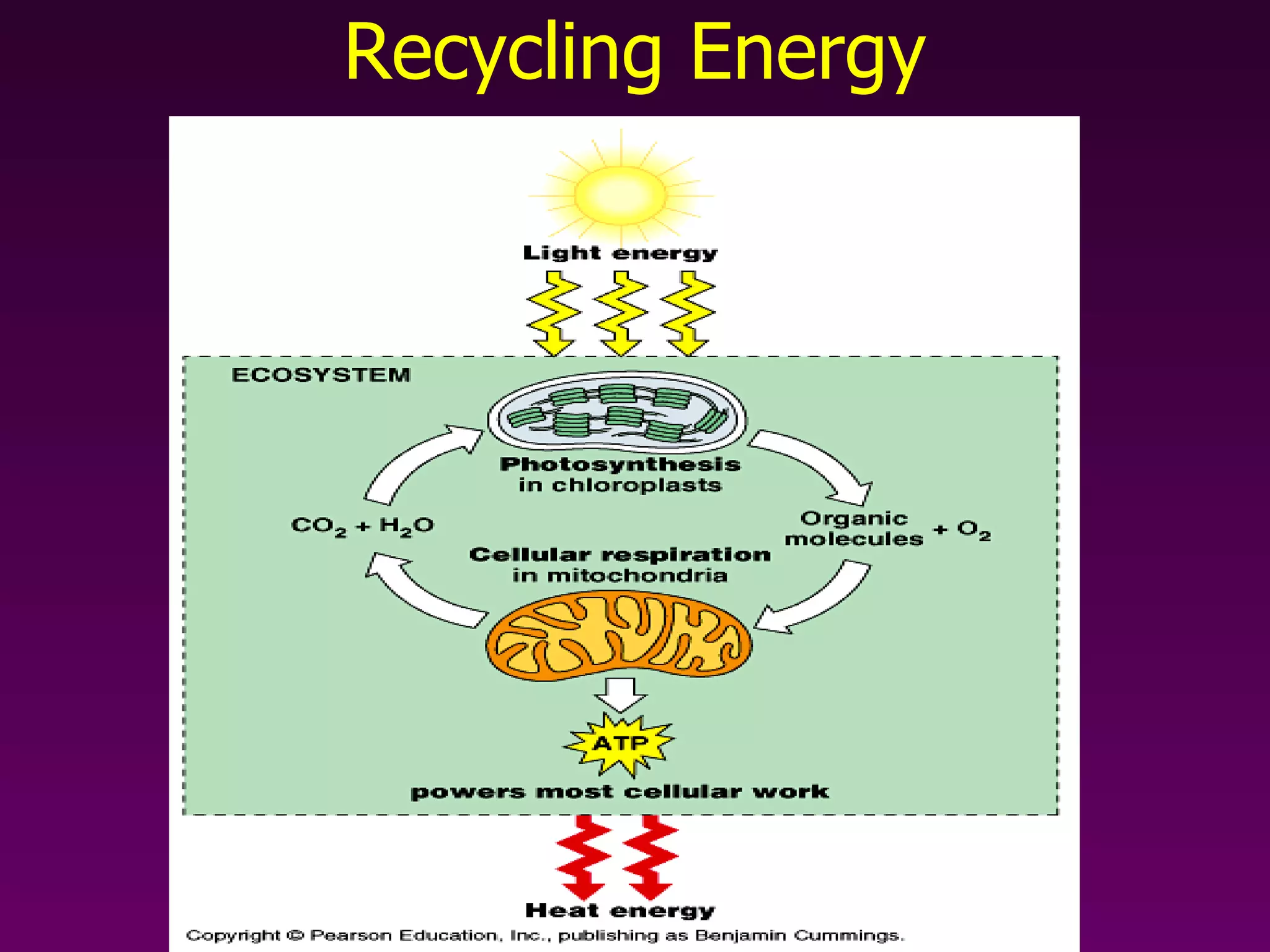
Recycling Energy
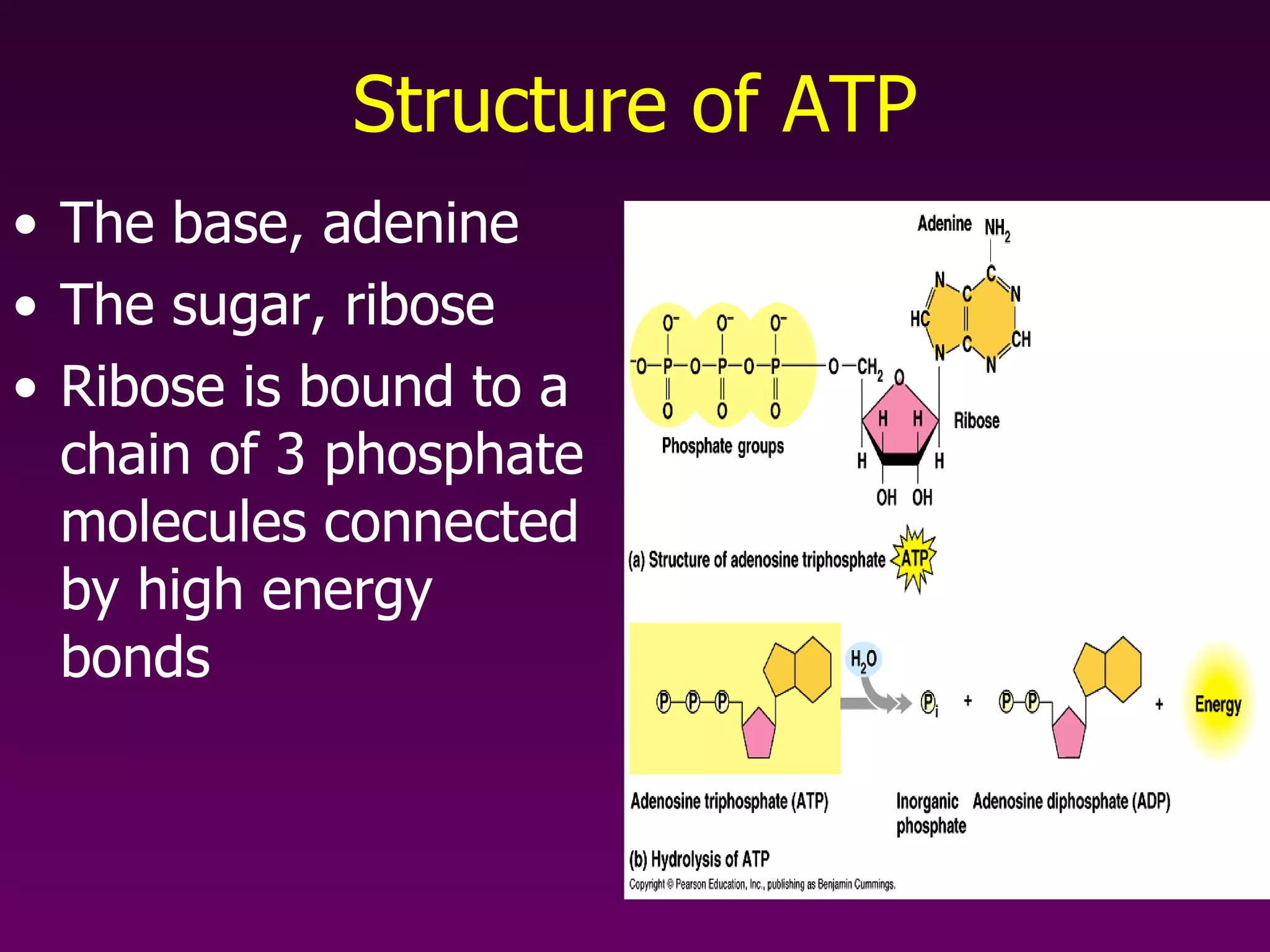
ATP Cells store energy in the chemical bonds of sugar, but cannot use it directly To use this energy, the cell must transfer the energy in sugar molecules to ATP ATP  = adenosine triphosphate
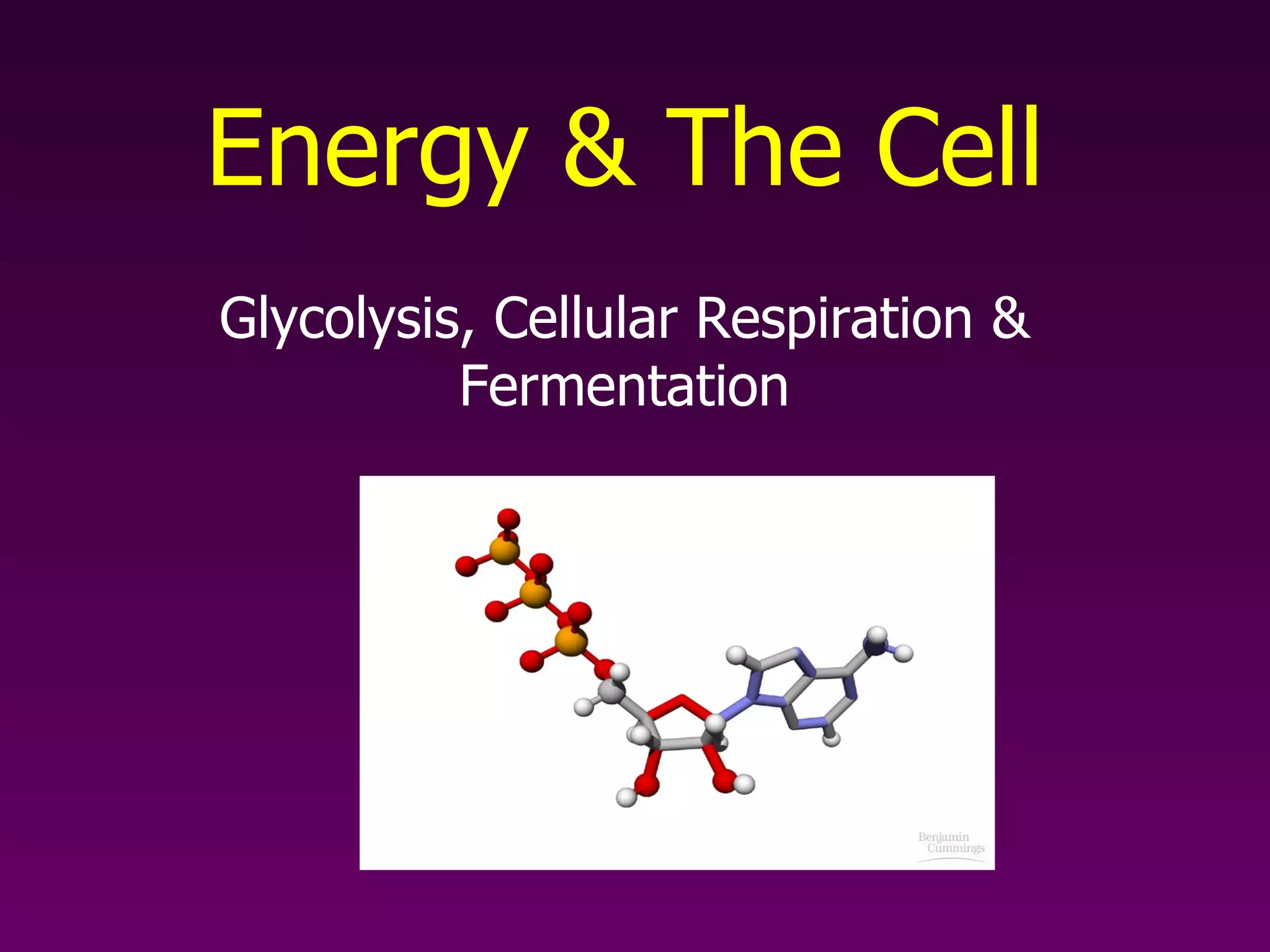
Structure of ATP The base, adenine The sugar, ribose Ribose is bound to a chain of 3 phosphate molecules connected by high energy bonds
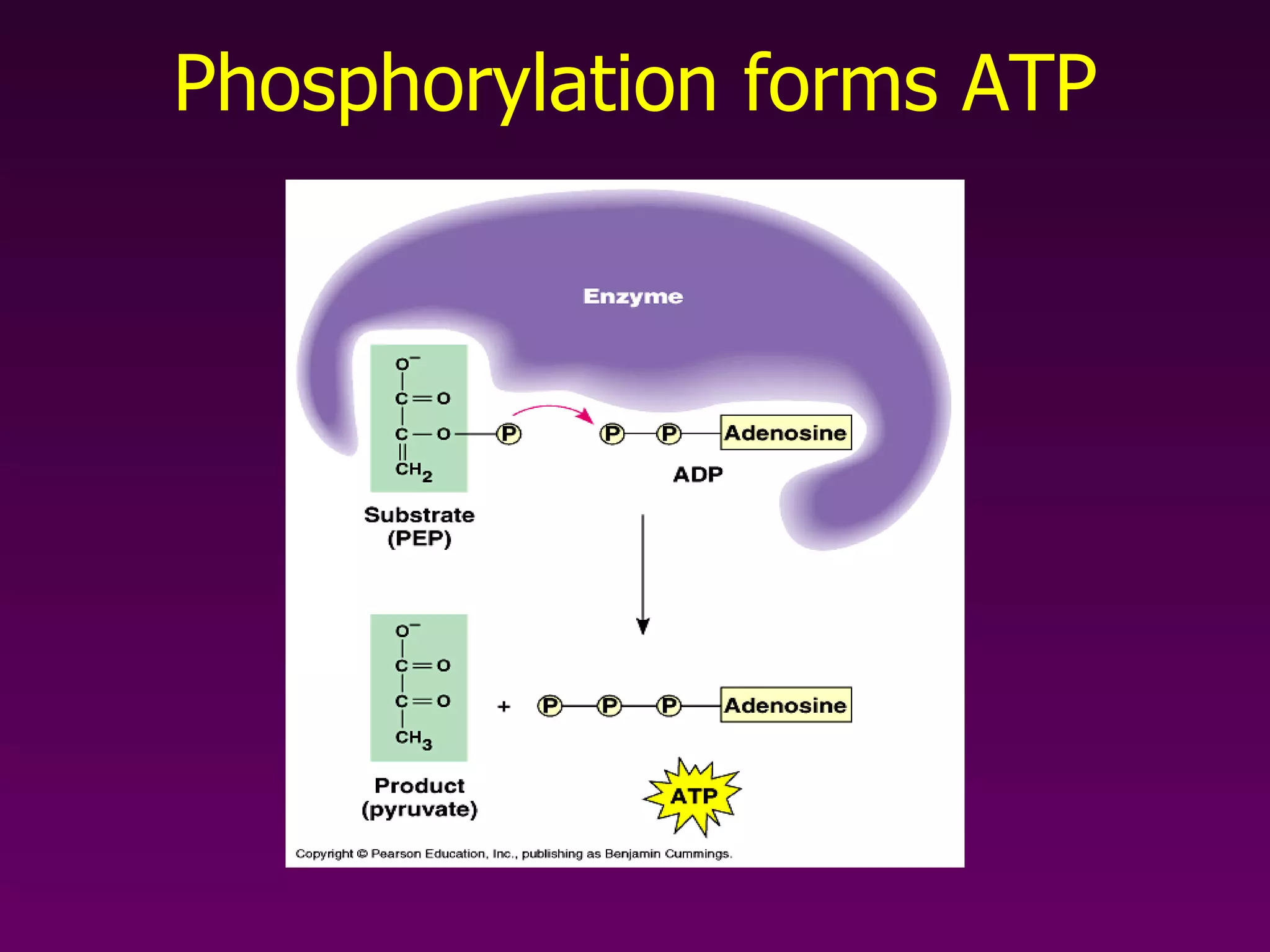
Phosphorylation forms ATP
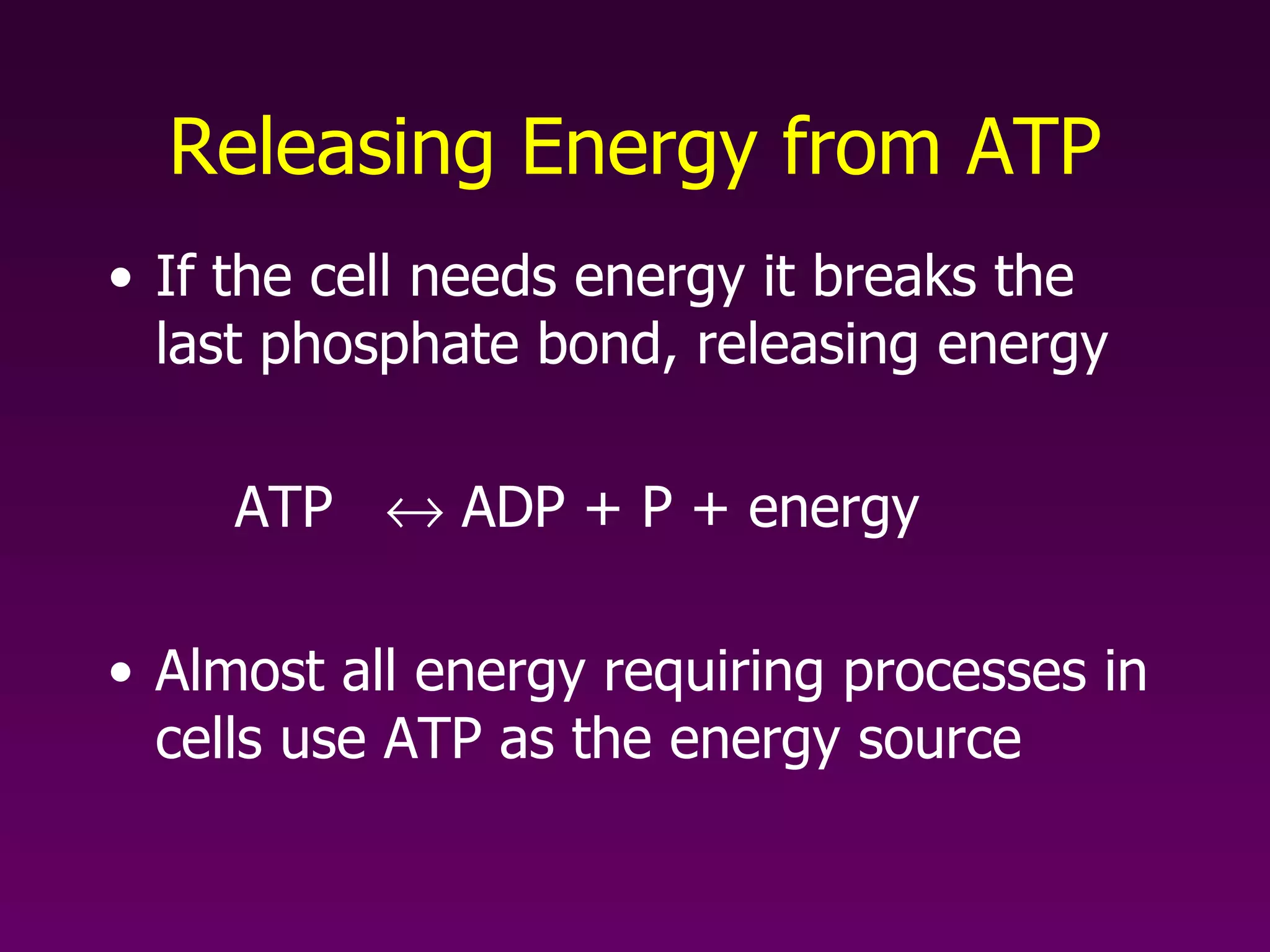
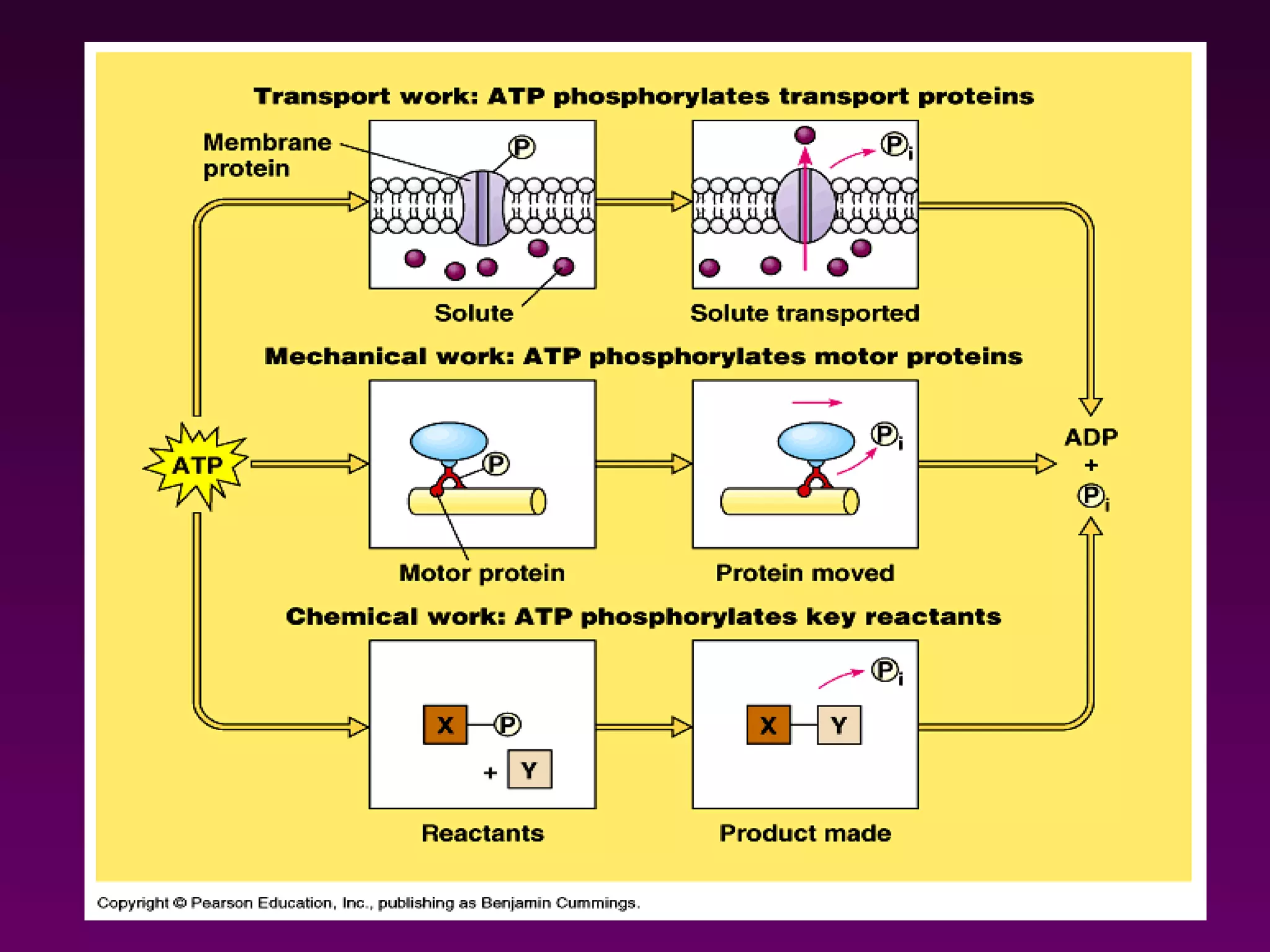
Releasing Energy from ATP If the cell needs energy it breaks the last phosphate bond, releasing energy ATP    ADP + P + energy Almost all energy requiring processes in cells use ATP as the energy source
 
Fermentation So, where does ATP come from? Fermentation  =  breakdown of glucose, yielding ATP, without O 2   The first living organisms were single cells that existed without O 2 Anaerobic Lack the enzymes needed to break down energy molecules with O 2 Many types of bacteria and other single celled organisms still use anaerobic processes to convert energy
Types of Fermentation 2 kinds: Alcoholic fermentation:   occurs in micro-organisms such as yeast Lactic acid fermentation:   occurs in bacteria and animal cells
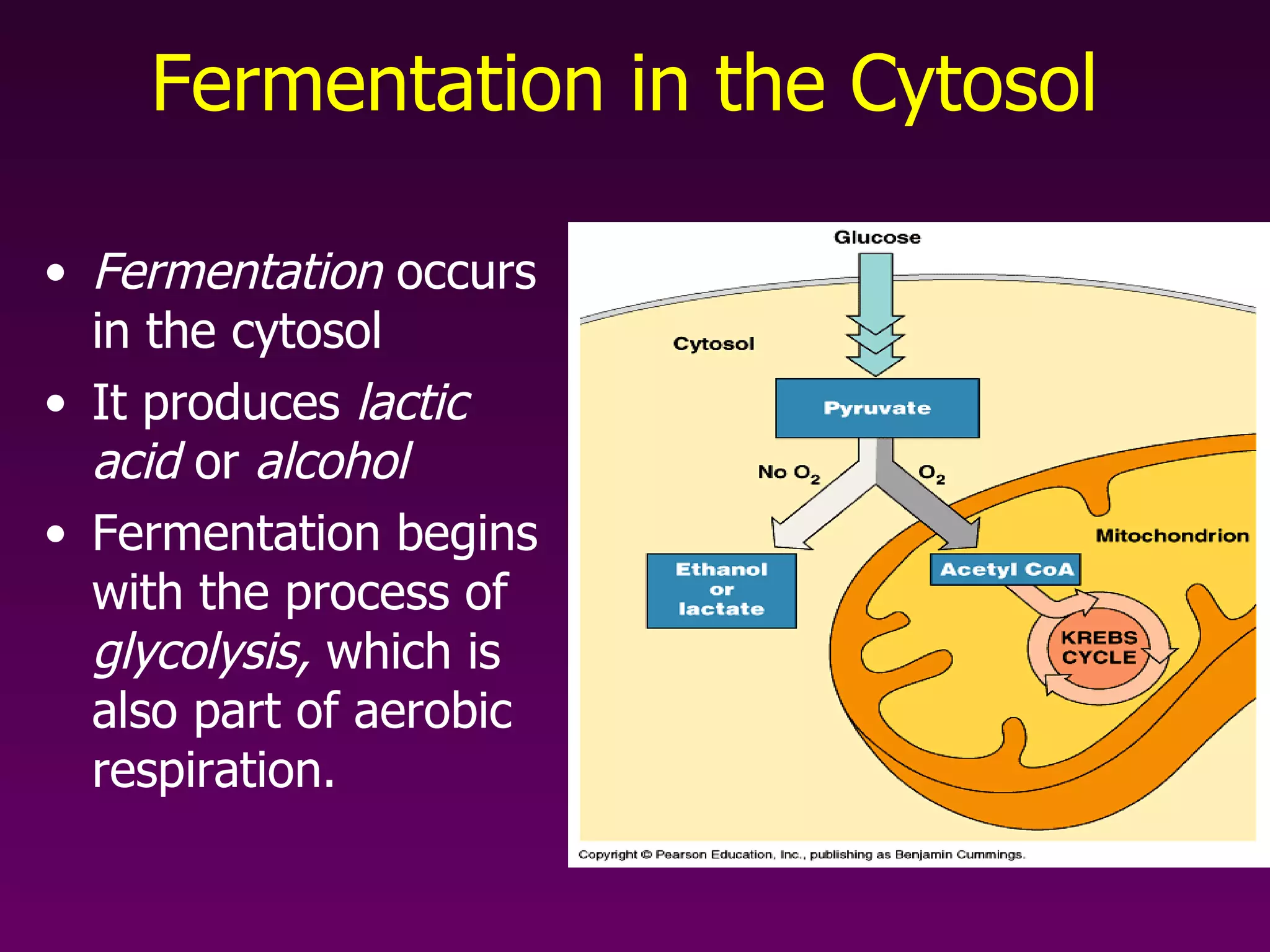
Fermentation in the Cytosol Fermentation  occurs in the cytosol It produces  lactic acid  or  alcohol Fermentation begins with the process of  glycolysis,  which is also part of aerobic respiration.
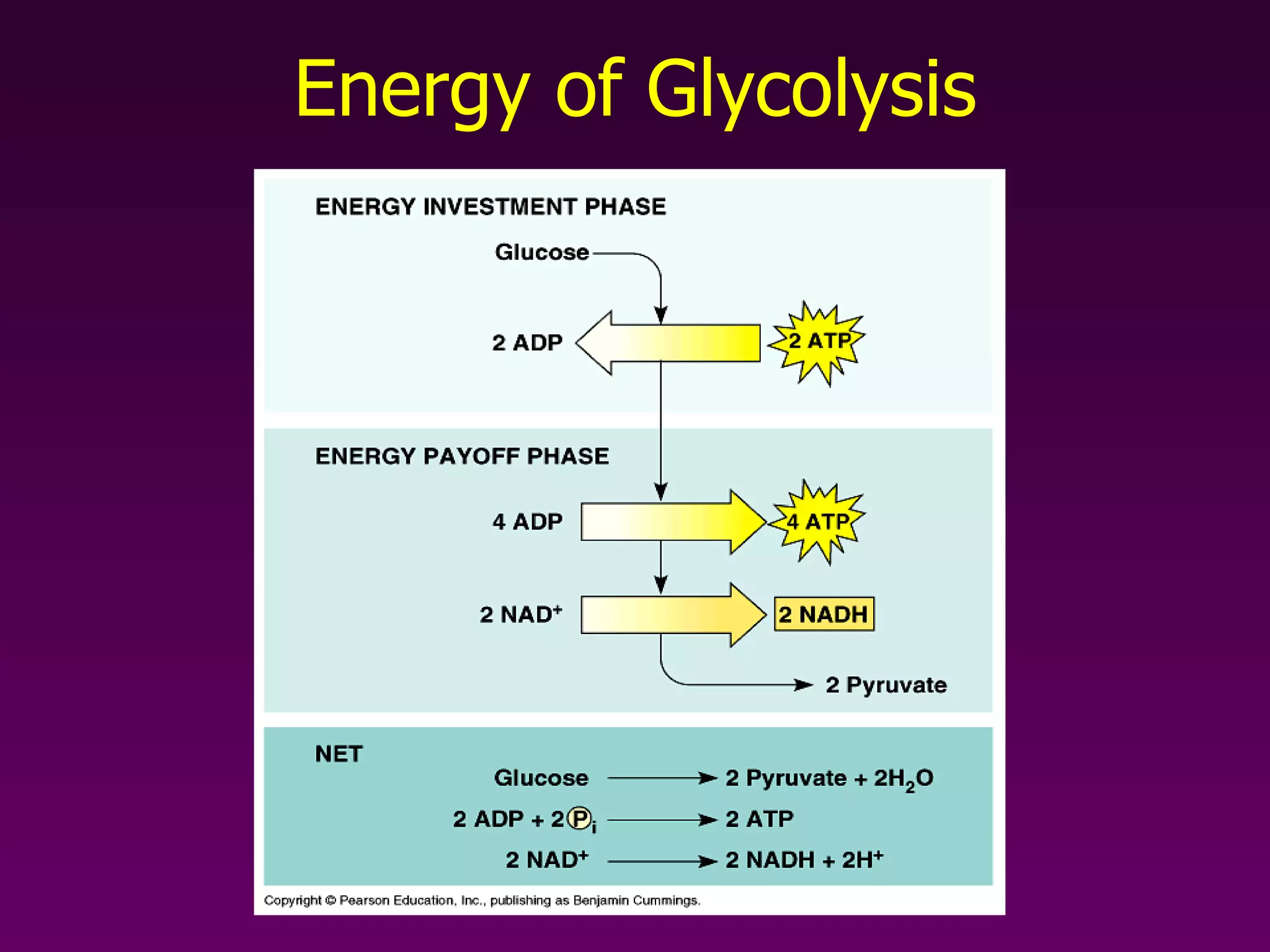
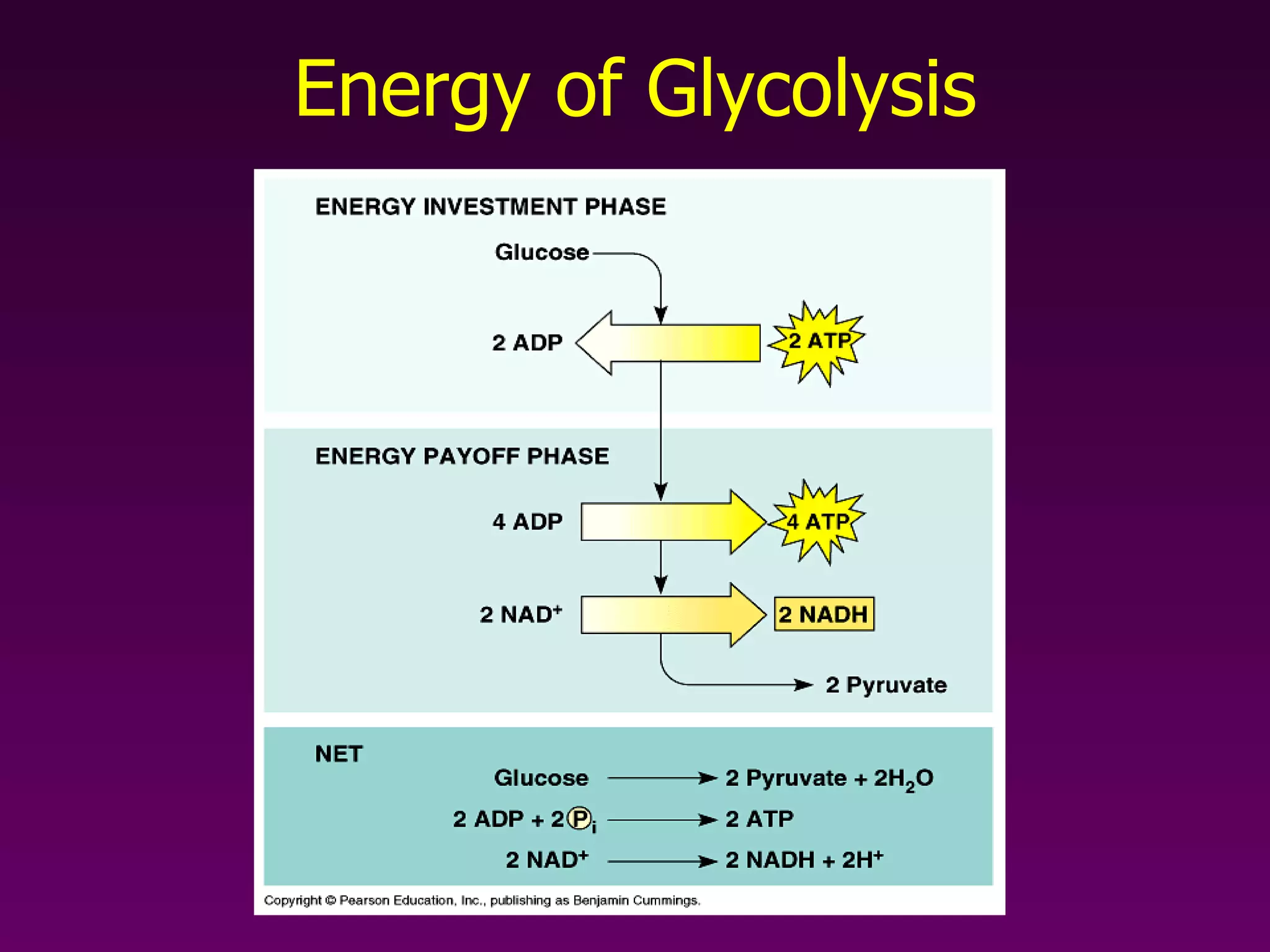
Glycolysis Occurs in the cytoplasm of the cell One molecule of glucose is split into two molecules of a three carbon compound called  pyruvic acid 2 molecules of ATP provide the energy to split the glucose molecule When glucose splits, it releases enough energy to form 4 molecules of ATP from ADP + P Therefore 2 molecules of ATP are gained
Energy of Glycolysis
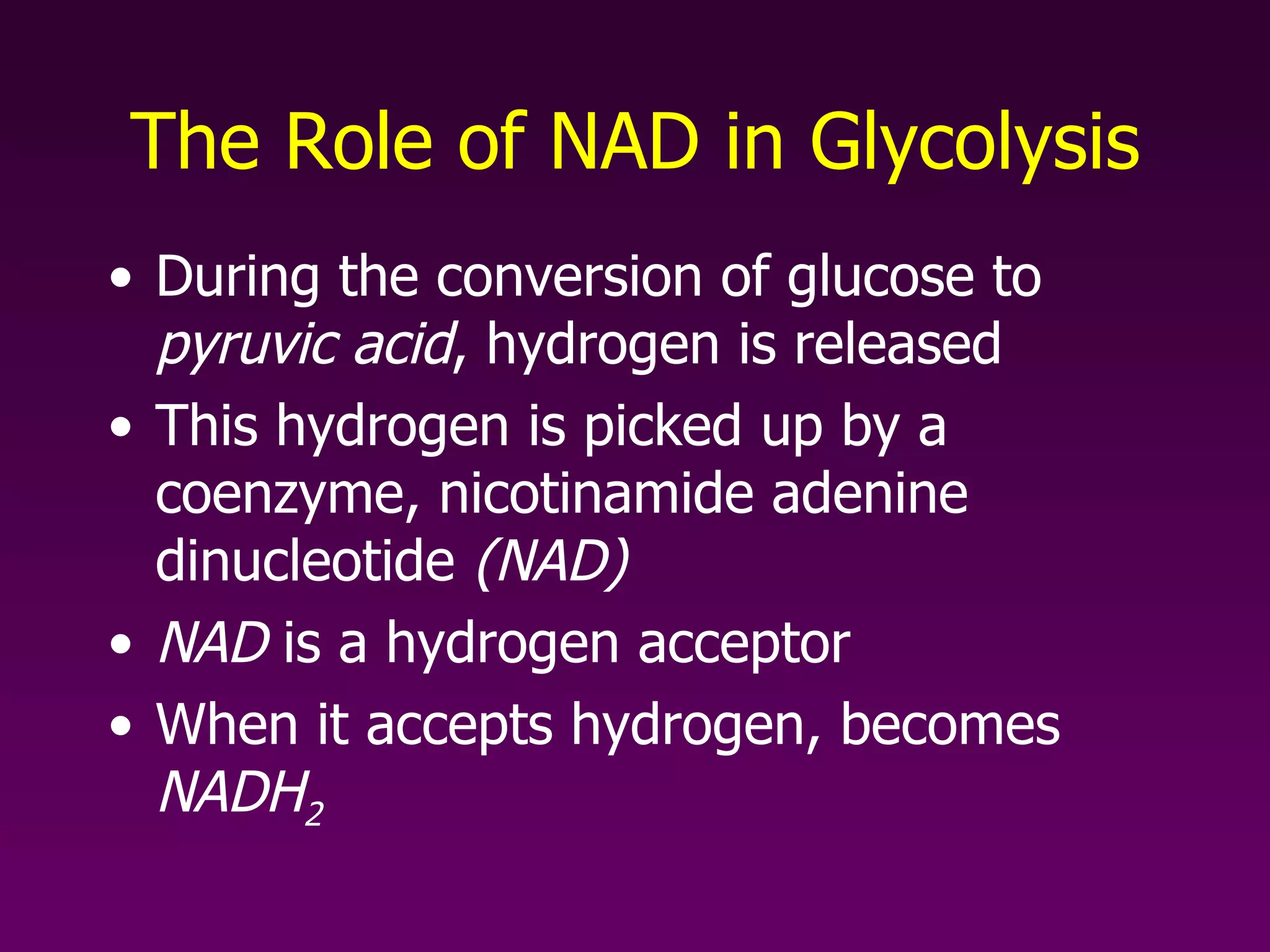
The Role of NAD in Glycolysis During the conversion of glucose to  pyruvic acid , hydrogen is released This hydrogen is picked up by a coenzyme, nicotinamide adenine dinucleotide  (NAD) NAD  is a hydrogen acceptor When it accepts hydrogen, becomes  NADH 2
Summary of Glycolysis - Investment
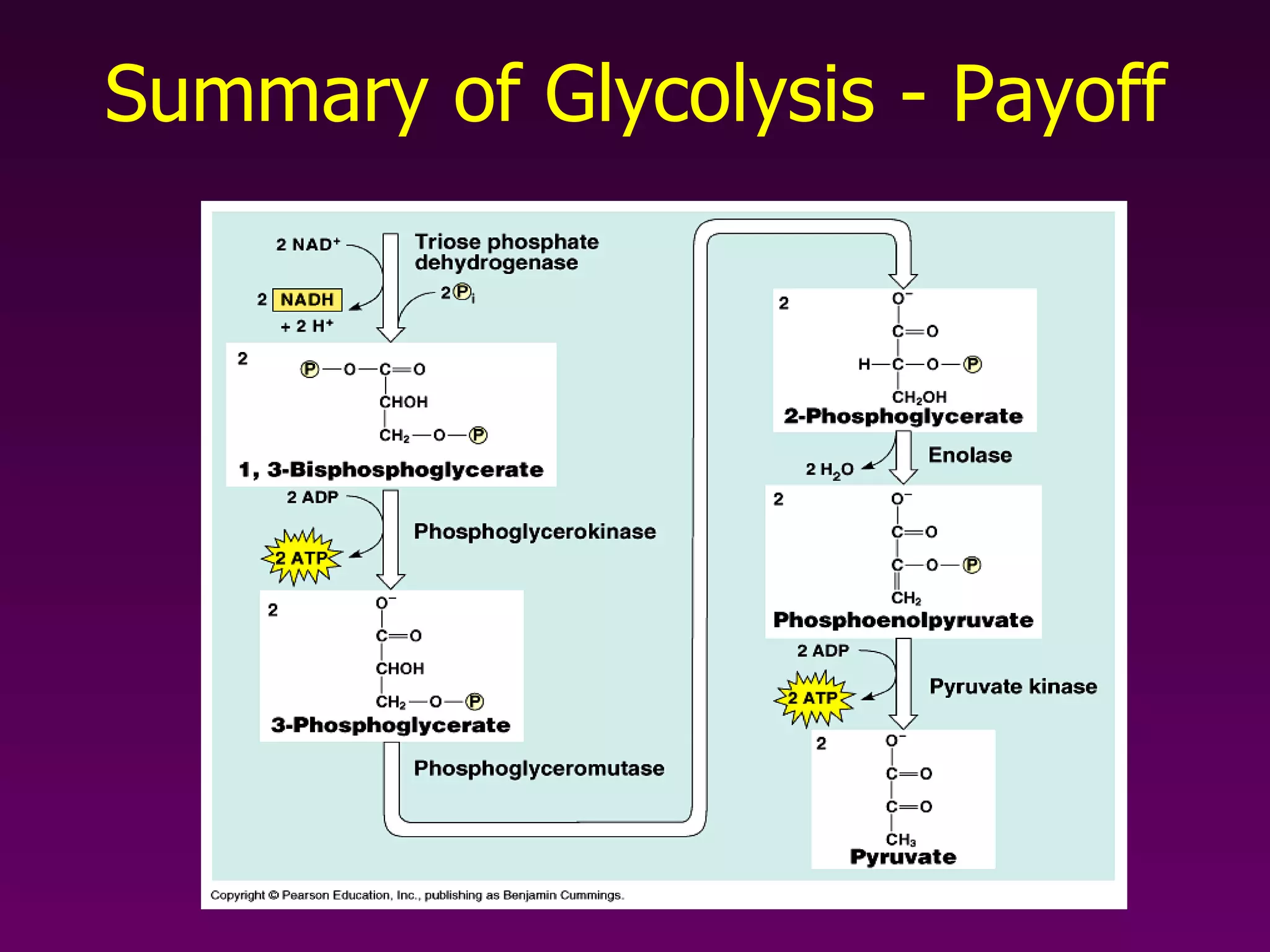
Summary of Glycolysis - Payoff
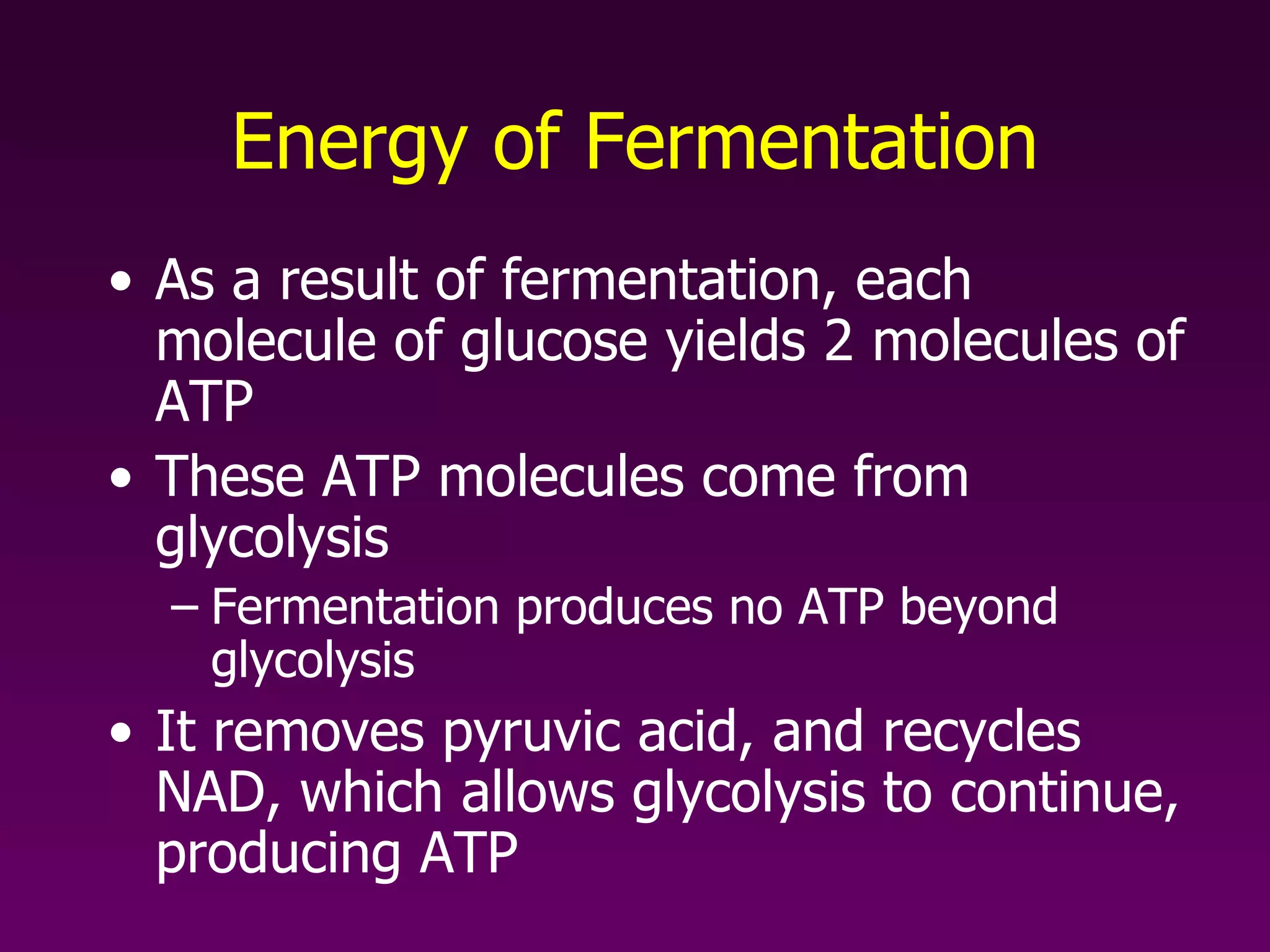
Energy of Fermentation As a result of fermentation, each molecule of glucose yields 2 molecules of ATP   These ATP molecules come from glycolysis Fermentation produces no ATP beyond glycolysis It removes pyruvic acid, and recycles NAD, which allows glycolysis to continue, producing ATP
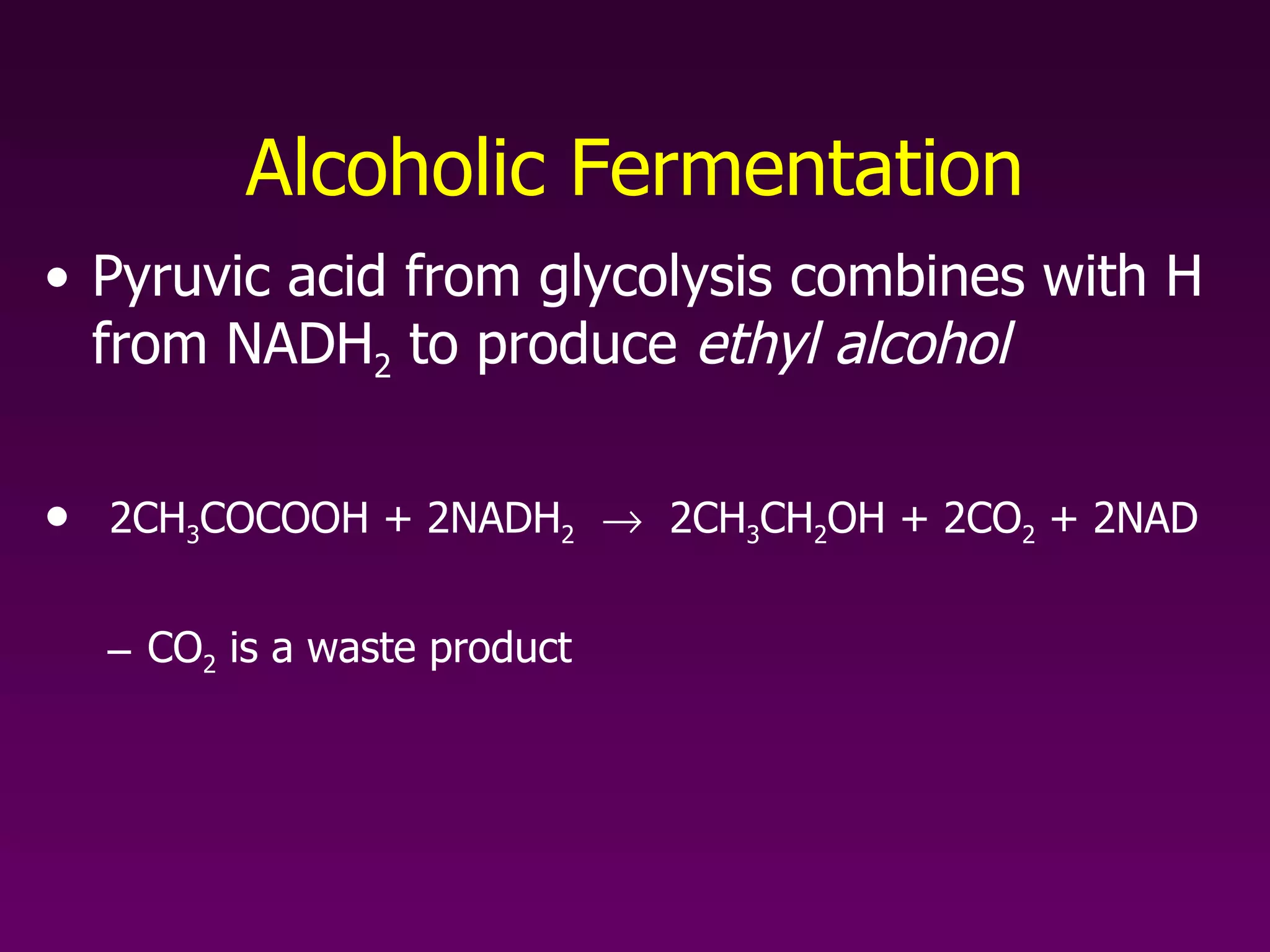
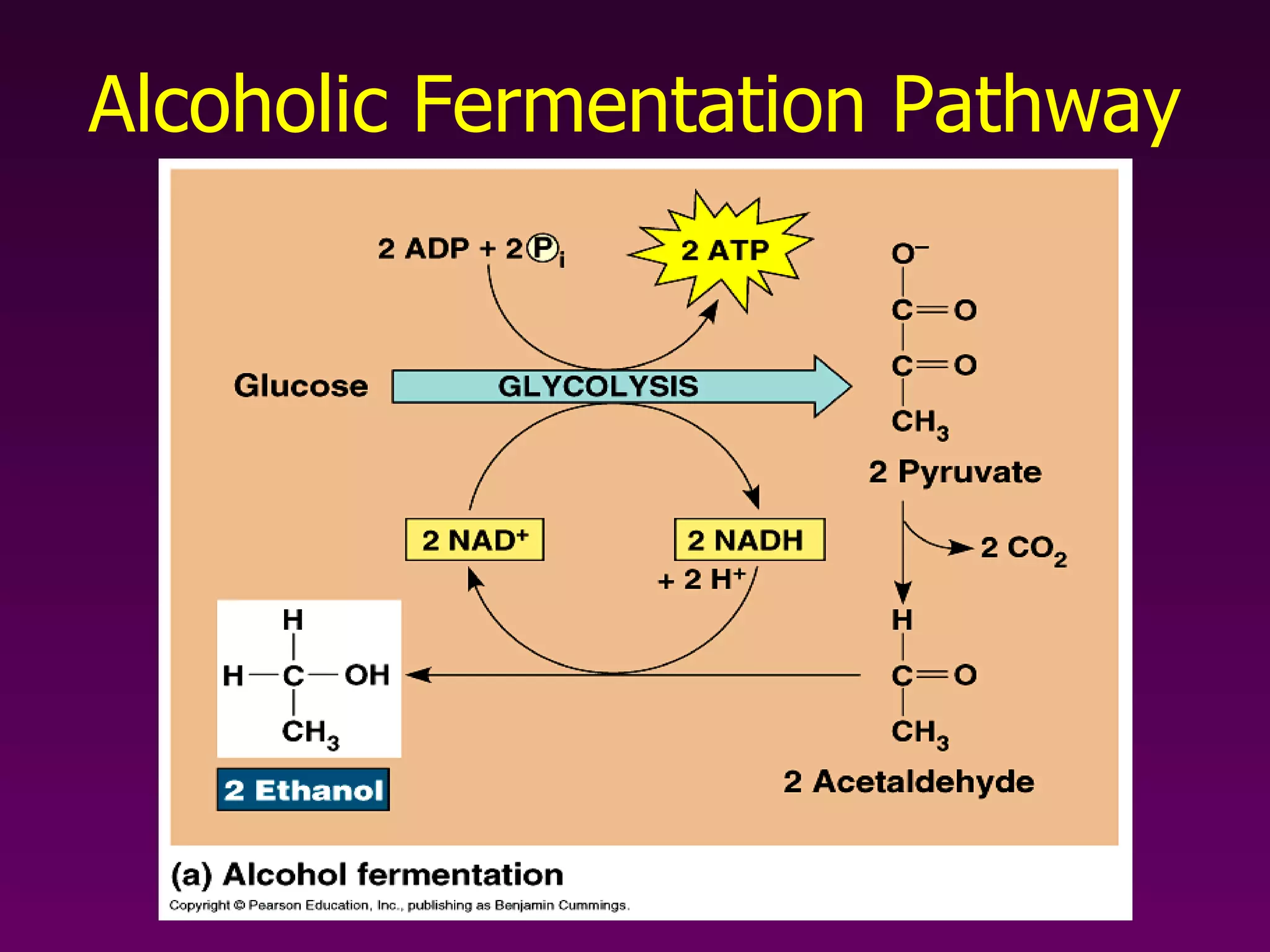
Alcoholic Fermentation Pyruvic acid from glycolysis combines with H from NADH 2  to produce  ethyl alcohol   2CH 3 COCOOH + 2NADH 2      2CH 3 CH 2 OH + 2CO 2  + 2NAD CO 2  is a waste product
Alcoholic Fermentation Pathway
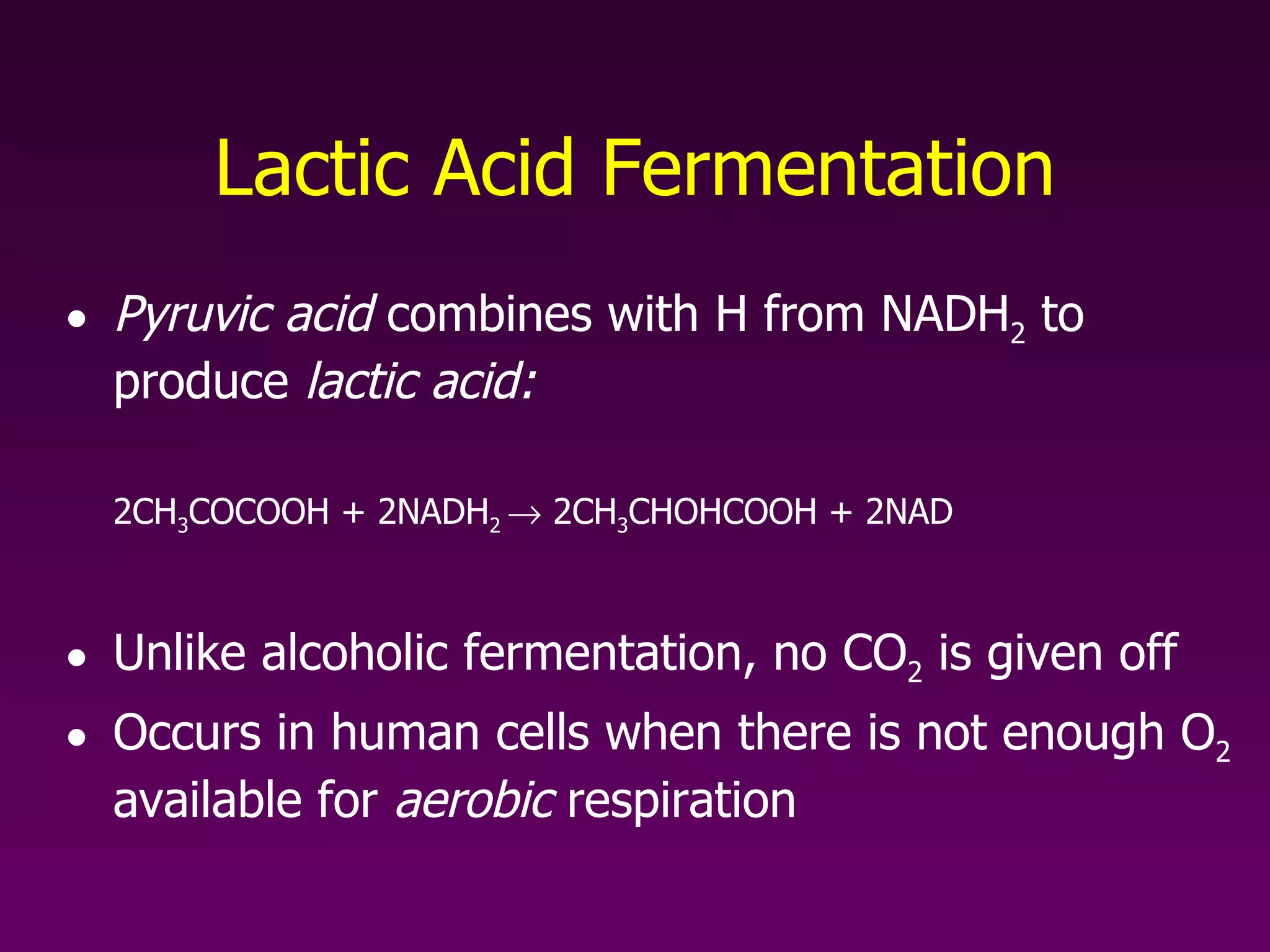
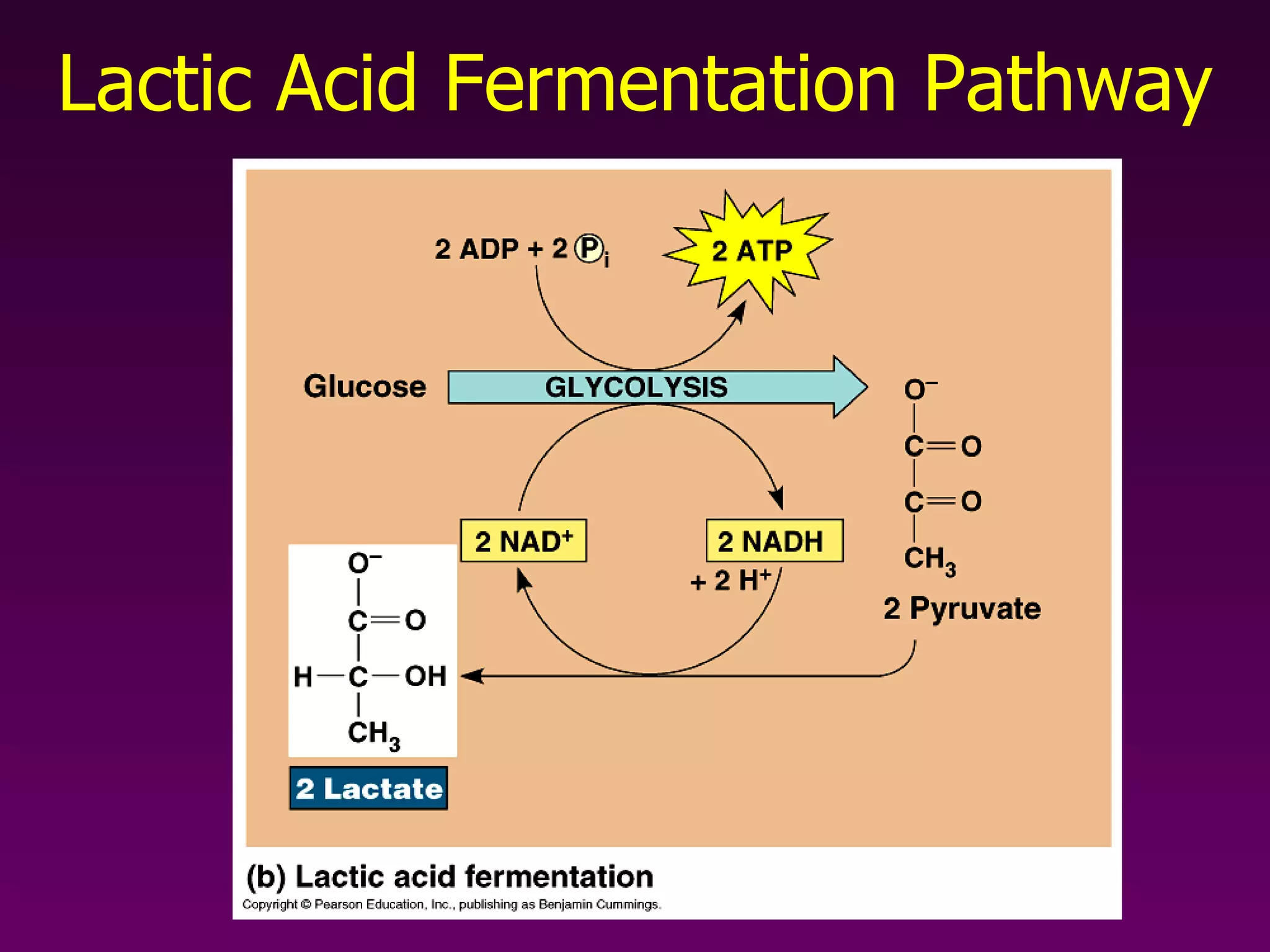
Lactic Acid Fermentation Pyruvic acid  combines with H from NADH 2  to produce  lactic acid: 2CH 3 COCOOH + 2NADH 2    2CH 3 CHOHCOOH + 2NAD Unlike alcoholic fermentation, no CO 2  is given off  Occurs in human cells when there is not enough O 2  available for  aerobic  respiration
Lactic Acid Fermentation Pathway
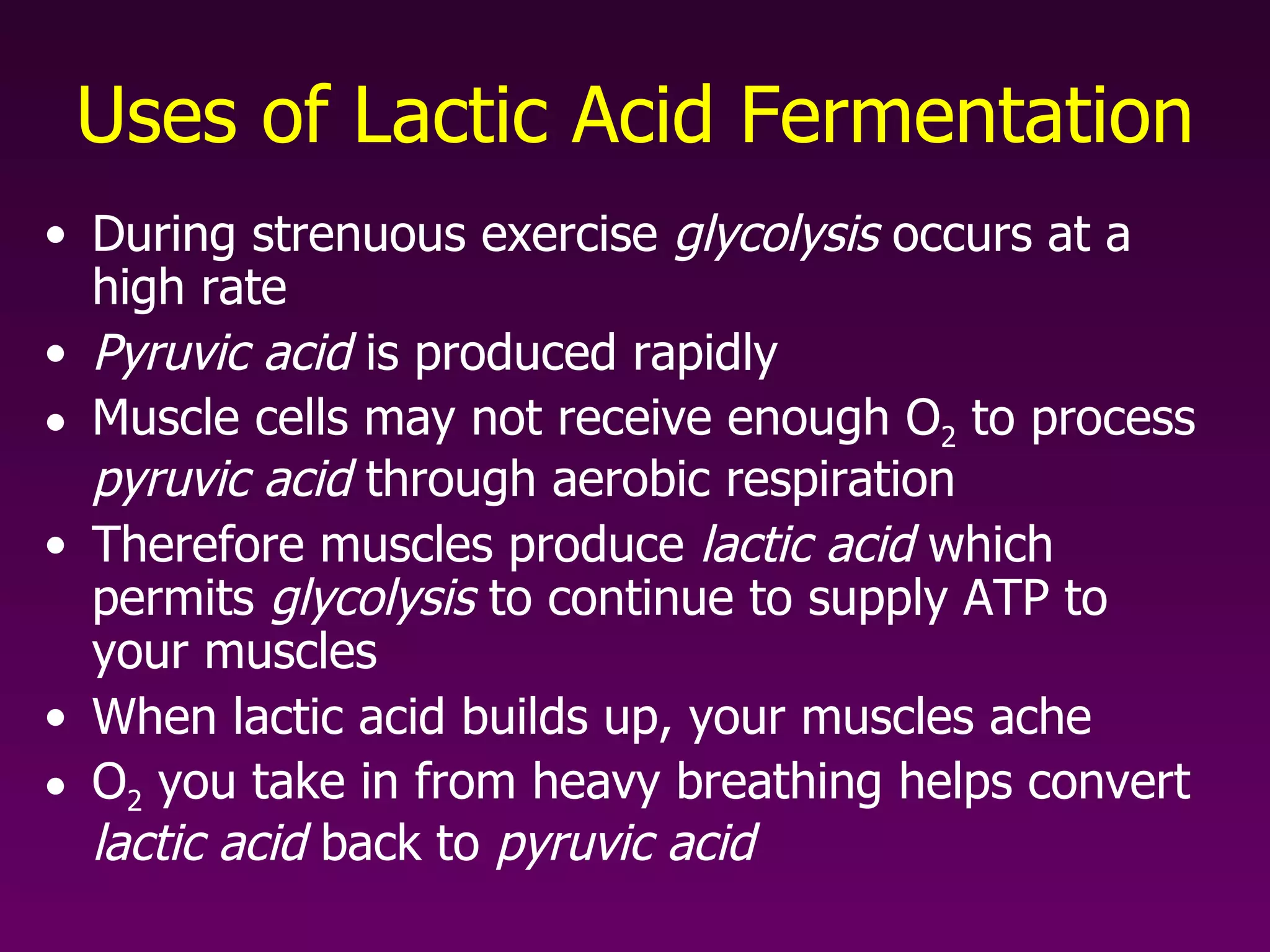
Uses of Lactic Acid Fermentation During strenuous exercise  glycolysis  occurs at a high rate Pyruvic acid  is produced rapidly Muscle cells may not receive enough O 2  to process  pyruvic acid  through aerobic respiration Therefore muscles produce  lactic acid  which permits  glycolysis  to continue to supply ATP to your muscles When lactic acid builds up, your muscles ache O 2  you take in from heavy breathing helps convert  lactic acid  back to  pyruvic acid
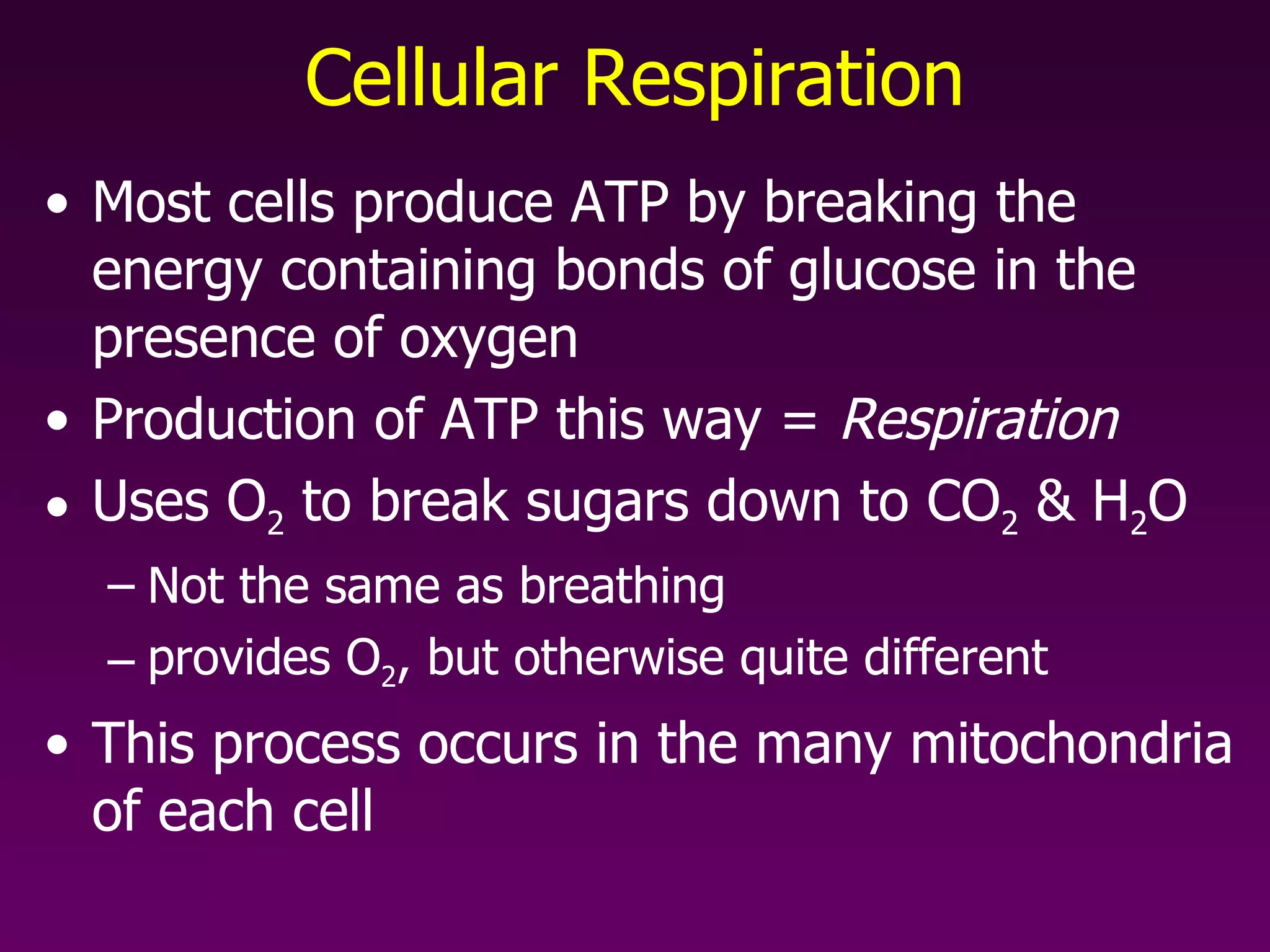
Cellular Respiration Most cells produce ATP by breaking the energy containing bonds of glucose in the presence of oxygen Production of ATP this way =  Respiration Uses O 2  to break sugars down to CO 2  & H 2 O Not the same as breathing  provides O 2 , but otherwise quite different This process occurs in the many mitochondria of each cell
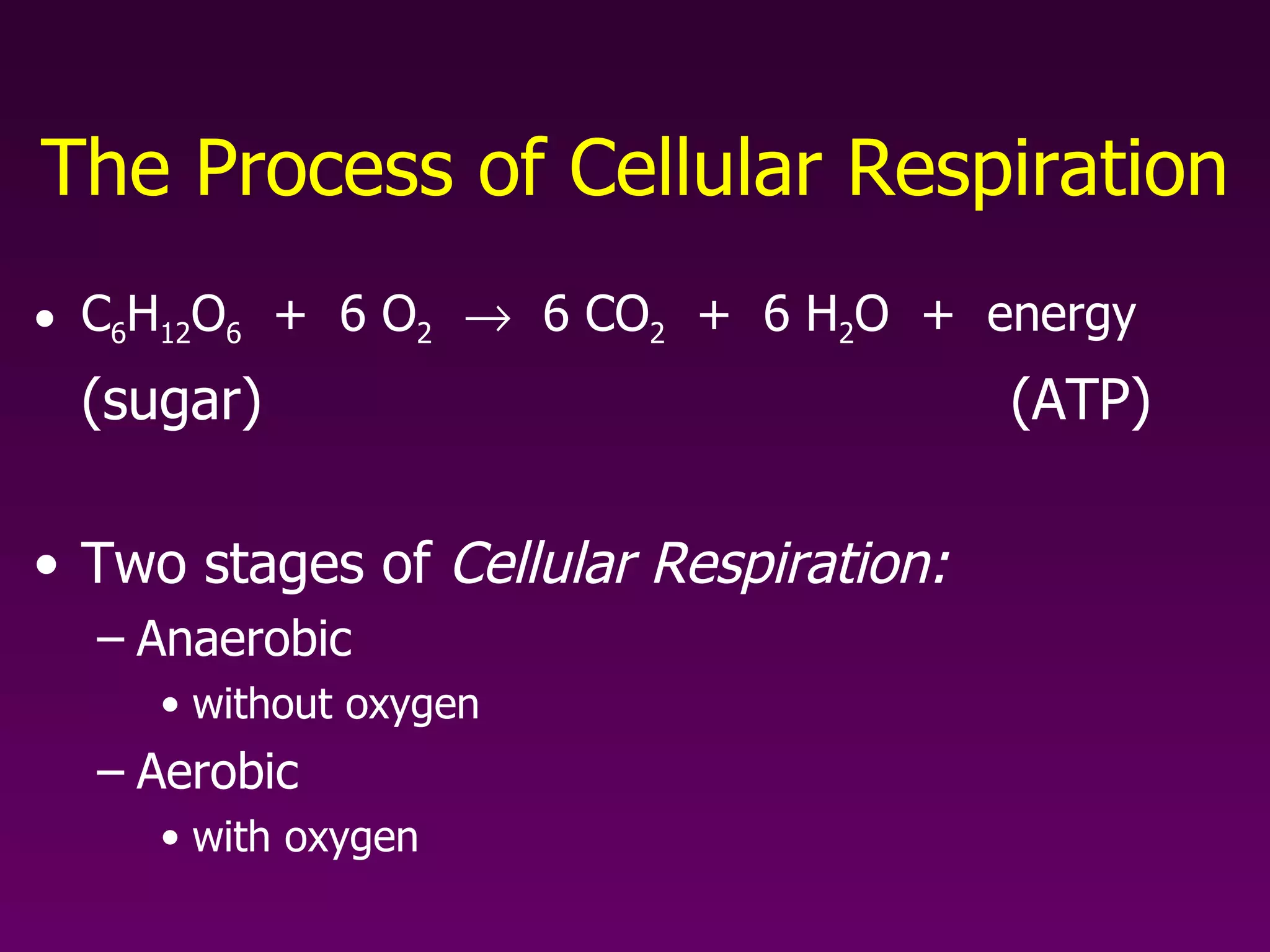
The Process of Cellular Respiration C 6 H 12 O 6   +  6 O 2      6 CO 2   +  6 H 2 O  +  energy (sugar)   (ATP) Two stages of  Cellular Respiration: Anaerobic  without oxygen Aerobic  with oxygen
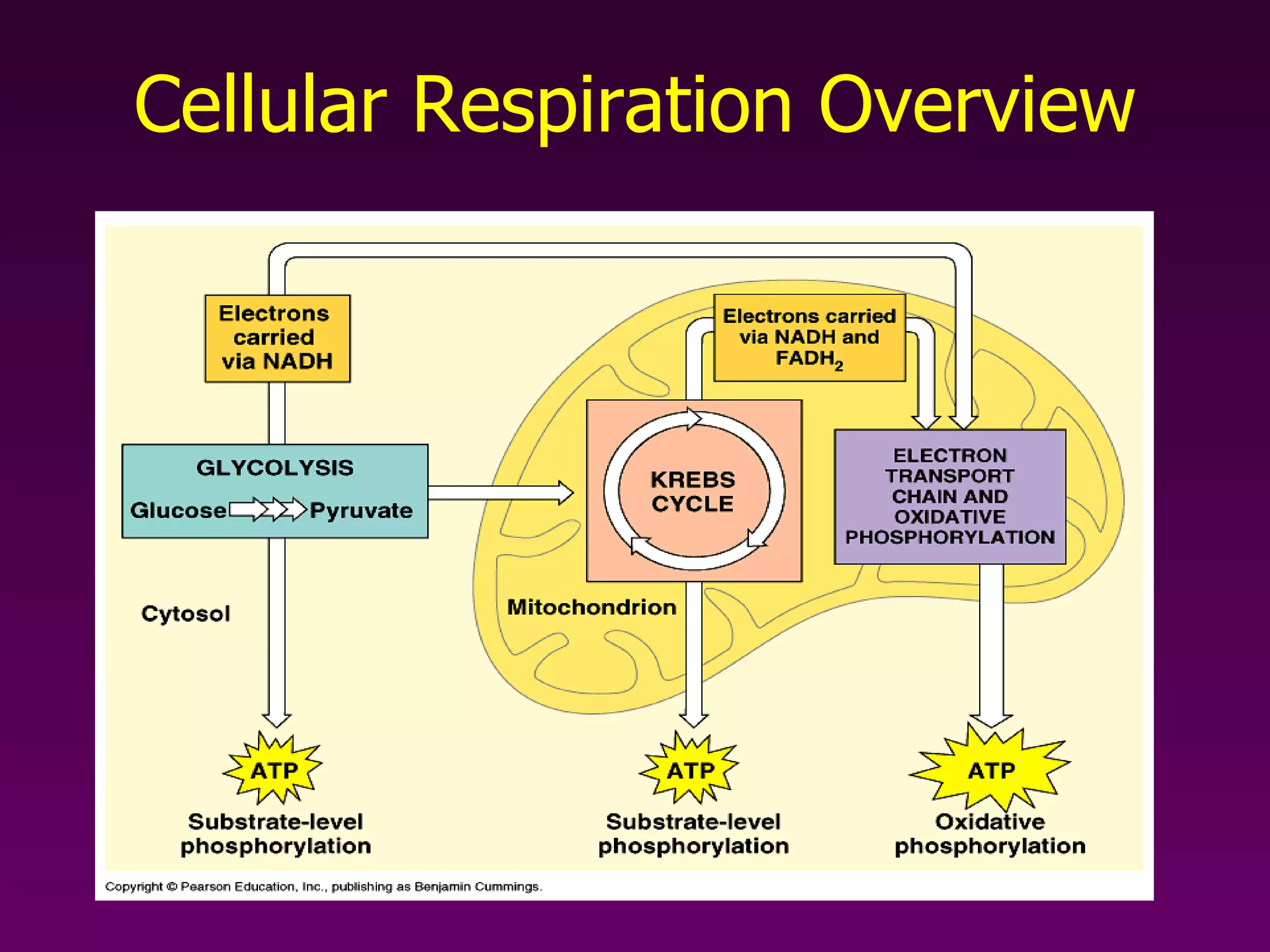
Cellular Respiration Overview
Anaerobic Stage The anaerobic stage of cellular respiration is  glycolysis , the same pathway used in fermentation This part of cellular respiration occurs in the cytoplasm  Recall the energy budget for glycolysis: One molecule of glucose is split into two molecules of a three carbon compound called  pyruvic acid 2 molecules of ATP provide the energy to split the glucose molecule When glucose splits, it releases enough energy to form 4 molecules of ATP from ADP + P Therefore 2 molecules of ATP are gained
Energy of Glycolysis
Aerobic Stage After  glycolysis , the chemical bonds of  pyruvic acid  are broken down in a series of chemical reactions These occur in the mitochondria and require O 2 The aerobic stage has two parts: The Citric Acid Cycle The Electron Transport Chain
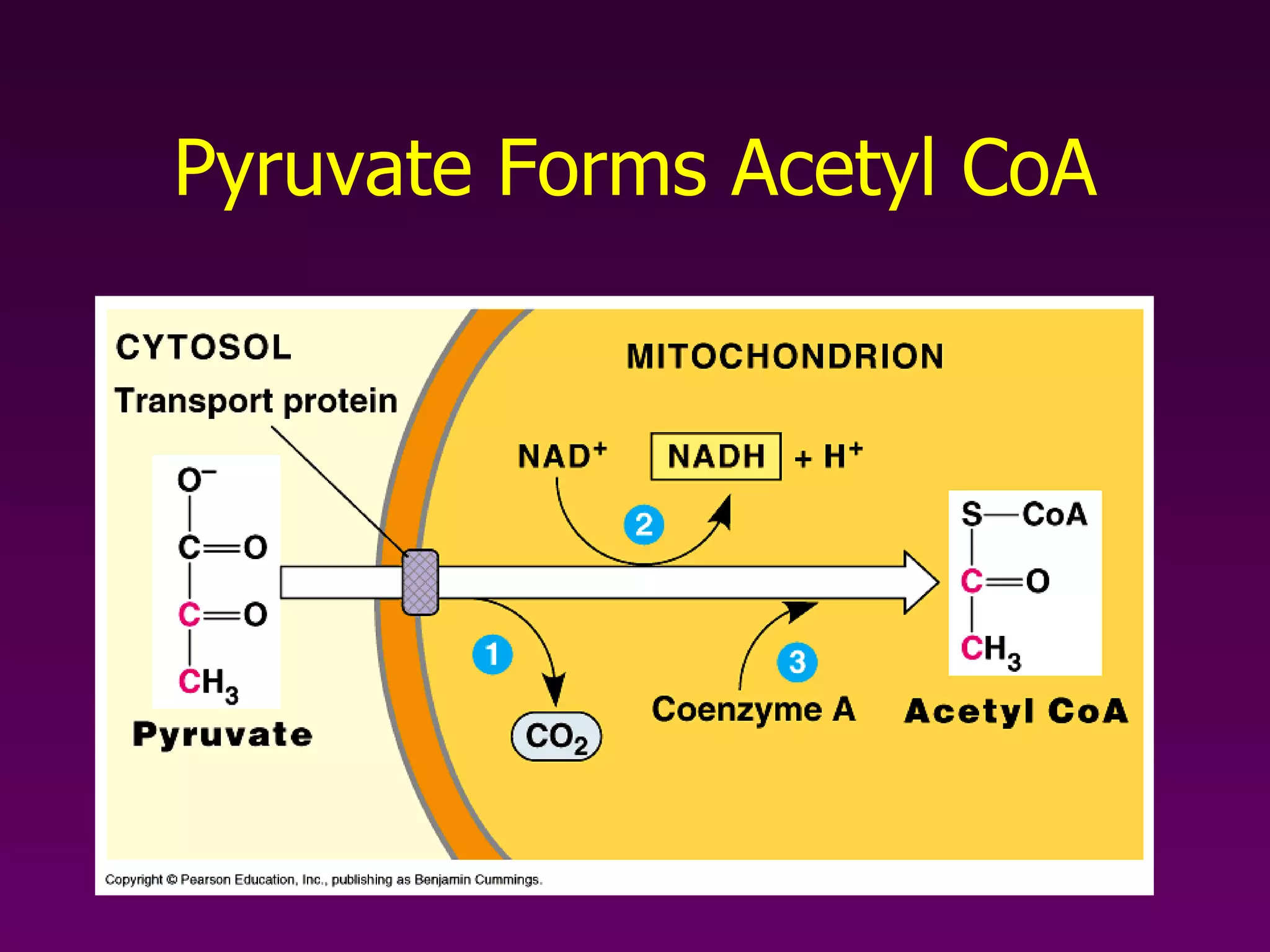
Pyruvate Forms Acetyl CoA
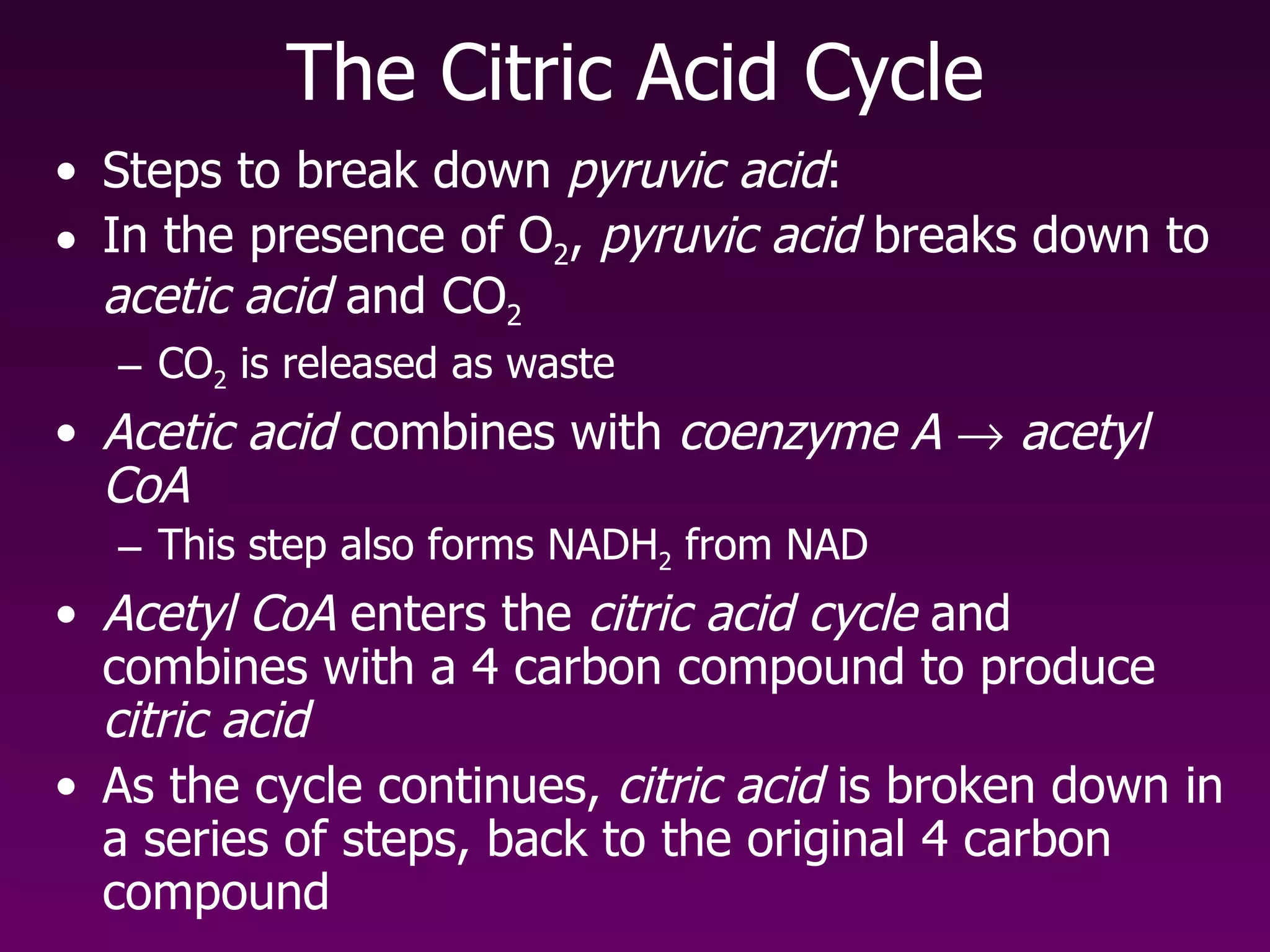
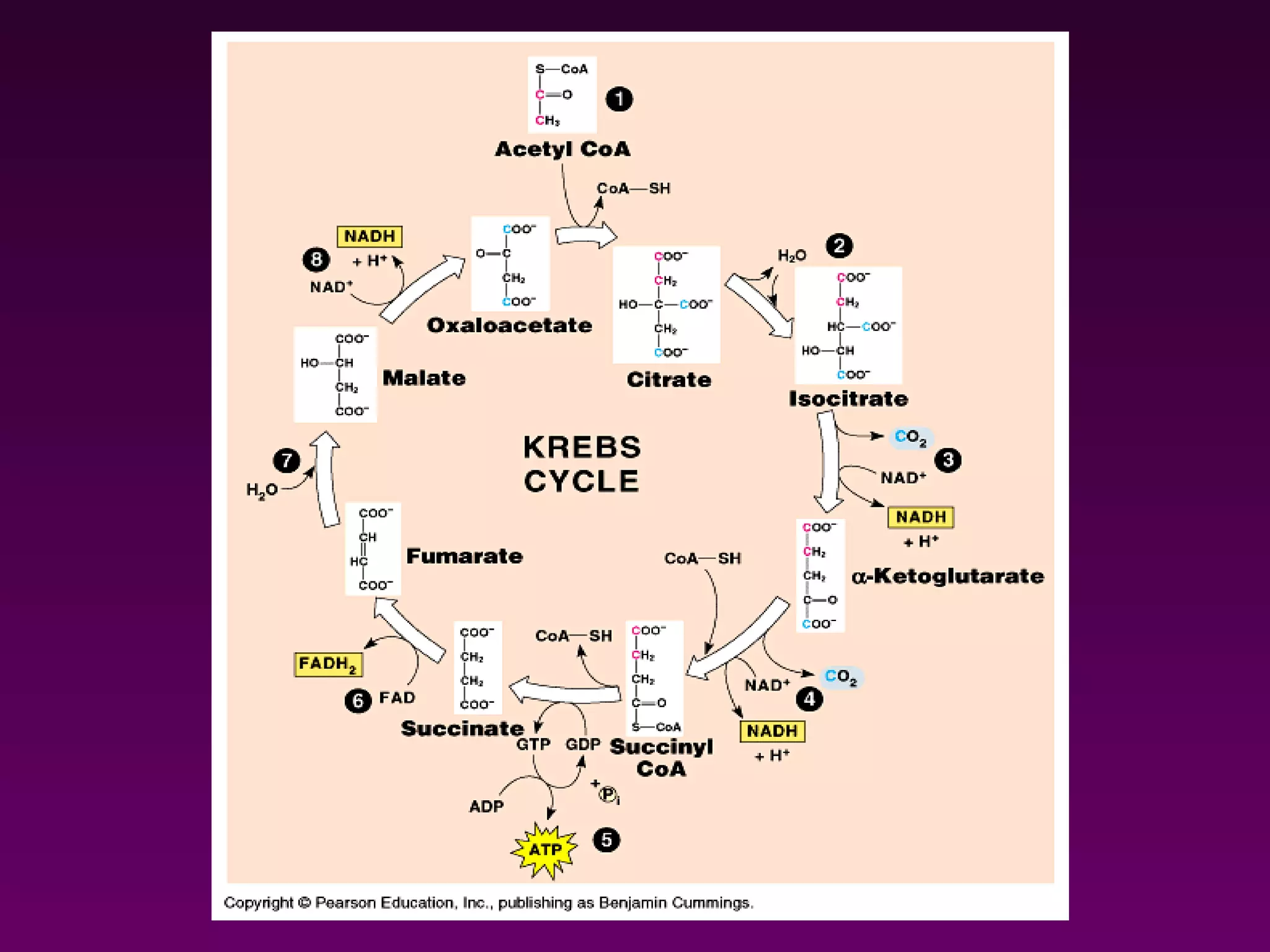
The Citric Acid Cycle Steps to break down  pyruvic acid : In the presence of O 2 ,  pyruvic acid  breaks down to  acetic acid  and CO 2   CO 2  is released as waste Acetic acid  combines with  coenzyme A      acetyl CoA This step also forms NADH 2  from NAD Acetyl CoA  enters the  citric acid cycle  and combines with a 4 carbon compound to produce  citric acid As the cycle continues,  citric acid  is broken down in a series of steps, back to the original 4 carbon compound
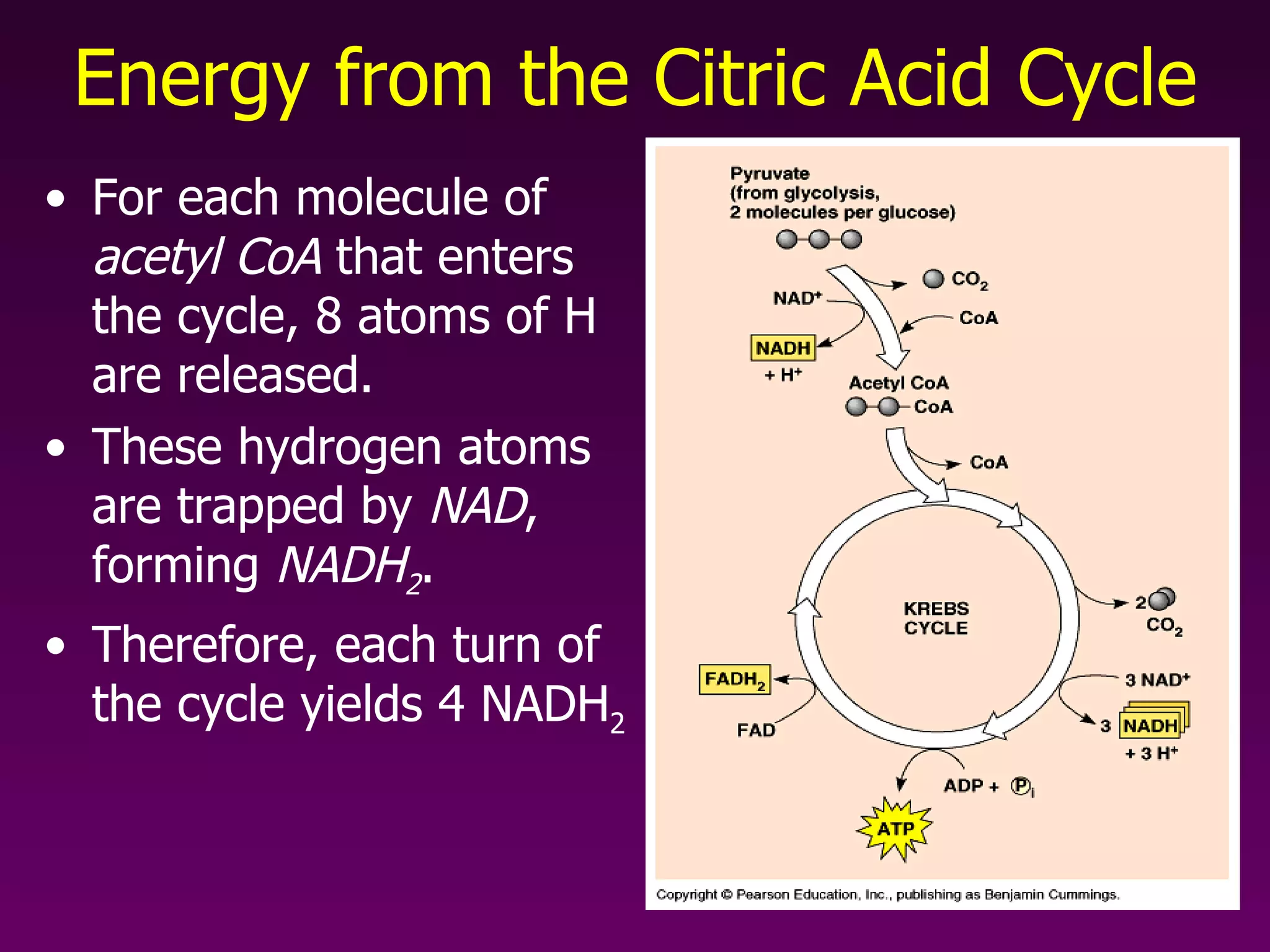
Energy from the Citric Acid Cycle For each molecule of  acetyl CoA  that enters the cycle, 8 atoms of H are released.  These hydrogen atoms are trapped by  NAD , forming  NADH 2 . Therefore, each turn of the cycle yields 4 NADH 2
 
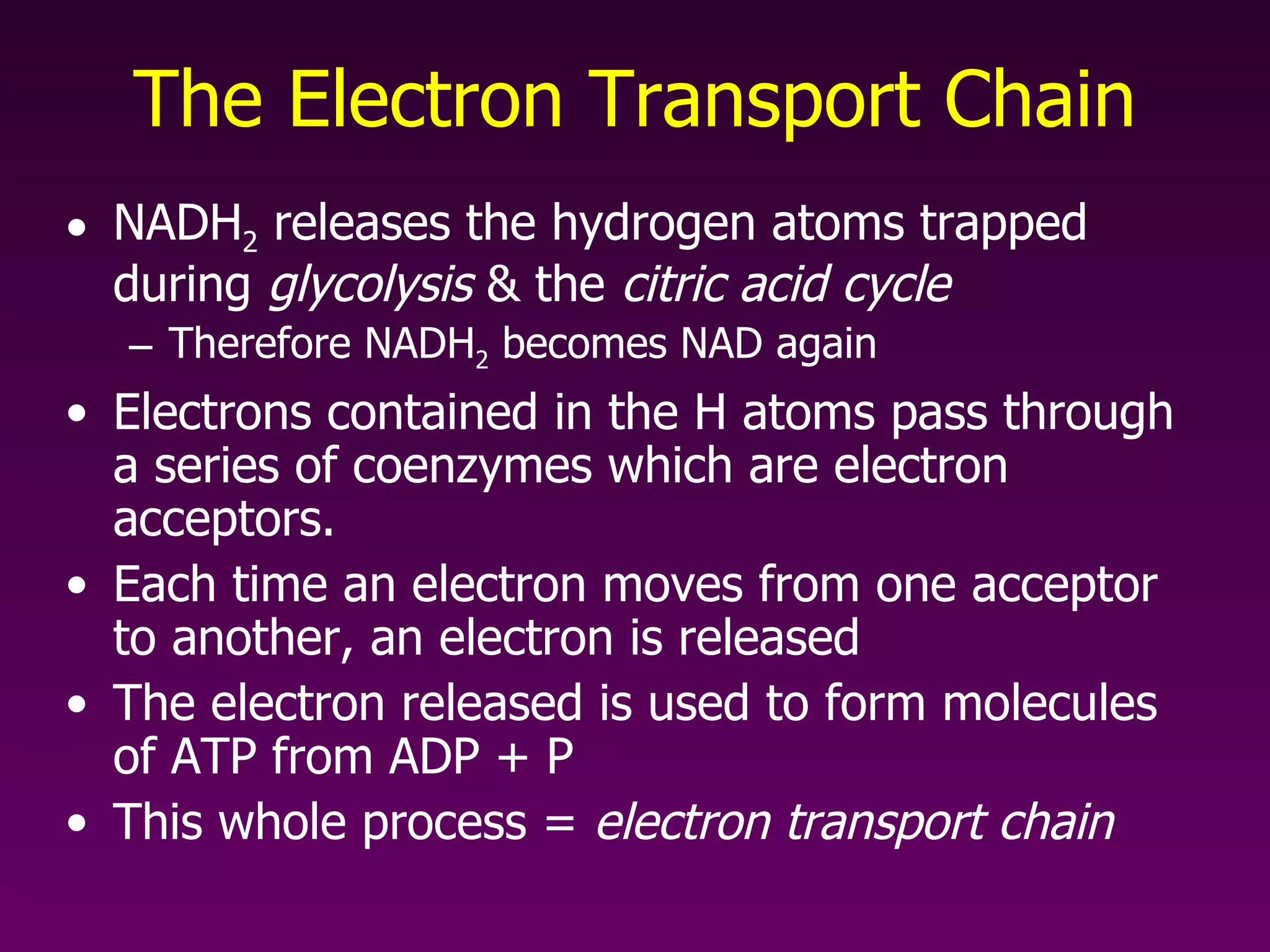
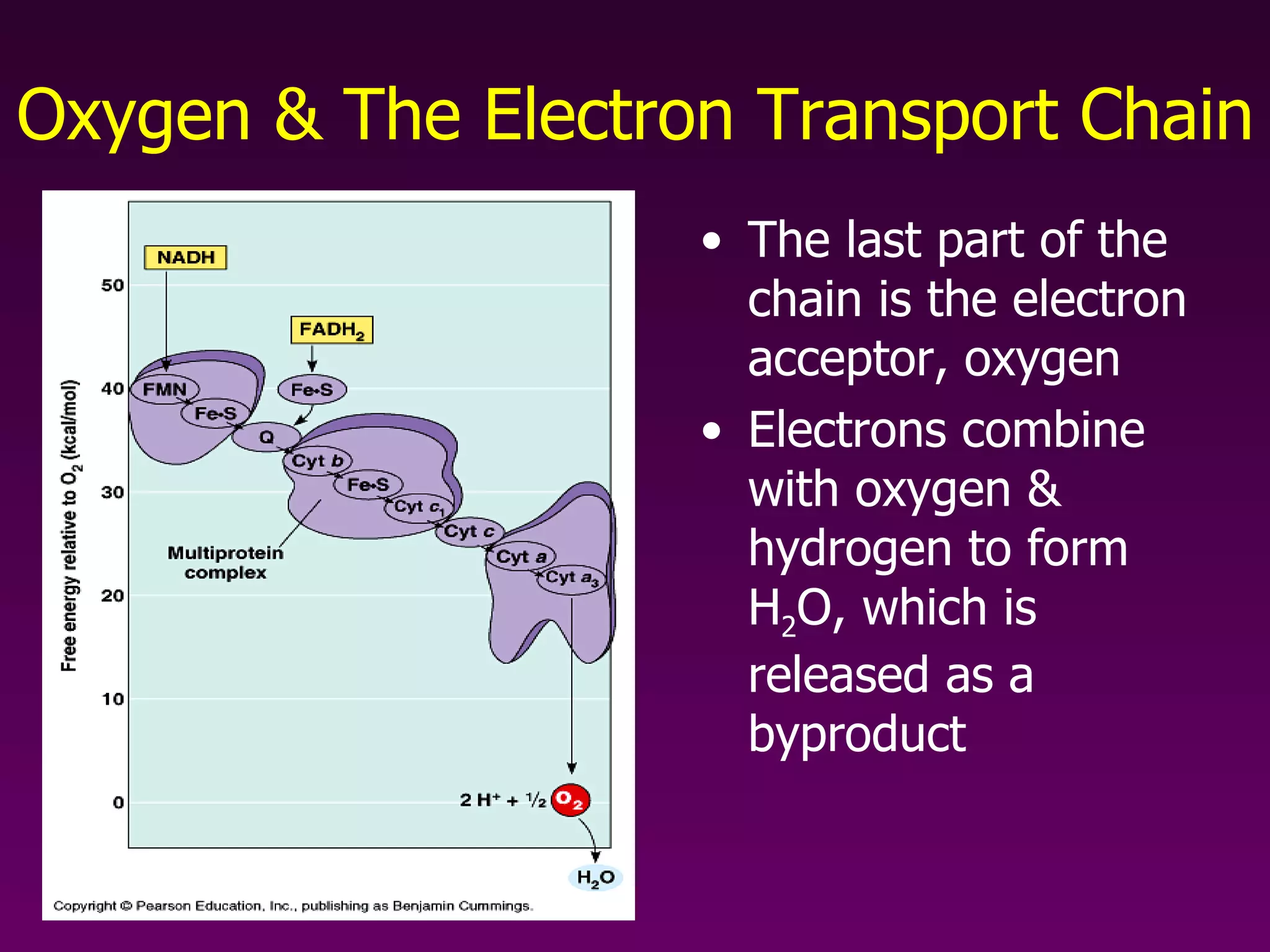
The Electron Transport Chain NADH 2  releases the hydrogen atoms trapped during  glycolysis  & the  citric acid cycle Therefore NADH 2  becomes NAD again Electrons contained in the H atoms pass through a series of coenzymes which are electron acceptors. Each time an electron moves from one acceptor to another, an electron is released The electron released is used to form molecules of ATP from ADP + P This whole process =  electron transport chain
Oxygen & The Electron Transport Chain The last part of the chain is the electron acceptor, oxygen Electrons combine with oxygen & hydrogen to form H 2 O, which is released as a byproduct
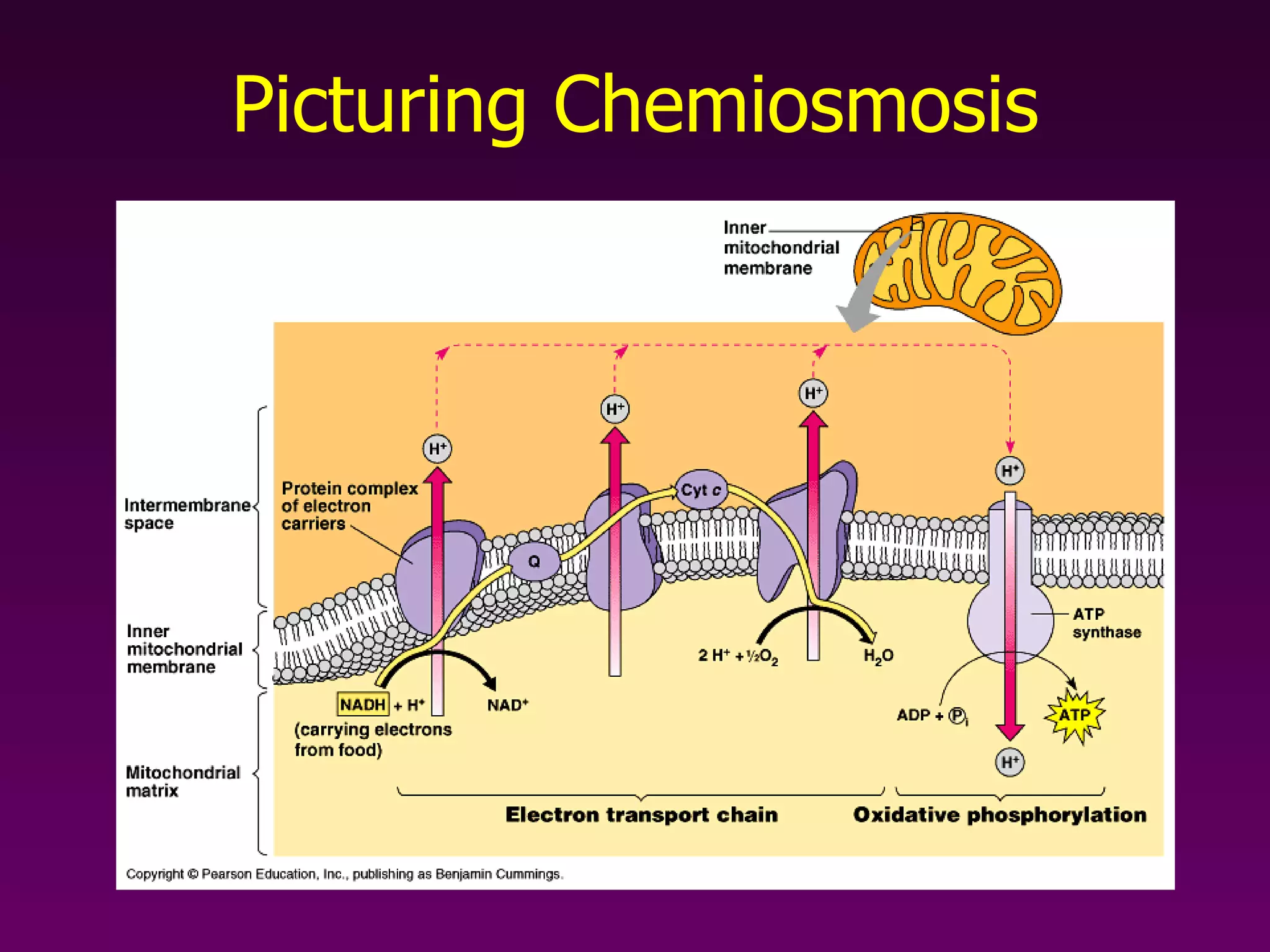
Chemiosmosis The process of formation of ATP during the ETS of aerobic respiration as the result of a pH gradient across the membrane of the cristae in the mitochondria = chemiosmosis Steps: H +  ions from the matrix are pumped into the space between the cristae and the outer membrane. A H + gradient develops between the inside and outside of the cristae This pH differential creates free energy H +  pass back across the membrane through F1 O 2  is the final H + / electron acceptor producing H 2 O
Picturing Chemiosmosis
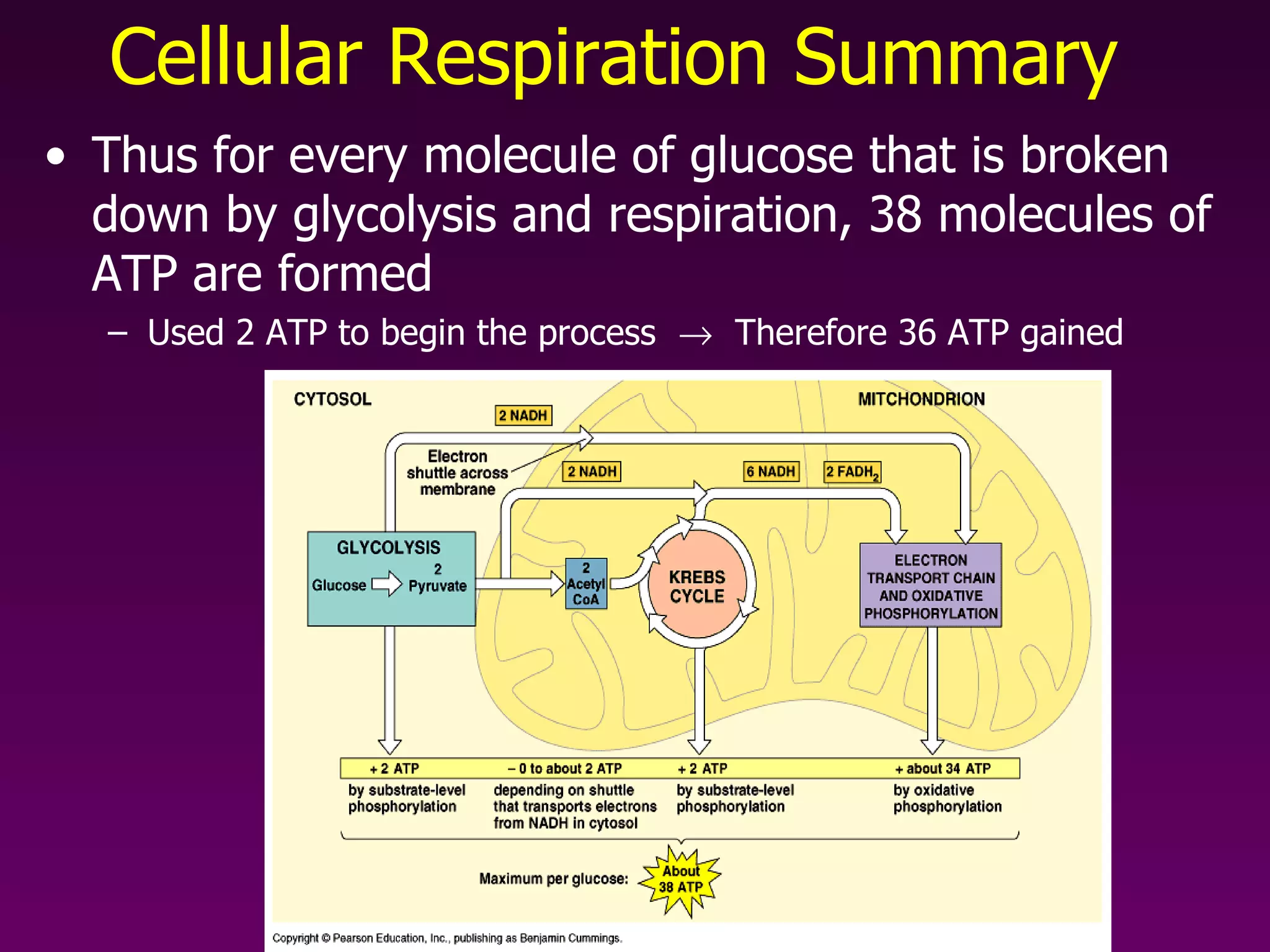
Cellular Respiration Summary Thus for every molecule of glucose that is broken down by glycolysis and respiration, 38 molecules of ATP are formed Used 2 ATP to begin the process     Therefore 36 ATP gained

Cellular Energy pt.2

  • 1.
    Energy & TheCell Glycolysis, Cellular Respiration & Fermentation
  • 2.
    Energy All liferequires energy Therefore cells require energy for growth, active transport, synthesis of carbohydrates, lipids, & proteins The source of energy for cells is the energy stored in chemical bonds of organic molecules these molecules = food molecules, especially carbohydrates (also lipids) most common is glucose
  • 3.
  • 4.
    ATP Cells storeenergy in the chemical bonds of sugar, but cannot use it directly To use this energy, the cell must transfer the energy in sugar molecules to ATP ATP = adenosine triphosphate
  • 5.
    Structure of ATPThe base, adenine The sugar, ribose Ribose is bound to a chain of 3 phosphate molecules connected by high energy bonds
  • 6.
  • 7.
    Releasing Energy fromATP If the cell needs energy it breaks the last phosphate bond, releasing energy ATP  ADP + P + energy Almost all energy requiring processes in cells use ATP as the energy source
  • 8.
  • 9.
    Fermentation So, wheredoes ATP come from? Fermentation = breakdown of glucose, yielding ATP, without O 2 The first living organisms were single cells that existed without O 2 Anaerobic Lack the enzymes needed to break down energy molecules with O 2 Many types of bacteria and other single celled organisms still use anaerobic processes to convert energy
  • 10.
    Types of Fermentation2 kinds: Alcoholic fermentation: occurs in micro-organisms such as yeast Lactic acid fermentation: occurs in bacteria and animal cells
  • 11.
    Fermentation in theCytosol Fermentation occurs in the cytosol It produces lactic acid or alcohol Fermentation begins with the process of glycolysis, which is also part of aerobic respiration.
  • 12.
    Glycolysis Occurs inthe cytoplasm of the cell One molecule of glucose is split into two molecules of a three carbon compound called pyruvic acid 2 molecules of ATP provide the energy to split the glucose molecule When glucose splits, it releases enough energy to form 4 molecules of ATP from ADP + P Therefore 2 molecules of ATP are gained
  • 13.
  • 14.
    The Role ofNAD in Glycolysis During the conversion of glucose to pyruvic acid , hydrogen is released This hydrogen is picked up by a coenzyme, nicotinamide adenine dinucleotide (NAD) NAD is a hydrogen acceptor When it accepts hydrogen, becomes NADH 2
  • 15.
  • 16.
  • 17.
    Energy of FermentationAs a result of fermentation, each molecule of glucose yields 2 molecules of ATP These ATP molecules come from glycolysis Fermentation produces no ATP beyond glycolysis It removes pyruvic acid, and recycles NAD, which allows glycolysis to continue, producing ATP
  • 18.
    Alcoholic Fermentation Pyruvicacid from glycolysis combines with H from NADH 2 to produce ethyl alcohol   2CH 3 COCOOH + 2NADH 2  2CH 3 CH 2 OH + 2CO 2 + 2NAD CO 2 is a waste product
  • 19.
  • 20.
    Lactic Acid FermentationPyruvic acid combines with H from NADH 2 to produce lactic acid: 2CH 3 COCOOH + 2NADH 2  2CH 3 CHOHCOOH + 2NAD Unlike alcoholic fermentation, no CO 2 is given off Occurs in human cells when there is not enough O 2 available for aerobic respiration
  • 21.
  • 22.
    Uses of LacticAcid Fermentation During strenuous exercise glycolysis occurs at a high rate Pyruvic acid is produced rapidly Muscle cells may not receive enough O 2 to process pyruvic acid through aerobic respiration Therefore muscles produce lactic acid which permits glycolysis to continue to supply ATP to your muscles When lactic acid builds up, your muscles ache O 2 you take in from heavy breathing helps convert lactic acid back to pyruvic acid
  • 23.
    Cellular Respiration Mostcells produce ATP by breaking the energy containing bonds of glucose in the presence of oxygen Production of ATP this way = Respiration Uses O 2 to break sugars down to CO 2 & H 2 O Not the same as breathing provides O 2 , but otherwise quite different This process occurs in the many mitochondria of each cell
  • 24.
    The Process ofCellular Respiration C 6 H 12 O 6 + 6 O 2  6 CO 2 + 6 H 2 O + energy (sugar) (ATP) Two stages of Cellular Respiration: Anaerobic without oxygen Aerobic with oxygen
  • 25.
  • 26.
    Anaerobic Stage Theanaerobic stage of cellular respiration is glycolysis , the same pathway used in fermentation This part of cellular respiration occurs in the cytoplasm Recall the energy budget for glycolysis: One molecule of glucose is split into two molecules of a three carbon compound called pyruvic acid 2 molecules of ATP provide the energy to split the glucose molecule When glucose splits, it releases enough energy to form 4 molecules of ATP from ADP + P Therefore 2 molecules of ATP are gained
  • 27.
  • 28.
    Aerobic Stage After glycolysis , the chemical bonds of pyruvic acid are broken down in a series of chemical reactions These occur in the mitochondria and require O 2 The aerobic stage has two parts: The Citric Acid Cycle The Electron Transport Chain
  • 29.
  • 30.
    The Citric AcidCycle Steps to break down pyruvic acid : In the presence of O 2 , pyruvic acid breaks down to acetic acid and CO 2 CO 2 is released as waste Acetic acid combines with coenzyme A  acetyl CoA This step also forms NADH 2 from NAD Acetyl CoA enters the citric acid cycle and combines with a 4 carbon compound to produce citric acid As the cycle continues, citric acid is broken down in a series of steps, back to the original 4 carbon compound
  • 31.
    Energy from theCitric Acid Cycle For each molecule of acetyl CoA that enters the cycle, 8 atoms of H are released. These hydrogen atoms are trapped by NAD , forming NADH 2 . Therefore, each turn of the cycle yields 4 NADH 2
  • 32.
  • 33.
    The Electron TransportChain NADH 2 releases the hydrogen atoms trapped during glycolysis & the citric acid cycle Therefore NADH 2 becomes NAD again Electrons contained in the H atoms pass through a series of coenzymes which are electron acceptors. Each time an electron moves from one acceptor to another, an electron is released The electron released is used to form molecules of ATP from ADP + P This whole process = electron transport chain
  • 34.
    Oxygen & TheElectron Transport Chain The last part of the chain is the electron acceptor, oxygen Electrons combine with oxygen & hydrogen to form H 2 O, which is released as a byproduct
  • 35.
    Chemiosmosis The processof formation of ATP during the ETS of aerobic respiration as the result of a pH gradient across the membrane of the cristae in the mitochondria = chemiosmosis Steps: H + ions from the matrix are pumped into the space between the cristae and the outer membrane. A H + gradient develops between the inside and outside of the cristae This pH differential creates free energy H + pass back across the membrane through F1 O 2 is the final H + / electron acceptor producing H 2 O
  • 36.
  • 37.
    Cellular Respiration SummaryThus for every molecule of glucose that is broken down by glycolysis and respiration, 38 molecules of ATP are formed Used 2 ATP to begin the process  Therefore 36 ATP gained