INITIATION AND TERMINATION
CODONS , MUTATION AND GENETIC
CODE
CONTENTS
Initiation codon
Termination codon
Mutation codon
Genetic code
INITIATION CODON
• The start codon is the first codon of a messenger RNA transcript
translated by a ribosome.
• The start codon always codes for methionine in eukaryotes and
a modified met ( f Met ) in prokaryotes.
• The most common start codon is AUG.
• The start codon is often preceded by a 5' untranslated region
( 5' UTR ) .
• The discovery of a t RNA specific for N – formylmethionine ( t RNAFmet )
initially suggested that it would recognize a codon different from the
AUG methionine codon.
• But as a elucidation of the t RNAF met sequence revealed that its
anticodon 3' – UAC – 5' was identical to that of the RNAM met.
• Both f Met and Met must therefore be directly coded by AUG.
• Discrimination between the two forms occurs through their differential
binding by protein synthesis factors.
• Only fmet – t RNAF met can bind to the initiation factor IF2 to
form the 30 S initiation complex ; and only Met – t RNA M met is
able to bind to the elongation factor EF – Tu during polypeptide
chain elongation.
• A further complication is the realisation, coming first from in
vitro studies and later from m RNA sequences, that f Met – t RNA
F met can bind to and initiate synthesis at GUG as well as AUG
codons.
• GUG is used as an initiator codon only about one – thirteenth as
frequently as AUG initiators in E.coli.
• Normally, GUG is a valine codon and its recognition by tRNA F met
would require an unusual sort of wobble in the codon – anticodon
interaction.
• The ambiguity is at the first (5') as opposed to the third (3') position
of the codon and would therefore involve the 3' base of the
anticodon.
• A possible explanation for the unexpected ability of the initiator t
RNA to engage in first – position wobble lies in the t RNA F met
sequence.
• The nucleotide adjacent to the 3' end of the anticodon is an
unmodified adenine, not the bulky alkylated derivative found in
virtually all other t RNAS.
• In fact, UUG and CUG codons also specify initiation, although
even more rarely than GUG.
• Thus, the unique wobble capability of the third (3') position of
the t RNAFmet anticodon seems to extend to all possible
partners.
TERMINATION CODONS
• There are 3 stop codons in the genetic code – UAG, UAA, and UGA.
• These codons are also known as nonsense codons or termination
codons as they do not code for an amino acid.
• The three stop codons have been named as amber [ UAG ] , opal or
umber [ UGA ] and ochre [ UAA].
• Amber or UAG was discovered by Charles Steinberg and Richard
Epstein and they named it amber after the German meaning of the
last name of their friend Harris Bernstein.
• The remaining two STOP codons were then named " Ocher " and
" opal " so as to maintain the " colour names " theme.
• During protein synthesis, STOP codons cause the release of the
new polypeptide chain from the ribosome.
• This occurs because there are no t RNAS with anticodons
complementary to the STOP codons.
• Two release factors, RF1 and RF2, have been identified, each of
which recognizes two codons.
• One is specific for USA and UAG and the other for UAA and UGA.
• The use of proteins to read the stop signals emphasizes the fact
that not only polynucleotide can specifically interact with other
polynucleotides.
• The specific hydrogen – bond – forming groups of the bases can
also be recognized by proteins containing specific constellations
of amino acids that have groups prone to hydrogen bonding.
• The presence of more than one stop codon may be a precaution
against the rare case in which the first codon fails, but why this
device is used only occasionally is unclear.
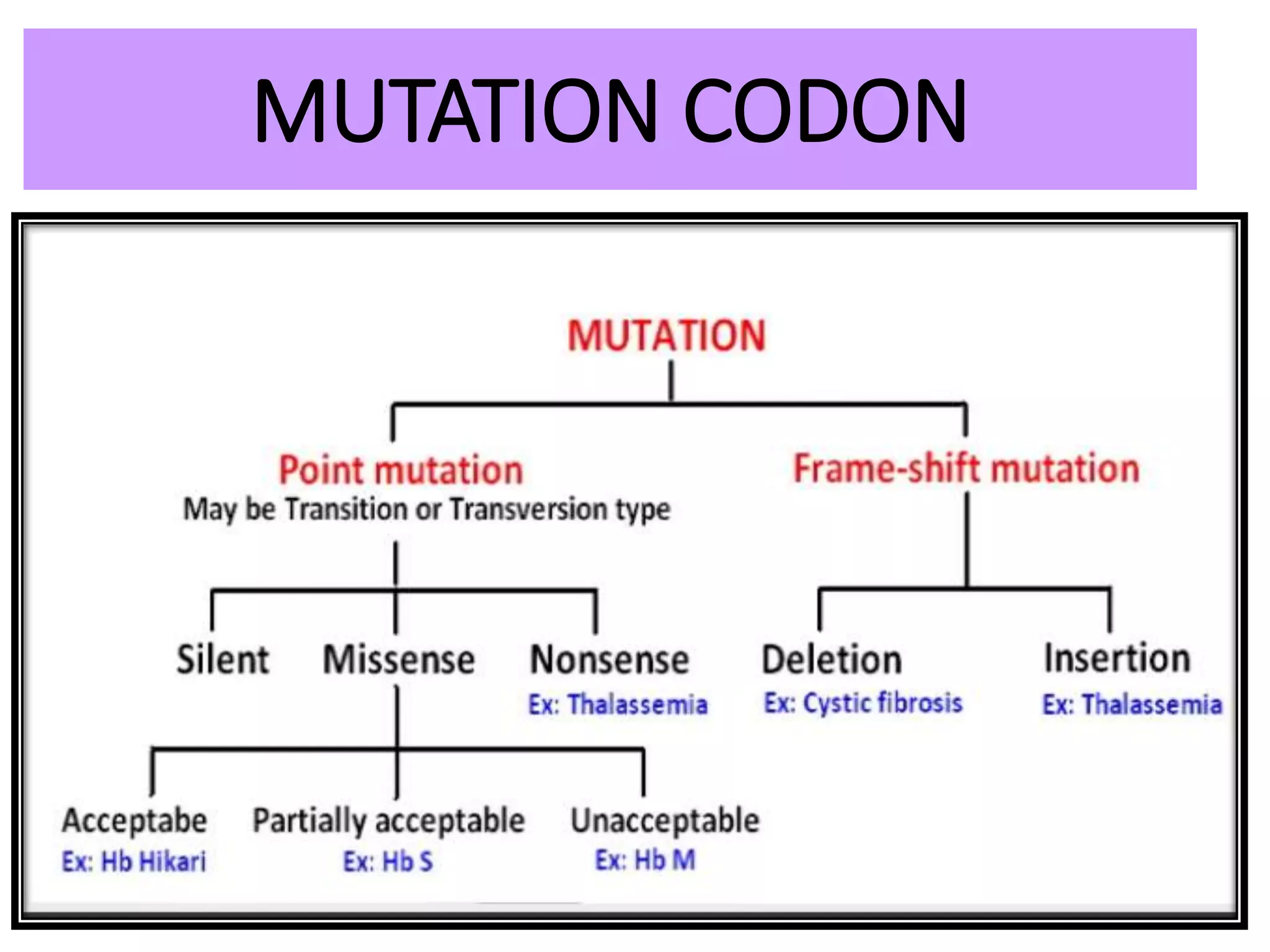
MUTATION CODON
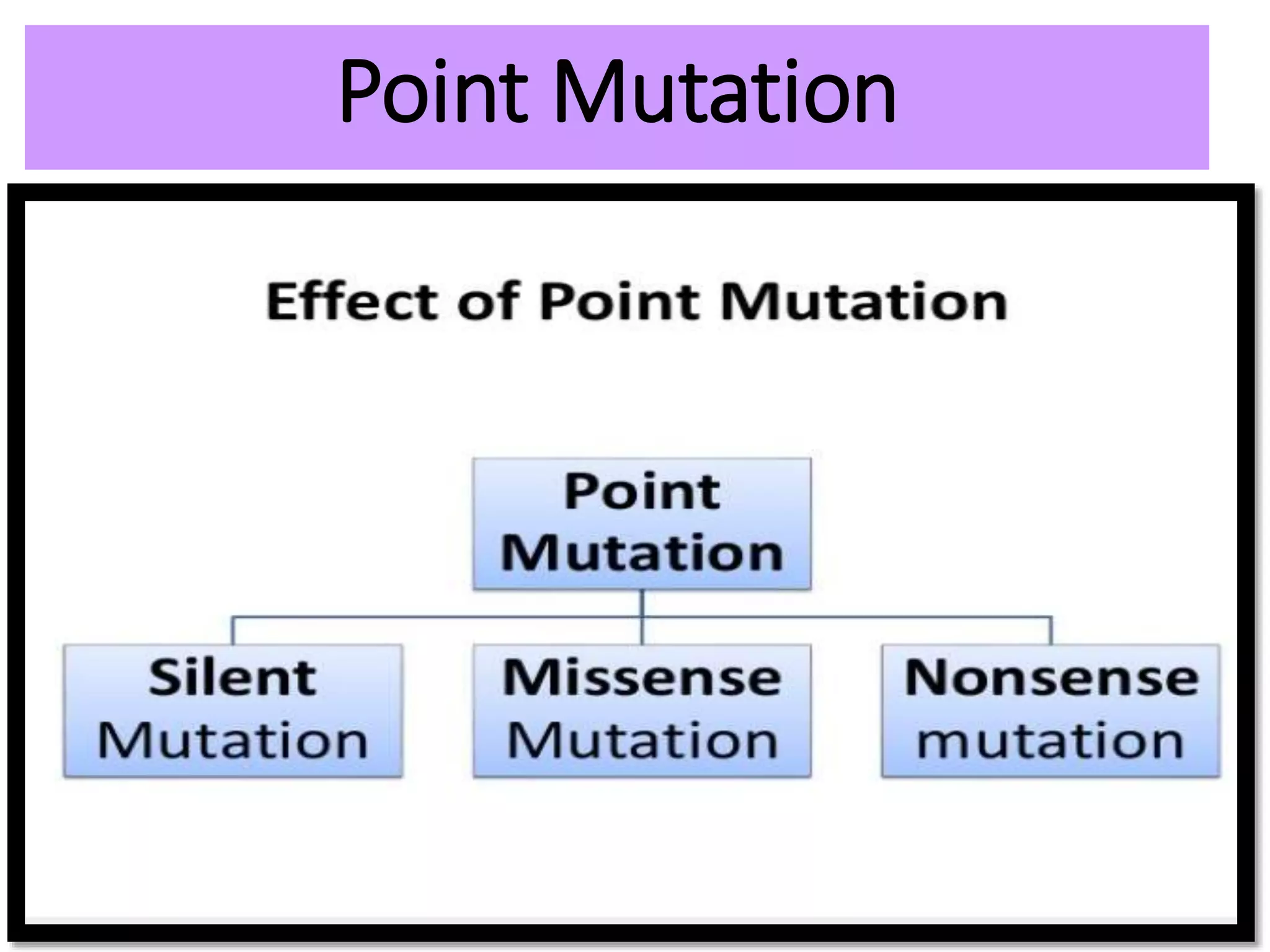
Point Mutation
• A point mutation is specifically when only one nucleotide base is
changed in some way, although multiple point mutations can
occur in one strand of DNA or RNA.
• Point mutations are sometimes caused by mutations that
spontaneously occur during DNA replication.
• The rate of mutations may also increase when a cell is exposed
to mutagenes, which are environmental factors that can change
an organisms DNA.
• Some mutages are X – rays , UV rays , extreme heat , or certain
chemicals like benzene.
 Substitution : –
• A substitution mutation occurs when one base pair is
substituted for another.
• For example, this would occur when one nucleotide
containing cytosine is accidentally substituted for one
containing guanine.
• There are three types of substitution mutations : –
a ) Silent Mutation
b ) Missene Mutation
c ) Nonsense Mutation
a ) Silent Mutation : –
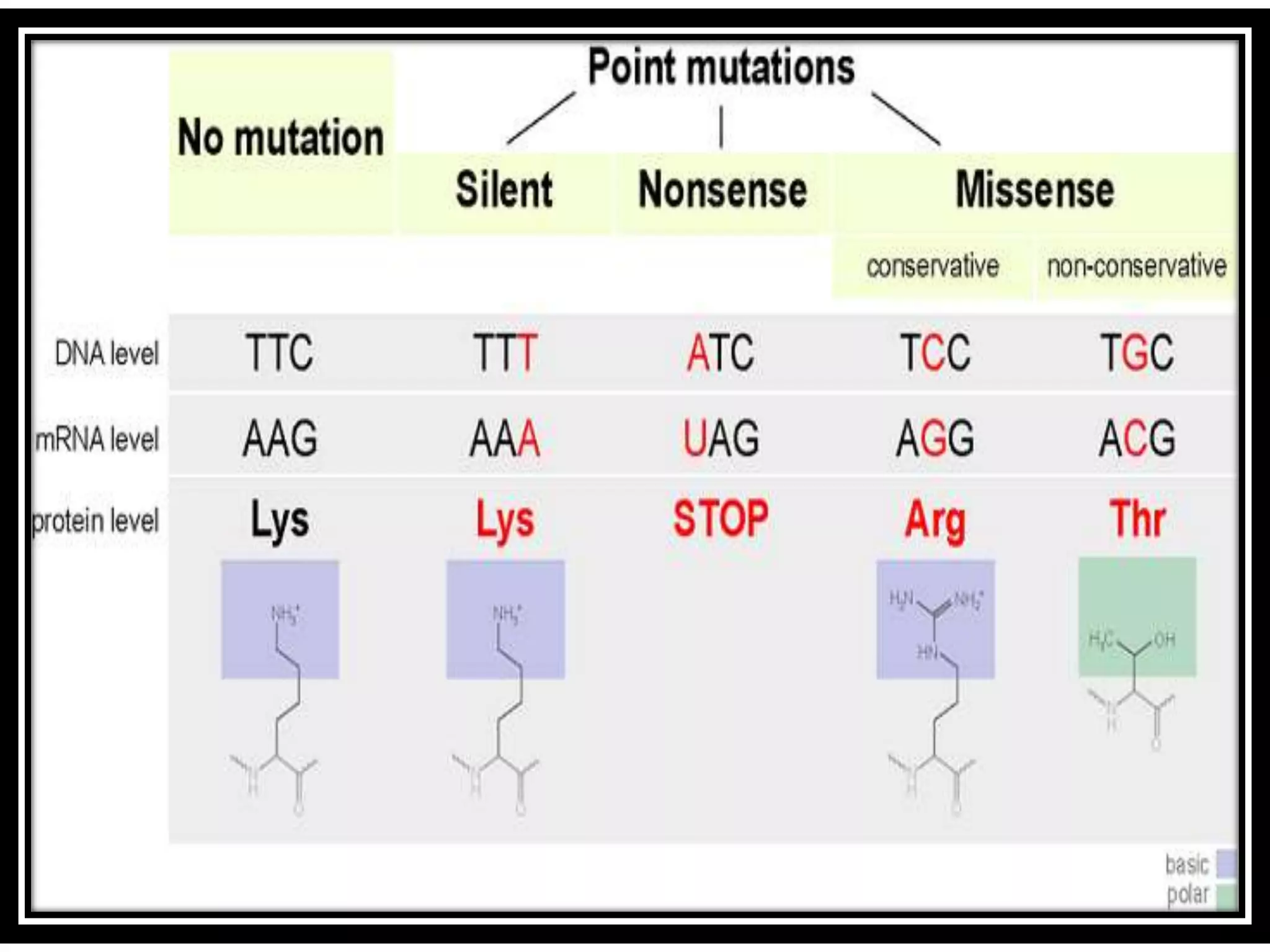
• In a silent mutations, a nucleotide is substituted but the same
amino acid is produced anyway.
• This can occur because multiple codons can code for the same
amino acid.
• For example, AAG and AAA both code for lysine , so if the G is
changed to an A, the same amino acid will form and the Protein
will not be affected.
b ) Missense Mutation : –
• This type of Mutation is a change in one DNA base paire that
results in the substitution of one amino acid for another in the
Protein made by a gene.
c ) Nonsense Mutation : –
• A nonsense mutation is also a change in one DNA basepair.
• Instead of substituting one amino acid for another, however,
the altered DNA sequence prematurely signals the cell to stop
building a protein.
• This type of mutation results in a shorted protein that may
function improperly or not at all.
Frameshift Mutation
• This type of mutation occurs when the addition or loss of DNA
bases changes a gene's reading frame.
• A reading frame consists of groups of 3 bases that each code for
one amino acid.
• A frameshift mutation shifts the grouping of these bases and
changes the code for amino acids.
• The resulting protein is usually non functional.
• Insertion, deletion and duplications can all be frameshift
mutations.
a ) Insertion : –
• An insertion changes the number of DNA based in a gene by
adding a piece of DNA.
• As a result, the protein made by the gene may not function
properly.
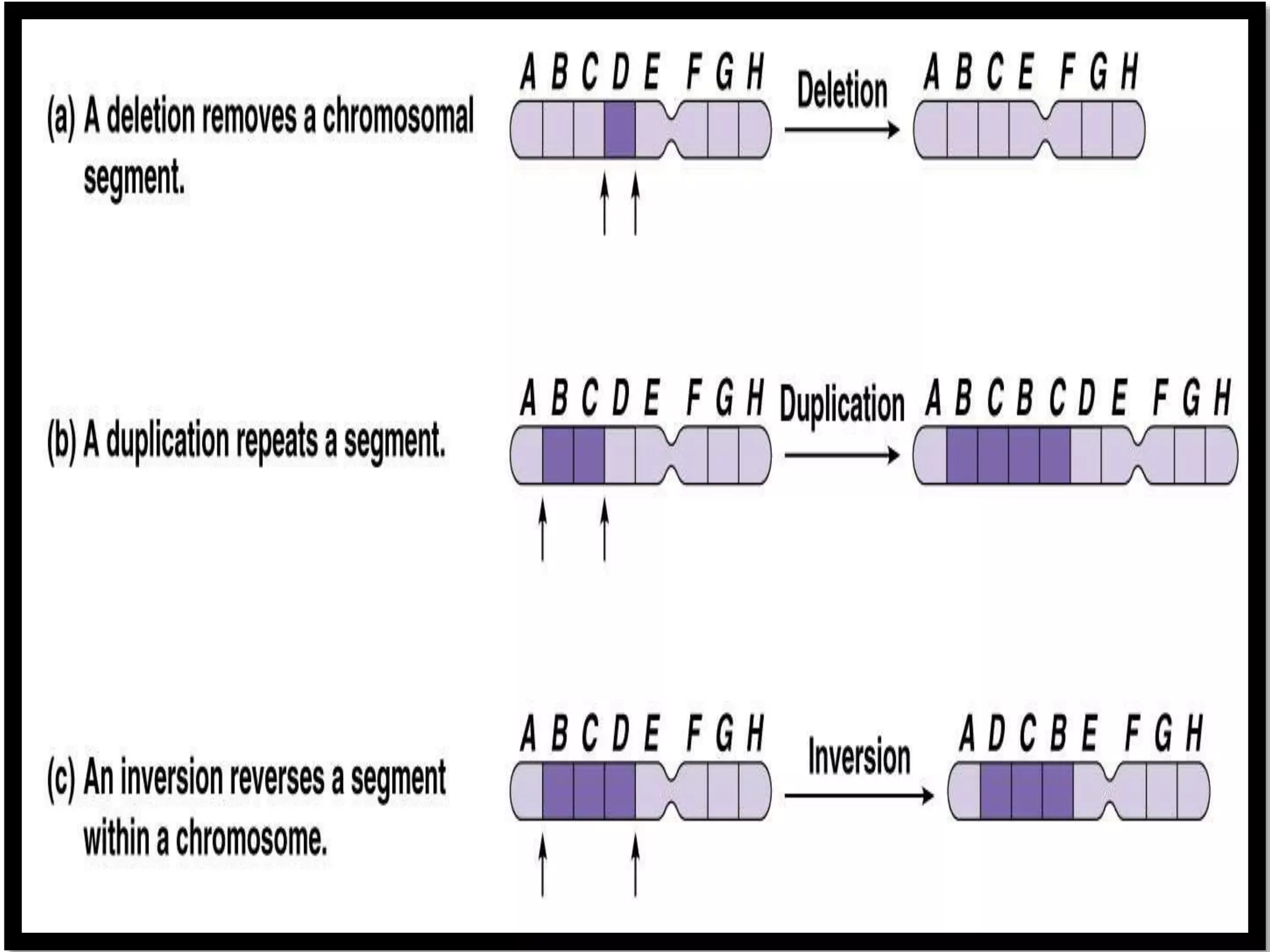
b ) Deletion : –
• A deletion changes the number of DNA bases by removing a
piece of DNA.
• Small deletions may remove one or a few base pairs within a
gene, while large deletions can remove an entire gene or
several neighbouring genes.
• The deleted DNA may alter the function of the resulting
proteins.
c ) Duplication : –
• A duplication consists of a piece of DNA abnormally copied one
or more times.
• This type of mutation may alter the function of the resulting
protein.
GENETIC CODE
• Translation is the process of conservation of nucleic acid
information into amino acids.
• This genetic information is encrypted in the form of code called
genetic code or codon.
• The genetic code is a set of information encoded in the sequence
of nucleic acids that does the coding for proteins to be
synthesized.
• Any change in genetic codes might lead to mutation.
• Let us understand mutation in terms of genetic codes.
• Genes are the functional units of heredity of organisms.
• It is mainly responsible for the structure and functional changes
and for the variation in organisms which could be good or bad.
• Even a minute change in the DNA sequence could alter the amino
acids to be produced and proteins to be synthesized.
• The genetic code is a dictionary that corresponds with the
sequence of nucleotides and sequence of the amino acids.
REFERENCES
• Molecular biology by : – Veer Bala Rastogi
• Molecular Biology Of The Gene by : —
Watson, Hopkins, Roberts, Steitz, Weiner
• Genetics by : – P. S. Verma & V. K. Agarwal
 https://www.slideshare.net
 https://www.biologydiscussion.com
Initiation and termination codons , mutation and genetic code

Initiation and termination codons , mutation and genetic code

  • 1.
    INITIATION AND TERMINATION CODONS, MUTATION AND GENETIC CODE
  • 2.
  • 3.
    INITIATION CODON • Thestart codon is the first codon of a messenger RNA transcript translated by a ribosome. • The start codon always codes for methionine in eukaryotes and a modified met ( f Met ) in prokaryotes. • The most common start codon is AUG. • The start codon is often preceded by a 5' untranslated region ( 5' UTR ) .
  • 4.
    • The discoveryof a t RNA specific for N – formylmethionine ( t RNAFmet ) initially suggested that it would recognize a codon different from the AUG methionine codon. • But as a elucidation of the t RNAF met sequence revealed that its anticodon 3' – UAC – 5' was identical to that of the RNAM met. • Both f Met and Met must therefore be directly coded by AUG. • Discrimination between the two forms occurs through their differential binding by protein synthesis factors.
  • 5.
    • Only fmet– t RNAF met can bind to the initiation factor IF2 to form the 30 S initiation complex ; and only Met – t RNA M met is able to bind to the elongation factor EF – Tu during polypeptide chain elongation. • A further complication is the realisation, coming first from in vitro studies and later from m RNA sequences, that f Met – t RNA F met can bind to and initiate synthesis at GUG as well as AUG codons. • GUG is used as an initiator codon only about one – thirteenth as frequently as AUG initiators in E.coli.
  • 6.
    • Normally, GUGis a valine codon and its recognition by tRNA F met would require an unusual sort of wobble in the codon – anticodon interaction. • The ambiguity is at the first (5') as opposed to the third (3') position of the codon and would therefore involve the 3' base of the anticodon. • A possible explanation for the unexpected ability of the initiator t RNA to engage in first – position wobble lies in the t RNA F met sequence.
  • 7.
    • The nucleotideadjacent to the 3' end of the anticodon is an unmodified adenine, not the bulky alkylated derivative found in virtually all other t RNAS. • In fact, UUG and CUG codons also specify initiation, although even more rarely than GUG. • Thus, the unique wobble capability of the third (3') position of the t RNAFmet anticodon seems to extend to all possible partners.
  • 8.
    TERMINATION CODONS • Thereare 3 stop codons in the genetic code – UAG, UAA, and UGA. • These codons are also known as nonsense codons or termination codons as they do not code for an amino acid. • The three stop codons have been named as amber [ UAG ] , opal or umber [ UGA ] and ochre [ UAA]. • Amber or UAG was discovered by Charles Steinberg and Richard Epstein and they named it amber after the German meaning of the last name of their friend Harris Bernstein.
  • 9.
    • The remainingtwo STOP codons were then named " Ocher " and " opal " so as to maintain the " colour names " theme. • During protein synthesis, STOP codons cause the release of the new polypeptide chain from the ribosome. • This occurs because there are no t RNAS with anticodons complementary to the STOP codons. • Two release factors, RF1 and RF2, have been identified, each of which recognizes two codons. • One is specific for USA and UAG and the other for UAA and UGA.
  • 10.
    • The useof proteins to read the stop signals emphasizes the fact that not only polynucleotide can specifically interact with other polynucleotides. • The specific hydrogen – bond – forming groups of the bases can also be recognized by proteins containing specific constellations of amino acids that have groups prone to hydrogen bonding. • The presence of more than one stop codon may be a precaution against the rare case in which the first codon fails, but why this device is used only occasionally is unclear.
  • 11.
  • 12.
  • 13.
    • A pointmutation is specifically when only one nucleotide base is changed in some way, although multiple point mutations can occur in one strand of DNA or RNA. • Point mutations are sometimes caused by mutations that spontaneously occur during DNA replication. • The rate of mutations may also increase when a cell is exposed to mutagenes, which are environmental factors that can change an organisms DNA. • Some mutages are X – rays , UV rays , extreme heat , or certain chemicals like benzene.
  • 14.
     Substitution :– • A substitution mutation occurs when one base pair is substituted for another. • For example, this would occur when one nucleotide containing cytosine is accidentally substituted for one containing guanine. • There are three types of substitution mutations : – a ) Silent Mutation b ) Missene Mutation c ) Nonsense Mutation
  • 15.
    a ) SilentMutation : – • In a silent mutations, a nucleotide is substituted but the same amino acid is produced anyway. • This can occur because multiple codons can code for the same amino acid. • For example, AAG and AAA both code for lysine , so if the G is changed to an A, the same amino acid will form and the Protein will not be affected.
  • 16.
    b ) MissenseMutation : – • This type of Mutation is a change in one DNA base paire that results in the substitution of one amino acid for another in the Protein made by a gene. c ) Nonsense Mutation : – • A nonsense mutation is also a change in one DNA basepair. • Instead of substituting one amino acid for another, however, the altered DNA sequence prematurely signals the cell to stop building a protein. • This type of mutation results in a shorted protein that may function improperly or not at all.
  • 18.
    Frameshift Mutation • Thistype of mutation occurs when the addition or loss of DNA bases changes a gene's reading frame. • A reading frame consists of groups of 3 bases that each code for one amino acid. • A frameshift mutation shifts the grouping of these bases and changes the code for amino acids. • The resulting protein is usually non functional. • Insertion, deletion and duplications can all be frameshift mutations.
  • 19.
    a ) Insertion: – • An insertion changes the number of DNA based in a gene by adding a piece of DNA. • As a result, the protein made by the gene may not function properly. b ) Deletion : – • A deletion changes the number of DNA bases by removing a piece of DNA. • Small deletions may remove one or a few base pairs within a gene, while large deletions can remove an entire gene or several neighbouring genes.
  • 20.
    • The deletedDNA may alter the function of the resulting proteins. c ) Duplication : – • A duplication consists of a piece of DNA abnormally copied one or more times. • This type of mutation may alter the function of the resulting protein.
  • 22.
    GENETIC CODE • Translationis the process of conservation of nucleic acid information into amino acids. • This genetic information is encrypted in the form of code called genetic code or codon. • The genetic code is a set of information encoded in the sequence of nucleic acids that does the coding for proteins to be synthesized. • Any change in genetic codes might lead to mutation.
  • 23.
    • Let usunderstand mutation in terms of genetic codes. • Genes are the functional units of heredity of organisms. • It is mainly responsible for the structure and functional changes and for the variation in organisms which could be good or bad. • Even a minute change in the DNA sequence could alter the amino acids to be produced and proteins to be synthesized. • The genetic code is a dictionary that corresponds with the sequence of nucleotides and sequence of the amino acids.
  • 24.
    REFERENCES • Molecular biologyby : – Veer Bala Rastogi • Molecular Biology Of The Gene by : — Watson, Hopkins, Roberts, Steitz, Weiner • Genetics by : – P. S. Verma & V. K. Agarwal  https://www.slideshare.net  https://www.biologydiscussion.com