1)Beadle & Tatum’s Experiment - Using bread mold  neurospora  to show each gene encodes the structure of one polypeptide. 2)Meselson & Stahl’s Experiment - Using the radioisotope labeling technique to show the  semi-conservative model of DNA replication
4.1.3   Gene concept; one gene one polypeptide George Beadle and Edward Tatum experiment: connection between genes & metabolism.  Neurospora crassa  as experimental organism.  - short life-cycle, easily grown.  Since it is  haploid  for much of its life cycle, mutations would be immediately expressed.
Gene concept; one gene one polypeptide Neurospora crassa  able to synthesize all of the amino acids and other chemicals needed for growth mutations will affect a single genes and single enzymes in specific metabolic pathways.
Chemical reactions occurring in the body mediated by enzymes  (proteins)  Heritable traits- must be a relationship between the gene and proteins.  Beadle and Tatum proposed the " one gene one enzyme " theory. Gene concept; one gene one polypeptide
One gene, one polypeptide One gene codes for one protein.  "One gene one enzyme" modified to " one gene one polypeptide " since many proteins made of more than one polypeptide Biosynthesis of amino acids: complex chemical reactions mediated by enzymes, which if mutated- shut down the pathway no growth.
 
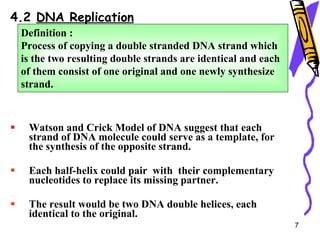
4.2  DNA Replication Watson and Crick Model of DNA suggest that each strand of DNA molecule could serve as a template, for the synthesis of the opposite strand. Each half-helix could pair  with  their complementary nucleotides to replace its missing partner. The result would be two DNA double helices, each identical to the original. Definition : Process of copying a double stranded DNA strand which is the two resulting double strands are identical and each of them consist of one original and one newly synthesize strand.
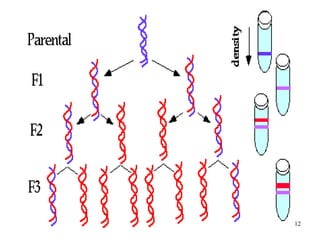
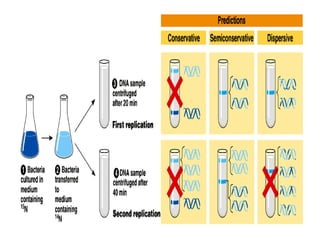
3 hypothesis that told about DNA replication :- CONSERVATIVE both parent (or old) strand remain together and an all new copy is made SEMICONSERVATIVE the 2 strand of the parental molecule separate and each functions as a template for synthesis of a new complementary strand DISPERSIVE each strand of both daughter molecules contains a mixture of old and newly synthesized parts
 
In 1958, Meselson and Stahl  studied the replication of  E.Coli . Meselson and Stahl Experiment Hypothesis :   DNA replication are take place by semiconservative mechanism


Conclusion Hypothesis are accepted. Experiment approved that DNA replication are take place by semiconservative.

2nd hour

  • 1.
    1)Beadle & Tatum’sExperiment - Using bread mold neurospora to show each gene encodes the structure of one polypeptide. 2)Meselson & Stahl’s Experiment - Using the radioisotope labeling technique to show the semi-conservative model of DNA replication
  • 2.
    4.1.3 Gene concept; one gene one polypeptide George Beadle and Edward Tatum experiment: connection between genes & metabolism. Neurospora crassa as experimental organism. - short life-cycle, easily grown. Since it is haploid for much of its life cycle, mutations would be immediately expressed.
  • 3.
    Gene concept; onegene one polypeptide Neurospora crassa able to synthesize all of the amino acids and other chemicals needed for growth mutations will affect a single genes and single enzymes in specific metabolic pathways.
  • 4.
    Chemical reactions occurringin the body mediated by enzymes (proteins) Heritable traits- must be a relationship between the gene and proteins. Beadle and Tatum proposed the " one gene one enzyme " theory. Gene concept; one gene one polypeptide
  • 5.
    One gene, onepolypeptide One gene codes for one protein. "One gene one enzyme" modified to " one gene one polypeptide " since many proteins made of more than one polypeptide Biosynthesis of amino acids: complex chemical reactions mediated by enzymes, which if mutated- shut down the pathway no growth.
  • 6.
  • 7.
    4.2 DNAReplication Watson and Crick Model of DNA suggest that each strand of DNA molecule could serve as a template, for the synthesis of the opposite strand. Each half-helix could pair with their complementary nucleotides to replace its missing partner. The result would be two DNA double helices, each identical to the original. Definition : Process of copying a double stranded DNA strand which is the two resulting double strands are identical and each of them consist of one original and one newly synthesize strand.
  • 8.
    3 hypothesis thattold about DNA replication :- CONSERVATIVE both parent (or old) strand remain together and an all new copy is made SEMICONSERVATIVE the 2 strand of the parental molecule separate and each functions as a template for synthesis of a new complementary strand DISPERSIVE each strand of both daughter molecules contains a mixture of old and newly synthesized parts
  • 9.
  • 10.
    In 1958, Meselsonand Stahl studied the replication of E.Coli . Meselson and Stahl Experiment Hypothesis : DNA replication are take place by semiconservative mechanism
  • 11.
  • 12.
  • 13.
  • 14.
    Conclusion Hypothesis areaccepted. Experiment approved that DNA replication are take place by semiconservative.