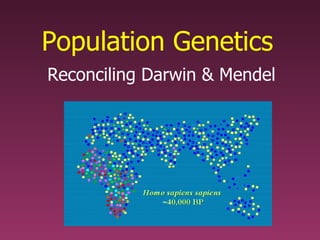
Population Genetics Reconciling Darwin & Mendel
Darwin Darwin’s main idea (evolution), was accepted  But not the mechanism (natural selection) Scientists did not understand Darwin’s mechanism because there was no understanding of  genetics Even once scientists grasped Mendel, genetics was viewed as an either/or  didn’t understand many traits are polygenic So how do you get the variation on which selection works?
Ideas About Evolution Orthogenesis  1920’s  saw evolution as a predictable progression to more & more elite forms of life Population Genetics  1930’s  reconciled Darwin & Mendel
Genetics of Populations Population  a localized group of individuals belonging to same species The definition of a species not always clear   Gene pool = The total genes in a population  Evolution on the smallest scale occurs when the relative frequency of alleles in a population changes over a succession of generations =  microevolution  
Genetics of a Non-evolving Population The gene pool is in stasis This is described by Hardy-Weinberg Theorem: The frequencies of alleles in a population’s gene pool remain constant over the generations unless acted on by agents other than sexual recombination i.e.  shuffling the deck has no effect on the overall genetic make-up of the population
The Hardy-Weinberg Theorem Example In pink flowers ( A) , is dominant over white flowers ( a) 2 alleles for at this locus Sample 500 plants: 20 white flowers ( aa ) 480 pink [320 (AA); 160 ( Aa )] Therefore there are 1000 genes for flower color in the population
Example (Continued) The dominant allele accounts for 800 of these:  [(320 x 2) + (160 x 1)] Therefore: the frequency of  A  in the population = 80% the frequency of  a  = 20%
Predicting Change How will genetic recombination during sexual reproduction affect the frequencies in the next generation? If mating is random: the probability of picking 2  AA  = (0.8 x 0.8) = .64 the probability of picking 2  aa  = (0.2 x 0.2) = .04 and of heterozygotes = 2(0.8 x 0.2) = 0.32  there 2 heterozygote combinations:  aA  &  Aa sperm or egg
Hardy-Weinberg Equilibrium This shows that the alleles are present in the gene pool in the same frequencies as they were in the previous generation A:  [0.64 + (0.32    2)] = 0.8 a:  [0.04 + (0.32    2)] = 0.2 The gene pool is at equilibrium This is called  Hardy-Weinberg equilibrium
The Hardy-Weinberg Equation This example is the simplest case:  2 alleles, one is dominant For this case:  if  p  = frequency of one allele  q  the frequency of the other Then:  p  +  q  = 1 probability of  AA  =  p 2 probability of  aa  =  q 2 probability of  Aa  = 2 pq   Therefore: p 2  + 2 pq  +  q 2  = 1
Uses of Hardy-Weinberg Thus you can calculate the frequency of a gene in a population if you know the frequency of the genotypes This is important in genetic disease counseling
Relevance to Evolution A population at genetic equilibrium does not evolve Hardy-Weinberg tells us what to expect in non-evolving populations Therefore it is a baseline for comparing actual populations where gene pools may be changing. Can determine if the population is evolving
Genetic Equilibrium Hardy-Weinberg equilibrium is maintained only if the population meets all 5 of the following criteria: Very large population size Isolation from other populations  migration can effect the gene pool No net mutations Random matings No natural selection no difference in reproductive success) Describes an ideal that never exists in nature
Altering Genetic Equilibrium For evolution to take place something must upset the genetic equilibrium of the population: Factors that change genetic equilibrium are: Genetic drift Migration (Gene flow) Non-randon mating (Isolation)  Mutation Natural selection
Genetic Drift Changes in gene frequency of a very small population due to chance Controlled by the laws of probability & chance Bottleneck effect Chance sampling error due to small population Founder’s effect  a few individuals colonize a remote spot  causes drift
Illustrating Genetic Drift
The Bottleneck Effect
Gene Flow (Migration) Movement of organisms into or out of a population Takes their genes out of the gene pool Most populations are not completely closed gain & lose alleles
Non-random Mating More apt to mate with close neighbors Promotes inbreeding Assortive mating  seek mate like self (i.e. size)
Isolation
Mutation A change in a gene An alteration of DNA The original source of variation Raw material on which natural selection works
Natural Selection If one type produces more offspring than another, upsets the balance of equilibrium There are three types of  natural selection: Stabilizing Selection Disruptive Selection Directional Selection

Population Genetics

  • 1.
  • 2.
    Darwin Darwin’s mainidea (evolution), was accepted But not the mechanism (natural selection) Scientists did not understand Darwin’s mechanism because there was no understanding of genetics Even once scientists grasped Mendel, genetics was viewed as an either/or didn’t understand many traits are polygenic So how do you get the variation on which selection works?
  • 3.
    Ideas About EvolutionOrthogenesis 1920’s saw evolution as a predictable progression to more & more elite forms of life Population Genetics 1930’s reconciled Darwin & Mendel
  • 4.
    Genetics of PopulationsPopulation a localized group of individuals belonging to same species The definition of a species not always clear   Gene pool = The total genes in a population Evolution on the smallest scale occurs when the relative frequency of alleles in a population changes over a succession of generations = microevolution  
  • 5.
    Genetics of aNon-evolving Population The gene pool is in stasis This is described by Hardy-Weinberg Theorem: The frequencies of alleles in a population’s gene pool remain constant over the generations unless acted on by agents other than sexual recombination i.e. shuffling the deck has no effect on the overall genetic make-up of the population
  • 6.
    The Hardy-Weinberg TheoremExample In pink flowers ( A) , is dominant over white flowers ( a) 2 alleles for at this locus Sample 500 plants: 20 white flowers ( aa ) 480 pink [320 (AA); 160 ( Aa )] Therefore there are 1000 genes for flower color in the population
  • 7.
    Example (Continued) Thedominant allele accounts for 800 of these: [(320 x 2) + (160 x 1)] Therefore: the frequency of A in the population = 80% the frequency of a = 20%
  • 8.
    Predicting Change Howwill genetic recombination during sexual reproduction affect the frequencies in the next generation? If mating is random: the probability of picking 2 AA = (0.8 x 0.8) = .64 the probability of picking 2 aa = (0.2 x 0.2) = .04 and of heterozygotes = 2(0.8 x 0.2) = 0.32 there 2 heterozygote combinations: aA & Aa sperm or egg
  • 9.
    Hardy-Weinberg Equilibrium Thisshows that the alleles are present in the gene pool in the same frequencies as they were in the previous generation A: [0.64 + (0.32  2)] = 0.8 a: [0.04 + (0.32  2)] = 0.2 The gene pool is at equilibrium This is called Hardy-Weinberg equilibrium
  • 10.
    The Hardy-Weinberg EquationThis example is the simplest case: 2 alleles, one is dominant For this case: if p = frequency of one allele q the frequency of the other Then: p + q = 1 probability of AA = p 2 probability of aa = q 2 probability of Aa = 2 pq Therefore: p 2 + 2 pq + q 2 = 1
  • 11.
    Uses of Hardy-WeinbergThus you can calculate the frequency of a gene in a population if you know the frequency of the genotypes This is important in genetic disease counseling
  • 12.
    Relevance to EvolutionA population at genetic equilibrium does not evolve Hardy-Weinberg tells us what to expect in non-evolving populations Therefore it is a baseline for comparing actual populations where gene pools may be changing. Can determine if the population is evolving
  • 13.
    Genetic Equilibrium Hardy-Weinbergequilibrium is maintained only if the population meets all 5 of the following criteria: Very large population size Isolation from other populations migration can effect the gene pool No net mutations Random matings No natural selection no difference in reproductive success) Describes an ideal that never exists in nature
  • 14.
    Altering Genetic EquilibriumFor evolution to take place something must upset the genetic equilibrium of the population: Factors that change genetic equilibrium are: Genetic drift Migration (Gene flow) Non-randon mating (Isolation) Mutation Natural selection
  • 15.
    Genetic Drift Changesin gene frequency of a very small population due to chance Controlled by the laws of probability & chance Bottleneck effect Chance sampling error due to small population Founder’s effect a few individuals colonize a remote spot causes drift
  • 16.
  • 17.
  • 18.
    Gene Flow (Migration)Movement of organisms into or out of a population Takes their genes out of the gene pool Most populations are not completely closed gain & lose alleles
  • 19.
    Non-random Mating Moreapt to mate with close neighbors Promotes inbreeding Assortive mating seek mate like self (i.e. size)
  • 20.
  • 21.
    Mutation A changein a gene An alteration of DNA The original source of variation Raw material on which natural selection works
  • 22.
    Natural Selection Ifone type produces more offspring than another, upsets the balance of equilibrium There are three types of natural selection: Stabilizing Selection Disruptive Selection Directional Selection