NUCLEOSOME AND
CHROMATIN
Aswathi K S
1ST MSc BCM
Roll no: 04
Central University of Keral
Why DNA needs to be
packed?
1. Enormous length of genome.
 Human genome- 23 pair of chromosome,
 Average length 1.3x10ˆ8 bp, aprox. 43mm
 For this amount of DNA to fit into nucleus of
size approx. 10-20µm require condensation
of DNA
2. Structural complexity
 Association of DNA with a number of proteins
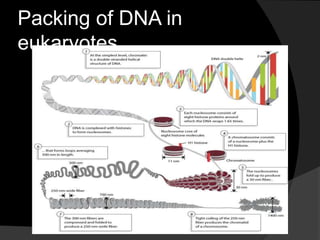
Packing of DNA in
eukaryotes
 DNA almost 10cm long is converted to
chromatin fibers 10-13nm in length and found
dispersed in nucleus
 At time of cell division these fibers condense
into much larger and compact structure called
chromosome.
 Proteins important in maintaining chromatin
structure are histones
 Histones are small proteins containing lysine
and arginine giving them a strong positive
charge
 Binding of negatively charged DNA to
positively charged histones is stabilized by
Types of Histones
Divided to 5 main types
1. H1
2. H2A
3. H2B
4. H3
5. H4
Chromatin contains equal numbers of H2A,
H2B, H3 and H4 and about half that number of
H1 molecules. Chromatin also contains diverse
group of non histone proteins that play a variety
of enzymatic, structural and regulatory roles.
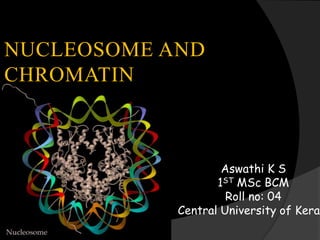
NUCLEOSOME
 Basic unit of chromatin structure.
 Folding of DNA of enormous length to a
nucleus not more than 5-10µm achieved.
 First insight to folding: in late 1960s- X-ray
diffraction studies by Maurice Wilkins revealed
that purified chromatin strands have a
repeating structural subunit seen neither in
DNA nor in histones alone.
 Wilkins concluded that histones impose a
repeating structural organisation upon DNA.
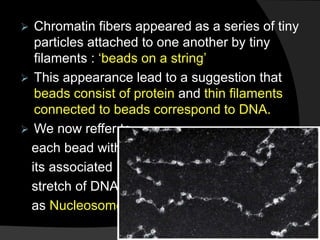
 In 1974, Ada Olins and Donald Olins
published electron micrographs of chromatin
 Chromatin fibers appeared as a series of tiny
particles attached to one another by tiny
filaments : ‘beads on a string’
 This appearance lead to a suggestion that
beads consist of protein and thin filaments
connected to beads correspond to DNA.
 We now reffer to
each bead with
its associated
stretch of DNA
as Nucleosome
 Independent evidence for existence of
repeating structure in chromatin was reported
by Dean Hewish and Leigh Burgoyne –
discovered that rat liver nuclei contain a
nuclease that is capable of cleaving DNA in
chromatin fibers.
 DNA was exposed to its nucleases and the
partially degraded DNA was purified to remove
chromatin proteins
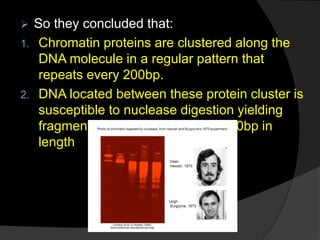
 Upon electrophoresis found a distinctive
pattern of fragments in which the smallest
piece of DNA is of 200bp in length.
 Nuclease digestion of DNA free protein does
 So they concluded that:
1. Chromatin proteins are clustered along the
DNA molecule in a regular pattern that
repeats every 200bp.
2. DNA located between these protein cluster is
susceptible to nuclease digestion yielding
fragments that are multiples of 200bp in
length
 To find out if the protein cluster postulated to
occur at 200bp intervals correspond to the
spherical structure on electron micrograph
further analysis was done.
 Chromatin exposed to micrococcal nuclease
(like rat nuclease) and fragmented chromatin
separated to fractions of varying size by
centrifugation and observed by electron
microscopy.
 Smallest fraction found to contain single
spherical particle, next fraction containing two
clustered units and so forth.
 When DNA analyzed by electrophoresis, DNA
from fraction containing single particle
 Therefore concluded that, the spherical
particle in electron micrograph are associated
with 200bbp of DNA.
 This basic repeating unit containing an
average of 200bp of DNA associated with
protein particle is the Nucleosome
HISTONES
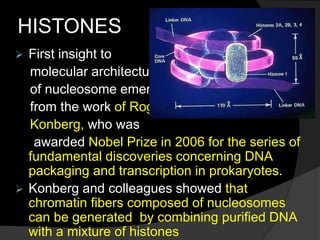
 First insight to
molecular architecture
of nucleosome emerged
from the work of Roger
Konberg, who was
awarded Nobel Prize in 2006 for the series of
fundamental discoveries concerning DNA
packaging and transcription in prokaryotes.
 Konberg and colleagues showed that
chromatin fibers composed of nucleosomes
can be generated by combining purified DNA
with a mixture of histones
 When attempted to use individually purified
histone, discovered that nucleosome could
only be be formed when histone isolated
gently.
 H2A bound to H2B and H3 bound to H4.
 H2A-H2B and H3-H4 complex when mixed
with DNA, reconstituted chromatin fibers
exhibiting nucleosomes.
 Kornberg concluded : ‘H3-H4 and H2A-H2B
complex are integral part of nucleosome’.
 To understand nature of histone interaction,
Kornberg and Jean Thomas treated isolated
chromatin with a reagent that forms covalent
crosslinks between protein molecule located
 After crosslinking, protein isolated and
analyzed by PAGE.
 Protein complexes the size of 8 histones were
prominent in such gels, suggesting that
nucleosomal particle contains octamer of
histones.
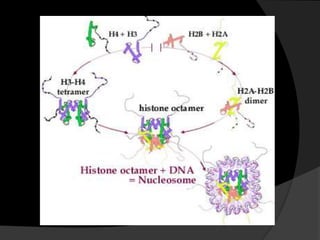
 Given that: H2A-H2B and H3-H4 form tight
complexes and these 4 histones are present
in roughly equivalent amounts in chromatin,
Kornberg and Thomas proposed that histone
octamers are created by joining together 2
H2A-H2B dimers and 2 H3-H4 dimers , and
Dna helix is wrapped around it.
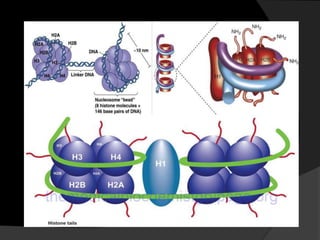
 In previous model, significance of H1 histone
was not given.
 H1 is not part of octamer.
 Nucleosomes are isolated by briefly digesting
chromatin with micrococcal nuclease and
degraded until the 200bp DNA reaches the
length of 146bp.
 During final stage, H1 is released.
 Remaining particle: histone octamer with
146bp DNA is called “core particle” and the
DNA fragment degraded out is called “linker
DNA” because it joins one nucleosome to the
next
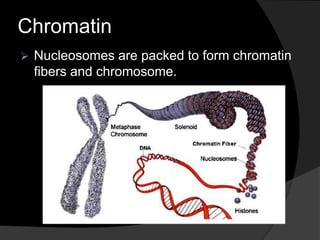
Chromatin
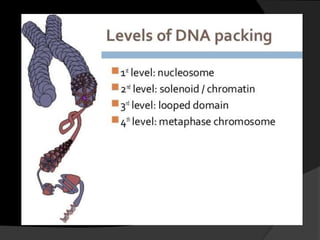
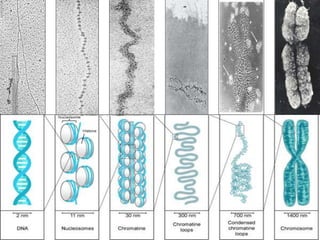
 Nucleosomes are packed to form chromatin
fibers and chromosome.
 Thicker chromatin(10nm) are called
chromatin fiber (30nm).
 H1 facilitates packing into thicker chromatin
fiber.
 Next level of packing is the folding of 30nm
fiber into looped domains. (ave 50,000 to
100,000 bp)
 This arrangement maintained by attachment
of DNA to insoluble network of non histone
proteins, that form chromosome scaffold, to
which long loops of DNA are attached.
 Active DNA more tightly packed than inactive
DNA, providing easier acess to proteins
 Tightly compacted chromatin:
Heterochromatin – appear as dark spots in
micrographs
 Loosely packed, diffuse form of chromatin:
Euchromatin
 Heterochromatin contain transcriptionally
inactive DNA
 Euchromatin is associated with DNA being
actively transcribed.
 Chromatin in metabolically active cell found
as euchromatin, but on cell division become
compacted to generate a group of
chromosomes.
 Each chromosomme consist of duplicated
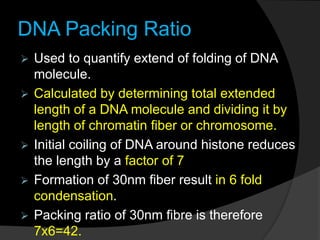
DNA Packing Ratio
 Used to quantify extend of folding of DNA
molecule.
 Calculated by determining total extended
length of a DNA molecule and dividing it by
length of chromatin fiber or chromosome.
 Initial coiling of DNA around histone reduces
the length by a factor of 7
 Formation of 30nm fiber result in 6 fold
condensation.
 Packing ratio of 30nm fibre is therefore
7x6=42.
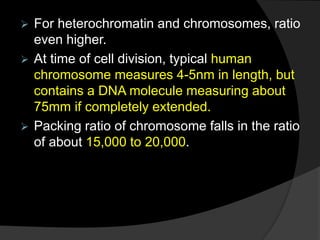
 For heterochromatin and chromosomes, ratio
even higher.
 At time of cell division, typical human
chromosome measures 4-5nm in length, but
contains a DNA molecule measuring about
75mm if completely extended.
 Packing ratio of chromosome falls in the ratio
of about 15,000 to 20,000.
Nucleosome and chromatin

Nucleosome and chromatin

  • 1.
    NUCLEOSOME AND CHROMATIN Aswathi KS 1ST MSc BCM Roll no: 04 Central University of Keral
  • 2.
    Why DNA needsto be packed? 1. Enormous length of genome.  Human genome- 23 pair of chromosome,  Average length 1.3x10ˆ8 bp, aprox. 43mm  For this amount of DNA to fit into nucleus of size approx. 10-20µm require condensation of DNA 2. Structural complexity  Association of DNA with a number of proteins
  • 3.
    Packing of DNAin eukaryotes
  • 4.
     DNA almost10cm long is converted to chromatin fibers 10-13nm in length and found dispersed in nucleus  At time of cell division these fibers condense into much larger and compact structure called chromosome.  Proteins important in maintaining chromatin structure are histones  Histones are small proteins containing lysine and arginine giving them a strong positive charge  Binding of negatively charged DNA to positively charged histones is stabilized by
  • 5.
    Types of Histones Dividedto 5 main types 1. H1 2. H2A 3. H2B 4. H3 5. H4 Chromatin contains equal numbers of H2A, H2B, H3 and H4 and about half that number of H1 molecules. Chromatin also contains diverse group of non histone proteins that play a variety of enzymatic, structural and regulatory roles.
  • 6.
    NUCLEOSOME  Basic unitof chromatin structure.  Folding of DNA of enormous length to a nucleus not more than 5-10µm achieved.  First insight to folding: in late 1960s- X-ray diffraction studies by Maurice Wilkins revealed that purified chromatin strands have a repeating structural subunit seen neither in DNA nor in histones alone.  Wilkins concluded that histones impose a repeating structural organisation upon DNA.  In 1974, Ada Olins and Donald Olins published electron micrographs of chromatin
  • 7.
     Chromatin fibersappeared as a series of tiny particles attached to one another by tiny filaments : ‘beads on a string’  This appearance lead to a suggestion that beads consist of protein and thin filaments connected to beads correspond to DNA.  We now reffer to each bead with its associated stretch of DNA as Nucleosome
  • 8.
     Independent evidencefor existence of repeating structure in chromatin was reported by Dean Hewish and Leigh Burgoyne – discovered that rat liver nuclei contain a nuclease that is capable of cleaving DNA in chromatin fibers.  DNA was exposed to its nucleases and the partially degraded DNA was purified to remove chromatin proteins  Upon electrophoresis found a distinctive pattern of fragments in which the smallest piece of DNA is of 200bp in length.  Nuclease digestion of DNA free protein does
  • 9.
     So theyconcluded that: 1. Chromatin proteins are clustered along the DNA molecule in a regular pattern that repeats every 200bp. 2. DNA located between these protein cluster is susceptible to nuclease digestion yielding fragments that are multiples of 200bp in length
  • 10.
     To findout if the protein cluster postulated to occur at 200bp intervals correspond to the spherical structure on electron micrograph further analysis was done.  Chromatin exposed to micrococcal nuclease (like rat nuclease) and fragmented chromatin separated to fractions of varying size by centrifugation and observed by electron microscopy.  Smallest fraction found to contain single spherical particle, next fraction containing two clustered units and so forth.  When DNA analyzed by electrophoresis, DNA from fraction containing single particle
  • 11.
     Therefore concludedthat, the spherical particle in electron micrograph are associated with 200bbp of DNA.  This basic repeating unit containing an average of 200bp of DNA associated with protein particle is the Nucleosome
  • 12.
    HISTONES  First insightto molecular architecture of nucleosome emerged from the work of Roger Konberg, who was awarded Nobel Prize in 2006 for the series of fundamental discoveries concerning DNA packaging and transcription in prokaryotes.  Konberg and colleagues showed that chromatin fibers composed of nucleosomes can be generated by combining purified DNA with a mixture of histones
  • 13.
     When attemptedto use individually purified histone, discovered that nucleosome could only be be formed when histone isolated gently.  H2A bound to H2B and H3 bound to H4.  H2A-H2B and H3-H4 complex when mixed with DNA, reconstituted chromatin fibers exhibiting nucleosomes.  Kornberg concluded : ‘H3-H4 and H2A-H2B complex are integral part of nucleosome’.  To understand nature of histone interaction, Kornberg and Jean Thomas treated isolated chromatin with a reagent that forms covalent crosslinks between protein molecule located
  • 14.
     After crosslinking,protein isolated and analyzed by PAGE.  Protein complexes the size of 8 histones were prominent in such gels, suggesting that nucleosomal particle contains octamer of histones.  Given that: H2A-H2B and H3-H4 form tight complexes and these 4 histones are present in roughly equivalent amounts in chromatin, Kornberg and Thomas proposed that histone octamers are created by joining together 2 H2A-H2B dimers and 2 H3-H4 dimers , and Dna helix is wrapped around it.
  • 16.
     In previousmodel, significance of H1 histone was not given.  H1 is not part of octamer.  Nucleosomes are isolated by briefly digesting chromatin with micrococcal nuclease and degraded until the 200bp DNA reaches the length of 146bp.  During final stage, H1 is released.  Remaining particle: histone octamer with 146bp DNA is called “core particle” and the DNA fragment degraded out is called “linker DNA” because it joins one nucleosome to the next
  • 18.
    Chromatin  Nucleosomes arepacked to form chromatin fibers and chromosome.
  • 20.
     Thicker chromatin(10nm)are called chromatin fiber (30nm).  H1 facilitates packing into thicker chromatin fiber.  Next level of packing is the folding of 30nm fiber into looped domains. (ave 50,000 to 100,000 bp)  This arrangement maintained by attachment of DNA to insoluble network of non histone proteins, that form chromosome scaffold, to which long loops of DNA are attached.  Active DNA more tightly packed than inactive DNA, providing easier acess to proteins
  • 21.
     Tightly compactedchromatin: Heterochromatin – appear as dark spots in micrographs  Loosely packed, diffuse form of chromatin: Euchromatin  Heterochromatin contain transcriptionally inactive DNA  Euchromatin is associated with DNA being actively transcribed.  Chromatin in metabolically active cell found as euchromatin, but on cell division become compacted to generate a group of chromosomes.  Each chromosomme consist of duplicated
  • 23.
    DNA Packing Ratio Used to quantify extend of folding of DNA molecule.  Calculated by determining total extended length of a DNA molecule and dividing it by length of chromatin fiber or chromosome.  Initial coiling of DNA around histone reduces the length by a factor of 7  Formation of 30nm fiber result in 6 fold condensation.  Packing ratio of 30nm fibre is therefore 7x6=42.
  • 24.
     For heterochromatinand chromosomes, ratio even higher.  At time of cell division, typical human chromosome measures 4-5nm in length, but contains a DNA molecule measuring about 75mm if completely extended.  Packing ratio of chromosome falls in the ratio of about 15,000 to 20,000.