RNA synthesis
and processing
Dr.S.Sethupathy, M.D.,Ph.D.,
Professor of Biochemistry,
Rajah Muthiah Medical College,
Annamalai University
RNAs of protein
synthesis
Messenger RNA
(mRNA)
Ribosomal RNA (rRNA)
Transfer RNA (tRNA)
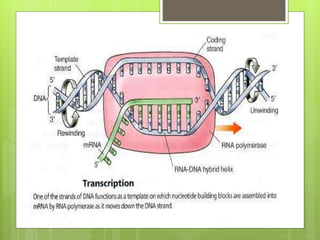
Transcription
 Ribonucleotides used
 Uracil instead of thymine used
 Primer not required by RNA polymerase
 Only a portion of genome is transcribed.
 The template strand is transcribed
 The other strand is coding strand as RNA
resembles except U instead of T
Direction
Reading is 3’ to 5’
direction
Synthesis is from 5’ to 3’
direction
RNA synthesis
Initiation
Elongation
termination
Initiation
Promoter site
105 transcription sites on the
entire DNA
5’ end of RNA transcript is +1 nt
The bases upstream are -1,-2,-3
…….n
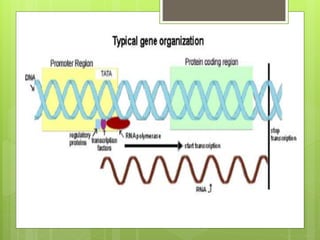
TATA box
 In bacteria - 10 bp (upstream), sequence of
5’- TATAAT-3’. TATA box – In the coding
region- TATA-binding protein (TBP) binds to
this region.
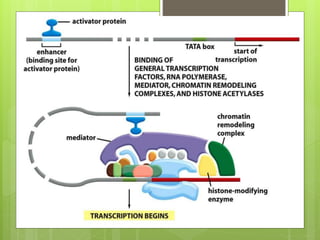
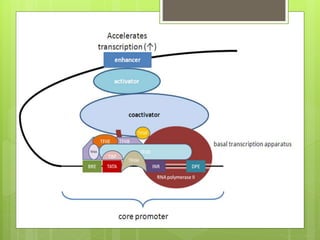
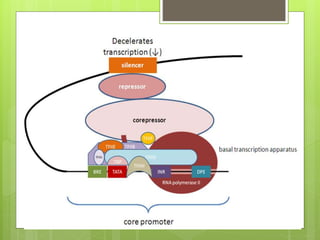
 Transcription factors and RNA polymerase
combine the TATA box to form Pre-initiation
complex (PIC).
 Activators and repressors also bind.
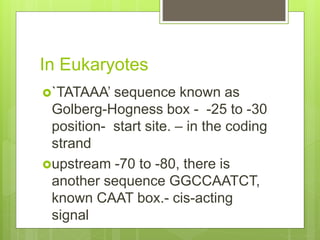
In Eukaryotes
`TATAAA’ sequence known as
Golberg-Hogness box - -25 to -30
position- start site. – in the coding
strand
upstream -70 to -80, there is
another sequence GGCCAATCT,
known CAAT box.- cis-acting
signal
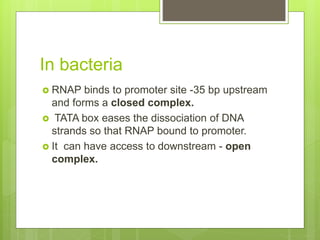
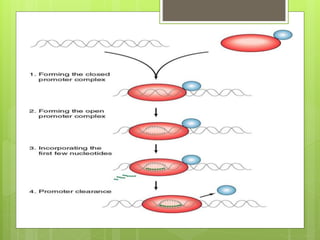
In bacteria
 RNAP binds to promoter site -35 bp upstream
and forms a closed complex.
 TATA box eases the dissociation of DNA
strands so that RNAP bound to promoter.
 It can have access to downstream - open
complex.
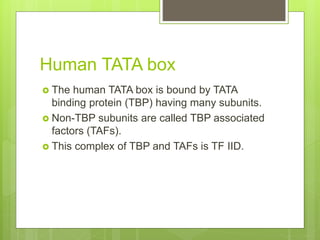
Human TATA box
 The human TATA box is bound by TATA
binding protein (TBP) having many subunits.
 Non-TBP subunits are called TBP associated
factors (TAFs).
 This complex of TBP and TAFs is TF IID.
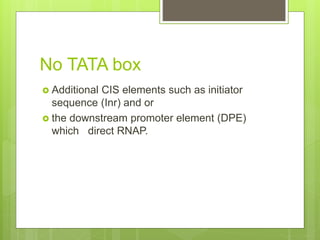
No TATA box
 Additional CIS elements such as initiator
sequence (Inr) and or
 the downstream promoter element (DPE)
which direct RNAP.
RNAPs
 RNAP I is insensitive to α- amanitin - rRNA
synthesis.
 RNAP II is highly sensitive to α- amanitin-s
mRNA, miRNA, snRNA synthesis.
 RNAP III is intermediate sensitive to α-
amanitin - tRNA, 5S rRNA synthesis.
Termination
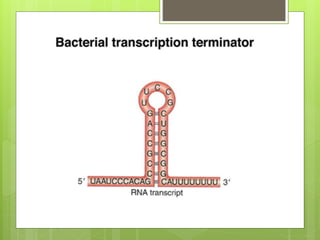
 In Rho-independent transcription termination,
intrinsic termination, RNA transcription stops when
the newly synthesized RNA molecule forms a G-
C-rich hairpin loop followed by a run of Us.
 When the hairpin forms, the mechanical stress
breaks the weak rU-dA bonds,
 This pulls the poly-U transcript out of the active
site of the RNA polymerase, terminating
transcription.
Rho dependent termination
 A sequence in the template strand of DNA -
recognized by a termination protein, the rho(р
factor).
 Rho factor is an ATP dependent RNA
stimulated helicase that disrupts RNAP,
nascent RNA and DNA.
 Transcription termination in eukaryotes is less
understood
Elongation phase
 Pyrophosphate is released following each
cycle of polymerization
 this is rapidly degraded to phosphate by
inorganic pyrophosphatase enzyme.
 DNA unwinding occurs for RNAP to have
access to the template.
 The unwinding results in transcription bubble
which is constant throughout transcription.
Unwinding
 Unwinding of DNA is dictated by RNAP which
has intrinsic unwindase activity.
 Topoisomerase both precedes and follows
RNAP and prevents supercoil tensions.
 RNAP – no nuclease activity . No proof
reading
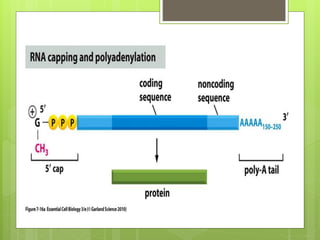
PTM of RNA
 mRNA- 7-methyl guanosine tri -P cap
structure to 5’ end
 Poly A tail to 3’ end mRNA precursor.
 The cap protects mRNA from attack by 5’to 3’
exonuclease.
 Poly(a) tail protects 3’ end of mRNA from
attack by 3’to 5’ exonuclease.
Cytoplasmic modification
 Cytoplasmic enzymes can both add and
remove adenylyl residues from the poly A
tails.
 It alters mRNA stability and translatability.
 In cytoplasmic organelles called P- bodies
(Processing bodies or P-bodies are involved
in mRNA turnover).
UTR
 Extra nucleotides found in untranslated
regions (UTR) on both ends of 5’ and 3’ of
coding region.
 The function of UTR is not known. The micro
RNAs target sequences within the 3’ UTR.
UTR- clinical applications
 Mutations in the untranslated regions of
mRNA (UTR) can also lead to diseases.
 Eg: breast cancer, Fragile X syndrome,
bipolar disorder and Alzheimer’s disease.
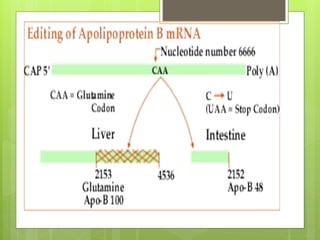
RNA editing
 RNA editing changes mRNA- coding information -
changed at the level of mRNA editing.
 Apo B gene in liver - B100 (100 kDa) protein.
 In the intestine -the same gene- cytidine
deaminase enzyme converts CAA codon in the
mRNA to UAA at a single specific site.
 Instead of glutamine, it becomes termination
codon. So Apo B48 (48 kDa) protein is formed
tRNA
 Modification of bases A,U,G and C -
methylation, reduction, deamination and
rearranged glycosidic bonds.
 CCA sequence is attached to 3’ end of tRNA
by nucleotidyl transferase in cytoplasm.
 The 3-OH group of A- ribose is the point of
attachment of amino acid.
Introns removal and splicing of exons
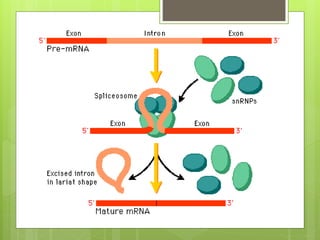
Splicing is done by spliceosomes.
It consists of the primary mRNA
transcript , five snRNAs (U1, U2, U4,
U5, U6 and many proteins.
This complex -Small nuclear
ribonucleoprotein complex (snurps).
 The splicing starts from 5’- end of exon-intron
junction.
 5’ end of intron undergoes nucleophilic
attack.
 Intron forms a loop or lariat. Second cut is
made at 3’ and of intron.
 Ligation of 3’ end of exon-1 with 5’ end of
exon-2 is done.
 Intron is digested.
Alternative splicing
 The processing of mRNA is also a site for
regulation of gene expression.
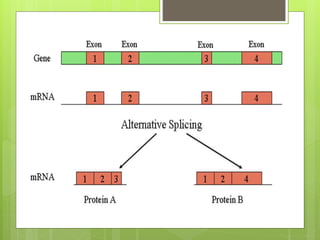
 By selective splicing and altering donor site,
alternative splicing is done.
 Different mRNAs from the same primary
transcript formed.
Faulty splicing
 e.g: In β- thalassemia, globin
gene of hemoglobin- under
expressed due to nucleotide
change in exon- intron junction.
Splicing modulation – helps-
Duchenne muscular dystrophy,
HIV.
Alternative promoter utilization
 Tissue specific gene expression by
alternative splicing or by the use of alternative
promoters.
 e.g:. Glucokinase gene has 10 exons and 9
introns. 2-10 exons is identical in liver and β-
cells of pancreas.
 Two different promoters - β- cells, the liver
promoter and exon IL - removed by splicing.
Ribosomal RNA
 The three rRNA molecules (28S,18S,5.8S)
are from a single 45S precursor rRNA.
 The precursor is processed in the nucleolus
to its components.
 The rRNA genes are present in the nucleolus
of mammalian cells.
Clinical applications
 rRNA is the target of several antibiotics:
chloramphenicol, erythromycin,
paromomycin, spectinomycin, streptomycin,
and thiostrepton.
 Now many thousands of rRNA sequences are
known
 Data stored in specialized databases such as
RDP-II.
Micro RNAs
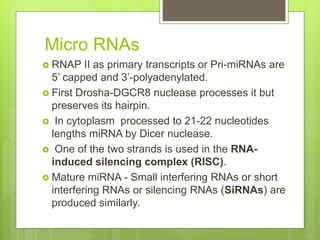
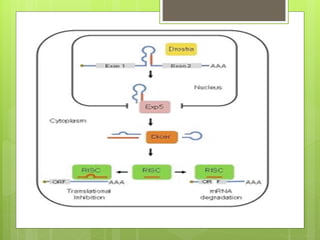
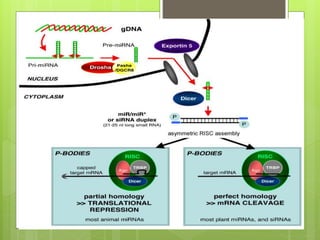
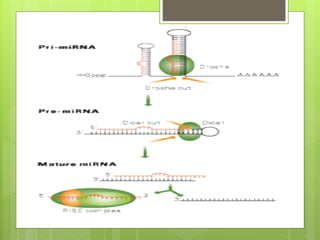
 RNAP II as primary transcripts or Pri-miRNAs are
5’ capped and 3’-polyadenylated.
 First Drosha-DGCR8 nuclease processes it but
preserves its hairpin.
 In cytoplasm processed to 21-22 nucleotides
lengths miRNA by Dicer nuclease.
 One of the two strands is used in the RNA-
induced silencing complex (RISC).
 Mature miRNA - Small interfering RNAs or short
interfering RNAs or silencing RNAs (SiRNAs) are
produced similarly.
Clinical applications
 A mutation in the miRNA - polar cataract, hearing
loss.
 miRNA deregulation -chronic lymphocytic
leukemia.
 Altered expression of miRNAs causing DNA repair
deficiencies leads to cancer.
 miRNAs -altered expression - schizophrenia.
 miRNAs that regulate insulin resistance, obesity,
and diabetes- the let-7 family.
 Overexpression of let-7 mimics accelerated
aging.
Ribozymes
Ribozymes are RNA molecules
with catalytic activity.
 e.g. RNA involved in splicing,
endoribonucleases-RNase P, RNA
with peptidyl transferase activity.
Reverse transcriptase
 Retrovirus is a group of RNA viruses. e.g AIDS virus.
. RNA dependent DNA polymerase (reverse
transcriptase) synthesize a new DNA strand.
 RNA is degraded by RNAase H.
 Another strand of DNA- using the DNA strand -to
form dsDNA
 Reverse transcriptase inhibitors as drugs in the
treatment of AIDS. Such as zidovudine , lamivudine
and tenofovir.
Inhibitors of RNA synthesis
 Actinomycin D and Mitomycin intercalate with two
GpC bp of DNA and inhibits RNA synthesis.
 Ripampicin – TB drug binds to β-subunit of RNA
polymerase which is inactivated.
 α-amanitin is a toxin from mushroom which
inactivates RNAP II.
 3-deoxy adenosine is a synthetic analog that
causes chain termination.
 Thiolutin, a sulfur based microbial antibiotic is an
RNA polymerase inhibitor.
Rna synthesis  and processing

Rna synthesis and processing

  • 1.
    RNA synthesis and processing Dr.S.Sethupathy,M.D.,Ph.D., Professor of Biochemistry, Rajah Muthiah Medical College, Annamalai University
  • 2.
    RNAs of protein synthesis MessengerRNA (mRNA) Ribosomal RNA (rRNA) Transfer RNA (tRNA)
  • 3.
    Transcription  Ribonucleotides used Uracil instead of thymine used  Primer not required by RNA polymerase  Only a portion of genome is transcribed.  The template strand is transcribed  The other strand is coding strand as RNA resembles except U instead of T
  • 4.
    Direction Reading is 3’to 5’ direction Synthesis is from 5’ to 3’ direction
  • 5.
  • 6.
    Initiation Promoter site 105 transcriptionsites on the entire DNA 5’ end of RNA transcript is +1 nt The bases upstream are -1,-2,-3 …….n
  • 7.
    TATA box  Inbacteria - 10 bp (upstream), sequence of 5’- TATAAT-3’. TATA box – In the coding region- TATA-binding protein (TBP) binds to this region.  Transcription factors and RNA polymerase combine the TATA box to form Pre-initiation complex (PIC).  Activators and repressors also bind.
  • 11.
    In Eukaryotes `TATAAA’ sequenceknown as Golberg-Hogness box - -25 to -30 position- start site. – in the coding strand upstream -70 to -80, there is another sequence GGCCAATCT, known CAAT box.- cis-acting signal
  • 12.
    In bacteria  RNAPbinds to promoter site -35 bp upstream and forms a closed complex.  TATA box eases the dissociation of DNA strands so that RNAP bound to promoter.  It can have access to downstream - open complex.
  • 13.
    Human TATA box The human TATA box is bound by TATA binding protein (TBP) having many subunits.  Non-TBP subunits are called TBP associated factors (TAFs).  This complex of TBP and TAFs is TF IID.
  • 14.
    No TATA box Additional CIS elements such as initiator sequence (Inr) and or  the downstream promoter element (DPE) which direct RNAP.
  • 17.
    RNAPs  RNAP Iis insensitive to α- amanitin - rRNA synthesis.  RNAP II is highly sensitive to α- amanitin-s mRNA, miRNA, snRNA synthesis.  RNAP III is intermediate sensitive to α- amanitin - tRNA, 5S rRNA synthesis.
  • 19.
    Termination  In Rho-independenttranscription termination, intrinsic termination, RNA transcription stops when the newly synthesized RNA molecule forms a G- C-rich hairpin loop followed by a run of Us.  When the hairpin forms, the mechanical stress breaks the weak rU-dA bonds,  This pulls the poly-U transcript out of the active site of the RNA polymerase, terminating transcription.
  • 21.
    Rho dependent termination A sequence in the template strand of DNA - recognized by a termination protein, the rho(р factor).  Rho factor is an ATP dependent RNA stimulated helicase that disrupts RNAP, nascent RNA and DNA.  Transcription termination in eukaryotes is less understood
  • 22.
    Elongation phase  Pyrophosphateis released following each cycle of polymerization  this is rapidly degraded to phosphate by inorganic pyrophosphatase enzyme.  DNA unwinding occurs for RNAP to have access to the template.  The unwinding results in transcription bubble which is constant throughout transcription.
  • 23.
    Unwinding  Unwinding ofDNA is dictated by RNAP which has intrinsic unwindase activity.  Topoisomerase both precedes and follows RNAP and prevents supercoil tensions.  RNAP – no nuclease activity . No proof reading
  • 24.
    PTM of RNA mRNA- 7-methyl guanosine tri -P cap structure to 5’ end  Poly A tail to 3’ end mRNA precursor.  The cap protects mRNA from attack by 5’to 3’ exonuclease.  Poly(a) tail protects 3’ end of mRNA from attack by 3’to 5’ exonuclease.
  • 25.
    Cytoplasmic modification  Cytoplasmicenzymes can both add and remove adenylyl residues from the poly A tails.  It alters mRNA stability and translatability.  In cytoplasmic organelles called P- bodies (Processing bodies or P-bodies are involved in mRNA turnover).
  • 26.
    UTR  Extra nucleotidesfound in untranslated regions (UTR) on both ends of 5’ and 3’ of coding region.  The function of UTR is not known. The micro RNAs target sequences within the 3’ UTR.
  • 28.
    UTR- clinical applications Mutations in the untranslated regions of mRNA (UTR) can also lead to diseases.  Eg: breast cancer, Fragile X syndrome, bipolar disorder and Alzheimer’s disease.
  • 29.
    RNA editing  RNAediting changes mRNA- coding information - changed at the level of mRNA editing.  Apo B gene in liver - B100 (100 kDa) protein.  In the intestine -the same gene- cytidine deaminase enzyme converts CAA codon in the mRNA to UAA at a single specific site.  Instead of glutamine, it becomes termination codon. So Apo B48 (48 kDa) protein is formed
  • 31.
    tRNA  Modification ofbases A,U,G and C - methylation, reduction, deamination and rearranged glycosidic bonds.  CCA sequence is attached to 3’ end of tRNA by nucleotidyl transferase in cytoplasm.  The 3-OH group of A- ribose is the point of attachment of amino acid.
  • 32.
    Introns removal andsplicing of exons Splicing is done by spliceosomes. It consists of the primary mRNA transcript , five snRNAs (U1, U2, U4, U5, U6 and many proteins. This complex -Small nuclear ribonucleoprotein complex (snurps).
  • 33.
     The splicingstarts from 5’- end of exon-intron junction.  5’ end of intron undergoes nucleophilic attack.  Intron forms a loop or lariat. Second cut is made at 3’ and of intron.  Ligation of 3’ end of exon-1 with 5’ end of exon-2 is done.  Intron is digested.
  • 35.
    Alternative splicing  Theprocessing of mRNA is also a site for regulation of gene expression.  By selective splicing and altering donor site, alternative splicing is done.  Different mRNAs from the same primary transcript formed.
  • 37.
    Faulty splicing  e.g:In β- thalassemia, globin gene of hemoglobin- under expressed due to nucleotide change in exon- intron junction. Splicing modulation – helps- Duchenne muscular dystrophy, HIV.
  • 38.
    Alternative promoter utilization Tissue specific gene expression by alternative splicing or by the use of alternative promoters.  e.g:. Glucokinase gene has 10 exons and 9 introns. 2-10 exons is identical in liver and β- cells of pancreas.  Two different promoters - β- cells, the liver promoter and exon IL - removed by splicing.
  • 39.
    Ribosomal RNA  Thethree rRNA molecules (28S,18S,5.8S) are from a single 45S precursor rRNA.  The precursor is processed in the nucleolus to its components.  The rRNA genes are present in the nucleolus of mammalian cells.
  • 40.
    Clinical applications  rRNAis the target of several antibiotics: chloramphenicol, erythromycin, paromomycin, spectinomycin, streptomycin, and thiostrepton.  Now many thousands of rRNA sequences are known  Data stored in specialized databases such as RDP-II.
  • 41.
    Micro RNAs  RNAPII as primary transcripts or Pri-miRNAs are 5’ capped and 3’-polyadenylated.  First Drosha-DGCR8 nuclease processes it but preserves its hairpin.  In cytoplasm processed to 21-22 nucleotides lengths miRNA by Dicer nuclease.  One of the two strands is used in the RNA- induced silencing complex (RISC).  Mature miRNA - Small interfering RNAs or short interfering RNAs or silencing RNAs (SiRNAs) are produced similarly.
  • 45.
    Clinical applications  Amutation in the miRNA - polar cataract, hearing loss.  miRNA deregulation -chronic lymphocytic leukemia.  Altered expression of miRNAs causing DNA repair deficiencies leads to cancer.  miRNAs -altered expression - schizophrenia.  miRNAs that regulate insulin resistance, obesity, and diabetes- the let-7 family.  Overexpression of let-7 mimics accelerated aging.
  • 46.
    Ribozymes Ribozymes are RNAmolecules with catalytic activity.  e.g. RNA involved in splicing, endoribonucleases-RNase P, RNA with peptidyl transferase activity.
  • 47.
    Reverse transcriptase  Retrovirusis a group of RNA viruses. e.g AIDS virus. . RNA dependent DNA polymerase (reverse transcriptase) synthesize a new DNA strand.  RNA is degraded by RNAase H.  Another strand of DNA- using the DNA strand -to form dsDNA  Reverse transcriptase inhibitors as drugs in the treatment of AIDS. Such as zidovudine , lamivudine and tenofovir.
  • 48.
    Inhibitors of RNAsynthesis  Actinomycin D and Mitomycin intercalate with two GpC bp of DNA and inhibits RNA synthesis.  Ripampicin – TB drug binds to β-subunit of RNA polymerase which is inactivated.  α-amanitin is a toxin from mushroom which inactivates RNAP II.  3-deoxy adenosine is a synthetic analog that causes chain termination.  Thiolutin, a sulfur based microbial antibiotic is an RNA polymerase inhibitor.