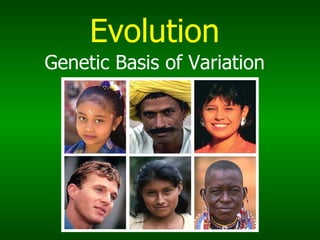
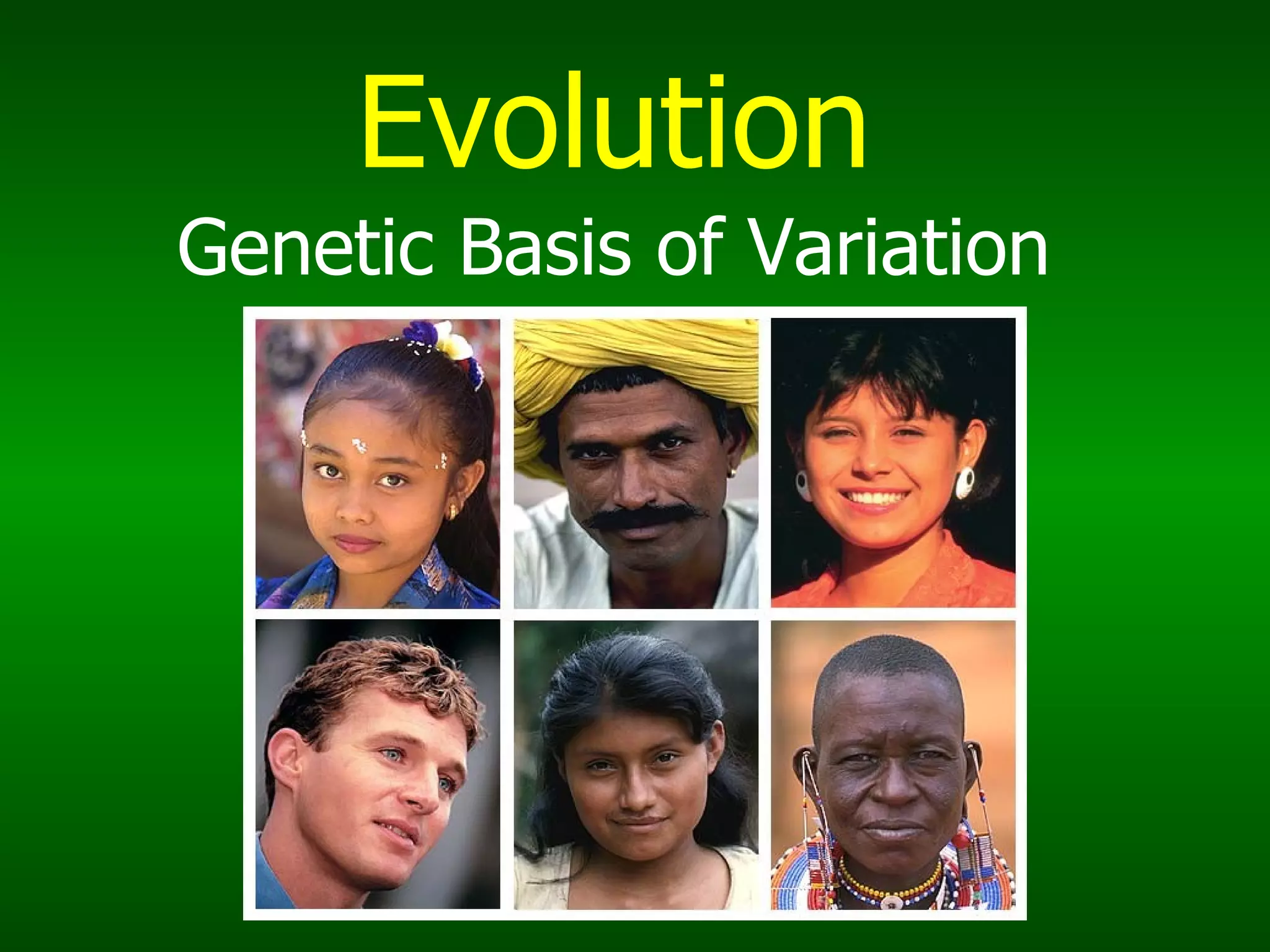
Evolution Genetic Basis of Variation
Genetic Polymorphism Two or more forms of a Mendellian character are often represented in a population Contrasting forms =  morphs The population is  polymorphic  if 2 or more  morphs  are commonly seen
Extent of Genetic Variation Genetic variation is extensive Example:  Fruit flies  The gene pool has 2 or more alleles at 30% of loci Each fly is heterozygous at 12% of loci Therefore 700-1200 heterozygous loci per fly Any 2 flies in a population differ in genotype at ~ 25% of loci Similar in humans
Geographic Variation Natural selection contributes because of different environmental factors Graded change in a trait =  cline e.g. body size increases with latitude in North American mammals
Sources of Genetic Variation Mutation & sexual recombination are sources of genetic variation Mutation rare & random only mutations in gametes can be passed on most point mutations are innocuous those that alter a protein are more often harmful than beneficial Recombination most variation is due to recombination of existing alleles sexual reshuffling crossing over
Preservation of Variation Natural selection doesn’t cull unfavorable genotypes Diploidy   preserves recessive alleles may not be favorable now, but maybe later Balanced  polymorphism  - ability to maintain diversity heterozygous advantage or  hybrid vigor Frequency dependent selection  reproductive success declines if that form becomes too common Some variation is neutral
Adaptive Evolution Darwinian fitness is measured only by the relative contribution an individual makes to the gene pool of the next generation Selection coefficient: Relative fitness of most fertile variant set at 1 So for wild flowers Aa or AA = 1 If plants with white flowers average 80% as many offspring, their relative fitness = 0.8 selection coefficient = 0.2 (1-0.8)
Pleiotropy Genes can have more than one effect The ability to effect multiple  phenotypic characters =  pleiotropy Preserved if good outweighs the bad
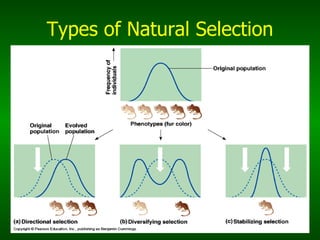
Modes of Natural Selection There are three types of  natural selection: Stabilizing Selection eliminates the extremes reduces variation maintains characteristics that are successful Disruptive or Diversifying Selection selects against the average favors opposite extremes over intermediate individuals Directional Selection moves characteristic in a particular direction    shifts population by favoring variants at one extreme
Types of Natural Selection

Evolution2

  • 1.
  • 2.
    Genetic Polymorphism Twoor more forms of a Mendellian character are often represented in a population Contrasting forms = morphs The population is polymorphic if 2 or more morphs are commonly seen
  • 3.
    Extent of GeneticVariation Genetic variation is extensive Example: Fruit flies The gene pool has 2 or more alleles at 30% of loci Each fly is heterozygous at 12% of loci Therefore 700-1200 heterozygous loci per fly Any 2 flies in a population differ in genotype at ~ 25% of loci Similar in humans
  • 4.
    Geographic Variation Naturalselection contributes because of different environmental factors Graded change in a trait = cline e.g. body size increases with latitude in North American mammals
  • 5.
    Sources of GeneticVariation Mutation & sexual recombination are sources of genetic variation Mutation rare & random only mutations in gametes can be passed on most point mutations are innocuous those that alter a protein are more often harmful than beneficial Recombination most variation is due to recombination of existing alleles sexual reshuffling crossing over
  • 6.
    Preservation of VariationNatural selection doesn’t cull unfavorable genotypes Diploidy preserves recessive alleles may not be favorable now, but maybe later Balanced polymorphism - ability to maintain diversity heterozygous advantage or hybrid vigor Frequency dependent selection reproductive success declines if that form becomes too common Some variation is neutral
  • 7.
    Adaptive Evolution Darwinianfitness is measured only by the relative contribution an individual makes to the gene pool of the next generation Selection coefficient: Relative fitness of most fertile variant set at 1 So for wild flowers Aa or AA = 1 If plants with white flowers average 80% as many offspring, their relative fitness = 0.8 selection coefficient = 0.2 (1-0.8)
  • 8.
    Pleiotropy Genes canhave more than one effect The ability to effect multiple phenotypic characters = pleiotropy Preserved if good outweighs the bad
  • 9.
    Modes of NaturalSelection There are three types of natural selection: Stabilizing Selection eliminates the extremes reduces variation maintains characteristics that are successful Disruptive or Diversifying Selection selects against the average favors opposite extremes over intermediate individuals Directional Selection moves characteristic in a particular direction   shifts population by favoring variants at one extreme
  • 10.