Flame photometry or flame emission photometry 
By: Bijaya Kumar Uprety
Introduction 
•Theabsorptionandemissionofradiantenergybyatomsprovidepowerfulanalyticaltoolsforbothquantitativeandqualitativeanalysisofsubstances.Flameemissionandatomicabsorptionspectroscopyisamethodofelementalanalysis. 
•Thesemethodareparticularlyusefulfordeterminingtracemetalsinliquidsandisalmostindependentofthemolecularformofmetalinthesample. 
•Thesemethodareverysensitiveandcandetectdifferentmetalsinconcentrationsaslowas1ppm. 
•InFlameemissionspectroscopy,theconcentrationoftheanalytepresentinsampleisproportionaltotheintensityoftheemittedradiation. 
•Inatomicabsorptionspectroscopy,theconcentrationofanalyteismeasuredbyabsorbancerelatingtothesignalbyBeer-Lambert’slaw.
•Thefundamentalfactofemissionspectroscopyisverysimple,whereintheatomspresentinasampleundergoexcitationduetotheabsorptionofeitherelectricalorthermalenergy. 
•Subsequently,theradiationemittedbyatomsinanexcitedsampleisstudiedinanelaboratedmannerbothqualitativelyandquantitatively.Therefore,emissionspectroscopyisconsideredtobeanusefulanalyticaltoolfortheanalysisof: 
(i)elementalanalysisofmetals, 
(ii)identificationandquantitativedeterminationofmetallicelements, 
(iii)estimationofmetalloidse.g.,arsenic,silicon,selenium,presentisextremelylowconcentrations,and 
(iv)analysisofsolids,liquidsorgasesasfollows: 
solids-assuchorevaporatedsolutions, 
liquids-atomizedspray,analyzedoccasionally,and 
gases-analyzedrarely. 
•Inshort,emissionspectroscopyisconsideredtobethemostaccurate,preciseandreliablemeansofquantitativeanalysisofelementsasondate.Ifproperskill, precautionsandwisdomareappliedtogetherthismethodmaybeadoptedsafelyandconvenientlytoanalyzeapproximatelyseventyelementsfromthe‘periodictable’ataconcentrationaslowas1ppm.
Theory and principle 
•Inflameemissionspectrometry,thesamplesolutionisnebulized(convertedintoafineaerosol)andintroducedintotheflamewhereitisdesolvated,vaporized,andatomized,allinrapidsuccession. 
•Subsequently,atomsandmoleculesareraisedtoexcitedstatesviathermalcollisionswiththeconstituentsofthepartiallyburnedflamegases.Upontheirreturntoalowerorgroundelectronicstate,theexcitedatomsandmoleculesemitradiationcharacteristicofthesamplecomponents. 
•Theemittedradiationpassesthroughamonochromatorthatisolatesthespecificwavelengthforthedesiredanalysis.Aphotodetectormeasurestheradiantpoweroftheselectedradiation,whichisthenamplifiedandsenttoareadoutdevice,meter,recorder,ormicrocomputersystem.
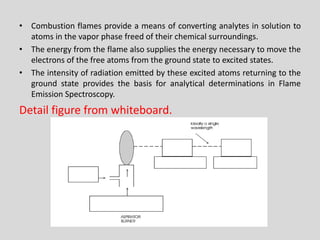
•Combustionflamesprovideameansofconvertinganalytesinsolutiontoatomsinthevaporphasefreedoftheirchemicalsurroundings. 
•Theenergyfromtheflamealsosuppliestheenergynecessarytomovetheelectronsofthefreeatomsfromthegroundstatetoexcitedstates. 
•TheintensityofradiationemittedbytheseexcitedatomsreturningtothegroundstateprovidesthebasisforanalyticaldeterminationsinFlameEmissionSpectroscopy. 
Detailfigurefromwhiteboard.
Instrumentation 
•Flameemissionspectrometers(flamephotometers)areprobablythesimplesttypeofatomicspectrometers.Theyarenormallydesignedtomakemeasurementsonupto10differentelements,usuallythosefromgroupIandIIoftheperiodictable. Thisisachievedusinginterchangeablecolouredfiltersordiffractiongratings, whichisolateanareaofthespectrumcontainingthechosenemissionline. 
•The sequence of events occurring is as follows: 
1.Solution is introduced into the flame as a fine spray. This is normally achieved using an aspirator. Solution is drawn out of the sample holder using a pump and fed into the gas stream through a thin nozzle creating an aerosol spray . 
2.Solvent evaporate leaving the dehydrated salt. 
3.Salt dissociate into free gaseous atoms in the ground state. 
4.A certain fraction of atoms absorbs energy and are raised into excited state. 
5.These excited atoms on returning to ground state emits photons of characteristic wavelength. 
6.The emission from the flame passes through a conventional monochromator which filters out all emitted light except the wavelength of our interest. 
7.A photoelectric detector measures the intensity of the filtered light.
1. Flame atomiser 
•Theroleofatomizeristogeneratethevaporsofanalytewhichgetexcitedbythethermalenergyoftheflameandthenemitcharacteristicradiationthatismeasured. 
•Theflameatomizerassemblyconsistsoftwocomponents.Thepriorisanebulizerwherethesampleintheformofasolutionisdrawninandconvertedintoafinemistoranaerosol. 
•Itisthenpassedontothesecondcomponenti.e.theburneralongwithairoroxygenandafuelgas.Intheflameanumberofprocessesoccurthatconverttheanalyteintoexcitedspecies. 
a.Nebulizer:Itisadeviceusedforsampleintroductionintotheflame.Theprocessiscallednebulisationandconsistsofthermalvaporizationanddissociationofaerosolparticlesathightemperaturesproducingsmallparticlesizewithhighresidencetime.Anumberofnebulisationmethodsareavailable.Afewarelistedbelow. 
•Pneumaticnebulisation 
•Ultrasonicnebulisation 
•Electrothermalvaporization 
•Hydridegeneration(usedforcertainelementsonly).
•However,wewoulddiscussaboutthepneumaticnebulisationonly.Itisthemostcommonlyemployednebulisationmethodinflamephotometers. 
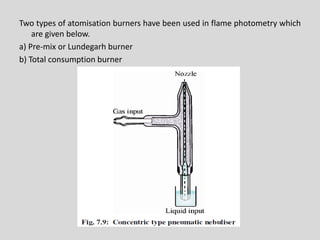
•Pneumaticnebulizeristhemostcommonlyusednebulizerforintroducingaqueous/liquidsamples.Inthisthesamplesolutionisfedoraspiratedintothenebulizerwhichconvertsliquidintoafinemist,oraerosolwhichisthenfedintotheflame.Acommontypeofpneumaticnebulizeriscalledconcentricpneumaticnebulizer,asshowninFig.7.9. Theconcentricpneumaticnebulizerconsistsofafinecapillarysurroundedbyconcentrictubewithasmallorificenearoneendofthecapillary.Thecapillaryisdippedintoasolutionoftheanalytewhiletheoutertubeisconnectedtoahighpressuregassupply.TheanalyteissuckedintothecapillarybythehighpressuregasstreamflowingaroundthetipofthecapillaryusingtheBernoullieffect.Theprocessiscalledaspiration.Thehighvelocitygasbreaksuptheliquidintovarioussizedfinedroplets.Theothertypesofthepneumaticnebulizersalsoworkonthesameprinciple.
b.AtomiserBurnersFlamePhotometry 
Thesampleisintroducedintheformofafinesprayatacontrolledrateintotheflameofburnerwiththehelpofnebuliser.Intheburner,theanalyteundergoesanumberofprocessesasmentionedearlier. 
•The following processes occur in the flame. 
i) Desolvation: The sample containing metal particles is dehydrated by the heat of 
the flame and the solvent is evaporated. 
ii) Vapourisation: The heat of the flame vapourises the sample constituents. No chemical change takes place at this stage. 
iii) Atomisation: At this stage the metal ions that were in the solvent are reduced to 
metal atoms. For example, 
Mg2+ (aq)+ 2e-Mg (g) 
By heat of the flame and action of the reducing gas (fuel), molecules and ions of the sample species are decomposed and reduced to give atoms.
iv)Excitation:Theatomsatthisstageareabletoabsorbenergyfromtheheatoftheflame.Theamountofenergyabsorbeddependsontheelectrostaticforcesofattractionbetweenthenegativelychargedelectronsandthepositivelycharged nucleus.Thisinturndependsuponthenumberofprotonsinthenucleus.Aselectronsabsorbenergytheymovetohigherenergylevelsandareintheexcitedstate. 
v)Emissionofradiation:Electronsintheexcitedstateareveryunstableandmovebackdowntothegroundstateoralowerenergystatequitequickly.Astheydoso, theyemittheenergyintheformofradiationofcharacteristicwavelength,whichismeasuredbyadetector. 
Forsomemetalsthisradiationcorrespondstowavelengthsoflightinthevisibleregionoftheelectromagneticspectrumandisobservedasacharacteristiccolouroftheflame. 
Aselectronsfromdifferentenergylevelsareabletoemitlightastheyrelax,theflamecolourobservedwillbeamixtureofallthedifferentwavelengthsemittedbythedifferentelectronsinthemetalatomunderinvestigation. .
Twotypesofatomisationburnershavebeenusedinflamephotometrywhicharegivenbelow. 
a)Pre-mixorLundegarhburner 
b)Totalconsumptionburner
2.Monochromator 
•Generallyagratingoraprismmonochromatorisemployed.Theroleofthemonochromatoristodispersetheradiationcomingfromtheflameandfallingonit.Thedispersedradiationfromtheexitslitofthemonochromatorgoestothedetector. 
•Incasealowtemperaturesflameisused,thespectrallinesfromonlyafewelementsareemitted.Insuchacase,formostroutineanalyses,afiltercanbeusedasamonochromatortoisolateaparticularspectralline. 
•Filtersaregenerallymadefrommaterialswhicharetransparentinasmallselectivewavelengthregion.Thefilterchosenisonewhichhasawavelengthrangeinwhichitistransparenttoemissionfromtheelementofinterest. 
•Insuchacase,acondenserlenssystemisemployedtocollecttheemittedlightandsendtheraysthroughthefilterasanapproximatelycollimated(parallel)beamtoreachthedetector.Filtershavebeendesignedforuseinthedeterminationoflithium,sodium,potassium,calciumandotherelements.
3. Detector 
•Thefunctionofadetectoristomeasuretheintensityofradiationfallingonit. 
•Photoemissivecellsorphotomultipliertubesarecommonlyemployedforthepurpose. 
•ThesedetectorsarealsousedinUV-VISspectrophotometers. 
•ReadindetailaboutthephotoemissivecellfromUVspectroscopynotes.
4. Amplifier and Readout Device 
•Theoutputfromthedetectorissuitablyamplifiedanddisplayedonareadoutdevicelikeameteroradigitaldisplay. 
•Thesensitivityoftheamplifiercanbechangedsoastobeabletoanalyzesamplesofvaryingconcentrations. 
•Nowadaystheinstrumentshavemicroprocessorcontrolledelectronicsthatprovidesoutputscompatiblewiththeprintersandcomputerstherebyminimizingthepossibilityofoperatorerrorintransferringdata.
QualitativeApplications 
•Flamephotometricmethodsarewidelyusedforthedeterminationofalkaliandthealkalineearthmetalsinsamplesthatareeasilypreparedasaqueoussolutions. 
•Someoftheseelementscanbedetectedvisuallybythecolorintheflame, e.g.sodiumproducesyellowflame.However,thismethodisnotveryreliable. 
•Thebestmethodistouseflamephotometerwithafilterormonochromatortoseparateradiationwiththewavelengthscharacteristicofthedifferentmetalsfromotherradiationspresent. 
•Iftheradiationofthecharacteristicwavelengthisdetected,itwillindicatethepresenceofthemetalinthesample. 
•Themethodtocarryoutdetectionofelementsbyflamephotometryisfast,simpleandifcarriedoutwithcare,quitereliable.However,therearesomedifficulties. 
•Itdoesnotprovideinformationaboutthemolecularstructureofthecompoundpresentinthesamplesolution.Nonradiatingelementsuchascarbon,hydrogenandhalidescannotbedetected.Thesecanonlybedeterminedunderspecialcircumstances.
QuantitativeMeasurements. 
•Theintensityofthespectrallinebeingmeasuredisdirectlyproportionaltothesolutionconcentrationoftheanalyte. 
•Quantitativemeasurementsaremadebyreferencetoapreviouslypreparedcalibrationlineorbythemethodofstandardaddition. 
•Theresponselinearityofmostinstrumentsisrestrictedtoconcentrationsbetween10and100ppmwhichisfairlylimiting.TypicalelementsthatthistechniqueisusedforareCa,Ba,K,Li,Na,Mg,Al. 
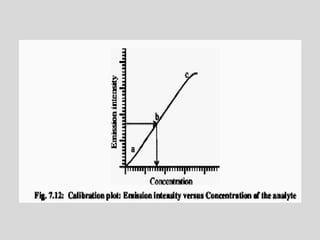
•Oneofthemethodofquantitativemeasurementinvolvesthepreparationofcalibrationcurvebymeasuringtheintensityofemissionforaseriesofsolutionsofdifferentconcentrationspreparedbyusingastandardsolutionandplottingagraphbetweenemissionintensityversusconcentrationoftheionicspeciesoftheelementofinterest.Theconcentrationoftheelementintheunknownsamplecanthenbefoundoutfromthestandardplotasisdoneinvisiblespectrophotometry. Further,itisveryimportanttomeasuretheemissionfromthestandardandunknownsolutionsunderconditionsthatareasnearlyidenticalaspossible.
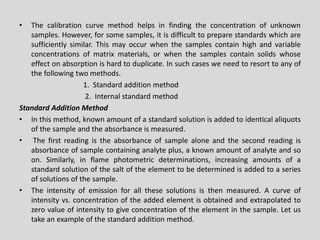
•Thecalibrationcurvemethodhelpsinfindingtheconcentrationofunknownsamples.However,forsomesamples,itisdifficulttopreparestandardswhicharesufficientlysimilar.Thismayoccurwhenthesamplescontainhighandvariableconcentrationsofmatrixmaterials,orwhenthesamplescontainsolidswhoseeffectonabsorptionishardtoduplicate.Insuchcasesweneedtoresorttoanyofthefollowingtwomethods. 
1.Standardadditionmethod 
2.Internalstandardmethod 
StandardAdditionMethod 
•Inthismethod,knownamountofastandardsolutionisaddedtoidenticalaliquotsofthesampleandtheabsorbanceismeasured. 
•Thefirstreadingistheabsorbanceofsamplealoneandthesecondreadingisabsorbanceofsamplecontaininganalyteplus,aknownamountofanalyteandsoon.Similarly,inflamephotometricdeterminations,increasingamountsofastandardsolutionofthesaltoftheelementtobedeterminedisaddedtoaseriesofsolutionsofthesample. 
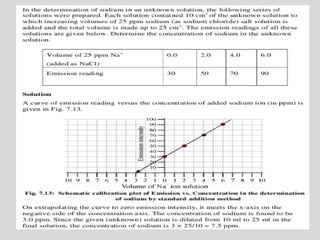
•Theintensityofemissionforallthesesolutionsisthenmeasured.Acurveofintensityvs.concentrationoftheaddedelementisobtainedandextrapolatedtozerovalueofintensitytogiveconcentrationoftheelementinthesample.Letustakeanexampleofthestandardadditionmethod.
InternalStandardMethod 
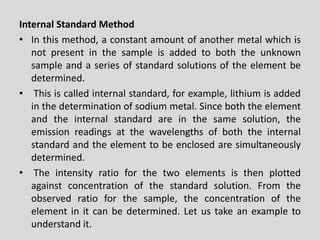
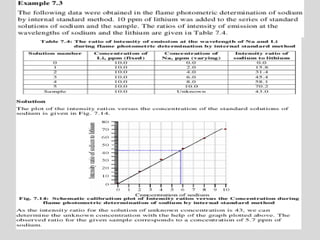
•Inthismethod,aconstantamountofanothermetalwhichisnotpresentinthesampleisaddedtoboththeunknownsampleandaseriesofstandardsolutionsoftheelementbedetermined. 
•Thisiscalledinternalstandard,forexample,lithiumisaddedinthedeterminationofsodiummetal.Sinceboththeelementandtheinternalstandardareinthesamesolution,theemissionreadingsatthewavelengthsofboththeinternalstandardandtheelementtobeenclosedaresimultaneouslydetermined. 
•Theintensityratioforthetwoelementsisthenplottedagainstconcentrationofthestandardsolution.Fromtheobservedratioforthesample,theconcentrationoftheelementinitcanbedetermined.Letustakeanexampletounderstandit.
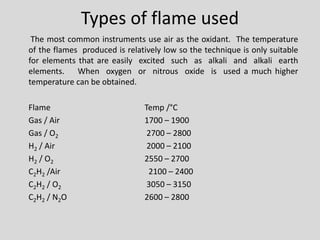
Types of flame used 
Themostcommoninstrumentsuseairastheoxidant.Thetemperatureoftheflamesproducedisrelativelylowsothetechniqueisonlysuitableforelementsthatareeasilyexcitedsuchasalkaliandalkaliearthelements.Whenoxygenornitrousoxideisusedamuchhighertemperaturecanbeobtained. 
FlameTemp/°C 
Gas/Air1700–1900 
Gas/O22700–2800 
H2/Air2000–2100 
H2/O22550–2700 
C2H2/Air2100–2400 
C2H2/O23050–3150 
C2H2/N2O2600–2800
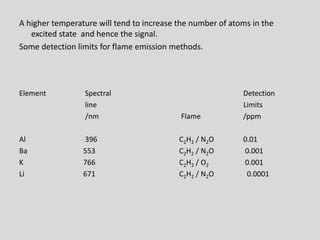
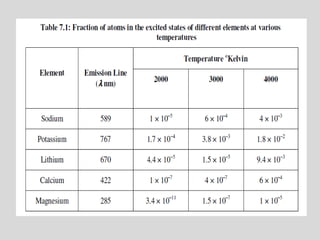
A higher temperature will tend to increase the number of atoms in the excited state and hence the signal. 
Some detection limits for flame emission methods. 
Element Spectral Detection 
line Limits 
/nm Flame /ppm 
Al 396 C2H2/ N2O 0.01 
Ba 553 C2H2/ N2O 0.001 
K 766 C2H2/ O20.001 
Li 671 C2H2/ N2O 0.0001
Interference in Quantitative analysis 
•Thesuccessofthequantitativedeterminationdependsonhowaccuratelytheintensityoftheemittedradiationrepresentstheconcentrationoftheanalyte. 
•Ithasbeenfoundthatnumberoffactorsbesidestheanalyteaffecttheintensityoftheemittedradiation.Theanalyticalsignalsmeasuredoftenincludecontributionsfromconstituentsotherthantheanalyte.Theconstituentsarecalledthematrixconstituents. 
•Thecontributionsareknownasinterferencesandarefoundtoinfluencetheoutcomeoftheanalyticalprocedure.Thesecanbecorrectedbysubtractingtheircontributionstothesignal.Thecontributionoftheinterferentcanbecalculatedfromthemagnitudeoftheinterferenceandtheconcentrationoftheinterferent. Theinterferencesencounteredcanbeclassifiedasfollows. 
1.Spectralinterferences 
2.Ionisedinterferences 
3.Chemicalinterferences 
•Letuslearnaboutdifferenttypesofinterferencesencounteredinquantitativedeterminationsbyflamephotometry.
SpectralInterferences 
•Theserefertotheinterferencesthataffectthespectralintensityorresolution.Thereareseveraltypesofspectralinterferenceswhichareexplainedbelow. 
•Thefirsttypeofinterferenceariseswhentwoelementsexhibitspectra,whichpartiallyoverlap,andbothemitradiationatsomeparticularwavelength.Thedetectorcannotdistinguishbetweenthesourcesofradiationandrecordsthetotalsignal,thusresultinginincorrectanswer.Suchinterferencesaremorecommonathighflametemperaturesbecausenumerousspectrallinesareproducedathightemperatures.Forexample,theFelineat324.73nmoverlapswiththeCulineat324.75nm.Suchinterferencecanbeovercomeeitherbytakingmeasurementsatanalternativewavelengthwhichhasnooverlap,ifavailable,orbyremovingtheinterferingelementbyextraction.Alternatively,onemaymakeacalibrationcurve,whichispreparedfromasolutionhavingsimilarquantitiesoftheinterferingelement. 
•Thesecondtypeofspectralinterferencedealswithspectrallinesoftwoormoreelementswhichareclosebuttheirspectradonotoverlap.Thistypeofinterferencebecomesaproblemwhenafilterisusedasthedevicetoisolatespectrallines.Afiltermayallowspectrallinesseparatedby5.0-10.0nmtopassthrough,thusresultinginanerrorintheanalysis.Suchinterferencescanbereducedbyincreasingtheresolutionofthespectralisolationsystem. However,theinterferencecannotbeeliminatedentirelyduetothefinitewidthofthespectralisolationsystemandthefiniteslitwidthinsuchsystems. 
•Athirdtypeofspectralinterferenceoccursduetothepresenceofcontinuousbackgroundwhicharisesduetohighconcentrationofsaltsinthesample,especiallyofalkaliandalkalineearthmetals.Someorganicsolventsalsoproduceacontinuousbackground.Thistypeofinterferencecanbecorrectedbyusingsuitablescanningtechnique.
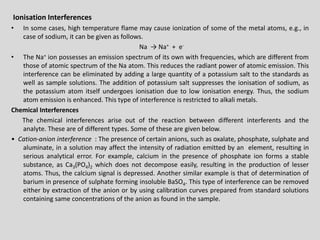
IonisationInterferences 
•Insomecases,hightemperatureflamemaycauseionizationofsomeofthemetalatoms,e.g.,incaseofsodium,itcanbegivenasfollows. 
Na→Na++e- 
•TheNa+ionpossessesanemissionspectrumofitsownwithfrequencies,whicharedifferentfromthoseofatomicspectrumoftheNaatom.Thisreducestheradiantpowerofatomicemission.Thisinterferencecanbeeliminatedbyaddingalargequantityofapotassiumsalttothestandardsaswellassamplesolutions.Theadditionofpotassiumsaltsuppressestheionisationofsodium,asthepotassiumatomitselfundergoesionisationduetolowionisationenergy.Thus,thesodiumatomemissionisenhanced.Thistypeofinterferenceisrestrictedtoalkalimetals. 
ChemicalInterferences 
Thechemicalinterferencesariseoutofthereactionbetweendifferentinterferentsandtheanalyte.Theseareofdifferenttypes.Someofthesearegivenbelow. 
•Cation-anioninterference:Thepresenceofcertainanions,suchasoxalate,phosphate,sulphateandaluminate,inasolutionmayaffecttheintensityofradiationemittedbyanelement,resultinginseriousanalyticalerror.Forexample,calciuminthepresenceofphosphateionformsastablesubstance,asCa3(PO4)2whichdoesnotdecomposeeasily,resultingintheproductionoflesseratoms.Thus,thecalciumsignalisdepressed.AnothersimilarexampleisthatofdeterminationofbariuminpresenceofsulphateforminginsolubleBaSO4.Thistypeofinterferencecanberemovedeitherbyextractionoftheanionorbyusingcalibrationcurvespreparedfromstandardsolutionscontainingsameconcentrationsoftheanionasfoundinthesample.
•Cation-cationinterference:Inmanycases,mutualinterferencesofcationshavebeenobserved,resultinginreducedsignalintensityoftheelementbeingdetermined. Theseinterferencesareneitherspectralnorionicinnatureandthemechanismofsuchinterferencesisnotwellunderstood.Thus,forexample,aluminuminterfereswithcalciumandmagnesium.Also,sodiumandpotassiumshowcation-cationinterferenceononeanother. 
•Interferenceduetooxideformation:Thistypeofinterferencearisesduetotheformationofstablemetaloxideifoxygenispresentintheflame,resultinginreducedsignalintensity.Thealkalineearthmetalsaresubjecttothistypeofinterference. Thistypeofinterferencecanbeeliminatedbyeitherusingveryhighflametemperaturetodissociatetheoxidesorbyusingoxygen-deficientenvironmenttoproduceexcitedatom.
Structure of Flames 
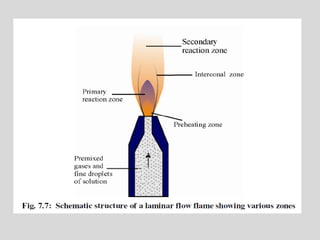
•Flamesarenotuniformincomposition,lengthorcrosssection.Thestructureofapremixedflame,supportedasalaminarflowisshowninFig.7.7. 
•As seen in the figure, the flame may be divided into the following regions or zones. 
i) Preheating zones 
ii) Primary reaction zone or inner zone 
iii) Internal zone 
iv) Secondary reaction zone
•Thefirstortheinnermostregionoftheflameisthepreheatingzonewherethecombustionmixtureisheatedtotheignitiontemperaturebythermalconductionfromtheprimaryreactionzone. 
•Thesecondzoneistheprimaryreactionzoneorinnerzone.Thiszoneisabout0.1mmthickatatmosphericpressureandisvisiblebyvirtueofitsbluegreenlightascribedtoradicals.C2and.CH.Thereisnothermodynamicequilibriuminthiszoneandtheconcentrationofionsandfreeradicalsisveryhigh.Thisregionisnotusedforflamephotometry. 
•Immediatelyabovetheprimaryreactionzoneliesthethirdorinterconalzoneorthereactionfreezonewhichcanextenduptoconsiderableheight.Themaximumtemperatureisachievedjustabovethetipoftheinnerzone.Thehighertemperaturefavoursbothproductionoffreeatomsandmaximumexcitationforatomicemissionspectroscopy.Therefore,thiszoneisusedforflamephotometry. 
•Theoutermostfourthzoneisthesecondaryreactionzone.Withinthiszone,theproductsofthecombustionprocessesareburnttostablemolecularspeciesbythesurroundingair.
•Theshapeofanunmixedflameisgenerallydifferent.Theinnerzonecanstillberecognised,butitisveryvagueandisthickened.Alaminarflamemakesastronghissingnoisewhichgetslouderwhenaliquidisatomisedintoit.Weshallnowlookintothereactionswhicharetakingplacewhentheelementisplacedinflame.
Limitation of Flame Emission Photometry 
•Asnaturalgasandairflameisemployedforexcitationthetemperatureisnothighenoughtoexcitetransitionmetals,thereforethemethodisselectivetowardsdetectionofalkaliandalkalineearthmetals. 
•Thelowtemperaturemakesthismethodsusceptibletocertaindisadvantages, mostofthemrelatedtointerferenceandthestabilityoftheflameandaspirationconditions.Fuelandoxidantflowratesandpurity,aspirationrates,solutionviscosity,affectthese.Itisthereforeveryimportanttomeasuretheemissionofthestandardandunknownsolutionsunderidenticalconditions. 
•Therelativelylowenergyavailablefromtheflameleadstorelativelylowintensityoftheradiationfromthemetalatoms,particularlythosethatrequirelargeamountofenergytobecomeexcited. 
•Flame photometry is a means of determining the total metal concentration of a sample; it tells us nothing about the molecular form of the metal in the original sample. 
•Only liquid samples can be used. In some cases, lengthy steps are necessary to prepare liquid samples.
Applications 
•Flamephotometersarewidelyusedinqualitycontrolwhereasimpleandquickdeterminationofalkalioralkaliearthelementsisrequired.Theyhavetheadvantageofbeingsignificantlylowerpricedthanmostotheratomicspectrometers. 
•Biological/medicalapplications–notableapplicationsarethedeterminationsofNa,K,CaandMginbodyfluidsandotherbiologicalsamples. 
•Foodindustry–determinationofcalciumandironinbeer.

Flame emission spectroscopy