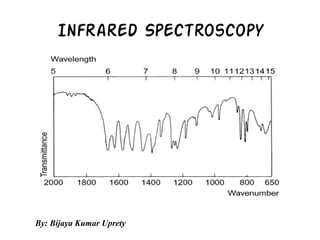
Infrared Spectroscopy 
By: Bijaya Kumar Uprety
Introduction 
•Thetwoatomsjoinedtogetherbyachemicalbond(maybesingle,doubleortriplebond),macroscopicallycanbecomposedastwoballsjoinedbyaspring. 
•Theapplicationofaforcelike(i)stretchingofoneorboththeballs(atoms)awayfromeachotherorclosertoeachother(ii)bendingofoneoftheatomseitherverticallyorhorizontallyandthenreleaseoftheforceresultsinthevibrationsonthetwoballs(atoms). 
•Thesevibrationsdependonthestrengthofthespringandalsothemode(stretchingorbending)inwhichtheforceisbeingapplied. 
•Similarly,atordinarytemperatures,organicmoleculesareinaconstantstateofvibrations,eachbondhavingitscharacteristicstretchingandbendingfrequencies. 
•Wheninfraredlightradiationsbetween4000-400cm-1(theregionmostconcernedtoanorganicchemist)arepassedthroughasampleofanorganiccompound, someoftheseradiationsareabsorbedbythesampleandareconvertedintoenergyofmolecularvibrations.Theotherradiationswhichdonotinteractwiththesamplearetransmittedthroughthesamplewithoutbeingabsorbed.Theplotof% transmittanceagainstfrequencyiscalledtheinfraredspectrumofthesampleorcompound.
Continue… 
•Thisstudyofvibrationsofbondsbetweendifferentatomsandvariedmultiplicitieswhichdependingontheelectronegativity,massesoftheatomandtheirgeometryvibrateatdifferentbutspecifiedfrequencies;iscalledinfraredspectroscopy. 
•Thepresenceofsuchcharacteristicvibrationalbandsinaninfraredspectrumindicatesthepresenceofthesebondsinthesampleunderinvestigation. 
Principle: 
IRspectroscopyisbasedupontheprinciplethat,whenacompoundisexposedtoIRradiations,itselectivelyabsorbstheradiationsresultinginvibrationofthemoleculesofthecompound.Itresultsincloselypackedabsorptionbandswhicharecharacteristictothefunctionalgroupsandbondspresentinthecompound.ThusanIRspectrumofcompoundisconsideredasthefingerprintforitsidentification.
•Theinfraredportionoftheelectromagneticspectrumisusuallydividedintothreeregions;thenear-,mid- andfar-infrared,namedfortheirrelationtothevisiblespectrum. 
•Thehigher-energynear-IR,approximately14000– 4000cm−1(0.8–2.5μmwavelength)canexciteovertoneorharmonicvibrations. 
•Themid-infrared,approximately4000–400cm−1(2.5– 25μm)maybeusedtostudythefundamentalvibrationsandassociatedrotational- vibrationalstructure. 
•Thefar-infrared,approximately400–10cm−1(25– 1000μm),lyingadjacenttothemicrowaveregion,haslowenergyandmaybeusedforrotationalspectroscopy.
Hooke’s law and Absorption of radiations 
• 
•Therefore,inprinciple,eachabsorptionofradiationintheinfraredregionisquantizedandshouldappearassharpline.However,eachvibrationaltransitionwithinthemoleculeisassociatedwithnumberofrotationalenergychangesandthusappearsascombinationofvibrational-rotationalbands. 
•Theanalogyofachemicalbondwithtwoatomslinkedthroughaspringcanbeusedtorationalizeseveralfeaturesoftheinfraredspectroscopy. 
•TheapproximationtovibrationfrequencyofabondcanbemadebytheapplicationofHooke’slaw.InHooke’slaw,twoatomsandtheirconnectingbondaretreatedasasimpleharmonicoscillatorcomposedoftwomassesjoinedbyaspringandfrequencyofvibrationisstatedas
•Therefore,thevibrationalfrequencyofabondwouldincreasewiththedecreaseinreducedmassofthesystem.ItimpliesthatC-HandO-HstretchingabsorptionsshouldappearathigherfrequenciesthanC-CandC-Ostretchingfrequencies.Further,inparallelwiththegeneralknowledgethatthestretchingofthespringrequiresmoreenergythantobendit,thestretchingabsorptionofabandalwaysappearathigherenergythanthebendingabsorptionofthesameband. 
•TheHooke’slawcanbeusedtotheoreticallycalculatetheapproximatestretchingfrequencyofabond.ThevalueofKisapproximately5x105dyne/cmforsinglebondsandapproximatelytwoandthreetimesthisvalueforthedoubleandtriplebonds,respectively. 
•LetuscalculatetheapproximatefrequencyoftheC-Hstretchingvibrationfromthemassesofcarbonandhydrogen.
IR Frequency Range 
•Infraredradiationspansasectionoftheelectromagneticspectrumhavingwavenumbersfromroughly13,000to10cm–1,orwavelengthsfrom0.78to1000μm.Itisboundbytheredendofthevisibleregionathighfrequenciesandthemicrowaveregionatlowfrequencies. 
•IRabsorptionpositionsaregenerallypresentedaseitherwavenumbersorwavelengths(l). 
•Wavenumberdefinesthenumberofwavesperunitlength.Thus,wavenumbersaredirectlyproportionaltofrequency,aswellastheenergyoftheIRabsorption. Thewavenumberunit(cm–1,reciprocalcentimeter)ismorecommonlyusedinmodernIRinstrumentsthatarelinearinthecm–1scale. 
•Inthecontrast,wavelengthsareinverselyproportionaltofrequenciesandtheirassociatedenergy. 
•Wavenumbersandwavelengthscanbeinterconvertedusingthefollowingequation:
•ThefarIRrequires[400–10cm−1(25–1000μm)]theuseofspecializedopticalmaterialsandsources.Itisusedforanalysisoforganic,inorganic, andorganometalliccompoundsinvolvingheavyatoms(massnumberover19).Itprovidesusefulinformationtostructuralstudiessuchasconformationandlatticedynamicsofsamples. 
•NearIR[14000–4000cm−1(0.8–2.5μmwavelength)]needsminimalornosamplepreparation.Itoffershigh-speedquantitativeanalysiswithoutconsumptionordestructionofthesample.ItsinstrumentscanoftenbecombinedwithUV-visiblespectrometerandcoupledwithfiberopticdevicesforremoteanalysis.NearIRspectroscopyhasgainedincreasedinterest,especiallyinprocesscontrolapplications. 
•However,themostfrequentlyusedregionismidIRregionwhichliesbetween4000and400cm–1.
Region of IR Spectrum 
•A molecule absorbs IR radiations of various wavelengths depending upon the nature of groups or bonds present in it and gives characteristic absorption bands. 
•The presence of characteristic absorption band indicates the presence of a particular functional group. 
•There are two general regions in the infrared spectrum, namely : 
(a)Groupfrequencyregion/FunctionalGroupRegion:havingawavenumberfrom4000-1500cm–1.Here,thestretchingandbendingvibrationalbandsassociatedwithspecificstructuralorfunctionalgroupsareobservedfrequently. 
(b)Fingerprintregion:havingawavenumberfrom1500-400cm–1.Here,thevibrationalmodesdependsolelyandstronglyontherestofthemolecule.Example:TheC—Cstretchingfrequencydependslargelyonwhatelseisbondedtothecarbonatoms.Itisinterestingtoobserveherethatthisparticularregionofthespectrumisdenselypopulatedwithbands.Asweknowthatnotwo‘fingerprints’couldbeidenticalinhumanbeings,exactlyinasimilarmannernotwocompoundsmayhavethesame‘fingerprintregion’.Thus,eachandeverymoleculeessentiallygivesrisetoauniquespectrumwhichoffersacharacteristicfeatureofthesame.
The primary regions of the IR spectrum
Criteria for Absorption of IR radiation 
(i)DipoleMoment: 
•Weknowthatatordinarytemperature,moleculesareinconstantstateofvibrations. Thechangeindipolemomentduringvibrationofthemoleculeproducesastationaryalternatingelectricfield. 
•Whenthefrequencyofincidentelectromagneticradiationsisequaltothealternatingelectricfieldproducedbychangesinthedipolemoment,theradiationisabsorbedandvibrationallevelsofthemoleculeareexcited. 
•Onceinthevibrationallyexcitedstate,themoleculescanloosetheextraenergybyrotational,collisionortranslationalprocessesetc.andcomebacktogroundstate. 
•Therefore,onlythosevibrationswhichresultinarhythmicalchangeinthedipolemomentofthemoleculeabsorbinfraredradiationsandaredefinedasIRactive. 
•TheotherswhichdonotundergochangeindipolemomentofthemoleculeareIRinactivee.g.thestretchingofasymmetricallysubstitutedbond,vizC≡Cinacetyleneandsymmetricalstretchingincarbondioxide,alinearmolecule,producenochangeinthedipolemomentofthesystemandthesevibrationscannotinteractwithinfraredlightandareIRinactive. 
•Ingeneral,thefunctionalgroupsthathaveastrongdipolegiverisetostrongabsorptionbandsintheIR.
(ii)WavelengthofIncidentRadiation:Theabsorptionofradiationsbythemoleculeoccursonlywhenthefrequencyofincidentradiationisequivalenttonaturalfrequencyofvibrationofthepartofthemolecule.Thepartofthemoleculecanbeanatomorgroupofatom.Afterabsorptionofcharacteristicradiations,themoleculevibrateswithgreateramplitudeduetoabsorbedIRenergy.
Modes of Vibration 
•Allmoleculesarecontinuallyvibrating.Thesevibrationareoftwotypes: 
A.Stretchingvibrations:Inthistypeofvibration,thedistancebetweenthetwoatomsincreasesordecreases,buttheatomsremaininthesamebondaxis.Thisisduetochangeinbondlength.Thestretchingvibrationsmaybefurthersub-dividedintotwocategories,namely: 
(a)SymmetricalStretching:Inthiscase,thetwoatoms(AandB)eithermovetowardsorawayfromthecentralatom,withoutchangeinbondaxisorbondangle. 
(b)AsymmetricalStretching:Inthisinstance,thetwoatomsAandBmovewithrespecttocentralatomsuchthatonemovesawayandtheothermovestowardsthecentralatomC. 
B.BendingVibration:Thesetypeofvibrationinvolvesmovementofatomswhichareattachedtoacommoncentralatom,suchthatthereischangeinbondaxisandbondangleofeachindividualatomwithoutchangeintheirbondlength.Bendingvibrationscantakeplaceeitherin-planeorout-of-plane.
(i) In-Plane Bending Vibrations 
These are two types : 
(a) Scissoring or Symmetrical Bending : In these type of vibration, in plane bending of atoms occur wherein they move back and forth. 
(b) Rocking : In this case, in plane bending of atoms occur wherein they swing back and forth with respect to the central atom. 
(ii) Out-of Plane Bending Vibrations 
These are also of two kinds, namely : 
(a) Wagging : In these type of vibrations, out of plane bending of atoms occur wherein they oscillate back and forth. 
(b) Twisting : In these types of vibrations, out of plane bending of atoms occur wherein they rotate around the bond which joins the central atom C of molecule.
•Eachbendingandstretchingvibrationofabondinamoleculeoccurswithacharacteristicfrequency. 
•Whenacompoundisbombardedwithradiationofafrequencythatexactlymatchesthefrequencyofoneofitsvibrations,themoleculewillabsorbenergy. 
•Determiningthewavenumbersoftheenergyabsorbedbyaparticularcompound,wecantellwhatkindsofbondsithas. 
•The bending (or deformation) vibrations generally require less energy and take place at longer-wavelength than the corresponding stretching vibrations. 
•In contrast, the stretching vibrations are observed to occur with respect to their corresponding bond strengths. 
Note: 
v(asymmetricstretching)>v(symmetricstretching)>v(bending)
•Wheneveraverysmallprotonlike:C—H;O—H;orN—Hisinvolvedinasinglebond,thestretchingvibrationsnormallytakeplaceatmuchhigherfrequencyi.e., 3700-2630cm–1(or2.7-3.8μ).Itis,however,interestingtonotethatO—Hbondabsorbsat2.8μ(or3570cm–1),whereasO—Dbondabsorbsat3.8μ(or2630cm–1).Inthisspecificcase,thestrengthsofthetwobondsaremoreorlessthesame,butthemassofoneatomisalmostdoubled.(i.edeuteriumisalmostdoublethemassofhydrogen) 
•Moleculeswithlargenumberofatomspossessalargenumberofvibrationalfrequencies.Foranon-linearmoleculewithnatoms,thenumberoffundamentalvibrationalmodesis(3n-6);linearmoleculeshave3n-5fundamentalvibrationalmodes.Therefore,water-anon-linearmoleculetheoreticallypossesses3fundamentalvibrations–twostretchingandonebending;whereascarbondioxide-alinearmoleculepossess4fundamentalabsorptionbandsinvolvingtwostretchingandtwobendingmodes.
For animation: http://teaching.shu.ac.uk/hwb/chemistry/tutorials/molspec/irspec1.htm
Factors influencing vibrational Frequencies 
•There are a number of factors that influence the precise frequency of a molecular vibration, namely : 
(a) Vibrational coupling, 
(b) Hydrogen bonding, 
(c) Electronic Effects, and 
(d) Field Effects. 
a.Vibrational coupling: 
•Vibrational coupling involves interaction between two similar or different vibrating groups. Vibrational coupling depends upon various factors such as: 
1.When two atoms are bonded to a common central atom, the stretching vibrations of these atoms show strong coupling. 
2.Coupling between bending vibrations is seen only when the two vibrating groups are separated by a common bond. 
3.Coupling is maximum when the vibrating groups have individual energies which are approximately equal in magnitudes. 
4.If the vibrating groups are separated by two or more bonds, negligible or no coupling takes place.
•Example1:VibrationcouplingcanbebestexplainedbytakinganexampleoftriatomicmoleculesuchasCO2.AsCO2isalinearmolecule,thenumberofmodesofvibrationsforitisgivenby; 
3n-5=3x3-5=4.ThusnumberofpeaksshouldbefourintheIRspectrum(twostretchingandtwobending) 
•Buthereonlytwopeaksappearthatisanti-symmetricandbendingpeaks. 
•Anti-symmetricpeaksappearat2350cm-1. 
•Heresymmetricpeakdoesn’tappearbecausethereisnochangeindipolemoment.ThereforeitisIRinactive. 
•Andinsteadoftwobendingpeakonlyonebendingpeakappearsbecauseenergyofabsorptionissame. 
•Example2:Anothere.g.isofAcetaldehyde.Heren=7andmoleculeisnon-linearsothenumberofpeaksaccordingtoformula3n-6shouldbe15butonlyfivepeaksappearinthespectraduetovibrationalcoupling.
(b)HydrogenBonding 
•HydrogenbondingisatypeofelectrostaticinteractionbetweenmoleculesthathavehydrogenatomandelectronegativeatomslikeF,N, Oetc. 
•Compoundscontainingprotondonorgroupssuchascarbonyl,hydroxylamine(NH2-OH),amide(CO-NH2),etccanbeinvolvedinintra-orintermolecularhydrogenbondinginthepresenceofprotonacceptors, e.g.O,N,halogens,C=C. 
•ThestiffnessoftheX—Hbondistherebylessened,resultinginaloweringofthestretchingfrequency,andthebandbroadensandoftenintensifies. 
•Conversely,thefrequencyofthebendingmodeisraisedbuttheeffectismuchlesspronounced. 
•Intermolecularhydrogenbondingissuppressedatelevatedtemperaturesbutitisfavouredbyahighsoluteconcentration. 
•Intramolecularhydrogenbondingisalsoreducedatelevatedtemperaturesbutitisunaffectedbychangesinsoluteconcentration. Theseeffectsareparticularlysignificantinthespectraofalcohols, phenols,carboxylicacidsandamines.
•GroupssuchashydroxylandamineshowscharacteristicvibrationalfrequencieswhenexposedtoIRradiations.However,thesefrequenciesarealteredwhenthecompoundcontainingthesegroupsexhibitshydrogenbonding. 
•E.g.Hydrogenbondinginanalcohols(-OH)isstrongerthanthatinamines(-NH2)because,oxygenofalcoholismoreelectronegativethannitrogenofamines. 
•Thus,vibrationalfrequencyof(-OH)groupisloweredmoreinIRspectrumofalcoholswhencomparedto(-NH2)groupofamines. 
•Strengthofhydrogenbondingisinverselyproportionaltothechangeinfundamentalvibrationalfrequencyofthecompoundinvolvedinbonding.i.e.ifthehydrogenbondingisstrong,then, thefundamentalvibrationalfrequencyofthegroupinvolvedinbondingisloweredandtheabsorptionbandobtainedisbroaderandmoreintenseandviceversa.
(c)ElectronicEffect: 
•Dependsonthepresenceofsubstituent. 
•Inorganicmolecules,theelectrondisplacementtakesplacebyvariousmechanismsuchasConjugationeffect,mesomericeffectandinductiveeffects. 
•ThesemechanisminfluencesthevibrationfrequenciesinIRspectroscopy. 
1.Conjugationeffect: 
•ItisobservedtolowerthefrequencyofbothC=Cstr.andC=Ostr. 
•In II, lowering of band order in the C = C bond is observed due to conjugation effect whereby the stretching vibration frequency is decreased by 40-50 cm–1(compare I and II above).
•Inasimilarmanner,inVdelocalizationofπ-electronsbetweenC=Oandthebenzeneringenhancesthedouble-bondcharacterofthebondjoiningtheC=Otothering.ItultimatelyleadstoalowerbandorderintheC=Obondtherebydecreasingthestretchingvibrationfrequencyby20-30cm–1(compareIIIandVabove). 
2.Resonanceeffect(Mesomericeffect): 
•Meanssinglemoleculecanberepresentedintwoormorethantwostructuresthatdifferonlyinthearrangementofelectrons. 
•Ifelectronreleasinggrouppresentincreasesindelocalizationofelectronitdecreasesthedoublebondcharacteristicincreaseinbondlengthdecreaseinbondstrengthsodecreasesvibrationalfrequency. 
•Similarly,ifelectronwithdrawinggrouppresentitincreasesvibrationalfrequency.
3.InductiveEffect: 
•Theinductiveeffectssolelydependsuponthe‘intrinsic’tendencyofasubstituenttoeitherreleaseorwithdrawelectrons,itselectronegativityactingeitherthroughthemolecularchainorthroughspace.Thiseffectusuallyweakenssteadilywithincreasingdistancefromthesubstituent. 
•Inductiveandresonancebothtypeofeffectsareexistinginmolecule. 
•Finallywhichtypeofeffectisshownbyamoleculedependsonwhicheffectisprominent. 
e.g. 
i.Amides:(R-C-NH2):Containsmoreelectronreleasingmoiety(NH2) thusenhancedresonanceeffectsodecreasedvibrationalfrequency. Fig(q) 
ii.Acylchloride(R-CO-Cl):C=Oiselectronwithdrawingsodecreaseindelocalizationofelectronincreasedbondstrengthincreasevibrationalfrequency.Fig(r)
4. Field Effect
Instrumentation 
•Theimportantfeaturesofaninfraredspectrophotometerareasfollows: 
(i)Infraredsources, 
(ii)Monochromators, 
(iii)Detectors,and 
(iv)ModeofOperation 
InfraredSources 
•Themostcommoninfraredsourcesareelectricallyheatedrodsofthefollowingtypes: 
(a)FusedmixturesoftheoxidesofZirconium(Zr),Yttrium(Y),Erbium(Er)etc., alsoknownas‘NernstGlower’, 
(b)SiliconCarbide‘Globar’,and 
(c)Variousceramic(clay)materials. 
•Itisquiteevidentthattheinfraredoutputfromallthesedifferentsourcesinvariablyvariesinintensityoveradefinitefrequencyrange,therefore,acompensatingvariableslitisusuallyprogrammedtooperateinunisonwiththescanningovertheindividualfrequencies.
Monochromators 
•Threetypesofsubstancesarenormallyemployedasmonochromators,namely: 
(i)MetalHalidePrisms:Variousmetalhalideprisms,suchas:KBr(12- 25μm),LiF(0.2-6μm)andCeBr(15-38μm)havebeenusedearlier, buttheyhavebecomemoreorlessobsolescentnowadays. 
(ii)NaClPrism(2-15μm):Sodiumchlorideprismareofuseforthewholeoftheregionfrom4000-650cm–1.First,itofferslowresolutionat4000-2500cm–1,andsecondly,becauseofitshygroscopicnaturetheopticshavegottobeprotectedat20°Cabovetheambienttemperature. 
(iii)Gratings:Ingeneral,gratingsarecommonlyemployedinthedesignoftheinstrumentsandofferbetterresolutionathigherfrequencythantheprisms.Theyoffermuchbetterresolutionatlowfrequency,viz.,typicalrulingsare240linespernmforthe4000- 1500cm–1regionand120linespernmforthe1500-650cm–1region.
Detectors 
•Therearethreedifferenttypesofdetectorsthatareusedintheinfraredregion: 
(a)Thermocouples(orThermopiles):Theunderlyingprincipleofathermocoupleisthatiftwodissimilarmetalwiresarejoinedheadtotail,thenadifferenceintemperaturebetweenheadandtailcausesacurrenttoflowinthewires.Intheinfraredspectrophotometerthiscurrentshallbedirectlyproportionaltotheintensityofradiationfallingonthethermocouple.Hence,thethermocouplesareinvariablyemployedintheinfraredregion,andtohelpinthecompleteabsorptionof‘availableenergy’the‘hot’junctionorreceiverisnormallyblackened. 
(b)GolayDetector:Inthisspecificinstancetheabsorptionofinfraredradiationaffordsexpansionofaninertgasinacell-chamber.Theheatproducedduetoabsorptionofradiationcausesthegastoexpandandthusdeformtheflexiblesilvereddiaphragmwhichactsasmirror.Thedeformationofdiaphragmisamplifiedbyplacingalampinthedetector.Fromthelamp,lightismadetofallonthediaphragmwhichinturnreflectsitontothephototube.Whendiaphragmisatrestnolightpassesthroughitbutwhendiaphragmflexesvaryingamountoflightreachesphototube.Thecurrentfromthephototubeisdirectlyproportionaltotheincidentradiation.
Figure: Golaydetector.
(c)Bolometers:Thesearebasedontheprinciplethatmakeuseoftheincreaseinresistanceofametalwithincreaseintemperature.Forinstance,whenthetwoplatinumfoilsareappropriatelyincorporatedintoaWheatstonebridge,andradiationisallowedtofallononeofthefoil(knownasindicatorstrip),achangeintheresistanceisobservedultimately.Thiscausesanout-of-balancecurrentthatisdirectlyproportionaltotheincidentalradiation.Justlikethethermocouples,theyareusedintheinfraredregion. 
TypesofIRspectrometer 
Theinstrumentthatdeterminestheabsorptionspectrumforacompoundiscalledaninfraredspectrometeror,moreprecisely,aspectrophotometer.Twotypesofinfraredspectrometersareincommonuseintheorganiclaboratory:dispersiveandFouriertransform(FT) instruments.Bothofthesetypesofinstrumentsprovidespectraofcompoundsinthecommonrangeof4000to400cm−1.Althoughthetwoprovidenearlyidenticalspectraforagivencompound,FTinfraredspectrometersprovidetheinfraredspectrummuchmorerapidlythanthedispersiveinstruments.
Dispersive Infrared Spectrometers 
•Figure2.3aschematicallyillustratesthecomponentsofasimpledispersiveinfraredspectrometer.Theinstrumentproducesabeamofinfraredradiationfromahotwireand,bymeansofmirrors,dividesitintotwoparallelbeamsofequal-intensityradiation.Thesampleisplacedinonebeam,andtheotherbeamisusedasareference.Thebeamsthenpassintothemonochromator,whichdisperseseachintoacontinuousspectrumoffrequenciesofinfraredlight.Themonochromatorconsistsofarapidlyrotatingsector(beamchopper) thatpassesthetwobeamsalternatelytoadiffractiongrating(aprisminolderinstruments).Theslowlyrotatingdiffractiongratingvariesthefrequencyorwavelengthofradiationreachingthethermocoupledetector.Thedetectorsensestheratiobetweentheintensitiesofthereferenceandsamplebeams.Inthisway,thedetectordetermineswhichfrequencieshavebeenabsorbedbythesampleandwhichfrequenciesareunaffectedbythelightpassingthroughthesample. Afterthesignalfromthedetectorisamplified,therecorderdrawstheresultingspectrumofthesampleonachart.Itisimportanttorealizethatthespectrumisrecordedasthefrequencyofinfraredradiationchangesbyrotationofthediffractiongrating.Dispersiveinstrumentsaresaidtorecordaspectruminthefrequencydomain.
•Notethatitiscustomarytoplotfrequency(wavenumber,cm−1)versuslighttransmitted,notlightabsorbed.Thisisrecordedaspercenttransmittance(%T)becausethedetectorrecordstheratiooftheintensitiesofthetwobeams,and 
%Transmittance=Is/Irx100 
•whereIstheintensityofthesamplebeam,andIristheintensityofthereferencebeam.Inmanypartsofthespectrum,thetransmittanceisnearly100%,meaningthatthesampleisnearlytransparenttoradiationofthatfrequency(doesnotabsorbit).Maximumabsorptionisthusrepresentedbyaminimumonthechart.Evenso,theabsorptionistraditionallycalledapeak.Thechemistoftenobtainsthespectrumofacompoundbydissolvingitinasolvent. 
•Thesolutionisthenplacedinthesamplebeam,whilepuresolventisplacedinthereferencebeaminanidenticalcell.Theinstrumentautomatically“subtracts”thespectrumofthesolventfromthatofthesample.Theinstrumentalsocancelsouttheeffectsoftheinfrared- activeatmosphericgases,carbondioxideandwatervapor,fromthespectrumofthesample(theyarepresentinbothbeams).Thisconveniencefeatureisthereasonmostdispersiveinfraredspectrometersaredouble-beam(sample+reference)instrumentsthatmeasureintensityratios;sincethesolventabsorbsinbothbeams,itisinbothtermsoftheratioIs/Irandcancelsout.Ifapureliquidisanalyzed(nosolvent),thecompoundisplacedinthesamplebeam,andnothingisinsertedintothereferencebeam.Whenthespectrumoftheliquidisobtained,theeffectsoftheatmosphericgasesareautomaticallycanceledsincetheyarepresentinbothbeams
B. Fourier Transform Spectrometers 
•Themostmoderninfraredspectrometers(spectrophotometers)operateonadifferentprinciple.Thedesignoftheopticalpathwayproducesapatterncalledaninterferogram.Theinterferogramisacomplexsignal,butitswave-likepatterncontainsallthefrequenciesthatmakeuptheinfraredspectrum. 
•Aninterferogramisessentiallyaplotofintensityversustime(atime- domainspectrum).However,achemistismoreinterestedinaspectrumthatisaplotofintensityversusfrequency(afrequency-domainspectrum).AmathematicaloperationknownasaFouriertransform(FT) canseparatetheindividualabsorptionfrequenciesfromtheinterferogram,producingaspectrumvirtuallyidenticaltothatobtainedwithadispersivespectrometer.ThistypeofinstrumentisknownasaFouriertransforminfraredspectrometer,orFT-IR. 
•TheadvantageofanFT-IRinstrumentisthatitacquirestheinterferograminlessthanasecond.Itisthuspossibletocollectdozensofinterferogramsofthesamesampleandaccumulatetheminthememoryofacomputer. WhenaFouriertransformisperformedonthesumoftheaccumulatedinterferograms,aspectrumwithabettersignal-to-noiseratiocanbeplotted.AnFT-IRinstrumentisthereforecapableofgreaterspeedandgreatersensitivitythanadispersioninstrument.
•AschematicdiagramofanFT-IRisshowninFigure2.3b. 
•TheFT-IRusesaninterferometertoprocesstheenergysenttothesample.Intheinterferometer,thesourceenergypassesthroughabeamsplitter,amirrorplacedata45°angletotheincomingradiation,whichallowstheincomingradiationtopassthroughbutseparatesitintotwoperpendicularbeams,oneundeflected,theotherorientedata90°angle. 
•Onebeam,theoneorientedat90°inFigure2.3b,goestoastationaryor“fixed”mirrorandisreturnedtothebeamsplitter.Theundeflectedbeamgoestoamovingmirrorandisalsoreturnedtothebeamsplitter. 
•Themotionofthemirrorcausesthepathlengththatthesecondbeamtraversestovary.Whenthetwobeamsmeetatthebeamsplitter,theyrecombine,butthepathlengthdifferences(differingwavelengthcontent) ofthetwobeamscausebothconstructiveanddestructiveinterferences. 
•Thecombinedbeamcontainingtheseinterferencepatternsiscalledthe 
interferogram.Thisinterferogramcontainsalloftheradiativeenergycomingfromthesourceandhasawiderangeofwavelengths.
•Theinterferogramgeneratedbycombiningthetwobeamsisorientedtowardthesamplebythebeamsplitter.Asitpassesthroughthesample,thesamplesimultaneouslyabsorbsallofthewavelengths(frequencies)thatarenormallyfoundinitsinfraredspectrum. 
•Themodifiedinterferogramsignalthatreachesthedetectorcontainsinformationabouttheamountofenergythatwasabsorbedateverywavelength(frequency). 
•Thecomputercomparesthemodifiedinterferogramtoareferencelaserbeamtohaveastandardofcomparison.Thefinalinterferogramcontainsalloftheinformationinonetime-domainsignal,asignalthatcannotbereadbyahuman. 
•AmathematicalprocesscalledaFouriertransformmustbeimplementedbycomputertoextracttheindividualfrequenciesthatwereabsorbedandtoreconstructandplotwhatwerecognizeasatypicalinfraredspectrum.Computer-interfacedFT-IRinstrumentsoperateinasingle-beammode.
•Toobtainaspectrumofacompound,thechemistfirstobtainsaninterferogramofthe“background,”whichconsistsoftheinfrared- activeatmosphericgases,carbondioxideandwatervapor(oxygenandnitrogenarenotinfraredactive). 
•TheinterferogramissubjectedtoaFouriertransform,whichyieldsthespectrumofthebackground.Thenthechemistplacesthecompound(sample)intothebeamandobtainsthespectrumresultingfromtheFouriertransformoftheinterferogram. 
•Thisspectrumcontainsabsorptionbandsforboththecompoundandthebackground.Thecomputersoftwareautomaticallysubtractsthespectrumofthebackgroundfromthesamplespectrum,yieldingthespectrumofthecompoundbeinganalyzed. Thesubtractedspectrumisessentiallyidenticaltothatobtainedfromatraditionaldouble-beamdispersiveinstrument.
PREPARATION OF SAMPLES FOR INFRARED SPECTROSCOPY 
•Todeterminetheinfraredspectrumofacompound,onemustplacethecompoundinasampleholder,orcell.Ininfraredspectroscopy, thisimmediatelyposesaproblem. 
•Glassandplasticsabsorbstronglythroughouttheinfraredregionofthespectrum.Cellsmustbeconstructedofionicsubstancestypicallysodiumchlorideorpotassiumbromide. 
•Potassiumbromideplatesaremoreexpensivethansodiumchlorideplatesbuthavetheadvantageofusefulnessintherangeof4000to400cm−1. 
•Sodiumchlorideplatesareusedwidelybecauseoftheirrelativelylowcost.Thepracticalrangefortheiruseinspectroscopyextendsfrom4000to650cm−1. 
•Sodiumchloridebeginstoabsorbat650cm−1,andanybandswithfrequencieslessthanthisvaluewillnotbeobserved.Sincefewimportantbandsappearbelow650cm−1,sodiumchlorideplatesareinmostcommonuseforroutineinfraredspectroscopy.
•Liquids.Adropofaliquidorganiccompoundisplacedbetweenapairofpolishedsodiumchlorideorpotassiumbromideplates,referredtoassaltplates.Whentheplatesaresqueezedgently,athinliquidfilmformsbetweenthem.Aspectrumdeterminedbythismethodisreferredtoasaneatspectrumsincenosolventisused.Saltplatesbreakeasilyandarewatersoluble.Organiccompoundsanalyzedbythistechniquemustbefreeofwater.Thepairofplatesisinsertedintoaholderthatfitsintothespectrometer. 
•Solids.Thereareatleastthreecommonmethodsforpreparingasolidsampleforspectroscopy.Thefirstmethodinvolvesmixingthefinelygroundsolidsamplewithpowderedpotassiumbromideandpressingthemixtureunderhighpressure. 
•Underpressure,thepotassiumbromidemeltsandsealsthecompoundintoamatrix.TheresultisaKBrpelletthatcanbeinsertedintoaholderinthespectrometer.Themaindisadvantageofthismethodisthatpotassiumbromideabsorbswater,whichmayinterferewiththespectrumthatisobtained.
•Ifagoodpelletisprepared,thespectrumobtainedwillhavenointerferingbandssincepotassiumbromideistransparentdownto400cm−1. 
•Thesecondmethod,aNujolmull,involvesgrindingthecompoundwithmineraloil(Nujol)tocreateasuspensionofthefinelygroundsampledispersedinthemineraloil.Thethicksuspensionisplacedbetweensaltplates.Themaindisadvantageofthismethodisthatthemineraloilobscuresbandsthatmaybepresentintheanalyzedcompound.Nujolbandsappearat2924,1462,and1377cm−1. 
•Thethirdcommonmethodusedwithsolidsistodissolvetheorganiccompoundinasolvent,mostcommonlycarbontetrachloride(CCl4)andobserveitintheIRrangebyplacingfewdropsofsampleintheIRplates(egKBrplates).Again,aswasthecasewithmineraloil,someregionsofthespectrumareobscuredbybandsinthesolvent.Althoughitispossibletocanceloutthesolventfromthespectrumbycomputerorinstrumentaltechniques,theregionaround785cm−1isoftenobscuredbythestrongC- Clstretchthatoccursthere.
Advantages of Fourier transform IR over dispersive IR 
•ThemultiplexorFellgett'sadvantage.Thisarisesfromthefactthatinformationfromallwavelengthsiscollectedsimultaneously.ItresultsinahigherSignal-to-noiseratioforagivenscan-timeorashorterscan-timeforagivenresolution. 
•ThethroughputorJacquinot'sadvantage.Thisresultsfromthefactthat, inadispersiveinstrument,themonochromatorhasentranceandexitslitswhichrestricttheamountoflightthatpassesthroughit.Theinterferometerthroughputisdeterminedonlybythediameterofthecollimatedbeamcomingfromthesource. 
•ConnesadvantageThewavenumberscaleofaninterferometerisderivedfromaHe-Ne(heliumneon)laserthatactsasaninternalreferenceforeachscan.Thewavenumberofthislaserisknownveryaccuratelyandisverystable.Asaresult,thewavenumbercalibrationofinterferometersismuchmoreaccurateandhasmuchbetterlongtermstabilitythanthecalibrationofdispersiveinstruments.
•NegligiblestraylightBecauseofthewayinwhichtheinterferometermodulateseachsourcewavelength.Thereisnodirectequivalentofthestraylightfoundindispersivespectrometers. 
•HighResolution. 
•Goodforweakabsorptionbands. 
•Canstudysamplesunderhighabsorbance. 
•Lesstimeforscan. 
•NodiscontinuitiesBecausetherearenogratingorfilterchanges,therearenodiscontinuitiesinthespectrum.
Disadvantages of FT-IR 
•Detectors response time needs to be fast. 
•Initial cost is higher. 
•Maintenance is complicated.
CORRELATION CHARTS AND TABLES 
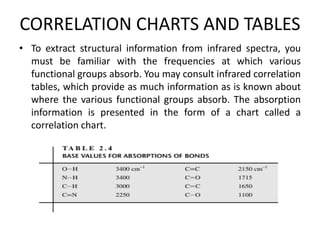
•Toextractstructuralinformationfrominfraredspectra,youmustbefamiliarwiththefrequenciesatwhichvariousfunctionalgroupsabsorb.Youmayconsultinfraredcorrelationtables,whichprovideasmuchinformationasisknownaboutwherethevariousfunctionalgroupsabsorb.Theabsorptioninformationispresentedintheformofachartcalledacorrelationchart.
C-HBendingVibrations 
•Thein-planeC-Hbendingvibrationsoccurbetween1300and1000cm−1.However,thesebandsarerarelyusefulbecausetheyoverlapother,strongerabsorptionsthatoccurinthisregion. 
•Theout-of-planeC-Hbendingvibrations,whichappearbetween900and690cm−1,arefarmoreusefulthanthein-planebands.Theseextremelyintenseabsorptions,resultingfromstrongcouplingwithadjacenthydrogenatoms,canbeusedtoassignthepositionsofsubstituentsonthearomaticring.
IR spectroscopy
IR spectroscopy
IR spectroscopy
IR spectroscopy
IR spectroscopy
IR spectroscopy
IR spectroscopy
IR spectroscopy

IR spectroscopy