
Rajat Singh
M.Pharm 1st year
Pharmaceutics
Morden analytical techniques
CONTENTs
 ATOMIC ABSORPTION SPECTROPHOTOMETRY
 FLAME EMISSION SPECTROPHOTOMETRY
Atomic absorption flame spectrophotometry
Atomic absorption spectrophotometry is an
analytical technique that measures the
concentrations of elements. It makes use of the
absorption of light by these elements in order to
measure their concentration.
Atomic absorption is a very common technique for
detecting metals and metalloids in environmental
samples like aluminum, Cu, lead, Li, Mg, Zn etc
Atomic absorption flame spectrophotometry
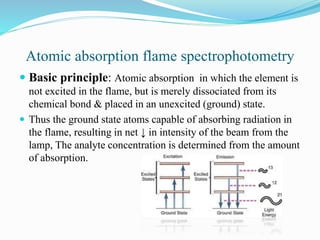
 Basic principle: Atomic absorption in which the element is
not excited in the flame, but is merely dissociated from its
chemical bond & placed in an unexcited (ground) state.
 Thus the ground state atoms capable of absorbing radiation in
the flame, resulting in net ↓ in intensity of the beam from the
lamp, The analyte concentration is determined from the amount
of absorption.
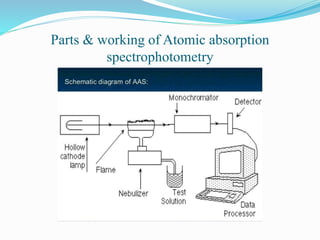
Parts & working of Atomic absorption
spectrophotometry
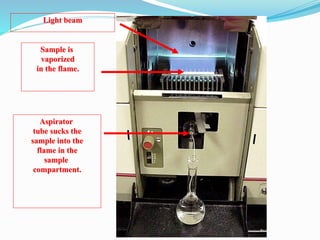
Sample is
vaporized
in the flame.
Aspirator
tube sucks the
sample into the
flame in the
sample
compartment.
Light beam
Types of burner
There are mainly two types of burners which are generally used
and they are as follows.
1. Total Consumption Burner
2. Premix/laminar Flow Burner
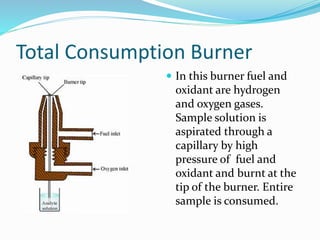
Total Consumption Burner
 In this burner fuel and
oxidant are hydrogen
and oxygen gases.
Sample solution is
aspirated through a
capillary by high
pressure of fuel and
oxidant and burnt at the
tip of the burner. Entire
sample is consumed.
Premix/laminar Flow Burner
 In this type of burner,
aspirated sample, fuel
and oxidant are
thoroughly mixed before
reaching the burner
opening and then
entering the flame.
There is high lose of
sample (95%) as large
droplets which are
drained out.
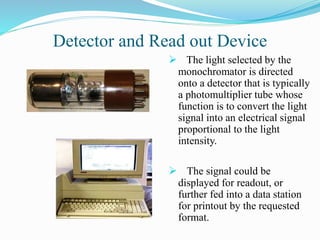
Monochromator
 The monochromater in Atomic Absorption Spectrophotometry
is placed between flame and detector
 Used to select the specific wavelength of light which is
absorbed by the sample, and to exclude other wavelengths.
 To allow the single line in the spectrum of analyte.
 To minimize the emission from the flame itself because
detector detects photons over a wide wavelength range.
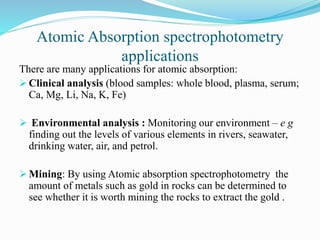
Detector and Read out Device
 The light selected by the
monochromator is directed
onto a detector that is typically
a photomultiplier tube whose
function is to convert the light
signal into an electrical signal
proportional to the light
intensity.
 The signal could be
displayed for readout, or
further fed into a data station
for printout by the requested
format.
Atomic Absorption spectrophotometry
applications
There are many applications for atomic absorption:
 Clinical analysis (blood samples: whole blood, plasma, serum;
Ca, Mg, Li, Na, K, Fe)
 Environmental analysis : Monitoring our environment – e g
finding out the levels of various elements in rivers, seawater,
drinking water, air, and petrol.
 Mining: By using Atomic absorption spectrophotometry the
amount of metals such as gold in rocks can be determined to
see whether it is worth mining the rocks to extract the gold .
Atomic absorption spectrophotometry
applications
 Trace elements in food analysis
 Trace element analysis of cosmetics
 Trace element analysis of hair
 Analysis of additives in lubricating oils and greases (Ba, Ca,
Na, Li, Zn, Mg)
 Analysis of soils
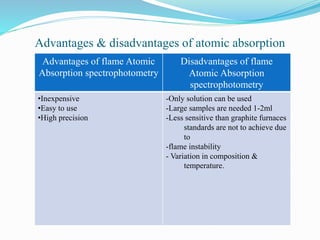
Advantages & disadvantages of atomic absorption
spectrophotometryAdvantages of flame Atomic
Absorption spectrophotometry
Disadvantages of flame
Atomic Absorption
spectrophotometry
•Inexpensive
•Easy to use
•High precision
-Only solution can be used
-Large samples are needed 1-2ml
-Less sensitive than graphite furnaces
standards are not to achieve due
to
-flame instability
- Variation in composition &
temperature.
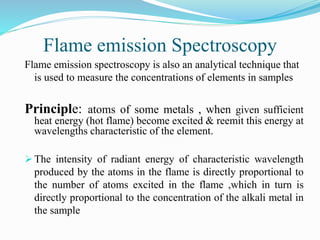
Flame emission Spectroscopy
Flame emission spectroscopy is also an analytical technique that
is used to measure the concentrations of elements in samples
Principle: atoms of some metals , when given sufficient
heat energy (hot flame) become excited & reemit this energy at
wavelengths characteristic of the element.
 The intensity of radiant energy of characteristic wavelength
produced by the atoms in the flame is directly proportional to
the number of atoms excited in the flame ,which in turn is
directly proportional to the concentration of the alkali metal in
the sample
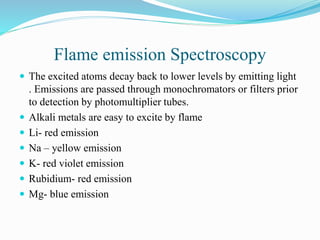
Flame emission Spectroscopy
 The excited atoms decay back to lower levels by emitting light
. Emissions are passed through monochromators or filters prior
to detection by photomultiplier tubes.
 Alkali metals are easy to excite by flame
 Li- red emission
 Na – yellow emission
 K- red violet emission
 Rubidium- red emission
 Mg- blue emission
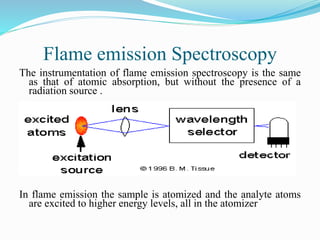
Flame emission Spectroscopy
The instrumentation of flame emission spectroscopy is the same
as that of atomic absorption, but without the presence of a
radiation source .
In flame emission the sample is atomized and the analyte atoms
are excited to higher energy levels, all in the atomizer
Flame emission Spectroscopy
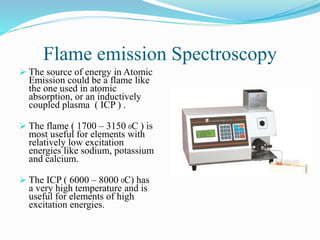
 The source of energy in Atomic
Emission could be a flame like
the one used in atomic
absorption, or an inductively
coupled plasma ( ICP ) .
 The flame ( 1700 – 3150 0C ) is
most useful for elements with
relatively low excitation
energies like sodium, potassium
and calcium.
 The ICP ( 6000 – 8000 0C) has
a very high temperature and is
useful for elements of high
excitation energies.
Application of flame emission
spectroscopy
1.Electrons of alkali metals like sodium, potassium, lithium
become easily excited hence preferentially analyzed by flame
photometry.
2.Used in clinical laboratory to determine concentrations of
sodium and potassium in biological fluids like serum, urine and
sweat.
3.Serum lithium levels – therapeutic monitoring.
Comparison Between Atomic Absorption and
Emission Spectroscopy
Absorption Emission
- Measure trace metal
concentrations in
complex matrices .
- Atomic absorption
depends upon the
number of ground state atoms
- Measure trace metal
concentrations in
complex matrices .
- Atomic emission depends
upon the number of
excited atoms .
Comparison Between Atomic Absorption and Flame
Emission Spectrophotometry
Atomic absorption
spectrophotometry
Flame emission
spectrophotometry
 It measures the radiation
absorbed by the ground state
atoms.
 Presence of a light source
(HCL- Hollow cathod lamp ).
 The temperature in the atomizer
is adjusted to atomize the
analyte atoms in the ground
state only.
 It measures the
radiation emitted by the excited
atoms.
 Absence of the light
source.
 The temperature in the
atomizer is big enough to atomize
the analyte atoms and excite them
to a higher energy level.
Interference
 Some interferences occur in Flame emission spectrophotometry
and Atomic absorption spectrophotometry but to different
extents, generally they are as follows
 Spectral Interference: arise when the absorption or emission of an
interfering species either overlaps or lies so close to the analyte band
that resolution by the monochromator become impossible
 Ionization Interference: atoms with low ionization potential become
ionized reducing the population of both the ground state and excited
state free atoms
 Chemical Interference: It is the main interference which
causes interference in the spectra of the compound, they
are as follows
 1. Cation- Cation Interference: Cation-Cation
interferences invariably decreases the signal intensity of
the element present in the sample. These interferences are
neither non-ionic in nature and mechanisms of their
interactions are unknown. E.g: cation-cation interferences
is that Al interferes with Ca & Mg.
 2. Cation- Anion Interference: This presence of certain anion
may affect the intensity of radiation emitted by an element. E.g:
Anions such as oxalates, Phosphates, sulphates can’t be
dissociated calcium properly.
 3. Oxide formation Interference: This type of interference
arises due to the formation of stable oxides with free metal
atoms if oxygen is present in the flame. Thus the emission
intensity is lowered because a large percentage of free metal
atoms have been removed from the flame. All of the alkaline
earth elements form oxides and are subject to this type of
interferene.
Thank you

Aas and fes

  • 1.
    Rajat Singh M.Pharm 1styear Pharmaceutics Morden analytical techniques
  • 2.
    CONTENTs  ATOMIC ABSORPTIONSPECTROPHOTOMETRY  FLAME EMISSION SPECTROPHOTOMETRY
  • 3.
    Atomic absorption flamespectrophotometry Atomic absorption spectrophotometry is an analytical technique that measures the concentrations of elements. It makes use of the absorption of light by these elements in order to measure their concentration. Atomic absorption is a very common technique for detecting metals and metalloids in environmental samples like aluminum, Cu, lead, Li, Mg, Zn etc
  • 4.
    Atomic absorption flamespectrophotometry  Basic principle: Atomic absorption in which the element is not excited in the flame, but is merely dissociated from its chemical bond & placed in an unexcited (ground) state.  Thus the ground state atoms capable of absorbing radiation in the flame, resulting in net ↓ in intensity of the beam from the lamp, The analyte concentration is determined from the amount of absorption.
  • 5.
    Parts & workingof Atomic absorption spectrophotometry
  • 6.
    Sample is vaporized in theflame. Aspirator tube sucks the sample into the flame in the sample compartment. Light beam
  • 7.
    Types of burner Thereare mainly two types of burners which are generally used and they are as follows. 1. Total Consumption Burner 2. Premix/laminar Flow Burner
  • 8.
    Total Consumption Burner In this burner fuel and oxidant are hydrogen and oxygen gases. Sample solution is aspirated through a capillary by high pressure of fuel and oxidant and burnt at the tip of the burner. Entire sample is consumed.
  • 9.
    Premix/laminar Flow Burner In this type of burner, aspirated sample, fuel and oxidant are thoroughly mixed before reaching the burner opening and then entering the flame. There is high lose of sample (95%) as large droplets which are drained out.
  • 10.
    Monochromator  The monochromaterin Atomic Absorption Spectrophotometry is placed between flame and detector  Used to select the specific wavelength of light which is absorbed by the sample, and to exclude other wavelengths.  To allow the single line in the spectrum of analyte.  To minimize the emission from the flame itself because detector detects photons over a wide wavelength range.
  • 11.
    Detector and Readout Device  The light selected by the monochromator is directed onto a detector that is typically a photomultiplier tube whose function is to convert the light signal into an electrical signal proportional to the light intensity.  The signal could be displayed for readout, or further fed into a data station for printout by the requested format.
  • 12.
    Atomic Absorption spectrophotometry applications Thereare many applications for atomic absorption:  Clinical analysis (blood samples: whole blood, plasma, serum; Ca, Mg, Li, Na, K, Fe)  Environmental analysis : Monitoring our environment – e g finding out the levels of various elements in rivers, seawater, drinking water, air, and petrol.  Mining: By using Atomic absorption spectrophotometry the amount of metals such as gold in rocks can be determined to see whether it is worth mining the rocks to extract the gold .
  • 13.
    Atomic absorption spectrophotometry applications Trace elements in food analysis  Trace element analysis of cosmetics  Trace element analysis of hair  Analysis of additives in lubricating oils and greases (Ba, Ca, Na, Li, Zn, Mg)  Analysis of soils
  • 14.
    Advantages & disadvantagesof atomic absorption spectrophotometryAdvantages of flame Atomic Absorption spectrophotometry Disadvantages of flame Atomic Absorption spectrophotometry •Inexpensive •Easy to use •High precision -Only solution can be used -Large samples are needed 1-2ml -Less sensitive than graphite furnaces standards are not to achieve due to -flame instability - Variation in composition & temperature.
  • 15.
    Flame emission Spectroscopy Flameemission spectroscopy is also an analytical technique that is used to measure the concentrations of elements in samples Principle: atoms of some metals , when given sufficient heat energy (hot flame) become excited & reemit this energy at wavelengths characteristic of the element.  The intensity of radiant energy of characteristic wavelength produced by the atoms in the flame is directly proportional to the number of atoms excited in the flame ,which in turn is directly proportional to the concentration of the alkali metal in the sample
  • 16.
    Flame emission Spectroscopy The excited atoms decay back to lower levels by emitting light . Emissions are passed through monochromators or filters prior to detection by photomultiplier tubes.  Alkali metals are easy to excite by flame  Li- red emission  Na – yellow emission  K- red violet emission  Rubidium- red emission  Mg- blue emission
  • 17.
    Flame emission Spectroscopy Theinstrumentation of flame emission spectroscopy is the same as that of atomic absorption, but without the presence of a radiation source . In flame emission the sample is atomized and the analyte atoms are excited to higher energy levels, all in the atomizer
  • 18.
    Flame emission Spectroscopy The source of energy in Atomic Emission could be a flame like the one used in atomic absorption, or an inductively coupled plasma ( ICP ) .  The flame ( 1700 – 3150 0C ) is most useful for elements with relatively low excitation energies like sodium, potassium and calcium.  The ICP ( 6000 – 8000 0C) has a very high temperature and is useful for elements of high excitation energies.
  • 19.
    Application of flameemission spectroscopy 1.Electrons of alkali metals like sodium, potassium, lithium become easily excited hence preferentially analyzed by flame photometry. 2.Used in clinical laboratory to determine concentrations of sodium and potassium in biological fluids like serum, urine and sweat. 3.Serum lithium levels – therapeutic monitoring.
  • 20.
    Comparison Between AtomicAbsorption and Emission Spectroscopy Absorption Emission - Measure trace metal concentrations in complex matrices . - Atomic absorption depends upon the number of ground state atoms - Measure trace metal concentrations in complex matrices . - Atomic emission depends upon the number of excited atoms .
  • 21.
    Comparison Between AtomicAbsorption and Flame Emission Spectrophotometry Atomic absorption spectrophotometry Flame emission spectrophotometry  It measures the radiation absorbed by the ground state atoms.  Presence of a light source (HCL- Hollow cathod lamp ).  The temperature in the atomizer is adjusted to atomize the analyte atoms in the ground state only.  It measures the radiation emitted by the excited atoms.  Absence of the light source.  The temperature in the atomizer is big enough to atomize the analyte atoms and excite them to a higher energy level.
  • 22.
    Interference  Some interferencesoccur in Flame emission spectrophotometry and Atomic absorption spectrophotometry but to different extents, generally they are as follows  Spectral Interference: arise when the absorption or emission of an interfering species either overlaps or lies so close to the analyte band that resolution by the monochromator become impossible  Ionization Interference: atoms with low ionization potential become ionized reducing the population of both the ground state and excited state free atoms
  • 23.
     Chemical Interference:It is the main interference which causes interference in the spectra of the compound, they are as follows  1. Cation- Cation Interference: Cation-Cation interferences invariably decreases the signal intensity of the element present in the sample. These interferences are neither non-ionic in nature and mechanisms of their interactions are unknown. E.g: cation-cation interferences is that Al interferes with Ca & Mg.
  • 24.
     2. Cation-Anion Interference: This presence of certain anion may affect the intensity of radiation emitted by an element. E.g: Anions such as oxalates, Phosphates, sulphates can’t be dissociated calcium properly.  3. Oxide formation Interference: This type of interference arises due to the formation of stable oxides with free metal atoms if oxygen is present in the flame. Thus the emission intensity is lowered because a large percentage of free metal atoms have been removed from the flame. All of the alkaline earth elements form oxides and are subject to this type of interferene.
  • 25.