ATOMIC ABSORPTION 
SPECTROPHOTOMETRY 
BASIC CONCEPTS, 
INSTRUMENTATION, 
OPERATION, AND APPLICATION
INTRODUCTION: 
• Introduced by Alan Walsh(1950) 
• It is a method of elemental analysis used widely in 
clinical laboratories 
• Useful for determining trace metals like Aluminum, 
Calcium, Copper, Lead, Lithium, Magnesium and 
Zinc in liquid or biological samples. 
• Highly sensitive and can detect metals in 
concentrations lower than 1ppm
BASIC CONCEPTS: 
• This technique basically uses the principle that 
free atoms (gas) generated in an atomizer can 
absorb radiation at specific frequency. 
• AA is an emission technique in which an element 
in the sample is excited and the radiant energy 
given off is measured as the element returns to its 
lower energy level as in FES. 
• However, the element is not appreciably excited in 
the flame, but it is merely dissociated from its 
chemical bonds (atomised) and placed in an 
unexcited ground state (neutral atom)
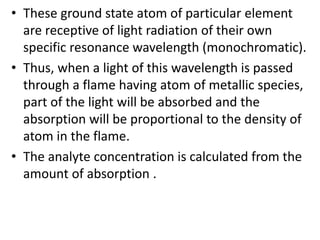
• These ground state atom of particular element 
are receptive of light radiation of their own 
specific resonance wavelength (monochromatic). 
• Thus, when a light of this wavelength is passed 
through a flame having atom of metallic species, 
part of the light will be absorbed and the 
absorption will be proportional to the density of 
atom in the flame. 
• The analyte concentration is calculated from the 
amount of absorption .
Differences btw Atomic Absorption 
Spectrophotometry (AAS) and Flame Emission 
Spectrophotometry: 
AAS 
• Amount of light absorbed 
by ground state atom is 
measured 
• Absorption intensity does 
not depend upon 
temperature 
• Beers law is obeyed over 
wide range of 
concentration 
FES 
• Amount of light emitted 
by the excited atom is 
measured 
• Absorption intensity is 
greatly influenced by 
temperature variation 
• Beer’s law is not obeyed
AAS 
AES (FES)
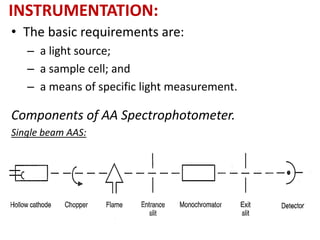
INSTRUMENTATION: 
• The basic requirements are: 
– a light source; 
– a sample cell; and 
– a means of specific light measurement. 
Components of AA Spectrophotometer. 
Single beam AAS:
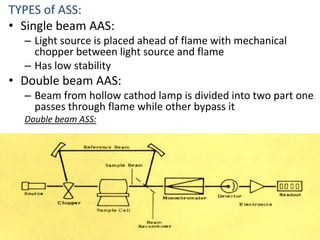
TYPES of ASS: 
• Single beam AAS: 
– Light source is placed ahead of flame with mechanical 
chopper between light source and flame 
– Has low stability 
• Double beam AAS: 
– Beam from hollow cathod lamp is divided into two part one 
passes through flame while other bypass it 
Double beam ASS:
Light source: 
• Radiation source: are of two types 
• Hollow cathode lamp- emits spectral line of that metal which is 
used in the cathod (HCL) 
• Electrodeless discharge lamp (EDL) 
• A hollow-cathode lamp are made of the metal of the 
substance to be analyzed (different for each metal 
analysis). The anode is made of Tungsten 
• Each HCL will have a particular current for optimum 
performance. 
• In general, higher currents will produce brighter 
emission and less baseline noise. 
• As the current continues to increase, lamp life may 
shorten and spectral line broadening may occur, 
resulting in a reduction in sensitivity and linear 
working range. 
• If an alloy is used, it results in a multi-element lamp
Limitations of HCL: 
• A finite lifetime – due to depletion of the analyte 
element from the cathode 
• Adsorption of fill gas atoms onto the inner surfaces of 
the lamp – the primary cause for lamp failure 
• Some cathode materials can slowly evolve hydrogen 
when heated – a background continuum emission 
contaminates the purity of the line spectrum of the 
element, resulting in a reduction of atomic absorption 
sensitivity and poor calibration linearity. 
Chopper: 
• It is a rotating wheel interposed between the hollow 
cathode lamp and flame. 
• Gives pulsating current in the photocell
Atomiser: 
• Flame atomiser: total consumption burner and 
premixed burner 
• Non flame atomiser (carbon rod or ā€œgraphite furnace) 
– Temp of the rod is raised to dry, char, and atomise the 
sample in a chamber 
– More sensitive than the conventional flame methods 
– Permits determination of trace metals in small samples of 
blood or tissue 
– Zeeman correction used to correct for background 
absorption by placing the analyte in a strong magnetic field 
which splits the degenerate atomic energy into two 
components that are polarised parallel and perpendicularly 
and interacts differently with polarized light.
– Two absorption measurement are taken at different 
polarizer setting. one measures both analyte and 
background absorption, At,the other measures only 
background absorptions. 
– Thus, the same light source at the same wavelength is used 
to measure the total and the background absortion. The 
difference btw the two is the corrected absorbance. 
Nebulization of liquid sample: 
• method of formation of small droplet from the liquid 
sample 
• Nebulization is done by use of a gas moving at high 
velocity 
Monochromator: 
• Function of monochromator is to select given 
absorbing line from spectral line emitted from hollow 
cathode 
• Common monochromator are prism and gratings
Detctor: 
• Photomultiplier tube is most suitable. The intensity of 
the light is fairly low, so a photomultiplier tube (PMT) 
is used to boost the signal intensity 
• Has good stability if used with stable power supply 
• A detector (a special type of transducer) is used to 
generate voltage from the impingement of electrons 
generated by the photomultiplier tube 
Amplifier: 
• It amplifies electric current 
• Lock in amplifier are preferred to achieve excellent 
signal to noise ratio(measure of signal strength 
relative to background noise) 
Read out device: 
• Digital read out device are used
Advantages of AAS: 
• Technique is specific because the atom of 
particular element can only absorb radiation of 
their own characteristic wavelength 
• Is independent of flame temperature 
Disadvantages of AAS: 
• Separate lamp for each element to be determined 
is required 
• Technique cannot be used successfully for 
estimation of element like Mo, Si etc because 
these element give rise to oxide in the flame 
• Predominant anion affect the signal to negotiable 
degree
OPERATION: 
• A meter is adjusted to zero absorbance when 
blank solution is sprayed on the flame, and rest 
of the light passes on to the photomultiplier 
tube. 
• Then the light solution containing absorbing 
species is introduced a part of light is absorbed, 
resulting in a decrease in light intensity falling on 
a photomultiplier tube.
INTERFERENCES IN AAS: 
Spectral Interferences: include 
• Absorption from other closely absorbing atomic 
species, usually not a problem because of the 
extremely narrow band-width used 
• Absorption and scattering by molecular species, 
usually problematic at lower atomising 
temperatures 
• Scattering by non-volatile salt particles and oxides 
• Background emission (which can be electronically 
filtered)
Non-spectral Interferences: could be specific or non-specific 
• Non-specific interferences: affect the nebulization by 
altering the viscosity, surface tension, or density of the 
analyte solution and consequently the sample flow 
rate 
• Some contaminants also decrease the desolvation and 
atomization efficiency by lowering the atomizer 
temperature 
• Specific interferences: are also called chemical 
interferences because they are more analyte 
dependent 
– Solute volatilization interference: refers to the situation 
when the contaminant forms non-volatile species with the 
analyte
– Dissociation interferences: affects the degree of 
dissociation of the analyte. Analytes that form oxides 
and hydroxides are esp susceptible to dissociation 
interferences 
– Ionization interferences: occurs when the presence of 
an easily ionized element, such as K, affects the degree 
of ionization of the analyte which leads to changes in 
the analyte signal . 
– Excitation interferences: occur when the analyte atoms 
are excited in the atomizer with a subsequent 
emission at the absorption wavelength . This is more 
pronounced at higher temperatures.
APPLICATION OF AAS: 
• Qualitative and quantitative analysis 
• Determination of metallic elements in biological 
system 
• Determination of metallic element in food industry 
• Determination of Ca, Mg, Na, K in serum 
• Determination of lead in petrol
REFERENCES: 
• Shriver and Atkins’ Inorganic Chemistry, Fifth 
Edition 
• Concepts, Instrumentation and Techniques in 
Atomic Absorption Spectrophotometry by 
Richard D. Beaty and Jack D. Kerber 
• An elementary overview of elemental analysis 
by thermo elemental

Atomic absorption spectrophotometry

  • 1.
    ATOMIC ABSORPTION SPECTROPHOTOMETRY BASIC CONCEPTS, INSTRUMENTATION, OPERATION, AND APPLICATION
  • 2.
    INTRODUCTION: • Introducedby Alan Walsh(1950) • It is a method of elemental analysis used widely in clinical laboratories • Useful for determining trace metals like Aluminum, Calcium, Copper, Lead, Lithium, Magnesium and Zinc in liquid or biological samples. • Highly sensitive and can detect metals in concentrations lower than 1ppm
  • 3.
    BASIC CONCEPTS: •This technique basically uses the principle that free atoms (gas) generated in an atomizer can absorb radiation at specific frequency. • AA is an emission technique in which an element in the sample is excited and the radiant energy given off is measured as the element returns to its lower energy level as in FES. • However, the element is not appreciably excited in the flame, but it is merely dissociated from its chemical bonds (atomised) and placed in an unexcited ground state (neutral atom)
  • 4.
    • These groundstate atom of particular element are receptive of light radiation of their own specific resonance wavelength (monochromatic). • Thus, when a light of this wavelength is passed through a flame having atom of metallic species, part of the light will be absorbed and the absorption will be proportional to the density of atom in the flame. • The analyte concentration is calculated from the amount of absorption .
  • 5.
    Differences btw AtomicAbsorption Spectrophotometry (AAS) and Flame Emission Spectrophotometry: AAS • Amount of light absorbed by ground state atom is measured • Absorption intensity does not depend upon temperature • Beers law is obeyed over wide range of concentration FES • Amount of light emitted by the excited atom is measured • Absorption intensity is greatly influenced by temperature variation • Beer’s law is not obeyed
  • 6.
  • 7.
    INSTRUMENTATION: • Thebasic requirements are: – a light source; – a sample cell; and – a means of specific light measurement. Components of AA Spectrophotometer. Single beam AAS:
  • 8.
    TYPES of ASS: • Single beam AAS: – Light source is placed ahead of flame with mechanical chopper between light source and flame – Has low stability • Double beam AAS: – Beam from hollow cathod lamp is divided into two part one passes through flame while other bypass it Double beam ASS:
  • 9.
    Light source: •Radiation source: are of two types • Hollow cathode lamp- emits spectral line of that metal which is used in the cathod (HCL) • Electrodeless discharge lamp (EDL) • A hollow-cathode lamp are made of the metal of the substance to be analyzed (different for each metal analysis). The anode is made of Tungsten • Each HCL will have a particular current for optimum performance. • In general, higher currents will produce brighter emission and less baseline noise. • As the current continues to increase, lamp life may shorten and spectral line broadening may occur, resulting in a reduction in sensitivity and linear working range. • If an alloy is used, it results in a multi-element lamp
  • 10.
    Limitations of HCL: • A finite lifetime – due to depletion of the analyte element from the cathode • Adsorption of fill gas atoms onto the inner surfaces of the lamp – the primary cause for lamp failure • Some cathode materials can slowly evolve hydrogen when heated – a background continuum emission contaminates the purity of the line spectrum of the element, resulting in a reduction of atomic absorption sensitivity and poor calibration linearity. Chopper: • It is a rotating wheel interposed between the hollow cathode lamp and flame. • Gives pulsating current in the photocell
  • 11.
    Atomiser: • Flameatomiser: total consumption burner and premixed burner • Non flame atomiser (carbon rod or ā€œgraphite furnace) – Temp of the rod is raised to dry, char, and atomise the sample in a chamber – More sensitive than the conventional flame methods – Permits determination of trace metals in small samples of blood or tissue – Zeeman correction used to correct for background absorption by placing the analyte in a strong magnetic field which splits the degenerate atomic energy into two components that are polarised parallel and perpendicularly and interacts differently with polarized light.
  • 12.
    – Two absorptionmeasurement are taken at different polarizer setting. one measures both analyte and background absorption, At,the other measures only background absorptions. – Thus, the same light source at the same wavelength is used to measure the total and the background absortion. The difference btw the two is the corrected absorbance. Nebulization of liquid sample: • method of formation of small droplet from the liquid sample • Nebulization is done by use of a gas moving at high velocity Monochromator: • Function of monochromator is to select given absorbing line from spectral line emitted from hollow cathode • Common monochromator are prism and gratings
  • 13.
    Detctor: • Photomultipliertube is most suitable. The intensity of the light is fairly low, so a photomultiplier tube (PMT) is used to boost the signal intensity • Has good stability if used with stable power supply • A detector (a special type of transducer) is used to generate voltage from the impingement of electrons generated by the photomultiplier tube Amplifier: • It amplifies electric current • Lock in amplifier are preferred to achieve excellent signal to noise ratio(measure of signal strength relative to background noise) Read out device: • Digital read out device are used
  • 14.
    Advantages of AAS: • Technique is specific because the atom of particular element can only absorb radiation of their own characteristic wavelength • Is independent of flame temperature Disadvantages of AAS: • Separate lamp for each element to be determined is required • Technique cannot be used successfully for estimation of element like Mo, Si etc because these element give rise to oxide in the flame • Predominant anion affect the signal to negotiable degree
  • 15.
    OPERATION: • Ameter is adjusted to zero absorbance when blank solution is sprayed on the flame, and rest of the light passes on to the photomultiplier tube. • Then the light solution containing absorbing species is introduced a part of light is absorbed, resulting in a decrease in light intensity falling on a photomultiplier tube.
  • 16.
    INTERFERENCES IN AAS: Spectral Interferences: include • Absorption from other closely absorbing atomic species, usually not a problem because of the extremely narrow band-width used • Absorption and scattering by molecular species, usually problematic at lower atomising temperatures • Scattering by non-volatile salt particles and oxides • Background emission (which can be electronically filtered)
  • 17.
    Non-spectral Interferences: couldbe specific or non-specific • Non-specific interferences: affect the nebulization by altering the viscosity, surface tension, or density of the analyte solution and consequently the sample flow rate • Some contaminants also decrease the desolvation and atomization efficiency by lowering the atomizer temperature • Specific interferences: are also called chemical interferences because they are more analyte dependent – Solute volatilization interference: refers to the situation when the contaminant forms non-volatile species with the analyte
  • 18.
    – Dissociation interferences:affects the degree of dissociation of the analyte. Analytes that form oxides and hydroxides are esp susceptible to dissociation interferences – Ionization interferences: occurs when the presence of an easily ionized element, such as K, affects the degree of ionization of the analyte which leads to changes in the analyte signal . – Excitation interferences: occur when the analyte atoms are excited in the atomizer with a subsequent emission at the absorption wavelength . This is more pronounced at higher temperatures.
  • 19.
    APPLICATION OF AAS: • Qualitative and quantitative analysis • Determination of metallic elements in biological system • Determination of metallic element in food industry • Determination of Ca, Mg, Na, K in serum • Determination of lead in petrol
  • 20.
    REFERENCES: • Shriverand Atkins’ Inorganic Chemistry, Fifth Edition • Concepts, Instrumentation and Techniques in Atomic Absorption Spectrophotometry by Richard D. Beaty and Jack D. Kerber • An elementary overview of elemental analysis by thermo elemental