Ali Hassan Al-Ashiri
20100858
Hussain Hassan Ali
20102244
The objective of this project was to do analysis and
researchers about the Liquid-Liquid extraction by doing
two type of methods:
1- maintenance the Liquid-Liquid extraction unit.
2-do manual experiments.
However we faced one problem when we tried to maintain
the unit, which led us to do only the manual experiments.
The project contains analyzes and studies to the problems
that we faced
 Is to study the principle of Liquid-Liquid extraction by
doing manual experiments and maintenance the
Liquid-Liquid extraction unit.
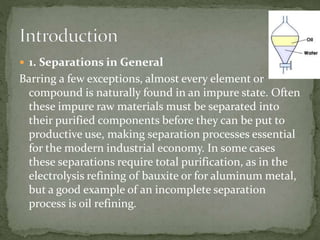
 1. Separations in General
Barring a few exceptions, almost every element or
compound is naturally found in an impure state. Often
these impure raw materials must be separated into
their purified components before they can be put to
productive use, making separation processes essential
for the modern industrial economy. In some cases
these separations require total purification, as in the
electrolysis refining of bauxite or for aluminum metal,
but a good example of an incomplete separation
process is oil refining.
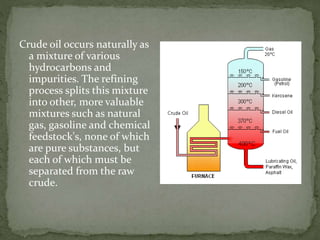
Crude oil occurs naturally as
a mixture of various
hydrocarbons and
impurities. The refining
process splits this mixture
into other, more valuable
mixtures such as natural
gas, gasoline and chemical
feedstock's, none of which
are pure substances, but
each of which must be
separated from the raw
crude.
1-Separation not feasible by distillation.
2-Break azeotropes.
3-Energy requirements of distillation are prohibitive.
4-Heat sensitive.
5-A complex distillation sequence is required.
 Liquid-liquid extraction is based on the
transfer of a solute substance from one liquid
phase into another liquid phase according to
the solubility. Extraction becomes a very
useful tool if you choose a suitable extraction
solvent. You can use extraction to separate a
substance selectively from a mixture, or to
remove unwanted impurities from a solution.
In
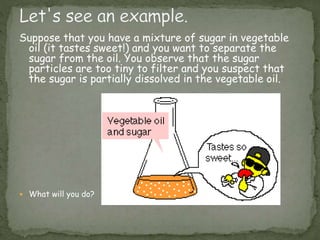
Suppose that you have a mixture of sugar in vegetable
oil (it tastes sweet!) and you want to separate the
sugar from the oil. You observe that the sugar
particles are too tiny to filter and you suspect that
the sugar is partially dissolved in the vegetable oil.
 What will you do?
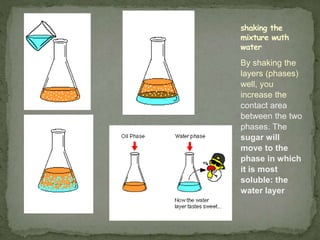
By shaking the
layers (phases)
well, you
increase the
contact area
between the two
phases. The
sugar will
move to the
phase in which
it is most
soluble: the
water layer
shaking the
mixture wuth
water
Factors to be considered:
 Selectivity
 Distribution coefficient
 Insolubility of solvent
 Recoverability of solute from solvent
 Density difference between liquid phases
 Interfacial tension
 Chemical reactivity
 Cost
 Viscosity, vapour pressure
 Flammability, toxicity
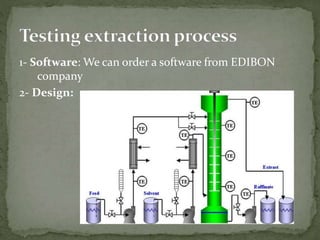
1- Software: We can order a software from EDIBON
company
2- Design:
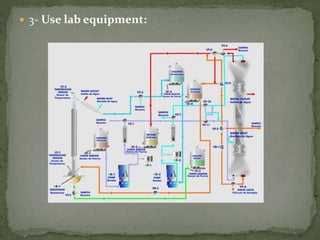
 3- Use lab equipment:
Objective:
To test the working efficiency of available liquid-liquid extraction unit.
Result:
At the began, we switch on and filled the tanks with water, at the same
time we switched the pump that are supplied with feeding tank on the
inlet, and column on the outlet. The pump it was works fine, and the
liquid was dosing in the pipe, but little cleaning it was required on the
pipes that are supplied with the pump.
After that, we has switched the another pump on, which are supplied with
solvent tank on inlet, and the column it the outlet. The pump it was
working, but for some reason it doesn’t dosing the liquid.
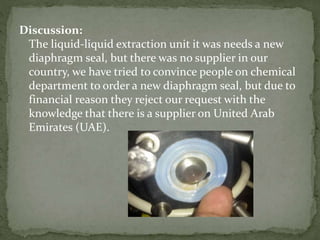
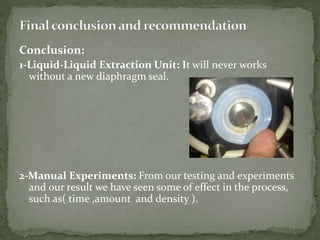
We had figured the problem that was on that pump. We opened the
pump to see what the happened inside it. We have seen a hole on the
diaphragm seal. We have tried to fixed the problem by ordered a new
diaphragm seal, but there was no supplier locally.
Discussion:
The liquid-liquid extraction unit it was needs a new
diaphragm seal, but there was no supplier in our
country, we have tried to convince people on chemical
department to order a new diaphragm seal, but due to
financial reason they reject our request with the
knowledge that there is a supplier on United Arab
Emirates (UAE).
Conclusion:
The liquid-liquid extraction unit it will never works
without a new diaphragm seal.
Recommendations:
We recommend, If another students they want to works
on this unit they have to buy a new diaphragm seal or
buy a new pump. Buying a new pump is better than
buying new diaphragm seal, because the diaphragm
pump is consist on diaphragm seal, and this part is
cost too much money.
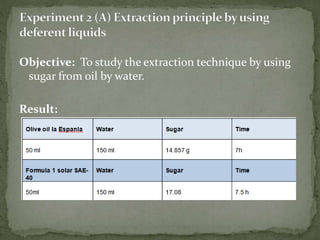
Objective: To study the extraction technique by using
sugar from oil by water.
Result:
Objective: To study the effect of amount of solvent and
solute on extraction by using sugar, oil and water.
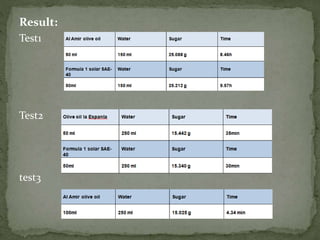
Result:
Test1
Test2
test3
Analysis:
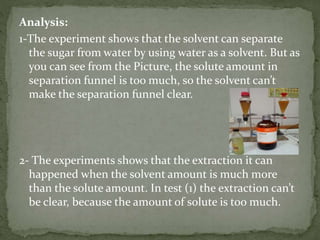
1-The experiment shows that the solvent can separate
the sugar from water by using water as a solvent. But as
you can see from the Picture, the solute amount in
separation funnel is too much, so the solvent can’t
make the separation funnel clear.
2- The experiments shows that the extraction it can
happened when the solvent amount is much more
than the solute amount. In test (1) the extraction can’t
be clear, because the amount of solute is too much.
Conclusion:
1-The sugar it didn’t separated clearly from oil, because
the amount of solute is too much.
2- The extraction it can be happened when the solvent
amount is much more than the solute amount.
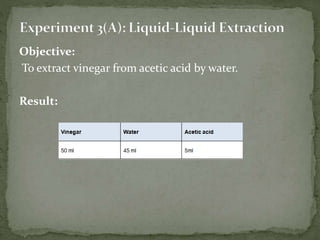
Objective:
To extract vinegar from acetic acid by water.
Result:
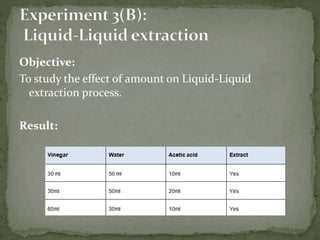
Objective:
To study the effect of amount on Liquid-Liquid
extraction process.
Result:
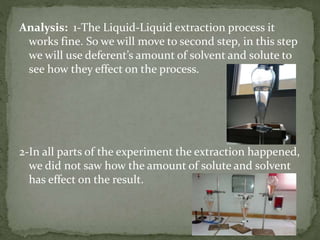
Analysis: 1-The Liquid-Liquid extraction process it
works fine. So we will move to second step, in this step
we will use deferent’s amount of solvent and solute to
see how they effect on the process.
2-In all parts of the experiment the extraction happened,
we did not saw how the amount of solute and solvent
has effect on the result.
Conclusion:
1- The Liquid-Liquid extraction, can extract vinegar from
acetic acid by using water as a solvent.
2- The Liquid-Liquid extraction technique, can extract
vinegar from acetic acid by using water as a solvent.
Conclusion:
1-Liquid-Liquid Extraction Unit: It will never works
without a new diaphragm seal.
2-Manual Experiments: From our testing and experiments
and our result we have seen some of effect in the process,
such as( time ,amount and density ).
Recommendation:
1- If another students they want to works on this unit
they have to buy a new diaphragm seal or buy a
new pump. Buying a new pump is better than
buying new diaphragm seal, because the
diaphragm pump is consist on diaphragm seal, and
this part is cost too much money.
2 If another students they want to works on same
topic, they have to do much more testing and
experiments because we didn’t got time to do
everything.

Liquid liquid extraction

  • 1.
  • 2.
    The objective ofthis project was to do analysis and researchers about the Liquid-Liquid extraction by doing two type of methods: 1- maintenance the Liquid-Liquid extraction unit. 2-do manual experiments. However we faced one problem when we tried to maintain the unit, which led us to do only the manual experiments. The project contains analyzes and studies to the problems that we faced
  • 3.
     Is tostudy the principle of Liquid-Liquid extraction by doing manual experiments and maintenance the Liquid-Liquid extraction unit.
  • 4.
     1. Separationsin General Barring a few exceptions, almost every element or compound is naturally found in an impure state. Often these impure raw materials must be separated into their purified components before they can be put to productive use, making separation processes essential for the modern industrial economy. In some cases these separations require total purification, as in the electrolysis refining of bauxite or for aluminum metal, but a good example of an incomplete separation process is oil refining.
  • 5.
    Crude oil occursnaturally as a mixture of various hydrocarbons and impurities. The refining process splits this mixture into other, more valuable mixtures such as natural gas, gasoline and chemical feedstock's, none of which are pure substances, but each of which must be separated from the raw crude.
  • 6.
    1-Separation not feasibleby distillation. 2-Break azeotropes. 3-Energy requirements of distillation are prohibitive. 4-Heat sensitive. 5-A complex distillation sequence is required.
  • 7.
     Liquid-liquid extractionis based on the transfer of a solute substance from one liquid phase into another liquid phase according to the solubility. Extraction becomes a very useful tool if you choose a suitable extraction solvent. You can use extraction to separate a substance selectively from a mixture, or to remove unwanted impurities from a solution. In
  • 8.
    Suppose that youhave a mixture of sugar in vegetable oil (it tastes sweet!) and you want to separate the sugar from the oil. You observe that the sugar particles are too tiny to filter and you suspect that the sugar is partially dissolved in the vegetable oil.  What will you do?
  • 9.
    By shaking the layers(phases) well, you increase the contact area between the two phases. The sugar will move to the phase in which it is most soluble: the water layer shaking the mixture wuth water
  • 10.
    Factors to beconsidered:  Selectivity  Distribution coefficient  Insolubility of solvent  Recoverability of solute from solvent  Density difference between liquid phases  Interfacial tension  Chemical reactivity  Cost  Viscosity, vapour pressure  Flammability, toxicity
  • 11.
    1- Software: Wecan order a software from EDIBON company 2- Design:
  • 12.
     3- Uselab equipment:
  • 14.
    Objective: To test theworking efficiency of available liquid-liquid extraction unit. Result: At the began, we switch on and filled the tanks with water, at the same time we switched the pump that are supplied with feeding tank on the inlet, and column on the outlet. The pump it was works fine, and the liquid was dosing in the pipe, but little cleaning it was required on the pipes that are supplied with the pump. After that, we has switched the another pump on, which are supplied with solvent tank on inlet, and the column it the outlet. The pump it was working, but for some reason it doesn’t dosing the liquid. We had figured the problem that was on that pump. We opened the pump to see what the happened inside it. We have seen a hole on the diaphragm seal. We have tried to fixed the problem by ordered a new diaphragm seal, but there was no supplier locally.
  • 15.
    Discussion: The liquid-liquid extractionunit it was needs a new diaphragm seal, but there was no supplier in our country, we have tried to convince people on chemical department to order a new diaphragm seal, but due to financial reason they reject our request with the knowledge that there is a supplier on United Arab Emirates (UAE).
  • 16.
    Conclusion: The liquid-liquid extractionunit it will never works without a new diaphragm seal. Recommendations: We recommend, If another students they want to works on this unit they have to buy a new diaphragm seal or buy a new pump. Buying a new pump is better than buying new diaphragm seal, because the diaphragm pump is consist on diaphragm seal, and this part is cost too much money.
  • 17.
    Objective: To studythe extraction technique by using sugar from oil by water. Result:
  • 18.
    Objective: To studythe effect of amount of solvent and solute on extraction by using sugar, oil and water.
  • 19.
  • 20.
    Analysis: 1-The experiment showsthat the solvent can separate the sugar from water by using water as a solvent. But as you can see from the Picture, the solute amount in separation funnel is too much, so the solvent can’t make the separation funnel clear. 2- The experiments shows that the extraction it can happened when the solvent amount is much more than the solute amount. In test (1) the extraction can’t be clear, because the amount of solute is too much.
  • 21.
    Conclusion: 1-The sugar itdidn’t separated clearly from oil, because the amount of solute is too much. 2- The extraction it can be happened when the solvent amount is much more than the solute amount.
  • 22.
    Objective: To extract vinegarfrom acetic acid by water. Result:
  • 23.
    Objective: To study theeffect of amount on Liquid-Liquid extraction process. Result:
  • 24.
    Analysis: 1-The Liquid-Liquidextraction process it works fine. So we will move to second step, in this step we will use deferent’s amount of solvent and solute to see how they effect on the process. 2-In all parts of the experiment the extraction happened, we did not saw how the amount of solute and solvent has effect on the result.
  • 25.
    Conclusion: 1- The Liquid-Liquidextraction, can extract vinegar from acetic acid by using water as a solvent. 2- The Liquid-Liquid extraction technique, can extract vinegar from acetic acid by using water as a solvent.
  • 26.
    Conclusion: 1-Liquid-Liquid Extraction Unit:It will never works without a new diaphragm seal. 2-Manual Experiments: From our testing and experiments and our result we have seen some of effect in the process, such as( time ,amount and density ).
  • 27.
    Recommendation: 1- If anotherstudents they want to works on this unit they have to buy a new diaphragm seal or buy a new pump. Buying a new pump is better than buying new diaphragm seal, because the diaphragm pump is consist on diaphragm seal, and this part is cost too much money. 2 If another students they want to works on same topic, they have to do much more testing and experiments because we didn’t got time to do everything.