Introduction to principle and
instrumentation of atomic emission
spectroscopy
BY
Humna Mehmood
BS Chemistry (2017-2021)
1
Introduction to atomic emission spectroscopy:
• Atomic spectroscopy is thought to be the oldest instrumental
method for the determination of elements.
• Atomic emission spectroscopy uses quantitative
measurement of the optical emission from excited atoms to
determine analyte composition.
• It is used to identify elements and determine their
concentration in analyte.
2
Principle:
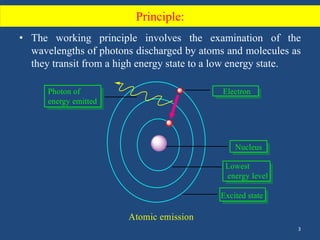
• The working principle involves the examination of the
wavelengths of photons discharged by atoms and molecules as
they transit from a high energy state to a low energy state.
3
o A characteristic set of wavelengths is emitted by each element or
substance which depends on its electronic structure.
o The atomic spectral line wavelength identifies the element.
o The intensity of light emitted is proportional to the atom count of
the element.
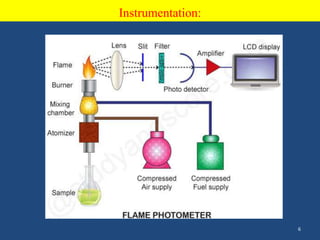
o The sample solution is nebulized and introduced into the
excitation source (flame).
o Atoms are raised to excited states. Upon their return to a lower or
ground electronic state, the excited atoms emit radiations.
o The emitted radiations passes through a wavelength selector that
isolates the specific wavelength .
o A photo detector measures the radiant power of radiation, which
is then amplified and sent to a readout device.
4
5
Instrumentation:
6
Pretreatment of Sample
• Solid sample must be dissolved in solvent.
• Substances in sample that interfere with the emission
measurement must be removed or masked
• Reagents used to dissolve samples must not contain
substances that lead to interference problems.
7
Nebulizer
• This is a component of sample delivery system, which breaks up
the bigger liquid droplet to smaller liquid droplets
• The process of conversion of sample to a fined mist of finely
divided droplets using a jet of compressed gas is known as
nebulization.
Types of nebulizer
• Ultrasonic nebulizer
• Electro-thermal vaporizer
• Pneumatic nebulizer
8
Ultrasonic nebulizer
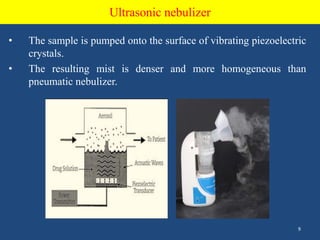
• The sample is pumped onto the surface of vibrating piezoelectric
crystals.
• The resulting mist is denser and more homogeneous than
pneumatic nebulizer.
9
Electro-thermal vaporizers
• It is an electro thermal
vaporizer
• It contains an evaporator
in a closed chamber
through which an inert
gas carries the vaporized
sample into atomizer.
10
Pneumatic nebulizer
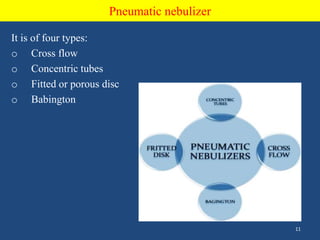
It is of four types:
o Cross flow
o Concentric tubes
o Fitted or porous disc
o Babington
11
Cross flow
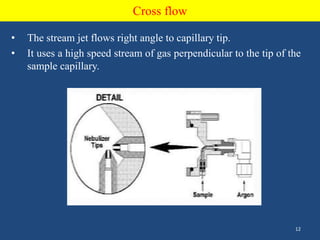
• The stream jet flows right angle to capillary tip.
• It uses a high speed stream of gas perpendicular to the tip of the
sample capillary.
12
Concentric tubes
• The liquid sample is sucked
through a capillary tube by a
high pressure jet of gas
flowing around the tip of the
capillary tube.
• The high velocity breaks the
sample into mist and carries
it to atomization region.
13
Babington
• The jet is pumped through a
small orifice in a sphere on
which a thin film of sample
flows
• In this type of nebulizer
sample solution flows freely
over small aperture rather than
passing through a fine
capillary tube
14
Fritted or porous disk
• The sample is pumped into a
fritted disk through which the
gas jet is flowing and this gives
fine aerosol then others
• High efficiency can be obtained
by introducing the sample at
predetermined location of
fritted surface.
15
Source of flame
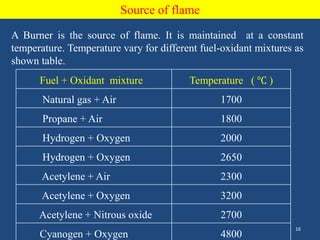
A Burner is the source of flame. It is maintained at a constant
temperature. Temperature vary for different fuel-oxidant mixtures as
shown table.
Fuel + Oxidant mixture Temperature ( ℃ )
Natural gas + Air 1700
Propane + Air 1800
Hydrogen + Oxygen 2000
Hydrogen + Oxygen 2650
Acetylene + Air 2300
Acetylene + Oxygen 3200
Acetylene + Nitrous oxide 2700
Cyanogen + Oxygen 4800
16
Zones of flame
17
Processes occurring in the flame:
• Desolvation: The metal particles are dehydrated and the
solvent is evaporated.
• Vaporization: This also led to the evaporation of the solvent.
• Atomization: Reduction of metal ions in the solvent to metal
atoms by the flame heat.
• Excitation: The atoms jump to the exited energy state.
• Emission process: Atoms jump back to the stable low energy
state with the emission of energy in the form of radiation of
characteristic wavelength.
18
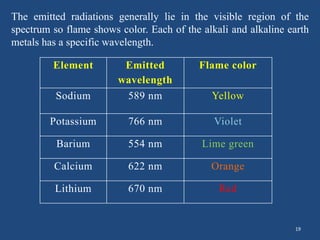
The emitted radiations generally lie in the visible region of the
spectrum so flame shows color. Each of the alkali and alkaline earth
metals has a specific wavelength.
Element Emitted
wavelength
Flame color
Sodium 589 nm Yellow
Potassium 766 nm Violet
Barium 554 nm Lime green
Calcium 622 nm Orange
Lithium 670 nm Red
19
Types of burner
20
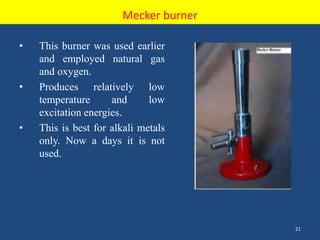
Mecker burner
• This burner was used earlier
and employed natural gas
and oxygen.
• Produces relatively low
temperature and low
excitation energies.
• This is best for alkali metals
only. Now a days it is not
used.
21
Total consumption burner
• In this burner fuel and
oxidant are hydrogen and
oxygen gases.
• Sample solution is aspirated
through a capillary by high
pressure of fuel and oxidant
and burnt at tip of burner.
• Entire sample is consumed.
22
Premix or laminar burner
• In this type of burner aspirated sample fuel and oxidant is mixed
thoroughly before reaching the burner opening and then entering in
the flame.
• There is high loss of sample (95%) as large droplets are drained
out.
23
Shielded burner
• This flame is shielded from ambient atmosphere by a stream
of inert gas.
• Shielding is done to get better analytical sensitivity and
quieter flame.
24
Nitrous oxide -acetylene flame
• This flame is superior to other flames
for effectively producing free atoms.
• The drawback of it is its high
temperature reduces its usefulness for
the determination of alkali metals as
they are easily ionized and intense
background emission, which makes
the measurement of metal emission
very difficult.
25
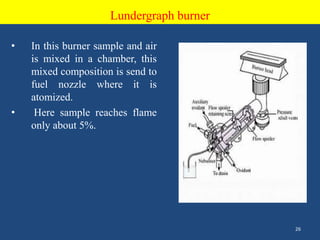
Lundergraph burner
• In this burner sample and air
is mixed in a chamber, this
mixed composition is send to
fuel nozzle where it is
atomized.
• Here sample reaches flame
only about 5%.
26
Mirror, Lens and Wavelength selector
Mirror
o The radiation from flame are emitted in all the directions in the
space.
o Mirror is located behind the burner to reflect radiations back to
slit of monochromator. The reflecting surface of mirror is front
faced.
Lens:
o It helps to focus the light on a point or slit.
Wavelength selector:
o The radiations from the mirror pass through the slit and reach
the filters.
o Filters will isolate the light of different wavelengths.
27
Photodetector, Amplifier and Readout device
Photo-detector:
o The intensity of radiation emitted by the flame is measured by
photo detector.
o Here the emitted radiation is converted to an electrical signal
with the help of photo detector.
o These electrical signals are directly proportional to the intensity
of light.
Amplifier:
o It amplify electrical signals.
Readout device:
o LCD display is used as readout device.
28

Atomic emission spectroscopy PPT

  • 1.
    Introduction to principleand instrumentation of atomic emission spectroscopy BY Humna Mehmood BS Chemistry (2017-2021) 1
  • 2.
    Introduction to atomicemission spectroscopy: • Atomic spectroscopy is thought to be the oldest instrumental method for the determination of elements. • Atomic emission spectroscopy uses quantitative measurement of the optical emission from excited atoms to determine analyte composition. • It is used to identify elements and determine their concentration in analyte. 2
  • 3.
    Principle: • The workingprinciple involves the examination of the wavelengths of photons discharged by atoms and molecules as they transit from a high energy state to a low energy state. 3
  • 4.
    o A characteristicset of wavelengths is emitted by each element or substance which depends on its electronic structure. o The atomic spectral line wavelength identifies the element. o The intensity of light emitted is proportional to the atom count of the element. o The sample solution is nebulized and introduced into the excitation source (flame). o Atoms are raised to excited states. Upon their return to a lower or ground electronic state, the excited atoms emit radiations. o The emitted radiations passes through a wavelength selector that isolates the specific wavelength . o A photo detector measures the radiant power of radiation, which is then amplified and sent to a readout device. 4
  • 5.
  • 6.
  • 7.
    Pretreatment of Sample •Solid sample must be dissolved in solvent. • Substances in sample that interfere with the emission measurement must be removed or masked • Reagents used to dissolve samples must not contain substances that lead to interference problems. 7
  • 8.
    Nebulizer • This isa component of sample delivery system, which breaks up the bigger liquid droplet to smaller liquid droplets • The process of conversion of sample to a fined mist of finely divided droplets using a jet of compressed gas is known as nebulization. Types of nebulizer • Ultrasonic nebulizer • Electro-thermal vaporizer • Pneumatic nebulizer 8
  • 9.
    Ultrasonic nebulizer • Thesample is pumped onto the surface of vibrating piezoelectric crystals. • The resulting mist is denser and more homogeneous than pneumatic nebulizer. 9
  • 10.
    Electro-thermal vaporizers • Itis an electro thermal vaporizer • It contains an evaporator in a closed chamber through which an inert gas carries the vaporized sample into atomizer. 10
  • 11.
    Pneumatic nebulizer It isof four types: o Cross flow o Concentric tubes o Fitted or porous disc o Babington 11
  • 12.
    Cross flow • Thestream jet flows right angle to capillary tip. • It uses a high speed stream of gas perpendicular to the tip of the sample capillary. 12
  • 13.
    Concentric tubes • Theliquid sample is sucked through a capillary tube by a high pressure jet of gas flowing around the tip of the capillary tube. • The high velocity breaks the sample into mist and carries it to atomization region. 13
  • 14.
    Babington • The jetis pumped through a small orifice in a sphere on which a thin film of sample flows • In this type of nebulizer sample solution flows freely over small aperture rather than passing through a fine capillary tube 14
  • 15.
    Fritted or porousdisk • The sample is pumped into a fritted disk through which the gas jet is flowing and this gives fine aerosol then others • High efficiency can be obtained by introducing the sample at predetermined location of fritted surface. 15
  • 16.
    Source of flame ABurner is the source of flame. It is maintained at a constant temperature. Temperature vary for different fuel-oxidant mixtures as shown table. Fuel + Oxidant mixture Temperature ( ℃ ) Natural gas + Air 1700 Propane + Air 1800 Hydrogen + Oxygen 2000 Hydrogen + Oxygen 2650 Acetylene + Air 2300 Acetylene + Oxygen 3200 Acetylene + Nitrous oxide 2700 Cyanogen + Oxygen 4800 16
  • 17.
  • 18.
    Processes occurring inthe flame: • Desolvation: The metal particles are dehydrated and the solvent is evaporated. • Vaporization: This also led to the evaporation of the solvent. • Atomization: Reduction of metal ions in the solvent to metal atoms by the flame heat. • Excitation: The atoms jump to the exited energy state. • Emission process: Atoms jump back to the stable low energy state with the emission of energy in the form of radiation of characteristic wavelength. 18
  • 19.
    The emitted radiationsgenerally lie in the visible region of the spectrum so flame shows color. Each of the alkali and alkaline earth metals has a specific wavelength. Element Emitted wavelength Flame color Sodium 589 nm Yellow Potassium 766 nm Violet Barium 554 nm Lime green Calcium 622 nm Orange Lithium 670 nm Red 19
  • 20.
  • 21.
    Mecker burner • Thisburner was used earlier and employed natural gas and oxygen. • Produces relatively low temperature and low excitation energies. • This is best for alkali metals only. Now a days it is not used. 21
  • 22.
    Total consumption burner •In this burner fuel and oxidant are hydrogen and oxygen gases. • Sample solution is aspirated through a capillary by high pressure of fuel and oxidant and burnt at tip of burner. • Entire sample is consumed. 22
  • 23.
    Premix or laminarburner • In this type of burner aspirated sample fuel and oxidant is mixed thoroughly before reaching the burner opening and then entering in the flame. • There is high loss of sample (95%) as large droplets are drained out. 23
  • 24.
    Shielded burner • Thisflame is shielded from ambient atmosphere by a stream of inert gas. • Shielding is done to get better analytical sensitivity and quieter flame. 24
  • 25.
    Nitrous oxide -acetyleneflame • This flame is superior to other flames for effectively producing free atoms. • The drawback of it is its high temperature reduces its usefulness for the determination of alkali metals as they are easily ionized and intense background emission, which makes the measurement of metal emission very difficult. 25
  • 26.
    Lundergraph burner • Inthis burner sample and air is mixed in a chamber, this mixed composition is send to fuel nozzle where it is atomized. • Here sample reaches flame only about 5%. 26
  • 27.
    Mirror, Lens andWavelength selector Mirror o The radiation from flame are emitted in all the directions in the space. o Mirror is located behind the burner to reflect radiations back to slit of monochromator. The reflecting surface of mirror is front faced. Lens: o It helps to focus the light on a point or slit. Wavelength selector: o The radiations from the mirror pass through the slit and reach the filters. o Filters will isolate the light of different wavelengths. 27
  • 28.
    Photodetector, Amplifier andReadout device Photo-detector: o The intensity of radiation emitted by the flame is measured by photo detector. o Here the emitted radiation is converted to an electrical signal with the help of photo detector. o These electrical signals are directly proportional to the intensity of light. Amplifier: o It amplify electrical signals. Readout device: o LCD display is used as readout device. 28