Atomic Absorption
Spectroscopy
• Submitted by: Preeti choudhary
• M.Sc.(Applied Physics)
Atomic Absorption Spectroscopy Flame Emission Spectroscopy
Atomic Absorption and Flame Emission Spectroscopy
Atomic spectroscopy is one of the major tools for qualitative and
quantitative analysis of trace (ppm and ppb) metallic elements in
industrial and environmental laboratories.
About 70 elements have been analyzed by this technique.
In these methods, the solution sample is aspirated into a flame that
is hot enough to break the molecules into their atomic states. The
concentration of the analyte in the flame may be measured by either
its absorption or emission of the radiation.
The absorption mode is known as atomic absorption spectroscopy
(AAS) whereas emission mode as flame emission spectroscopy (FES)
Atomic Absorption Spectroscopy, AAS
Atomic Emission Spectroscopy, AES
Principle of Atomic Absorption and Emission Spectrophotometer
Ground state E0
Excited state E1
e
Absorption
Ground state E0
Excited state E1
e
Emission
ee
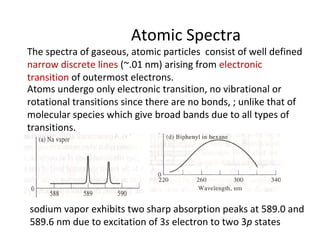
The spectra of gaseous, atomic particles consist of well defined
narrow discrete lines (~.01 nm) arising from electronic
transition of outermost electrons.
Atoms undergo only electronic transition, no vibrational or
rotational transitions since there are no bonds, ; unlike that of
molecular species which give broad bands due to all types of
transitions.
sodium vapor exhibits two sharp absorption peaks at 589.0 and
589.6 nm due to excitation of 3s electron to two 3p states
Atomic Spectra
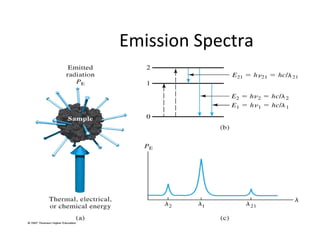
Emission Spectra
Spectral lines of Na and Mg+
Atomization
It is the conversion of molecules to their component atoms in gaseous
state. It is carried out by introduction of the solution in the flame in the
form of very fine droplets. The precision and accuracy of atomic methods
are dependent upon the atomization step.
In Flame Emission
-Atoms in gaseous state in the flame absorb thermal energy from the
flame itself . Some of the atoms get excited & as they return back to the
ground state they emit radiation having energy equal to that absorbed.
-The emission intensity is proportional to the number of excited atoms,
which is proportional to the total number of atoms in the flame
i.e. the sample concentration. It is of two types:
Flame method
Flameless method
Elements detectable by atomic absorption are
highlighted in pink in this periodic table
Elements detected
Flame-its functions
One of the features common to both Flame Emission and
Atomic Absorption is the use of a flame to atomize the analyte.
The function of the flame differs in the two techniques:
In AAS, the flame serves to convert the analyte into free
atoms; the conditions should be such that no ionization occurs.
In FES the flame serves to atomize the analyte as well as
provide excitation energy.
Flame-its functions
Upper diagram shows FES while
the lower one shows AAS. In FES
the flame also provides the
excitation energy, but in AAS it
provides only for the atomization
.
These flames vary in temperature, reducibility and transmission characteristics and
are selected according to the element being analyzed, and properties of the sample.
Flame selection
Regions in a flame
Regions in a flame
Most sensitive part of flame for analyses varies
with analyte
Steps for atomization
Nebulization: sample solution is introduced through an
orifice into a high velocity gas jet, usually the oxidant,
in either parallel or perpendicular manner
Sample stream is converted into a cloud of droplet in the
aerosol modifier or spray chamber, combined with the
oxidizer/fuel and carried to the burner
1)When aerosol containing
MX enter the flame, the
solvent is evaporated,
leaving particles of dry,
solid MX (desolvation)
2) solid MX is converted to
MX vapor (volatilization)
3) portion of MX molecules
are dissociated to give
free M atoms
(Dissociation)
Steps for atomization
Burners
Laminar flow Total consumption
Laminar Flow Burner:
Cheap
Simple
Flame stability
Not hazardous
21
Disadvantages of flame atomization
Only 5 – 15 % of the nebulized sample reaches
the flame
A minimum sample volume of 0.5 – 1.0 mL is needed
to give a reliable reading
Samples which are viscous require dilution with a
solvent
Schematic arrangement of a typical
flame emission spectrophotometer:
Limitation of Flame Emission Photometry
1-The number of excited atoms in flame is very small. It is the alkaline
and alkaline earth metals that can be practically determined.
2-It needs perfect control of flame temperature.
3- Interference by other elements is not easy to be eliminated.
4-For heavy and transition metals , the number of absorption
and emission lines is enormous and the spectra are complex.
Atomic Absorption Spectroscopy
•In atomic absorption spectroscopy the radiation of
the lines of the analyte are produced by the lamp.
•The presence of the atomic state of the analyte in
the flame attenuates or reduces the intensity of
the
radiation.
•The absorbance is proportional to the
concentration of the analyte, similar to optical
spectroscopy.
Atomic Absorption Spectrometer
The flowing fuel and air mixture provides the aspiration action
drawing the solution sample into the flame.
ATOMIC ABSORPTION SPECTROSCOPY
• Atoms in the vapor state are subjected to external source of
radiation which produces one line or beam of monochromatic
light with single wavelength.
• This wavelength is a resonance one for the atoms and that
will be absorbed by them.
INSTRUMENT FOR ATOMIC ABSORPTION
1- Source of radiation 2- Chopper
3- Atomizer
4-Monochromator 5- Detector
6- Read out meter
Atomic Absoprption Spectrometer
Source of radiation - hollow cathode lamp
• It is a tube with a front quartz window
• Contains an anode of tungsten and a cylindrical cathode , the material
of which is the same element as that of the sample to be determined.
•Passage of a dc voltage through the lamp produces the specific lines of
those elements.
• The glass tube is filled with neon or argon at a pressure of 1 to 5 torr.
.
<
T>
Hollow cathode lamp
Variety of hollow cathode
lamps are available
commercially
Some cathode are made up
of a mixture of several
metals permitting analysis
of many elements
a)
• in order for Beer’s law, to be followed, band-width
of the source must be narrow relative to the width of
an absorption peak (0.002-0.005nm)
•as a result nonlinear calibration curves are inevitable
when continuous radiation source are used
• problem is solved by using the line sources with
bandwidths narrower than absorption peaks
Radiation source
Why cannot we use continuous radiation source?
Radiation source
The bandwidth of the
absorption line is much
broader than the
bandwidth of the spectral
lines of the hollow cathode
lamp.
Hollow cathode lamp
Spectral output of the
multi-element steel
hollow cathode lamp.
Note the extremely
sharp spectral lines.
The chopper
• The function of the chopper is to chop the light leaving the source so
that when the incident beam hits the chopper at the solid surface,
the beam will be blocked and detector will only read the emitted
signal from the flame. As the chopper rotates and the beam emerges
to the detector, the detector signal will be the sum of the
transmitted signal plus that emitted from the flame. The signal
processor will be able to subtract the first signal from the second
one, thus excluding the signal from emission in flames. This can be
represented by the following equations:
• Signal 1 (Blocked Beam) = Pe
• Signal 2 (Transmitted Beam) = P + Pe
• Overall Difference Signal = (P + Pe) - Pe= P (Corrected Signal)
• This correction method for background emission in flames is called
source modulation
Interferences with FES and AAS
There are 3 types of interferences associated with both FES
and AAS:
Spectral Interferences arise whenever the line of interest
cannot be easily resolved from another element or from a
molecular band present in the background.
Generally, the bandpass of even very
goodmonochromators 10 times greater than the width of
the lines of the HCL. In some cases, amplitude modulation
of the HCL helps to detect these interferences.
Background absorption is caused by the large number of
species present in the flame (metal oxide, OH radical, H2,
fragments of solvent mol.etc)
Incident radiation is absorbed by these species as well as by
the analyte atoms
Correction:
“blank” solution (solution devoid of analyte) can be used to
correct the measurement from sample solution (in
practice it is difficult to prepare exact blank)
Spectral interferences
39
Spectral interferences
----- spectral overlap
Cu 324.754 nm, Eu 324.753 nm
Al 308.215 nm , V 308.211nm,
Al 309.27 nm
Avoid the interference by observing the
aluminum line at 309.27 nm
40
Spectral interferences
----- light scatter
• Metal oxide particles with diameters greater than the
wavelength of light; eg CaOH interferes with Ba analysis.
• When sample contains organic species or when organic
solvents are used to dissolve the sample, incomplete
combustion of the organic matrix leaves carbonaceous
particles that are capable of scattering light
41
Spectral interferences
• The interference can be avoided by
variation in analytical variables, such as
flame temperature and fuel to oxidant
ratio. The solution to many of these
problems is a hotter flame, such as the use
of acetylene/nitrous oxide.
• Standard addition method
42
Chemical interferences
----- Formation of compounds of low
volatility
Increase in flame temperature



Use of releasing agents- La 3+,
Sr+3
)
Ca 2+
, PO4
3-
Use of protective agents (EDTA)
Ionization Interference:
• atoms with low ionization potential become
ionized reducing the population of both the ground
state and excited state free atoms
• by adding an excess of easily ionized element (viz.
K, Cs or Sr), ionization in the sample and calibration
solution can be suppressed
• more easily ionized atoms produces a large
concentration of electrons in the vapor and, by mass
action, suppresses the ionization of analyte atoms
Standard Addition Method
Mg concentration
after filled up
X X+0.1 X+0.2 X+0.3
100 ml
Solvent
No.1 No.2 No.4No.3
10 ml Unknown sample
10 ml 10 ml 10 ml 10 ml
1.0 ppm X Standard solution (ppm : mg/1000ml)
20 ml
30 ml
10 ml
Standard Addition Method
Thank-you

Atomic spectroscopy

  • 1.
    Atomic Absorption Spectroscopy • Submittedby: Preeti choudhary • M.Sc.(Applied Physics)
  • 2.
    Atomic Absorption SpectroscopyFlame Emission Spectroscopy
  • 3.
    Atomic Absorption andFlame Emission Spectroscopy Atomic spectroscopy is one of the major tools for qualitative and quantitative analysis of trace (ppm and ppb) metallic elements in industrial and environmental laboratories. About 70 elements have been analyzed by this technique. In these methods, the solution sample is aspirated into a flame that is hot enough to break the molecules into their atomic states. The concentration of the analyte in the flame may be measured by either its absorption or emission of the radiation. The absorption mode is known as atomic absorption spectroscopy (AAS) whereas emission mode as flame emission spectroscopy (FES)
  • 4.
    Atomic Absorption Spectroscopy,AAS Atomic Emission Spectroscopy, AES Principle of Atomic Absorption and Emission Spectrophotometer Ground state E0 Excited state E1 e Absorption Ground state E0 Excited state E1 e Emission ee
  • 5.
    The spectra ofgaseous, atomic particles consist of well defined narrow discrete lines (~.01 nm) arising from electronic transition of outermost electrons. Atoms undergo only electronic transition, no vibrational or rotational transitions since there are no bonds, ; unlike that of molecular species which give broad bands due to all types of transitions. sodium vapor exhibits two sharp absorption peaks at 589.0 and 589.6 nm due to excitation of 3s electron to two 3p states Atomic Spectra
  • 6.
  • 7.
  • 8.
    Atomization It is theconversion of molecules to their component atoms in gaseous state. It is carried out by introduction of the solution in the flame in the form of very fine droplets. The precision and accuracy of atomic methods are dependent upon the atomization step. In Flame Emission -Atoms in gaseous state in the flame absorb thermal energy from the flame itself . Some of the atoms get excited & as they return back to the ground state they emit radiation having energy equal to that absorbed. -The emission intensity is proportional to the number of excited atoms, which is proportional to the total number of atoms in the flame i.e. the sample concentration. It is of two types: Flame method Flameless method
  • 10.
    Elements detectable byatomic absorption are highlighted in pink in this periodic table Elements detected
  • 11.
    Flame-its functions One ofthe features common to both Flame Emission and Atomic Absorption is the use of a flame to atomize the analyte. The function of the flame differs in the two techniques: In AAS, the flame serves to convert the analyte into free atoms; the conditions should be such that no ionization occurs. In FES the flame serves to atomize the analyte as well as provide excitation energy.
  • 12.
    Flame-its functions Upper diagramshows FES while the lower one shows AAS. In FES the flame also provides the excitation energy, but in AAS it provides only for the atomization .
  • 13.
    These flames varyin temperature, reducibility and transmission characteristics and are selected according to the element being analyzed, and properties of the sample. Flame selection
  • 14.
  • 15.
    Regions in aflame Most sensitive part of flame for analyses varies with analyte
  • 16.
  • 17.
    Nebulization: sample solutionis introduced through an orifice into a high velocity gas jet, usually the oxidant, in either parallel or perpendicular manner Sample stream is converted into a cloud of droplet in the aerosol modifier or spray chamber, combined with the oxidizer/fuel and carried to the burner
  • 18.
    1)When aerosol containing MXenter the flame, the solvent is evaporated, leaving particles of dry, solid MX (desolvation) 2) solid MX is converted to MX vapor (volatilization) 3) portion of MX molecules are dissociated to give free M atoms (Dissociation) Steps for atomization
  • 19.
  • 20.
  • 21.
    21 Disadvantages of flameatomization Only 5 – 15 % of the nebulized sample reaches the flame A minimum sample volume of 0.5 – 1.0 mL is needed to give a reliable reading Samples which are viscous require dilution with a solvent
  • 22.
    Schematic arrangement ofa typical flame emission spectrophotometer:
  • 23.
    Limitation of FlameEmission Photometry 1-The number of excited atoms in flame is very small. It is the alkaline and alkaline earth metals that can be practically determined. 2-It needs perfect control of flame temperature. 3- Interference by other elements is not easy to be eliminated. 4-For heavy and transition metals , the number of absorption and emission lines is enormous and the spectra are complex.
  • 24.
    Atomic Absorption Spectroscopy •Inatomic absorption spectroscopy the radiation of the lines of the analyte are produced by the lamp. •The presence of the atomic state of the analyte in the flame attenuates or reduces the intensity of the radiation. •The absorbance is proportional to the concentration of the analyte, similar to optical spectroscopy.
  • 25.
    Atomic Absorption Spectrometer Theflowing fuel and air mixture provides the aspiration action drawing the solution sample into the flame.
  • 27.
    ATOMIC ABSORPTION SPECTROSCOPY •Atoms in the vapor state are subjected to external source of radiation which produces one line or beam of monochromatic light with single wavelength. • This wavelength is a resonance one for the atoms and that will be absorbed by them. INSTRUMENT FOR ATOMIC ABSORPTION 1- Source of radiation 2- Chopper 3- Atomizer 4-Monochromator 5- Detector 6- Read out meter
  • 28.
  • 29.
    Source of radiation- hollow cathode lamp • It is a tube with a front quartz window • Contains an anode of tungsten and a cylindrical cathode , the material of which is the same element as that of the sample to be determined. •Passage of a dc voltage through the lamp produces the specific lines of those elements. • The glass tube is filled with neon or argon at a pressure of 1 to 5 torr. .
  • 31.
  • 32.
    Hollow cathode lamp Varietyof hollow cathode lamps are available commercially Some cathode are made up of a mixture of several metals permitting analysis of many elements
  • 33.
    a) • in orderfor Beer’s law, to be followed, band-width of the source must be narrow relative to the width of an absorption peak (0.002-0.005nm) •as a result nonlinear calibration curves are inevitable when continuous radiation source are used • problem is solved by using the line sources with bandwidths narrower than absorption peaks Radiation source Why cannot we use continuous radiation source?
  • 34.
    Radiation source The bandwidthof the absorption line is much broader than the bandwidth of the spectral lines of the hollow cathode lamp.
  • 35.
    Hollow cathode lamp Spectraloutput of the multi-element steel hollow cathode lamp. Note the extremely sharp spectral lines.
  • 36.
    The chopper • Thefunction of the chopper is to chop the light leaving the source so that when the incident beam hits the chopper at the solid surface, the beam will be blocked and detector will only read the emitted signal from the flame. As the chopper rotates and the beam emerges to the detector, the detector signal will be the sum of the transmitted signal plus that emitted from the flame. The signal processor will be able to subtract the first signal from the second one, thus excluding the signal from emission in flames. This can be represented by the following equations: • Signal 1 (Blocked Beam) = Pe • Signal 2 (Transmitted Beam) = P + Pe • Overall Difference Signal = (P + Pe) - Pe= P (Corrected Signal) • This correction method for background emission in flames is called source modulation
  • 37.
    Interferences with FESand AAS There are 3 types of interferences associated with both FES and AAS: Spectral Interferences arise whenever the line of interest cannot be easily resolved from another element or from a molecular band present in the background. Generally, the bandpass of even very goodmonochromators 10 times greater than the width of the lines of the HCL. In some cases, amplitude modulation of the HCL helps to detect these interferences.
  • 38.
    Background absorption iscaused by the large number of species present in the flame (metal oxide, OH radical, H2, fragments of solvent mol.etc) Incident radiation is absorbed by these species as well as by the analyte atoms Correction: “blank” solution (solution devoid of analyte) can be used to correct the measurement from sample solution (in practice it is difficult to prepare exact blank) Spectral interferences
  • 39.
    39 Spectral interferences ----- spectraloverlap Cu 324.754 nm, Eu 324.753 nm Al 308.215 nm , V 308.211nm, Al 309.27 nm Avoid the interference by observing the aluminum line at 309.27 nm
  • 40.
    40 Spectral interferences ----- lightscatter • Metal oxide particles with diameters greater than the wavelength of light; eg CaOH interferes with Ba analysis. • When sample contains organic species or when organic solvents are used to dissolve the sample, incomplete combustion of the organic matrix leaves carbonaceous particles that are capable of scattering light
  • 41.
    41 Spectral interferences • Theinterference can be avoided by variation in analytical variables, such as flame temperature and fuel to oxidant ratio. The solution to many of these problems is a hotter flame, such as the use of acetylene/nitrous oxide. • Standard addition method
  • 42.
    42 Chemical interferences ----- Formationof compounds of low volatility Increase in flame temperature    Use of releasing agents- La 3+, Sr+3 ) Ca 2+ , PO4 3- Use of protective agents (EDTA)
  • 43.
    Ionization Interference: • atomswith low ionization potential become ionized reducing the population of both the ground state and excited state free atoms • by adding an excess of easily ionized element (viz. K, Cs or Sr), ionization in the sample and calibration solution can be suppressed • more easily ionized atoms produces a large concentration of electrons in the vapor and, by mass action, suppresses the ionization of analyte atoms
  • 44.
    Standard Addition Method Mgconcentration after filled up X X+0.1 X+0.2 X+0.3 100 ml Solvent No.1 No.2 No.4No.3 10 ml Unknown sample 10 ml 10 ml 10 ml 10 ml 1.0 ppm X Standard solution (ppm : mg/1000ml) 20 ml 30 ml 10 ml
  • 45.
  • 47.