Thermogravimetry
Analysis(TGA)
Presented by,
Miss Sujata Holkar
M.pharm 1st year
(Pharmacology)
1
◆Contents:-
1: Introduction
2: Principle
3: Instrumentation
4: The factors affecting the precision
and accuracy of theTG curve
2
◼ An Internationally accepted definition of
thermogravimetry is as follows:-
"It is a technique where by weight of substance in an
environment heated or cooled at a controlled rate, is
recorded as a function of time or temperature.”
3
OR
Thermogravimetric analysis or thermal gravimetric
analysis (TGA) is a method of thermal analysis in which
the mass of a sample is measured over time as the
temperature changes.
◆Definition
A TGA analysis is performed by gradually raising the
temperature of a sample in a furnace as its weight is
measured on an analytical balance that remains
outside of the furnace. In TGA, mass loss is observed
if a thermal event involves loss of a volatile
component.
4
◆Principle:-
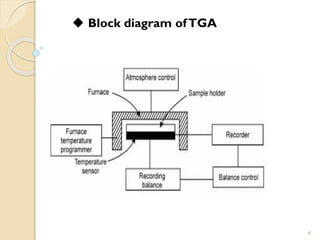
A.Recording balance
B.Sample holder
C.Furnace
D.Furnace temperature programmer/
controller
E.Recorder
5
◆Instrumentation:-
◼ Components of
intrumentation
◆ Block diagram ofTGA
6
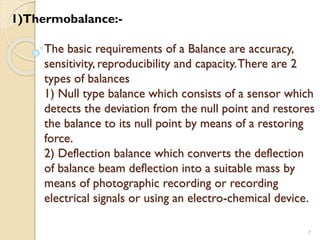
The basic requirements of a Balance are accuracy,
sensitivity, reproducibility and capacity.There are 2
types of balances
1) Null type balance which consists of a sensor which
detects the deviation from the null point and restores
the balance to its null point by means of a restoring
force.
2) Deflection balance which converts the deflection
of balance beam deflection into a suitable mass by
means of photographic recording or recording
electrical signals or using an electro-chemical device.
7
1)Thermobalance:-
The Furnace provides linear heating over a wide range
of operating temperaures, typically -150 deg. Celsius to
about 2000 deg. Celsius depending on the requirement.
8
2)Furnace:-
Temperature measurement and regulation is done with
the help of thermocouples. Usually 2 thermocouples
are used, where one records the temperature change,
the other actuates the control system.
9
3)Furnace tempreture
programmer/controler:-
The recording unit makes use of a microprocessor
which allows for digital data acquisition and
processing using a personal computer.
10
4)Recorder:-
1) Furnace heating rate
2) Sensitivity of the sensors
3) Recording speed
4) Amount of sample
5) Particle size
6) Heat of reaction etc.
11
◆The factors affecting the precision and
accuracy of theTG curve are
Thank you
12

TGA instrumentation

  • 1.
    Thermogravimetry Analysis(TGA) Presented by, Miss SujataHolkar M.pharm 1st year (Pharmacology) 1
  • 2.
    ◆Contents:- 1: Introduction 2: Principle 3:Instrumentation 4: The factors affecting the precision and accuracy of theTG curve 2
  • 3.
    ◼ An Internationallyaccepted definition of thermogravimetry is as follows:- "It is a technique where by weight of substance in an environment heated or cooled at a controlled rate, is recorded as a function of time or temperature.” 3 OR Thermogravimetric analysis or thermal gravimetric analysis (TGA) is a method of thermal analysis in which the mass of a sample is measured over time as the temperature changes. ◆Definition
  • 4.
    A TGA analysisis performed by gradually raising the temperature of a sample in a furnace as its weight is measured on an analytical balance that remains outside of the furnace. In TGA, mass loss is observed if a thermal event involves loss of a volatile component. 4 ◆Principle:-
  • 5.
    A.Recording balance B.Sample holder C.Furnace D.Furnacetemperature programmer/ controller E.Recorder 5 ◆Instrumentation:- ◼ Components of intrumentation
  • 6.
  • 7.
    The basic requirementsof a Balance are accuracy, sensitivity, reproducibility and capacity.There are 2 types of balances 1) Null type balance which consists of a sensor which detects the deviation from the null point and restores the balance to its null point by means of a restoring force. 2) Deflection balance which converts the deflection of balance beam deflection into a suitable mass by means of photographic recording or recording electrical signals or using an electro-chemical device. 7 1)Thermobalance:-
  • 8.
    The Furnace provideslinear heating over a wide range of operating temperaures, typically -150 deg. Celsius to about 2000 deg. Celsius depending on the requirement. 8 2)Furnace:-
  • 9.
    Temperature measurement andregulation is done with the help of thermocouples. Usually 2 thermocouples are used, where one records the temperature change, the other actuates the control system. 9 3)Furnace tempreture programmer/controler:-
  • 10.
    The recording unitmakes use of a microprocessor which allows for digital data acquisition and processing using a personal computer. 10 4)Recorder:-
  • 11.
    1) Furnace heatingrate 2) Sensitivity of the sensors 3) Recording speed 4) Amount of sample 5) Particle size 6) Heat of reaction etc. 11 ◆The factors affecting the precision and accuracy of theTG curve are
  • 12.