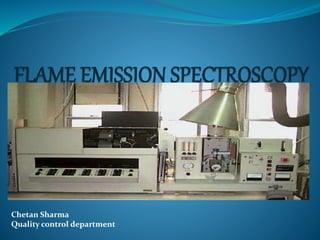
dsss 
Chetan Sharma 
Quality control department
Introduction 
 Flame photometry (more accurately called flame atomic 
emission spectrometry) 
 It is a branch of atomic spectroscopy in which the species 
examined in the spectrometer are in the form of atoms 
 Based on measurement of intensity of the light emitted when a 
metal is introduced into flame 
• The wavelength of color tells what the element is . 
• The color's intensity tells us how much of the element present.
History 
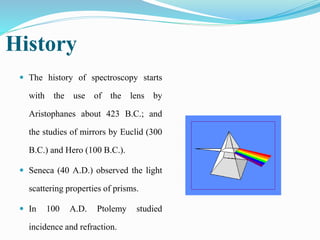
 The history of spectroscopy starts 
with the use of the lens by 
Aristophanes about 423 B.C.; and 
the studies of mirrors by Euclid (300 
B.C.) and Hero (100 B.C.). 
 Seneca (40 A.D.) observed the light 
scattering properties of prisms. 
 In 100 A.D. Ptolemy studied 
incidence and refraction.
 Fraunhofer , about 1814-15, observed diffraction phenomena and 
was able to measure wavelength instead of angles of refraction. 
 Herschel (1823) and Talbot (1825) discovered atomic emission 
when certain atoms were placed in a flame. 
 Wheatstone concluded in 1835 that metals could be distinguished 
from one another on basis on the wavelengths of this emission. 
 In 1848, Foucault observed atomic emission from sodium and 
discovered that the element would absorb the same rays from 
an electric arc.
 In the later 1800, scientists such as Kirchoff, Bunsen, 
Angstrm, Rowland, Michelson and Balmer studied the 
composition of the sun based on their emissions at 
different wavelengths. 
 Kirchhoff summarized the law which states that, 
"Matter absorbs light at the same wavelength at 
which it emits light". It is under this law that atomic 
absorption spectroscopy works.
 Woodson was one of the first to apply this principle to 
the detection of mercury. 
 In 1955, Walsh suggested the use of cathode lamps to 
provide an emission of appropriate wavelength; and 
the use of a flame to produce neutral atoms that would 
absorb the emission as they crossed its path
Principle 
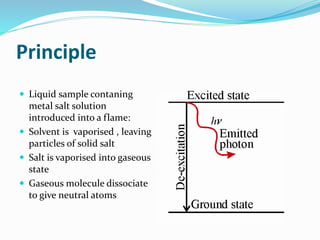
 Liquid sample contaning 
metal salt solution 
introduced into a flame: 
 Solvent is vaporised , leaving 
particles of solid salt 
 Salt is vaporised into gaseous 
state 
 Gaseous molecule dissociate 
to give neutral atoms
 Neutral atoms are excited by thermal energy of flame 
 The unstable excited atoms emit photons while 
returning to lower energy state 
 The measurement of emitted photons forms the basis 
of flame photometry.
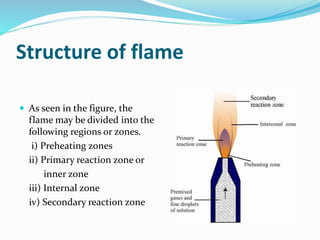
Structure of flame 
 As seen in the figure, the 
flame may be divided into the 
following regions or zones. 
i) Preheating zones 
ii) Primary reaction zone or 
inner zone 
iii) Internal zone 
iv) Secondary reaction zone
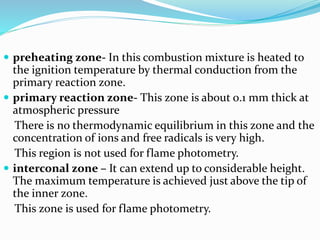
 preheating zone- In this combustion mixture is heated to 
the ignition temperature by thermal conduction from the 
primary reaction zone. 
 primary reaction zone- This zone is about 0.1 mm thick at 
atmospheric pressure 
There is no thermodynamic equilibrium in this zone and the 
concentration of ions and free radicals is very high. 
This region is not used for flame photometry. 
 interconal zone – It can extend up to considerable height. 
The maximum temperature is achieved just above the tip of 
the inner zone. 
This zone is used for flame photometry.
 secondary reaction zone - In this zone, the products 
of the combustion processes are burnt to stable 
molecular species by the surrounding air.
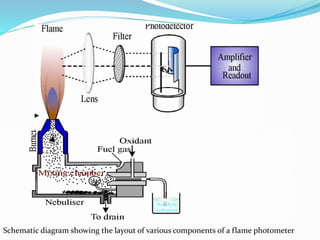
Instrumentation 
1. Sample Delivery 
2. Source 
3. Monochromator 
4. Detector 
5. Read out device
Schematic diagram showing the layout of various components of a flame photometer
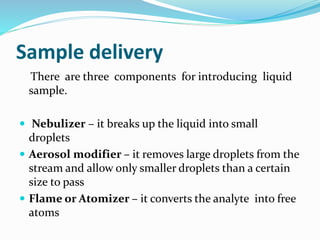
Sample delivery 
There are three components for introducing liquid 
sample. 
 Nebulizer – it breaks up the liquid into small 
droplets 
 Aerosol modifier – it removes large droplets from the 
stream and allow only smaller droplets than a certain 
size to pass 
 Flame or Atomizer – it converts the analyte into free 
atoms
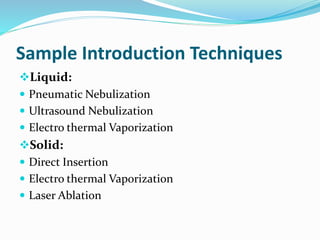
Sample Introduction Techniques 
Liquid: 
 Pneumatic Nebulization 
 Ultrasound Nebulization 
 Electro thermal Vaporization 
Solid: 
 Direct Insertion 
 Electro thermal Vaporization 
 Laser Ablation
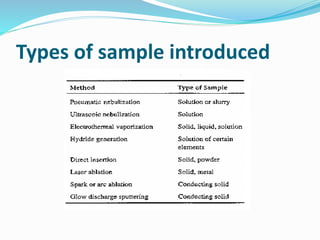
Types of sample introduced
Nebulization 
 Nebulization: is conversion of a sample to a fine mist of 
finely divided droplets using a jet of compressed gas. 
The flow carries the sample into the atomization region. 
 Pneumatic Nebulizers: (most common) 
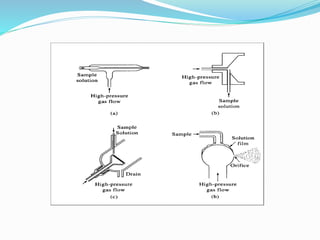
Four types of pneumatic nebulizers: 
 Concentric tube 
 Cross flow 
 Fritted disk 
 Babington
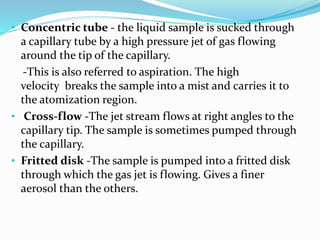
• Concentric tube - the liquid sample is sucked through 
a capillary tube by a high pressure jet of gas flowing 
around the tip of the capillary. 
-This is also referred to aspiration. The high 
velocity breaks the sample into a mist and carries it to 
the atomization region. 
• Cross-flow -The jet stream flows at right angles to the 
capillary tip. The sample is sometimes pumped through 
the capillary. 
• Fritted disk -The sample is pumped into a fritted disk 
through which the gas jet is flowing. Gives a finer 
aerosol than the others.
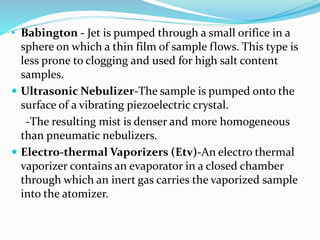
• Babington - Jet is pumped through a small orifice in a 
sphere on which a thin film of sample flows. This type is 
less prone to clogging and used for high salt content 
samples. 
 Ultrasonic Nebulizer-The sample is pumped onto the 
surface of a vibrating piezoelectric crystal. 
-The resulting mist is denser and more homogeneous 
than pneumatic nebulizers. 
 Electro-thermal Vaporizers (Etv)-An electro thermal 
vaporizer contains an evaporator in a closed chamber 
through which an inert gas carries the vaporized sample 
into the atomizer.
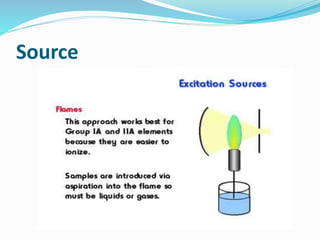
Source
Source 
Burner-which are used to spray the sample solution 
into fine droplets. 
Several burners and fuel – oxidant combinations have 
been used to produce analytical flame 
 Premixed burner 
 Mecker burner 
 Total consumption burner 
 Lundergarh burner 
 Shielded burner 
 Nitrous oxide-acetylene flames
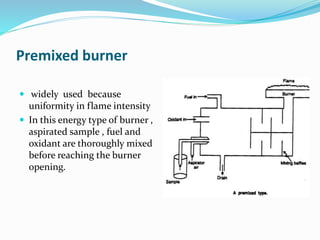
Premixed burner 
 widely used because 
uniformity in flame intensity 
 In this energy type of burner , 
aspirated sample , fuel and 
oxidant are thoroughly mixed 
before reaching the burner 
opening.
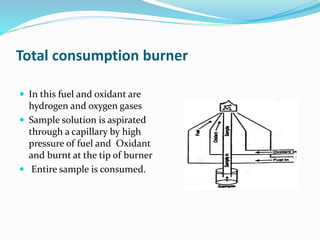
Total consumption burner 
 In this fuel and oxidant are 
hydrogen and oxygen gases 
 Sample solution is aspirated 
through a capillary by high 
pressure of fuel and Oxidant 
and burnt at the tip of burner 
 Entire sample is consumed.
 Mecker burner - Generally used for study of alkali 
metals only. 
 Lundergarh burner-In this sample must be in liquid 
form 
• Large droplets condense on the side or drain away 
• Small droplets and vaporised sample are swept into the 
base of flame in form of cloud 
• Devices such as ultrasonic vibrators are used to 
enhance the nebulization stage in this burner.
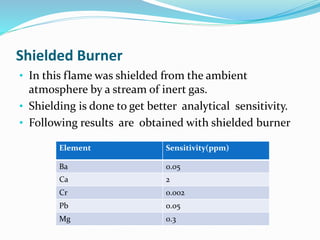
Shielded Burner 
• In this flame was shielded from the ambient 
atmosphere by a stream of inert gas. 
• Shielding is done to get better analytical sensitivity. 
• Following results are obtained with shielded burner 
Element Sensitivity(ppm) 
Ba 0.05 
Ca 2 
Cr 0.002 
Pb 0.05 
Mg 0.3
Nitrous oxide-Acetylene flame 
• These flames were superior to other flames for 
effectively producing free atoms 
• Eg.-metals with very reflective oxides such as 
aluminium and titanium. 
 The drawback of it is: 
• the high temperature reduces its usefulness for the 
determination of alkali metals as they are easily 
ionized 
• Intense background emission, which makes the 
measurement of metal emission very difficult
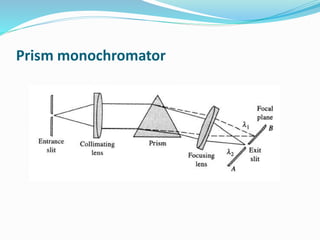
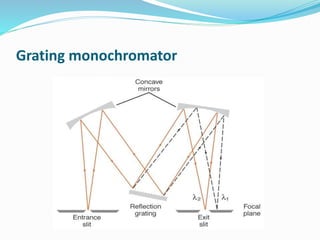
Monochromator 
Converts a polychromatic light into monochromatic 
light. 
 It is of two types: 
1. Prism : Quartz material is used for making prism, as 
quartz is transparent over entire region 
2. Grating : it employs a grating which is essentially a 
series of parallel straight lines cut into a plane 
surface
Prism monochromator
Grating monochromator
Detectors 
 Photomultiplier tubes 
 Photo emissive cell 
 Photo voltaic cell
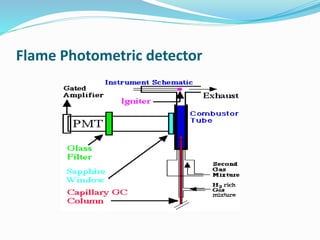
Flame Photometric detector
Photovoltaic cell 
• It has a thin metallic layer coated with silver or gold act 
as electrode , also has metal base plate which act as 
another electrode 
• Two layers are separated by semiconductor layer of 
selenium, when light radiation falls on selenium layer. 
• This creates potential diff. between the two electrode 
and cause flow of current.
Read Out Device 
 It is capable of displaying the absorption spectrum as well 
absorbance at specific wavelength 
 Nowadays the instruments have microprocessor 
controlled electronics that provides outputs compatible 
with the printers and computers thereby minimising the 
possibility of operator error in transferring data.
Applications 
 Qualitative application: 
• used for the determination of alkali and the alkaline 
earth metals 
• elements can be detected visually by the colour in the 
flame, e.g. sodium produces yellow flame
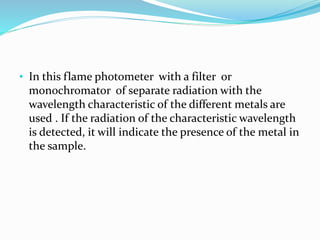
• In this flame photometer with a filter or 
monochromator of separate radiation with the 
wavelength characteristic of the different metals are 
used . If the radiation of the characteristic wavelength 
is detected, it will indicate the presence of the metal in 
the sample.
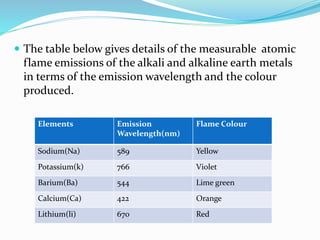
 The table below gives details of the measurable atomic 
flame emissions of the alkali and alkaline earth metals 
in terms of the emission wavelength and the colour 
produced. 
Elements Emission 
Wavelength(nm) 
Flame Colour 
Sodium(Na) 589 Yellow 
Potassium(k) 766 Violet 
Barium(Ba) 544 Lime green 
Calcium(Ca) 422 Orange 
Lithium(li) 670 Red
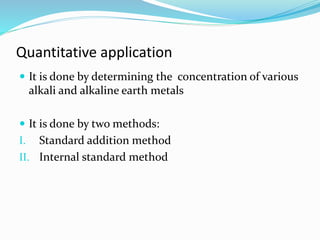
Quantitative application 
 It is done by determining the concentration of various 
alkali and alkaline earth metals 
 It is done by two methods: 
I. Standard addition method 
II. Internal standard method
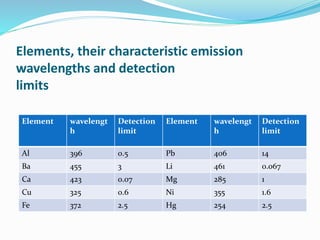
Elements, their characteristic emission 
wavelengths and detection 
limits 
Element wavelengt 
h 
Detection 
limit 
Element wavelengt 
h 
Detection 
limit 
Al 396 0.5 Pb 406 14 
Ba 455 3 Li 461 0.067 
Ca 423 0.07 Mg 285 1 
Cu 325 0.6 Ni 355 1.6 
Fe 372 2.5 Hg 254 2.5
Other applications 
 Useful in determination of Na , K , Al, Ca , B: 
• In biological fluids and tissues 
• In soil analysis 
 Used for natural and industrial waters, glass , cement , 
petroleum products.
INTERFERENCES IN QUANTITATIVE 
DETERMINATIONS 
 The interferences encountered can be classified as 
follows. 
• Spectral interferences 
• Ionised interferences 
• Chemical interferences
Spectral interferences 
 The first type of interference arises when two 
elements exhibit spectra, which partially overlap, and 
both emit radiation at some particular wavelength. 
eg. - the Fe line at 324.73 nm overlaps 
with the Cu line at 324.75 nm. 
• It can overcome either by taking measurements at an 
alternative wavelength which has no overlap, if 
available, or by removing the interfering element by 
extraction.
 The second type of spectral interference deals with 
spectral lines of two or more elements which are close 
but their spectra do not overlap. 
• It can be reduced by increasing the resolution of the 
spectral isolation system. 
 A third type of spectral interference occurs due to the 
presence of continuous background which arises due 
to high concentration of salts in the sample, especially 
of alkali and alkaline earth metals 
• This type of interference can be corrected by using 
suitable scanning technique.
Ionisation interferences 
 high temperature flame may cause ionisation of some 
of the metal atoms, e.g. sodium 
Na Na+ + e_ 
The Na+ ion possesses an emission spectrum of its 
own with frequencies, which are different from those 
of atomic spectrum of the Na atom.
• The addition of potassium salt suppresses the 
ionisation of sodium, as the potassium atom itself 
undergoes ionisation due to low ionisation energy. 
Chemical Interferences: 
 The chemical interferences arise out of the reaction 
between different interferents and the analyte . These 
are of different types:
Cation-anion interference 
• The presence of certain anions, such as oxalate, 
phosphate, sulphate , in a solution may affect the 
intensity of radiation emitted by an element, resulting 
in serious analytical error. 
• For example, calcium in the presence of phosphate ion 
forms a stable substance, as Ca3(PO4)2 which does not 
decompose easily, resulting in the production of lesser 
atoms.
Cation-cation interferences 
• Due to mutual interferences of cations 
• These interferences are neither spectral nor ionic in 
nature 
• Eg. aluminum interferes with calcium and magnesium. 
Interference due to oxide formation: 
It arises due to the formation of stable metal oxide if 
oxygen is present in the flame
Limitations 
 The temperature is not high enough to excite 
transition metals, therefore the method is selective 
towards detection of alkali and alkaline earth metals. 
 The relatively low energy available from the flame 
leads to relatively low intensity of the radiation from 
the metal atoms. 
 The low temperature renders to interference and the 
stability of the flame and aspiration conditions. 
 Interference by other elements is not easy to be 
eliminated.
New technology in flame 
photometry 
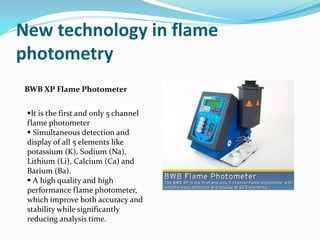
BWB XP Flame Photometer 
It is the first and only 5 channel 
flame photometer 
 Simultaneous detection and 
display of all 5 elements like 
potassium (K), Sodium (Na), 
Lithium (Li), Calcium (Ca) and 
Barium (Ba). 
 A high quality and high 
performance flame photometer, 
which improve both accuracy and 
stability while significantly 
reducing analysis time.
Chetan

Chetan

  • 1.
    dsss Chetan Sharma Quality control department
  • 2.
    Introduction  Flamephotometry (more accurately called flame atomic emission spectrometry)  It is a branch of atomic spectroscopy in which the species examined in the spectrometer are in the form of atoms  Based on measurement of intensity of the light emitted when a metal is introduced into flame • The wavelength of color tells what the element is . • The color's intensity tells us how much of the element present.
  • 3.
    History  Thehistory of spectroscopy starts with the use of the lens by Aristophanes about 423 B.C.; and the studies of mirrors by Euclid (300 B.C.) and Hero (100 B.C.).  Seneca (40 A.D.) observed the light scattering properties of prisms.  In 100 A.D. Ptolemy studied incidence and refraction.
  • 4.
     Fraunhofer ,about 1814-15, observed diffraction phenomena and was able to measure wavelength instead of angles of refraction.  Herschel (1823) and Talbot (1825) discovered atomic emission when certain atoms were placed in a flame.  Wheatstone concluded in 1835 that metals could be distinguished from one another on basis on the wavelengths of this emission.  In 1848, Foucault observed atomic emission from sodium and discovered that the element would absorb the same rays from an electric arc.
  • 5.
     In thelater 1800, scientists such as Kirchoff, Bunsen, Angstrm, Rowland, Michelson and Balmer studied the composition of the sun based on their emissions at different wavelengths.  Kirchhoff summarized the law which states that, "Matter absorbs light at the same wavelength at which it emits light". It is under this law that atomic absorption spectroscopy works.
  • 6.
     Woodson wasone of the first to apply this principle to the detection of mercury.  In 1955, Walsh suggested the use of cathode lamps to provide an emission of appropriate wavelength; and the use of a flame to produce neutral atoms that would absorb the emission as they crossed its path
  • 7.
    Principle  Liquidsample contaning metal salt solution introduced into a flame:  Solvent is vaporised , leaving particles of solid salt  Salt is vaporised into gaseous state  Gaseous molecule dissociate to give neutral atoms
  • 8.
     Neutral atomsare excited by thermal energy of flame  The unstable excited atoms emit photons while returning to lower energy state  The measurement of emitted photons forms the basis of flame photometry.
  • 9.
    Structure of flame  As seen in the figure, the flame may be divided into the following regions or zones. i) Preheating zones ii) Primary reaction zone or inner zone iii) Internal zone iv) Secondary reaction zone
  • 10.
     preheating zone-In this combustion mixture is heated to the ignition temperature by thermal conduction from the primary reaction zone.  primary reaction zone- This zone is about 0.1 mm thick at atmospheric pressure There is no thermodynamic equilibrium in this zone and the concentration of ions and free radicals is very high. This region is not used for flame photometry.  interconal zone – It can extend up to considerable height. The maximum temperature is achieved just above the tip of the inner zone. This zone is used for flame photometry.
  • 11.
     secondary reactionzone - In this zone, the products of the combustion processes are burnt to stable molecular species by the surrounding air.
  • 12.
    Instrumentation 1. SampleDelivery 2. Source 3. Monochromator 4. Detector 5. Read out device
  • 13.
    Schematic diagram showingthe layout of various components of a flame photometer
  • 14.
    Sample delivery Thereare three components for introducing liquid sample.  Nebulizer – it breaks up the liquid into small droplets  Aerosol modifier – it removes large droplets from the stream and allow only smaller droplets than a certain size to pass  Flame or Atomizer – it converts the analyte into free atoms
  • 15.
    Sample Introduction Techniques Liquid:  Pneumatic Nebulization  Ultrasound Nebulization  Electro thermal Vaporization Solid:  Direct Insertion  Electro thermal Vaporization  Laser Ablation
  • 16.
    Types of sampleintroduced
  • 17.
    Nebulization  Nebulization:is conversion of a sample to a fine mist of finely divided droplets using a jet of compressed gas. The flow carries the sample into the atomization region.  Pneumatic Nebulizers: (most common) Four types of pneumatic nebulizers:  Concentric tube  Cross flow  Fritted disk  Babington
  • 19.
    • Concentric tube- the liquid sample is sucked through a capillary tube by a high pressure jet of gas flowing around the tip of the capillary. -This is also referred to aspiration. The high velocity breaks the sample into a mist and carries it to the atomization region. • Cross-flow -The jet stream flows at right angles to the capillary tip. The sample is sometimes pumped through the capillary. • Fritted disk -The sample is pumped into a fritted disk through which the gas jet is flowing. Gives a finer aerosol than the others.
  • 20.
    • Babington -Jet is pumped through a small orifice in a sphere on which a thin film of sample flows. This type is less prone to clogging and used for high salt content samples.  Ultrasonic Nebulizer-The sample is pumped onto the surface of a vibrating piezoelectric crystal. -The resulting mist is denser and more homogeneous than pneumatic nebulizers.  Electro-thermal Vaporizers (Etv)-An electro thermal vaporizer contains an evaporator in a closed chamber through which an inert gas carries the vaporized sample into the atomizer.
  • 21.
  • 22.
    Source Burner-which areused to spray the sample solution into fine droplets. Several burners and fuel – oxidant combinations have been used to produce analytical flame  Premixed burner  Mecker burner  Total consumption burner  Lundergarh burner  Shielded burner  Nitrous oxide-acetylene flames
  • 23.
    Premixed burner widely used because uniformity in flame intensity  In this energy type of burner , aspirated sample , fuel and oxidant are thoroughly mixed before reaching the burner opening.
  • 24.
    Total consumption burner  In this fuel and oxidant are hydrogen and oxygen gases  Sample solution is aspirated through a capillary by high pressure of fuel and Oxidant and burnt at the tip of burner  Entire sample is consumed.
  • 25.
     Mecker burner- Generally used for study of alkali metals only.  Lundergarh burner-In this sample must be in liquid form • Large droplets condense on the side or drain away • Small droplets and vaporised sample are swept into the base of flame in form of cloud • Devices such as ultrasonic vibrators are used to enhance the nebulization stage in this burner.
  • 26.
    Shielded Burner •In this flame was shielded from the ambient atmosphere by a stream of inert gas. • Shielding is done to get better analytical sensitivity. • Following results are obtained with shielded burner Element Sensitivity(ppm) Ba 0.05 Ca 2 Cr 0.002 Pb 0.05 Mg 0.3
  • 27.
    Nitrous oxide-Acetylene flame • These flames were superior to other flames for effectively producing free atoms • Eg.-metals with very reflective oxides such as aluminium and titanium.  The drawback of it is: • the high temperature reduces its usefulness for the determination of alkali metals as they are easily ionized • Intense background emission, which makes the measurement of metal emission very difficult
  • 28.
    Monochromator Converts apolychromatic light into monochromatic light.  It is of two types: 1. Prism : Quartz material is used for making prism, as quartz is transparent over entire region 2. Grating : it employs a grating which is essentially a series of parallel straight lines cut into a plane surface
  • 29.
  • 30.
  • 31.
    Detectors  Photomultipliertubes  Photo emissive cell  Photo voltaic cell
  • 32.
  • 33.
    Photovoltaic cell •It has a thin metallic layer coated with silver or gold act as electrode , also has metal base plate which act as another electrode • Two layers are separated by semiconductor layer of selenium, when light radiation falls on selenium layer. • This creates potential diff. between the two electrode and cause flow of current.
  • 34.
    Read Out Device  It is capable of displaying the absorption spectrum as well absorbance at specific wavelength  Nowadays the instruments have microprocessor controlled electronics that provides outputs compatible with the printers and computers thereby minimising the possibility of operator error in transferring data.
  • 35.
    Applications  Qualitativeapplication: • used for the determination of alkali and the alkaline earth metals • elements can be detected visually by the colour in the flame, e.g. sodium produces yellow flame
  • 36.
    • In thisflame photometer with a filter or monochromator of separate radiation with the wavelength characteristic of the different metals are used . If the radiation of the characteristic wavelength is detected, it will indicate the presence of the metal in the sample.
  • 37.
     The tablebelow gives details of the measurable atomic flame emissions of the alkali and alkaline earth metals in terms of the emission wavelength and the colour produced. Elements Emission Wavelength(nm) Flame Colour Sodium(Na) 589 Yellow Potassium(k) 766 Violet Barium(Ba) 544 Lime green Calcium(Ca) 422 Orange Lithium(li) 670 Red
  • 38.
    Quantitative application It is done by determining the concentration of various alkali and alkaline earth metals  It is done by two methods: I. Standard addition method II. Internal standard method
  • 39.
    Elements, their characteristicemission wavelengths and detection limits Element wavelengt h Detection limit Element wavelengt h Detection limit Al 396 0.5 Pb 406 14 Ba 455 3 Li 461 0.067 Ca 423 0.07 Mg 285 1 Cu 325 0.6 Ni 355 1.6 Fe 372 2.5 Hg 254 2.5
  • 40.
    Other applications Useful in determination of Na , K , Al, Ca , B: • In biological fluids and tissues • In soil analysis  Used for natural and industrial waters, glass , cement , petroleum products.
  • 41.
    INTERFERENCES IN QUANTITATIVE DETERMINATIONS  The interferences encountered can be classified as follows. • Spectral interferences • Ionised interferences • Chemical interferences
  • 42.
    Spectral interferences The first type of interference arises when two elements exhibit spectra, which partially overlap, and both emit radiation at some particular wavelength. eg. - the Fe line at 324.73 nm overlaps with the Cu line at 324.75 nm. • It can overcome either by taking measurements at an alternative wavelength which has no overlap, if available, or by removing the interfering element by extraction.
  • 43.
     The secondtype of spectral interference deals with spectral lines of two or more elements which are close but their spectra do not overlap. • It can be reduced by increasing the resolution of the spectral isolation system.  A third type of spectral interference occurs due to the presence of continuous background which arises due to high concentration of salts in the sample, especially of alkali and alkaline earth metals • This type of interference can be corrected by using suitable scanning technique.
  • 44.
    Ionisation interferences high temperature flame may cause ionisation of some of the metal atoms, e.g. sodium Na Na+ + e_ The Na+ ion possesses an emission spectrum of its own with frequencies, which are different from those of atomic spectrum of the Na atom.
  • 45.
    • The additionof potassium salt suppresses the ionisation of sodium, as the potassium atom itself undergoes ionisation due to low ionisation energy. Chemical Interferences:  The chemical interferences arise out of the reaction between different interferents and the analyte . These are of different types:
  • 46.
    Cation-anion interference •The presence of certain anions, such as oxalate, phosphate, sulphate , in a solution may affect the intensity of radiation emitted by an element, resulting in serious analytical error. • For example, calcium in the presence of phosphate ion forms a stable substance, as Ca3(PO4)2 which does not decompose easily, resulting in the production of lesser atoms.
  • 47.
    Cation-cation interferences •Due to mutual interferences of cations • These interferences are neither spectral nor ionic in nature • Eg. aluminum interferes with calcium and magnesium. Interference due to oxide formation: It arises due to the formation of stable metal oxide if oxygen is present in the flame
  • 48.
    Limitations  Thetemperature is not high enough to excite transition metals, therefore the method is selective towards detection of alkali and alkaline earth metals.  The relatively low energy available from the flame leads to relatively low intensity of the radiation from the metal atoms.  The low temperature renders to interference and the stability of the flame and aspiration conditions.  Interference by other elements is not easy to be eliminated.
  • 49.
    New technology inflame photometry BWB XP Flame Photometer It is the first and only 5 channel flame photometer  Simultaneous detection and display of all 5 elements like potassium (K), Sodium (Na), Lithium (Li), Calcium (Ca) and Barium (Ba).  A high quality and high performance flame photometer, which improve both accuracy and stability while significantly reducing analysis time.