Value-added uses for crude glycerol–a byproduct
of biodiesel production
Fangxia Yang, Milford A Hanna & Runcang Sun,
Biotechnology for Biofuels 2012
Presented By: Bijaya K. Uprety
PhD (Biotechnology) student
Background
Fluctuating
oil prices
Depletion of
fossil fuel
Increasing
energy
demand
Environmental
issues
Biodiesel?
1
What is
biodiesel? • Alternative fuel to conventional or
fossil diesel.
• Can be produced from
 oil from plants such as soybean
& jatropha,
 animal fats,
 from microalgae or fungus.
• Can be used in diesel engines with
little or no modification.
• Typically blended with petroleum
diesel in the formulations referred
to as B2, B5, B20 and B100 (pure
biodiesel).
2
Biodiesel Compared to Petroleum Diesel
Advantages Disadvantages
Domestically produced from non-petroleum,
renewable resources
Use of blends above B5 not yet approved by
many auto makers
Can be used in most diesel engines, especially
newer ones
Lower fuel economy and power (10% lower for
B100, 2% for B20)
Less air pollutants (other than nitrogen oxides) Currently more expensive
Less greenhouse gas emissions (e.g., B20
reduces CO2 by 15%)
B100 generally not suitable for use in low
temperatures (form gels)
Biodegradable, non-toxic and safer to handle Biodiesel fuel distribution infrastructure needs
improvement
Biodiesel Diesel
3
Trans-esterification reaction for biodiesel
production
4
 Biodiesel is produced
using Transesterification
process
 Reacting vegetable oils or
animal fats catalytically
with a short-chained
aliphatic alcohol (typically
methanol or ethanol).”
 Glycerol is the byproduct.
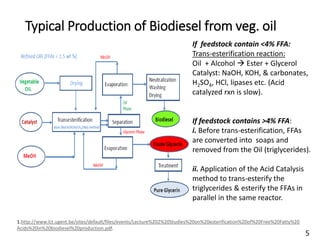
Typical Production of Biodiesel from veg. oil
1.http://www.lct.ugent.be/sites/default/files/events/Lecture%202%20Studies%20on%20esterification%20of%20Free%20Fatty%20
Acids%20in%20biodiesel%20production.pdf.
If feedstock contain <4% FFA:
Trans-esterification reaction:
Oil + Alcohol  Ester + Glycerol
Catalyst: NaOH, KOH, & carbonates,
H2SO4, HCl, lipases etc. (Acid
catalyzed rxn is slow).
If feedstock contains >4% FFA:
i. Before trans-esterification, FFAs
are converted into soaps and
removed from the Oil (triglycerides).
ii. Application of the Acid Catalysis
method to trans-esterify the
triglycerides & esterify the FFAs in
parallel in the same reactor.
5
Glycerol as byproduct during biodiesel production
• Glycerol (also known as glycerin) is a major byproduct in the
biodiesel manufacturing process.
• Biodiesel production will generate about 10% (w/w) glycerol
as the main byproduct.
• In general, for every 100 pounds of biodiesel produced,
approximately 10 pounds of crude glycerol are created.
• It is projected that the world biodiesel market would reach
37 billion gallons by 2016, which implied that approximately
4 billion gallons of crude glycerol would be produced.
6
Composition of crude glycerol
However, almost every crude
glycerol contains,
Glycerol
Light solvent (Methanol or
ethanol, water)
Soap
Fatty acid methyl esters
(FAME i.e. biodiesel)
Glycerides (i.e. to mono, di &
tri-glycerides),
Free fatty acids (FFA)
Ash
Variations in biodiesel production methods variation in composition
of crude glycerol
7
(Table adapted from: Xiao. et al., 2013)
 Catalyst type used- lipase, alkaline,acidic
 Transesterification efficiency
 Recovery efficiency of biodiesel
 Impurities in feedstock
 Recovery efficiency of methanol and catalyst
Factors affecting the composition of crude glycerol
8
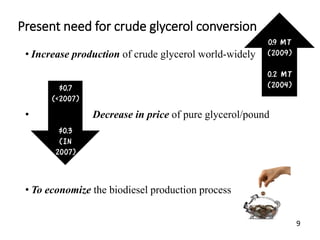
Present need for crude glycerol conversion
• Increase production of crude glycerol world-widely
• Decrease in price of pure glycerol/pound
• To economize the biodiesel production process
0.9 MT
(2009)
0.2 MT
(2004)$0.7
(<2007)
$0.3
(In
2007)
9
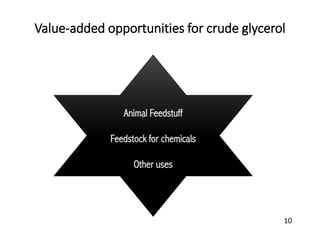
Value-added opportunities for crude glycerol
Animal Feedstuff
Feedstock for chemicals
Other uses
10
Feedstuffs for animal
• Glycerol as animal feed ingredient since 1970
• Crude glycerol (CG) as feed has been recently investigated.
• Glycerol has high absorption & is good energy source.
85% of the CG samples from various biodiesel house showed (Dasari, 2007)
Digestible energy (DE) values: 14.9-15.3 MJ/kg
Metabolizable energy(ME)values: of 13.9-14.7 MJ/kg
11
Continue…
• Research shows excellent source of calories for non-
ruminants such as broilers, laying hens, and swine.
• Has potential to replace corn in diets.
• Weaned pigs upto 10% feed performance
• Broiler  2.5-5% inclusion feed conversion ratio
“But”
Residual level of potassium in it wet litter or imbalances in
dietary electrolyte balance in broilers
12
Continue..
• Daily gains by Pigs during growth period but not on the
finishing period. Effective at certain stage of growth
• Broiler  Improved feed conversion but no effect on growth
performance and nutrient digestibility.
• Dietary treatments had no significant effects on meat
quality.
“The influences of levels and quality of crude glycerol on pellet
quality needs further study”.
Dr. Liliana Revolledo stated in an article- The companies will need to guarantee more than 80 % of glycerol, a maximum of 12
% of moisture and maximum level of methanol of 150 ppm, apart from guarantee correct levels of sodium and chlorine.
1 http://www.veterinariadigital.com/uk/noticia.php?id=43
13
Crude glycerol in ruminant diets
Ruminants
Inclusion of crude
glycerol Effects References
Finishing lamb Up to 15%
Improved weight,
no change in
carcass
characteristics
Gunn et al. (2010)
Meat goats Up to 5% Improved weight Hampy et al. (2008)
Cattle
Up to 15%
Improved weight
and feed
efficiency
Parson et al. (2009)
14
Feedstocks for chemicals
• Two approaches for conversion of crude glycerol into value-
added chemicals.
Biological conversion- use of mo’s
Catalytic conversion
• Various chemical produced via biological conversion includes,
 1,3 Propandiol
 Citric acid
 Poly(hydroxyalkanoates)
 Docosahexaenoic acid
 Lipids
15
Continue…
• Fermentation is the most common technique for the
biological conversion of these products.
16
Feedstock for chemicals
Products Organisms Method Notes References
1, 3 –
propandiol
Clostridium butyricum
strains VP 13266, F2b,
VPI1718
Klebsiella pneumonia
(13.8 g/l)
Anaerobic
fermentation
Chatzifragkou et al. showed
 Methanol didn’t affect C. butyricum
conversion and
 NaCl had effect during continuous but
not batch process
Mu et.al
(2006),
BR et.al
(2008)
Citric acid Yarrowia lipolytica
ACA-DC50109,
Y. lipolytica N15
mutant Y. lipolytica
wratislavia AWG7
strain
Aerobic
fermentation
 Yarrowia lipolytica ACA-DC50109
produced citric acid was similar to the
one obtained from conventional
process using sugar. (SCO was also
produced).
 Y. lipolytica N15 produced high
quantity i.e. 71 g/l using CG and 98
g/l using PG.
 mutant Y. lipolytica produced
131.5 g/l using CG and 139 g/l
using PG
Papanikolaou
et al (2003),
Rywinska et
al (2009),
Kamzolova et
al (2011)
17
Products Organisms Method Notes References
Hydrogen Rhodopseudomonas
palustris
Photofermentation  Sabourin et al. (2009)- equal
production from crude and pure
glycerol.
 Developing effective photo-
bioreactor and enhancing light
utilization efficiency is a problem for
large scale production.
 Crude glycerol used as co-substrate
for enhanced hydrogen and
methane production during
anaerobic treatment of sewage
sludge, solid waste etc.
(Fountoulakis et al, Lopez et al)
Sabourin et al
(2009)
Ethanol Enterobacter
aerogenes HU 101
(facultative
anaerobe)
Fermentation  High yield of ethanol and hydrogen
simultaneously (Nakashimadu et al,
2005).
 K. pneumonia mutant strain and
non-pathogenic kluyera
cryocrescens S26 have been
reported as promising strains.
Nakashimadu
et al, 2005).
Choi etal
(2011)
18
Products Organisms Notes
Poly -
hydroxyalkanoates
(PHA)
Paracoccus
denitrificans
Cupriavidus necator
JMP
134
Zobellella
denitrificans MW1
Pseudomonas
oleovorans NRRL B-
14682 (promising strain)
 Complex class of naturally occurring bacterial
polyesters
 Recognized as good substitute for non-
biodegradable polymers.
 10 million gallon/year biodiesel plant has
potential to produce 20.9 ton PHB.
 PHB is the most studied polyester belonging to
group PHA
 The polymers PHB produced by P. denitrificans
and C. necator JMP 134 were similar to that
obtained from glucose but the process was
hindered by the presence of NaCl
contamination.
 Zobellella denitrificans MW1 can produce PHB
even in presence of NaCl.
19
Products Organisms Notes
Docosahexanoic
acid (DHA) & EPA
(Omega-3-fatty
acid)
Schizochytrium
limacinum (algae)-
Fermentation
Pythium irregulare
DHA:
 Fermentation of alga S. limacinum using crude
glycerol in the optimum range of 75-100 g/l
 Highest DHA yield 4.91 g/l (Chi et al, 2007), temp
19.2 0C and ammonium acetate 1 g/l.
 The resulting algae had similar content of DHA
and comparable nutritional profile to commercial
algal biomass.
EPA:
 Fortified foods through fungal fermentation with
Pythium irregular
 Less EPA content compared to microalgae for EPA.
 Optimization of culture condition required.
20
Products Organisms Notes
Lipids Schizochytrium
limacinum SR21
(microalgae)
Cryptococcus
curvatus (fungus)
Schizochytrium limacinum SR21
 S. limacinum algal growth and lipid production were affected
by the concentrations of glycerol.
 Optimum crude glycerol concentration is 35 g/l  lipid
content produced was 73.3%.
 Methanol could harm the growth.
 C. curvatus yeast growth wasn’t affected by the methanol
presence  lipid content was 52%
 Methanol didn’t show inhibitory action on growth.
 Lipid had high concentration of monounsaturated fatty acid
and was good biodiesel feedstock.
21
Products Organisms Notes
Lipids Rhodotorula glutinis TISTR
5159 (yeast)
 Cultured on crude glycerol produced lipids (10.05 yield,
60.7% lipid content) and carotenoids (6.10 g/l yield).
 Ammonium sulfate and tween 20 addition enhanced the
accumulation.
 Additionally, Chatzifragkou et al. studied the potential of
fifteen eukaryotic microorganisms to convert crude
glycerol to metabolic products.
Yeast accumulation (up to 22 wt.%, wt/wt < fungi accumulation
(18.1 and 42.6%, wt/wt)
22
Continue…
On-going research for various other chemicals
Succinic acid - Basifia succiniciproducens DD1
Phytase - Pichia pastoris
Butanol- Clostridium pasteurianum (0.30 g/g) > Clostridium
acetobutylicum (0.15-0.20 g/g; glucose substrate)
Fungal protein - Rhizopus microspores var. oligosporus
Further understanding and optimization of the process still
needed for upscaling
23
Chemicals produced through conventional
catalytic conversion
• (2,2-dimethyl-1,3-dioxolan-4-yl) methyl acetate (biodiesel
additive)  Enhance the biodiesel viscosity, oxidation
stability, and flash point.
• Acrolein precursor for detergents, acrylic acid ester and
super absorber polymers.
• Syngas (H2 and CO )  Synthetic gas for the production of
ammonia or methanol.
CG gasified into these product Gasification (>700 0C, no
combustion, controlled oxygen) with in situ CO2 removal
was effective technique
24
• Production of monoglycerides via. glycerolysis of
triglycerides with crude glycerol.
• Its use as green solvent in organic reactions.
• As fuel for generating electricity from microbial fuel cells.
25
Conclusion
• Effective utilization of crude glycerol is very crucial for the further
development of the biodiesel production.
• Characterization of crude glycerol is important as impurities present
in it play a major role in crude glycerol conversion.
• Conventional catalysis and biotransformation are the two main
routes for converting the crude glycerol into value added products.
• Extensive studies on biological conversion has produced encouraging
results in the recent past. However, all these conversion still have to
overcome technological hurdles for its practical implementation on
large scale.
26
Value added products from glycerol

Value added products from glycerol

  • 1.
    Value-added uses forcrude glycerol–a byproduct of biodiesel production Fangxia Yang, Milford A Hanna & Runcang Sun, Biotechnology for Biofuels 2012 Presented By: Bijaya K. Uprety PhD (Biotechnology) student
  • 2.
    Background Fluctuating oil prices Depletion of fossilfuel Increasing energy demand Environmental issues Biodiesel? 1
  • 3.
    What is biodiesel? •Alternative fuel to conventional or fossil diesel. • Can be produced from  oil from plants such as soybean & jatropha,  animal fats,  from microalgae or fungus. • Can be used in diesel engines with little or no modification. • Typically blended with petroleum diesel in the formulations referred to as B2, B5, B20 and B100 (pure biodiesel). 2
  • 4.
    Biodiesel Compared toPetroleum Diesel Advantages Disadvantages Domestically produced from non-petroleum, renewable resources Use of blends above B5 not yet approved by many auto makers Can be used in most diesel engines, especially newer ones Lower fuel economy and power (10% lower for B100, 2% for B20) Less air pollutants (other than nitrogen oxides) Currently more expensive Less greenhouse gas emissions (e.g., B20 reduces CO2 by 15%) B100 generally not suitable for use in low temperatures (form gels) Biodegradable, non-toxic and safer to handle Biodiesel fuel distribution infrastructure needs improvement Biodiesel Diesel 3
  • 5.
    Trans-esterification reaction forbiodiesel production 4  Biodiesel is produced using Transesterification process  Reacting vegetable oils or animal fats catalytically with a short-chained aliphatic alcohol (typically methanol or ethanol).”  Glycerol is the byproduct.
  • 6.
    Typical Production ofBiodiesel from veg. oil 1.http://www.lct.ugent.be/sites/default/files/events/Lecture%202%20Studies%20on%20esterification%20of%20Free%20Fatty%20 Acids%20in%20biodiesel%20production.pdf. If feedstock contain <4% FFA: Trans-esterification reaction: Oil + Alcohol  Ester + Glycerol Catalyst: NaOH, KOH, & carbonates, H2SO4, HCl, lipases etc. (Acid catalyzed rxn is slow). If feedstock contains >4% FFA: i. Before trans-esterification, FFAs are converted into soaps and removed from the Oil (triglycerides). ii. Application of the Acid Catalysis method to trans-esterify the triglycerides & esterify the FFAs in parallel in the same reactor. 5
  • 7.
    Glycerol as byproductduring biodiesel production • Glycerol (also known as glycerin) is a major byproduct in the biodiesel manufacturing process. • Biodiesel production will generate about 10% (w/w) glycerol as the main byproduct. • In general, for every 100 pounds of biodiesel produced, approximately 10 pounds of crude glycerol are created. • It is projected that the world biodiesel market would reach 37 billion gallons by 2016, which implied that approximately 4 billion gallons of crude glycerol would be produced. 6
  • 8.
    Composition of crudeglycerol However, almost every crude glycerol contains, Glycerol Light solvent (Methanol or ethanol, water) Soap Fatty acid methyl esters (FAME i.e. biodiesel) Glycerides (i.e. to mono, di & tri-glycerides), Free fatty acids (FFA) Ash Variations in biodiesel production methods variation in composition of crude glycerol 7 (Table adapted from: Xiao. et al., 2013)
  • 9.
     Catalyst typeused- lipase, alkaline,acidic  Transesterification efficiency  Recovery efficiency of biodiesel  Impurities in feedstock  Recovery efficiency of methanol and catalyst Factors affecting the composition of crude glycerol 8
  • 10.
    Present need forcrude glycerol conversion • Increase production of crude glycerol world-widely • Decrease in price of pure glycerol/pound • To economize the biodiesel production process 0.9 MT (2009) 0.2 MT (2004)$0.7 (<2007) $0.3 (In 2007) 9
  • 11.
    Value-added opportunities forcrude glycerol Animal Feedstuff Feedstock for chemicals Other uses 10
  • 12.
    Feedstuffs for animal •Glycerol as animal feed ingredient since 1970 • Crude glycerol (CG) as feed has been recently investigated. • Glycerol has high absorption & is good energy source. 85% of the CG samples from various biodiesel house showed (Dasari, 2007) Digestible energy (DE) values: 14.9-15.3 MJ/kg Metabolizable energy(ME)values: of 13.9-14.7 MJ/kg 11
  • 13.
    Continue… • Research showsexcellent source of calories for non- ruminants such as broilers, laying hens, and swine. • Has potential to replace corn in diets. • Weaned pigs upto 10% feed performance • Broiler  2.5-5% inclusion feed conversion ratio “But” Residual level of potassium in it wet litter or imbalances in dietary electrolyte balance in broilers 12
  • 14.
    Continue.. • Daily gainsby Pigs during growth period but not on the finishing period. Effective at certain stage of growth • Broiler  Improved feed conversion but no effect on growth performance and nutrient digestibility. • Dietary treatments had no significant effects on meat quality. “The influences of levels and quality of crude glycerol on pellet quality needs further study”. Dr. Liliana Revolledo stated in an article- The companies will need to guarantee more than 80 % of glycerol, a maximum of 12 % of moisture and maximum level of methanol of 150 ppm, apart from guarantee correct levels of sodium and chlorine. 1 http://www.veterinariadigital.com/uk/noticia.php?id=43 13
  • 15.
    Crude glycerol inruminant diets Ruminants Inclusion of crude glycerol Effects References Finishing lamb Up to 15% Improved weight, no change in carcass characteristics Gunn et al. (2010) Meat goats Up to 5% Improved weight Hampy et al. (2008) Cattle Up to 15% Improved weight and feed efficiency Parson et al. (2009) 14
  • 16.
    Feedstocks for chemicals •Two approaches for conversion of crude glycerol into value- added chemicals. Biological conversion- use of mo’s Catalytic conversion • Various chemical produced via biological conversion includes,  1,3 Propandiol  Citric acid  Poly(hydroxyalkanoates)  Docosahexaenoic acid  Lipids 15
  • 17.
    Continue… • Fermentation isthe most common technique for the biological conversion of these products. 16
  • 18.
    Feedstock for chemicals ProductsOrganisms Method Notes References 1, 3 – propandiol Clostridium butyricum strains VP 13266, F2b, VPI1718 Klebsiella pneumonia (13.8 g/l) Anaerobic fermentation Chatzifragkou et al. showed  Methanol didn’t affect C. butyricum conversion and  NaCl had effect during continuous but not batch process Mu et.al (2006), BR et.al (2008) Citric acid Yarrowia lipolytica ACA-DC50109, Y. lipolytica N15 mutant Y. lipolytica wratislavia AWG7 strain Aerobic fermentation  Yarrowia lipolytica ACA-DC50109 produced citric acid was similar to the one obtained from conventional process using sugar. (SCO was also produced).  Y. lipolytica N15 produced high quantity i.e. 71 g/l using CG and 98 g/l using PG.  mutant Y. lipolytica produced 131.5 g/l using CG and 139 g/l using PG Papanikolaou et al (2003), Rywinska et al (2009), Kamzolova et al (2011) 17
  • 19.
    Products Organisms MethodNotes References Hydrogen Rhodopseudomonas palustris Photofermentation  Sabourin et al. (2009)- equal production from crude and pure glycerol.  Developing effective photo- bioreactor and enhancing light utilization efficiency is a problem for large scale production.  Crude glycerol used as co-substrate for enhanced hydrogen and methane production during anaerobic treatment of sewage sludge, solid waste etc. (Fountoulakis et al, Lopez et al) Sabourin et al (2009) Ethanol Enterobacter aerogenes HU 101 (facultative anaerobe) Fermentation  High yield of ethanol and hydrogen simultaneously (Nakashimadu et al, 2005).  K. pneumonia mutant strain and non-pathogenic kluyera cryocrescens S26 have been reported as promising strains. Nakashimadu et al, 2005). Choi etal (2011) 18
  • 20.
    Products Organisms Notes Poly- hydroxyalkanoates (PHA) Paracoccus denitrificans Cupriavidus necator JMP 134 Zobellella denitrificans MW1 Pseudomonas oleovorans NRRL B- 14682 (promising strain)  Complex class of naturally occurring bacterial polyesters  Recognized as good substitute for non- biodegradable polymers.  10 million gallon/year biodiesel plant has potential to produce 20.9 ton PHB.  PHB is the most studied polyester belonging to group PHA  The polymers PHB produced by P. denitrificans and C. necator JMP 134 were similar to that obtained from glucose but the process was hindered by the presence of NaCl contamination.  Zobellella denitrificans MW1 can produce PHB even in presence of NaCl. 19
  • 21.
    Products Organisms Notes Docosahexanoic acid(DHA) & EPA (Omega-3-fatty acid) Schizochytrium limacinum (algae)- Fermentation Pythium irregulare DHA:  Fermentation of alga S. limacinum using crude glycerol in the optimum range of 75-100 g/l  Highest DHA yield 4.91 g/l (Chi et al, 2007), temp 19.2 0C and ammonium acetate 1 g/l.  The resulting algae had similar content of DHA and comparable nutritional profile to commercial algal biomass. EPA:  Fortified foods through fungal fermentation with Pythium irregular  Less EPA content compared to microalgae for EPA.  Optimization of culture condition required. 20
  • 22.
    Products Organisms Notes LipidsSchizochytrium limacinum SR21 (microalgae) Cryptococcus curvatus (fungus) Schizochytrium limacinum SR21  S. limacinum algal growth and lipid production were affected by the concentrations of glycerol.  Optimum crude glycerol concentration is 35 g/l  lipid content produced was 73.3%.  Methanol could harm the growth.  C. curvatus yeast growth wasn’t affected by the methanol presence  lipid content was 52%  Methanol didn’t show inhibitory action on growth.  Lipid had high concentration of monounsaturated fatty acid and was good biodiesel feedstock. 21
  • 23.
    Products Organisms Notes LipidsRhodotorula glutinis TISTR 5159 (yeast)  Cultured on crude glycerol produced lipids (10.05 yield, 60.7% lipid content) and carotenoids (6.10 g/l yield).  Ammonium sulfate and tween 20 addition enhanced the accumulation.  Additionally, Chatzifragkou et al. studied the potential of fifteen eukaryotic microorganisms to convert crude glycerol to metabolic products. Yeast accumulation (up to 22 wt.%, wt/wt < fungi accumulation (18.1 and 42.6%, wt/wt) 22
  • 24.
    Continue… On-going research forvarious other chemicals Succinic acid - Basifia succiniciproducens DD1 Phytase - Pichia pastoris Butanol- Clostridium pasteurianum (0.30 g/g) > Clostridium acetobutylicum (0.15-0.20 g/g; glucose substrate) Fungal protein - Rhizopus microspores var. oligosporus Further understanding and optimization of the process still needed for upscaling 23
  • 25.
    Chemicals produced throughconventional catalytic conversion • (2,2-dimethyl-1,3-dioxolan-4-yl) methyl acetate (biodiesel additive)  Enhance the biodiesel viscosity, oxidation stability, and flash point. • Acrolein precursor for detergents, acrylic acid ester and super absorber polymers. • Syngas (H2 and CO )  Synthetic gas for the production of ammonia or methanol. CG gasified into these product Gasification (>700 0C, no combustion, controlled oxygen) with in situ CO2 removal was effective technique 24
  • 26.
    • Production ofmonoglycerides via. glycerolysis of triglycerides with crude glycerol. • Its use as green solvent in organic reactions. • As fuel for generating electricity from microbial fuel cells. 25
  • 27.
    Conclusion • Effective utilizationof crude glycerol is very crucial for the further development of the biodiesel production. • Characterization of crude glycerol is important as impurities present in it play a major role in crude glycerol conversion. • Conventional catalysis and biotransformation are the two main routes for converting the crude glycerol into value added products. • Extensive studies on biological conversion has produced encouraging results in the recent past. However, all these conversion still have to overcome technological hurdles for its practical implementation on large scale. 26