Biodiesel production from oleaginous
microorganisms
Xin Meng, Jianming Yang, Xin Xu, Lei Zhang, Qingjuan Nie, Mo Xian
Renewable Energy (2009)
Presented By: Bijaya K. Uprety
PhD (Biotechnology) student
Background
• Biodiesel is an alternative
fuel to conventional or fossil
diesel.
• Chemically known as FAME
or FAAE.
• Produced by
transesterification reaction
of oil from plants (such as
soybean & jatropha),
animal fats, and from
microalgae or fungus.
1
Conventional feedstocks for biodiesel
S.E Asia- palm oil
Europe- rapseed oil
U.S- soyabeans
China- wasting oil
Plant  energy &
land
Animals  food
Feedstock accounts
70-85% production
cost
Feedstock cost
has to be
reduced to make
the process
economical
2
Microorganisms available for biodiesel production
• Alternative source of feedstock investigated for biodiesel
production:
 Microalgae
 Bacillus
 Fungi
 Yeast
• Biodiesel production using microbial lipids, which is named
as single cell oils (SCO), has attracted great attention in the
whole world.
3
Oleaginous microorganisms are able to accumulate lipids above the 20% of
their biomass, on dry basis.
Lipids from all cannot be
converted into biodiesel
mainly due to less yield
Single cell oil (SCO)
• Lipids obtained from microbes or single celled entity.
• Obtained from yeast, bacteria and microalgae.
• Lipid accumulation by micro-organisms depends on;
 Genetic constituents
 Different culture conditions (pH, Temp, culture
time, etc.)
“Single cell oil might be defined as the edible oils obtainable from
microorganisms being similar in type and composition to those oils and fats
from plants or animals”
4
Microalgae
• Prokaryotic or eukaryotic photosynthetic microorganisms
• Can grow rapidly
• Live in harsh conditions due to their unicellular or simple
multicellular structure
• Good candidates for biodiesel production,
 higher photosynthetic efficiency
 higher biomass production and
 faster growth compared to other energy crops
5
Continue..
• Can be induced to accumulate substantial quantities of lipids
thus contributing to a high oil yield.
• Some of the common algae
Chlorella, Crypthecodinium, Cylindrotheca, Dunaliella, Isochrysis,
Nannochloris, Nannochloropsis, Neochloris, Nitzschia, Phaeodactylum,
Porphyridium, Schizochytrium, Tetraselmis
Average lipid content- (1-70%)
Maximum- 90%
6
• Microalgae cultivation can be done in
 Open-culture systems (lakes or ponds) and
 Highly controlled closed-culture systems called photo-bioreactors.
• Accumulated oil is mainly triglycerides (>80%) with fatty acid profile
rich in C16 and C18 and is comparable to plant seed oil.
• Different nutritional and environmental factors, cultivation
conditions and growth phases may affect the fatty acid
composition.
1. Mata et al Microalgae for biodiesel production and other applications: A review (2010)
Nitrogen deficiency and salt stress induced the accumulation of C18:1 in all
treated species and to some extent C20:5 in Botryococcus braunii (Thomas et
al)
7
Downside
• Need to be grown under controlled temperature conditions
• Requires phosphorus as a fertilizer which is becoming scarce
• Relatively high upfront capital costs
• Requires a considerable amount of land and water
• Presently cost of production is too high.
8
Bacteria
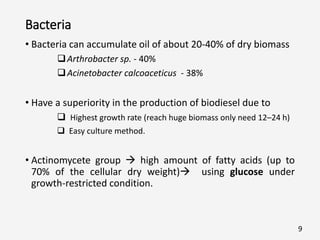
• Bacteria can accumulate oil of about 20-40% of dry biomass
Arthrobacter sp. - 40%
Acinetobacter calcoaceticus - 38%
• Have a superiority in the production of biodiesel due to
 Highest growth rate (reach huge biomass only need 12–24 h)
 Easy culture method.
• Actinomycete group  high amount of fatty acids (up to
70% of the cellular dry weight) using glucose under
growth-restricted condition.
9
Downside
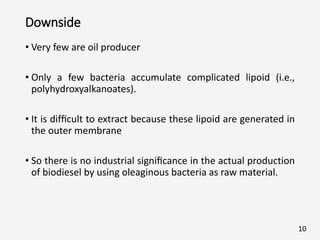
• Very few are oil producer
• Only a few bacteria accumulate complicated lipoid (i.e.,
polyhydroxyalkanoates).
• It is difficult to extract because these lipoid are generated in
the outer membrane
• So there is no industrial significance in the actual production
of biodiesel by using oleaginous bacteria as raw material.
10
Fungi & Yeast
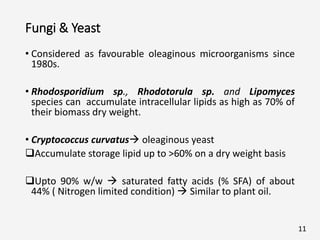
• Considered as favourable oleaginous microorganisms since
1980s.
• Rhodosporidium sp., Rhodotorula sp. and Lipomyces
species can accumulate intracellular lipids as high as 70% of
their biomass dry weight.
• Cryptococcus curvatus oleaginous yeast
Accumulate storage lipid up to >60% on a dry weight basis
Upto 90% w/w  saturated fatty acids (% SFA) of about
44% ( Nitrogen limited condition)  Similar to plant oil.
11
• Produced tryglycerides (lipids) are rich in polyunsaturated
fatty acid.
• Commonly found fatty acid includes,
 Oleic (18:1)
 Linoleic (18:2) acids
 Palmitic (16:0) or palmitoleic acids (C16:1)
12
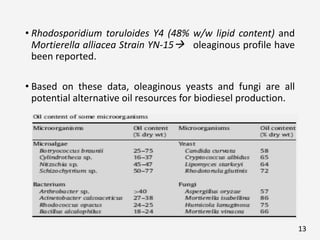
• Rhodosporidium toruloides Y4 (48% w/w lipid content) and
Mortierella alliacea Strain YN-15 oleaginous profile have
been reported.
• Based on these data, oleaginous yeasts and fungi are all
potential alternative oil resources for biodiesel production.
13
Metabolic regulation microbial lipid
why some
oleaginous species
are able to
accumulate more
lipid than other
species?
14
How is lipid accumulated in oleaginous?
Exhaust of nutrient
(N2) but carbon
(glucose) is present
Triglyceride are
synthesized
Cell proliferation
stops & formed
lipids are stored
In nutrient
(nitrogen) limited
condition
However, in non-
oleaginous: no
assimilation occurs
but in case if its
there, carbon is
directed to other
polysaccharides
(glycogen , glucan,
mannans, etc.)
15
Activities that are unique to oleaginous organisms
AMP  inosine 5’- monophosphate + NH3 Catalysed by: AMP deaminase
Activity of Isocitrate dehydrogenase as a component of the TCA cycle is
dependent on the presence of AMP This allow citric acid accumulation
during nitrogen limited condition
The formation of acetyl-CoA in oleaginous microorganisms has been
attributed to the presence of ATP: citrate lyase (ACL, reaction no. 1) which
does not appear to occur in the majority of non-oleaginous species:
Citrate+ CoA + ATP  acetyl- COA + Oxaloacetate + ADP + Pi
Isocitrate cis-aconitate citrate Catalysed by: aconitase
16
AMP  ICDH activity
Under Nitrogen limited condition
Citrate
17
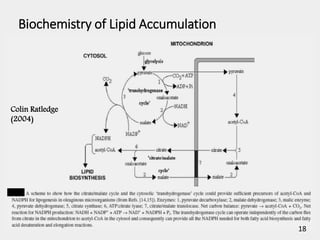
Biochemistry of Lipid Accumulation
Colin Ratledge
(2004)
18
• Two critical regulated enzymes, including malic enzyme and ATP:
citrate lyase (ACL), have effect on lipid accumulation.
• Strong correlation between the presence of ACL activity and the
ability to accumulate lipid in yeasts, fungi and other oleaginous
microorganisms.
• Some yeast however have ACL activity but no high lipid
accumulating ability.
• Hence, other enzymes must also be responsible for controlling the
extent of lipid biosynthesis in individual microorganisms.
“ACL activity is a prerequisite but not the sole factor”
Variation in the amount of lipid produced
First phenomenon explained
19
The total mass of microbial lipid is also regulated by the
content of fatty acid
• There are some different kinds of enzymes controlling fatty
acid synthesis.
Example:
Acetyl-CoA carboxylase (ACCase)  Rate limiting enzyme 
catalyzes the first reaction of synthesis of fatty acid in
microorganisms
• Use of biotechnological tools to enhance the activity of
ACCase could enhance the fatty acid production
Second Phenomenon
20
Quality of biodiesel from microbes
• Biodiesel fuel, in the form of FAME, is now manufactured in
many countries.
• Relevant standard to assess biodiesel are;
 ASTM D6751 ( In USA)
 EN 14214 (In EU, intended for vehicle use)
 EN 14213 (In EU, for use as heating oil)
• Oil obtained from microalgae, fungus and yeast has been
converted into biodiesel and properties of thus formed biodiesel
has been assessed and assessed in various instances.
21
Fuel properties of algae based biodiesel
1. Nautiyal et al (2014) Production and Characterization of biodiesel from algae
22
1. Azeem et.al (1999) Biotechnology production of oil:fatty acid composition of microbial oil
23
Improvement of microbial lipid production
• Research are aimed at improving the economic
competitiveness of microbial lipids compared to plant and
animal derived oils.
• Three main pathways are ongoing to improve economics of
microorganism biodiesel.
1. Screening for potential oleaginous microorganism
1. Genetic and metabolic engineering
1. Making full use of byproducts
24
I. Screening of potential oleaginous microorganisms
• Although several wild-type oleaginous microorganisms are able
to synthesize rich oil, these strains have a limited ability to
produce biomass.
• Making use of mutation techniques in microbial lipid
production to filtrate better strain will get much more biomass
than wild-type.
• Greece researcher reported in a Nitrogen limited condition,
Mortierella isabellina  cell growth (up to 35.9 g/L) & enhance
survival rate and glucose uptake rate even at a concentration of
100 g/L in media.
25
II. Genetic and metabolic engineering
• Appropriate modification of genome of mo improve oil
production
• However, production of stable engineered strains is an issue.
• Degree of unsaturation and length of carbon chain of fatty
acid  regulated by enzymes however purification and
study of their function is a major issue.
26
• Three genetic technologies are explored interdependent
Cloning genes of critical enzymes
Transgenic expression of these genes aimed to achieve a
fine high-product microbial oil recombination strain
Modification of cloned genes in order to engineer the
expressed protein
• Genetically engineered Pseudomonas citronellolis, E. coli
and S. cerevisiae for enhanced production of wax ester, fatty
acid butyl ester and FAME respectively.
27
• It is also possible to produce lipid with varying composition
of fatty acid by varying the growth condition such as
temperature and C:N ratio.
• Suutari et al. (1990) reported temperature induced
changes in fatty acid composition of lipid of yeast.
• At 20 0C, the proportion of palmitic acid decreased, while
those of palmitoleic and vaccenic acid increased.
Both bacteria and yeasts have been reported to contain an increasing
proportion of unsaturated fatty acids as the growth temperature
decreases.
28
• Variation in C:N ratio could have an effect on the production
and fatty acid composition,
1. At high C:N ratio, C. Curvatus  70 g/l and main lipid were
palmitic (C16:0), stearic (C18:0) and oleic acid (C18:1)
2. At specific C:N =50, Bacillus subtilis  marked difference in
the fatty acid composition than the original one
Research involving development and optimization of methods to improve
the total fatty acid and change the lipid composition to adapt for the
biodiesel production is presently ongoing and is vital
29
III. Making full use of byproducts
Byproduct
from
biodiesel
Value added
product from
glycerol
Microalgae
residual biomass
as feed
Methane
production using
anaerobic digesion
Oleaginous mO’s
are rich in
protein,
carbohydrate and
other nutrients
30
Conclusion
• At present plant oil is the main feedstock for biodiesel production.
• However, at present biodiesel is not competitive with conventional fuels
in the whole world due to high cost of production.
• Production of microbial based diesel can be an economical beneficial.
• However, it still needs lots of improvement which could be done using
the various biotechnological techniques and methods.
• Developing high lipid content microorganisms or engineered strains for
biodiesel production from microbes are promising option in future and
opens a possibility for academic research.
31
Biodiesel production from oleaginous microorganisms

Biodiesel production from oleaginous microorganisms

  • 1.
    Biodiesel production fromoleaginous microorganisms Xin Meng, Jianming Yang, Xin Xu, Lei Zhang, Qingjuan Nie, Mo Xian Renewable Energy (2009) Presented By: Bijaya K. Uprety PhD (Biotechnology) student
  • 2.
    Background • Biodiesel isan alternative fuel to conventional or fossil diesel. • Chemically known as FAME or FAAE. • Produced by transesterification reaction of oil from plants (such as soybean & jatropha), animal fats, and from microalgae or fungus. 1
  • 3.
    Conventional feedstocks forbiodiesel S.E Asia- palm oil Europe- rapseed oil U.S- soyabeans China- wasting oil Plant  energy & land Animals  food Feedstock accounts 70-85% production cost Feedstock cost has to be reduced to make the process economical 2
  • 4.
    Microorganisms available forbiodiesel production • Alternative source of feedstock investigated for biodiesel production:  Microalgae  Bacillus  Fungi  Yeast • Biodiesel production using microbial lipids, which is named as single cell oils (SCO), has attracted great attention in the whole world. 3 Oleaginous microorganisms are able to accumulate lipids above the 20% of their biomass, on dry basis. Lipids from all cannot be converted into biodiesel mainly due to less yield
  • 5.
    Single cell oil(SCO) • Lipids obtained from microbes or single celled entity. • Obtained from yeast, bacteria and microalgae. • Lipid accumulation by micro-organisms depends on;  Genetic constituents  Different culture conditions (pH, Temp, culture time, etc.) “Single cell oil might be defined as the edible oils obtainable from microorganisms being similar in type and composition to those oils and fats from plants or animals” 4
  • 6.
    Microalgae • Prokaryotic oreukaryotic photosynthetic microorganisms • Can grow rapidly • Live in harsh conditions due to their unicellular or simple multicellular structure • Good candidates for biodiesel production,  higher photosynthetic efficiency  higher biomass production and  faster growth compared to other energy crops 5
  • 7.
    Continue.. • Can beinduced to accumulate substantial quantities of lipids thus contributing to a high oil yield. • Some of the common algae Chlorella, Crypthecodinium, Cylindrotheca, Dunaliella, Isochrysis, Nannochloris, Nannochloropsis, Neochloris, Nitzschia, Phaeodactylum, Porphyridium, Schizochytrium, Tetraselmis Average lipid content- (1-70%) Maximum- 90% 6
  • 8.
    • Microalgae cultivationcan be done in  Open-culture systems (lakes or ponds) and  Highly controlled closed-culture systems called photo-bioreactors. • Accumulated oil is mainly triglycerides (>80%) with fatty acid profile rich in C16 and C18 and is comparable to plant seed oil. • Different nutritional and environmental factors, cultivation conditions and growth phases may affect the fatty acid composition. 1. Mata et al Microalgae for biodiesel production and other applications: A review (2010) Nitrogen deficiency and salt stress induced the accumulation of C18:1 in all treated species and to some extent C20:5 in Botryococcus braunii (Thomas et al) 7
  • 9.
    Downside • Need tobe grown under controlled temperature conditions • Requires phosphorus as a fertilizer which is becoming scarce • Relatively high upfront capital costs • Requires a considerable amount of land and water • Presently cost of production is too high. 8
  • 10.
    Bacteria • Bacteria canaccumulate oil of about 20-40% of dry biomass Arthrobacter sp. - 40% Acinetobacter calcoaceticus - 38% • Have a superiority in the production of biodiesel due to  Highest growth rate (reach huge biomass only need 12–24 h)  Easy culture method. • Actinomycete group  high amount of fatty acids (up to 70% of the cellular dry weight) using glucose under growth-restricted condition. 9
  • 11.
    Downside • Very feware oil producer • Only a few bacteria accumulate complicated lipoid (i.e., polyhydroxyalkanoates). • It is difficult to extract because these lipoid are generated in the outer membrane • So there is no industrial significance in the actual production of biodiesel by using oleaginous bacteria as raw material. 10
  • 12.
    Fungi & Yeast •Considered as favourable oleaginous microorganisms since 1980s. • Rhodosporidium sp., Rhodotorula sp. and Lipomyces species can accumulate intracellular lipids as high as 70% of their biomass dry weight. • Cryptococcus curvatus oleaginous yeast Accumulate storage lipid up to >60% on a dry weight basis Upto 90% w/w  saturated fatty acids (% SFA) of about 44% ( Nitrogen limited condition)  Similar to plant oil. 11
  • 13.
    • Produced tryglycerides(lipids) are rich in polyunsaturated fatty acid. • Commonly found fatty acid includes,  Oleic (18:1)  Linoleic (18:2) acids  Palmitic (16:0) or palmitoleic acids (C16:1) 12
  • 14.
    • Rhodosporidium toruloidesY4 (48% w/w lipid content) and Mortierella alliacea Strain YN-15 oleaginous profile have been reported. • Based on these data, oleaginous yeasts and fungi are all potential alternative oil resources for biodiesel production. 13
  • 15.
    Metabolic regulation microbiallipid why some oleaginous species are able to accumulate more lipid than other species? 14
  • 16.
    How is lipidaccumulated in oleaginous? Exhaust of nutrient (N2) but carbon (glucose) is present Triglyceride are synthesized Cell proliferation stops & formed lipids are stored In nutrient (nitrogen) limited condition However, in non- oleaginous: no assimilation occurs but in case if its there, carbon is directed to other polysaccharides (glycogen , glucan, mannans, etc.) 15
  • 17.
    Activities that areunique to oleaginous organisms AMP  inosine 5’- monophosphate + NH3 Catalysed by: AMP deaminase Activity of Isocitrate dehydrogenase as a component of the TCA cycle is dependent on the presence of AMP This allow citric acid accumulation during nitrogen limited condition The formation of acetyl-CoA in oleaginous microorganisms has been attributed to the presence of ATP: citrate lyase (ACL, reaction no. 1) which does not appear to occur in the majority of non-oleaginous species: Citrate+ CoA + ATP  acetyl- COA + Oxaloacetate + ADP + Pi Isocitrate cis-aconitate citrate Catalysed by: aconitase 16
  • 18.
    AMP  ICDHactivity Under Nitrogen limited condition Citrate 17
  • 19.
    Biochemistry of LipidAccumulation Colin Ratledge (2004) 18
  • 20.
    • Two criticalregulated enzymes, including malic enzyme and ATP: citrate lyase (ACL), have effect on lipid accumulation. • Strong correlation between the presence of ACL activity and the ability to accumulate lipid in yeasts, fungi and other oleaginous microorganisms. • Some yeast however have ACL activity but no high lipid accumulating ability. • Hence, other enzymes must also be responsible for controlling the extent of lipid biosynthesis in individual microorganisms. “ACL activity is a prerequisite but not the sole factor” Variation in the amount of lipid produced First phenomenon explained 19
  • 21.
    The total massof microbial lipid is also regulated by the content of fatty acid • There are some different kinds of enzymes controlling fatty acid synthesis. Example: Acetyl-CoA carboxylase (ACCase)  Rate limiting enzyme  catalyzes the first reaction of synthesis of fatty acid in microorganisms • Use of biotechnological tools to enhance the activity of ACCase could enhance the fatty acid production Second Phenomenon 20
  • 22.
    Quality of biodieselfrom microbes • Biodiesel fuel, in the form of FAME, is now manufactured in many countries. • Relevant standard to assess biodiesel are;  ASTM D6751 ( In USA)  EN 14214 (In EU, intended for vehicle use)  EN 14213 (In EU, for use as heating oil) • Oil obtained from microalgae, fungus and yeast has been converted into biodiesel and properties of thus formed biodiesel has been assessed and assessed in various instances. 21
  • 23.
    Fuel properties ofalgae based biodiesel 1. Nautiyal et al (2014) Production and Characterization of biodiesel from algae 22
  • 24.
    1. Azeem et.al(1999) Biotechnology production of oil:fatty acid composition of microbial oil 23
  • 25.
    Improvement of microbiallipid production • Research are aimed at improving the economic competitiveness of microbial lipids compared to plant and animal derived oils. • Three main pathways are ongoing to improve economics of microorganism biodiesel. 1. Screening for potential oleaginous microorganism 1. Genetic and metabolic engineering 1. Making full use of byproducts 24
  • 26.
    I. Screening ofpotential oleaginous microorganisms • Although several wild-type oleaginous microorganisms are able to synthesize rich oil, these strains have a limited ability to produce biomass. • Making use of mutation techniques in microbial lipid production to filtrate better strain will get much more biomass than wild-type. • Greece researcher reported in a Nitrogen limited condition, Mortierella isabellina  cell growth (up to 35.9 g/L) & enhance survival rate and glucose uptake rate even at a concentration of 100 g/L in media. 25
  • 27.
    II. Genetic andmetabolic engineering • Appropriate modification of genome of mo improve oil production • However, production of stable engineered strains is an issue. • Degree of unsaturation and length of carbon chain of fatty acid  regulated by enzymes however purification and study of their function is a major issue. 26
  • 28.
    • Three genetictechnologies are explored interdependent Cloning genes of critical enzymes Transgenic expression of these genes aimed to achieve a fine high-product microbial oil recombination strain Modification of cloned genes in order to engineer the expressed protein • Genetically engineered Pseudomonas citronellolis, E. coli and S. cerevisiae for enhanced production of wax ester, fatty acid butyl ester and FAME respectively. 27
  • 29.
    • It isalso possible to produce lipid with varying composition of fatty acid by varying the growth condition such as temperature and C:N ratio. • Suutari et al. (1990) reported temperature induced changes in fatty acid composition of lipid of yeast. • At 20 0C, the proportion of palmitic acid decreased, while those of palmitoleic and vaccenic acid increased. Both bacteria and yeasts have been reported to contain an increasing proportion of unsaturated fatty acids as the growth temperature decreases. 28
  • 30.
    • Variation inC:N ratio could have an effect on the production and fatty acid composition, 1. At high C:N ratio, C. Curvatus  70 g/l and main lipid were palmitic (C16:0), stearic (C18:0) and oleic acid (C18:1) 2. At specific C:N =50, Bacillus subtilis  marked difference in the fatty acid composition than the original one Research involving development and optimization of methods to improve the total fatty acid and change the lipid composition to adapt for the biodiesel production is presently ongoing and is vital 29
  • 31.
    III. Making fulluse of byproducts Byproduct from biodiesel Value added product from glycerol Microalgae residual biomass as feed Methane production using anaerobic digesion Oleaginous mO’s are rich in protein, carbohydrate and other nutrients 30
  • 32.
    Conclusion • At presentplant oil is the main feedstock for biodiesel production. • However, at present biodiesel is not competitive with conventional fuels in the whole world due to high cost of production. • Production of microbial based diesel can be an economical beneficial. • However, it still needs lots of improvement which could be done using the various biotechnological techniques and methods. • Developing high lipid content microorganisms or engineered strains for biodiesel production from microbes are promising option in future and opens a possibility for academic research. 31