ATOMIC ABSORPTION 
SPECTROPHOTOMETRY 
Presented By : 
G. Prasanth 
11AB1R0085 
VIGNAN PHARMACY COLLEGE 
(Approved by AICTE, PCI & Affiliated to JNTUK) 
VADLAMUDI, 522213. 
UNDER THE ESTEEMED 
GUIDANCE OF 
Mr. Ch. DEVADASU M.Pharm 
Assistant professor 
Department of PA & QA
CONTENTS 
 Introduction 
 Principle 
 Instrumentation 
1. Sharp line radiation source 
2. Nebulizer and Burner 
3. Monochromator 
4. Photomultiplier 
5. Recording system 
 Flameless vaporization techniques 
1. Electro thermal atomizers 
2. Cold vapour systems 
3. Hydride generation systems 
7-Oct-14 Pharmaceutical Analysis 2
 Interferences in atomic absorption spectroscopy 
1. Special 
2. Chemical 
 Advantages 
 Disadvantages 
 Applications 
 Conclusion 
7-Oct-14 Pharmaceutical Analysis 3
INTRODUCTION 
 Atomic absorption spectroscopy technique was introduced for 
analytical purpose by WALSH, ALKEMADE and MILATZ in 1956. 
 Atomic absorption spectroscopy is an absorption spectroscopic 
method where radiation from a source is absorbed by non-excited 
atoms in the vapour state. 
 Atomic absorption spectroscopy deals with the absorption of 
specific wavelength of radiation by neutral atoms in the ground state. 
7-Oct-14 Pharmaceutical Analysis 4
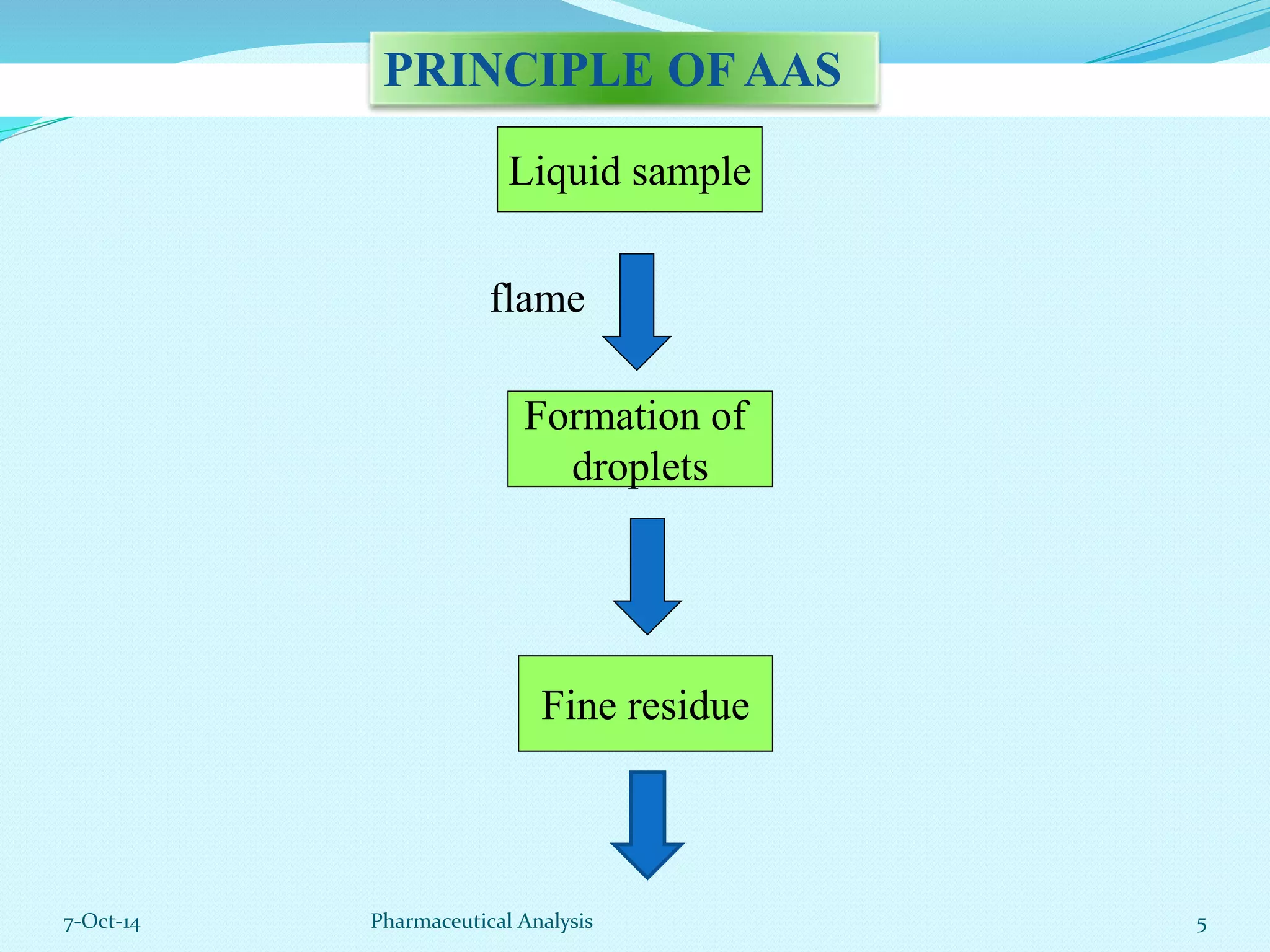
PRINCIPLE OF AAS 
Liquid sample 
flame 
Formation of 
droplets 
Fine residue 
7-Oct-14 Pharmaceutical Analysis 5
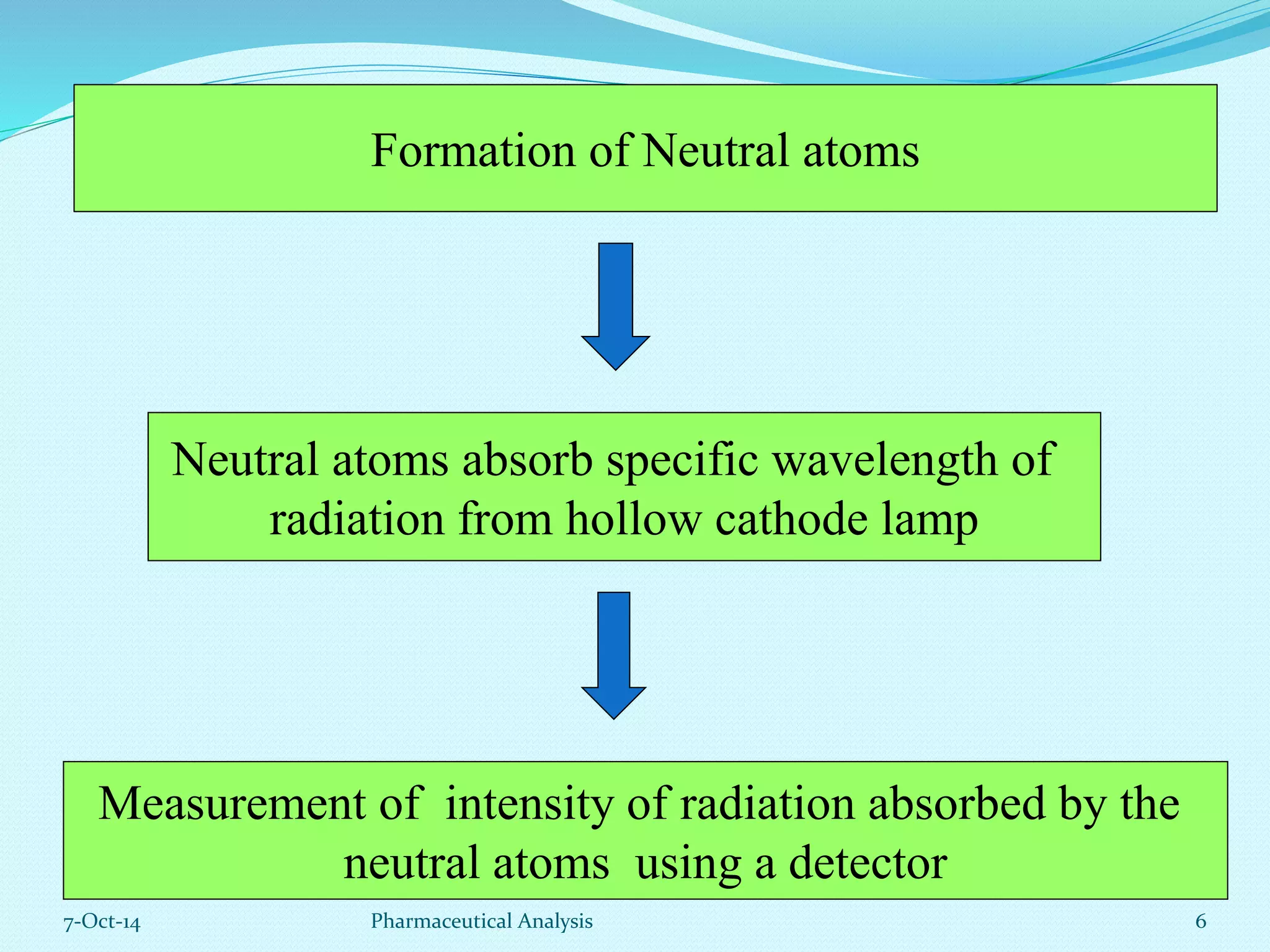
Formation of Neutral atoms 
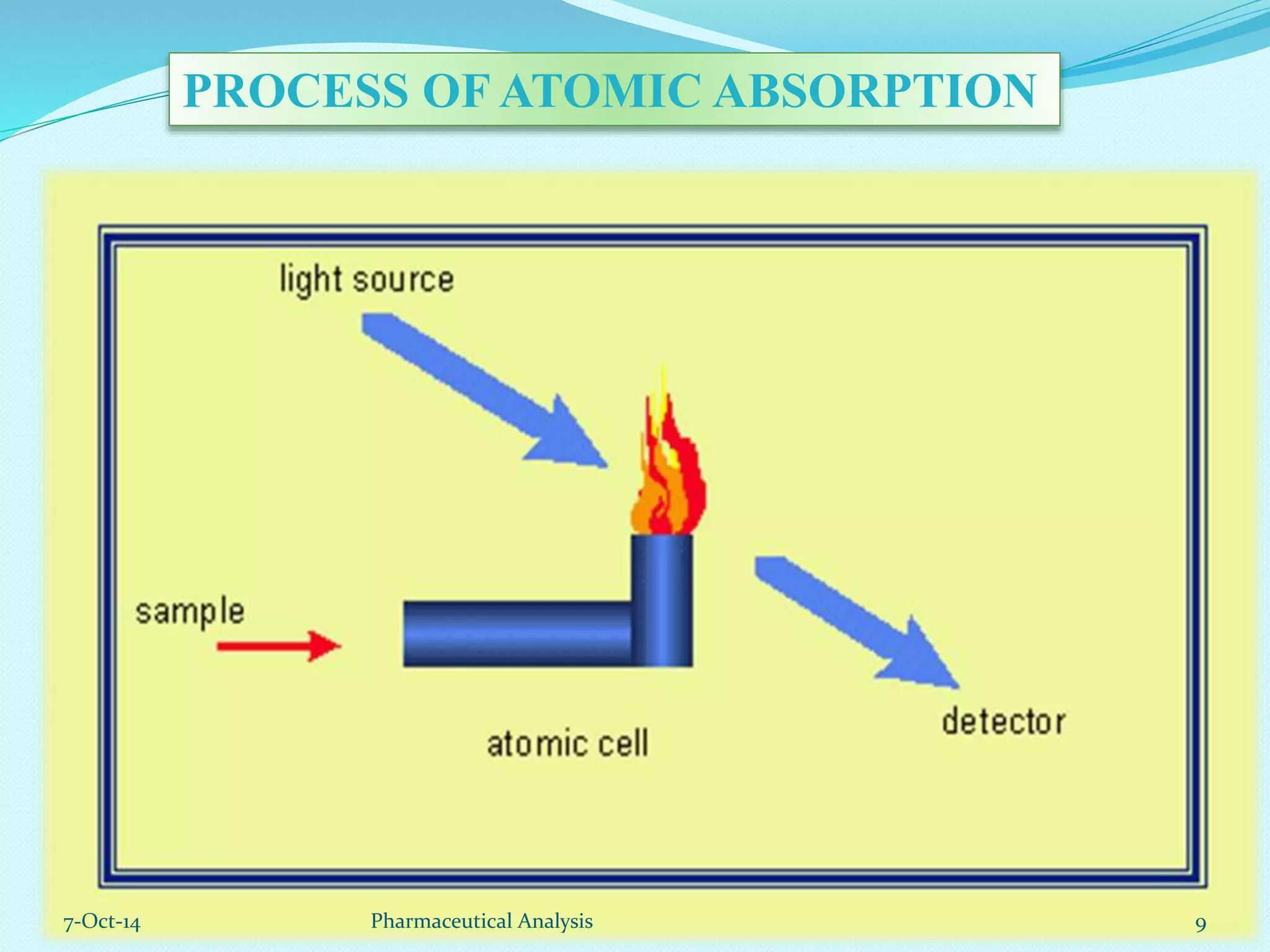
Neutral atoms absorb specific wavelength of 
radiation from hollow cathode lamp 
Measurement of intensity of radiation absorbed by the 
neutral atoms using a detector 
7-Oct-14 Pharmaceutical Analysis 6
PRINCIPLE OF AAS 
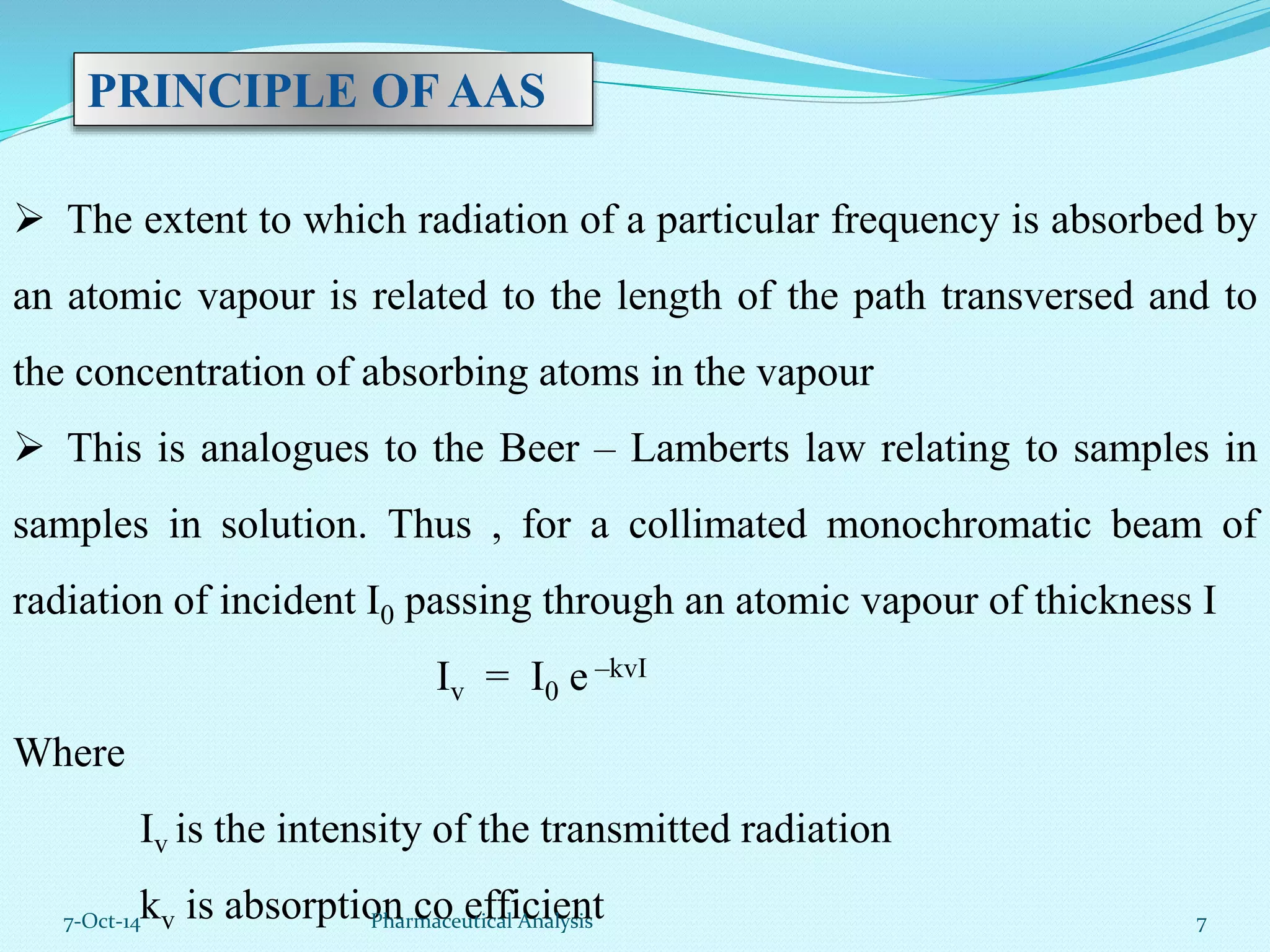
 The extent to which radiation of a particular frequency is absorbed by 
an atomic vapour is related to the length of the path transversed and to 
the concentration of absorbing atoms in the vapour 
 This is analogues to the Beer – Lamberts law relating to samples in 
samples in solution. Thus , for a collimated monochromatic beam of 
radiation of incident I0 passing through an atomic vapour of thickness I 
Iv = I0 e –kvI 
Where 
Iv is the intensity of the transmitted radiation 
kv is absorption co efficient 
7-Oct-14 Pharmaceutical Analysis 7
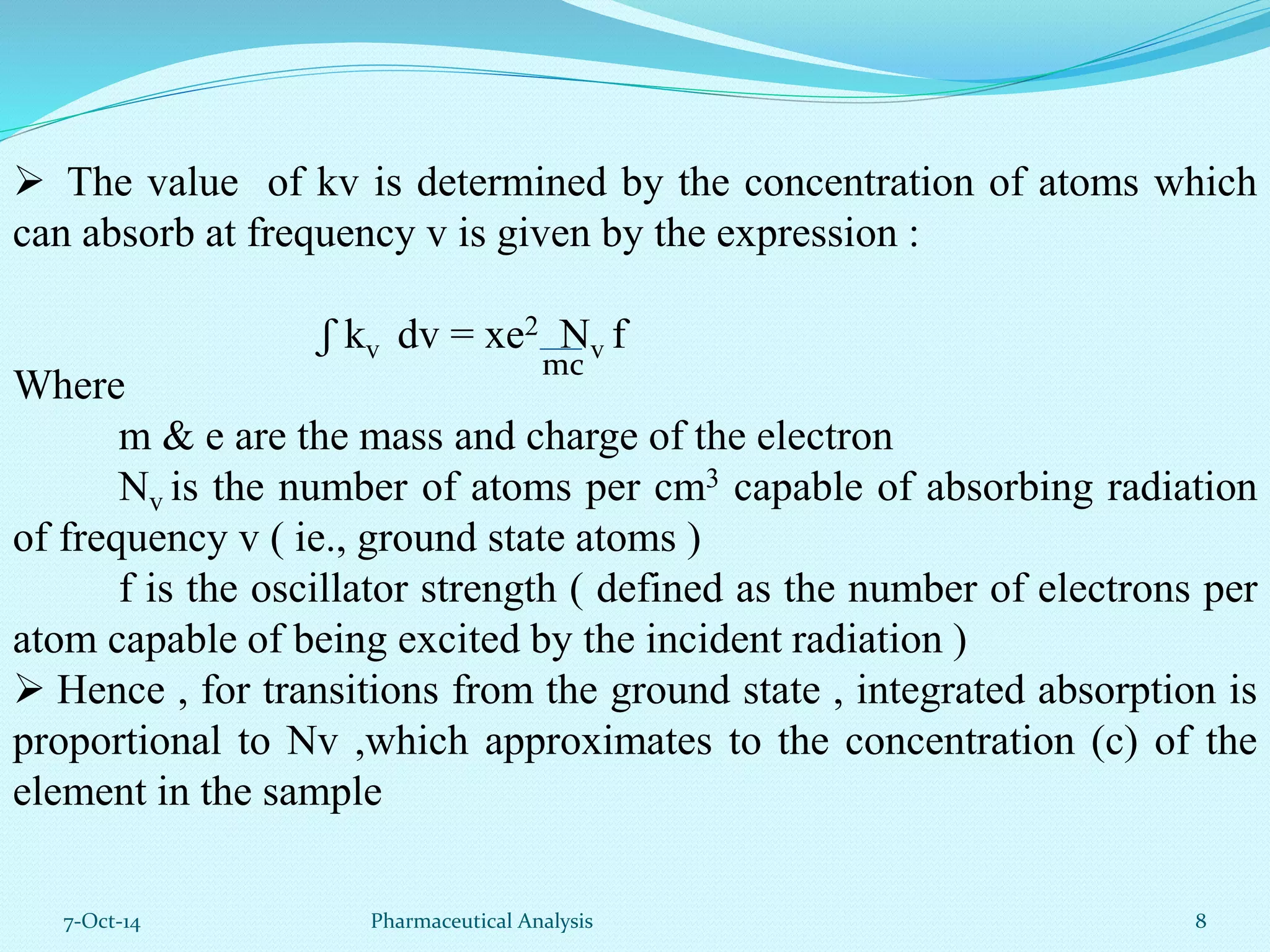
 The value of kv is determined by the concentration of atoms which 
can absorb at frequency v is given by the expression : 
ʃ kv dv = xe2 Nv f 
Where 
mc 
m & e are the mass and charge of the electron 
Nv is the number of atoms per cm3 capable of absorbing radiation 
of frequency v ( ie., ground state atoms ) 
f is the oscillator strength ( defined as the number of electrons per 
atom capable of being excited by the incident radiation ) 
 Hence , for transitions from the ground state , integrated absorption is 
proportional to Nv ,which approximates to the concentration (c) of the 
element in the sample 
7-Oct-14 Pharmaceutical Analysis 8
PROCESS OF ATOMIC ABSORPTION 
7-Oct-14 Pharmaceutical Analysis 9
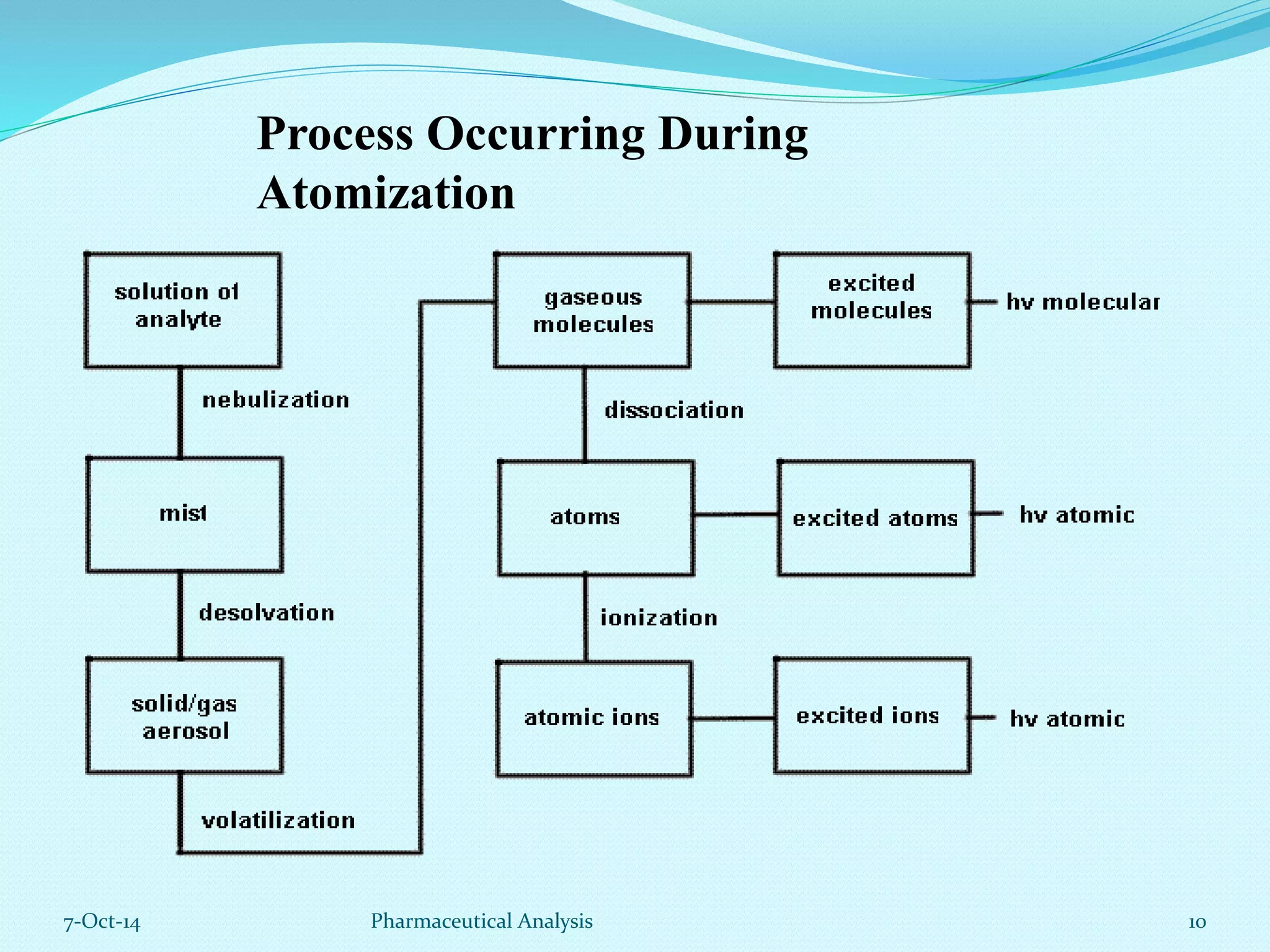
Process Occurring During 
Atomization 
7-Oct-14 Pharmaceutical Analysis 10
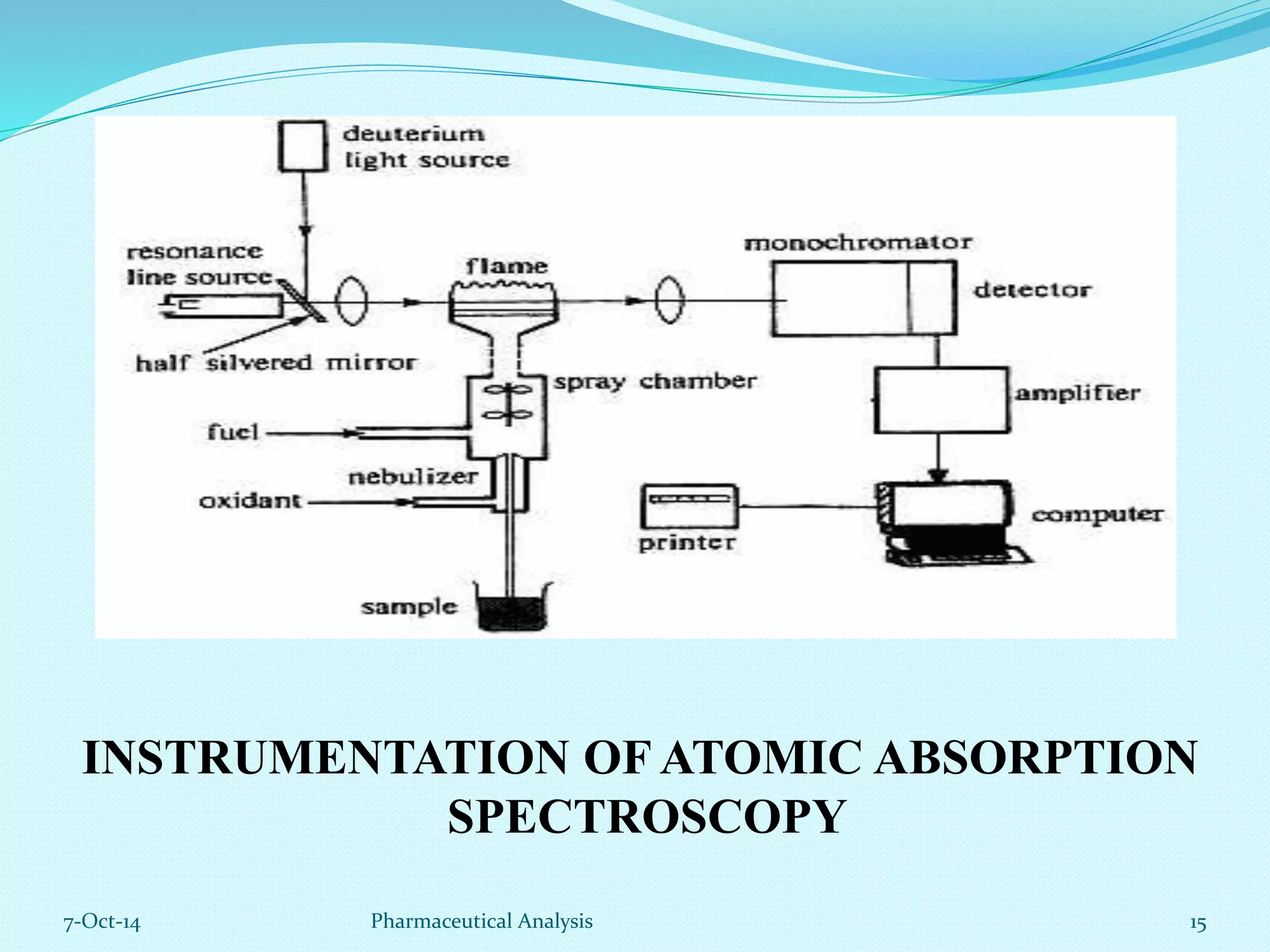
INSTRUMENTATION 
 Sharp-line radiation source (usually a hollow-cathode 
lamp) 
 A solution nebulizer and burner (an electrically heated 
furnace) 
 Monochromator 
 Photomultiplier and 
 Recording system 
7-Oct-14 Pharmaceutical Analysis 11
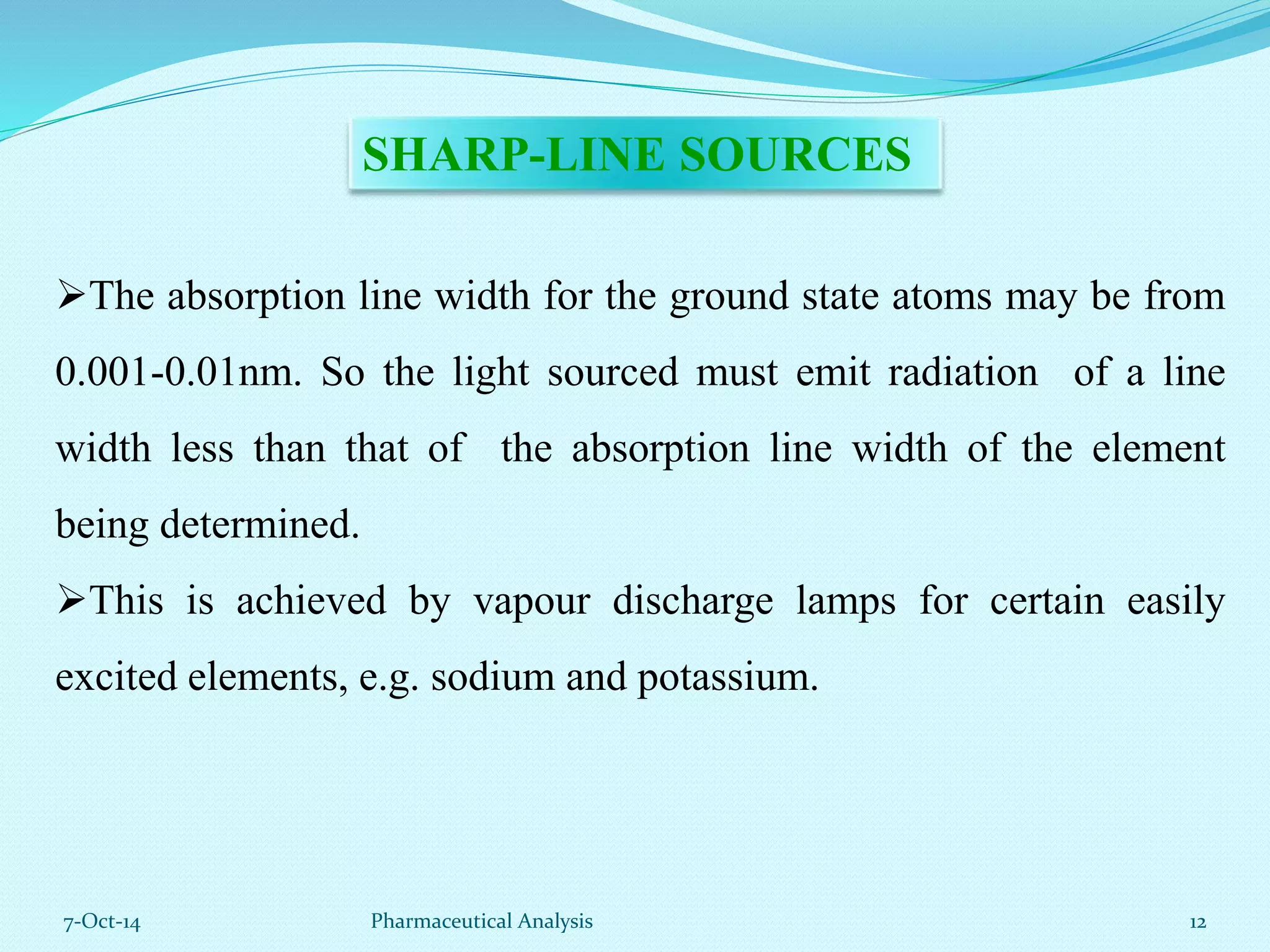
SHARP-LINE SOURCES 
The absorption line width for the ground state atoms may be from 
0.001-0.01nm. So the light sourced must emit radiation of a line 
width less than that of the absorption line width of the element 
being determined. 
This is achieved by vapour discharge lamps for certain easily 
excited elements, e.g. sodium and potassium. 
7-Oct-14 Pharmaceutical Analysis 12
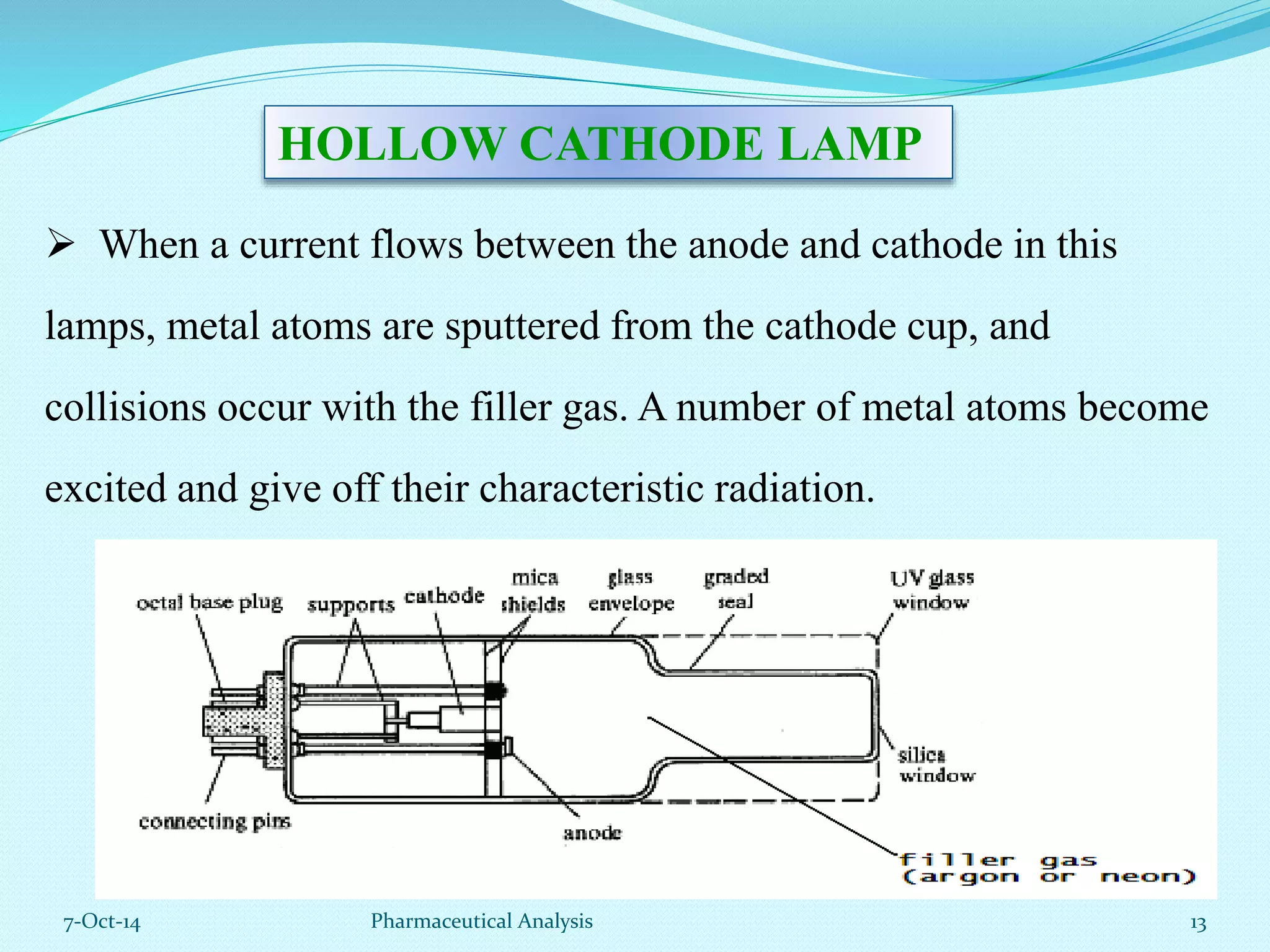
HOLLOW CATHODE LAMP 
 When a current flows between the anode and cathode in this 
lamps, metal atoms are sputtered from the cathode cup, and 
collisions occur with the filler gas. A number of metal atoms become 
excited and give off their characteristic radiation. 
7-Oct-14 Pharmaceutical Analysis 13
SAMPLE VAPORIZATION BY FLAME 
The production of an homogeneous atomic vapour from a 
sample is achieved by aspirating a solution into a flame or 
evaporating small volumes in an electrically heated tube furnace 
or from the surface of a carbon rod. 
In all cases, the thermal energy supplied must 
(a) Evaporate the solvent and 
(b) Dissociate the remaining solids into their constituent atoms 
without causing appreciable ionization. 
7-Oct-14 Pharmaceutical Analysis 14
INSTRUMENTATION OF ATOMIC ABSORPTION 
SPECTROSCOPY 
7-Oct-14 Pharmaceutical Analysis 15
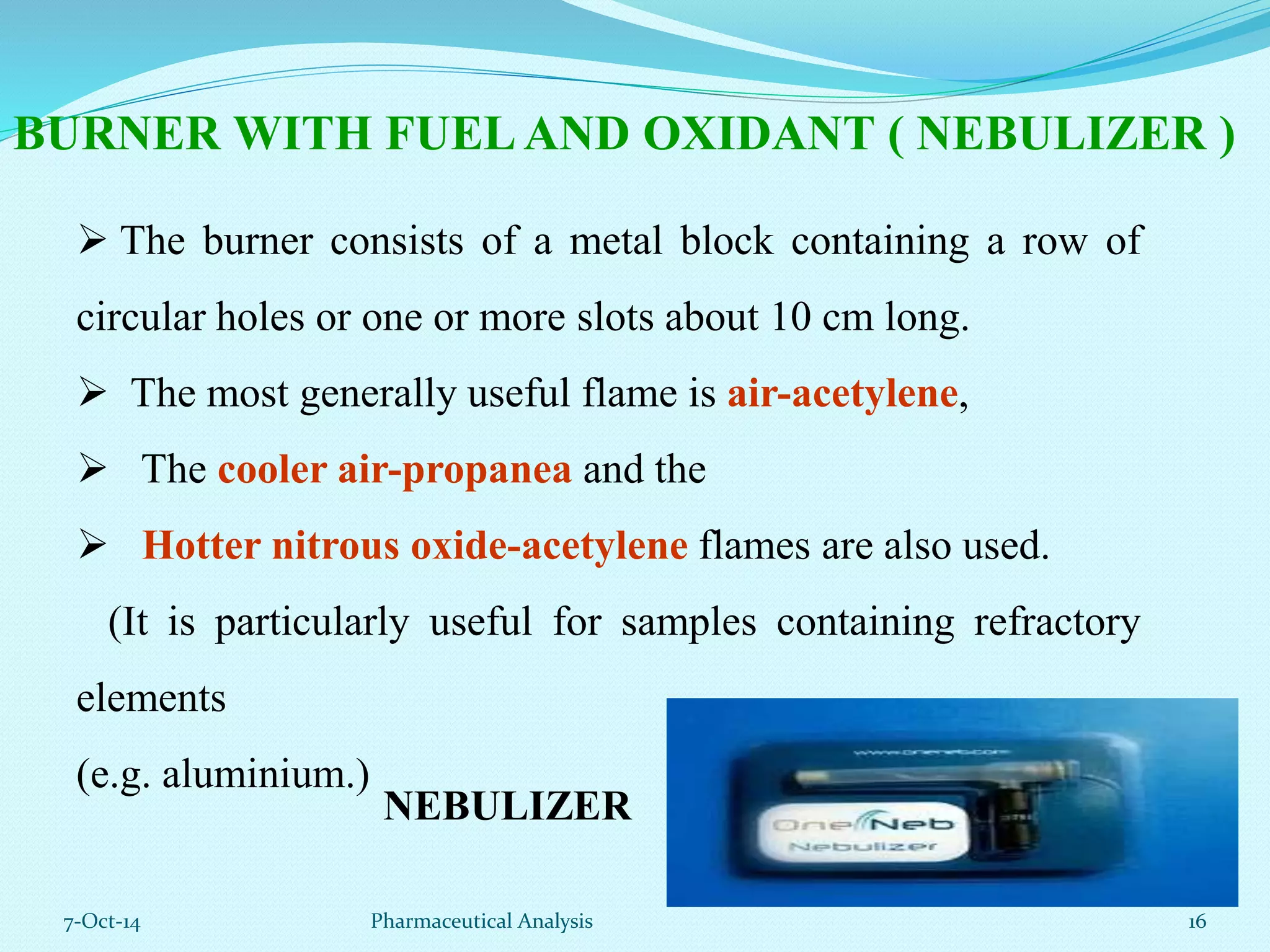
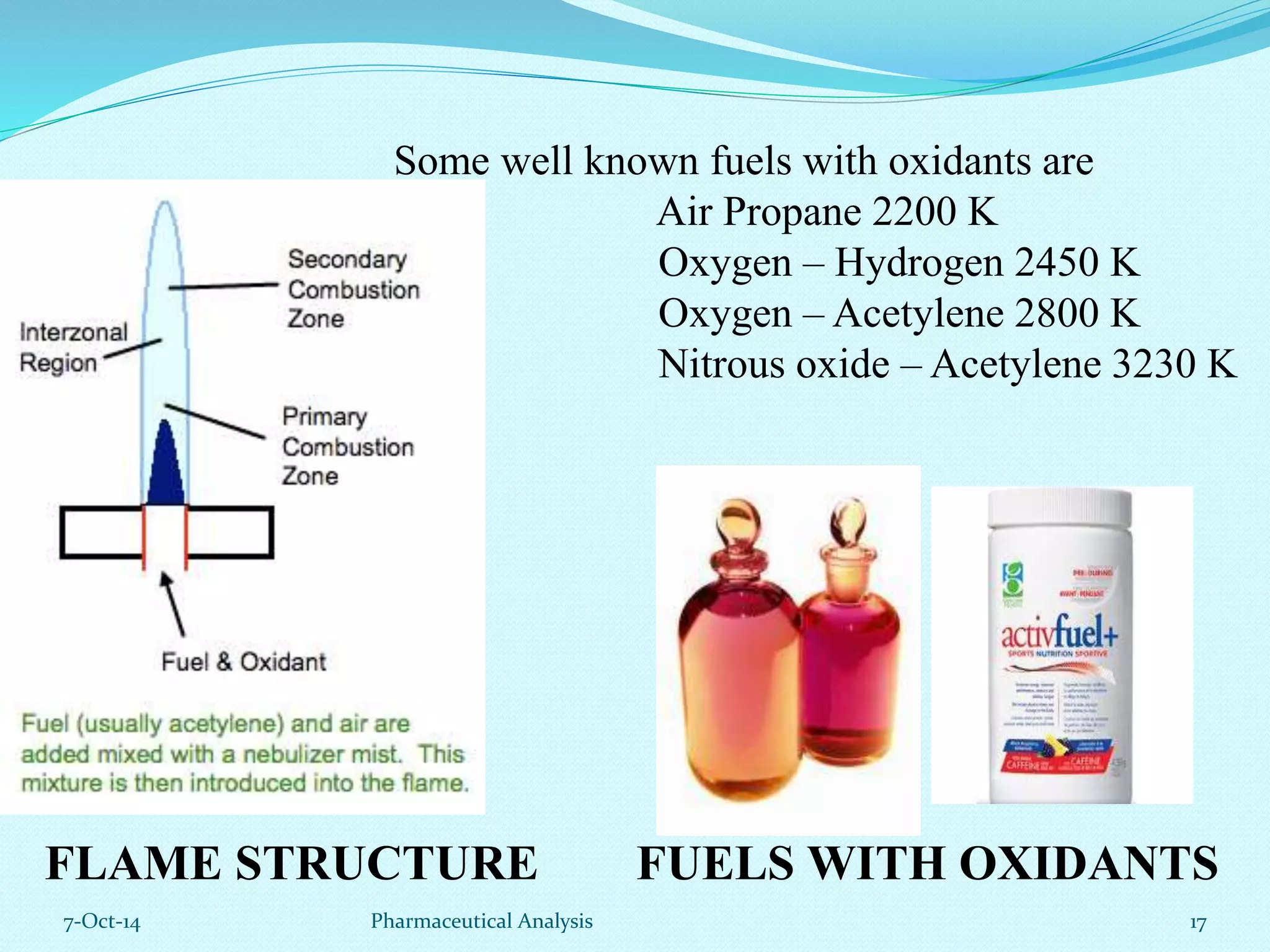
BURNER WITH FUEL AND OXIDANT ( NEBULIZER ) 
 The burner consists of a metal block containing a row of 
circular holes or one or more slots about 10 cm long. 
 The most generally useful flame is air-acetylene, 
 The cooler air-propanea and the 
 Hotter nitrous oxide-acetylene flames are also used. 
(It is particularly useful for samples containing refractory 
elements 
(e.g. aluminium.) 
NEBULIZER 
7-Oct-14 Pharmaceutical Analysis 16
Some well known fuels with oxidants are 
Air Propane 2200 K 
Oxygen – Hydrogen 2450 K 
Oxygen – Acetylene 2800 K 
Nitrous oxide – Acetylene 3230 K 
FLAME STRUCTURE FUELS WITH OXIDANTS 
7-Oct-14 Pharmaceutical Analysis 17
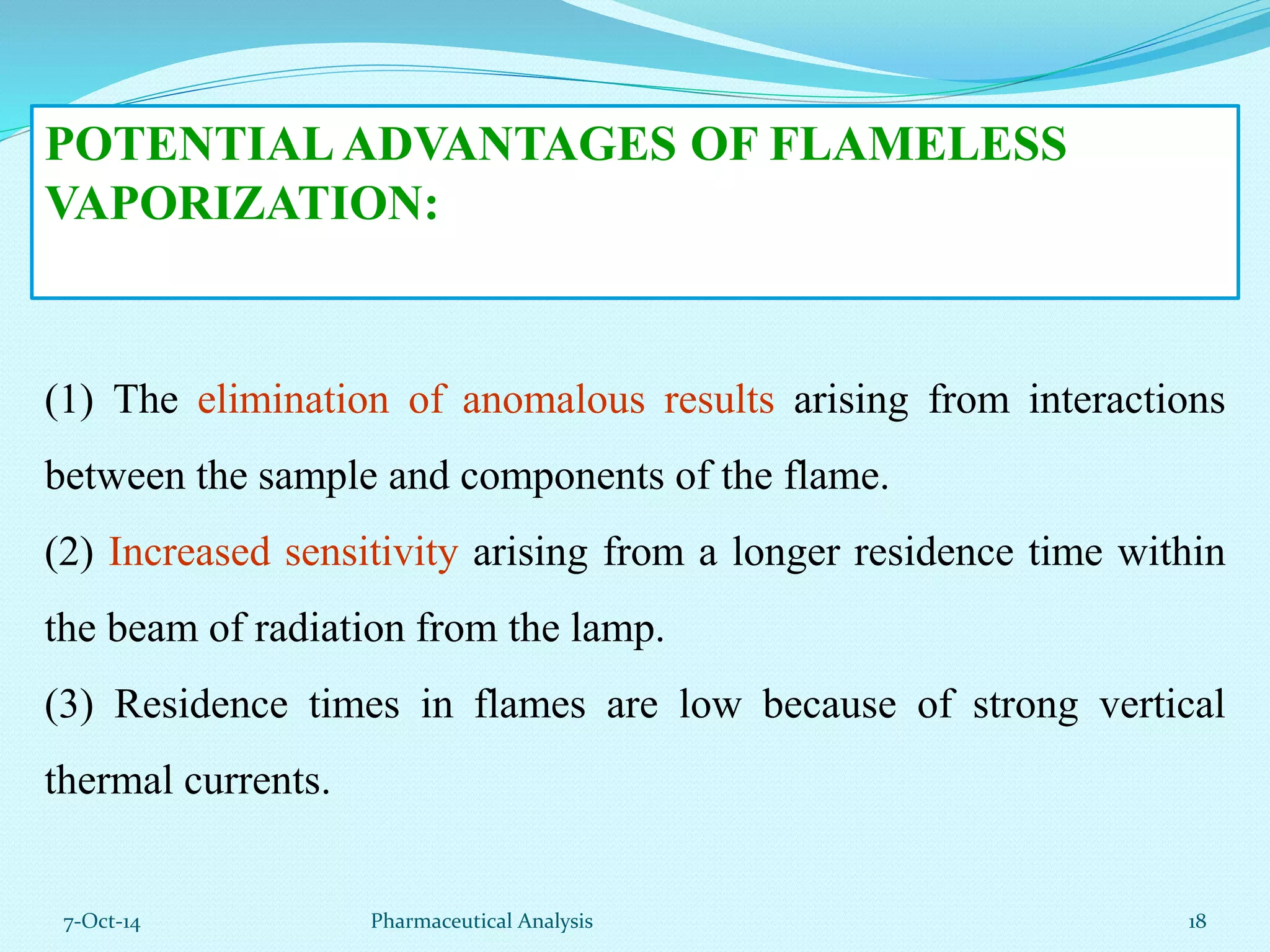
POTENTIAL ADVANTAGES OF FLAMELESS 
VAPORIZATION: 
(1) The elimination of anomalous results arising from interactions 
between the sample and components of the flame. 
(2) Increased sensitivity arising from a longer residence time within 
the beam of radiation from the lamp. 
(3) Residence times in flames are low because of strong vertical 
thermal currents. 
7-Oct-14 Pharmaceutical Analysis 18
(4) Increased sensitivity because of a higher proportion of the 
analyte being converted to free atoms. 
(The conversion may be as low as 0.1% for flame atomization.) 
(5) The ability to handle very small samples such as clinical 
specimens. 
(A nebulizer, spray chamber, burner arrangement consumes 
several cm3 of sample per minute, most of which runs to waste). 
7-Oct-14 Pharmaceutical Analysis 19
FLAMELESS VAPORIZATION TECHNIQUES 
 Electro thermal Atomizers 
 Cold vapour systems 
 Hydride generation systems 
7-Oct-14 Pharmaceutical Analysis 20
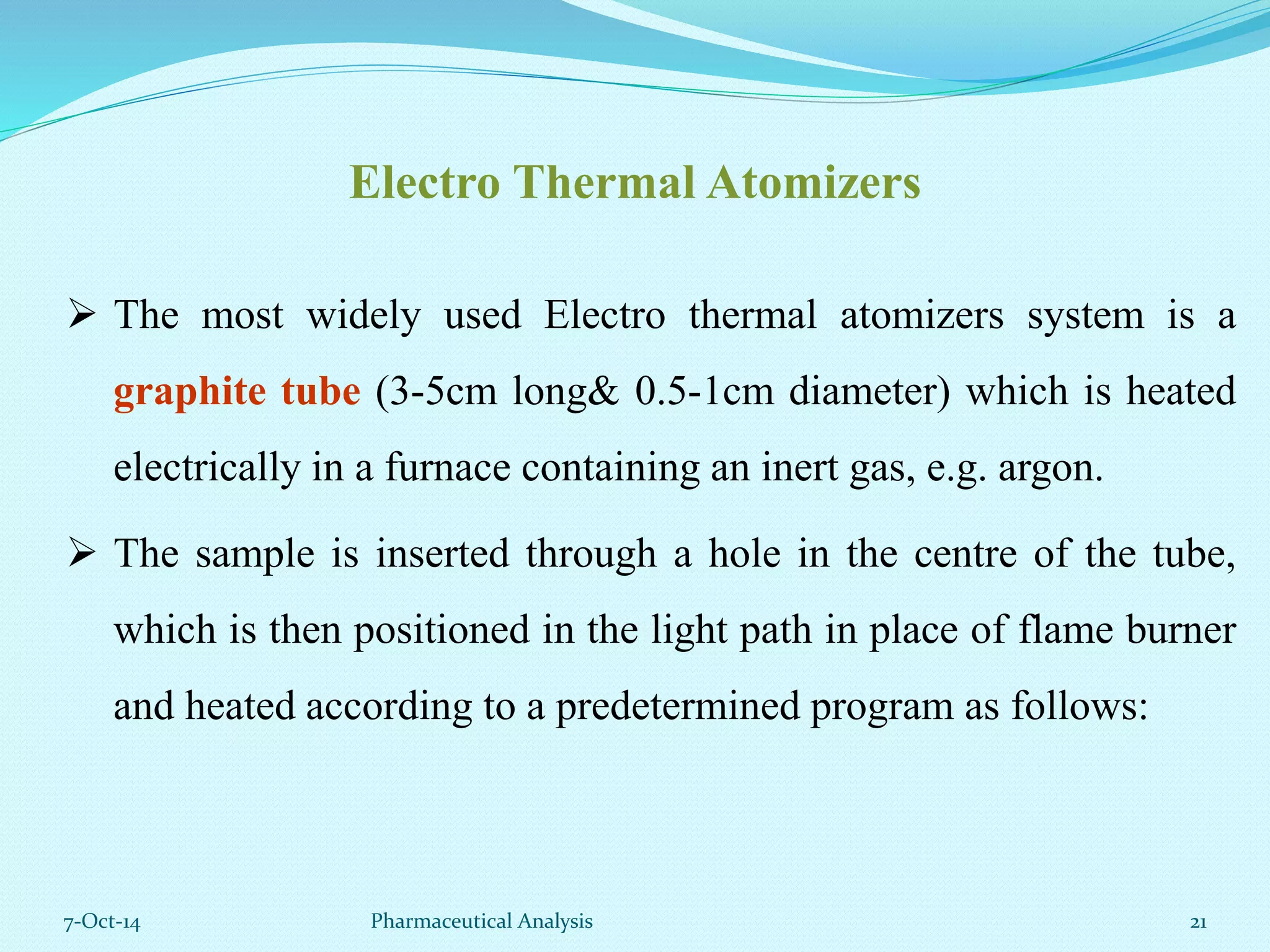
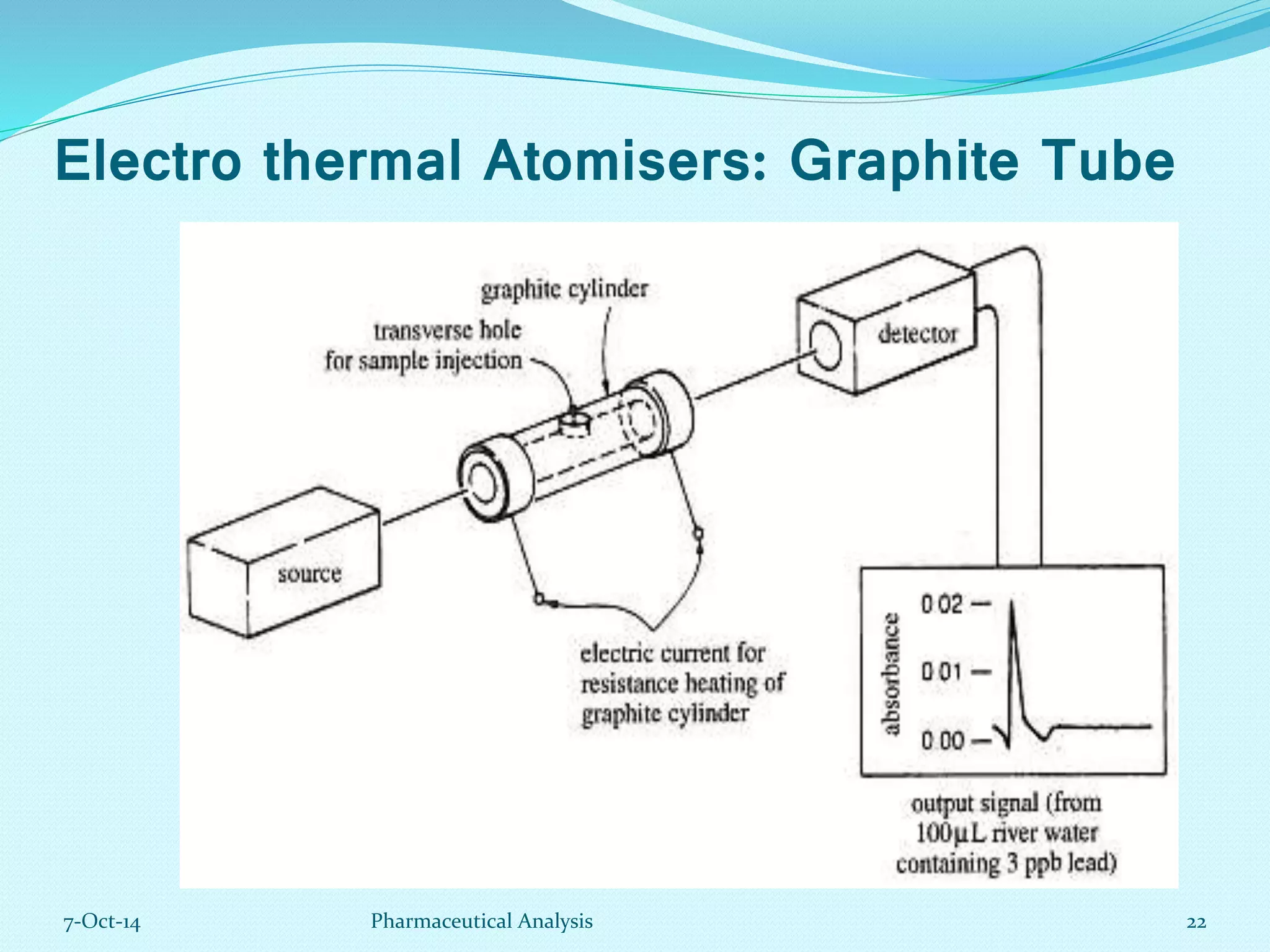
Electro Thermal Atomizers 
 The most widely used Electro thermal atomizers system is a 
graphite tube (3-5cm long& 0.5-1cm diameter) which is heated 
electrically in a furnace containing an inert gas, e.g. argon. 
 The sample is inserted through a hole in the centre of the tube, 
which is then positioned in the light path in place of flame burner 
and heated according to a predetermined program as follows: 
7-Oct-14 Pharmaceutical Analysis 21
Electro thermal Atomisers: Graphite Tube 
7-Oct-14 Pharmaceutical Analysis 22
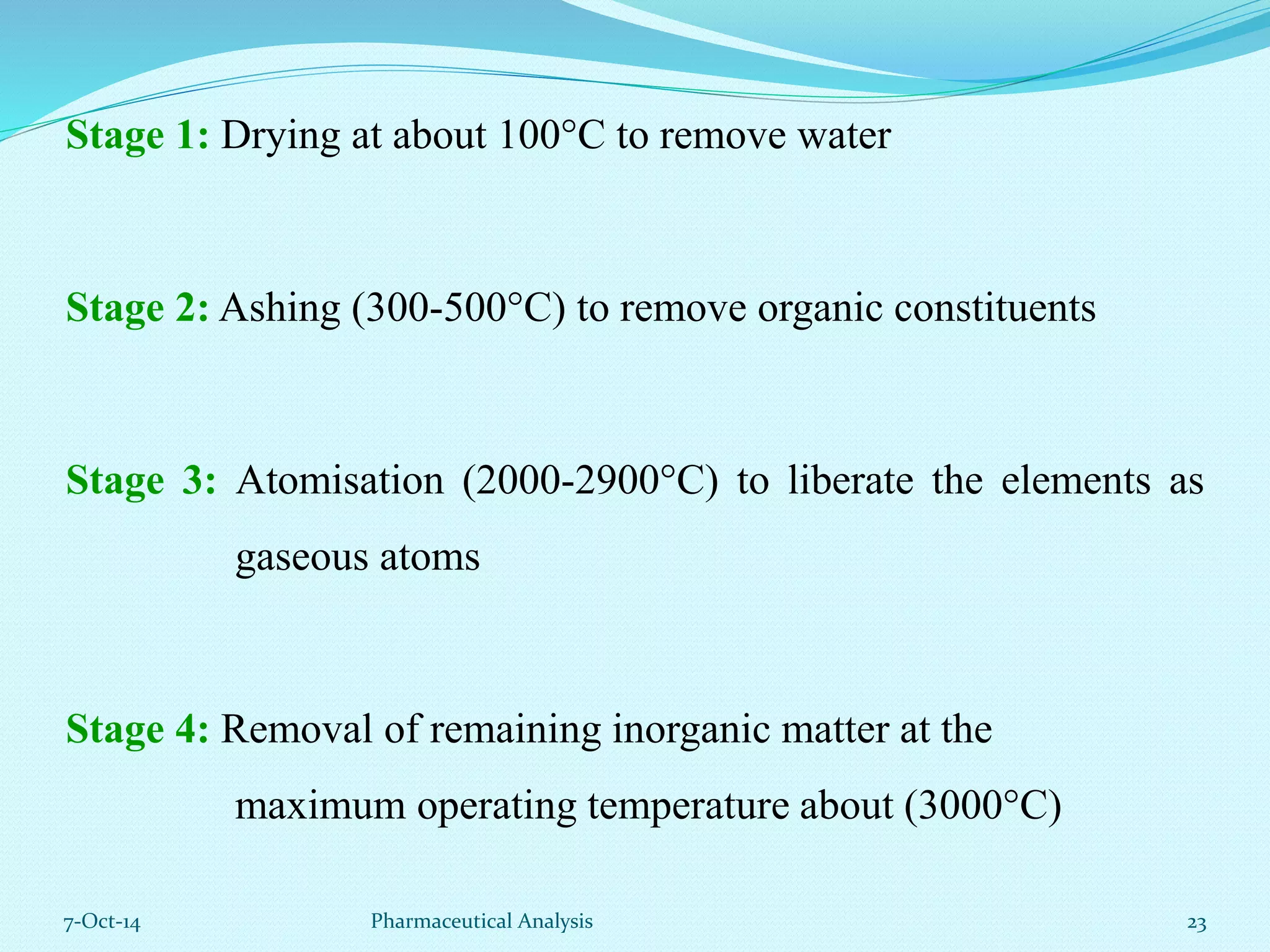
Stage 1: Drying at about 100°C to remove water 
Stage 2: Ashing (300-500°C) to remove organic constituents 
Stage 3: Atomisation (2000-2900°C) to liberate the elements as 
gaseous atoms 
Stage 4: Removal of remaining inorganic matter at the 
maximum operating temperature about (3000°C) 
7-Oct-14 Pharmaceutical Analysis 23
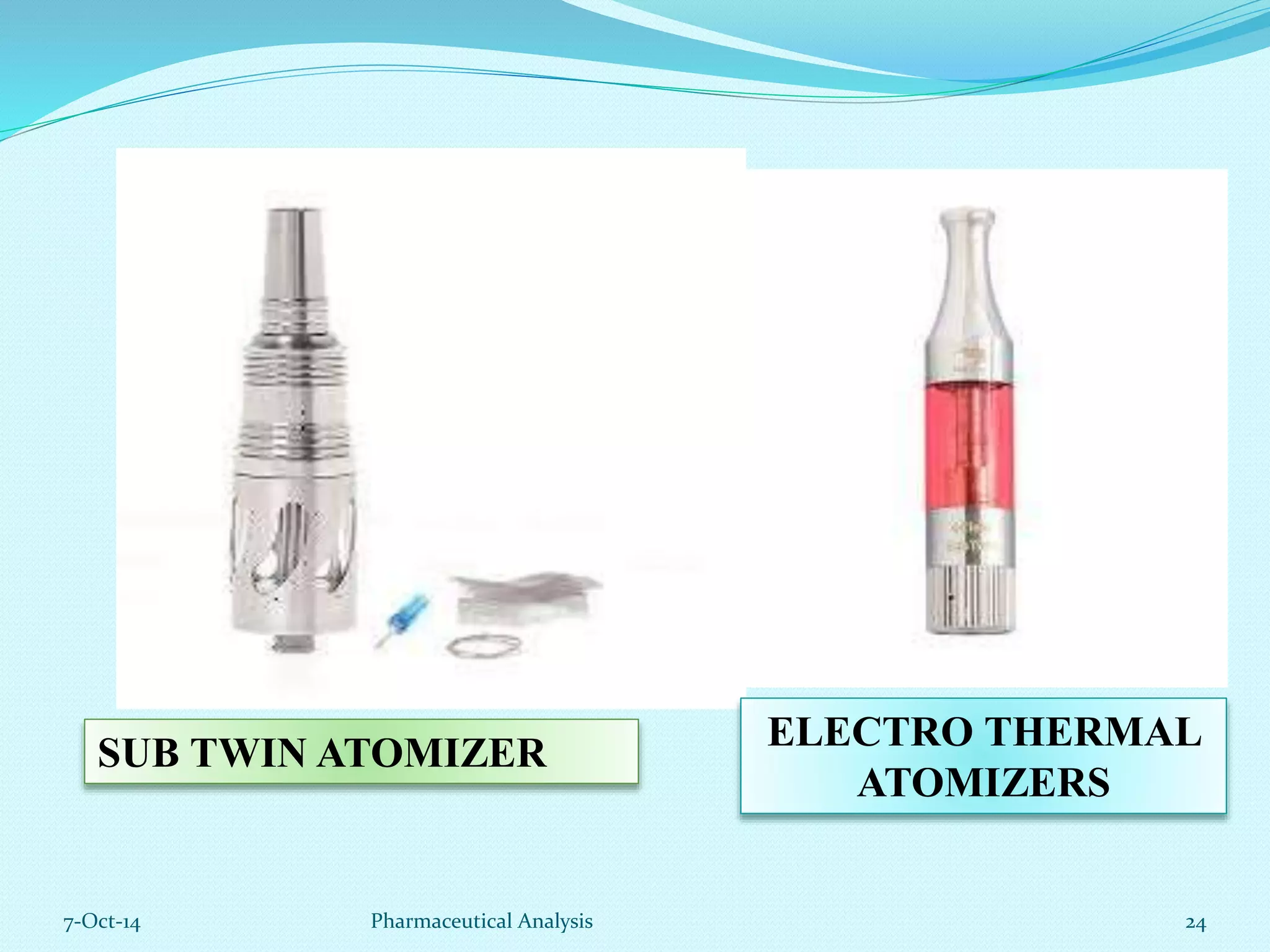
ELECTRO THERMAL 
ATOMIZERS 
SUB TWIN ATOMIZER 
7-Oct-14 Pharmaceutical Analysis 24
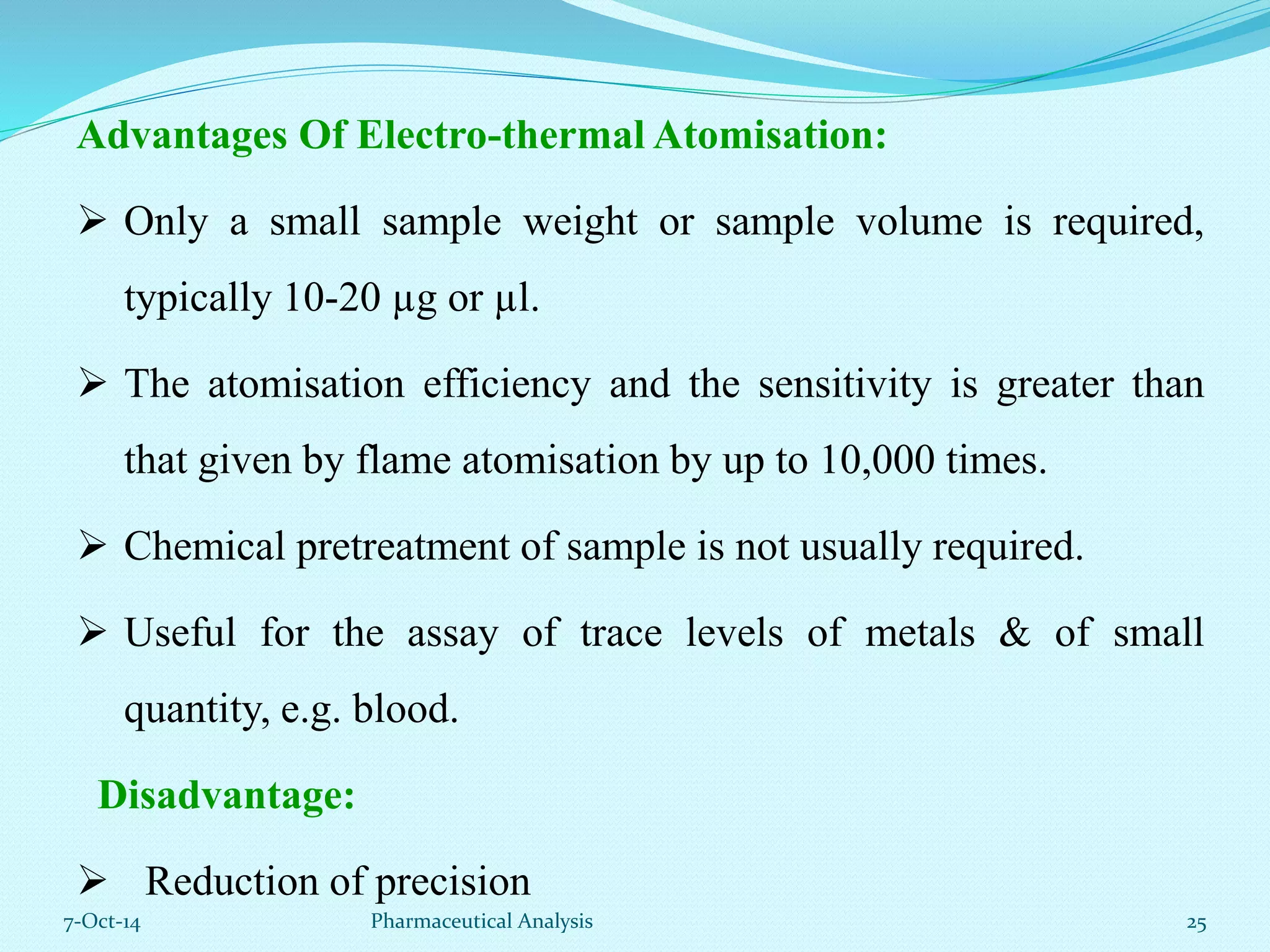
Advantages Of Electro-thermal Atomisation: 
 Only a small sample weight or sample volume is required, 
typically 10-20 μg or μl. 
 The atomisation efficiency and the sensitivity is greater than 
that given by flame atomisation by up to 10,000 times. 
 Chemical pretreatment of sample is not usually required. 
 Useful for the assay of trace levels of metals & of small 
quantity, e.g. blood. 
Disadvantage: 
 Reduction of precision 
7-Oct-14 Pharmaceutical Analysis 25
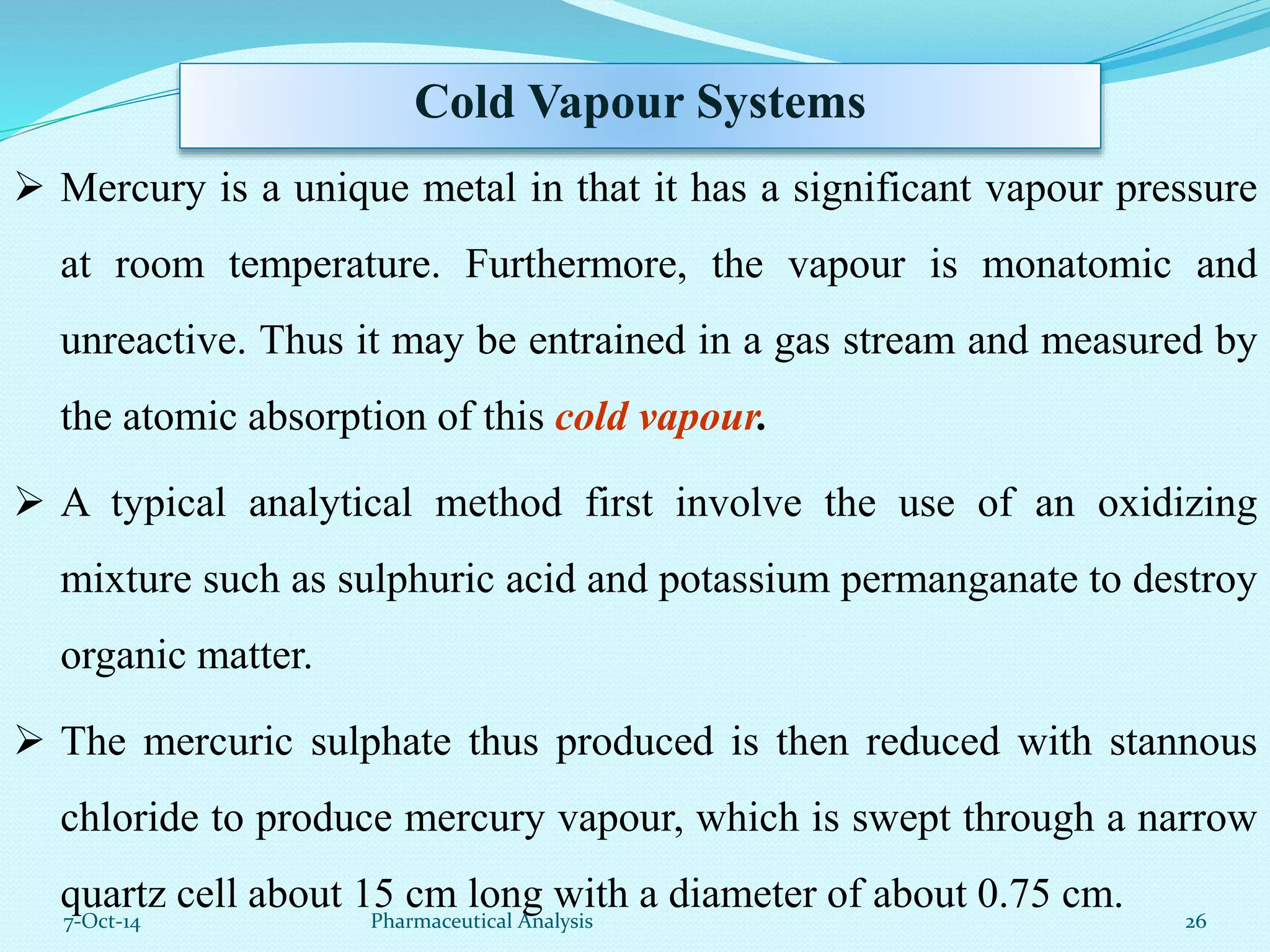
Cold Vapour Systems 
 Mercury is a unique metal in that it has a significant vapour pressure 
at room temperature. Furthermore, the vapour is monatomic and 
unreactive. Thus it may be entrained in a gas stream and measured by 
the atomic absorption of this cold vapour. 
 A typical analytical method first involve the use of an oxidizing 
mixture such as sulphuric acid and potassium permanganate to destroy 
organic matter. 
 The mercuric sulphate thus produced is then reduced with stannous 
chloride to produce mercury vapour, which is swept through a narrow 
quartz cell about 15 cm long with a diameter of about 0.75 cm. 
7-Oct-14 Pharmaceutical Analysis 26
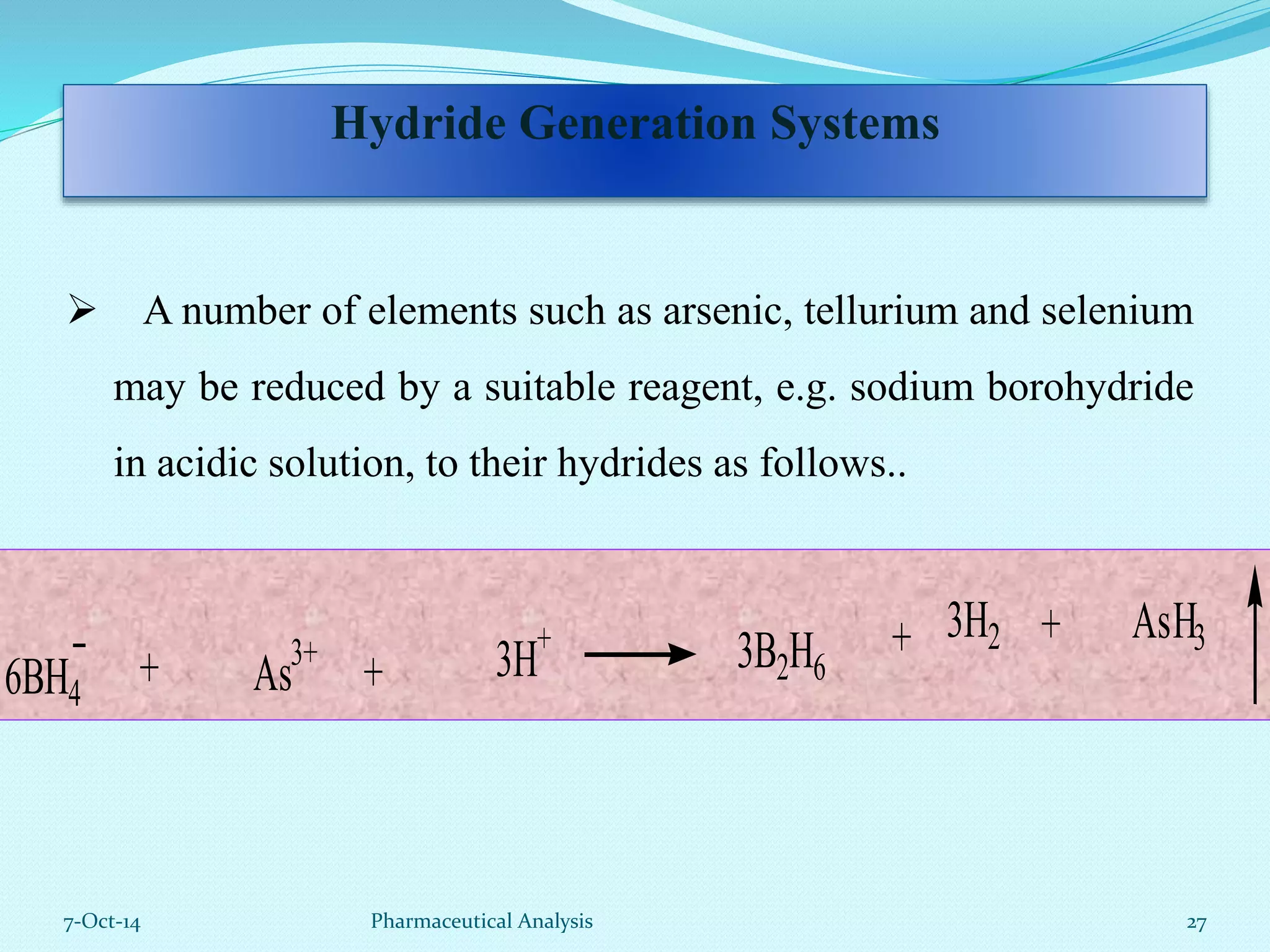
Hydride Generation Systems 
 A number of elements such as arsenic, tellurium and selenium 
may be reduced by a suitable reagent, e.g. sodium borohydride 
in acidic solution, to their hydrides as follows.. 
6BH4 
+ As3+ + 3H+ 3B2H6 
+ 3H2 + AsH3 
7-Oct-14 Pharmaceutical Analysis 27
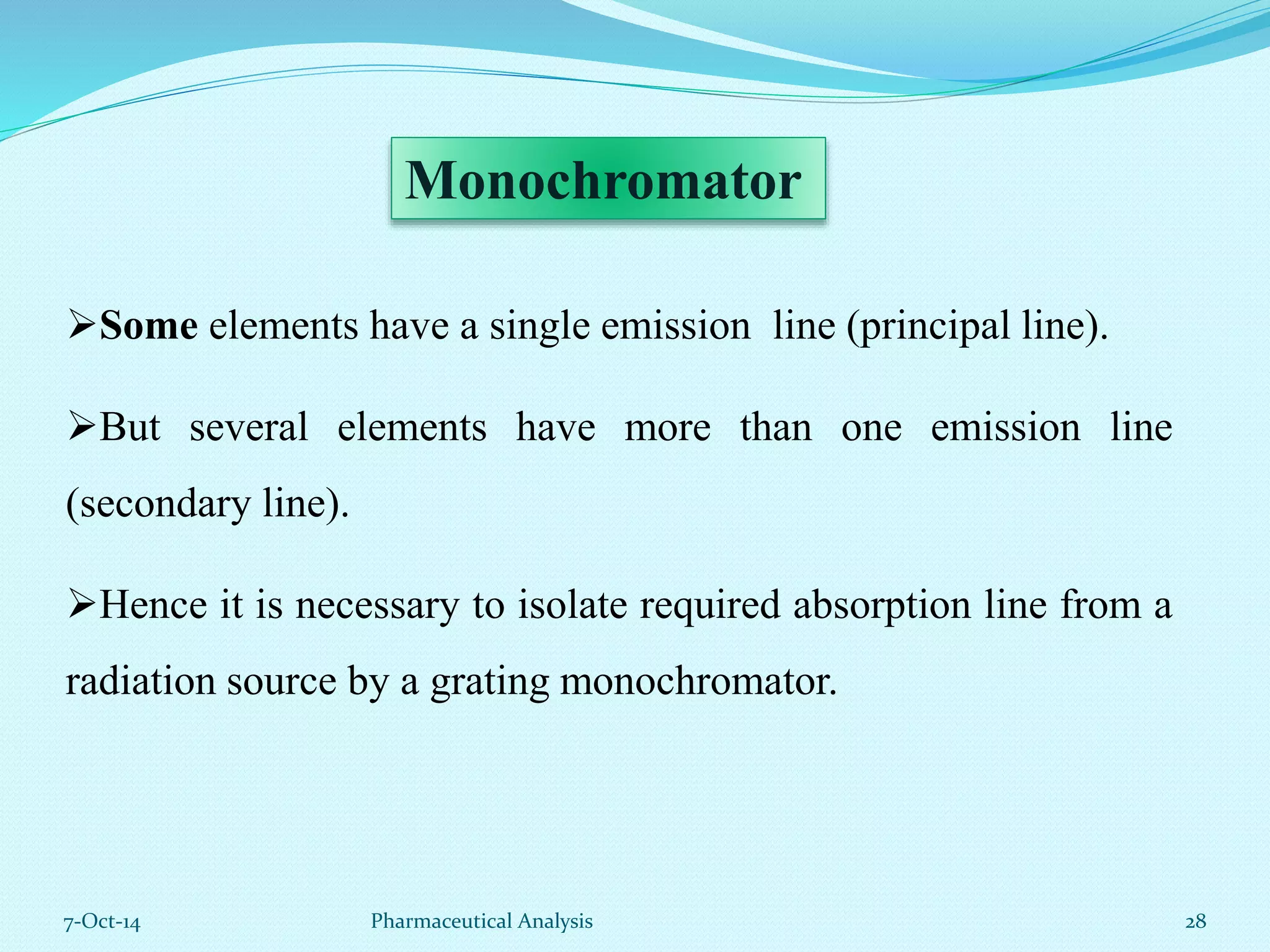
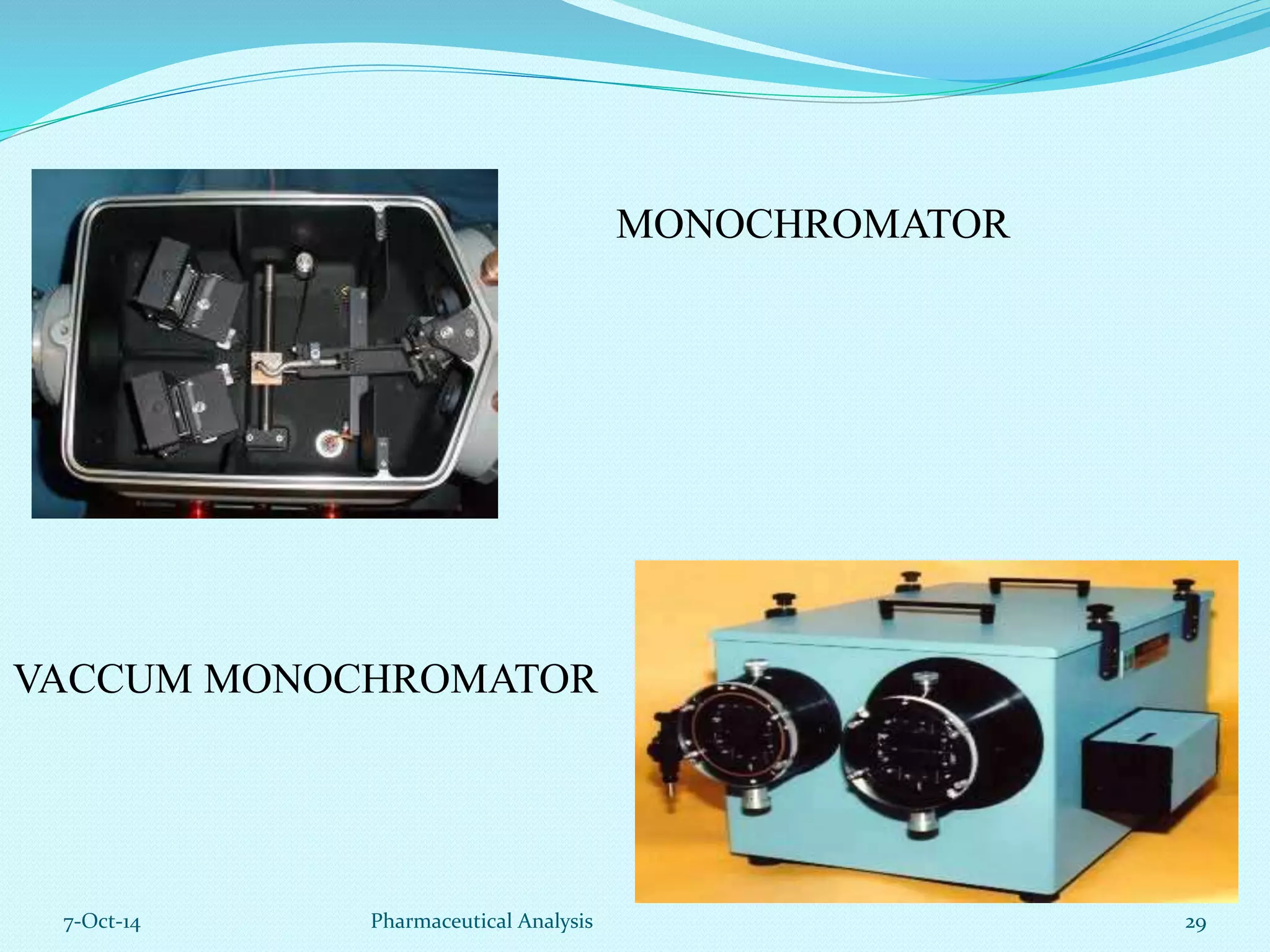
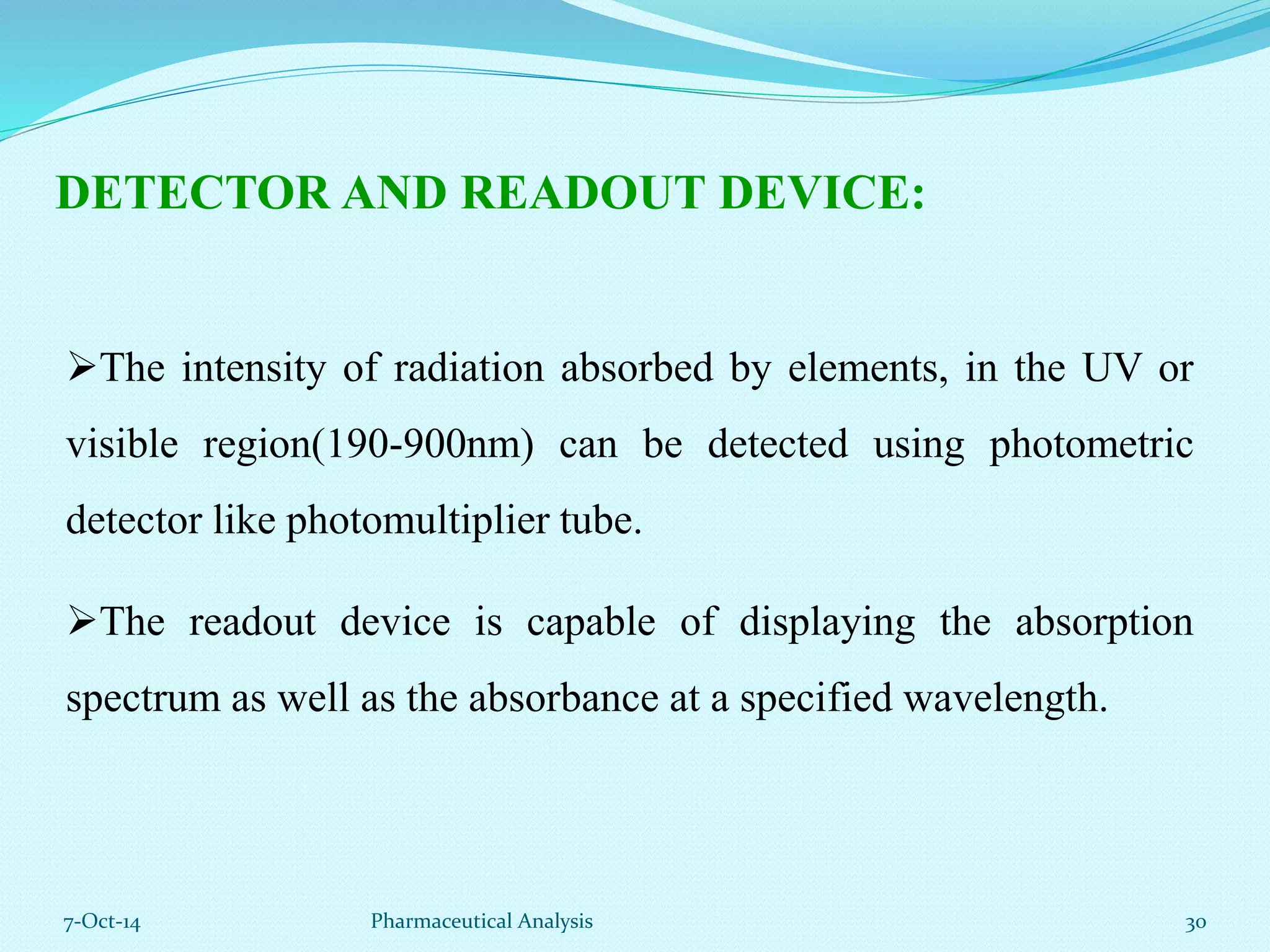
Monochromator 
Some elements have a single emission line (principal line). 
But several elements have more than one emission line 
(secondary line). 
Hence it is necessary to isolate required absorption line from a 
radiation source by a grating monochromator. 
7-Oct-14 Pharmaceutical Analysis 28
VACCUM MONOCHROMATOR 
MONOCHROMATOR 
7-Oct-14 Pharmaceutical Analysis 29
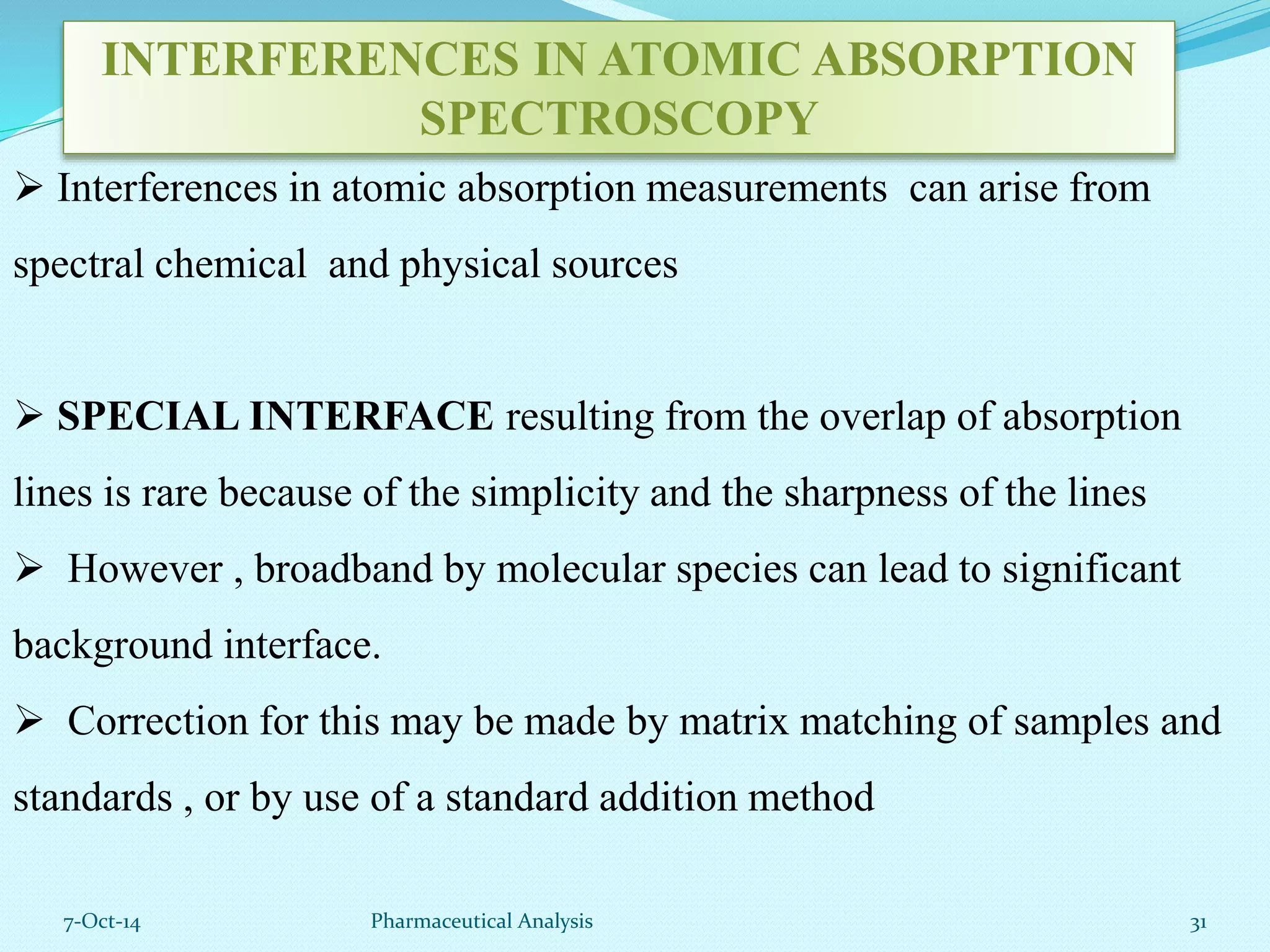
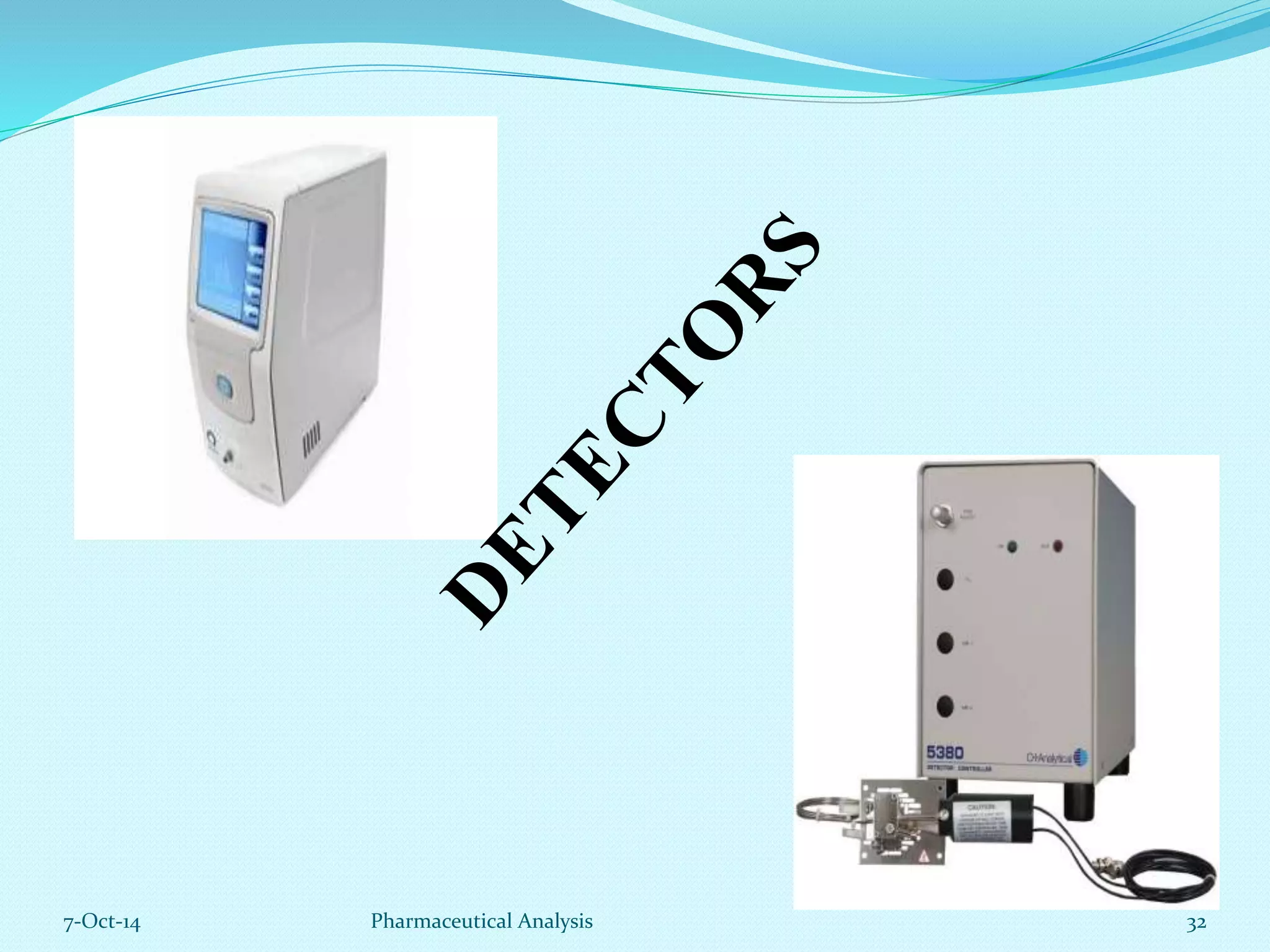
DETECTOR AND READOUT DEVICE: 
The intensity of radiation absorbed by elements, in the UV or 
visible region(190-900nm) can be detected using photometric 
detector like photomultiplier tube. 
The readout device is capable of displaying the absorption 
spectrum as well as the absorbance at a specified wavelength. 
7-Oct-14 Pharmaceutical Analysis 30
INTERFERENCES IN ATOMIC ABSORPTION 
SPECTROSCOPY 
 Interferences in atomic absorption measurements can arise from 
spectral chemical and physical sources 
 SPECIAL INTERFACE resulting from the overlap of absorption 
lines is rare because of the simplicity and the sharpness of the lines 
 However , broadband by molecular species can lead to significant 
background interface. 
 Correction for this may be made by matrix matching of samples and 
standards , or by use of a standard addition method 
7-Oct-14 Pharmaceutical Analysis 31
7-Oct-14 Pharmaceutical Analysis 32
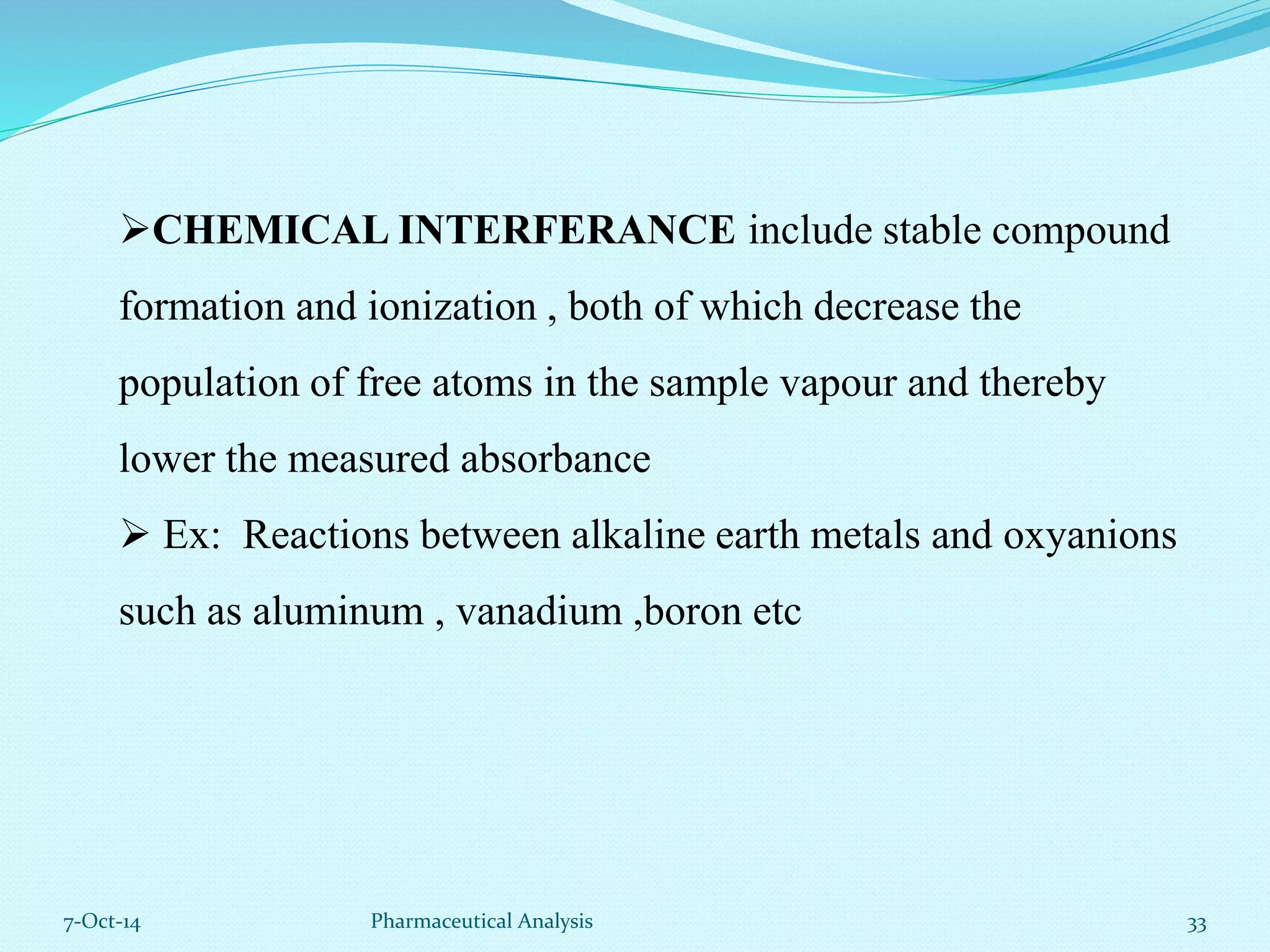
CHEMICAL INTERFERANCE include stable compound 
formation and ionization , both of which decrease the 
population of free atoms in the sample vapour and thereby 
lower the measured absorbance 
 Ex: Reactions between alkaline earth metals and oxyanions 
such as aluminum , vanadium ,boron etc 
7-Oct-14 Pharmaceutical Analysis 33
ADVANTAGES OF AAS 
 Solutions, slurries and solid samples can be analysed. 
 Much more efficient atomization 
 Greater sensitivity 
 Smaller quantities of sample (typically 5 – 50 μL) 
 Provides a reducing environment for easily oxidized 
7-OEct-1l4ements Pharmaceutical Analysis 34
DISADVANTAGES 
 Expensive 
 Low precision 
 Low sample throughput 
 Requires high level of operator skill 
 Sample must be in solution or at least volatile 
 Individual source lamps required foreach element 
7-Oct-14 Pharmaceutical Analysis 35
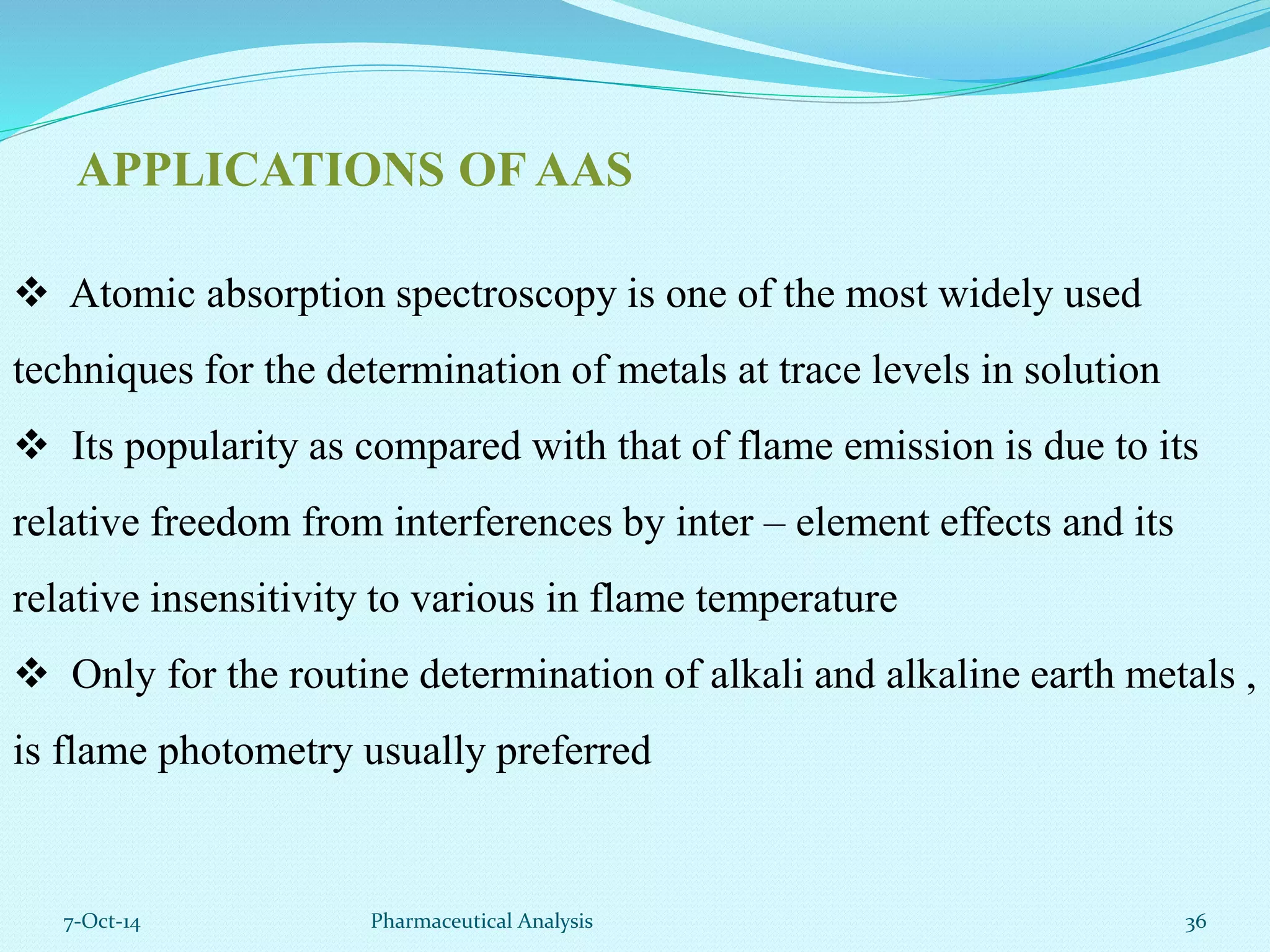
APPLICATIONS OF AAS 
 Atomic absorption spectroscopy is one of the most widely used 
techniques for the determination of metals at trace levels in solution 
 Its popularity as compared with that of flame emission is due to its 
relative freedom from interferences by inter – element effects and its 
relative insensitivity to various in flame temperature 
 Only for the routine determination of alkali and alkaline earth metals , 
is flame photometry usually preferred 
7-Oct-14 Pharmaceutical Analysis 36
 Over sixty elements can be determined in almost in any matrix 
by atomic absorption . 
Ex: 1. Heavy metals in body fluids 
2. Polluted waters 
3. Food stuffs 
4. Soft drinks and beer 
5. Analysis of metallurgical and geochemical 
samples 
6. Determination of many metals in soils , crude oils 
, petroleum products and plastics etc 
PURIFICATION OF WATER PETROLEUM PRODUCTS FOOD STUFF 
7-Oct-14 Pharmaceutical Analysis 37
 Detection limits generally lie in the range 100- 0.1 ppb but these 
can be improved by chemical pre – concentration procedures 
involving solvent extraction or ion exchange 
Peak – Peak 
noise curve 
 Currently a balance seems to have reached in the use of various 
techniques for the determination of metals at trace levels 
 In its modern form AAS remains important and competative 
where small ranges of elemants need to be determined in samples 
7-Oct-14 Pharmaceutical Analysis 38
CONCLUSION 
 Atoms of a metal are volatilized in a flame and there absorption of 
a narrow band of radiation produced by a hallow cathode lamp, 
coated with particular metal being determined is measured. 
 More sensitive than atomic emission spectrometer. 
 A highly specific method of analysis useful in some aspects of 
quality control. 
 Determination of metal residues remaining from the manufacturing 
process in drugs. 
7-Oct-14 Pharmaceutical Analysis 39
 Skoog, Holler, Crouch ‘s (2nd Edition) Instrumental 
Analysis.(p.g no 272-287) 
 Chatwal’s Instrumental Analysis(p.g no.340-2.366) 
 Vogel’s (6th Edition) p.g No 562-586. 
 A.H Beckett & J.B Stenlake Part 2 Practical 
Pharmaceutical Chemiatry(4th Edition)p.g No 346-357. 
 David. G. Watson’s Pharmaceutical Analysis (p.g 142-148). 
7-Oct-14 Pharmaceutical Analysis 40
Acknowledg 
ement 
 I like to thank my guide Ch. DEVADSU sir for his 
constant support & guidance to achieve my seminar 
topic. 
 I also thank our principal sir P. SRINIVASA BABU 
garu & seminar committee for giving me this 
wonderful opportunity. 
 Thank you guys for being patience. 
7-Oct-14 Pharmaceutical Analysis 41
7-Oct-14 Pharmaceutical Analysis 42

ATOMIC ABSORPTION SPECTROPHOTOMETRY

  • 1.
    ATOMIC ABSORPTION SPECTROPHOTOMETRY Presented By : G. Prasanth 11AB1R0085 VIGNAN PHARMACY COLLEGE (Approved by AICTE, PCI & Affiliated to JNTUK) VADLAMUDI, 522213. UNDER THE ESTEEMED GUIDANCE OF Mr. Ch. DEVADASU M.Pharm Assistant professor Department of PA & QA
  • 2.
    CONTENTS  Introduction  Principle  Instrumentation 1. Sharp line radiation source 2. Nebulizer and Burner 3. Monochromator 4. Photomultiplier 5. Recording system  Flameless vaporization techniques 1. Electro thermal atomizers 2. Cold vapour systems 3. Hydride generation systems 7-Oct-14 Pharmaceutical Analysis 2
  • 3.
     Interferences inatomic absorption spectroscopy 1. Special 2. Chemical  Advantages  Disadvantages  Applications  Conclusion 7-Oct-14 Pharmaceutical Analysis 3
  • 4.
    INTRODUCTION  Atomicabsorption spectroscopy technique was introduced for analytical purpose by WALSH, ALKEMADE and MILATZ in 1956.  Atomic absorption spectroscopy is an absorption spectroscopic method where radiation from a source is absorbed by non-excited atoms in the vapour state.  Atomic absorption spectroscopy deals with the absorption of specific wavelength of radiation by neutral atoms in the ground state. 7-Oct-14 Pharmaceutical Analysis 4
  • 5.
    PRINCIPLE OF AAS Liquid sample flame Formation of droplets Fine residue 7-Oct-14 Pharmaceutical Analysis 5
  • 6.
    Formation of Neutralatoms Neutral atoms absorb specific wavelength of radiation from hollow cathode lamp Measurement of intensity of radiation absorbed by the neutral atoms using a detector 7-Oct-14 Pharmaceutical Analysis 6
  • 7.
    PRINCIPLE OF AAS  The extent to which radiation of a particular frequency is absorbed by an atomic vapour is related to the length of the path transversed and to the concentration of absorbing atoms in the vapour  This is analogues to the Beer – Lamberts law relating to samples in samples in solution. Thus , for a collimated monochromatic beam of radiation of incident I0 passing through an atomic vapour of thickness I Iv = I0 e –kvI Where Iv is the intensity of the transmitted radiation kv is absorption co efficient 7-Oct-14 Pharmaceutical Analysis 7
  • 8.
     The valueof kv is determined by the concentration of atoms which can absorb at frequency v is given by the expression : ʃ kv dv = xe2 Nv f Where mc m & e are the mass and charge of the electron Nv is the number of atoms per cm3 capable of absorbing radiation of frequency v ( ie., ground state atoms ) f is the oscillator strength ( defined as the number of electrons per atom capable of being excited by the incident radiation )  Hence , for transitions from the ground state , integrated absorption is proportional to Nv ,which approximates to the concentration (c) of the element in the sample 7-Oct-14 Pharmaceutical Analysis 8
  • 9.
    PROCESS OF ATOMICABSORPTION 7-Oct-14 Pharmaceutical Analysis 9
  • 10.
    Process Occurring During Atomization 7-Oct-14 Pharmaceutical Analysis 10
  • 11.
    INSTRUMENTATION  Sharp-lineradiation source (usually a hollow-cathode lamp)  A solution nebulizer and burner (an electrically heated furnace)  Monochromator  Photomultiplier and  Recording system 7-Oct-14 Pharmaceutical Analysis 11
  • 12.
    SHARP-LINE SOURCES Theabsorption line width for the ground state atoms may be from 0.001-0.01nm. So the light sourced must emit radiation of a line width less than that of the absorption line width of the element being determined. This is achieved by vapour discharge lamps for certain easily excited elements, e.g. sodium and potassium. 7-Oct-14 Pharmaceutical Analysis 12
  • 13.
    HOLLOW CATHODE LAMP  When a current flows between the anode and cathode in this lamps, metal atoms are sputtered from the cathode cup, and collisions occur with the filler gas. A number of metal atoms become excited and give off their characteristic radiation. 7-Oct-14 Pharmaceutical Analysis 13
  • 14.
    SAMPLE VAPORIZATION BYFLAME The production of an homogeneous atomic vapour from a sample is achieved by aspirating a solution into a flame or evaporating small volumes in an electrically heated tube furnace or from the surface of a carbon rod. In all cases, the thermal energy supplied must (a) Evaporate the solvent and (b) Dissociate the remaining solids into their constituent atoms without causing appreciable ionization. 7-Oct-14 Pharmaceutical Analysis 14
  • 15.
    INSTRUMENTATION OF ATOMICABSORPTION SPECTROSCOPY 7-Oct-14 Pharmaceutical Analysis 15
  • 16.
    BURNER WITH FUELAND OXIDANT ( NEBULIZER )  The burner consists of a metal block containing a row of circular holes or one or more slots about 10 cm long.  The most generally useful flame is air-acetylene,  The cooler air-propanea and the  Hotter nitrous oxide-acetylene flames are also used. (It is particularly useful for samples containing refractory elements (e.g. aluminium.) NEBULIZER 7-Oct-14 Pharmaceutical Analysis 16
  • 17.
    Some well knownfuels with oxidants are Air Propane 2200 K Oxygen – Hydrogen 2450 K Oxygen – Acetylene 2800 K Nitrous oxide – Acetylene 3230 K FLAME STRUCTURE FUELS WITH OXIDANTS 7-Oct-14 Pharmaceutical Analysis 17
  • 18.
    POTENTIAL ADVANTAGES OFFLAMELESS VAPORIZATION: (1) The elimination of anomalous results arising from interactions between the sample and components of the flame. (2) Increased sensitivity arising from a longer residence time within the beam of radiation from the lamp. (3) Residence times in flames are low because of strong vertical thermal currents. 7-Oct-14 Pharmaceutical Analysis 18
  • 19.
    (4) Increased sensitivitybecause of a higher proportion of the analyte being converted to free atoms. (The conversion may be as low as 0.1% for flame atomization.) (5) The ability to handle very small samples such as clinical specimens. (A nebulizer, spray chamber, burner arrangement consumes several cm3 of sample per minute, most of which runs to waste). 7-Oct-14 Pharmaceutical Analysis 19
  • 20.
    FLAMELESS VAPORIZATION TECHNIQUES  Electro thermal Atomizers  Cold vapour systems  Hydride generation systems 7-Oct-14 Pharmaceutical Analysis 20
  • 21.
    Electro Thermal Atomizers  The most widely used Electro thermal atomizers system is a graphite tube (3-5cm long& 0.5-1cm diameter) which is heated electrically in a furnace containing an inert gas, e.g. argon.  The sample is inserted through a hole in the centre of the tube, which is then positioned in the light path in place of flame burner and heated according to a predetermined program as follows: 7-Oct-14 Pharmaceutical Analysis 21
  • 22.
    Electro thermal Atomisers:Graphite Tube 7-Oct-14 Pharmaceutical Analysis 22
  • 23.
    Stage 1: Dryingat about 100°C to remove water Stage 2: Ashing (300-500°C) to remove organic constituents Stage 3: Atomisation (2000-2900°C) to liberate the elements as gaseous atoms Stage 4: Removal of remaining inorganic matter at the maximum operating temperature about (3000°C) 7-Oct-14 Pharmaceutical Analysis 23
  • 24.
    ELECTRO THERMAL ATOMIZERS SUB TWIN ATOMIZER 7-Oct-14 Pharmaceutical Analysis 24
  • 25.
    Advantages Of Electro-thermalAtomisation:  Only a small sample weight or sample volume is required, typically 10-20 μg or μl.  The atomisation efficiency and the sensitivity is greater than that given by flame atomisation by up to 10,000 times.  Chemical pretreatment of sample is not usually required.  Useful for the assay of trace levels of metals & of small quantity, e.g. blood. Disadvantage:  Reduction of precision 7-Oct-14 Pharmaceutical Analysis 25
  • 26.
    Cold Vapour Systems  Mercury is a unique metal in that it has a significant vapour pressure at room temperature. Furthermore, the vapour is monatomic and unreactive. Thus it may be entrained in a gas stream and measured by the atomic absorption of this cold vapour.  A typical analytical method first involve the use of an oxidizing mixture such as sulphuric acid and potassium permanganate to destroy organic matter.  The mercuric sulphate thus produced is then reduced with stannous chloride to produce mercury vapour, which is swept through a narrow quartz cell about 15 cm long with a diameter of about 0.75 cm. 7-Oct-14 Pharmaceutical Analysis 26
  • 27.
    Hydride Generation Systems  A number of elements such as arsenic, tellurium and selenium may be reduced by a suitable reagent, e.g. sodium borohydride in acidic solution, to their hydrides as follows.. 6BH4 + As3+ + 3H+ 3B2H6 + 3H2 + AsH3 7-Oct-14 Pharmaceutical Analysis 27
  • 28.
    Monochromator Some elementshave a single emission line (principal line). But several elements have more than one emission line (secondary line). Hence it is necessary to isolate required absorption line from a radiation source by a grating monochromator. 7-Oct-14 Pharmaceutical Analysis 28
  • 29.
    VACCUM MONOCHROMATOR MONOCHROMATOR 7-Oct-14 Pharmaceutical Analysis 29
  • 30.
    DETECTOR AND READOUTDEVICE: The intensity of radiation absorbed by elements, in the UV or visible region(190-900nm) can be detected using photometric detector like photomultiplier tube. The readout device is capable of displaying the absorption spectrum as well as the absorbance at a specified wavelength. 7-Oct-14 Pharmaceutical Analysis 30
  • 31.
    INTERFERENCES IN ATOMICABSORPTION SPECTROSCOPY  Interferences in atomic absorption measurements can arise from spectral chemical and physical sources  SPECIAL INTERFACE resulting from the overlap of absorption lines is rare because of the simplicity and the sharpness of the lines  However , broadband by molecular species can lead to significant background interface.  Correction for this may be made by matrix matching of samples and standards , or by use of a standard addition method 7-Oct-14 Pharmaceutical Analysis 31
  • 32.
  • 33.
    CHEMICAL INTERFERANCE includestable compound formation and ionization , both of which decrease the population of free atoms in the sample vapour and thereby lower the measured absorbance  Ex: Reactions between alkaline earth metals and oxyanions such as aluminum , vanadium ,boron etc 7-Oct-14 Pharmaceutical Analysis 33
  • 34.
    ADVANTAGES OF AAS  Solutions, slurries and solid samples can be analysed.  Much more efficient atomization  Greater sensitivity  Smaller quantities of sample (typically 5 – 50 μL)  Provides a reducing environment for easily oxidized 7-OEct-1l4ements Pharmaceutical Analysis 34
  • 35.
    DISADVANTAGES  Expensive  Low precision  Low sample throughput  Requires high level of operator skill  Sample must be in solution or at least volatile  Individual source lamps required foreach element 7-Oct-14 Pharmaceutical Analysis 35
  • 36.
    APPLICATIONS OF AAS  Atomic absorption spectroscopy is one of the most widely used techniques for the determination of metals at trace levels in solution  Its popularity as compared with that of flame emission is due to its relative freedom from interferences by inter – element effects and its relative insensitivity to various in flame temperature  Only for the routine determination of alkali and alkaline earth metals , is flame photometry usually preferred 7-Oct-14 Pharmaceutical Analysis 36
  • 37.
     Over sixtyelements can be determined in almost in any matrix by atomic absorption . Ex: 1. Heavy metals in body fluids 2. Polluted waters 3. Food stuffs 4. Soft drinks and beer 5. Analysis of metallurgical and geochemical samples 6. Determination of many metals in soils , crude oils , petroleum products and plastics etc PURIFICATION OF WATER PETROLEUM PRODUCTS FOOD STUFF 7-Oct-14 Pharmaceutical Analysis 37
  • 38.
     Detection limitsgenerally lie in the range 100- 0.1 ppb but these can be improved by chemical pre – concentration procedures involving solvent extraction or ion exchange Peak – Peak noise curve  Currently a balance seems to have reached in the use of various techniques for the determination of metals at trace levels  In its modern form AAS remains important and competative where small ranges of elemants need to be determined in samples 7-Oct-14 Pharmaceutical Analysis 38
  • 39.
    CONCLUSION  Atomsof a metal are volatilized in a flame and there absorption of a narrow band of radiation produced by a hallow cathode lamp, coated with particular metal being determined is measured.  More sensitive than atomic emission spectrometer.  A highly specific method of analysis useful in some aspects of quality control.  Determination of metal residues remaining from the manufacturing process in drugs. 7-Oct-14 Pharmaceutical Analysis 39
  • 40.
     Skoog, Holler,Crouch ‘s (2nd Edition) Instrumental Analysis.(p.g no 272-287)  Chatwal’s Instrumental Analysis(p.g no.340-2.366)  Vogel’s (6th Edition) p.g No 562-586.  A.H Beckett & J.B Stenlake Part 2 Practical Pharmaceutical Chemiatry(4th Edition)p.g No 346-357.  David. G. Watson’s Pharmaceutical Analysis (p.g 142-148). 7-Oct-14 Pharmaceutical Analysis 40
  • 41.
    Acknowledg ement I like to thank my guide Ch. DEVADSU sir for his constant support & guidance to achieve my seminar topic.  I also thank our principal sir P. SRINIVASA BABU garu & seminar committee for giving me this wonderful opportunity.  Thank you guys for being patience. 7-Oct-14 Pharmaceutical Analysis 41
  • 42.