Gamal A. Hamid
2
Gamal A. Hamid
Contents
ICP or AAS  Introduction ICP
 Fundamental parts of ICP
 Introduction AAS
 Fundamental parts of AAS
 Analysis
 Comparison
 Applications
3
Gamal A. Hamid
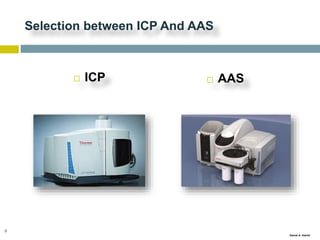
Selection between ICP And AAS
 ICP  AAS
4
Gamal A. Hamid
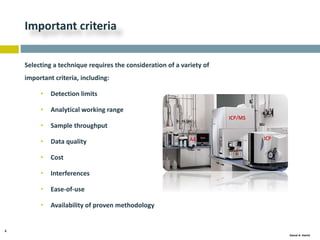
Important criteria
Selecting a technique requires the consideration of a variety of
important criteria, including:
• Detection limits
• Analytical working range
• Sample throughput
• Data quality
• Cost
• Interferences
• Ease-of-use
• Availability of proven methodology
IntroductionICP
6
Gamal A. Hamid
Emission
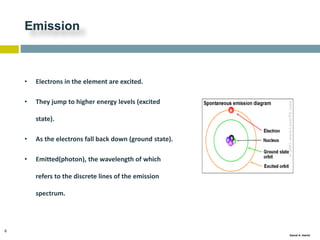
• Electrons in the element are excited.
• They jump to higher energy levels (excited
state).
• As the electrons fall back down (ground state).
• Emitted(photon), the wavelength of which
refers to the discrete lines of the emission
spectrum.
7
Gamal A. Hamid
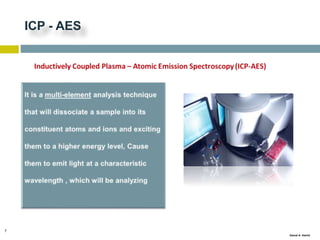
ICP - AES
8
Gamal A. Hamid
Technique
1. The sample is nebulized and entrained in the flow of plasma support gas, which is typically
Ar.
2. The plasma torch consists of concentric quartz tubes.
3. The inner tube contains the sample aerosol and Ar support gas and the outer tube contains
flowing gas to keep the tubes cool.
4. A Radiofrequency (RF) generator produces an oscillating current in an induction coil that
wraps around the tubes.
5. The induction coil creates an oscillating magnetic field, which produces an oscillating
magnetic field, The magnetic field in turn sets up an oscillating current in the ions and
electrons of the support gas (argon).
6. As the ions and electrons collide with other atoms in the support gas and temp increase.
9
Gamal A. Hamid
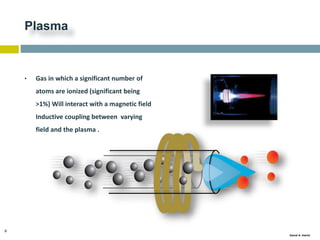
Plasma
• Gas in which a significant number of
atoms are ionized (significant being
>1%) Will interact with a magnetic field
Inductive coupling between varying
field and the plasma .
Fundamental partsICP
11
Gamal A. Hamid
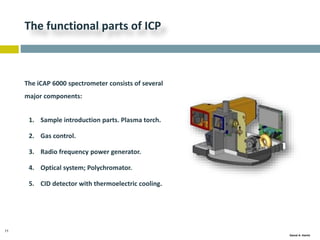
The functional parts of ICP
The iCAP 6000 spectrometer consists of several
major components:
1. Sample introduction parts. Plasma torch.
2. Gas control.
3. Radio frequency power generator.
4. Optical system; Polychromator.
5. CID detector with thermoelectric cooling.
12
Gamal A. Hamid
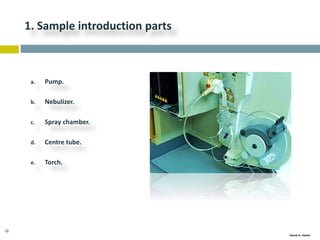
1. Sample introduction parts
a. Pump.
b. Nebulizer.
c. Spray chamber.
d. Centre tube.
e. Torch.
13
Gamal A. Hamid
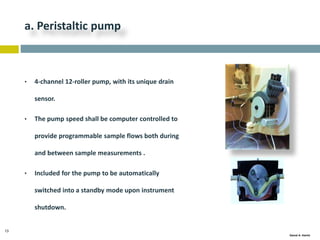
a. Peristaltic pump
• 4-channel 12-roller pump, with its unique drain
sensor.
• The pump speed shall be computer controlled to
provide programmable sample flows both during
and between sample measurements .
• Included for the pump to be automatically
switched into a standby mode upon instrument
shutdown.
14
Gamal A. Hamid
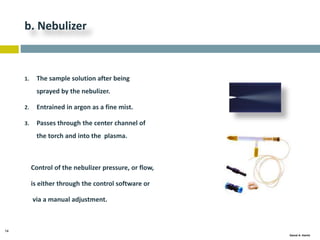
b. Nebulizer
1. The sample solution after being
sprayed by the nebulizer.
2. Entrained in argon as a fine mist.
3. Passes through the center channel of
the torch and into the plasma.
Control of the nebulizer pressure, or flow,
is either through the control software or
via a manual adjustment.
15
Gamal A. Hamid
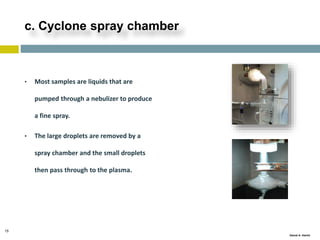
c. Cyclone spray chamber
• Most samples are liquids that are
pumped through a nebulizer to produce
a fine spray.
• The large droplets are removed by a
spray chamber and the small droplets
then pass through to the plasma.
16
Gamal A. Hamid
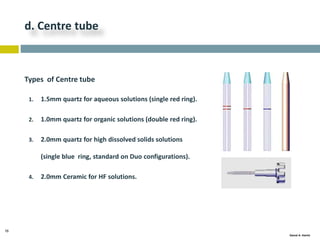
d. Centre tube
Types of Centre tube
1. 1.5mm quartz for aqueous solutions (single red ring).
2. 1.0mm quartz for organic solutions (double red ring).
3. 2.0mm quartz for high dissolved solids solutions
(single blue ring, standard on Duo configurations).
4. 2.0mm Ceramic for HF solutions.
17
Gamal A. Hamid
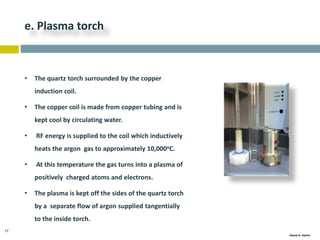
e. Plasma torch
• The quartz torch surrounded by the copper
induction coil.
• The copper coil is made from copper tubing and is
kept cool by circulating water.
• RF energy is supplied to the coil which inductively
heats the argon gas to approximately 10,000oC.
• At this temperature the gas turns into a plasma of
positively charged atoms and electrons.
• The plasma is kept off the sides of the quartz torch
by a separate flow of argon supplied tangentially
to the inside torch.
18
Gamal A. Hamid
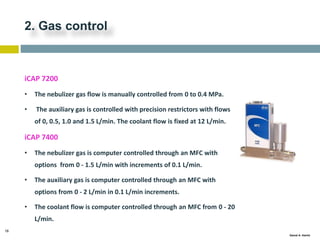
2. Gas control
iCAP 7200
• The nebulizer gas flow is manually controlled from 0 to 0.4 MPa.
• The auxiliary gas is controlled with precision restrictors with flows
of 0, 0.5, 1.0 and 1.5 L/min. The coolant flow is fixed at 12 L/min.
iCAP 7400
• The nebulizer gas is computer controlled through an MFC with
options from 0 - 1.5 L/min with increments of 0.1 L/min.
• The auxiliary gas is computer controlled through an MFC with
options from 0 - 2 L/min in 0.1 L/min increments.
• The coolant flow is computer controlled through an MFC from 0 - 20
L/min.
19
Gamal A. Hamid
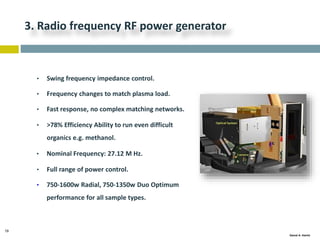
3. Radio frequency RF power generator
• Swing frequency impedance control.
• Frequency changes to match plasma load.
• Fast response, no complex matching networks.
• >78% Efficiency Ability to run even difficult
organics e.g. methanol.
• Nominal Frequency: 27.12 M Hz.
• Full range of power control.
• 750-1600w Radial, 750-1350w Duo Optimum
performance for all sample types.
20
Gamal A. Hamid
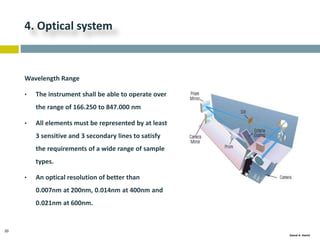
4. Optical system
Wavelength Range
• The instrument shall be able to operate over
the range of 166.250 to 847.000 nm
• All elements must be represented by at least
3 sensitive and 3 secondary lines to satisfy
the requirements of a wide range of sample
types.
• An optical resolution of better than
0.007nm at 200nm, 0.014nm at 400nm and
0.021nm at 600nm.
21
Gamal A. Hamid
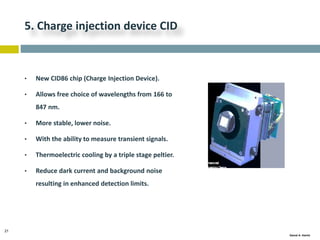
5. Charge injection device CID
• New CID86 chip (Charge Injection Device).
• Allows free choice of wavelengths from 166 to
847 nm.
• More stable, lower noise.
• With the ability to measure transient signals.
• Thermoelectric cooling by a triple stage peltier.
• Reduce dark current and background noise
resulting in enhanced detection limits.
IntroductionAAS
23
Gamal A. Hamid
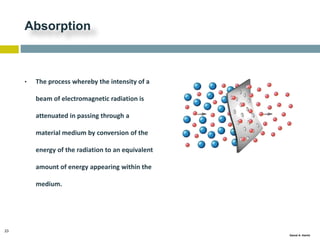
Absorption
• The process whereby the intensity of a
beam of electromagnetic radiation is
attenuated in passing through a
material medium by conversion of the
energy of the radiation to an equivalent
amount of energy appearing within the
medium.
24
Gamal A. Hamid
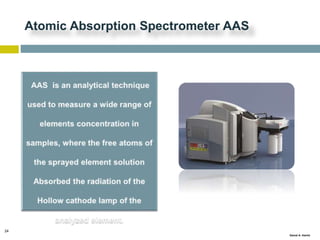
Atomic Absorption Spectrometer AAS
25
Gamal A. Hamid
Technique
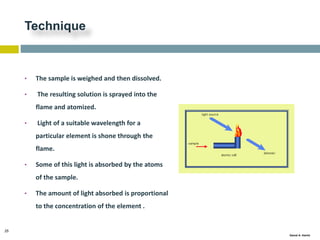
• The sample is weighed and then dissolved.
• The resulting solution is sprayed into the
flame and atomized.
• Light of a suitable wavelength for a
particular element is shone through the
flame.
• Some of this light is absorbed by the atoms
of the sample.
• The amount of light absorbed is proportional
to the concentration of the element .
Fundamental partsAAS
27
Gamal A. Hamid
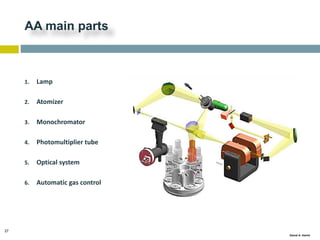
AA main parts
1. Lamp
2. Atomizer
3. Monochromator
4. Photomultiplier tube
5. Optical system
6. Automatic gas control
28
Gamal A. Hamid
1. Lamps
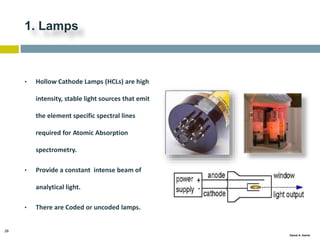
• Hollow Cathode Lamps (HCLs) are high
intensity, stable light sources that emit
the element specific spectral lines
required for Atomic Absorption
spectrometry.
• Provide a constant intense beam of
analytical light.
• There are Coded or uncoded lamps.
29
Gamal A. Hamid
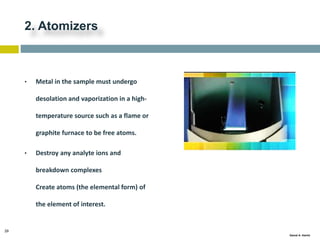
2. Atomizers
• Metal in the sample must undergo
desolation and vaporization in a high-
temperature source such as a flame or
graphite furnace to be free atoms.
• Destroy any analyte ions and
breakdown complexes
Create atoms (the elemental form) of
the element of interest.
30
Gamal A. Hamid
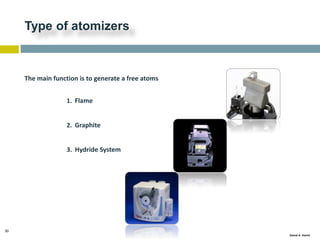
Type of atomizers
The main function is to generate a free atoms
1. Flame
2. Graphite
3. Hydride System
31
Gamal A. Hamid
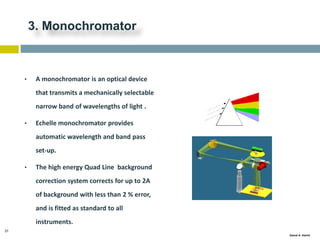
3. Monochromator
• A monochromator is an optical device
that transmits a mechanically selectable
narrow band of wavelengths of light .
• Echelle monochromator provides
automatic wavelength and band pass
set-up.
• The high energy Quad Line background
correction system corrects for up to 2A
of background with less than 2 % error,
and is fitted as standard to all
instruments.
32
Gamal A. Hamid
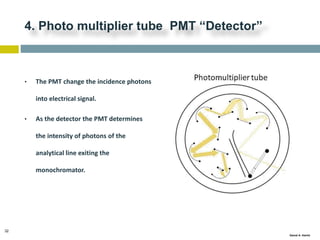
4. Photo multiplier tube PMT “Detector”
• The PMT change the incidence photons
into electrical signal.
• As the detector the PMT determines
the intensity of photons of the
analytical line exiting the
monochromator.
33
Gamal A. Hamid
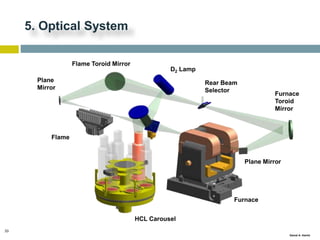
5. Optical System
Furnace
Toroid
Mirror
Flame Toroid Mirror
Plane Mirror
Rear Beam
Selector
Furnace
Plane
Mirror
Flame
HCL Carousel
D2 Lamp
34
Gamal A. Hamid
6. Automatic Gas Control
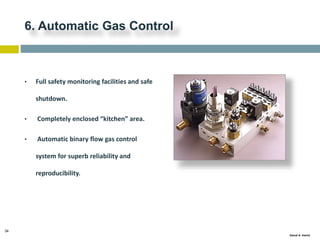
• Full safety monitoring facilities and safe
shutdown.
• Completely enclosed “kitchen” area.
• Automatic binary flow gas control
system for superb reliability and
reproducibility.
TechniquesAAS
36
Gamal A. Hamid
1. Flame Atomic Absorption FAAS
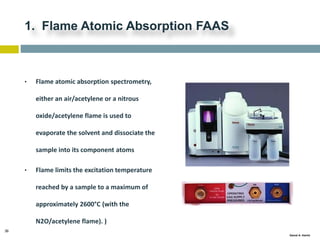
• Flame atomic absorption spectrometry,
either an air/acetylene or a nitrous
oxide/acetylene flame is used to
evaporate the solvent and dissociate the
sample into its component atoms
• Flame limits the excitation temperature
reached by a sample to a maximum of
approximately 2600°C (with the
N2O/acetylene flame). )
37
Gamal A. Hamid
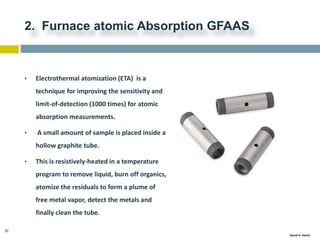
2. Furnace atomic Absorption GFAAS
• Electrothermal atomization (ETA) is a
technique for improving the sensitivity and
limit-of-detection (1000 times) for atomic
absorption measurements.
• A small amount of sample is placed inside a
hollow graphite tube.
• This is resistively-heated in a temperature
program to remove liquid, burn off organics,
atomize the residuals to form a plume of
free metal vapor, detect the metals and
finally clean the tube.
38
Gamal A. Hamid
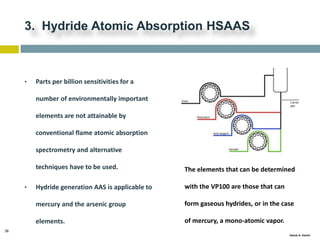
3. Hydride Atomic Absorption HSAAS
• Parts per billion sensitivities for a
number of environmentally important
elements are not attainable by
conventional flame atomic absorption
spectrometry and alternative
techniques have to be used.
• Hydride generation AAS is applicable to
mercury and the arsenic group
elements.
The elements that can be determined
with the VP100 are those that can
form gaseous hydrides, or in the case
of mercury, a mono-atomic vapor.
Analysis ICP & AAS
40
Gamal A. Hamid
Sample preparation
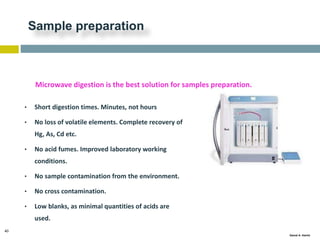
• Short digestion times. Minutes, not hours
• No loss of volatile elements. Complete recovery of
Hg, As, Cd etc.
• No acid fumes. Improved laboratory working
conditions.
• No sample contamination from the environment.
• No cross contamination.
• Low blanks, as minimal quantities of acids are
used.
Microwave digestion is the best solution for samples preparation.
41
Gamal A. Hamid
Standards preparation
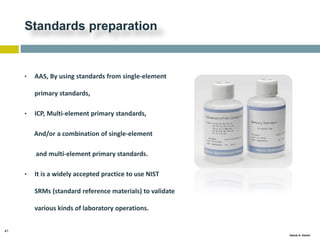
• AAS, By using standards from single-element
primary standards,
• ICP, Multi-element primary standards,
And/or a combination of single-element
and multi-element primary standards.
• It is a widely accepted practice to use NIST
SRMs (standard reference materials) to validate
various kinds of laboratory operations.
42
Gamal A. Hamid
Water & chemicals
• Forget about grids.
• But, All types of acids, water and
other used chemicals should be
free of the required elements.
43
Gamal A. Hamid
Calibration
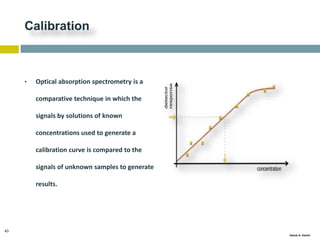
• Optical absorption spectrometry is a
comparative technique in which the
signals by solutions of known
concentrations used to generate a
calibration curve is compared to the
signals of unknown samples to generate
results.
Comparison
45
Gamal A. Hamid
Theory of Technique
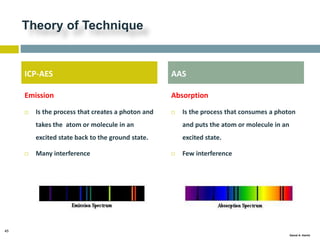
Emission
 Is the process that creates a photon and
takes the atom or molecule in an
excited state back to the ground state.
 Many interference
Absorption
 Is the process that consumes a photon
and puts the atom or molecule in an
excited state.
 Few interference
ICP-AES AAS
46
Gamal A. Hamid
Samples Throughput
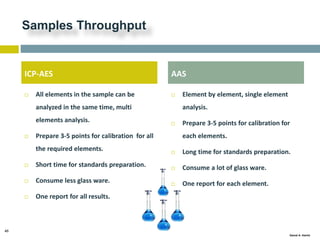
 All elements in the sample can be
analyzed in the same time, multi
elements analysis.
 Prepare 3-5 points for calibration for all
the required elements.
 Short time for standards preparation.
 Consume less glass ware.
 One report for all results.
 Element by element, single element
analysis.
 Prepare 3-5 points for calibration for
each elements.
 Long time for standards preparation.
 Consume a lot of glass ware.
 One report for each element.
ICP-AES AAS
47
Gamal A. Hamid
Element analysis
48
Gamal A. Hamid
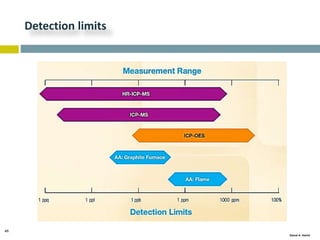
Detection limits
49
Gamal A. Hamid
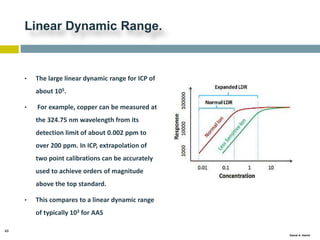
Linear Dynamic Range.
• The large linear dynamic range for ICP of
about 105.
• For example, copper can be measured at
the 324.75 nm wavelength from its
detection limit of about 0.002 ppm to
over 200 ppm. In ICP, extrapolation of
two point calibrations can be accurately
used to achieve orders of magnitude
above the top standard.
• This compares to a linear dynamic range
of typically 103 for AAS
50
Gamal A. Hamid
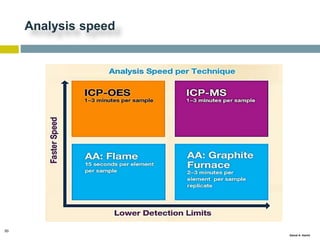
Analysis speed
51
Gamal A. Hamid
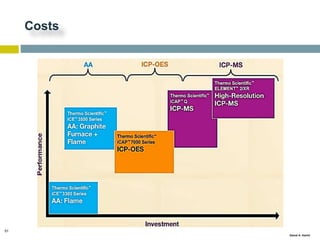
Costs
52
Gamal A. Hamid
Easy to use
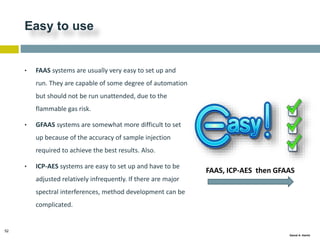
• FAAS systems are usually very easy to set up and
run. They are capable of some degree of automation
but should not be run unattended, due to the
flammable gas risk.
• GFAAS systems are somewhat more difficult to set
up because of the accuracy of sample injection
required to achieve the best results. Also.
• ICP-AES systems are easy to set up and have to be
adjusted relatively infrequently. If there are major
spectral interferences, method development can be
complicated.
FAAS, ICP-AES then GFAAS
53
Gamal A. Hamid
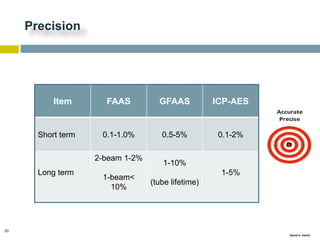
Precision
Item FAAS GFAAS ICP-AES
Short term 0.1-1.0% 0.5-5% 0.1-2%
Long term
2-beam 1-2%
1-beam<
10%
1-10%
(tube lifetime)
1-5%
54
Gamal A. Hamid
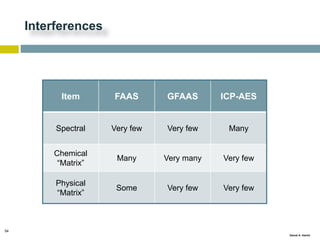
Interferences
Item FAAS GFAAS ICP-AES
Spectral Very few Very few Many
Chemical
“Matrix”
Many Very many Very few
Physical
“Matrix”
Some Very few Very few
55
Gamal A. Hamid
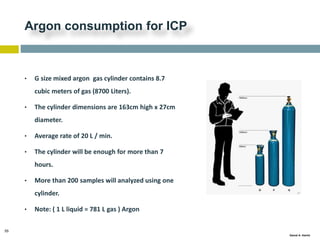
Argon consumption for ICP
• G size mixed argon gas cylinder contains 8.7
cubic meters of gas (8700 Liters).
• The cylinder dimensions are 163cm high x 27cm
diameter.
• Average rate of 20 L / min.
• The cylinder will be enough for more than 7
hours.
• More than 200 samples will analyzed using one
cylinder.
• Note: ( 1 L liquid = 781 L gas ) Argon
56
Gamal A. Hamid
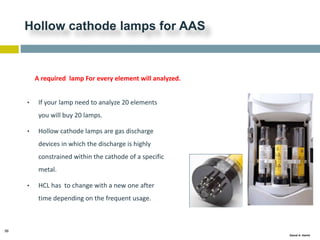
Hollow cathode lamps for AAS
• If your lamp need to analyze 20 elements
you will buy 20 lamps.
• Hollow cathode lamps are gas discharge
devices in which the discharge is highly
constrained within the cathode of a specific
metal.
• HCL has to change with a new one after
time depending on the frequent usage.
A required lamp For every element will analyzed.
Applications ICP & AAS
58
Gamal A. Hamid
Applications
1. Environmental Analyses Applications
2. Petrochemical Analyses
3. Metallurgical analyses
4. Geological analyses
5. Foodstuffs analyses
6. And more.
59
Gamal A. Hamid
Environmental
1. Waters – potable, natural, effluent,
wastewaters, sea and coastal waters
2. Soils – soils, sediments, foliage, biota,
contaminated land, landfill sites
3. Sludge's – solid and digested waste
4. Air – chimney exhaust filters, air filters
of contaminated sites, dusts
60
Gamal A. Hamid
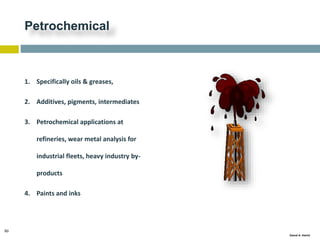
Petrochemical
1. Specifically oils & greases,
2. Additives, pigments, intermediates
3. Petrochemical applications at
refineries, wear metal analysis for
industrial fleets, heavy industry by-
products
4. Paints and inks
61
Gamal A. Hamid
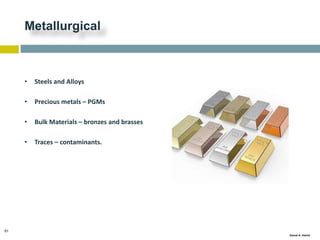
Metallurgical
• Steels and Alloys
• Precious metals – PGMs
• Bulk Materials – bronzes and brasses
• Traces – contaminants.
62
Gamal A. Hamid
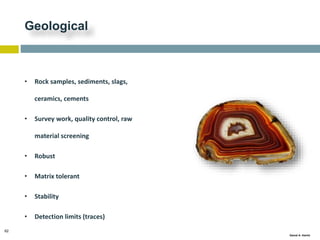
Geological
• Rock samples, sediments, slags,
ceramics, cements
• Survey work, quality control, raw
material screening
• Robust
• Matrix tolerant
• Stability
• Detection limits (traces)
63
Gamal A. Hamid
Foodstuffs
• Bulk materials, raw and finished
products in food production
• Trace analysis of micronutrients
• Toxins - contamination of land and sea
• Animal feed
• Crop analysis
gamal.abdelhamid@meslo.com.eg
gamal_a_hamid@hotmail.com

ICP / AAS Comparison

  • 1.
  • 2.
    2 Gamal A. Hamid Contents ICPor AAS  Introduction ICP  Fundamental parts of ICP  Introduction AAS  Fundamental parts of AAS  Analysis  Comparison  Applications
  • 3.
    3 Gamal A. Hamid Selectionbetween ICP And AAS  ICP  AAS
  • 4.
    4 Gamal A. Hamid Importantcriteria Selecting a technique requires the consideration of a variety of important criteria, including: • Detection limits • Analytical working range • Sample throughput • Data quality • Cost • Interferences • Ease-of-use • Availability of proven methodology
  • 5.
  • 6.
    6 Gamal A. Hamid Emission •Electrons in the element are excited. • They jump to higher energy levels (excited state). • As the electrons fall back down (ground state). • Emitted(photon), the wavelength of which refers to the discrete lines of the emission spectrum.
  • 7.
  • 8.
    8 Gamal A. Hamid Technique 1.The sample is nebulized and entrained in the flow of plasma support gas, which is typically Ar. 2. The plasma torch consists of concentric quartz tubes. 3. The inner tube contains the sample aerosol and Ar support gas and the outer tube contains flowing gas to keep the tubes cool. 4. A Radiofrequency (RF) generator produces an oscillating current in an induction coil that wraps around the tubes. 5. The induction coil creates an oscillating magnetic field, which produces an oscillating magnetic field, The magnetic field in turn sets up an oscillating current in the ions and electrons of the support gas (argon). 6. As the ions and electrons collide with other atoms in the support gas and temp increase.
  • 9.
    9 Gamal A. Hamid Plasma •Gas in which a significant number of atoms are ionized (significant being >1%) Will interact with a magnetic field Inductive coupling between varying field and the plasma .
  • 10.
  • 11.
    11 Gamal A. Hamid Thefunctional parts of ICP The iCAP 6000 spectrometer consists of several major components: 1. Sample introduction parts. Plasma torch. 2. Gas control. 3. Radio frequency power generator. 4. Optical system; Polychromator. 5. CID detector with thermoelectric cooling.
  • 12.
    12 Gamal A. Hamid 1.Sample introduction parts a. Pump. b. Nebulizer. c. Spray chamber. d. Centre tube. e. Torch.
  • 13.
    13 Gamal A. Hamid a.Peristaltic pump • 4-channel 12-roller pump, with its unique drain sensor. • The pump speed shall be computer controlled to provide programmable sample flows both during and between sample measurements . • Included for the pump to be automatically switched into a standby mode upon instrument shutdown.
  • 14.
    14 Gamal A. Hamid b.Nebulizer 1. The sample solution after being sprayed by the nebulizer. 2. Entrained in argon as a fine mist. 3. Passes through the center channel of the torch and into the plasma. Control of the nebulizer pressure, or flow, is either through the control software or via a manual adjustment.
  • 15.
    15 Gamal A. Hamid c.Cyclone spray chamber • Most samples are liquids that are pumped through a nebulizer to produce a fine spray. • The large droplets are removed by a spray chamber and the small droplets then pass through to the plasma.
  • 16.
    16 Gamal A. Hamid d.Centre tube Types of Centre tube 1. 1.5mm quartz for aqueous solutions (single red ring). 2. 1.0mm quartz for organic solutions (double red ring). 3. 2.0mm quartz for high dissolved solids solutions (single blue ring, standard on Duo configurations). 4. 2.0mm Ceramic for HF solutions.
  • 17.
    17 Gamal A. Hamid e.Plasma torch • The quartz torch surrounded by the copper induction coil. • The copper coil is made from copper tubing and is kept cool by circulating water. • RF energy is supplied to the coil which inductively heats the argon gas to approximately 10,000oC. • At this temperature the gas turns into a plasma of positively charged atoms and electrons. • The plasma is kept off the sides of the quartz torch by a separate flow of argon supplied tangentially to the inside torch.
  • 18.
    18 Gamal A. Hamid 2.Gas control iCAP 7200 • The nebulizer gas flow is manually controlled from 0 to 0.4 MPa. • The auxiliary gas is controlled with precision restrictors with flows of 0, 0.5, 1.0 and 1.5 L/min. The coolant flow is fixed at 12 L/min. iCAP 7400 • The nebulizer gas is computer controlled through an MFC with options from 0 - 1.5 L/min with increments of 0.1 L/min. • The auxiliary gas is computer controlled through an MFC with options from 0 - 2 L/min in 0.1 L/min increments. • The coolant flow is computer controlled through an MFC from 0 - 20 L/min.
  • 19.
    19 Gamal A. Hamid 3.Radio frequency RF power generator • Swing frequency impedance control. • Frequency changes to match plasma load. • Fast response, no complex matching networks. • >78% Efficiency Ability to run even difficult organics e.g. methanol. • Nominal Frequency: 27.12 M Hz. • Full range of power control. • 750-1600w Radial, 750-1350w Duo Optimum performance for all sample types.
  • 20.
    20 Gamal A. Hamid 4.Optical system Wavelength Range • The instrument shall be able to operate over the range of 166.250 to 847.000 nm • All elements must be represented by at least 3 sensitive and 3 secondary lines to satisfy the requirements of a wide range of sample types. • An optical resolution of better than 0.007nm at 200nm, 0.014nm at 400nm and 0.021nm at 600nm.
  • 21.
    21 Gamal A. Hamid 5.Charge injection device CID • New CID86 chip (Charge Injection Device). • Allows free choice of wavelengths from 166 to 847 nm. • More stable, lower noise. • With the ability to measure transient signals. • Thermoelectric cooling by a triple stage peltier. • Reduce dark current and background noise resulting in enhanced detection limits.
  • 22.
  • 23.
    23 Gamal A. Hamid Absorption •The process whereby the intensity of a beam of electromagnetic radiation is attenuated in passing through a material medium by conversion of the energy of the radiation to an equivalent amount of energy appearing within the medium.
  • 24.
    24 Gamal A. Hamid AtomicAbsorption Spectrometer AAS
  • 25.
    25 Gamal A. Hamid Technique •The sample is weighed and then dissolved. • The resulting solution is sprayed into the flame and atomized. • Light of a suitable wavelength for a particular element is shone through the flame. • Some of this light is absorbed by the atoms of the sample. • The amount of light absorbed is proportional to the concentration of the element .
  • 26.
  • 27.
    27 Gamal A. Hamid AAmain parts 1. Lamp 2. Atomizer 3. Monochromator 4. Photomultiplier tube 5. Optical system 6. Automatic gas control
  • 28.
    28 Gamal A. Hamid 1.Lamps • Hollow Cathode Lamps (HCLs) are high intensity, stable light sources that emit the element specific spectral lines required for Atomic Absorption spectrometry. • Provide a constant intense beam of analytical light. • There are Coded or uncoded lamps.
  • 29.
    29 Gamal A. Hamid 2.Atomizers • Metal in the sample must undergo desolation and vaporization in a high- temperature source such as a flame or graphite furnace to be free atoms. • Destroy any analyte ions and breakdown complexes Create atoms (the elemental form) of the element of interest.
  • 30.
    30 Gamal A. Hamid Typeof atomizers The main function is to generate a free atoms 1. Flame 2. Graphite 3. Hydride System
  • 31.
    31 Gamal A. Hamid 3.Monochromator • A monochromator is an optical device that transmits a mechanically selectable narrow band of wavelengths of light . • Echelle monochromator provides automatic wavelength and band pass set-up. • The high energy Quad Line background correction system corrects for up to 2A of background with less than 2 % error, and is fitted as standard to all instruments.
  • 32.
    32 Gamal A. Hamid 4.Photo multiplier tube PMT “Detector” • The PMT change the incidence photons into electrical signal. • As the detector the PMT determines the intensity of photons of the analytical line exiting the monochromator.
  • 33.
    33 Gamal A. Hamid 5.Optical System Furnace Toroid Mirror Flame Toroid Mirror Plane Mirror Rear Beam Selector Furnace Plane Mirror Flame HCL Carousel D2 Lamp
  • 34.
    34 Gamal A. Hamid 6.Automatic Gas Control • Full safety monitoring facilities and safe shutdown. • Completely enclosed “kitchen” area. • Automatic binary flow gas control system for superb reliability and reproducibility.
  • 35.
  • 36.
    36 Gamal A. Hamid 1.Flame Atomic Absorption FAAS • Flame atomic absorption spectrometry, either an air/acetylene or a nitrous oxide/acetylene flame is used to evaporate the solvent and dissociate the sample into its component atoms • Flame limits the excitation temperature reached by a sample to a maximum of approximately 2600°C (with the N2O/acetylene flame). )
  • 37.
    37 Gamal A. Hamid 2.Furnace atomic Absorption GFAAS • Electrothermal atomization (ETA) is a technique for improving the sensitivity and limit-of-detection (1000 times) for atomic absorption measurements. • A small amount of sample is placed inside a hollow graphite tube. • This is resistively-heated in a temperature program to remove liquid, burn off organics, atomize the residuals to form a plume of free metal vapor, detect the metals and finally clean the tube.
  • 38.
    38 Gamal A. Hamid 3.Hydride Atomic Absorption HSAAS • Parts per billion sensitivities for a number of environmentally important elements are not attainable by conventional flame atomic absorption spectrometry and alternative techniques have to be used. • Hydride generation AAS is applicable to mercury and the arsenic group elements. The elements that can be determined with the VP100 are those that can form gaseous hydrides, or in the case of mercury, a mono-atomic vapor.
  • 39.
  • 40.
    40 Gamal A. Hamid Samplepreparation • Short digestion times. Minutes, not hours • No loss of volatile elements. Complete recovery of Hg, As, Cd etc. • No acid fumes. Improved laboratory working conditions. • No sample contamination from the environment. • No cross contamination. • Low blanks, as minimal quantities of acids are used. Microwave digestion is the best solution for samples preparation.
  • 41.
    41 Gamal A. Hamid Standardspreparation • AAS, By using standards from single-element primary standards, • ICP, Multi-element primary standards, And/or a combination of single-element and multi-element primary standards. • It is a widely accepted practice to use NIST SRMs (standard reference materials) to validate various kinds of laboratory operations.
  • 42.
    42 Gamal A. Hamid Water& chemicals • Forget about grids. • But, All types of acids, water and other used chemicals should be free of the required elements.
  • 43.
    43 Gamal A. Hamid Calibration •Optical absorption spectrometry is a comparative technique in which the signals by solutions of known concentrations used to generate a calibration curve is compared to the signals of unknown samples to generate results.
  • 44.
  • 45.
    45 Gamal A. Hamid Theoryof Technique Emission  Is the process that creates a photon and takes the atom or molecule in an excited state back to the ground state.  Many interference Absorption  Is the process that consumes a photon and puts the atom or molecule in an excited state.  Few interference ICP-AES AAS
  • 46.
    46 Gamal A. Hamid SamplesThroughput  All elements in the sample can be analyzed in the same time, multi elements analysis.  Prepare 3-5 points for calibration for all the required elements.  Short time for standards preparation.  Consume less glass ware.  One report for all results.  Element by element, single element analysis.  Prepare 3-5 points for calibration for each elements.  Long time for standards preparation.  Consume a lot of glass ware.  One report for each element. ICP-AES AAS
  • 47.
  • 48.
  • 49.
    49 Gamal A. Hamid LinearDynamic Range. • The large linear dynamic range for ICP of about 105. • For example, copper can be measured at the 324.75 nm wavelength from its detection limit of about 0.002 ppm to over 200 ppm. In ICP, extrapolation of two point calibrations can be accurately used to achieve orders of magnitude above the top standard. • This compares to a linear dynamic range of typically 103 for AAS
  • 50.
  • 51.
  • 52.
    52 Gamal A. Hamid Easyto use • FAAS systems are usually very easy to set up and run. They are capable of some degree of automation but should not be run unattended, due to the flammable gas risk. • GFAAS systems are somewhat more difficult to set up because of the accuracy of sample injection required to achieve the best results. Also. • ICP-AES systems are easy to set up and have to be adjusted relatively infrequently. If there are major spectral interferences, method development can be complicated. FAAS, ICP-AES then GFAAS
  • 53.
    53 Gamal A. Hamid Precision ItemFAAS GFAAS ICP-AES Short term 0.1-1.0% 0.5-5% 0.1-2% Long term 2-beam 1-2% 1-beam< 10% 1-10% (tube lifetime) 1-5%
  • 54.
    54 Gamal A. Hamid Interferences ItemFAAS GFAAS ICP-AES Spectral Very few Very few Many Chemical “Matrix” Many Very many Very few Physical “Matrix” Some Very few Very few
  • 55.
    55 Gamal A. Hamid Argonconsumption for ICP • G size mixed argon gas cylinder contains 8.7 cubic meters of gas (8700 Liters). • The cylinder dimensions are 163cm high x 27cm diameter. • Average rate of 20 L / min. • The cylinder will be enough for more than 7 hours. • More than 200 samples will analyzed using one cylinder. • Note: ( 1 L liquid = 781 L gas ) Argon
  • 56.
    56 Gamal A. Hamid Hollowcathode lamps for AAS • If your lamp need to analyze 20 elements you will buy 20 lamps. • Hollow cathode lamps are gas discharge devices in which the discharge is highly constrained within the cathode of a specific metal. • HCL has to change with a new one after time depending on the frequent usage. A required lamp For every element will analyzed.
  • 57.
  • 58.
    58 Gamal A. Hamid Applications 1.Environmental Analyses Applications 2. Petrochemical Analyses 3. Metallurgical analyses 4. Geological analyses 5. Foodstuffs analyses 6. And more.
  • 59.
    59 Gamal A. Hamid Environmental 1.Waters – potable, natural, effluent, wastewaters, sea and coastal waters 2. Soils – soils, sediments, foliage, biota, contaminated land, landfill sites 3. Sludge's – solid and digested waste 4. Air – chimney exhaust filters, air filters of contaminated sites, dusts
  • 60.
    60 Gamal A. Hamid Petrochemical 1.Specifically oils & greases, 2. Additives, pigments, intermediates 3. Petrochemical applications at refineries, wear metal analysis for industrial fleets, heavy industry by- products 4. Paints and inks
  • 61.
    61 Gamal A. Hamid Metallurgical •Steels and Alloys • Precious metals – PGMs • Bulk Materials – bronzes and brasses • Traces – contaminants.
  • 62.
    62 Gamal A. Hamid Geological •Rock samples, sediments, slags, ceramics, cements • Survey work, quality control, raw material screening • Robust • Matrix tolerant • Stability • Detection limits (traces)
  • 63.
    63 Gamal A. Hamid Foodstuffs •Bulk materials, raw and finished products in food production • Trace analysis of micronutrients • Toxins - contamination of land and sea • Animal feed • Crop analysis
  • 64.