
NUCLEAR MAGNETIC RESONANCE (NMR)
Mr. PRASAD REDDY M. N
Indian Institute o f Cro p Pro cessing Techno lo gy
Ministry o f Fo o d Pro cessing Industries Go vernment o f India
Thanjavur-61 3005
 History
 Introduction to NMR
 Types of NMR
 Source of NMR
 Theory of NMR
 Principle of NMR
 Chemical shift
 Acquisition of spectra
 13
C NMR
 1
H NMR
 NMR set-up at IICPT
 Applications
 Summary
 References
Spectroscopy
 The study deals with interaction between electromagnetic
radiation with matter
 UV, IR, NMR Spectroscopy involves the interaction of
moleculeswith electromagnetic radiation.
 eg: An organic molecule is exposed to electromagnetic
energy of different wavelength and hencedifferent energy.
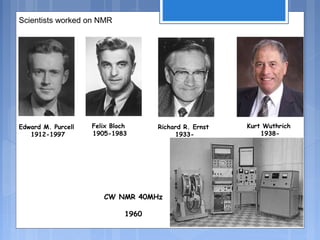
Felix Bloch
1905-1983
Edward M. Purcell
1912-1997
Kurt Wuthrich
1938-
Richard R. Ernst
1933-
CW NMR 40MHz
1960
Scientists worked on NMR
NMR spectroscopy is a powerful analytical technique used to
characterize organic molecules by identifying carbon-hydrogen
frameworks within molecules.
It is a research technique that exploits the magnetic properties
of certain atomic nuclei.
It determines the physical and chemical properties of atoms or
the molecules in which they are contained.
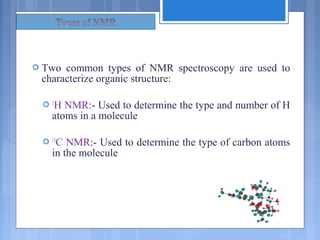
 Two common types of NMR spectroscopy are used to
characterize organic structure:
 1
H NMR:- Used to determine the type and number of H
atoms in a molecule
 13
C NMR:- Used to determine the type of carbon atoms
in the molecule
• The source of energy in NMR is radio waves which have
long wavelengths having more than 107
nm, and thus low
energy and frequency.
• When low-energy radio waves interact with a molecule, they
can change the nuclear spins of some elements, including 1
H
and 13
C.
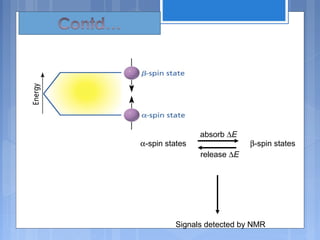
 In a magnetic field, there are now two energy states for a proton: a lower
energy state with the nucleus aligned in the same direction as Bo, and a
higher energy state in which the nucleus aligned against Bo.
 When an external energy source that matches the energy difference between
these two states is applied, energy is absorbed, causing the nucleus to “spin
flip” from one orientation to another.
 The energy difference between these two nuclear spin states corresponds to
the low frequency RF region of the electromagnetic spectrum.
 When a charged particle such as a proton spins on its axis, it
creates a magnetic field. Thus, the nucleus can be considered
to be a tiny bar magnet.
 Normally, these tiny bar magnets are randomly oriented in
space. However, in the presence of a magnetic field B0, they
are oriented with or against this applied field.
 More nuclei are oriented with the applied field because this
arrangement is lower in energy.
 The energy difference between these two states is very small
(<0.1 cal).
 Both liquid and solid type of samples can be used in NMR
spectroscopy.
 For liquid sample, conventional solution-state NMR spectroscopy
is used for analyzing where as for solid type sample, solid-state
spectroscopy NMR is used.
 In solid-phase media, samples like crystals, microcrystalline
powders, gels, anisotropic solutions, proteins, protein fibrils or all
kinds of polymers etc. can be used.
 In liquid phase, different types of liquid solutions, nucleic acid,
protein, carbohydrates etc. can be used.
Processmeasurement
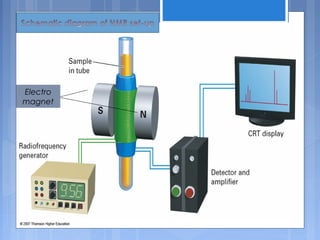
 The various or wet magnetic field strength is generated by
powerful magnet.
 A sample is irradiated with radio frequency of a constant
frequency
 When the magnetic field reaches the correct strength the
nuclei absorb energy and resonanceoccurs.
 This absorption causes a tiny electrical current (released
Radio frequency) to flow in receiver coil surrounding the
sample
 The instrument then amplifies this current and displays it as
signal peaks.
 Thesignal recorded isNMR spectrum.
Electro
magnet
 The sample is dissolved in a solvent, usually
CDCl3(deutero-chloroform), and placed in a magnetic field.
 A radiofrequency generator then irradiates the sample with
a short pulse of radiation, causing resonance.
 When the nuclei fall back to their lower energy state, the
detector measures the energy released and a spectrum is
recorded.
 Protons in different environments absorb at slightly
different frequencies, so they are distinguishable by NMR.
 The frequency at which a particular proton absorbs is
determined by its electronic environment.
 The size of the magnetic field generated by the electrons
around a proton determines where it absorbs.
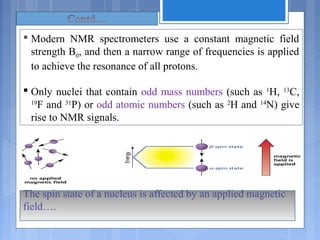
The spin state of a nucleus is affected by an applied magnetic
field….
 Modern NMR spectrometers use a constant magnetic field
strength B0, and then a narrow range of frequencies is applied
to achieve the resonance of all protons.
 Only nuclei that contain odd mass numbers (such as 1
H, 13
C,
19
F and 31
P) or odd atomic numbers (such as 2
H and 14
N) give
rise to NMR signals.
absorb ∆E
α-spin states β-spin states
release ∆E
Signals detected by NMR
 The relative energy of resonance of a particular nucleus resulting
from its local environment is called chemical shift.
 NMR spectra show applied field strength increasing from left to
right.
 Left part is downfield, the right is upfield.
 Nuclei that absorb on upfield side are strongly shielded where
nuclei that absorb on downfield side is weakly shielded.
 Chart calibrated versus a reference point, set as 0,
tetramethylsilane [TMS].
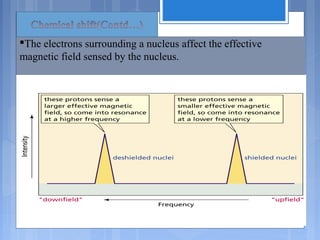
The electrons surrounding a nucleus affect the effective
magnetic field sensed by the nucleus.
Deshielded nuclei have a much higher energy difference
between the α- and β-spin states and these resonate at a much
higher frequency.
 Shielded nuclei do not ‘sense’ as large a magnetic field as
deshielded nuclei do. As a result, the energy difference
between the α- and β-spin states is much lower in energy for
shielded nuclei and resonate at a lower frequency.
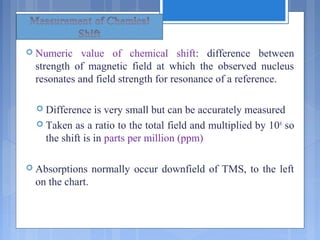
 Numeric value of chemical shift: difference between
strength of magnetic field at which the observed nucleus
resonates and field strength for resonance of a reference.
 Difference is very small but can be accurately measured
 Taken as a ratio to the total field and multiplied by 106
so
the shift is in parts per million (ppm)
 Absorptions normally occur downfield of TMS, to the left
on the chart.
 The received nuclear magnetic resonance response is very weak in
signal and requires a sensitive radio receiver to pick up.
 A Fourier transform is done to extract the frequency-domain
spectrum from the raw time-domain spectrum.
 Good 1
H NMR spectra can be acquired with 16 repeats, which
takes only minutes.
 However, for heavier elements than hydrogen, acquisition of
quantitative heavy-element spectra can be time-consuming, taking
tens of minutes to hours.
 Then a average of all the acquired spectrum will be generated and
displayed through the graph.
23
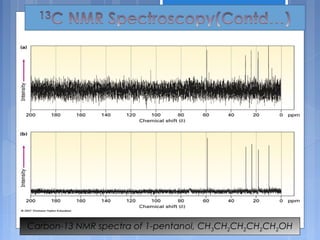
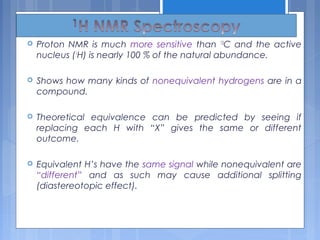
Carbon-13 NMR spectra of 1-pentanol, CH3CH2CH2CH2CH2OH
 Proton NMR is much more sensitive than 13
C and the active
nucleus (1
H) is nearly 100 % of the natural abundance.
 Shows how many kinds of nonequivalent hydrogens are in a
compound.
 Theoretical equivalence can be predicted by seeing if
replacing each H with “X” gives the same or different
outcome.
 Equivalent H’s have the same signal while nonequivalent are
“different” and as such may cause additional splitting
(diastereotopic effect).
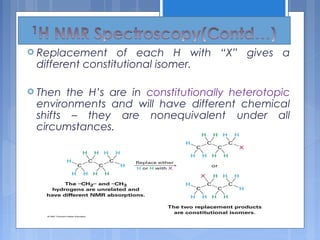
 Replacement of each H with “X” gives a
different constitutional isomer.
 Then the H’s are in constitutionally heterotopic
environments and will have different chemical
shifts – they are nonequivalent under all
circumstances.
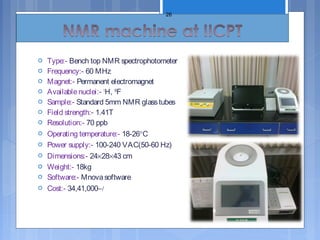
 Type:- Bench top NMR spectrophotometer
 Frequency:- 60 MHz
 Magnet:- Permanent electromagnet
 Availablenuclei:- 1
H, 19
F
 Sample:- Standard 5mm NMR glasstubes
 Field strength:- 1.41T
 Resolution:- 70 ppb
 Operating temperature:- 18-26°C
 Power supply:- 100-240 VAC(50-60 Hz)
 Dimensions:- 24×28×43 cm
 Weight:- 18kg
 Software:- Mnovasoftware
 Cost:- 34,41,000−/
26
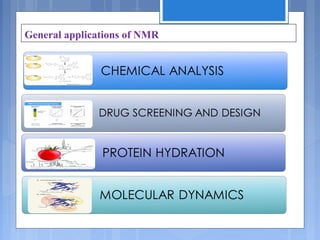
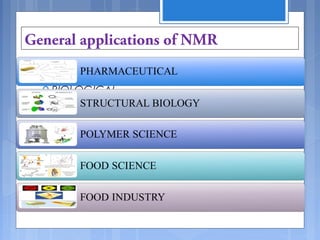
General applications of NMR
 BIOLOGICAL
Applicationsin food
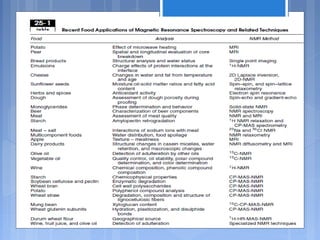
 The determination of fat or oil content in fresh food with
high water content is possible when pulsed-field-gradient
spin-echo-method isused.
 NMR is used to suppress unwanted signals in studies of
water droplet size distribution in oil (margarine, butter)
[Fourel et al., 1995]
 measurements of oil droplet size distribution on oil-in-water
emulsion (mayonnaise, dressings) [Goudappel et al., 2001].
 measurements and difusion experiments are very useful for
characterizing gels(e.g. yogurts)[Hinrichset al., 2003].
Specific Food Application Examples
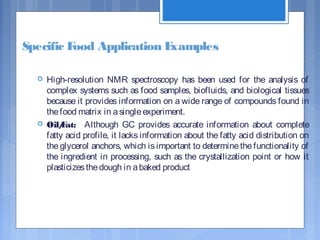
 High-resolution NMR spectroscopy has been used for the analysis of
complex systems such as food samples, biofluids, and biological tissues
because it provides information on a wide range of compounds found in
thefood matrix in asingleexperiment.
 Oil/Fat: Although GC provides accurate information about complete
fatty acid profile, it lacks information about the fatty acid distribution on
the glycerol anchors, which is important to determinethe functionality of
the ingredient in processing, such as the crystallization point or how it
plasticizesthedough in abaked product
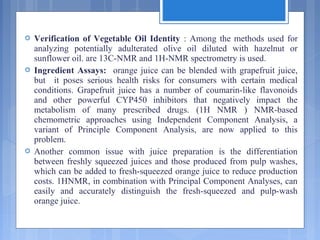
 Verification of Vegetable Oil Identity : Among the methods used for
analyzing potentially adulterated olive oil diluted with hazelnut or
sunflower oil. are 13C-NMR and 1H-NMR spectrometry is used.
 Ingredient Assays: orange juice can be blended with grapefruit juice,
but it poses serious health risks for consumers with certain medical
conditions. Grapefruit juice has a number of coumarin-like flavonoids
and other powerful CYP450 inhibitors that negatively impact the
metabolism of many prescribed drugs. (1H NMR ) NMR-based
chemometric approaches using Independent Component Analysis, a
variant of Principle Component Analysis, are now applied to this
problem.
 Another common issue with juice preparation is the differentiation
between freshly squeezed juices and those produced from pulp washes,
which can be added to fresh-squeezed orange juice to reduce production
costs. 1HNMR, in combination with Principal Component Analyses, can
easily and accurately distinguish the fresh-squeezed and pulp-wash
orange juice.
 NMR methods are used by other producers to improve
quality control in soft drink production, juice production,
and vegetableoil manufacturing.
 Similar methods also are used to monitor the quality of
functional foods and neutraceuticals (food extracts with
positive medicinal effects) that are harvested from different
geographic locations.
 Nuclear magnetic resonance spectroscopy
basically provides the detailed information about
the structure, dynamics, reaction state, and
chemical environment of molecules.
 It has various applications in food industries, food
science, chemical analysis of different products,
pharmaceutical approach etc.
 To analyse the carbon-hydrogen framework in the
molecule is the basic work of NMR technique.
34
 www.wikipedia.com
 "Background and Theory Page of Nuclear Magnetic
Resonance Facility". Mark Wainwright Analytical Centre -
University of Southern Wales Sydney. 9 December 2011.
Retrieved9 February 2014.
 Schweiger A, Geschke G.  Principles of Pulse
Paramagnetic Resonance.  Oxford University Press. Oxford,
2001.
 Haner, R.L. and Keifer, P.A. (2009). "Flow Probes for NMR
Spectroscopy". Encyclopedia of Magnetic
Resonance. doi:10.1002/9780470034590.emrstm1085. ISBN 
0470034599.
 Chapter 13. Nuclear Magnetic Resonance Spectroscopy.
Jo Blackburn. Richland College, Dallas, TX. Dallas County
Community College District. ã 2003 
 http://orgchem.colorado.edu/Spectroscopy/nmrtheory/T
HSNMR.ppt
35
THANK YOU
36

Nmr theory

  • 1.
    NUCLEAR MAGNETIC RESONANCE(NMR) Mr. PRASAD REDDY M. N Indian Institute o f Cro p Pro cessing Techno lo gy Ministry o f Fo o d Pro cessing Industries Go vernment o f India Thanjavur-61 3005
  • 2.
     History  Introductionto NMR  Types of NMR  Source of NMR  Theory of NMR  Principle of NMR  Chemical shift  Acquisition of spectra  13 C NMR  1 H NMR  NMR set-up at IICPT  Applications  Summary  References
  • 3.
    Spectroscopy  The studydeals with interaction between electromagnetic radiation with matter  UV, IR, NMR Spectroscopy involves the interaction of moleculeswith electromagnetic radiation.  eg: An organic molecule is exposed to electromagnetic energy of different wavelength and hencedifferent energy.
  • 4.
    Felix Bloch 1905-1983 Edward M.Purcell 1912-1997 Kurt Wuthrich 1938- Richard R. Ernst 1933- CW NMR 40MHz 1960 Scientists worked on NMR
  • 5.
    NMR spectroscopy isa powerful analytical technique used to characterize organic molecules by identifying carbon-hydrogen frameworks within molecules. It is a research technique that exploits the magnetic properties of certain atomic nuclei. It determines the physical and chemical properties of atoms or the molecules in which they are contained.
  • 6.
     Two commontypes of NMR spectroscopy are used to characterize organic structure:  1 H NMR:- Used to determine the type and number of H atoms in a molecule  13 C NMR:- Used to determine the type of carbon atoms in the molecule
  • 7.
    • The sourceof energy in NMR is radio waves which have long wavelengths having more than 107 nm, and thus low energy and frequency. • When low-energy radio waves interact with a molecule, they can change the nuclear spins of some elements, including 1 H and 13 C.
  • 8.
     In amagnetic field, there are now two energy states for a proton: a lower energy state with the nucleus aligned in the same direction as Bo, and a higher energy state in which the nucleus aligned against Bo.  When an external energy source that matches the energy difference between these two states is applied, energy is absorbed, causing the nucleus to “spin flip” from one orientation to another.  The energy difference between these two nuclear spin states corresponds to the low frequency RF region of the electromagnetic spectrum.
  • 9.
     When acharged particle such as a proton spins on its axis, it creates a magnetic field. Thus, the nucleus can be considered to be a tiny bar magnet.  Normally, these tiny bar magnets are randomly oriented in space. However, in the presence of a magnetic field B0, they are oriented with or against this applied field.  More nuclei are oriented with the applied field because this arrangement is lower in energy.  The energy difference between these two states is very small (<0.1 cal).
  • 10.
     Both liquidand solid type of samples can be used in NMR spectroscopy.  For liquid sample, conventional solution-state NMR spectroscopy is used for analyzing where as for solid type sample, solid-state spectroscopy NMR is used.  In solid-phase media, samples like crystals, microcrystalline powders, gels, anisotropic solutions, proteins, protein fibrils or all kinds of polymers etc. can be used.  In liquid phase, different types of liquid solutions, nucleic acid, protein, carbohydrates etc. can be used.
  • 11.
    Processmeasurement  The variousor wet magnetic field strength is generated by powerful magnet.  A sample is irradiated with radio frequency of a constant frequency  When the magnetic field reaches the correct strength the nuclei absorb energy and resonanceoccurs.  This absorption causes a tiny electrical current (released Radio frequency) to flow in receiver coil surrounding the sample  The instrument then amplifies this current and displays it as signal peaks.  Thesignal recorded isNMR spectrum.
  • 13.
  • 14.
     The sampleis dissolved in a solvent, usually CDCl3(deutero-chloroform), and placed in a magnetic field.  A radiofrequency generator then irradiates the sample with a short pulse of radiation, causing resonance.  When the nuclei fall back to their lower energy state, the detector measures the energy released and a spectrum is recorded.
  • 15.
     Protons indifferent environments absorb at slightly different frequencies, so they are distinguishable by NMR.  The frequency at which a particular proton absorbs is determined by its electronic environment.  The size of the magnetic field generated by the electrons around a proton determines where it absorbs.
  • 16.
    The spin stateof a nucleus is affected by an applied magnetic field….  Modern NMR spectrometers use a constant magnetic field strength B0, and then a narrow range of frequencies is applied to achieve the resonance of all protons.  Only nuclei that contain odd mass numbers (such as 1 H, 13 C, 19 F and 31 P) or odd atomic numbers (such as 2 H and 14 N) give rise to NMR signals.
  • 17.
    absorb ∆E α-spin statesβ-spin states release ∆E Signals detected by NMR
  • 18.
     The relativeenergy of resonance of a particular nucleus resulting from its local environment is called chemical shift.  NMR spectra show applied field strength increasing from left to right.  Left part is downfield, the right is upfield.  Nuclei that absorb on upfield side are strongly shielded where nuclei that absorb on downfield side is weakly shielded.  Chart calibrated versus a reference point, set as 0, tetramethylsilane [TMS].
  • 19.
    The electrons surroundinga nucleus affect the effective magnetic field sensed by the nucleus.
  • 20.
    Deshielded nuclei havea much higher energy difference between the α- and β-spin states and these resonate at a much higher frequency.  Shielded nuclei do not ‘sense’ as large a magnetic field as deshielded nuclei do. As a result, the energy difference between the α- and β-spin states is much lower in energy for shielded nuclei and resonate at a lower frequency.
  • 21.
     Numeric valueof chemical shift: difference between strength of magnetic field at which the observed nucleus resonates and field strength for resonance of a reference.  Difference is very small but can be accurately measured  Taken as a ratio to the total field and multiplied by 106 so the shift is in parts per million (ppm)  Absorptions normally occur downfield of TMS, to the left on the chart.
  • 22.
     The receivednuclear magnetic resonance response is very weak in signal and requires a sensitive radio receiver to pick up.  A Fourier transform is done to extract the frequency-domain spectrum from the raw time-domain spectrum.  Good 1 H NMR spectra can be acquired with 16 repeats, which takes only minutes.  However, for heavier elements than hydrogen, acquisition of quantitative heavy-element spectra can be time-consuming, taking tens of minutes to hours.  Then a average of all the acquired spectrum will be generated and displayed through the graph.
  • 23.
    23 Carbon-13 NMR spectraof 1-pentanol, CH3CH2CH2CH2CH2OH
  • 24.
     Proton NMRis much more sensitive than 13 C and the active nucleus (1 H) is nearly 100 % of the natural abundance.  Shows how many kinds of nonequivalent hydrogens are in a compound.  Theoretical equivalence can be predicted by seeing if replacing each H with “X” gives the same or different outcome.  Equivalent H’s have the same signal while nonequivalent are “different” and as such may cause additional splitting (diastereotopic effect).
  • 25.
     Replacement ofeach H with “X” gives a different constitutional isomer.  Then the H’s are in constitutionally heterotopic environments and will have different chemical shifts – they are nonequivalent under all circumstances.
  • 26.
     Type:- Benchtop NMR spectrophotometer  Frequency:- 60 MHz  Magnet:- Permanent electromagnet  Availablenuclei:- 1 H, 19 F  Sample:- Standard 5mm NMR glasstubes  Field strength:- 1.41T  Resolution:- 70 ppb  Operating temperature:- 18-26°C  Power supply:- 100-240 VAC(50-60 Hz)  Dimensions:- 24×28×43 cm  Weight:- 18kg  Software:- Mnovasoftware  Cost:- 34,41,000−/ 26
  • 27.
  • 28.
    General applications ofNMR  BIOLOGICAL
  • 29.
    Applicationsin food  Thedetermination of fat or oil content in fresh food with high water content is possible when pulsed-field-gradient spin-echo-method isused.  NMR is used to suppress unwanted signals in studies of water droplet size distribution in oil (margarine, butter) [Fourel et al., 1995]  measurements of oil droplet size distribution on oil-in-water emulsion (mayonnaise, dressings) [Goudappel et al., 2001].  measurements and difusion experiments are very useful for characterizing gels(e.g. yogurts)[Hinrichset al., 2003].
  • 30.
    Specific Food ApplicationExamples  High-resolution NMR spectroscopy has been used for the analysis of complex systems such as food samples, biofluids, and biological tissues because it provides information on a wide range of compounds found in thefood matrix in asingleexperiment.  Oil/Fat: Although GC provides accurate information about complete fatty acid profile, it lacks information about the fatty acid distribution on the glycerol anchors, which is important to determinethe functionality of the ingredient in processing, such as the crystallization point or how it plasticizesthedough in abaked product
  • 32.
     Verification ofVegetable Oil Identity : Among the methods used for analyzing potentially adulterated olive oil diluted with hazelnut or sunflower oil. are 13C-NMR and 1H-NMR spectrometry is used.  Ingredient Assays: orange juice can be blended with grapefruit juice, but it poses serious health risks for consumers with certain medical conditions. Grapefruit juice has a number of coumarin-like flavonoids and other powerful CYP450 inhibitors that negatively impact the metabolism of many prescribed drugs. (1H NMR ) NMR-based chemometric approaches using Independent Component Analysis, a variant of Principle Component Analysis, are now applied to this problem.  Another common issue with juice preparation is the differentiation between freshly squeezed juices and those produced from pulp washes, which can be added to fresh-squeezed orange juice to reduce production costs. 1HNMR, in combination with Principal Component Analyses, can easily and accurately distinguish the fresh-squeezed and pulp-wash orange juice.
  • 33.
     NMR methodsare used by other producers to improve quality control in soft drink production, juice production, and vegetableoil manufacturing.  Similar methods also are used to monitor the quality of functional foods and neutraceuticals (food extracts with positive medicinal effects) that are harvested from different geographic locations.
  • 34.
     Nuclear magneticresonance spectroscopy basically provides the detailed information about the structure, dynamics, reaction state, and chemical environment of molecules.  It has various applications in food industries, food science, chemical analysis of different products, pharmaceutical approach etc.  To analyse the carbon-hydrogen framework in the molecule is the basic work of NMR technique. 34
  • 35.
     www.wikipedia.com  "Backgroundand Theory Page of Nuclear Magnetic Resonance Facility". Mark Wainwright Analytical Centre - University of Southern Wales Sydney. 9 December 2011. Retrieved9 February 2014.  Schweiger A, Geschke G.  Principles of Pulse Paramagnetic Resonance.  Oxford University Press. Oxford, 2001.  Haner, R.L. and Keifer, P.A. (2009). "Flow Probes for NMR Spectroscopy". Encyclopedia of Magnetic Resonance. doi:10.1002/9780470034590.emrstm1085. ISBN  0470034599.  Chapter 13. Nuclear Magnetic Resonance Spectroscopy. Jo Blackburn. Richland College, Dallas, TX. Dallas County Community College District. ã 2003   http://orgchem.colorado.edu/Spectroscopy/nmrtheory/T HSNMR.ppt 35
  • 36.