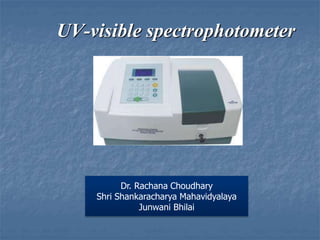
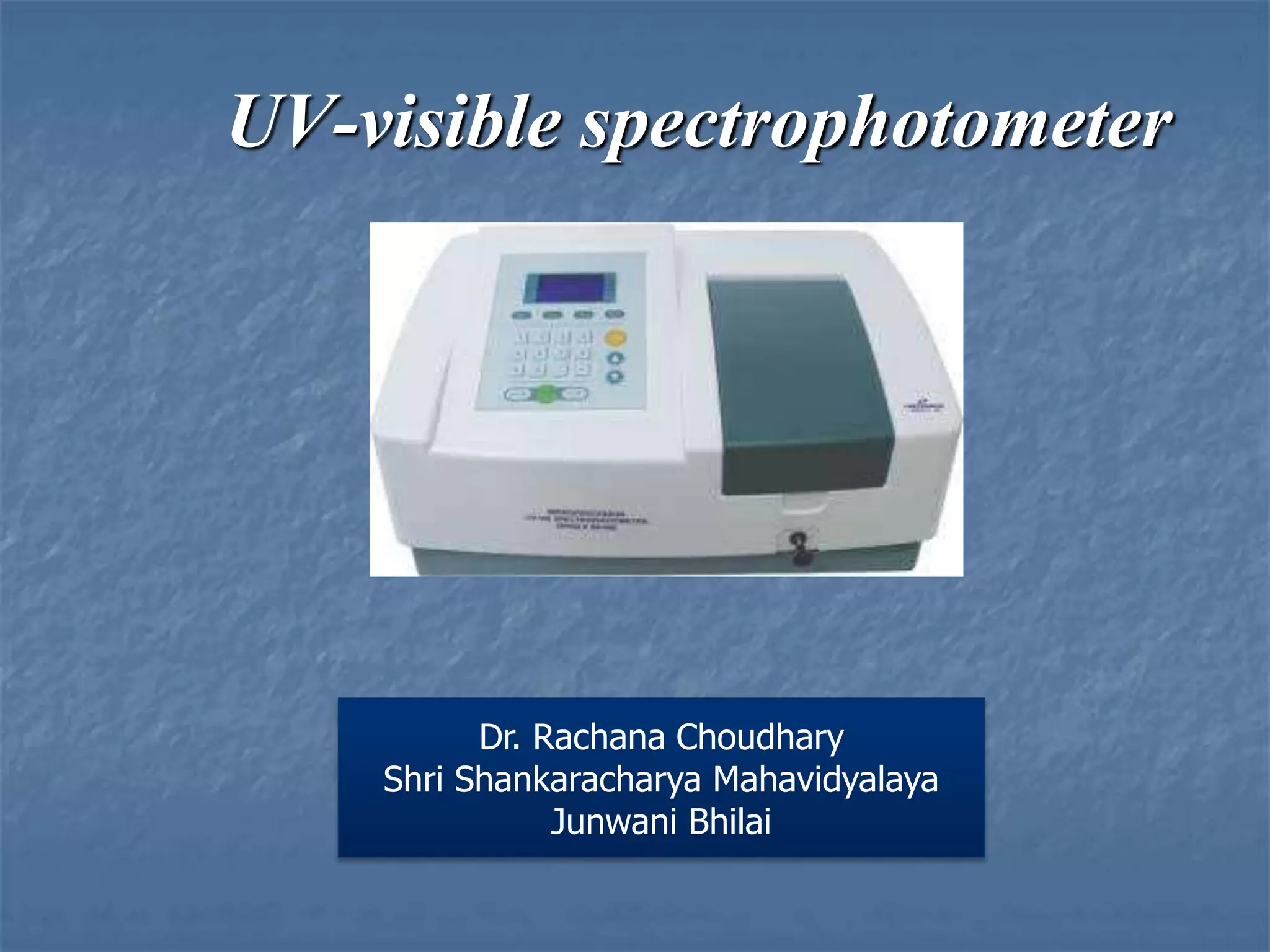
UV-visible spectrophotometer
Dr. Rachana Choudhary
Shri Shankaracharya Mahavidyalaya
Junwani Bhilai
Contents
 Introduction
 Absorption law
 Instrumentation
 Types of instruments
 Application
 Reference
Introduction
 A spectrophotometer is a photometer (a device
for measuring light intensity) that can measure
intensity as a function of the color (or more
specifically the wavelength).
 UV-visible spectroscopy or UV-visible
spectrophotometer involves the spectroscopy of
photons in the UV – visible region.
 This means it use light in the visible and
adjacent (near ultraviolet and near infrared)
range.
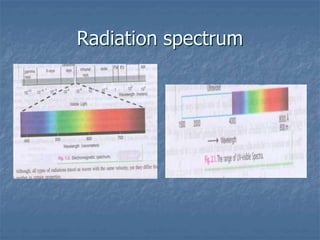
Radiation spectrum
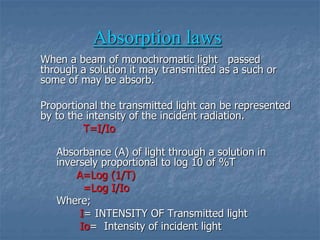
Absorption laws
When a beam of monochromatic light passed
through a solution it may transmitted as a such or
some of may be absorb.
Proportional the transmitted light can be represented
by to the intensity of the incident radiation.
T=I/Io
Absorbance (A) of light through a solution in
inversely proportional to log 10 of %T
A=Log (1/T)
=Log I/Io
Where;
I= INTENSITY OF Transmitted light
Io= Intensity of incident light
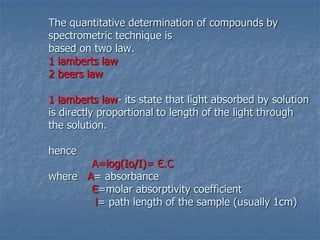
The quantitative determination of compounds by
spectrometric technique is
based on two law.
1 lamberts law
2 beers law
1 lamberts law- its state that light absorbed by solution
is directly proportional to length of the light through
the solution.
hence
A=log(Io/I)= Є.C
where A= absorbance
Є=molar absorptivity coefficient
l= path length of the sample (usually 1cm)
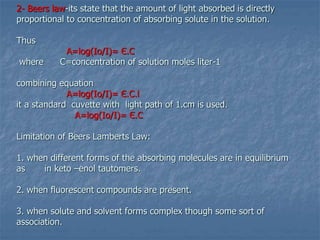
2- Beers law-its state that the amount of light absorbed is directly
proportional to concentration of absorbing solute in the solution.
Thus
A=log(Io/I)= Є.C
where C=concentration of solution moles liter-1
combining equation
A=log(Io/I)= Є.C.l
it a standard cuvette with light path of 1.cm is used.
A=log(Io/I)= Є.C
Limitation of Beers Lamberts Law:
1. when different forms of the absorbing molecules are in equilibrium
as in keto –enol tautomers.
2. when fluorescent compounds are present.
3. when solute and solvent forms complex though some sort of
association.
Instrumentation
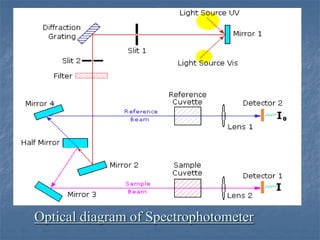
Spectrophotometer have the following basic
components.
1.Source
2.Filter and monochromators
3.Cell / sample holder
4.Detector
Optical diagram of Spectrophotometer
1-Source-: A continuous source of radiant energy covering the
region of spectrum in which the instrument is designed to work.
UV- Hydrogen Deuterium lamp
Visible- Tungsten lamp
2.Filter and monochromators-: A light filter is a device
that allow light of the required wavelength to pass but
absorbs light of the other wavelength wholly and
partially.
Filter-:filter are of two types
1 Absorption filter
2 Interference filter
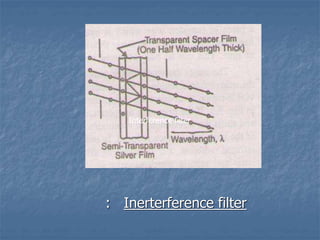
: Inerterference filter
Interference filter
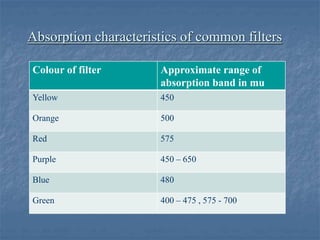
Absorption characteristics of common filters
Colour of filter Approximate range of
absorption band in mu
Yellow 450
Orange 500
Red 575
Purple 450 – 650
Blue 480
Green 400 – 475 , 575 - 700
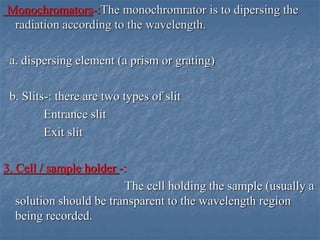
Monochromators-:The monochromrator is to dipersing the
radiation according to the wavelength.
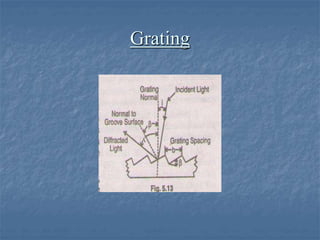
a. dispersing element (a prism or grating)
b. Slits-: there are two types of slit
Entrance slit
Exit slit
3. Cell / sample holder -:
The cell holding the sample (usually a
solution should be transparent to the wavelength region
being recorded.
Grating
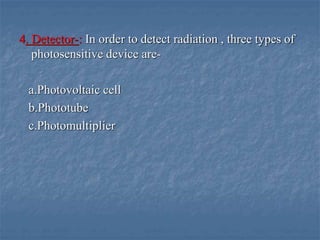
4. Detector-: In order to detect radiation , three types of
photosensitive device are-
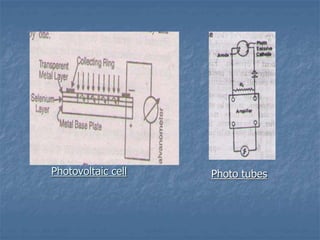
a.Photovoltaic cell
b.Phototube
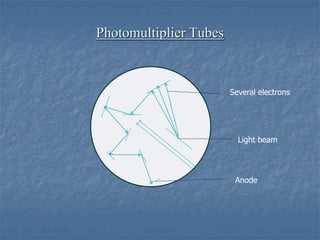
c.Photomultiplier
Photovoltaic cell Photo tubes
Photomultiplier Tubes
Several electrons
Light beam
Anode
Power supply-:
The power supply serves as triple function-
a. It decreases the line voltage to the instrument
operating level with a transformer.
b. It convert A.C to D.C with a rectifier if direct is
required by the instrument .
c. It smooths out any ripple which may occur in the line
voltages in order to deliver a constant voltage to the
source lamp and instrument.
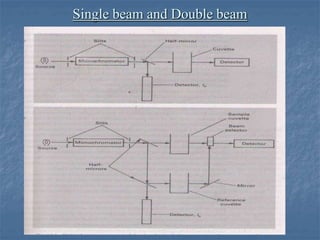
Types of instrument
 Single beam
 Double beam
Single beam and Double beam
Application
1. Detection of functional group
2. Extent of conjugation
3. Identification of unkown compound
4. Elucidation of the structure of vitamins-
5. Qualitative analysis
6. Quantitative analysis
7. Detection of impurities
Reference
 Instrumentation By B. K. Sharma
 Biophysical Chemistry by Upadhyay & Upadhyay
Nath.
 instrumental methods of chemical analysis by
chatwal
Thank You

Uv visible spectrophotometer

  • 1.
    UV-visible spectrophotometer Dr. RachanaChoudhary Shri Shankaracharya Mahavidyalaya Junwani Bhilai
  • 2.
    Contents  Introduction  Absorptionlaw  Instrumentation  Types of instruments  Application  Reference
  • 3.
    Introduction  A spectrophotometeris a photometer (a device for measuring light intensity) that can measure intensity as a function of the color (or more specifically the wavelength).  UV-visible spectroscopy or UV-visible spectrophotometer involves the spectroscopy of photons in the UV – visible region.  This means it use light in the visible and adjacent (near ultraviolet and near infrared) range.
  • 4.
  • 5.
    Absorption laws When abeam of monochromatic light passed through a solution it may transmitted as a such or some of may be absorb. Proportional the transmitted light can be represented by to the intensity of the incident radiation. T=I/Io Absorbance (A) of light through a solution in inversely proportional to log 10 of %T A=Log (1/T) =Log I/Io Where; I= INTENSITY OF Transmitted light Io= Intensity of incident light
  • 6.
    The quantitative determinationof compounds by spectrometric technique is based on two law. 1 lamberts law 2 beers law 1 lamberts law- its state that light absorbed by solution is directly proportional to length of the light through the solution. hence A=log(Io/I)= Є.C where A= absorbance Є=molar absorptivity coefficient l= path length of the sample (usually 1cm)
  • 7.
    2- Beers law-itsstate that the amount of light absorbed is directly proportional to concentration of absorbing solute in the solution. Thus A=log(Io/I)= Є.C where C=concentration of solution moles liter-1 combining equation A=log(Io/I)= Є.C.l it a standard cuvette with light path of 1.cm is used. A=log(Io/I)= Є.C Limitation of Beers Lamberts Law: 1. when different forms of the absorbing molecules are in equilibrium as in keto –enol tautomers. 2. when fluorescent compounds are present. 3. when solute and solvent forms complex though some sort of association.
  • 8.
    Instrumentation Spectrophotometer have thefollowing basic components. 1.Source 2.Filter and monochromators 3.Cell / sample holder 4.Detector
  • 9.
    Optical diagram ofSpectrophotometer
  • 10.
    1-Source-: A continuoussource of radiant energy covering the region of spectrum in which the instrument is designed to work. UV- Hydrogen Deuterium lamp Visible- Tungsten lamp 2.Filter and monochromators-: A light filter is a device that allow light of the required wavelength to pass but absorbs light of the other wavelength wholly and partially. Filter-:filter are of two types 1 Absorption filter 2 Interference filter
  • 11.
  • 12.
    Absorption characteristics ofcommon filters Colour of filter Approximate range of absorption band in mu Yellow 450 Orange 500 Red 575 Purple 450 – 650 Blue 480 Green 400 – 475 , 575 - 700
  • 13.
    Monochromators-:The monochromrator isto dipersing the radiation according to the wavelength. a. dispersing element (a prism or grating) b. Slits-: there are two types of slit Entrance slit Exit slit 3. Cell / sample holder -: The cell holding the sample (usually a solution should be transparent to the wavelength region being recorded.
  • 14.
  • 15.
    4. Detector-: Inorder to detect radiation , three types of photosensitive device are- a.Photovoltaic cell b.Phototube c.Photomultiplier
  • 16.
  • 17.
  • 18.
    Power supply-: The powersupply serves as triple function- a. It decreases the line voltage to the instrument operating level with a transformer. b. It convert A.C to D.C with a rectifier if direct is required by the instrument . c. It smooths out any ripple which may occur in the line voltages in order to deliver a constant voltage to the source lamp and instrument.
  • 19.
    Types of instrument Single beam  Double beam
  • 20.
    Single beam andDouble beam
  • 21.
    Application 1. Detection offunctional group 2. Extent of conjugation 3. Identification of unkown compound 4. Elucidation of the structure of vitamins- 5. Qualitative analysis 6. Quantitative analysis 7. Detection of impurities
  • 22.
    Reference  Instrumentation ByB. K. Sharma  Biophysical Chemistry by Upadhyay & Upadhyay Nath.  instrumental methods of chemical analysis by chatwal
  • 23.