2.4 – Circular Motion
Topic 2 - Mechanics
Acceleration
● Recall that when a nett force acts on an object
it causes an acceleration.
● This is the basis of Newton's second law
● This acceleration will cause a change in
velocity of the object
● It will change speed,
● It will change direction
● It will change speed and direction
Centripetal Acceleration
● Consider an object that is forced to go in a
circle by a string tied at the centre of that circle.
● IF the string is cut, the object will move off with
a linear velocity.
● IF the object is moving at constant speed then;
● There can be no component of acceleration in the
direction of the velocity.
● There must still be an acceleration towards the
centre of the circle because the string is there.
● The direction of the velocity must change by this
radial acceleration
Centripetal Acceleration
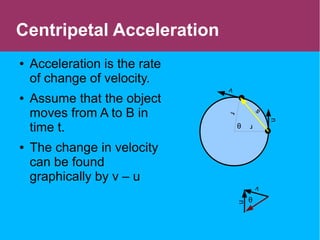
● Acceleration is the rate
of change of velocity.
● Assume that the object
moves from A to B in
time t.
● The change in velocity
can be found
graphically by v – u
u
v
r
rθ
u
v
s
θ
Centripetal Acceleration
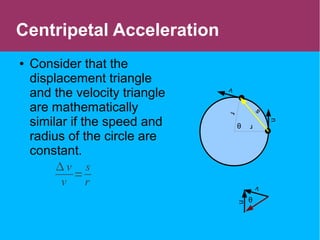
● Consider that the
displacement triangle
and the velocity triangle
are mathematically
similar if the speed and
radius of the circle are
constant.
u
v
r
rθ
u
v
 v
v
=
s
r
s
θ
Centripetal Acceleration
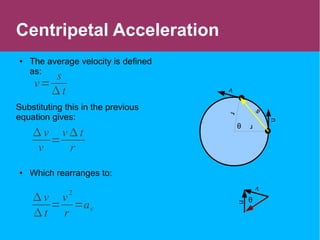
● The average velocity is defined
as:
Substituting this in the previous
equation gives:
● Which rearranges to:
u
v
r
rθ
u
v
v=
s
 t
s
θ
 v
v
=
v  t
r
 v
 t
=
v2
r
=ac
Centripetal Acceleration
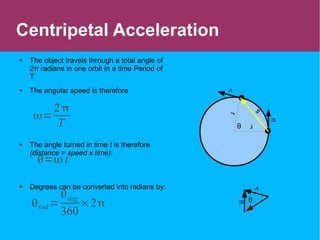
● The object travels through a total angle of
2π radians in one orbit in a time Period of
T
● The angular speed is therefore
● The angle turned in time t is therefore
(distance = speed x time):
● Degrees can be converted into radians by:
u
v
r
rθ
u
v
s
θ
=
2
T
rad =
deg
360
×2
= t
Centripetal Acceleration
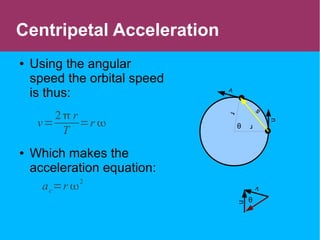
● Using the angular
speed the orbital speed
is thus:
● Which makes the
acceleration equation:
u
v
r
rθ
u
v
s
θ
v=
2 r
T
=r 
ac=r 2
Centripetal Acceleration
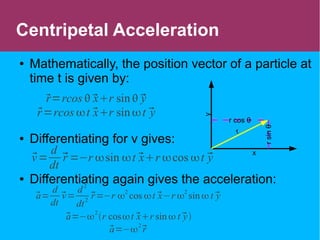
● Mathematically, the position vector of a particle at
time t is given by:
● Differentiating for v gives:
● Differentiating again gives the acceleration:
r=rcos  xr sin  y
r=rcos t xr sin t y
v=
d
dt
r =−r sin t xr cos t y
a=
d
dt
v=
d2
dt
2
r=−r 
2
cos t x−r 
2
sin  t y
a=−2
r cost xr sin t y
a=−
2
r
x
y
r
rsinθ
r cos θ
What causes this Acceleration?
● As has been shown, the uniform circular
acceleration occurs along a radius (radially) as
shown by the r in the equation and towards the
centre of the circle, as shown by the -.
● Any force that acts in this way will cause a
centripetal acceleration.
● e.g. the gravitational pull of the Earth on the Moon
causes the acceleration that keeps the Moon in
orbit.
● The sideways friction force (towards the centre) that
keeps a car's tyres from slipping outwards causes
the acceleration to make the car turn the corner.
Centrifugal Acceleration
● A centrifugal (centre-fleeing) acceleration does
not really exist.
● It is a consequence of Newton's first law that
states that objects with inertia will continue in a
straight line unless an external force acts.
● When we go around a corner in a car, we feel that
we are being thrown outwards.
● In reality our inertia causes us to try to go straight.
● The forces acting on the car tyres makes the car
accelerate (turn) across us.
● We collide with the side of the car, which exerts a
sideways force on us (Newton's 3rd
), that causes us
Questions
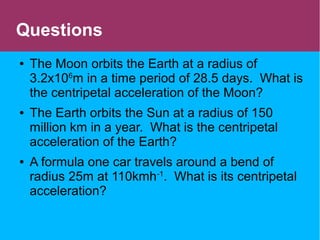
● The Moon orbits the Earth at a radius of
3.2x10⁶
m in a time period of 28.5 days. What is
the centripetal acceleration of the Moon?
● The Earth orbits the Sun at a radius of 150
million km in a year. What is the centripetal
acceleration of the Earth?
● A formula one car travels around a bend of
radius 25m at 110kmh-1
. What is its centripetal
acceleration?
Questions
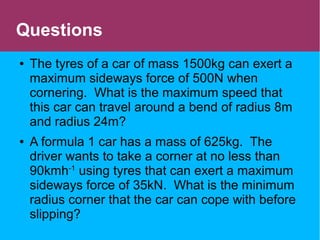
● The tyres of a car of mass 1500kg can exert a
maximum sideways force of 500N when
cornering. What is the maximum speed that
this car can travel around a bend of radius 8m
and radius 24m?
● A formula 1 car has a mass of 625kg. The
driver wants to take a corner at no less than
90kmh-1
using tyres that can exert a maximum
sideways force of 35kN. What is the minimum
radius corner that the car can cope with before
slipping?

2.4 circular motion

  • 1.
    2.4 – CircularMotion Topic 2 - Mechanics
  • 2.
    Acceleration ● Recall thatwhen a nett force acts on an object it causes an acceleration. ● This is the basis of Newton's second law ● This acceleration will cause a change in velocity of the object ● It will change speed, ● It will change direction ● It will change speed and direction
  • 3.
    Centripetal Acceleration ● Consideran object that is forced to go in a circle by a string tied at the centre of that circle. ● IF the string is cut, the object will move off with a linear velocity. ● IF the object is moving at constant speed then; ● There can be no component of acceleration in the direction of the velocity. ● There must still be an acceleration towards the centre of the circle because the string is there. ● The direction of the velocity must change by this radial acceleration
  • 4.
    Centripetal Acceleration ● Accelerationis the rate of change of velocity. ● Assume that the object moves from A to B in time t. ● The change in velocity can be found graphically by v – u u v r rθ u v s θ
  • 5.
    Centripetal Acceleration ● Considerthat the displacement triangle and the velocity triangle are mathematically similar if the speed and radius of the circle are constant. u v r rθ u v  v v = s r s θ
  • 6.
    Centripetal Acceleration ● Theaverage velocity is defined as: Substituting this in the previous equation gives: ● Which rearranges to: u v r rθ u v v= s  t s θ  v v = v  t r  v  t = v2 r =ac
  • 7.
    Centripetal Acceleration ● Theobject travels through a total angle of 2π radians in one orbit in a time Period of T ● The angular speed is therefore ● The angle turned in time t is therefore (distance = speed x time): ● Degrees can be converted into radians by: u v r rθ u v s θ = 2 T rad = deg 360 ×2 = t
  • 8.
    Centripetal Acceleration ● Usingthe angular speed the orbital speed is thus: ● Which makes the acceleration equation: u v r rθ u v s θ v= 2 r T =r  ac=r 2
  • 9.
    Centripetal Acceleration ● Mathematically,the position vector of a particle at time t is given by: ● Differentiating for v gives: ● Differentiating again gives the acceleration: r=rcos  xr sin  y r=rcos t xr sin t y v= d dt r =−r sin t xr cos t y a= d dt v= d2 dt 2 r=−r  2 cos t x−r  2 sin  t y a=−2 r cost xr sin t y a=− 2 r x y r rsinθ r cos θ
  • 10.
    What causes thisAcceleration? ● As has been shown, the uniform circular acceleration occurs along a radius (radially) as shown by the r in the equation and towards the centre of the circle, as shown by the -. ● Any force that acts in this way will cause a centripetal acceleration. ● e.g. the gravitational pull of the Earth on the Moon causes the acceleration that keeps the Moon in orbit. ● The sideways friction force (towards the centre) that keeps a car's tyres from slipping outwards causes the acceleration to make the car turn the corner.
  • 11.
    Centrifugal Acceleration ● Acentrifugal (centre-fleeing) acceleration does not really exist. ● It is a consequence of Newton's first law that states that objects with inertia will continue in a straight line unless an external force acts. ● When we go around a corner in a car, we feel that we are being thrown outwards. ● In reality our inertia causes us to try to go straight. ● The forces acting on the car tyres makes the car accelerate (turn) across us. ● We collide with the side of the car, which exerts a sideways force on us (Newton's 3rd ), that causes us
  • 12.
    Questions ● The Moonorbits the Earth at a radius of 3.2x10⁶ m in a time period of 28.5 days. What is the centripetal acceleration of the Moon? ● The Earth orbits the Sun at a radius of 150 million km in a year. What is the centripetal acceleration of the Earth? ● A formula one car travels around a bend of radius 25m at 110kmh-1 . What is its centripetal acceleration?
  • 13.
    Questions ● The tyresof a car of mass 1500kg can exert a maximum sideways force of 500N when cornering. What is the maximum speed that this car can travel around a bend of radius 8m and radius 24m? ● A formula 1 car has a mass of 625kg. The driver wants to take a corner at no less than 90kmh-1 using tyres that can exert a maximum sideways force of 35kN. What is the minimum radius corner that the car can cope with before slipping?