Topic 9.3 
3.4.1 AC Motors
AC Motor Construction 
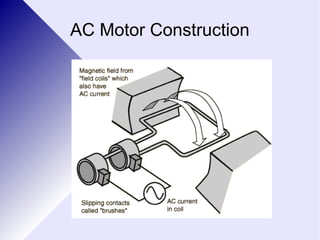
● An AC motor is structurally identical to a DC motor except 
that it has a slip-ring commutator rather than the split ring of 
a DC motor. 
● This is because the current in the coil changes direction 
due to its AC nature and doesn't need to be mechanically 
flipped. 
● This means that the rotation speed is harder to control as 
it is related to the frequency of the AC supply. 
● It is common in AC motors to use electromagnets (field coils) 
to create the stator field.
AC Motor Construction
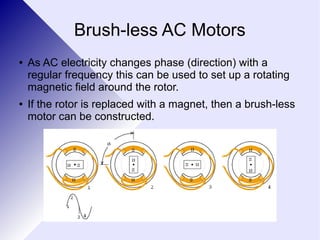
Brush-less AC Motors 
● As AC electricity changes phase (direction) with a 
regular frequency this can be used to set up a rotating 
magnetic field around the rotor. 
● If the rotor is replaced with a magnet, then a brush-less 
motor can be constructed.
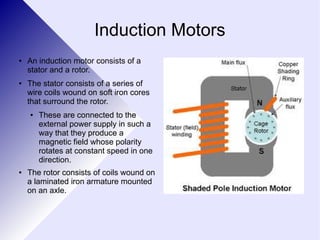
Induction Motors 
● An induction motor consists of a 
stator and a rotor. 
● The stator consists of a series of 
wire coils wound on soft iron cores 
that surround the rotor. 
● These are connected to the 
external power supply in such a 
way that they produce a 
magnetic field whose polarity 
rotates at constant speed in one 
direction. 
● The rotor consists of coils wound on 
a laminated iron armature mounted 
on an axle.
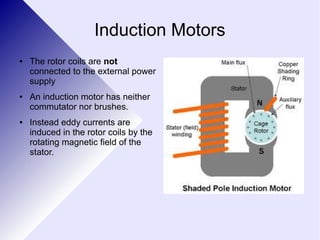
Induction Motors 
● The rotor coils are not 
connected to the external power 
supply 
● An induction motor has neither 
commutator nor brushes. 
● Instead eddy currents are 
induced in the rotor coils by the 
rotating magnetic field of the 
stator.
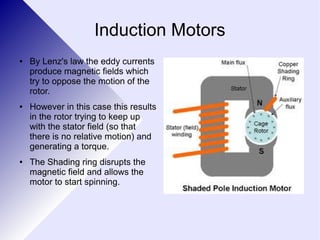
Induction Motors 
● By Lenz's law the eddy currents 
produce magnetic fields which 
try to oppose the motion of the 
rotor. 
● However in this case this results 
in the rotor trying to keep up 
with the stator field (so that 
there is no relative motion) and 
generating a torque. 
● The Shading ring disrupts the 
magnetic field and allows the 
motor to start spinning.
Induction Motors 
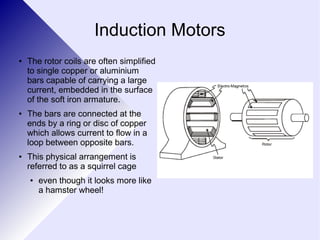
● The rotor coils are often simplified 
to single copper or aluminium 
bars capable of carrying a large 
current, embedded in the surface 
of the soft iron armature. 
● The bars are connected at the 
ends by a ring or disc of copper 
which allows current to flow in a 
loop between opposite bars. 
● This physical arrangement is 
referred to as a squirrel cage 
● even though it looks more like 
a hamster wheel!
Energy Transfers in the Home and 
Industry 
● There are many many examples of energy 
transfers in the home. 
● Remember that no energy transfer in the real 
world is ever 100% efficient 
● energy will always be wasted as thermal 
energy (and light and sound) in each change.
Energy Transfers in the Home and 
Industry 
● Good examples to give could 
include: 
Electrical → Kinetic: 
Electrical → Thermal: 
Electrical → Light: 
Electrical → Chemical: 
Electrical → Sound: 
● any device with a motor such as a 
washing machine. 
● any device that heats up such a 
kettle or toaster. 
● anything that glows or gives off 
light: lightbulb? 
● Battery re-chargers are good 
examples. 
● The best example is speakers 
(even though we know this goes 
via kinetic energy)

3.4.1 ac motors

  • 1.
    Topic 9.3 3.4.1AC Motors
  • 2.
    AC Motor Construction ● An AC motor is structurally identical to a DC motor except that it has a slip-ring commutator rather than the split ring of a DC motor. ● This is because the current in the coil changes direction due to its AC nature and doesn't need to be mechanically flipped. ● This means that the rotation speed is harder to control as it is related to the frequency of the AC supply. ● It is common in AC motors to use electromagnets (field coils) to create the stator field.
  • 3.
  • 4.
    Brush-less AC Motors ● As AC electricity changes phase (direction) with a regular frequency this can be used to set up a rotating magnetic field around the rotor. ● If the rotor is replaced with a magnet, then a brush-less motor can be constructed.
  • 5.
    Induction Motors ●An induction motor consists of a stator and a rotor. ● The stator consists of a series of wire coils wound on soft iron cores that surround the rotor. ● These are connected to the external power supply in such a way that they produce a magnetic field whose polarity rotates at constant speed in one direction. ● The rotor consists of coils wound on a laminated iron armature mounted on an axle.
  • 6.
    Induction Motors ●The rotor coils are not connected to the external power supply ● An induction motor has neither commutator nor brushes. ● Instead eddy currents are induced in the rotor coils by the rotating magnetic field of the stator.
  • 7.
    Induction Motors ●By Lenz's law the eddy currents produce magnetic fields which try to oppose the motion of the rotor. ● However in this case this results in the rotor trying to keep up with the stator field (so that there is no relative motion) and generating a torque. ● The Shading ring disrupts the magnetic field and allows the motor to start spinning.
  • 8.
    Induction Motors ●The rotor coils are often simplified to single copper or aluminium bars capable of carrying a large current, embedded in the surface of the soft iron armature. ● The bars are connected at the ends by a ring or disc of copper which allows current to flow in a loop between opposite bars. ● This physical arrangement is referred to as a squirrel cage ● even though it looks more like a hamster wheel!
  • 9.
    Energy Transfers inthe Home and Industry ● There are many many examples of energy transfers in the home. ● Remember that no energy transfer in the real world is ever 100% efficient ● energy will always be wasted as thermal energy (and light and sound) in each change.
  • 10.
    Energy Transfers inthe Home and Industry ● Good examples to give could include: Electrical → Kinetic: Electrical → Thermal: Electrical → Light: Electrical → Chemical: Electrical → Sound: ● any device with a motor such as a washing machine. ● any device that heats up such a kettle or toaster. ● anything that glows or gives off light: lightbulb? ● Battery re-chargers are good examples. ● The best example is speakers (even though we know this goes via kinetic energy)