Introduction

Consider the following
day-to-day activities
which we consider as work:
Reading, speaking, singing,
writing, thinking etc. We
require energy to perform
these activities, which we
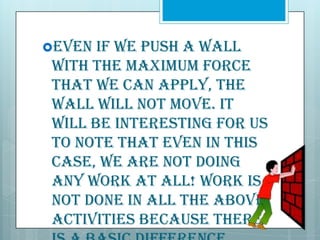
Even

if we push a wall
with the maximum force
that we can apply, the
wall will not move. It
will be interesting for us
to note that even in this
case, we are not doing
any work at all! Work is
not done in all the above
activities because there
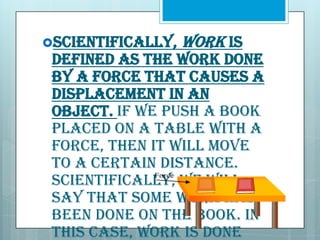
Scientifically,

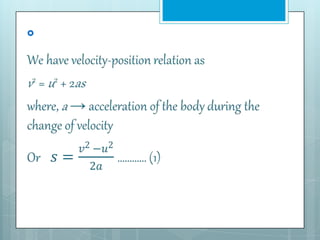
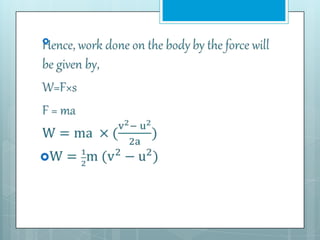
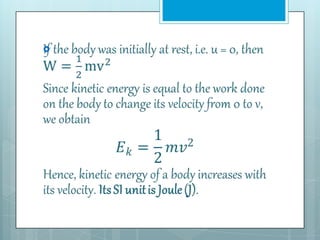
work is

defined as the work done
by a force that causes a
displacement in an
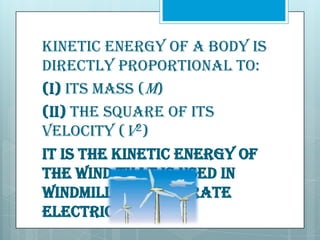
object. If we push a book
placed on a table with a
force, then it will move
to a certain distance.
Scientifically, we will
say that some work has
been done on the book. In
this case, work is done
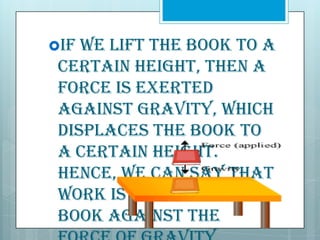
If

we lift the book to a
certain height, then a
force is exerted
against gravity, which
displaces the book to
a certain height.
Hence, we can say that
work is done on the
book against the
Work done
Whenever

displacement
is brought in the line of
force applied we call it
as work done.
Mathematically work
done is given a symbol W
and it is defined as the
product of force(F) and
There

could be four
different cases according to
the force and displacement
relationship. If:
+Force +Displacement =
+Work
-Force -Displacement =
+Work
-Force +Displacement = -Work
+Force -Displacement = -Work
Work Done By a Constant Force
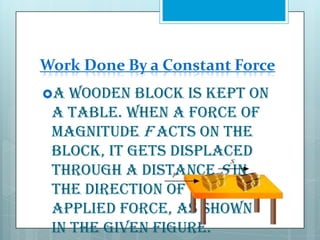
A

wooden block is kept on
a table. When a force of
magnitude F acts on the
block, it gets displaced
through a distance S in
the direction of the
applied force, as shown
in the given figure.
The magnitude of work
done is given by the
product of force (F) and
displacement (S). Let W be
the work done on the
block.
∴
Work = Force ×
Displacement
W= F × S
Unit of Work
To obtain the unit of work, we
substitute the SI units of
force, i.e. N, and distance, i.e.
m, in the equation of work.
W = N × m = Nm
Hence, the unit of work is Nm. In
the honor of physicist James P.
Joule, the SI unit of work is
written as Joule (J).
Hence, 1 J = 1 Nm
1 Joule is defined as the
Work done against gravity
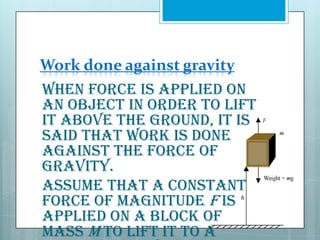
When force is applied on
an object in order to lift
it above the ground, it is
said that work is done
against the force of
gravity.
Assume that a constant
force of magnitude F is
applied on a block of
mass m to lift it to a
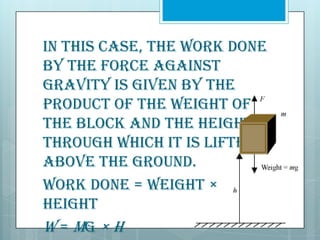
In this case, the work done
by the force against
gravity is given by the
product of the weight of
the block and the height
through which it is lifted
above the ground.
Work done = Weight ×
Height
W = mg × h
Negative work
If the force acts opposite to
the direction of displacement,
then the WORK done will be
negative i.e. W=F x (-s) or (-F x
s). Here, the directions of
displacement (S) and applied
force (F) are exactly opposite
to each other. Suppose, a
soccer player moves
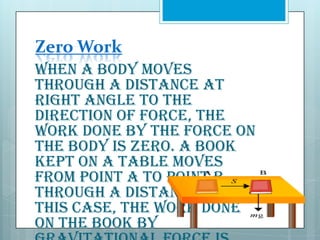
Zero Work
When a body moves
through a distance at
right angle to the
direction of force, the
work done by the force on
the body is zero. A book
kept on a table moves
from point A to point B
through a distance S. In
this case, the work done
on the book by
Energy
The world requires a lot
of energy. To satisfy this
demand, we have natural
energy sources such as
the sun, wind, water at a
height, tides, etc. We also
have artificial energy
sources such as
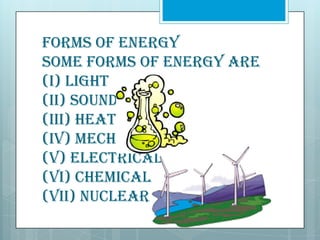
Forms of energy
Some forms of energy are
(i) Light
(ii) Sound
(iii) Heat
(iv) Mechanical
(v) Electrical
(vi) Chemical
(vii) Nuclear
Mechanical energy
It is the form of energy
possessed by an object that
has the potential to do work.
It is caused by the motion or
the position and
configuration of the object.
Mechanical energy is of two
types.
(i) Kinetic energy (caused by
Kinetic energy
Energy stored into an
object due to its motion. A
moving arrow can be
embedded into an object.
Hence, it is said that the
arrow possesses kinetic
energy. The elastic string
of a catapult is stretched
to throw a stone. The
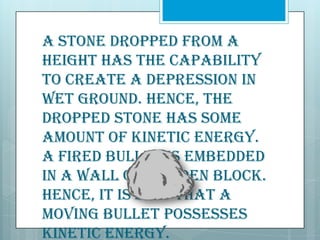
A stone dropped from a
height has the capability
to create a depression in
wet ground. Hence, the
dropped stone has some
amount of kinetic energy.
A fired bullet is embedded
in a wall or wooden block.
Hence, it is said that a
moving bullet possesses
kinetic energy.
Formula for kinetic energy
Kinetic energy of a moving
body is equal to the work
required to change its
velocity from u to v.
Let a body of mass m be
moving with a uniform
velocity u. Let an
external force be applied
on it so that it displaces a
distance s and its velocity



Kinetic energy of a body is
directly proportional to:
(i) Its mass (m)
(ii) The square of its
velocity (v2)
It is the kinetic energy of
the wind that is used in
windmills to generate
electricity.
Potential Energy
There are mainly two types of
potential energy:
Potential energy possessed
by a body by virtue of
its configuration is known
as elastic potential energy
Potential energy possessed
by a body by virtue of its
position with respect to the
ground is known
as gravitational potential
Potential energy of an object at
an height………
Any object located at a
height with respect to a
certain reference level is
said to possess energy
called gravitational
potential energy. This
energy depends on this
reference level (sometimes
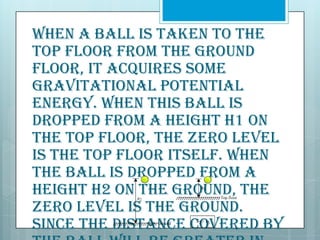
When a ball is taken to the
top floor from the ground
floor, it acquires some
gravitational potential
energy. When this ball is
dropped from a height h1 on
the top floor, the zero level
is the top floor itself. When
the ball is dropped from a
height h2 on the ground, the
zero level is the ground.
Since the distance covered by
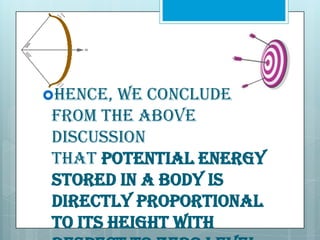
Hence,

we conclude
from the above
discussion
that potential energy
stored in a body is
directly proportional
to its height with
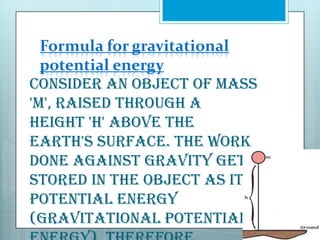
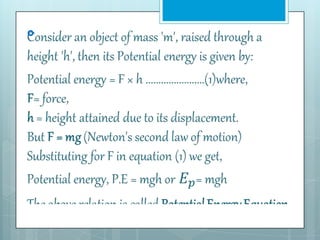
Formula for gravitational
potential energy
Consider an object of mass
'm', raised through a
height 'h' above the
earth's surface. The work
done against gravity gets
stored in the object as its
Potential Energy
(Gravitational Potential

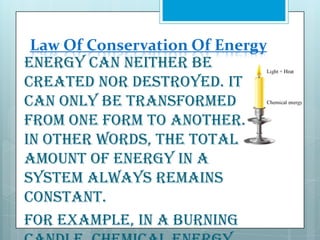
Law Of Conservation Of Energy
Energy can neither be
created nor destroyed. It
can only be transformed
from one form to another.
In other words, the total
amount of energy in a
system always remains
constant.
For example, in a burning


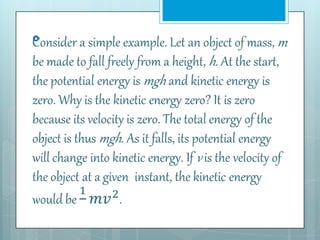
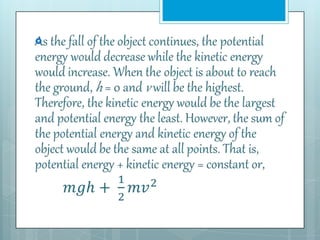
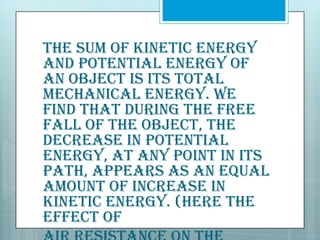
The sum of kinetic energy
and potential energy of
an object is its total
mechanical energy. We
find that during the free
fall of the object, the
decrease in potential
energy, at any point in its
path, appears as an equal
amount of increase in
kinetic energy. (Here the
effect of
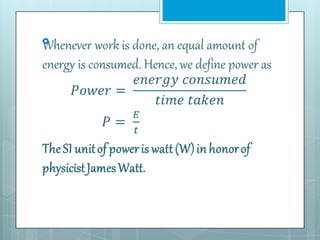
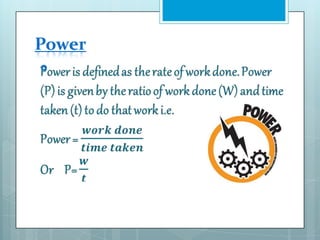
Power


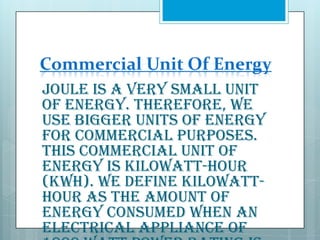
Commercial Unit Of Energy
Joule is a very small unit
of energy. Therefore, we
use bigger units of energy
for commercial purposes.
This commercial unit of
energy is kilowatt-hour
(kWh). We define kilowatthour as the amount of
energy consumed when an
electrical appliance of
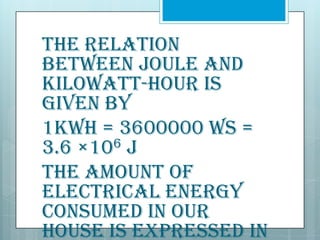
The relation
between joule and
kilowatt-hour is
given by
1kWh = 3600000 Ws =
3.6 ×10⁶ J
The amount of
electrical energy
consumed in our
house is expressed in


Work and energy

  • 2.
    Introduction Consider the following day-to-dayactivities which we consider as work: Reading, speaking, singing, writing, thinking etc. We require energy to perform these activities, which we
  • 3.
    Even if we pusha wall with the maximum force that we can apply, the wall will not move. It will be interesting for us to note that even in this case, we are not doing any work at all! Work is not done in all the above activities because there
  • 4.
    Scientifically, work is defined asthe work done by a force that causes a displacement in an object. If we push a book placed on a table with a force, then it will move to a certain distance. Scientifically, we will say that some work has been done on the book. In this case, work is done
  • 5.
    If we lift thebook to a certain height, then a force is exerted against gravity, which displaces the book to a certain height. Hence, we can say that work is done on the book against the
  • 6.
    Work done Whenever displacement is broughtin the line of force applied we call it as work done. Mathematically work done is given a symbol W and it is defined as the product of force(F) and
  • 7.
    There could be four differentcases according to the force and displacement relationship. If: +Force +Displacement = +Work -Force -Displacement = +Work -Force +Displacement = -Work +Force -Displacement = -Work
  • 8.
    Work Done Bya Constant Force A wooden block is kept on a table. When a force of magnitude F acts on the block, it gets displaced through a distance S in the direction of the applied force, as shown in the given figure.
  • 9.
    The magnitude ofwork done is given by the product of force (F) and displacement (S). Let W be the work done on the block. ∴ Work = Force × Displacement W= F × S
  • 10.
    Unit of Work Toobtain the unit of work, we substitute the SI units of force, i.e. N, and distance, i.e. m, in the equation of work. W = N × m = Nm Hence, the unit of work is Nm. In the honor of physicist James P. Joule, the SI unit of work is written as Joule (J). Hence, 1 J = 1 Nm 1 Joule is defined as the
  • 11.
    Work done againstgravity When force is applied on an object in order to lift it above the ground, it is said that work is done against the force of gravity. Assume that a constant force of magnitude F is applied on a block of mass m to lift it to a
  • 12.
    In this case,the work done by the force against gravity is given by the product of the weight of the block and the height through which it is lifted above the ground. Work done = Weight × Height W = mg × h
  • 13.
    Negative work If theforce acts opposite to the direction of displacement, then the WORK done will be negative i.e. W=F x (-s) or (-F x s). Here, the directions of displacement (S) and applied force (F) are exactly opposite to each other. Suppose, a soccer player moves
  • 14.
    Zero Work When abody moves through a distance at right angle to the direction of force, the work done by the force on the body is zero. A book kept on a table moves from point A to point B through a distance S. In this case, the work done on the book by
  • 15.
    Energy The world requiresa lot of energy. To satisfy this demand, we have natural energy sources such as the sun, wind, water at a height, tides, etc. We also have artificial energy sources such as
  • 16.
    Forms of energy Someforms of energy are (i) Light (ii) Sound (iii) Heat (iv) Mechanical (v) Electrical (vi) Chemical (vii) Nuclear
  • 17.
    Mechanical energy It isthe form of energy possessed by an object that has the potential to do work. It is caused by the motion or the position and configuration of the object. Mechanical energy is of two types. (i) Kinetic energy (caused by
  • 18.
    Kinetic energy Energy storedinto an object due to its motion. A moving arrow can be embedded into an object. Hence, it is said that the arrow possesses kinetic energy. The elastic string of a catapult is stretched to throw a stone. The
  • 19.
    A stone droppedfrom a height has the capability to create a depression in wet ground. Hence, the dropped stone has some amount of kinetic energy. A fired bullet is embedded in a wall or wooden block. Hence, it is said that a moving bullet possesses kinetic energy.
  • 20.
    Formula for kineticenergy Kinetic energy of a moving body is equal to the work required to change its velocity from u to v. Let a body of mass m be moving with a uniform velocity u. Let an external force be applied on it so that it displaces a distance s and its velocity
  • 21.
  • 22.
  • 23.
  • 24.
    Kinetic energy ofa body is directly proportional to: (i) Its mass (m) (ii) The square of its velocity (v2) It is the kinetic energy of the wind that is used in windmills to generate electricity.
  • 25.
    Potential Energy There aremainly two types of potential energy: Potential energy possessed by a body by virtue of its configuration is known as elastic potential energy Potential energy possessed by a body by virtue of its position with respect to the ground is known as gravitational potential
  • 26.
    Potential energy ofan object at an height……… Any object located at a height with respect to a certain reference level is said to possess energy called gravitational potential energy. This energy depends on this reference level (sometimes
  • 27.
    When a ballis taken to the top floor from the ground floor, it acquires some gravitational potential energy. When this ball is dropped from a height h1 on the top floor, the zero level is the top floor itself. When the ball is dropped from a height h2 on the ground, the zero level is the ground. Since the distance covered by
  • 28.
    Hence, we conclude from theabove discussion that potential energy stored in a body is directly proportional to its height with
  • 29.
    Formula for gravitational potentialenergy Consider an object of mass 'm', raised through a height 'h' above the earth's surface. The work done against gravity gets stored in the object as its Potential Energy (Gravitational Potential
  • 30.
  • 31.
    Law Of ConservationOf Energy Energy can neither be created nor destroyed. It can only be transformed from one form to another. In other words, the total amount of energy in a system always remains constant. For example, in a burning
  • 32.
  • 33.
  • 34.
    The sum ofkinetic energy and potential energy of an object is its total mechanical energy. We find that during the free fall of the object, the decrease in potential energy, at any point in its path, appears as an equal amount of increase in kinetic energy. (Here the effect of
  • 35.
  • 36.
  • 37.
    Commercial Unit OfEnergy Joule is a very small unit of energy. Therefore, we use bigger units of energy for commercial purposes. This commercial unit of energy is kilowatt-hour (kWh). We define kilowatthour as the amount of energy consumed when an electrical appliance of
  • 38.
    The relation between jouleand kilowatt-hour is given by 1kWh = 3600000 Ws = 3.6 ×10⁶ J The amount of electrical energy consumed in our house is expressed in
  • 39.

Editor's Notes