Uniform Circular Motion
When a velocity changes, it experiences an
acceleration
Since velocity is a vector, acceleration can be
experienced as …
A change in speed in the same direction
A change in direction at the same speed
A change in both speed and direction
• Consider a body travelling in a straight
line:
• Now consider that it changes direction:
• We know from inertia that bodies tend to
travel in a straight line at constant velocity
• If a body changes direction, we know
there must have been a force acting upon
it, and a corresponding acceleration.
• A body moving in a circle is constantly
changing direction, and therefore
constantly accelerating.
• In which direction does it accelerate?
• Recall that a = … (vf – vi)/t
Vi
Vf
• By subtracting vi from vf …
• … dividing by a scalar: ‘t’
• … and placing the resultant vector between the
initial and final vectors
• … we find that our acceleration points towards
the centre of the circle
• The force which causes this acceleration is
called CENTRIPETAL FORCE
Vf
ViVf – Vi
Vi
Vf
This makes sense because when you
consider the forces here …
T
… and here
mg
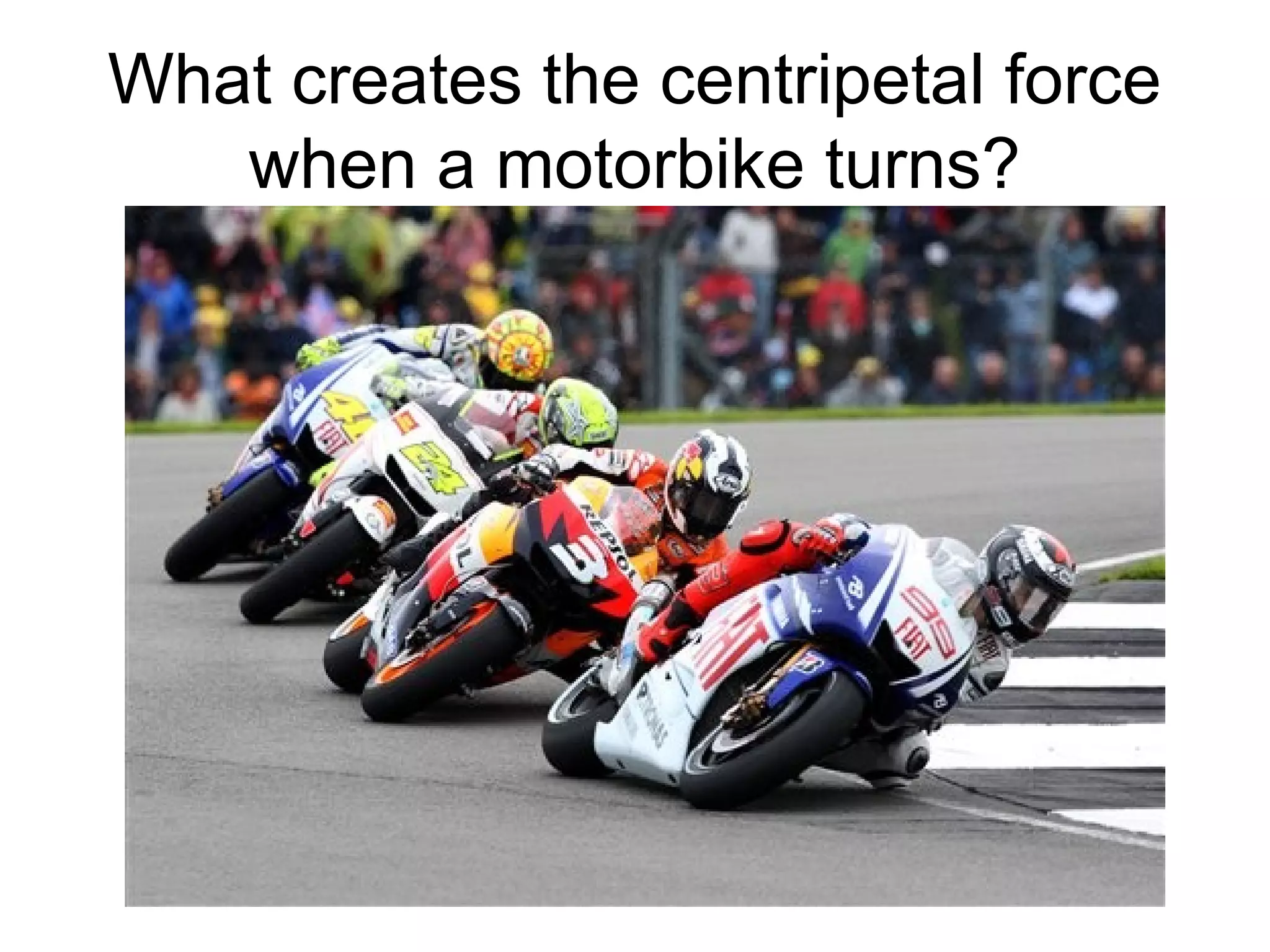
What creates the centripetal force
when a motorbike turns?
…
or when an
aeroplane
turns?
‘Centrifugal Force’
• It is often easy to believe that some force exists
to pull spinning objects outwards.
• In Newtonian physics, no such force exists
• This apparent ‘force’ is simply the body’s
tendency to continue travelling in a straight line,
disallowed by the constant centripetal force.
• The effect is similar to the feeling of being pulled
to the right when turning left in a car. Of course
you are not being ‘pulled’ to the right, but trying
to continue in your original direction.
• Relativity theory argues that such a centrifugal
force exists from the spinning object’s frame of
reference …
• … but that’s another story
Calculating Centripetal Force
In order to calculate centripetal force, we
need to:
1. Understand angular velocity
2. Understand the chain rule in
differentiation
3. Use angular velocity and the chain rule to
calculate centripetal acceleration
4. Use acceleration to calculate centripetal
force.
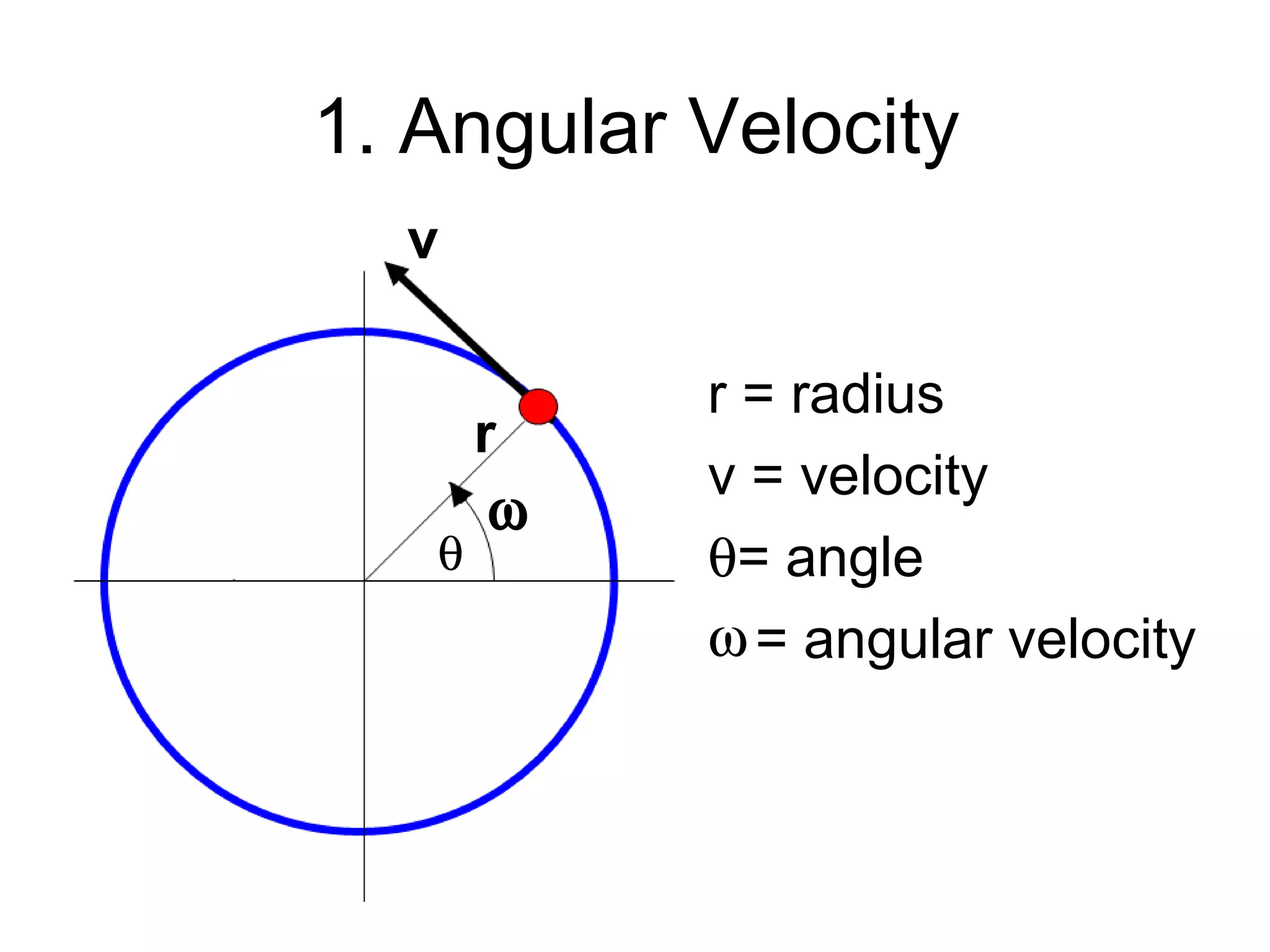
r = radius
v = velocity
θ= angle
ω = angular velocity
θ
v
ω
r
1. Angular Velocity
How far will the body travel in
one revolution?
How many radians will the
body travel through in one
revolution?
C = θr
C/t = (θ/t)r
v = ωr
ω = v/r
C = 2πr metres
θ = 2π radians
ω = v/r
This implies:
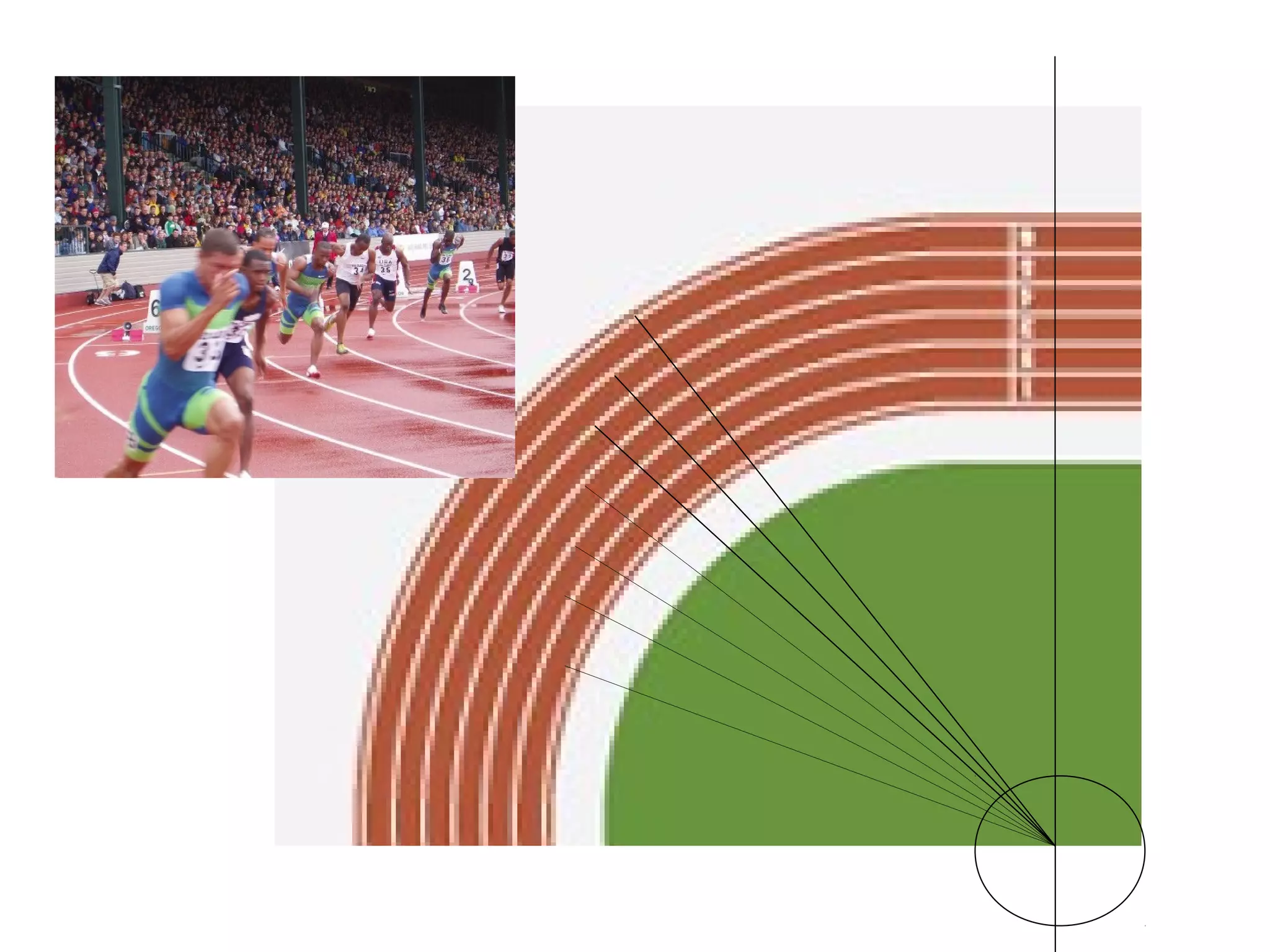
• That larger velocities will produce larger
angular velocities
• And that larger radii will produce smaller
angular velocities
– Eg: a runner on the inside will have an
advantage over a runner on the outside
The chain rule
y = f(x)
y’ = f’(x) = dy/dx
Sometimes we don’t have a relationship between y
and x. However, we have relationship between
y and u, and a relationship between u and x.
ie: y = f(u) and u = f(x)
We can can use these to find a relationship
between y and x
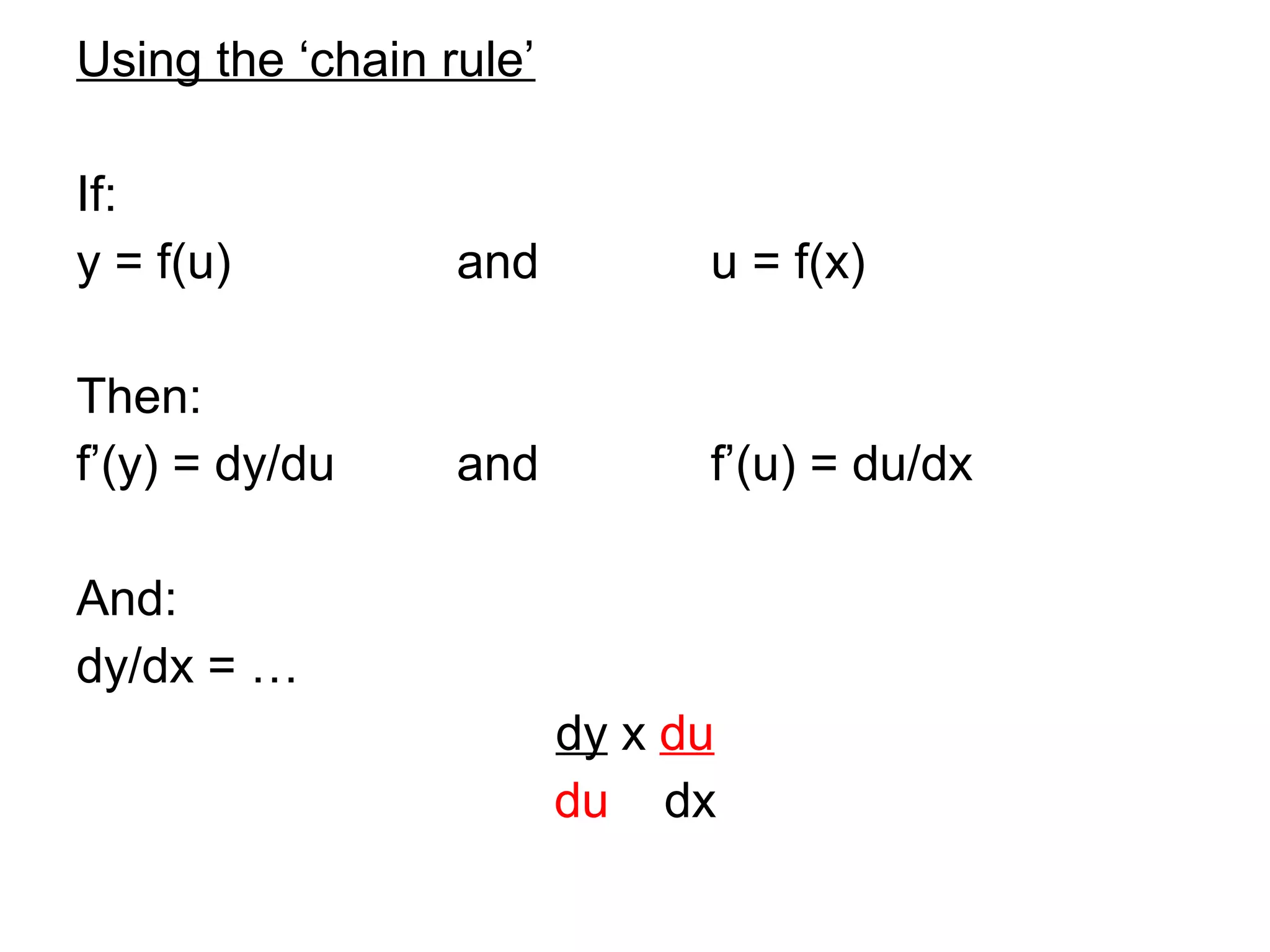
Using the ‘chain rule’
If:
y = f(u) and u = f(x)
Then:
f’(y) = dy/du and f’(u) = du/dx
And:
dy/dx = …
dy x du
du dx
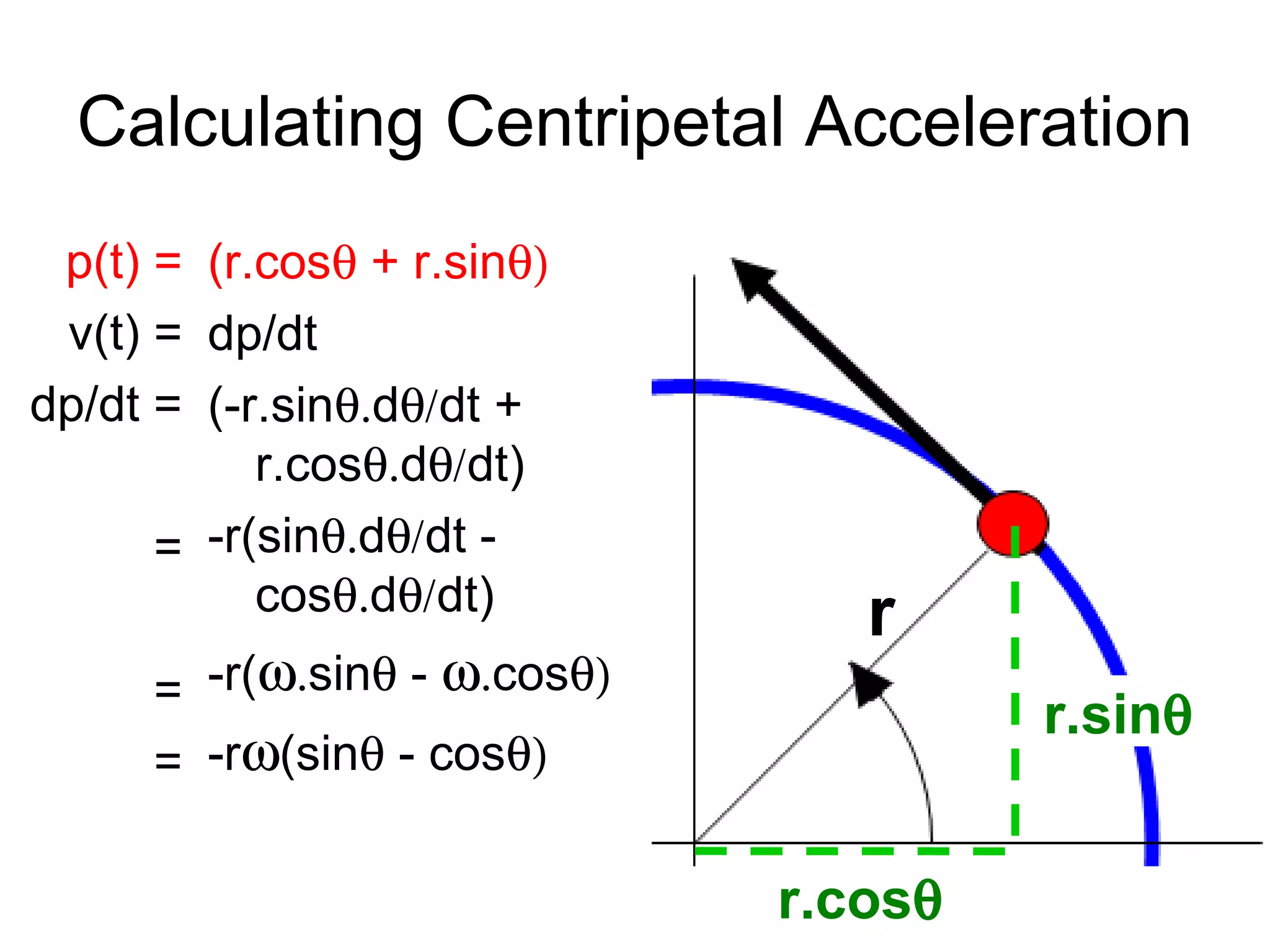
Calculating Centripetal Acceleration
p(t) =
v(t) =
dp/dt =
=
=
=
r
r.cosθ
r.sinθ
(r.cosθ + r.sinθ)
dp/dt
(-r.sinθ.dθ/dt +
r.cosθ.dθ/dt)
-r(sinθ.dθ/dt -
cosθ.dθ/dt)
-r(ω.sinθ - ω.cosθ)
-rω(sinθ - cosθ)
Calculating Centripetal Acceleration
v =
a =
dv/dt =
=
=
=
=
r
r.cosθ
r.sinθ
-rω(sinθ - cosθ)
dv/dt
-rω(cosθ.dθ/dt +
sinθ.dθ/dt)
-rω(cosθ.ω+sinθ.ω)
-rω2
(cosθ + sinθ)
-ω2
(r.cosθ + r.sinθ)
-ω2
p
Calculating Centripetal Acceleration
a =
IaI =
=
=
r
r.cosθ
r.sinθ
-ω2
p
I-ω2
I.r
(v/r)2
.r
v2
/ r
a = v2
/r
This makes sense …
The body will change direction more quickly if:
The velocity is higher
The radius is smaller
For higher velocity, this is easy to imagine
As the radius increases, the circumference
becomes straighter (eg: the horizon) and the
body’s change in direction is very gradual, even
at high speeds.
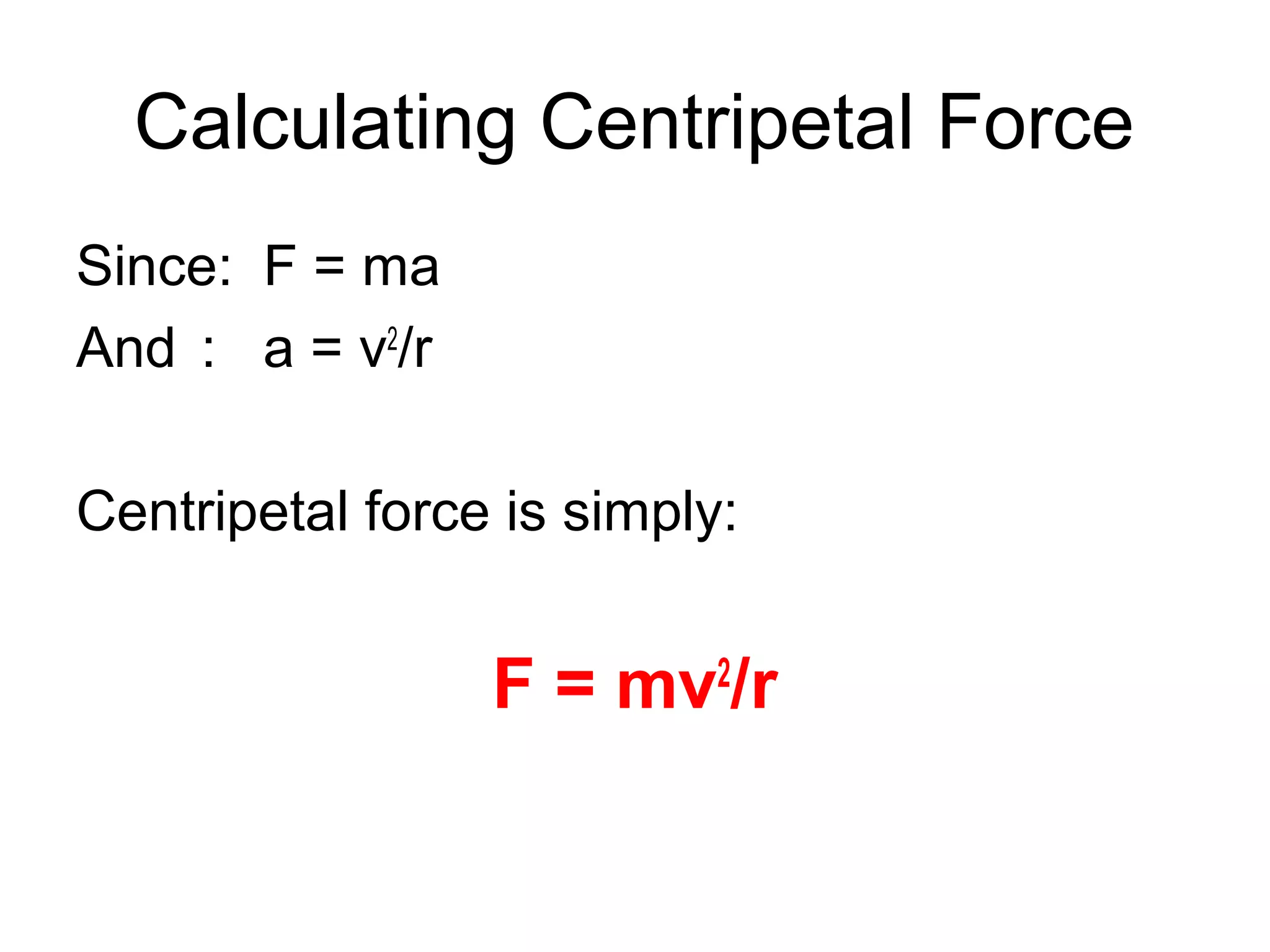
Calculating Centripetal Force
Since: F = ma
And : a = v2
/r
Centripetal force is simply:
F = mv2
/r
Angular velocity
θ

3c. uniform circular motion

  • 1.
  • 2.
    When a velocitychanges, it experiences an acceleration Since velocity is a vector, acceleration can be experienced as … A change in speed in the same direction A change in direction at the same speed A change in both speed and direction
  • 3.
    • Consider abody travelling in a straight line: • Now consider that it changes direction: • We know from inertia that bodies tend to travel in a straight line at constant velocity • If a body changes direction, we know there must have been a force acting upon it, and a corresponding acceleration.
  • 4.
    • A bodymoving in a circle is constantly changing direction, and therefore constantly accelerating. • In which direction does it accelerate? • Recall that a = … (vf – vi)/t Vi Vf
  • 5.
    • By subtractingvi from vf … • … dividing by a scalar: ‘t’ • … and placing the resultant vector between the initial and final vectors • … we find that our acceleration points towards the centre of the circle • The force which causes this acceleration is called CENTRIPETAL FORCE Vf ViVf – Vi Vi Vf
  • 6.
    This makes sensebecause when you consider the forces here … T
  • 7.
  • 8.
    What creates thecentripetal force when a motorbike turns?
  • 9.
  • 10.
    ‘Centrifugal Force’ • Itis often easy to believe that some force exists to pull spinning objects outwards. • In Newtonian physics, no such force exists • This apparent ‘force’ is simply the body’s tendency to continue travelling in a straight line, disallowed by the constant centripetal force. • The effect is similar to the feeling of being pulled to the right when turning left in a car. Of course you are not being ‘pulled’ to the right, but trying to continue in your original direction. • Relativity theory argues that such a centrifugal force exists from the spinning object’s frame of reference … • … but that’s another story
  • 11.
    Calculating Centripetal Force Inorder to calculate centripetal force, we need to: 1. Understand angular velocity 2. Understand the chain rule in differentiation 3. Use angular velocity and the chain rule to calculate centripetal acceleration 4. Use acceleration to calculate centripetal force.
  • 12.
    r = radius v= velocity θ= angle ω = angular velocity θ v ω r 1. Angular Velocity
  • 13.
    How far willthe body travel in one revolution? How many radians will the body travel through in one revolution? C = θr C/t = (θ/t)r v = ωr ω = v/r C = 2πr metres θ = 2π radians
  • 14.
    ω = v/r Thisimplies: • That larger velocities will produce larger angular velocities • And that larger radii will produce smaller angular velocities – Eg: a runner on the inside will have an advantage over a runner on the outside
  • 16.
    The chain rule y= f(x) y’ = f’(x) = dy/dx Sometimes we don’t have a relationship between y and x. However, we have relationship between y and u, and a relationship between u and x. ie: y = f(u) and u = f(x) We can can use these to find a relationship between y and x
  • 17.
    Using the ‘chainrule’ If: y = f(u) and u = f(x) Then: f’(y) = dy/du and f’(u) = du/dx And: dy/dx = … dy x du du dx
  • 18.
    Calculating Centripetal Acceleration p(t)= v(t) = dp/dt = = = = r r.cosθ r.sinθ (r.cosθ + r.sinθ) dp/dt (-r.sinθ.dθ/dt + r.cosθ.dθ/dt) -r(sinθ.dθ/dt - cosθ.dθ/dt) -r(ω.sinθ - ω.cosθ) -rω(sinθ - cosθ)
  • 19.
    Calculating Centripetal Acceleration v= a = dv/dt = = = = = r r.cosθ r.sinθ -rω(sinθ - cosθ) dv/dt -rω(cosθ.dθ/dt + sinθ.dθ/dt) -rω(cosθ.ω+sinθ.ω) -rω2 (cosθ + sinθ) -ω2 (r.cosθ + r.sinθ) -ω2 p
  • 20.
    Calculating Centripetal Acceleration a= IaI = = = r r.cosθ r.sinθ -ω2 p I-ω2 I.r (v/r)2 .r v2 / r
  • 21.
    a = v2 /r Thismakes sense … The body will change direction more quickly if: The velocity is higher The radius is smaller For higher velocity, this is easy to imagine As the radius increases, the circumference becomes straighter (eg: the horizon) and the body’s change in direction is very gradual, even at high speeds.
  • 22.
    Calculating Centripetal Force Since:F = ma And : a = v2 /r Centripetal force is simply: F = mv2 /r
  • 23.