Topic 1 – Physical Measurement 1.3 – Vectors and Scalars
Vectors and Scalars In Physics some quantities have values that depend on direction and some do not.
A quantity that has a direction associated with it is called a vector. Example velocity. A quantity that has no direction is called a scalar. Example mass For a vector quantity a “+” or “-” sign shows direction
For a scalar quantity a “-” sign is (usually) meaningless
Vectors and Scalars Sort the list of quantities below into a table of vectors and scalars. Mass Displacement
Time Energy
Velocity Speed
Distance Acceleration
Amount of Substance Force
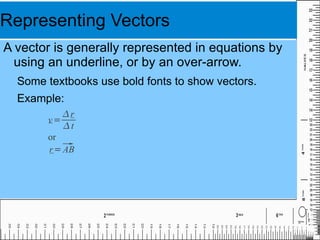
Representing Vectors A vector is generally represented in equations by using an underline, or by an over-arrow. Some textbooks use bold fonts to show vectors.
Example:
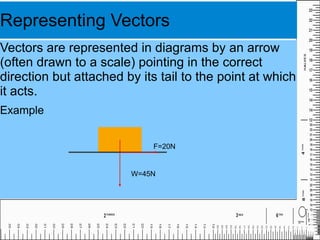
Representing Vectors Vectors are represented in diagrams by an arrow (often drawn to a scale) pointing in the correct direction but attached by its tail to the point at which it acts. Example W=45N F=20N
Combining Vectors Often in Physics we need to find what the total effect of a group of vectors is.

Physics 1.3 scalars and vectors

  • 1.
    Topic 1 –Physical Measurement 1.3 – Vectors and Scalars
  • 2.
    Vectors and ScalarsIn Physics some quantities have values that depend on direction and some do not.
  • 3.
    A quantity thathas a direction associated with it is called a vector. Example velocity. A quantity that has no direction is called a scalar. Example mass For a vector quantity a “+” or “-” sign shows direction
  • 4.
    For a scalarquantity a “-” sign is (usually) meaningless
  • 5.
    Vectors and ScalarsSort the list of quantities below into a table of vectors and scalars. Mass Displacement
  • 6.
  • 7.
  • 8.
  • 9.
  • 10.
    Representing Vectors Avector is generally represented in equations by using an underline, or by an over-arrow. Some textbooks use bold fonts to show vectors.
  • 11.
  • 12.
    Representing Vectors Vectorsare represented in diagrams by an arrow (often drawn to a scale) pointing in the correct direction but attached by its tail to the point at which it acts. Example W=45N F=20N
  • 13.
    Combining Vectors Oftenin Physics we need to find what the total effect of a group of vectors is.