Rocket propulsion uses Newton's third law of motion and the conservation of momentum. Chemical energy from fuel is converted to kinetic energy through combustion in the thrust chamber and nozzle, producing thrust via reaction from ejected exhaust. Rocket engines differ from jet engines in that rockets are non-air breathing and can operate in a vacuum, do not rely on atmospheric conditions for oxygen, and carry both fuel and oxidizer onboard. Rockets use stored propellants that are pumped into a combustion chamber where they burn and expand through a nozzle, producing thrust. Solid propellant rockets burn a solid fuel/oxidizer block, while liquid propellant rockets mix and burn liquid fuel and oxidizer.
Rocket working principle
•Newton third law of motion
• Law of conservation of momentum
• The chemical energy stored in the fuel is
converted into kinetic energy by burning the
fuel in the thrust chamber and subsequent
expansion in the nozzle to produce thrust
• Rockets obtain thrust by reaction from the
ejection of fast moving exhaust fluid from
rocket engine.
3.
Difference b/w jetand rocket
engine
Jet engine
• Air breathing engine
• It cannot be operated in
vacuum
• Thrust produced depends on
altitude and flight velocity.
• Friction increases with flight
speed
• Oxygen supply depends on
atmospheric conditions. It
carries only fuel
Rocket engine
• Non air breathing engine
• Space travel possible
• Trust production does not
depends on altitude.
• It offers no surface drag. No
gravitational effect. Rate of
climb increases with
altitude.
• It carries oxidizer as well as
fuel.
4.
Construction and working
•A rocket is a non air breathing engine and it
has a few moving parts.
• It carries fuel and oxidizer on the board of the
craft.
• The high pressure gases coming from the
combustion chamber act as rocket propellants.
• These gases expand through the nozzle, and
produces thrust on the rocket.
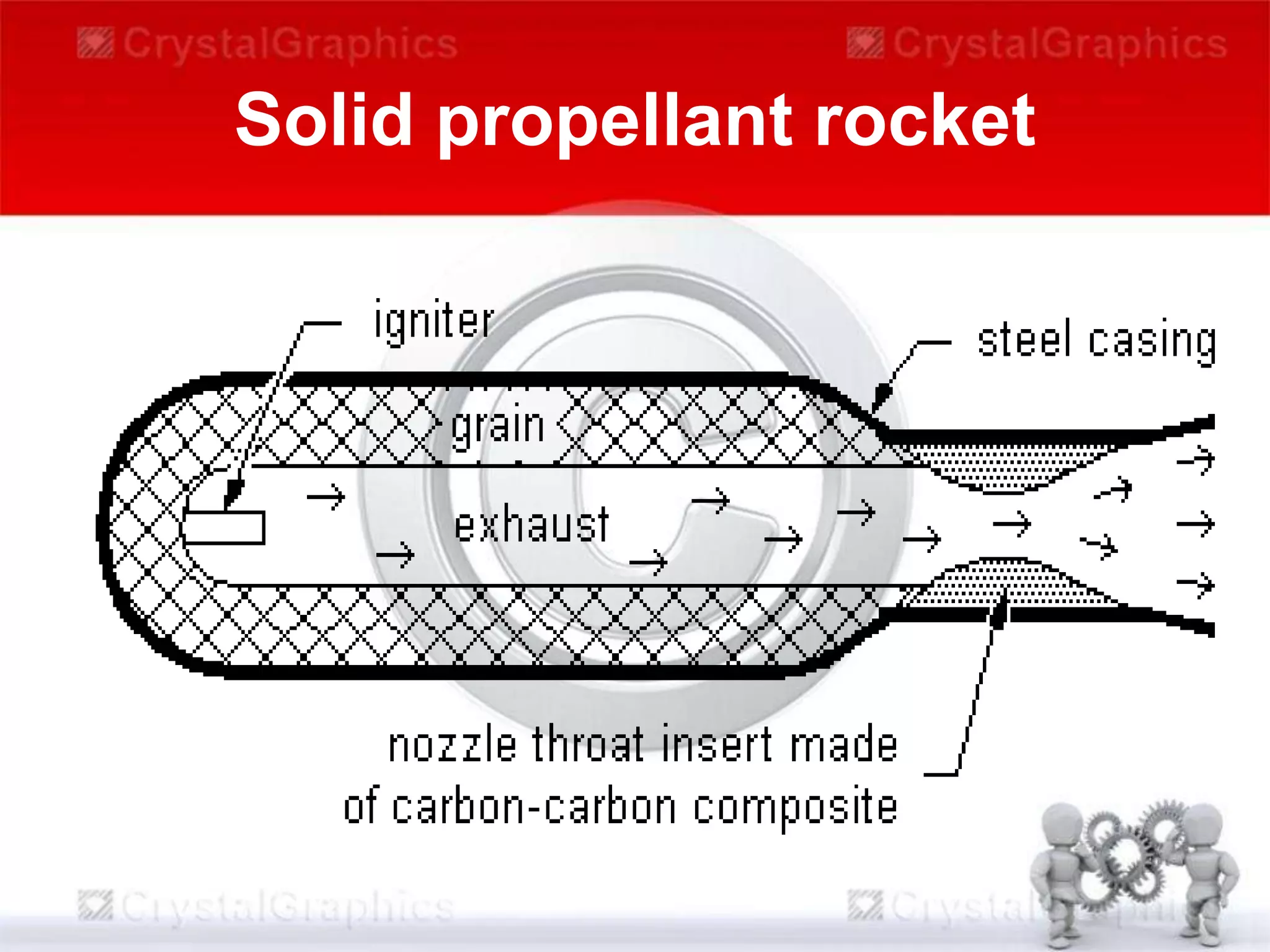
Solid propellant rocket
•Solid propellant rocket burns a solid block
made of fuel, oxidizer, and binder (plastic or
rubber). The block is called grain. Ammonium
per chlorate oxidizer and other chlorine
compounds are toxic, corrosive, and damage
the ozone layer. Ammonium nitrate oxidizer is
hygroscopic, but is usually more desirable,
because it is safe, cheap, and smokeless.
8.
Solid propellant rocket
•Solid propellant rocket is inexpensive, but has
a low specific impulse (2-3 km/s), has to carry
heavy casing, and cannot be throttled or
stopped; it burns until all the grain is
exhausted. When used in outer space, they
may produce space junk in the form of
micrometer-size aluminum oxide particles and
centimeter-size slag.
LIQUID PROPELLANT ROCKETS
•Fuel and oxidizer mixed in the
mixing chamber and preheated to
suitable temperature.
• Then it is injected in the
combustion chamber. Where the
mixture is ignited by an electric
torch.
• The steam is produced by mixing
a very high concentrated H2O2
with KMNO4.
• The pumps are driven by a steam
turbine.
Constructional
details
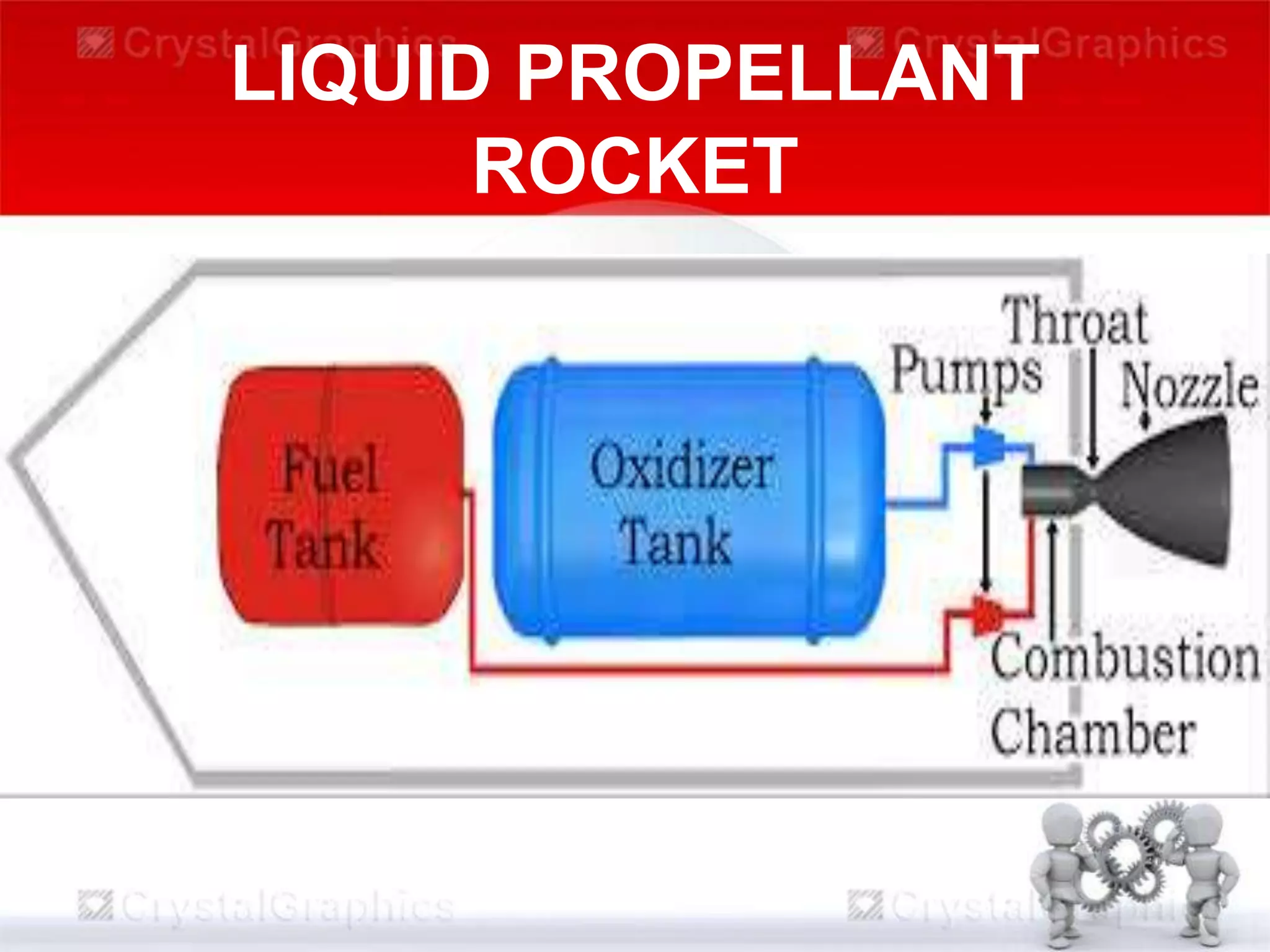
1. Fuel tank
2. Oxidizer tank
3. Fuel pump
4. Oxidizer pump
5. Injector
6. Steam turbine
7. Combustion
chamber
8. Control valves
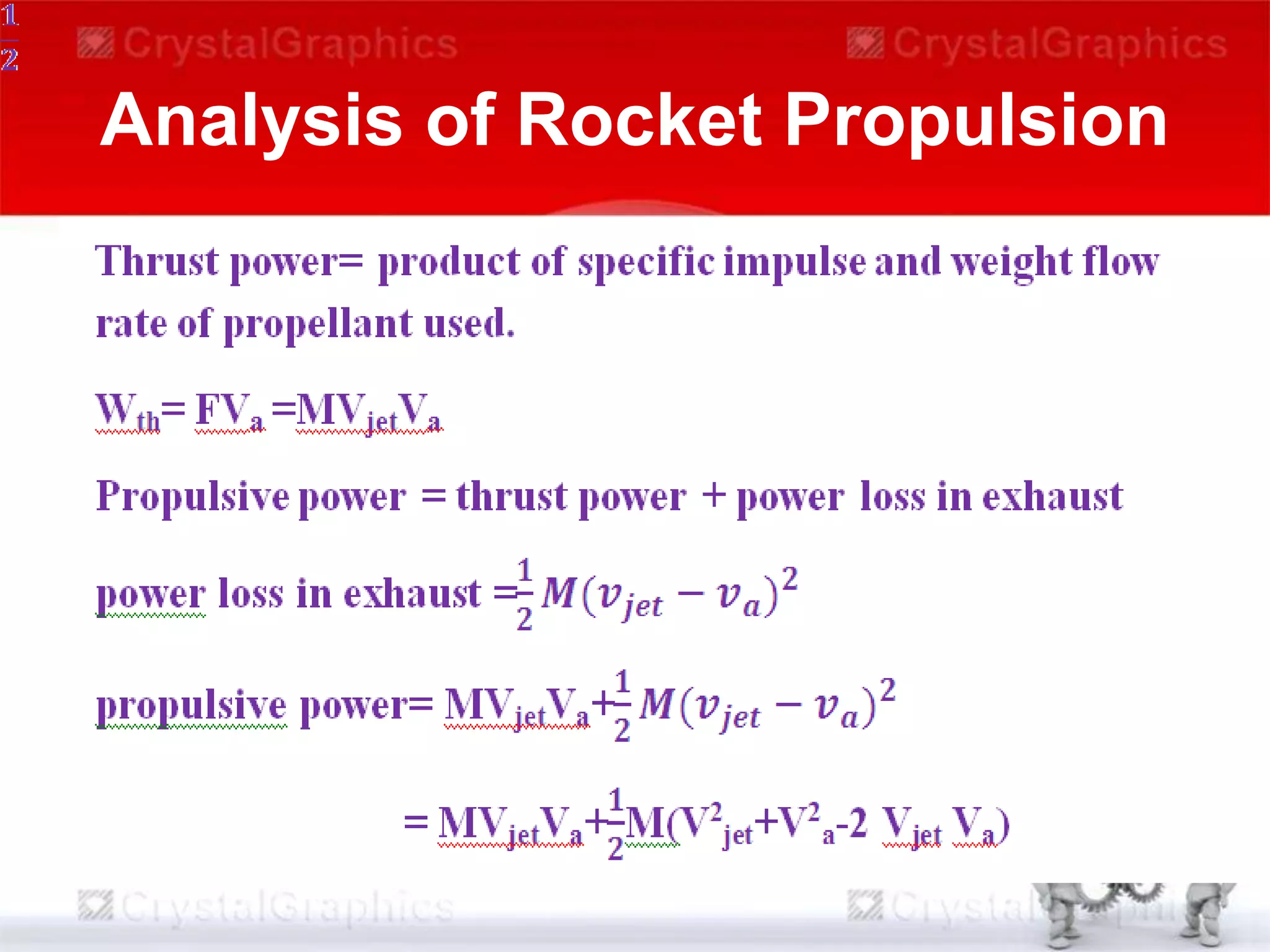
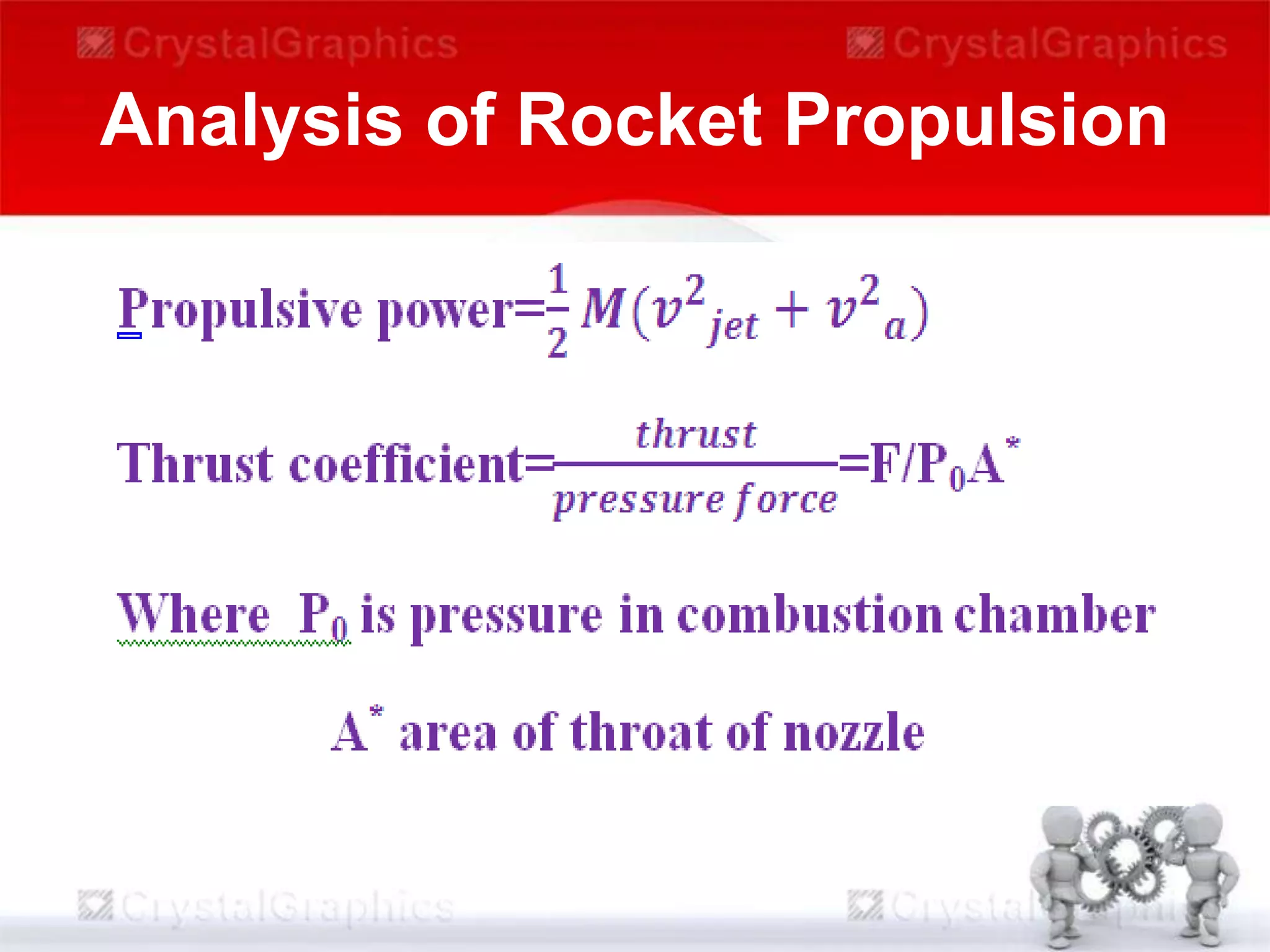
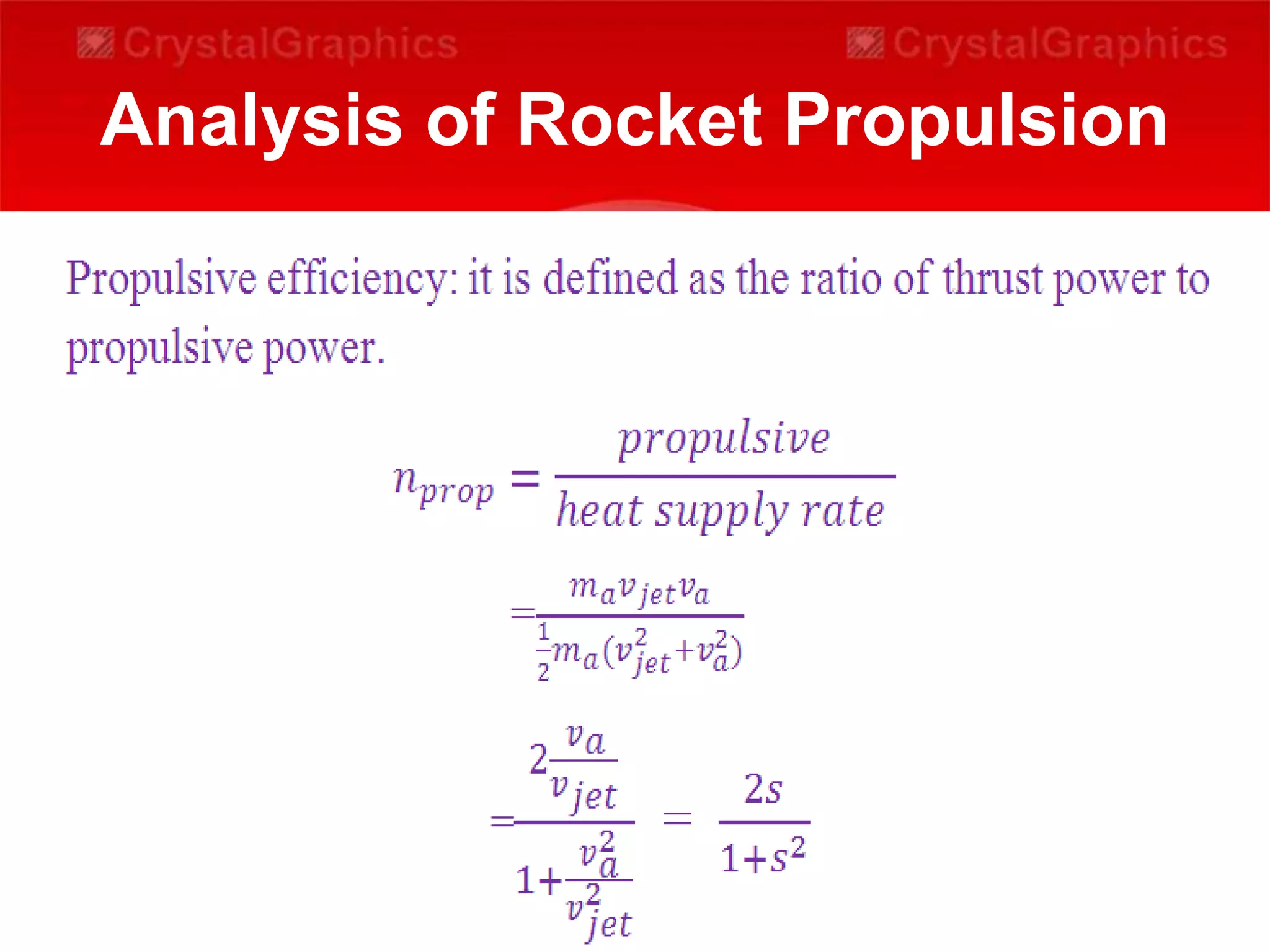
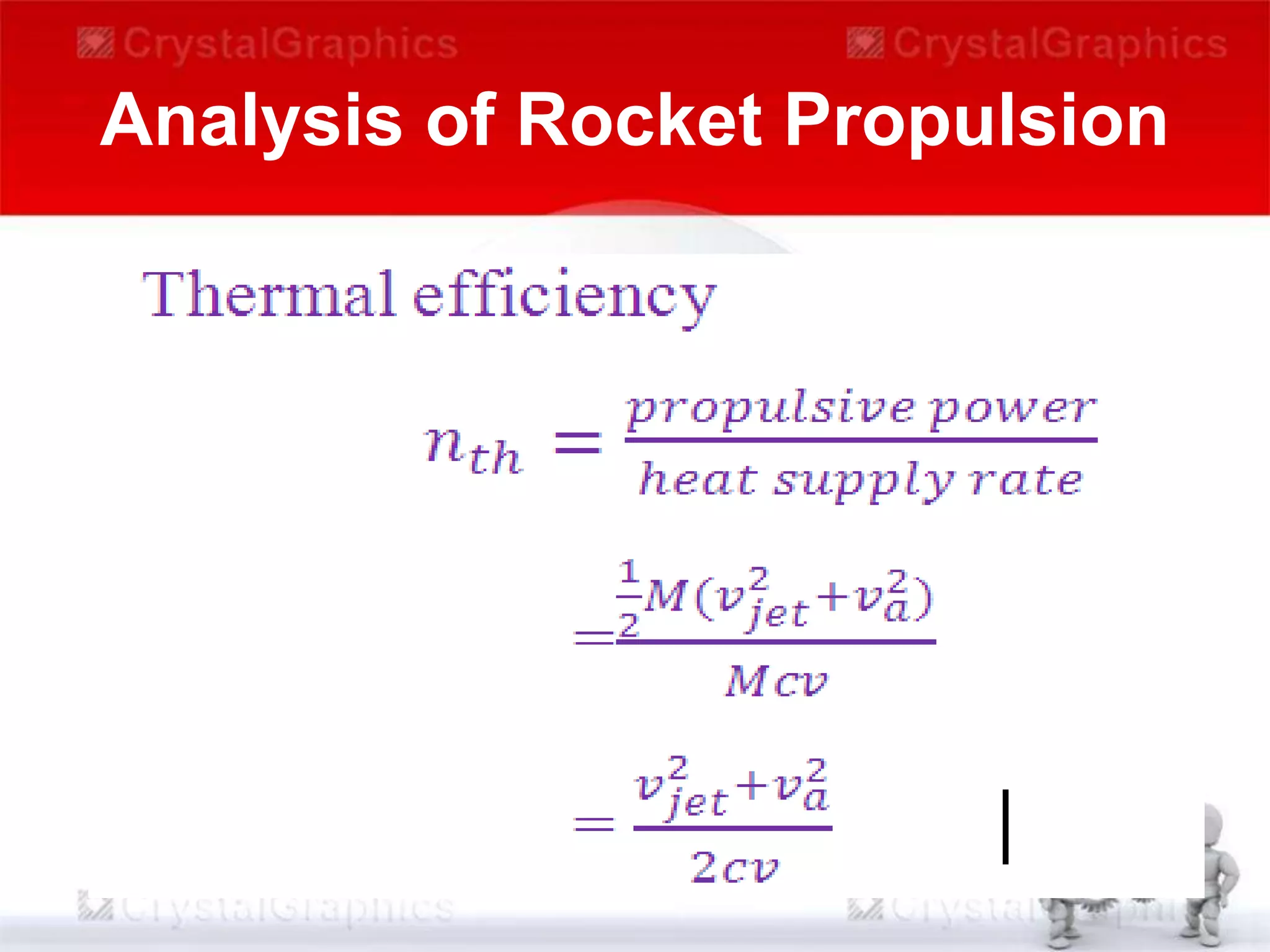
Analysis of RocketPropulsion
• Thrust(F)=Momentum thrust+ Pressure thrust
• Momentum thrust=M(jet velocity – propellant entry
velocity) i.e.,M(Vjet –Vi)
• But, oxygen and fuel are stored within rocket itself,
thus entry of propellant relative to rocket is zero.
• So, Momentum thrust=MVjet
• Pressure thrust =(pe-pa)Ae
• where Pe is exit pressure
• Pa is air pressure
13.
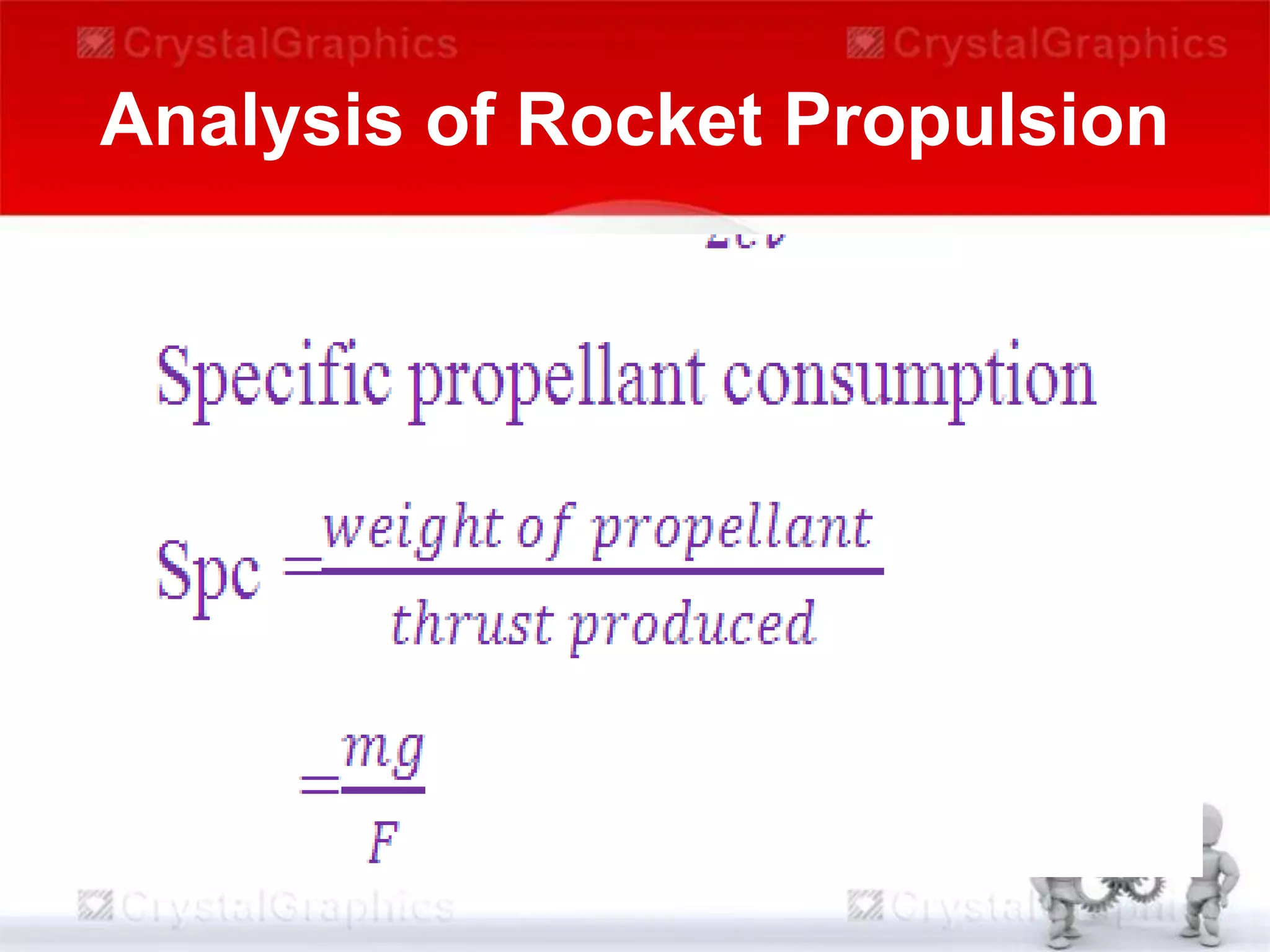
Analysis of RocketPropulsion
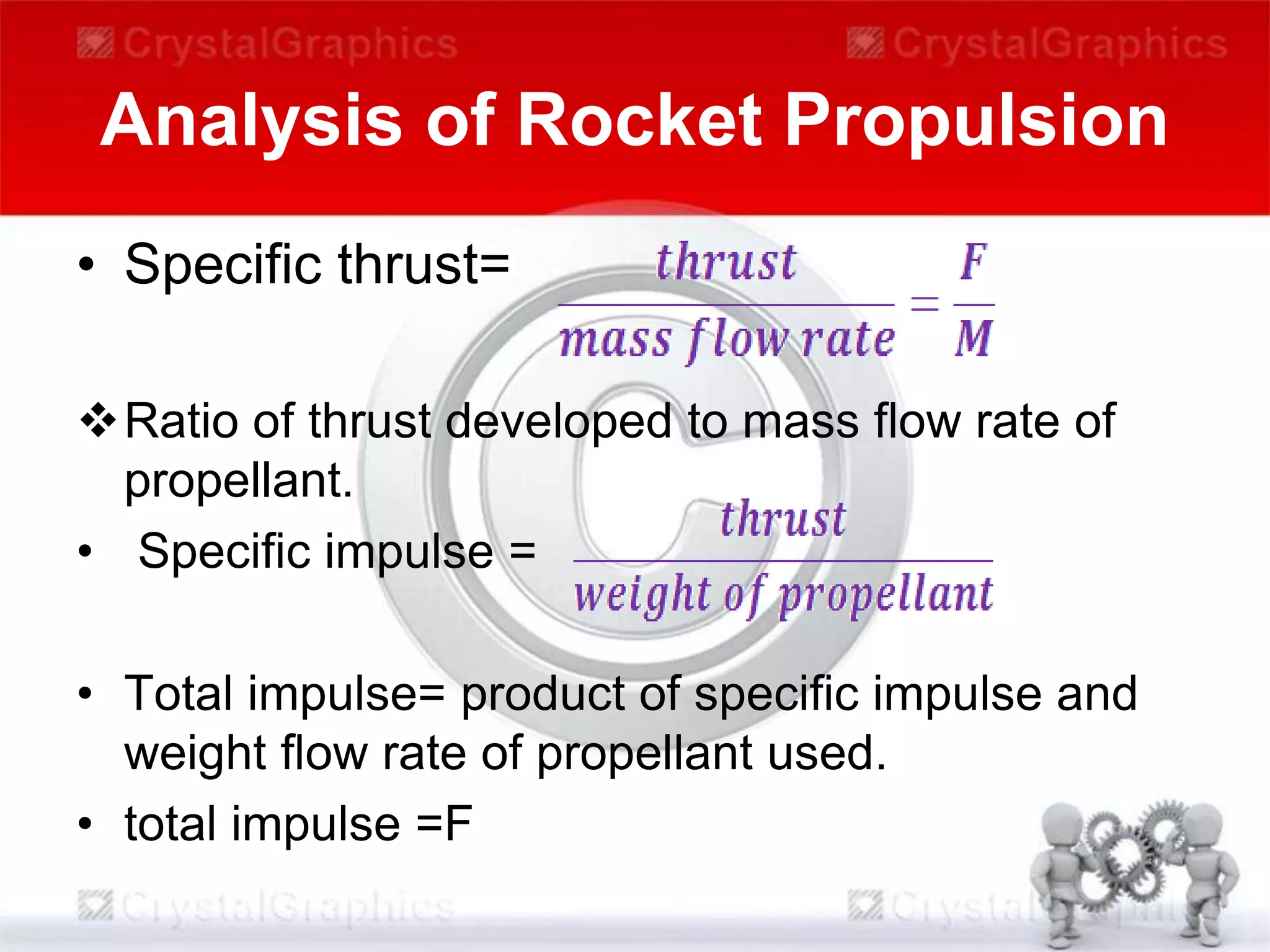
• Specific thrust=
Ratio of thrust developed to mass flow rate of
propellant.
• Specific impulse =
• Total impulse= product of specific impulse and
weight flow rate of propellant used.
• total impulse =F