Topic 4 – Oscillations and Waves
4.1 Simple Harmonic Motion
Oscillations
● There are many systems, both natural and man
made, that vibrate back and forth around an
equilibrium point.
● These systems are said to regularly oscillate.
● Common examples are:
● A mass on a spring
● A pendulum
● Electrons under alternating current
Key Terms
● The equilibrium point is that point where the
system will naturally rest.
● e.g. for a pendulum – bottom centre
● For a mass on a spring – the point where the
upwards pull of the spring equals the downward pull
of the weight.
● The displacement (x) of the system is the
vector displacement of the system from its
equilibrium point.
● Usually the displacement is considered in 1
dimension and is given the symbol x even if the
displacement is vertical.
Key Terms
● The amplitude (A) of an oscillation is the
maximum displacement of the system.
● It is the height of a wave from its equilibrium point.
● It is half the peak to trough height.
● The wavelength (λ) of a moving wave is the
distance from peak to peak in the space
dimension.
Key Terms
● The time period (T) is the time taken in seconds to
complete 1 complete cycle.
● This is the time from peak to peak in the time
dimension.
● A cycle is complete when the system is back in its
initial state.
● e.g. for a pendulum, when the bob is at its lowest point
and travelling in the same direction as at the start.
● The frequency (f) of the system is the number of
oscillations per second.
● It is the inverse of the time period.
● Frequency is measured in Hz or s-1
Key Terms
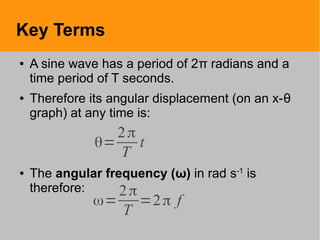
● A sine wave has a period of 2π radians and a
time period of T seconds.
● Therefore its angular displacement (on an x-θ
graph) at any time is:
● The angular frequency (ω) in rad s-1
is
therefore:
θ=
2π
T
t
ω=
2π
T
=2π f
Questions
● Calculate the frequency and angular frequency
of:
● A pendulum of period 4s
● A water wave of period 12s
● Mains electricity of period 0.02s
● Laser light with period 1.5 fs
Key Terms
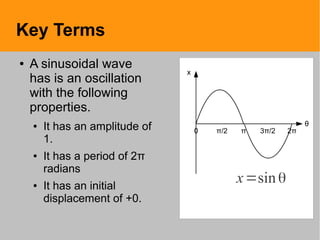
● A sinusoidal wave
has is an oscillation
with the following
properties.
● It has an amplitude of
1.
● It has a period of 2π
radians
● It has an initial
displacement of +0.
x
0 π/2 π 3π/2 2π
θ
x=sinθ
Key Terms
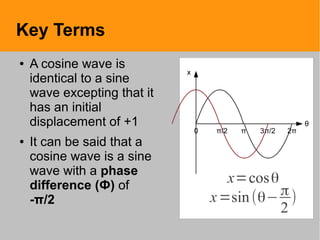
● A cosine wave is
identical to a sine
wave excepting that it
has an initial
displacement of +1
● It can be said that a
cosine wave is a sine
wave with a phase
difference (Ф) of
-π/2
x
0 π/2 π 3π/2 2π
θ
x=cosθ
x=sin(θ−π
2
)
Oscillating Systems
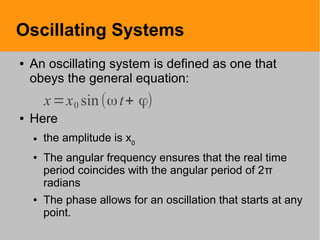
● An oscillating system is defined as one that
obeys the general equation:
● Here
● the amplitude is x0
● The angular frequency ensures that the real time
period coincides with the angular period of 2π
radians
● The phase allows for an oscillation that starts at any
point.
x=x0 sin(ωt+ ϕ)
Oscillating Systems
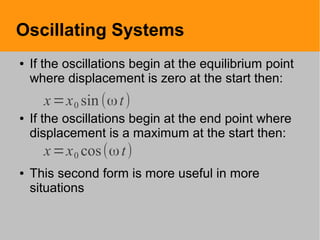
● If the oscillations begin at the equilibrium point
where displacement is zero at the start then:
● If the oscillations begin at the end point where
displacement is a maximum at the start then:
● This second form is more useful in more
situations
x=x0 sin(ωt)
x=x0 cos(ωt)
Questions
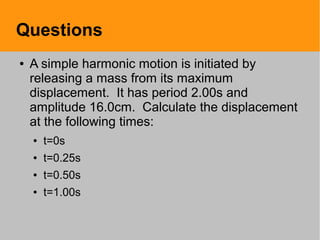
● A simple harmonic motion is initiated by
releasing a mass from its maximum
displacement. It has period 2.00s and
amplitude 16.0cm. Calculate the displacement
at the following times:
● t=0s
● t=0.25s
● t=0.50s
● t=1.00s
Time x v
0 0 +v0
T
/4
x0 0
T
/2 0 -v0
3T
/4
-x0 0
T 0 +v0
Oscillating Systems
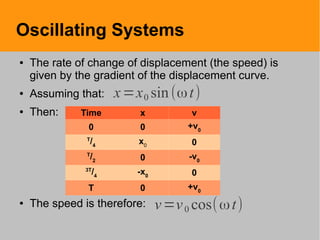
● The rate of change of displacement (the speed) is
given by the gradient of the displacement curve.
● Assuming that:
● Then:
● The speed is therefore:
x=x0 sin(ωt)
v=v0 cos(ωt)
Questions
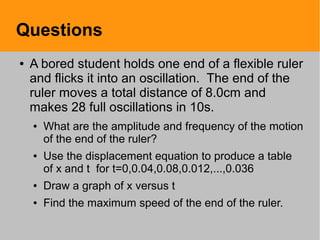
● A bored student holds one end of a flexible ruler
and flicks it into an oscillation. The end of the
ruler moves a total distance of 8.0cm and
makes 28 full oscillations in 10s.
● What are the amplitude and frequency of the motion
of the end of the ruler?
● Use the displacement equation to produce a table
of x and t for t=0,0.04,0.08,0.012,...,0.036
● Draw a graph of x versus t
● Find the maximum speed of the end of the ruler.
Oscillating Systems
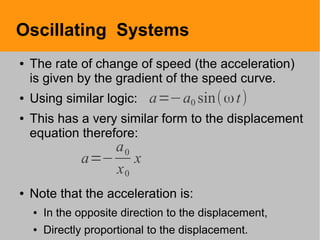
● The rate of change of speed (the acceleration)
is given by the gradient of the speed curve.
● Using similar logic:
● This has a very similar form to the displacement
equation therefore:
● Note that the acceleration is:
● In the opposite direction to the displacement,
● Directly proportional to the displacement.
a=−a0 sin(ωt)
a=−
a0
x0
x
The SHM Equation
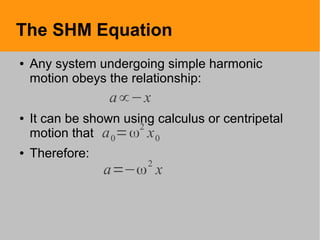
● Any system undergoing simple harmonic
motion obeys the relationship:
● It can be shown using calculus or centripetal
motion that
● Therefore:
a∝−x
a0=ω2
x0
a=−ω2
x
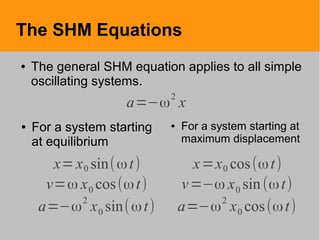
The SHM Equations
● For a system starting
at equilibrium
● The general SHM equation applies to all simple
oscillating systems.
a=−ω2
x
x=x0 sin(ωt)
v=ω x0 cos(ωt)
a=−ω
2
x0 sin(ωt)
● For a system starting at
maximum displacement
x=x0 cos(ωt)
v=−ω x0 sin(ωt)
a=−ω
2
x0 cos(ωt)
The SHM Equations
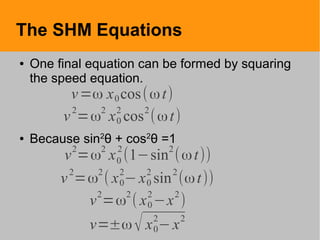
● One final equation can be formed by squaring
the speed equation.
● Because sin2
θ + cos2
θ =1
v=ω x0cos(ωt)
v
2
=ω
2
x0
2
cos
2
(ωt)
v2
=ω2
x0
2
(1−sin2
(ωt))
v2
=ω2
( x0
2
−x0
2
sin2
(ωt))
v
2
=ω
2
( x0
2
−x
2
)
v=±ω√x0
2
−x
2
Questions
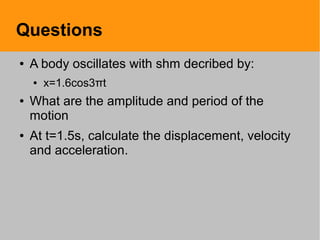
● A body oscillates with shm decribed by:
● x=1.6cos3πt
● What are the amplitude and period of the
motion
● At t=1.5s, calculate the displacement, velocity
and acceleration.
Questions
● The needle of a sewing machine moves up and
down with shm. If the total vertical motion of
the needle is 12mm and it makes 30 stitches in
7.0s calculate:
● The period,
● The amplitude,
● The maximum speed of the needle tip
● The maximum acceleration of the needle tip.
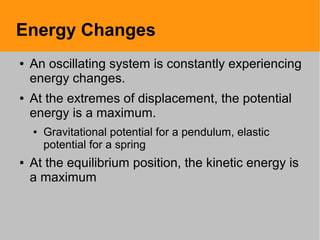
Energy Changes
● An oscillating system is constantly experiencing
energy changes.
● At the extremes of displacement, the potential
energy is a maximum.
● Gravitational potential for a pendulum, elastic
potential for a spring
● At the equilibrium position, the kinetic energy is
a maximum
Kinetic Energy
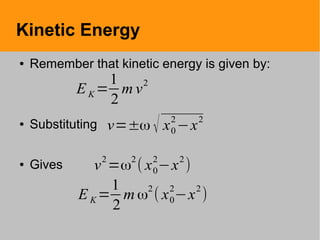
● Remember that kinetic energy is given by:
● Substituting
● Gives
v=±ω √ x0
2
−x2
v
2
=ω
2
( x0
2
−x
2
)
EK =
1
2
m ω
2
( x0
2
−x
2
)
EK =
1
2
m v
2
Total Energy
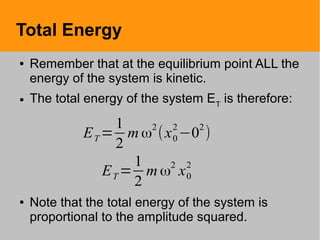
● Remember that at the equilibrium point ALL the
energy of the system is kinetic.
● The total energy of the system ET
is therefore:
● Note that the total energy of the system is
proportional to the amplitude squared.
ET =
1
2
m ω
2
(x0
2
−0
2
)
ET =
1
2
m ω2
x0
2
Potential Energy
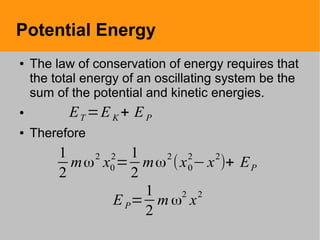
● The law of conservation of energy requires that
the total energy of an oscillating system be the
sum of the potential and kinetic energies.
●
● Therefore
1
2
mω
2
x0
2
=
1
2
mω
2
(x0
2
−x
2
)+ EP
EP=
1
2
m ω2
x2
ET =EK + EP
Questions
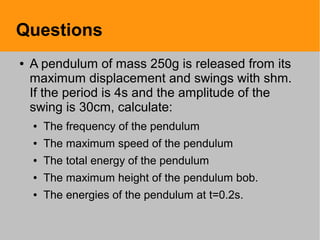
● A pendulum of mass 250g is released from its
maximum displacement and swings with shm.
If the period is 4s and the amplitude of the
swing is 30cm, calculate:
● The frequency of the pendulum
● The maximum speed of the pendulum
● The total energy of the pendulum
● The maximum height of the pendulum bob.
● The energies of the pendulum at t=0.2s.

4.1 simple harmonic motion

  • 1.
    Topic 4 –Oscillations and Waves 4.1 Simple Harmonic Motion
  • 2.
    Oscillations ● There aremany systems, both natural and man made, that vibrate back and forth around an equilibrium point. ● These systems are said to regularly oscillate. ● Common examples are: ● A mass on a spring ● A pendulum ● Electrons under alternating current
  • 3.
    Key Terms ● Theequilibrium point is that point where the system will naturally rest. ● e.g. for a pendulum – bottom centre ● For a mass on a spring – the point where the upwards pull of the spring equals the downward pull of the weight. ● The displacement (x) of the system is the vector displacement of the system from its equilibrium point. ● Usually the displacement is considered in 1 dimension and is given the symbol x even if the displacement is vertical.
  • 4.
    Key Terms ● Theamplitude (A) of an oscillation is the maximum displacement of the system. ● It is the height of a wave from its equilibrium point. ● It is half the peak to trough height. ● The wavelength (λ) of a moving wave is the distance from peak to peak in the space dimension.
  • 5.
    Key Terms ● Thetime period (T) is the time taken in seconds to complete 1 complete cycle. ● This is the time from peak to peak in the time dimension. ● A cycle is complete when the system is back in its initial state. ● e.g. for a pendulum, when the bob is at its lowest point and travelling in the same direction as at the start. ● The frequency (f) of the system is the number of oscillations per second. ● It is the inverse of the time period. ● Frequency is measured in Hz or s-1
  • 6.
    Key Terms ● Asine wave has a period of 2π radians and a time period of T seconds. ● Therefore its angular displacement (on an x-θ graph) at any time is: ● The angular frequency (ω) in rad s-1 is therefore: θ= 2π T t ω= 2π T =2π f
  • 7.
    Questions ● Calculate thefrequency and angular frequency of: ● A pendulum of period 4s ● A water wave of period 12s ● Mains electricity of period 0.02s ● Laser light with period 1.5 fs
  • 8.
    Key Terms ● Asinusoidal wave has is an oscillation with the following properties. ● It has an amplitude of 1. ● It has a period of 2π radians ● It has an initial displacement of +0. x 0 π/2 π 3π/2 2π θ x=sinθ
  • 9.
    Key Terms ● Acosine wave is identical to a sine wave excepting that it has an initial displacement of +1 ● It can be said that a cosine wave is a sine wave with a phase difference (Ф) of -π/2 x 0 π/2 π 3π/2 2π θ x=cosθ x=sin(θ−π 2 )
  • 10.
    Oscillating Systems ● Anoscillating system is defined as one that obeys the general equation: ● Here ● the amplitude is x0 ● The angular frequency ensures that the real time period coincides with the angular period of 2π radians ● The phase allows for an oscillation that starts at any point. x=x0 sin(ωt+ ϕ)
  • 11.
    Oscillating Systems ● Ifthe oscillations begin at the equilibrium point where displacement is zero at the start then: ● If the oscillations begin at the end point where displacement is a maximum at the start then: ● This second form is more useful in more situations x=x0 sin(ωt) x=x0 cos(ωt)
  • 12.
    Questions ● A simpleharmonic motion is initiated by releasing a mass from its maximum displacement. It has period 2.00s and amplitude 16.0cm. Calculate the displacement at the following times: ● t=0s ● t=0.25s ● t=0.50s ● t=1.00s
  • 13.
    Time x v 00 +v0 T /4 x0 0 T /2 0 -v0 3T /4 -x0 0 T 0 +v0 Oscillating Systems ● The rate of change of displacement (the speed) is given by the gradient of the displacement curve. ● Assuming that: ● Then: ● The speed is therefore: x=x0 sin(ωt) v=v0 cos(ωt)
  • 14.
    Questions ● A boredstudent holds one end of a flexible ruler and flicks it into an oscillation. The end of the ruler moves a total distance of 8.0cm and makes 28 full oscillations in 10s. ● What are the amplitude and frequency of the motion of the end of the ruler? ● Use the displacement equation to produce a table of x and t for t=0,0.04,0.08,0.012,...,0.036 ● Draw a graph of x versus t ● Find the maximum speed of the end of the ruler.
  • 15.
    Oscillating Systems ● Therate of change of speed (the acceleration) is given by the gradient of the speed curve. ● Using similar logic: ● This has a very similar form to the displacement equation therefore: ● Note that the acceleration is: ● In the opposite direction to the displacement, ● Directly proportional to the displacement. a=−a0 sin(ωt) a=− a0 x0 x
  • 16.
    The SHM Equation ●Any system undergoing simple harmonic motion obeys the relationship: ● It can be shown using calculus or centripetal motion that ● Therefore: a∝−x a0=ω2 x0 a=−ω2 x
  • 17.
    The SHM Equations ●For a system starting at equilibrium ● The general SHM equation applies to all simple oscillating systems. a=−ω2 x x=x0 sin(ωt) v=ω x0 cos(ωt) a=−ω 2 x0 sin(ωt) ● For a system starting at maximum displacement x=x0 cos(ωt) v=−ω x0 sin(ωt) a=−ω 2 x0 cos(ωt)
  • 18.
    The SHM Equations ●One final equation can be formed by squaring the speed equation. ● Because sin2 θ + cos2 θ =1 v=ω x0cos(ωt) v 2 =ω 2 x0 2 cos 2 (ωt) v2 =ω2 x0 2 (1−sin2 (ωt)) v2 =ω2 ( x0 2 −x0 2 sin2 (ωt)) v 2 =ω 2 ( x0 2 −x 2 ) v=±ω√x0 2 −x 2
  • 19.
    Questions ● A bodyoscillates with shm decribed by: ● x=1.6cos3πt ● What are the amplitude and period of the motion ● At t=1.5s, calculate the displacement, velocity and acceleration.
  • 20.
    Questions ● The needleof a sewing machine moves up and down with shm. If the total vertical motion of the needle is 12mm and it makes 30 stitches in 7.0s calculate: ● The period, ● The amplitude, ● The maximum speed of the needle tip ● The maximum acceleration of the needle tip.
  • 21.
    Energy Changes ● Anoscillating system is constantly experiencing energy changes. ● At the extremes of displacement, the potential energy is a maximum. ● Gravitational potential for a pendulum, elastic potential for a spring ● At the equilibrium position, the kinetic energy is a maximum
  • 22.
    Kinetic Energy ● Rememberthat kinetic energy is given by: ● Substituting ● Gives v=±ω √ x0 2 −x2 v 2 =ω 2 ( x0 2 −x 2 ) EK = 1 2 m ω 2 ( x0 2 −x 2 ) EK = 1 2 m v 2
  • 23.
    Total Energy ● Rememberthat at the equilibrium point ALL the energy of the system is kinetic. ● The total energy of the system ET is therefore: ● Note that the total energy of the system is proportional to the amplitude squared. ET = 1 2 m ω 2 (x0 2 −0 2 ) ET = 1 2 m ω2 x0 2
  • 24.
    Potential Energy ● Thelaw of conservation of energy requires that the total energy of an oscillating system be the sum of the potential and kinetic energies. ● ● Therefore 1 2 mω 2 x0 2 = 1 2 mω 2 (x0 2 −x 2 )+ EP EP= 1 2 m ω2 x2 ET =EK + EP
  • 25.
    Questions ● A pendulumof mass 250g is released from its maximum displacement and swings with shm. If the period is 4s and the amplitude of the swing is 30cm, calculate: ● The frequency of the pendulum ● The maximum speed of the pendulum ● The total energy of the pendulum ● The maximum height of the pendulum bob. ● The energies of the pendulum at t=0.2s.