Topic 3 - Thermodynamics
3.1 – Thermal Concepts
Energy in Substances
● All objects have internal energy (U)
● This is because the internal particles are
vibrating randomly in the substance and there
are electrical forces between them.
● Internal energy is the sum of the kinetic and
potential energies of the internal particles of a
substance.
● The potential energy is due mainly to the electric
fields between the particles, both bonding and
intermolecular
Energy in a Substance
● The energy in an object is internal energy
● The transfer of energy between objects by
non-mechanical methods is thermal energy.
● The temperature of a body is a measure of the
average internal kinetic energy of the
particles in the substance.
Energy Flows
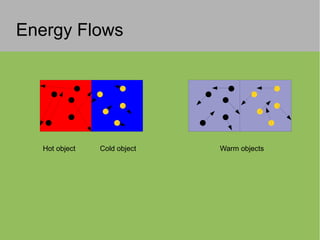
● Internal Energy flows as thermal energy from
areas of high temperature to areas of low
temperature.
● The rate of flow is directly proportional to the
temperature difference between the two
objects.
● This means that the internal energy of the
colder object increases at the same rate as the
internal energy of the hot object decreases.
Energy Flows
Hot object Cold object Warm objects
Energy Flows
● Thermal Energy can transferred by 3 methods
● It can be conducted by molecules vibrating into
the ones around it
● It can be convected, where energy moves due
to the movement of particles
● It can be radiated where the energy is given off
as electromagnetic waves due to the
temperature of the object.
Energy Flows - Conduction
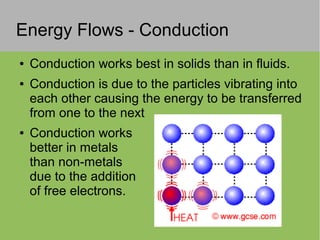
● Conduction works best in solids than in fluids.
● Conduction is due to the particles vibrating into
each other causing the energy to be transferred
from one to the next
● Conduction works
better in metals
than non-metals
due to the addition
of free electrons.
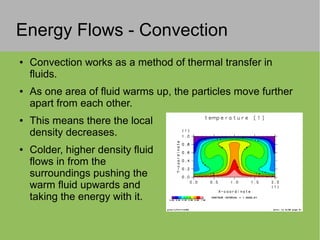
Energy Flows - Convection
● Convection works as a method of thermal transfer in
fluids.
● As one area of fluid warms up, the particles move further
apart from each other.
● This means there the local
density decreases.
● Colder, higher density fluid
flows in from the
surroundings pushing the
warm fluid upwards and
taking the energy with it.
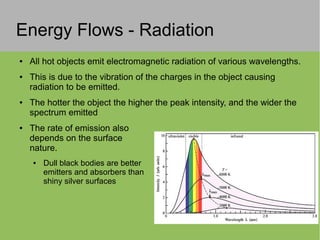
Energy Flows - Radiation
● All hot objects emit electromagnetic radiation of various wavelengths.
● This is due to the vibration of the charges in the object causing
radiation to be emitted.
● The hotter the object the higher the peak intensity, and the wider the
spectrum emitted
● The rate of emission also
depends on the surface
nature.
● Dull black bodies are better
emitters and absorbers than
shiny silver surfaces
Temperature Scales
● The thermal energy absorbed or emitted by a
body cannot be directly measured.
● The temperature, the average kinetic energy
per molecule, can be measured using a
thermometer.
● The common scales are Celsius, Fahrenheit and
Kelvin.
Temperature Scales
● A temperature scale is usually defined by either two
fixed points, or 1 fixed point and a fixed interval.
● Celsius is defined by the fixed points of the melting and
boiling point of pure water at standard pressures. (0 and
100 o
C)
● Fahrenheit is defined by the coldest temperature that
could be achieved in a lab at the time (0F) and the
blood temperature of a race horse (100F)
● The kelvin scale is a measure of the absolute
temperature of an object and is defined as 0K is the
coldest temperature possible with an interval equal to
1o
C.
Kelvin Temperatures
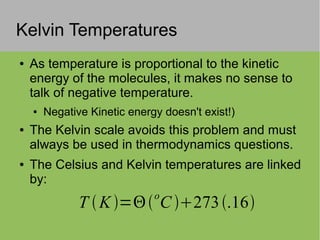
● As temperature is proportional to the kinetic
energy of the molecules, it makes no sense to
talk of negative temperature.
● Negative Kinetic energy doesn't exist!)
● The Kelvin scale avoids this problem and must
always be used in thermodynamics questions.
● The Celsius and Kelvin temperatures are linked
by:
T K = C
o
273.16
Absolute Zero
● At a temperature of 0K, the average kinetic
energy of the particles is zero. They are not
moving on average.
● This temperature is called absolute zero and is
currently thought to be -273.15o
C.
● However, this cannot be actually attained in the
laboratory.
Particles in Substances
● When we think about substances we often think
about their macroscopic properties.
● Mass, dimension, average temperature.
● However, we sometimes need to think about
the properties of individual particles.
● These are the microscopic properties.
● Internal energy, molecular mass, shape.
Particles in Substances
● A sample of a pure elemental substance will
contain a fixed number of atoms.
● The amount of substance is known as the mole
(mol)
● The number of atoms in 1 mole of carbon-12 is
the same as the number of atoms in 1 mole of
uranium-238.
● Clearly, these will not have the same total mass.
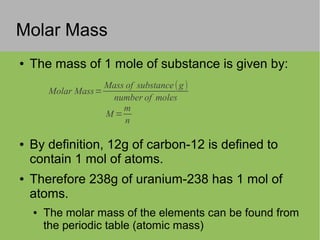
Molar Mass
Molar Mass=
Mass of substance(g)
number of moles
M =
m
n
● The mass of 1 mole of substance is given by:
● By definition, 12g of carbon-12 is defined to
contain 1 mol of atoms.
● Therefore 238g of uranium-238 has 1 mol of
atoms.
● The molar mass of the elements can be found from
the periodic table (atomic mass)
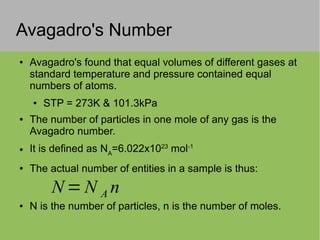
Avagadro's Number
● Avagadro's found that equal volumes of different gases at
standard temperature and pressure contained equal
numbers of atoms.
● STP = 273K & 101.3kPa
● The number of particles in one mole of any gas is the
Avagadro number.
● It is defined as NA
=6.022x10²³
mol-1
● The actual number of entities in a sample is thus:
● N is the number of particles, n is the number of moles.
N = N A n
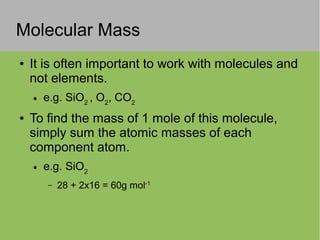
Molecular Mass
● It is often important to work with molecules and
not elements.
● e.g. SiO2
, O2
, CO2
● To find the mass of 1 mole of this molecule,
simply sum the atomic masses of each
component atom.
● e.g. SiO2
– 28 + 2x16 = 60g mol-1
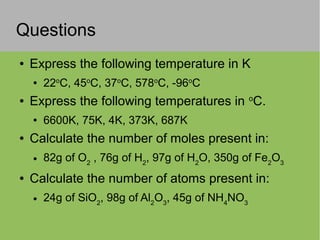
Questions
● Express the following temperature in K
● 22o
C, 45o
C, 37o
C, 578o
C, -96o
C
● Express the following temperatures in o
C.
● 6600K, 75K, 4K, 373K, 687K
● Calculate the number of moles present in:
● 82g of O2
, 76g of H2
, 97g of H2
O, 350g of Fe2
O3
● Calculate the number of atoms present in:
● 24g of SiO2
, 98g of Al2
O3
, 45g of NH4
NO3

3.1 thermal concepts

  • 1.
    Topic 3 -Thermodynamics 3.1 – Thermal Concepts
  • 2.
    Energy in Substances ●All objects have internal energy (U) ● This is because the internal particles are vibrating randomly in the substance and there are electrical forces between them. ● Internal energy is the sum of the kinetic and potential energies of the internal particles of a substance. ● The potential energy is due mainly to the electric fields between the particles, both bonding and intermolecular
  • 3.
    Energy in aSubstance ● The energy in an object is internal energy ● The transfer of energy between objects by non-mechanical methods is thermal energy. ● The temperature of a body is a measure of the average internal kinetic energy of the particles in the substance.
  • 4.
    Energy Flows ● InternalEnergy flows as thermal energy from areas of high temperature to areas of low temperature. ● The rate of flow is directly proportional to the temperature difference between the two objects. ● This means that the internal energy of the colder object increases at the same rate as the internal energy of the hot object decreases.
  • 5.
    Energy Flows Hot objectCold object Warm objects
  • 6.
    Energy Flows ● ThermalEnergy can transferred by 3 methods ● It can be conducted by molecules vibrating into the ones around it ● It can be convected, where energy moves due to the movement of particles ● It can be radiated where the energy is given off as electromagnetic waves due to the temperature of the object.
  • 7.
    Energy Flows -Conduction ● Conduction works best in solids than in fluids. ● Conduction is due to the particles vibrating into each other causing the energy to be transferred from one to the next ● Conduction works better in metals than non-metals due to the addition of free electrons.
  • 8.
    Energy Flows -Convection ● Convection works as a method of thermal transfer in fluids. ● As one area of fluid warms up, the particles move further apart from each other. ● This means there the local density decreases. ● Colder, higher density fluid flows in from the surroundings pushing the warm fluid upwards and taking the energy with it.
  • 9.
    Energy Flows -Radiation ● All hot objects emit electromagnetic radiation of various wavelengths. ● This is due to the vibration of the charges in the object causing radiation to be emitted. ● The hotter the object the higher the peak intensity, and the wider the spectrum emitted ● The rate of emission also depends on the surface nature. ● Dull black bodies are better emitters and absorbers than shiny silver surfaces
  • 10.
    Temperature Scales ● Thethermal energy absorbed or emitted by a body cannot be directly measured. ● The temperature, the average kinetic energy per molecule, can be measured using a thermometer. ● The common scales are Celsius, Fahrenheit and Kelvin.
  • 11.
    Temperature Scales ● Atemperature scale is usually defined by either two fixed points, or 1 fixed point and a fixed interval. ● Celsius is defined by the fixed points of the melting and boiling point of pure water at standard pressures. (0 and 100 o C) ● Fahrenheit is defined by the coldest temperature that could be achieved in a lab at the time (0F) and the blood temperature of a race horse (100F) ● The kelvin scale is a measure of the absolute temperature of an object and is defined as 0K is the coldest temperature possible with an interval equal to 1o C.
  • 12.
    Kelvin Temperatures ● Astemperature is proportional to the kinetic energy of the molecules, it makes no sense to talk of negative temperature. ● Negative Kinetic energy doesn't exist!) ● The Kelvin scale avoids this problem and must always be used in thermodynamics questions. ● The Celsius and Kelvin temperatures are linked by: T K = C o 273.16
  • 13.
    Absolute Zero ● Ata temperature of 0K, the average kinetic energy of the particles is zero. They are not moving on average. ● This temperature is called absolute zero and is currently thought to be -273.15o C. ● However, this cannot be actually attained in the laboratory.
  • 14.
    Particles in Substances ●When we think about substances we often think about their macroscopic properties. ● Mass, dimension, average temperature. ● However, we sometimes need to think about the properties of individual particles. ● These are the microscopic properties. ● Internal energy, molecular mass, shape.
  • 15.
    Particles in Substances ●A sample of a pure elemental substance will contain a fixed number of atoms. ● The amount of substance is known as the mole (mol) ● The number of atoms in 1 mole of carbon-12 is the same as the number of atoms in 1 mole of uranium-238. ● Clearly, these will not have the same total mass.
  • 16.
    Molar Mass Molar Mass= Massof substance(g) number of moles M = m n ● The mass of 1 mole of substance is given by: ● By definition, 12g of carbon-12 is defined to contain 1 mol of atoms. ● Therefore 238g of uranium-238 has 1 mol of atoms. ● The molar mass of the elements can be found from the periodic table (atomic mass)
  • 17.
    Avagadro's Number ● Avagadro'sfound that equal volumes of different gases at standard temperature and pressure contained equal numbers of atoms. ● STP = 273K & 101.3kPa ● The number of particles in one mole of any gas is the Avagadro number. ● It is defined as NA =6.022x10²³ mol-1 ● The actual number of entities in a sample is thus: ● N is the number of particles, n is the number of moles. N = N A n
  • 18.
    Molecular Mass ● Itis often important to work with molecules and not elements. ● e.g. SiO2 , O2 , CO2 ● To find the mass of 1 mole of this molecule, simply sum the atomic masses of each component atom. ● e.g. SiO2 – 28 + 2x16 = 60g mol-1
  • 19.
    Questions ● Express thefollowing temperature in K ● 22o C, 45o C, 37o C, 578o C, -96o C ● Express the following temperatures in o C. ● 6600K, 75K, 4K, 373K, 687K ● Calculate the number of moles present in: ● 82g of O2 , 76g of H2 , 97g of H2 O, 350g of Fe2 O3 ● Calculate the number of atoms present in: ● 24g of SiO2 , 98g of Al2 O3 , 45g of NH4 NO3