MomentumMomentum
Chapter 6Chapter 6
Momentum (Symbol = p) [Unit = kg m/s]
 Inertia in motion  The Quantity of Motion
Momentum = Mass • Velocity
p = m • v
Newton’s 2nd
Law
Impulse = change in momentum
( )
f i
f i
f i
v vvF ma a
t t
v v
t F m t
t
Ft mv mv
−∆= = =
−
• = •
= −
Impulse (Symbol = I)[Unit = Nsec]
 A force in a certain time
Concept: In order to change momentum,
we need a force in a certain amount of time!
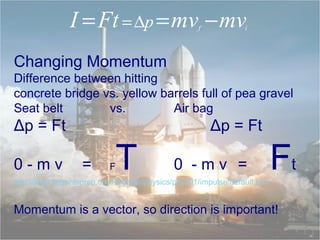
f ipI Ft mv mv=∆= = −
Changing Momentum
Difference between hitting
concrete bridge vs. yellow barrels full of pea gravel
Seat belt vs. Air bag
Δp = Ft Δp = Ft
0 - m v = FT 0 - m v = Ft
http://www.regentsprep.org/Regents/physics/phys01/impulse/default.htm
Momentum is a vector, so direction is important!
A 4.0 x 10⁴
N rocket is at rest when it fires its thrusters.
If the thrusters put out an average force of 5.0 x 10³
N
over 20 sec, then
(a) What is the impulse the rocket experiences?
(b) What is the rocket’s final velocity?
(a) Impulse
I = F t
I = 5000 (20)
I = 100,000 Nsec
(b) v
I = ∆p = mvf – mvi
100,000 = 4080 vf – 4080(0)
vf = 24.5 m/s
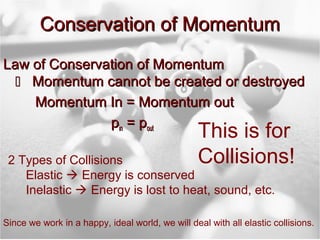
Conservation of MomentumConservation of Momentum
Law of Conservation of MomentumLaw of Conservation of Momentum
 Momentum cannot be created or destroyedMomentum cannot be created or destroyed
Momentum In = Momentum outMomentum In = Momentum out
ppinin = p= poutout
2 Types of Collisions
Elastic  Energy is conserved
Inelastic  Energy is lost to heat, sound, etc.
Since we work in a happy, ideal world, we will deal with all elastic collisions.
This is for
Collisions!
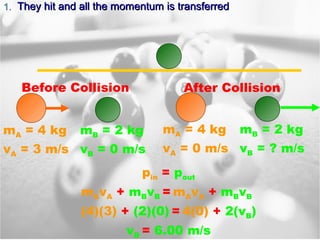
1.1. They hit and all the momentum is transferredThey hit and all the momentum is transferred
mA = 4 kg
vA = 3 m/s
mB = 2 kg
vB = 0 m/s
Before Collision
mA = 4 kg
vA = 0 m/s
mB = 2 kg
vB = ? m/s
After Collision
pin = pout
mAvA + mBvB = mAvA + mBvB
(4)(3) + (2)(0) = 4(0) + 2(vB)
vB = 6.00 m/s
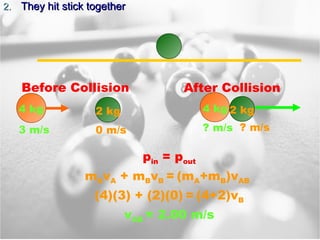
2.2. They hit stick togetherThey hit stick together
4 kg
3 m/s
2 kg
0 m/s
Before Collision
4 kg
? m/s
2 kg
? m/s
After Collision
pin = pout
mAvA + mBvB = (mA+mB)vAB
(4)(3) + (2)(0) = (4+2)vB
vAB = 2.00 m/s
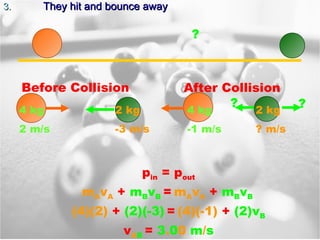
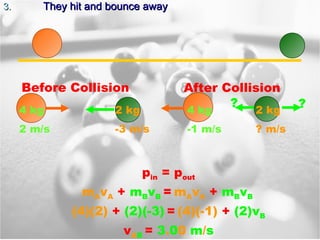
3.3. They hit and bounce awayThey hit and bounce away
4 kg
2 m/s
2 kg
-3 m/s
Before Collision
4 kg
-1 m/s
2 kg
? m/s
After Collision
pin = pout
mAvA + mBvB = mAvA + mBvB
(4)(2) + (2)(-3) = (4)(-1) + (2)vB
vAB = 3.00 m/s
? ?
?
3.3. They hit and bounce awayThey hit and bounce away
Before Collision After Collision
pin = pout
mAvA + mBvB = mAvA + mBvB
(4)(2) + (2)(-3) = (4)(-1) + (2)vB
vAB = 3.00 m/s
4 kg
2 m/s
2 kg
-3 m/s
4 kg
-1 m/s
2 kg
? m/s
? ?
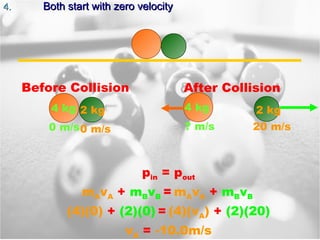
4.4. Both start with zero velocityBoth start with zero velocity
4 kg
0 m/s
2 kg
0 m/s
Before Collision
4 kg
? m/s
2 kg
20 m/s
After Collision
pin = pout
mAvA + mBvB = mAvA + mBvB
(4)(0) + (2)(0) = (4)(vA) + (2)(20)
vA = -10.0m/s
2 momentum notes (all)

2 momentum notes (all)

  • 1.
  • 2.
    Momentum (Symbol =p) [Unit = kg m/s]  Inertia in motion  The Quantity of Motion Momentum = Mass • Velocity p = m • v Newton’s 2nd Law Impulse = change in momentum ( ) f i f i f i v vvF ma a t t v v t F m t t Ft mv mv −∆= = = − • = • = − Impulse (Symbol = I)[Unit = Nsec]  A force in a certain time Concept: In order to change momentum, we need a force in a certain amount of time! f ipI Ft mv mv=∆= = −
  • 3.
    f ipI Ftmv mv=∆= = − Changing Momentum Difference between hitting concrete bridge vs. yellow barrels full of pea gravel Seat belt vs. Air bag Δp = Ft Δp = Ft 0 - m v = FT 0 - m v = Ft http://www.regentsprep.org/Regents/physics/phys01/impulse/default.htm Momentum is a vector, so direction is important!
  • 4.
    A 4.0 x10⁴ N rocket is at rest when it fires its thrusters. If the thrusters put out an average force of 5.0 x 10³ N over 20 sec, then (a) What is the impulse the rocket experiences? (b) What is the rocket’s final velocity? (a) Impulse I = F t I = 5000 (20) I = 100,000 Nsec (b) v I = ∆p = mvf – mvi 100,000 = 4080 vf – 4080(0) vf = 24.5 m/s
  • 6.
    Conservation of MomentumConservationof Momentum Law of Conservation of MomentumLaw of Conservation of Momentum  Momentum cannot be created or destroyedMomentum cannot be created or destroyed Momentum In = Momentum outMomentum In = Momentum out ppinin = p= poutout 2 Types of Collisions Elastic  Energy is conserved Inelastic  Energy is lost to heat, sound, etc. Since we work in a happy, ideal world, we will deal with all elastic collisions. This is for Collisions!
  • 7.
    1.1. They hitand all the momentum is transferredThey hit and all the momentum is transferred mA = 4 kg vA = 3 m/s mB = 2 kg vB = 0 m/s Before Collision mA = 4 kg vA = 0 m/s mB = 2 kg vB = ? m/s After Collision pin = pout mAvA + mBvB = mAvA + mBvB (4)(3) + (2)(0) = 4(0) + 2(vB) vB = 6.00 m/s
  • 8.
    2.2. They hitstick togetherThey hit stick together 4 kg 3 m/s 2 kg 0 m/s Before Collision 4 kg ? m/s 2 kg ? m/s After Collision pin = pout mAvA + mBvB = (mA+mB)vAB (4)(3) + (2)(0) = (4+2)vB vAB = 2.00 m/s
  • 9.
    3.3. They hitand bounce awayThey hit and bounce away 4 kg 2 m/s 2 kg -3 m/s Before Collision 4 kg -1 m/s 2 kg ? m/s After Collision pin = pout mAvA + mBvB = mAvA + mBvB (4)(2) + (2)(-3) = (4)(-1) + (2)vB vAB = 3.00 m/s ? ? ?
  • 10.
    3.3. They hitand bounce awayThey hit and bounce away Before Collision After Collision pin = pout mAvA + mBvB = mAvA + mBvB (4)(2) + (2)(-3) = (4)(-1) + (2)vB vAB = 3.00 m/s 4 kg 2 m/s 2 kg -3 m/s 4 kg -1 m/s 2 kg ? m/s ? ?
  • 11.
    4.4. Both startwith zero velocityBoth start with zero velocity 4 kg 0 m/s 2 kg 0 m/s Before Collision 4 kg ? m/s 2 kg 20 m/s After Collision pin = pout mAvA + mBvB = mAvA + mBvB (4)(0) + (2)(0) = (4)(vA) + (2)(20) vA = -10.0m/s

Editor's Notes