Week 10, Lesson 1 Rigid Body Rotation 1 
Rigid Body Rotation (cont’d) 
Week 10, Lesson 1 
• 
Parallel-Axis Theorem 
• 
Combined Rotation & Translation 
• 
Angular Momentum 
References/Reading Preparation: 
Schaum’s Outline Ch. 10 
Principles of Physics by Beuche – Ch.8
Week 10, Lesson 1 Rigid Body Rotation 2 
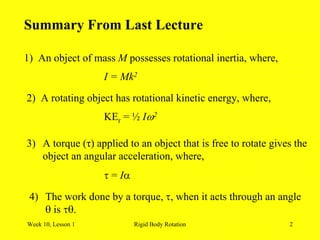
Summary From Last Lecture 
1) An object of mass Mpossesses rotational inertia, where, 
I = Mk2 
2) A rotating object has rotational kinetic energy, where, 
KEr = ½ I2 
3) 
A torque (τ) applied to an object that is free to rotate gives the 
object an angular acceleration, where, 
 = I 
4) 
The work done by a torque, , when it acts through an angle 
 is .
Week 10, Lesson 1 Rigid Body Rotation 3 
Parallel-Axis Theorem 
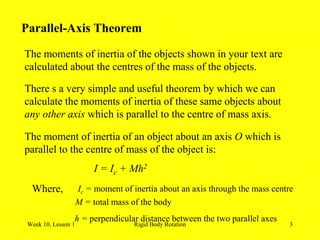
The moments of inertia of the objects shown in your text are 
calculated about the centres of the mass of the objects. 
There s a very simple and useful theorem by which we can 
calculate the moments of inertia of these same objects about 
any other axis which is parallel to the centre of mass axis. 
The moment of inertia of an object about an axis O which is 
parallel to the centre of mass of the object is: 
I = Ic + Mh2 
Where, 
Ic = moment of inertia about an axis through the mass centre 
M = total mass of the body 
h = perpendicular distance between the two parallel axes
Week 10, Lesson 1 Rigid Body Rotation 4 
Worked Example 
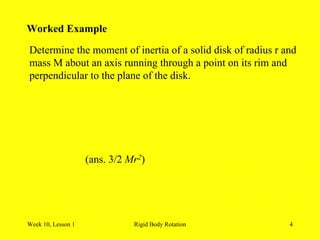
Determine the moment of inertia of a solid disk of radius r and 
mass M about an axis running through a point on its rim and 
perpendicular to the plane of the disk. 
(ans. 3/2 Mr2)
Week 10, Lesson 1 Rigid Body Rotation 5 
Worked Example 
Find the rotational kinetic energy of the earth due to its daily 
rotation on its axis. Assume a uniform sphere of 
M = 5.98 x 1024 kg, r = 6.37 x 10⁶ m
Week 10, Lesson 1 Rigid Body Rotation 6 
Worked Example 
A certain wheel with a radius of 40 cm has a mass of 30 kg and 
a radius of gyration, k, of 25 cm. A cord wound around its rim 
supplies a tangential force of 1.8 N to the wheel which turns 
freely on its axis. Find the angular acceleration of the wheel. 
( ans.  = 0.384 rad/s2)
Week 10, Lesson 1 Rigid Body Rotation 7 
Worked Example 
The larger wheel shown has a mass of 80 kg and a radius r of 25 cm. It is 
driven by a belt as shown. The tension in the upper part of the belt is 8.0 N 
and that for the lower part is essentially zero. Assume the wheel to be a 
uniform disk. 
a) 
How long does it take for the belt to accelerate the larger wheel from rest 
to a speed of 2.0 rev/s? 
b) 
How far does the wheel turn in this time (i.e., what is the angular 
displacement, )? 
c) What is the rotational KE? 
T = 8.0 N 
T = 0 
r 
(ans. t = 15.7 s 
 = 98.6 rad 
KEr = 197 J)
Week 10, Lesson 1 Rigid Body Rotation 8 
Worked Example 
A 500 g uniform sphere of 7.0 cm radius spins at 30 rev/s on an 
axis through its centre. Find its: 
a) 
KEr (ans. 17.3 J) 
b) 
Angular momentum (ans. 0.184 kg·m2/s) 
c) 
Radius of gyration (ans. 0.0443 m)
Week 10, Lesson 1 Rigid Body Rotation 9 
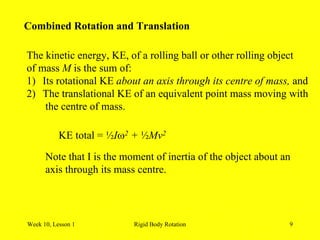
Combined Rotation and Translation 
The kinetic energy, KE, of a rolling ball or other rolling object 
of mass Mis the sum of: 
1) 
Its rotational KE about an axis through its centre of mass, and 
2) 
The translational KE of an equivalent point mass moving with 
the centre of mass. 
KE total = ½I2 + ½Mv2 
Note that I is the moment of inertia of the object about an 
axis through its mass centre.
Week 10, Lesson 1 Rigid Body Rotation 10 
Worked Example 
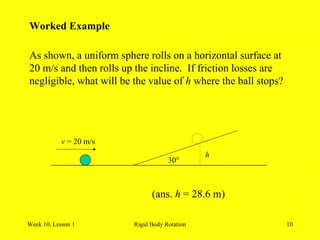
As shown, a uniform sphere rolls on a horizontal surface at 
20 m/s and then rolls up the incline. If friction losses are 
negligible, what will be the value of h where the ball stops? 
30° 
v = 20 m/s 
h 
(ans. h = 28.6 m)
Week 10, Lesson 1 Rigid Body Rotation 11 
Angular Momentum 
Rotational, or angular, momentum is associated with the fact 
that a rotating object persists in rotating. 
Angular momentum is a vector quantity with magnitude Iω and 
is directed along the axis of rotation. 
If the net torque on a body is zero, its angular momentum will 
Remain unchanged in both magnitude and direction. This is the 
Law of conservation of angular momentum.
Week 10, Lesson 1 Rigid Body Rotation 12 
Worked Example 
A disk of moment of inertia I1 is rotating freely with angular 
speed ω1 when a second, non-rotating, disk with moment of 
inertia I2 is dropped on it. The two then rotate as a unit. Find 
the angular speed. 
ans.  = (I1 1)/(I1 + I2)

Physics 12

  • 1.
    Week 10, Lesson1 Rigid Body Rotation 1 Rigid Body Rotation (cont’d) Week 10, Lesson 1 • Parallel-Axis Theorem • Combined Rotation & Translation • Angular Momentum References/Reading Preparation: Schaum’s Outline Ch. 10 Principles of Physics by Beuche – Ch.8
  • 2.
    Week 10, Lesson1 Rigid Body Rotation 2 Summary From Last Lecture 1) An object of mass Mpossesses rotational inertia, where, I = Mk2 2) A rotating object has rotational kinetic energy, where, KEr = ½ I2 3) A torque (τ) applied to an object that is free to rotate gives the object an angular acceleration, where,  = I 4) The work done by a torque, , when it acts through an angle  is .
  • 3.
    Week 10, Lesson1 Rigid Body Rotation 3 Parallel-Axis Theorem The moments of inertia of the objects shown in your text are calculated about the centres of the mass of the objects. There s a very simple and useful theorem by which we can calculate the moments of inertia of these same objects about any other axis which is parallel to the centre of mass axis. The moment of inertia of an object about an axis O which is parallel to the centre of mass of the object is: I = Ic + Mh2 Where, Ic = moment of inertia about an axis through the mass centre M = total mass of the body h = perpendicular distance between the two parallel axes
  • 4.
    Week 10, Lesson1 Rigid Body Rotation 4 Worked Example Determine the moment of inertia of a solid disk of radius r and mass M about an axis running through a point on its rim and perpendicular to the plane of the disk. (ans. 3/2 Mr2)
  • 5.
    Week 10, Lesson1 Rigid Body Rotation 5 Worked Example Find the rotational kinetic energy of the earth due to its daily rotation on its axis. Assume a uniform sphere of M = 5.98 x 1024 kg, r = 6.37 x 10⁶ m
  • 6.
    Week 10, Lesson1 Rigid Body Rotation 6 Worked Example A certain wheel with a radius of 40 cm has a mass of 30 kg and a radius of gyration, k, of 25 cm. A cord wound around its rim supplies a tangential force of 1.8 N to the wheel which turns freely on its axis. Find the angular acceleration of the wheel. ( ans.  = 0.384 rad/s2)
  • 7.
    Week 10, Lesson1 Rigid Body Rotation 7 Worked Example The larger wheel shown has a mass of 80 kg and a radius r of 25 cm. It is driven by a belt as shown. The tension in the upper part of the belt is 8.0 N and that for the lower part is essentially zero. Assume the wheel to be a uniform disk. a) How long does it take for the belt to accelerate the larger wheel from rest to a speed of 2.0 rev/s? b) How far does the wheel turn in this time (i.e., what is the angular displacement, )? c) What is the rotational KE? T = 8.0 N T = 0 r (ans. t = 15.7 s  = 98.6 rad KEr = 197 J)
  • 8.
    Week 10, Lesson1 Rigid Body Rotation 8 Worked Example A 500 g uniform sphere of 7.0 cm radius spins at 30 rev/s on an axis through its centre. Find its: a) KEr (ans. 17.3 J) b) Angular momentum (ans. 0.184 kg·m2/s) c) Radius of gyration (ans. 0.0443 m)
  • 9.
    Week 10, Lesson1 Rigid Body Rotation 9 Combined Rotation and Translation The kinetic energy, KE, of a rolling ball or other rolling object of mass Mis the sum of: 1) Its rotational KE about an axis through its centre of mass, and 2) The translational KE of an equivalent point mass moving with the centre of mass. KE total = ½I2 + ½Mv2 Note that I is the moment of inertia of the object about an axis through its mass centre.
  • 10.
    Week 10, Lesson1 Rigid Body Rotation 10 Worked Example As shown, a uniform sphere rolls on a horizontal surface at 20 m/s and then rolls up the incline. If friction losses are negligible, what will be the value of h where the ball stops? 30° v = 20 m/s h (ans. h = 28.6 m)
  • 11.
    Week 10, Lesson1 Rigid Body Rotation 11 Angular Momentum Rotational, or angular, momentum is associated with the fact that a rotating object persists in rotating. Angular momentum is a vector quantity with magnitude Iω and is directed along the axis of rotation. If the net torque on a body is zero, its angular momentum will Remain unchanged in both magnitude and direction. This is the Law of conservation of angular momentum.
  • 12.
    Week 10, Lesson1 Rigid Body Rotation 12 Worked Example A disk of moment of inertia I1 is rotating freely with angular speed ω1 when a second, non-rotating, disk with moment of inertia I2 is dropped on it. The two then rotate as a unit. Find the angular speed. ans.  = (I1 1)/(I1 + I2)