Work, Energy and
Power
In life, there are many forms of work
Work in Physics
In physics, ‘work’ has a very specific meaning.
Only one of the previous pictures shows ‘work’ in a
physics sense
Can you guess which one it is?
Definition of work
Work is defined as the a FORCE which is applied
over a DISTANCE.
W = Fx
Note that more work is done when …
… a greater force is used
… the force acts over a greater distance
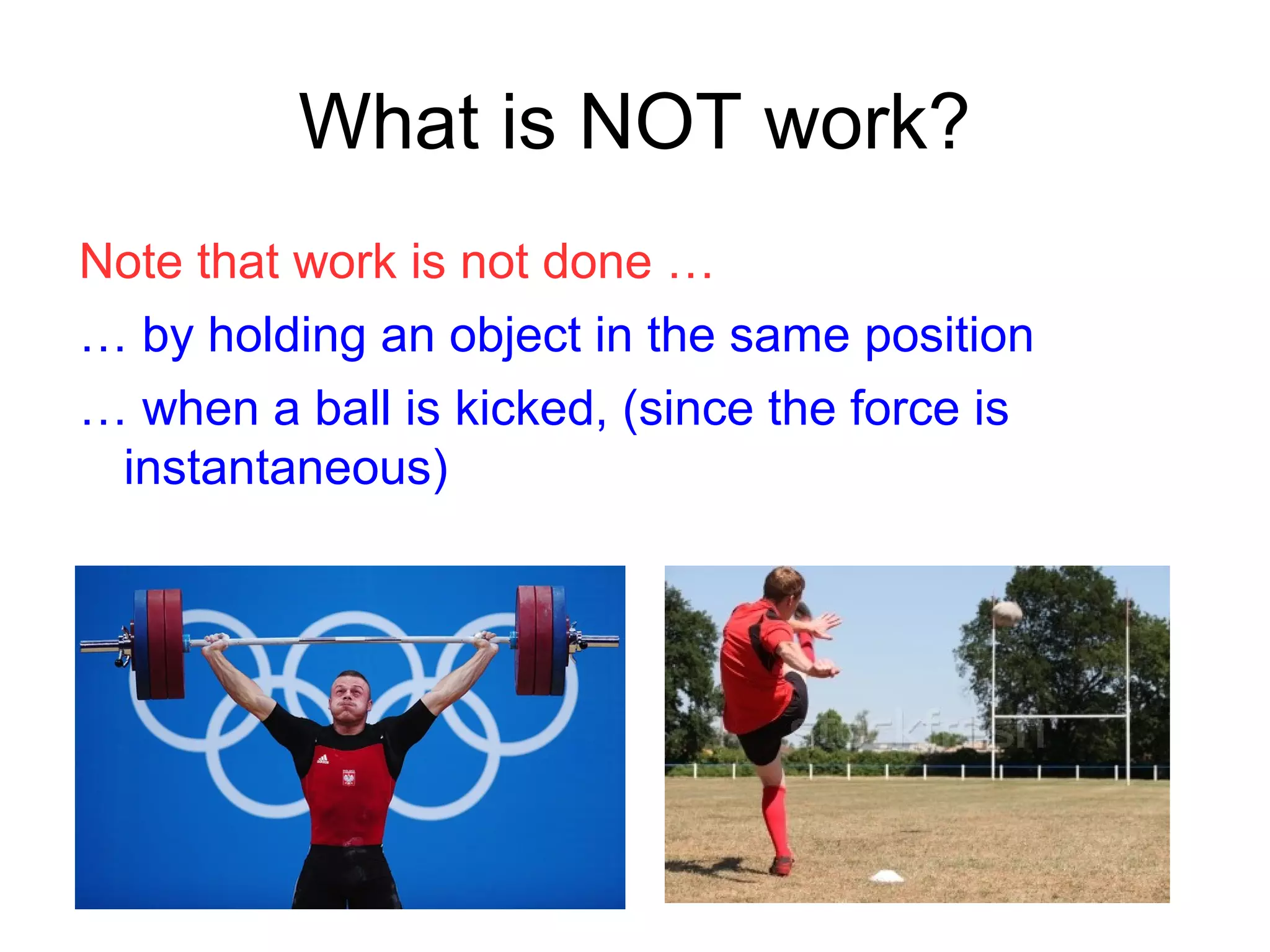
What is NOT work?
Note that work is not done …
… by holding an object in the same position
… when a ball is kicked, (since the force is
instantaneous)
Work can only be done while the force continues
to act on the object over this distance.
The Units of Work
Work is a SCALAR unit
The unit of work is JOULES
(note this is the unit of energy)
The fundamental units of work are …
Nm = kg.m^2
s^2
Problem
• What is the work done by the
forklift truck earlier?
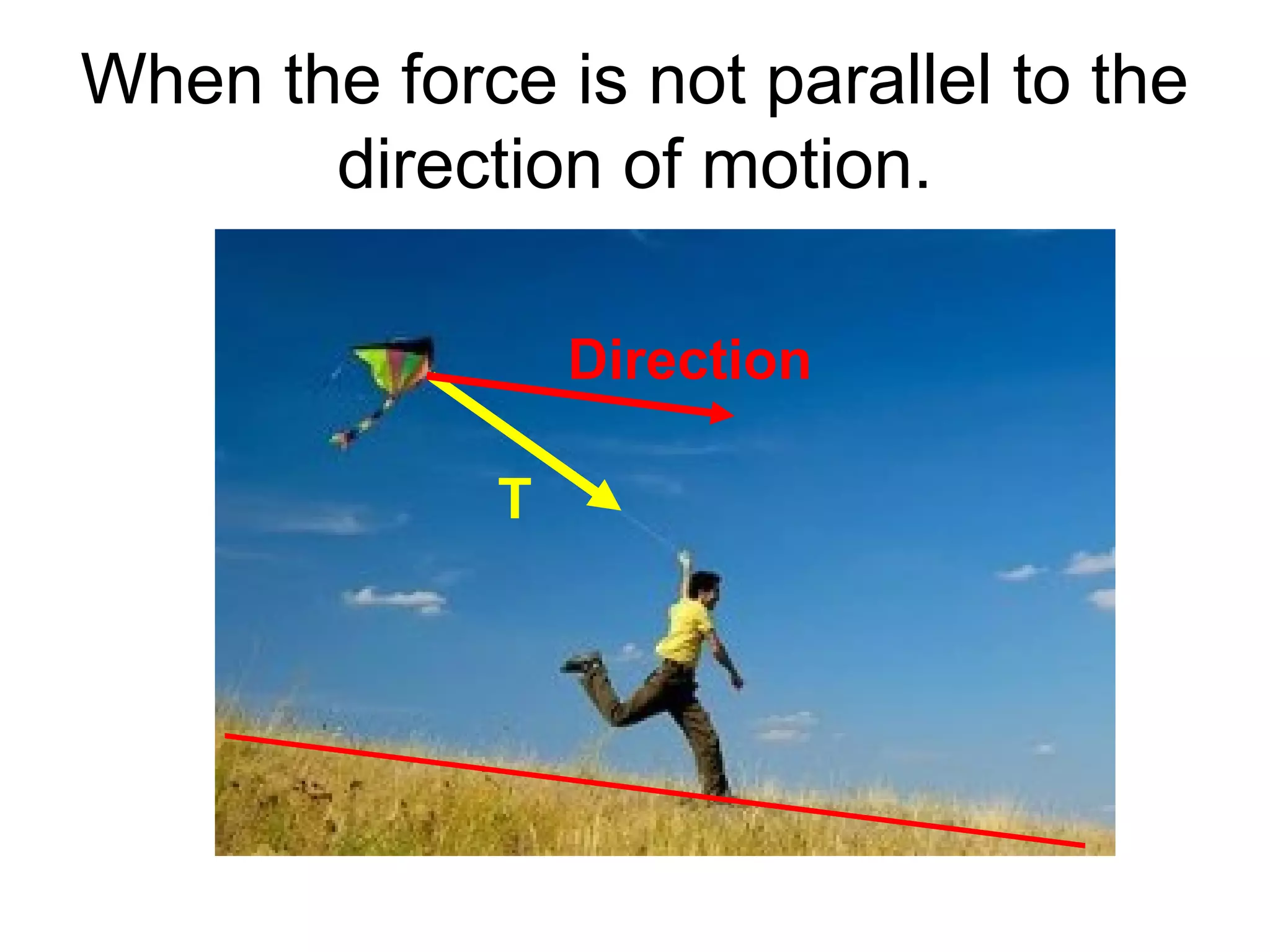
When the force is not parallel to the
direction of motion.
T
Direction
When the force is not parallel to the
direction of motion.
T
T.cos(q)
q
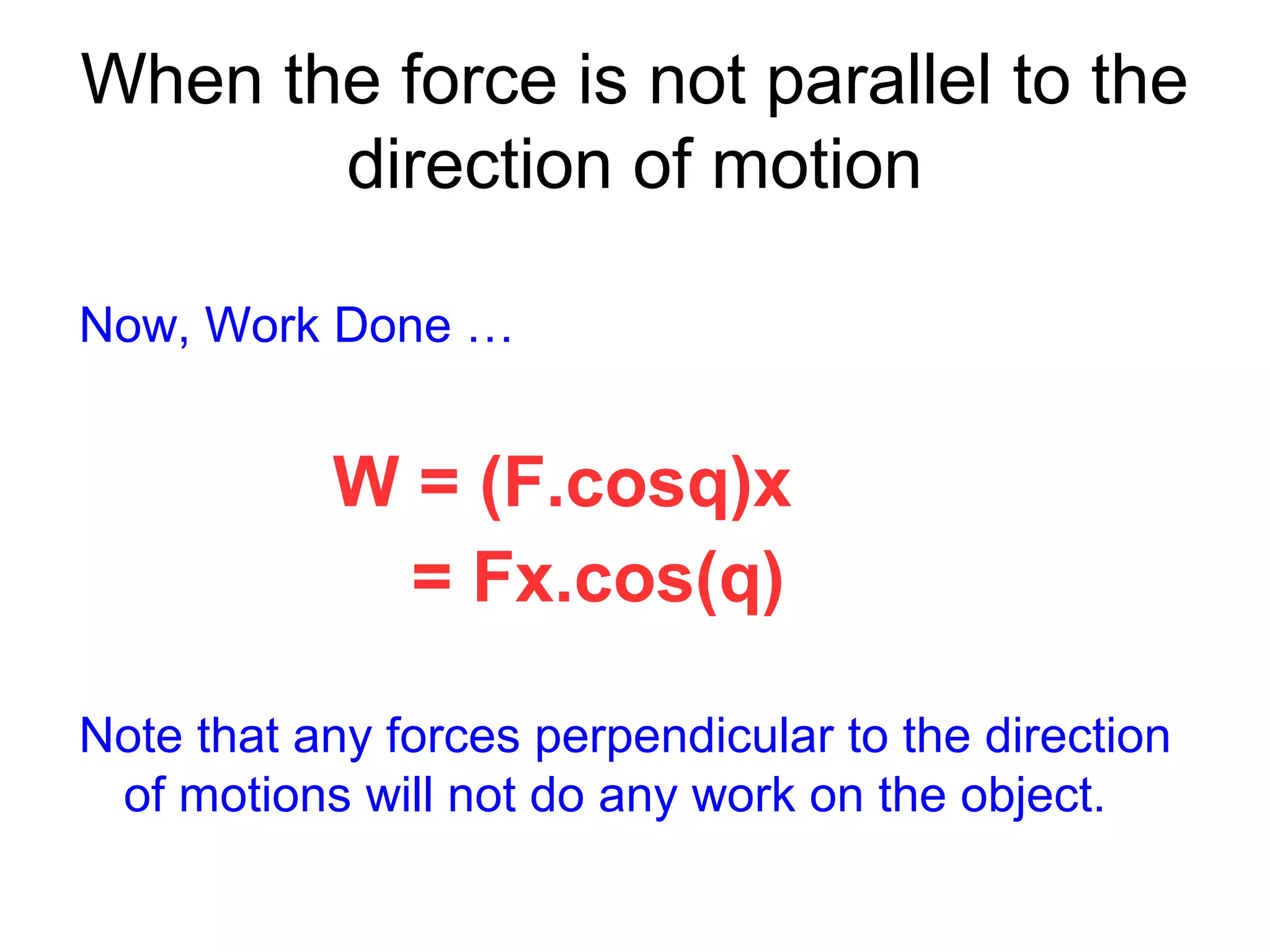
When the force is not parallel to the
direction of motion
Now, Work Done …
W = (F.cosq)x
= Fx.cos(q)
Note that any forces perpendicular to the direction
of motions will not do any work on the object.
Negative Work
Since: W = Fx.cos(q)
And we know that cos(q) is ..
positive from 0 to 90 deg.
negative from 90 to 180 deg.
Then when a force acts in the OPPOSITE
direction of it’s motion, the work done is
NEGATIVE
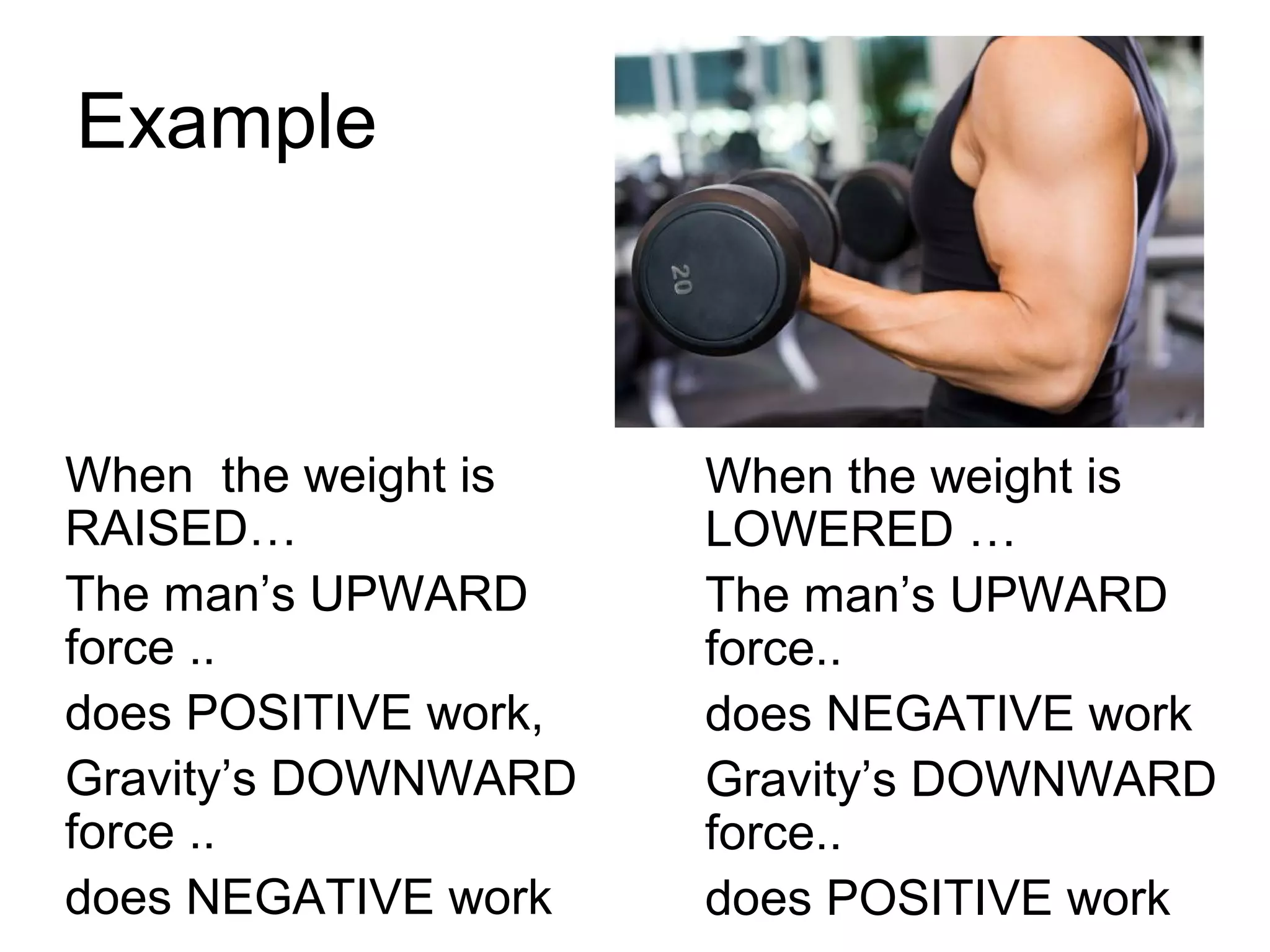
Example
When the weight is
RAISED…
The man’s UPWARD
force ..
does POSITIVE work,
Gravity’s DOWNWARD
force ..
does NEGATIVE work
When the weight is
LOWERED …
The man’s UPWARD
force..
does NEGATIVE work
Gravity’s DOWNWARD
force..
does POSITIVE work
Problem
1. A leaf of mass ‘m’ falls from the top of a tree of
height ‘h’. What is the work done by gravity on
the leaf?
2. A second leaf of the same mass fall from the
same height, but a breeze blows it so that it
falls with an angle of ‘q’ degrees to the vertical.
What is the work done by gravity on this leaf?
Solutions
1. W = Fx =mgh
1. W = (F.cosq)x = mg(cosq) x h/(cosq)
= mgh
q
h
h(cosq)
Problem Sheet 1
Work
The Force – Energy
Theorem
Variable Force
Sometimes, the force applied on a body is not
constant, but dependent upon it’s position
Consider a mass on a spring
A mass on a Spring
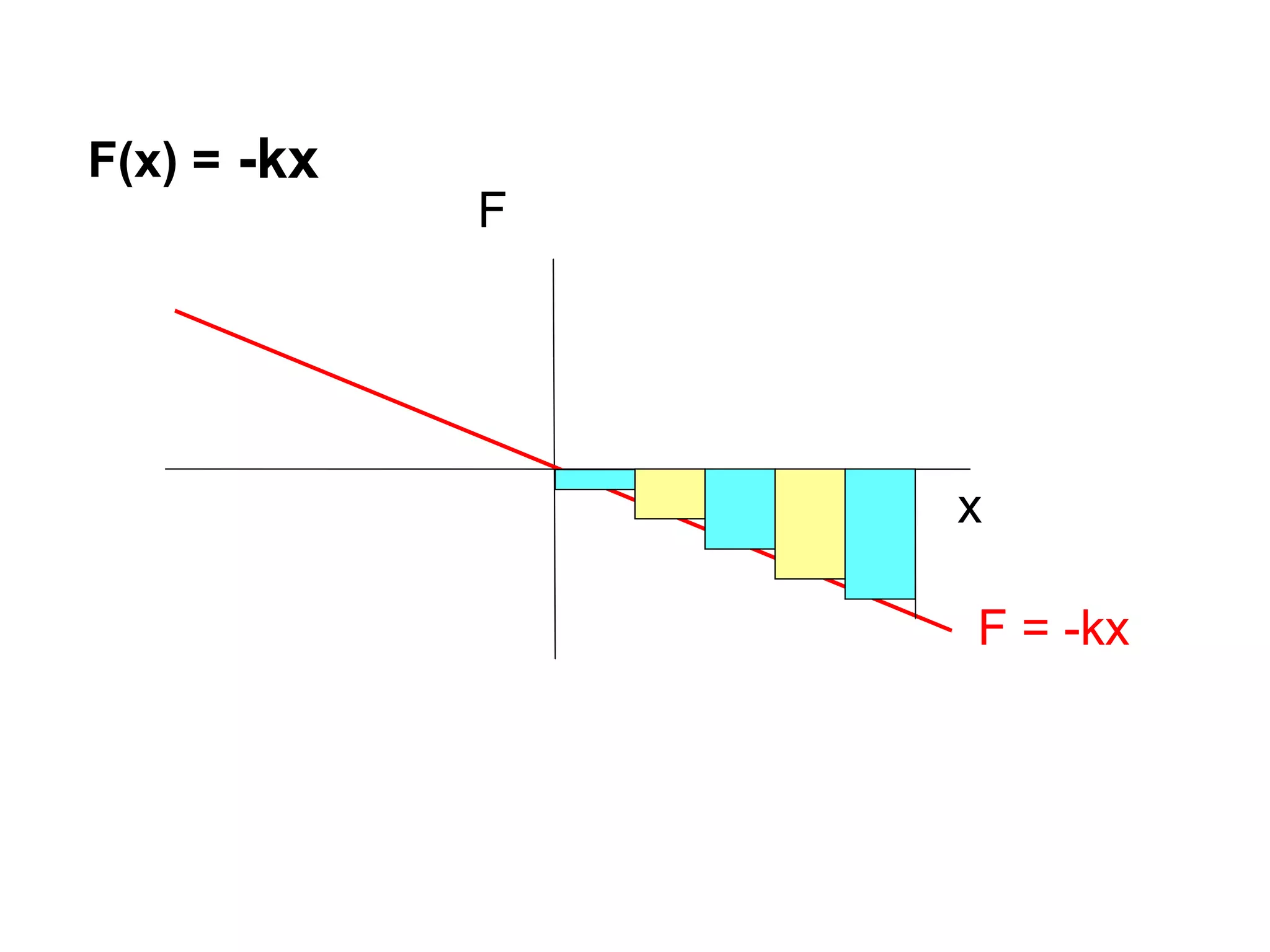
W F1.dx + F2.dx + … + Fn.dx
As dx 0,
dx.ΣF F(x).dx
F(x) =
F
x
F = -kx
-kx
dx
For a variable force
Work …
W = F(x).dx
Note that for a
constant force: F
W = F.dx = Fx + d
(as seen earlier)
F
x
F
x
W
W
Problem

Calculate the general formula for finding the
work done of a mass on a spring

What is the work done on a mass that is moved
by a spring with constant k=5 a displacement of
10 to 20cm past its equilibrium?
Solution
Work Done by spring
Work Done by spring
= F(x).dx
= -kx.dx
= -1
/2
kx2
= -2.5 [0.22
– 0.12
]
= -2.5 [0.04 – 0.01]
= -0.075 J
Work and Energy
F = ma …
= m . dv/dt
= m . dv .
dx
dx
dt
= mv . dv/dx
Newton’s 2nd
Law
Chain rule
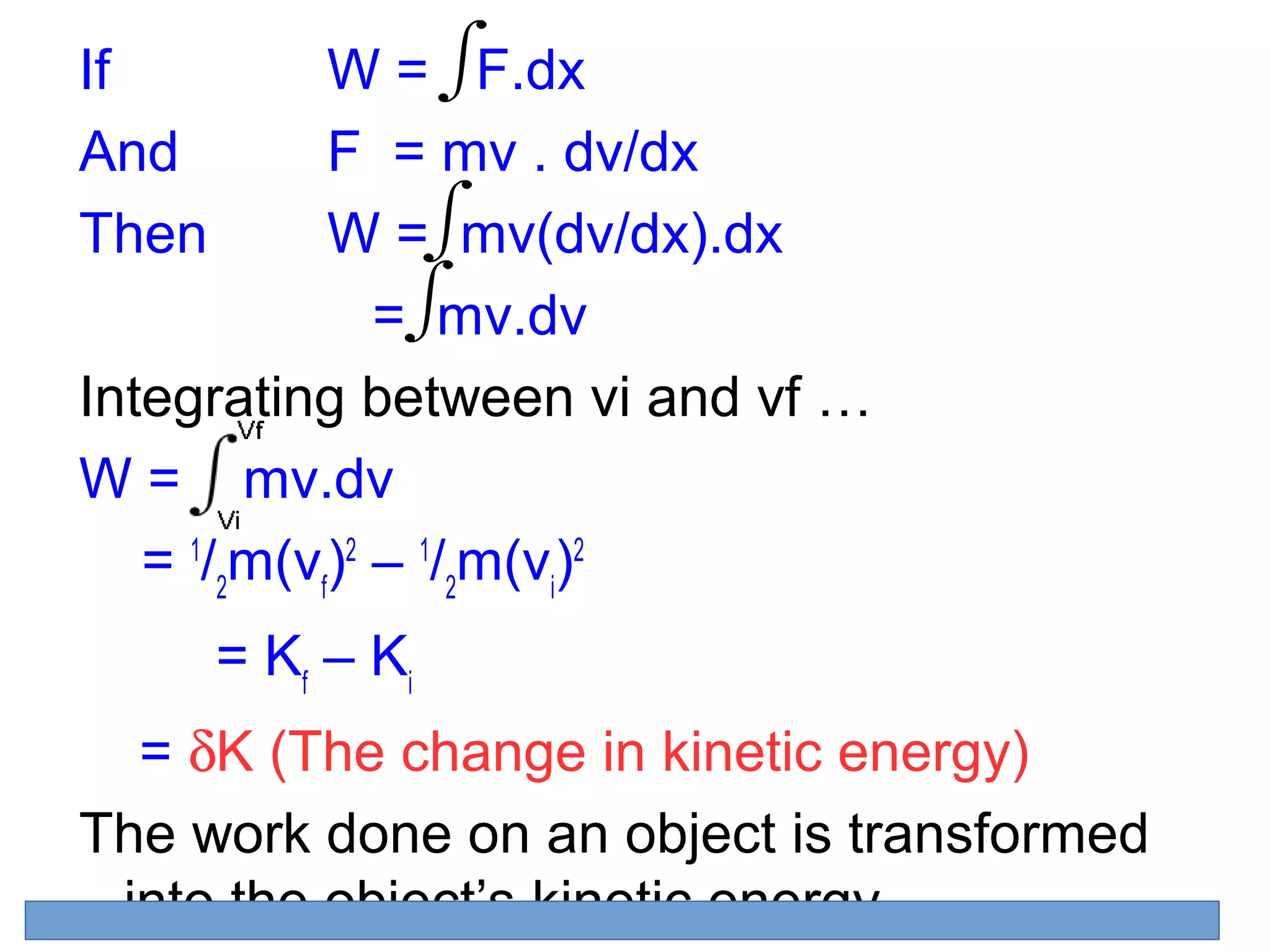
If W = F.dx
And F = mv . dv/dx
Then W = mv(dv/dx).dx
= mv.dv
Integrating between vi and vf …
W = mv.dv
= 1
/2
m(vf
)2
– 1
/2
m(vi
)2
= Kf
– Ki
= δK (The change in kinetic energy)
The work done on an object is transformed
into the object’s kinetic energy.
Problem Sheet 2
The Work – Energy Theorem
Power
Mechanical systems, (eg: engines) are not so
much limited by the work they can do, but the
RATE at which they can do this work.
The rate at which work is done is called:
POWER
Since power is the RATE of work, Average power
…
P = W/t
The unit of power is JOULE PER SECOND, or …
WATT
Note that ...

a CONSTANT FORCE

produces a constant acceleration

Thus, the body will move a greater
distance (x) each second

Thus the work done each second will
increase

Thus the power will increase over time
Therefore, a constant force does NOT
produce a constant power.
Problem
1. A force of 2N is applied to a stationary body of
1kg. How far will this body travel during each
second for the first 3 seconds?
2. Calculate the average power applied during
each second for the first 3 seconds
3. Find P(t) (Power as a function of time)
From F=ma, a constant force of 2N produces a
constant acceleration of 2m/s^2, (velocity
increases by 2 seconds every second)
Solution
d(t) = 1/2at^2 + v.t + d
d(1) = ½(2)(1)+0 =1m
d(2) = ½(2)(1)+2 =3m
d(3) = ½(2)(1)+4 =5m
W = Fx
W(1) = (2)(1) = 2J
W(2) = (2)(3) = 6J
W(3) = (2)(5) = 10J
Since P = W/t, and the work is calculated over one
second, the power over the first 3 seconds is
also: 2W, 6W and 10W
d(t) = 1/2at^2
W(t) = Fd = F(1/2at^2)
= 1/2Fat^2
P(t) = W/t = W/1
= 1/2Fat^2
P(t) = 0.5Fat^2
6W
10W
2W
Instantaneous Power
In fact instantaneous power is usually calculated
using calculus:
P = dW/dt
= F.cos(θ)(dx) =F.cos(θ) . dx/dt
dt
P = Fv.cos(θ)
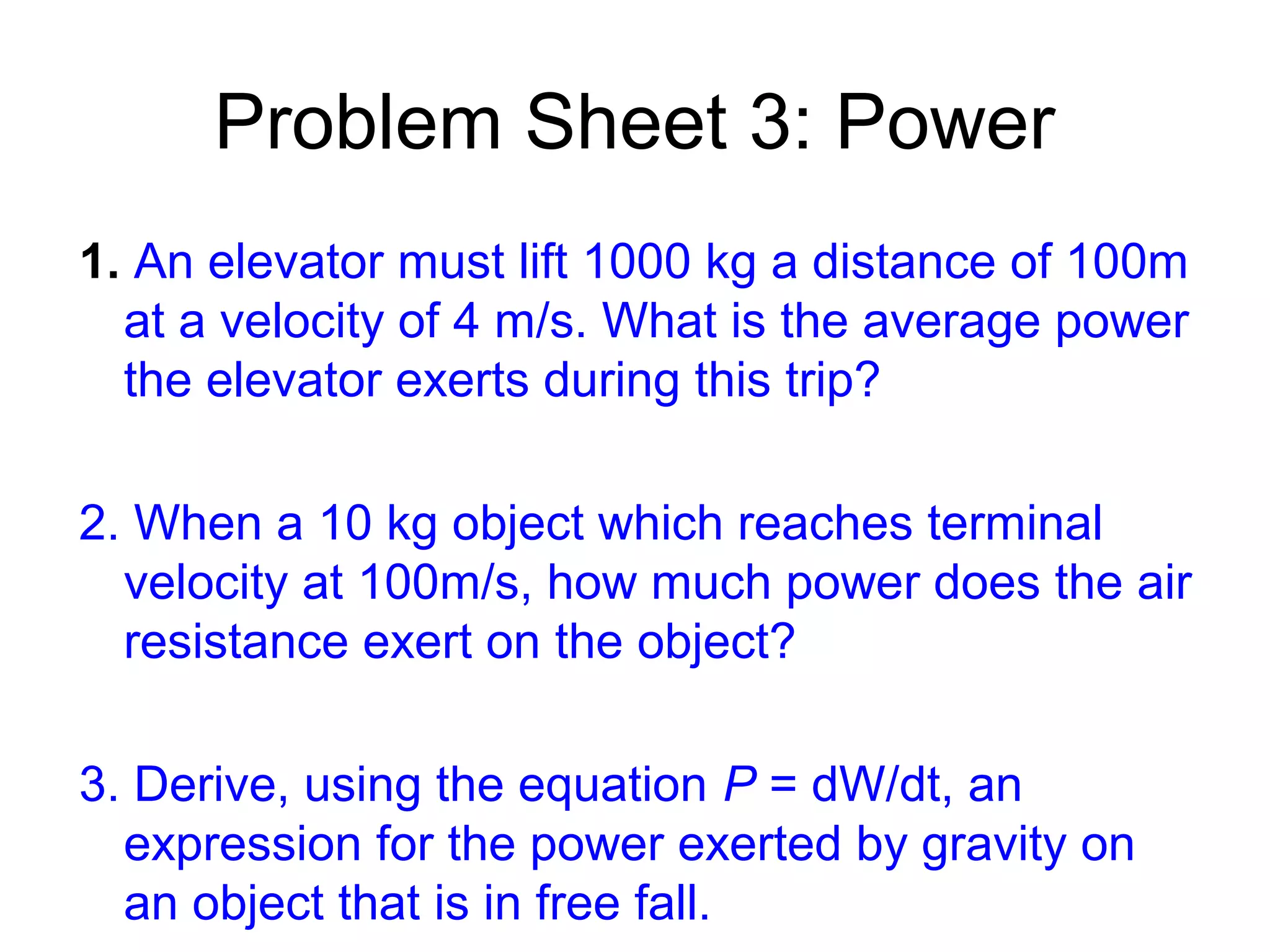
Problem Sheet 3: Power
1. An elevator must lift 1000 kg a distance of 100m
at a velocity of 4 m/s. What is the average power
the elevator exerts during this trip?
2. When a 10 kg object which reaches terminal
velocity at 100m/s, how much power does the air
resistance exert on the object?
3. Derive, using the equation P = dW/dt, an
expression for the power exerted by gravity on
an object that is in free fall.
Summary
Work done by a …
Constant parallel force
Constant non parallel force
Variable parallel force
Work - energy theorem
Average power
Instantaneous power
For constant parallel force
Constant non parallel force
= Force x Distance
= Fx.cos(q)
= F(x).dx
= dK
= W/t
= dW/dt
= Force x Velocity
= Fv.cos(q)
Points to remember
• Work is only done when the Force continues to
be applied over the distance
• A constant force does not produce a constant
power, but an increasing power
W = F1.dx + F2.dx + F3.dx
+
= dx (F1 + F2 + F3 + …)F
xdx
F1
F2 F3
F4 F5
F(x) =
F
x
F = -kx
-kx

A work, energy and power

  • 1.
  • 2.
    In life, thereare many forms of work
  • 3.
    Work in Physics Inphysics, ‘work’ has a very specific meaning. Only one of the previous pictures shows ‘work’ in a physics sense Can you guess which one it is?
  • 4.
    Definition of work Workis defined as the a FORCE which is applied over a DISTANCE. W = Fx Note that more work is done when … … a greater force is used … the force acts over a greater distance
  • 5.
    What is NOTwork? Note that work is not done … … by holding an object in the same position … when a ball is kicked, (since the force is instantaneous)
  • 6.
    Work can onlybe done while the force continues to act on the object over this distance.
  • 7.
    The Units ofWork Work is a SCALAR unit The unit of work is JOULES (note this is the unit of energy) The fundamental units of work are … Nm = kg.m^2 s^2
  • 8.
    Problem • What isthe work done by the forklift truck earlier?
  • 9.
    When the forceis not parallel to the direction of motion. T Direction
  • 10.
    When the forceis not parallel to the direction of motion. T T.cos(q) q
  • 11.
    When the forceis not parallel to the direction of motion Now, Work Done … W = (F.cosq)x = Fx.cos(q) Note that any forces perpendicular to the direction of motions will not do any work on the object.
  • 12.
    Negative Work Since: W= Fx.cos(q) And we know that cos(q) is .. positive from 0 to 90 deg. negative from 90 to 180 deg. Then when a force acts in the OPPOSITE direction of it’s motion, the work done is NEGATIVE
  • 13.
    Example When the weightis RAISED… The man’s UPWARD force .. does POSITIVE work, Gravity’s DOWNWARD force .. does NEGATIVE work When the weight is LOWERED … The man’s UPWARD force.. does NEGATIVE work Gravity’s DOWNWARD force.. does POSITIVE work
  • 14.
    Problem 1. A leafof mass ‘m’ falls from the top of a tree of height ‘h’. What is the work done by gravity on the leaf? 2. A second leaf of the same mass fall from the same height, but a breeze blows it so that it falls with an angle of ‘q’ degrees to the vertical. What is the work done by gravity on this leaf?
  • 15.
    Solutions 1. W =Fx =mgh 1. W = (F.cosq)x = mg(cosq) x h/(cosq) = mgh q h h(cosq)
  • 16.
  • 17.
    The Force –Energy Theorem
  • 18.
    Variable Force Sometimes, theforce applied on a body is not constant, but dependent upon it’s position Consider a mass on a spring
  • 19.
    A mass ona Spring
  • 20.
    W F1.dx +F2.dx + … + Fn.dx As dx 0, dx.ΣF F(x).dx F(x) = F x F = -kx -kx dx
  • 21.
    For a variableforce Work … W = F(x).dx Note that for a constant force: F W = F.dx = Fx + d (as seen earlier) F x F x W W
  • 22.
    Problem  Calculate the generalformula for finding the work done of a mass on a spring  What is the work done on a mass that is moved by a spring with constant k=5 a displacement of 10 to 20cm past its equilibrium?
  • 23.
    Solution Work Done byspring Work Done by spring = F(x).dx = -kx.dx = -1 /2 kx2 = -2.5 [0.22 – 0.12 ] = -2.5 [0.04 – 0.01] = -0.075 J
  • 24.
    Work and Energy F= ma … = m . dv/dt = m . dv . dx dx dt = mv . dv/dx Newton’s 2nd Law Chain rule
  • 25.
    If W =F.dx And F = mv . dv/dx Then W = mv(dv/dx).dx = mv.dv Integrating between vi and vf … W = mv.dv = 1 /2 m(vf )2 – 1 /2 m(vi )2 = Kf – Ki = δK (The change in kinetic energy) The work done on an object is transformed into the object’s kinetic energy.
  • 26.
    Problem Sheet 2 TheWork – Energy Theorem
  • 27.
  • 28.
    Mechanical systems, (eg:engines) are not so much limited by the work they can do, but the RATE at which they can do this work. The rate at which work is done is called: POWER
  • 29.
    Since power isthe RATE of work, Average power … P = W/t The unit of power is JOULE PER SECOND, or … WATT
  • 30.
    Note that ...  aCONSTANT FORCE  produces a constant acceleration  Thus, the body will move a greater distance (x) each second  Thus the work done each second will increase  Thus the power will increase over time Therefore, a constant force does NOT produce a constant power.
  • 31.
    Problem 1. A forceof 2N is applied to a stationary body of 1kg. How far will this body travel during each second for the first 3 seconds? 2. Calculate the average power applied during each second for the first 3 seconds 3. Find P(t) (Power as a function of time)
  • 32.
    From F=ma, aconstant force of 2N produces a constant acceleration of 2m/s^2, (velocity increases by 2 seconds every second) Solution d(t) = 1/2at^2 + v.t + d d(1) = ½(2)(1)+0 =1m d(2) = ½(2)(1)+2 =3m d(3) = ½(2)(1)+4 =5m W = Fx W(1) = (2)(1) = 2J W(2) = (2)(3) = 6J W(3) = (2)(5) = 10J Since P = W/t, and the work is calculated over one second, the power over the first 3 seconds is also: 2W, 6W and 10W
  • 33.
    d(t) = 1/2at^2 W(t)= Fd = F(1/2at^2) = 1/2Fat^2 P(t) = W/t = W/1 = 1/2Fat^2 P(t) = 0.5Fat^2 6W 10W 2W
  • 34.
    Instantaneous Power In factinstantaneous power is usually calculated using calculus: P = dW/dt = F.cos(θ)(dx) =F.cos(θ) . dx/dt dt P = Fv.cos(θ)
  • 35.
    Problem Sheet 3:Power 1. An elevator must lift 1000 kg a distance of 100m at a velocity of 4 m/s. What is the average power the elevator exerts during this trip? 2. When a 10 kg object which reaches terminal velocity at 100m/s, how much power does the air resistance exert on the object? 3. Derive, using the equation P = dW/dt, an expression for the power exerted by gravity on an object that is in free fall.
  • 36.
    Summary Work done bya … Constant parallel force Constant non parallel force Variable parallel force Work - energy theorem Average power Instantaneous power For constant parallel force Constant non parallel force = Force x Distance = Fx.cos(q) = F(x).dx = dK = W/t = dW/dt = Force x Velocity = Fv.cos(q)
  • 37.
    Points to remember •Work is only done when the Force continues to be applied over the distance • A constant force does not produce a constant power, but an increasing power
  • 38.
    W = F1.dx+ F2.dx + F3.dx + = dx (F1 + F2 + F3 + …)F xdx F1 F2 F3 F4 F5
  • 39.