Topic 9.2 
1.1.1 Gravitational Fields
Mass, Weight and Gravity 
 Remember that mass is a measure 
of the amount of substance in an 
object. 
 Weight is the force of gravity pulling 
down on the object's mass. 
 This is expressed as the formula: 
 W=mg 
 What are the units of each term in this 
equation?
The Simple Pendulum 
 A simple pendulum consists of a 
mass (called a bob) on a light (no 
mass) string. 
 The weight of the object causes it 
to try to return to the lowest 
position when it is disturbed. 
 The time taken to make one 
complete swing (Left to right to 
Left) is called the TIME PERIOD, T.
Investigating the Simple Pendulum 
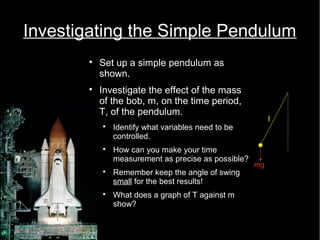
 Set up a simple pendulum as 
shown. 
 Investigate the effect of the mass 
of the bob, m, on the time period, 
T, of the pendulum. 
 Identify what variables need to be 
controlled. 
 How can you make your time 
measurement as precise as possible? 
 Remember keep the angle of swing 
small for the best results! 
 What does a graph of T against m 
show? 
mg 
l
Investigating the Simple Pendulum 
 Now investigate the effect of the 
pendulum length, l, on the period, 
T. 
 Identify what variables need to be 
controlled. 
 How should you measure the length 
of the pendulum? 
 What does a graph of T against l 
show? 
 What does a graph of T2 against l 
show?
Measuring g 
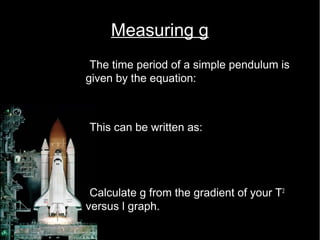
•The time period of a simple pendulum is 
given by the equation: 
T = 2p l 
g 
•This can be written as: 
2 
2 = 4p 
l 
g 
T 
•Calculate g from the gradient of your T2 
versus l graph.
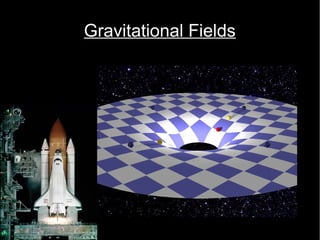
Gravitational Fields 
 Gravity can act over large distances, 
even through space. 
 To explain this we use the idea of a field. 
 All objects with mass create their own 
gravitational field. 
 This field extends to infinity and causes 
other objects to be attracted towards the 
mass. 
 This is similar to the electromagnetic fields. 
 The gravitational field is much weaker than 
the other fields.
Gravitational Fields
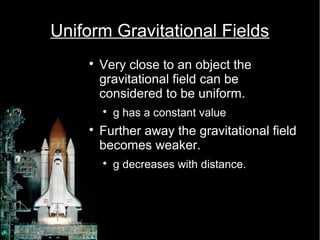
Uniform Gravitational Fields 
 Very close to an object the 
gravitational field can be 
considered to be uniform. 
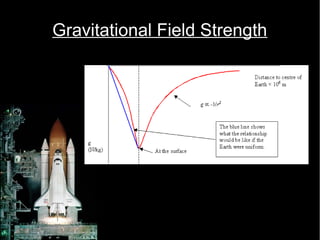
 g has a constant value 
 Further away the gravitational field 
becomes weaker. 
 g decreases with distance.
Gravitational Potential Energy 
 Close to Earth, where g is constant, we know 
that the energy gained by an object when it is 
lifted equals the work done on it. 
 EG = Work Done = Force x Distance 
EG = WΔh = mgΔh 
 How much GPE is gained when a 65kg object 
is raised through 7.0m close to the Earth's 
surface?
Gravitational Potential Energy 
 Normally, the Earth's surface is defined 
to have a GPE of 0J. 
 In space, a new zero must be defined 
which is the same for everyone. 
 A point an infinite distance from Earth is 
defined as having zero GPE. 
 “Gravitational Potential Energy is a 
measure of the work done to move an 
object from infinity to a point within the 
gravitational field”
Gravitational Potential Energy 
 If a point an infinite distance from 
Earth has zero GPE AND lifting an 
object away from the Earth 
increases its GPE then GPE MUST 
ALWAYS BE NEGATIVE!! 
 i.e. lifting an object makes its GPE 
less negative!
Gravitational Potential Energy 
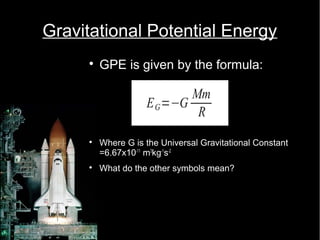
 GPE is given by the formula: 
EG=−G Mm 
R 
 Where G is the Universal Gravitational Constant 
=6.67x10⁻¹¹ m3kg-1s-2 
 What do the other symbols mean?
Gravitational Potential Energy 
 Calculate the GPE of a 200kg 
satellite when in low Earth orbit 
125km above the Earth's surface. 
 What is the GPE of a 400kg 
satellite in a geostationary orbit 
36,000km above the Earth's 
surface? 
 mEarth=5.98x1024 kg 
 rEarth=6.38x10⁶ m
Gravitational Field Strength 
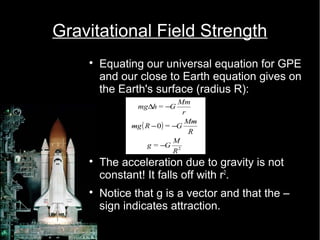
 Equating our universal equation for GPE 
and our close to Earth equation gives on 
the Earth's surface (radius R): 
mg h= G Mm 
r 
D - 
mg R = G Mm 
( ) 
- - 
g = G M 
2 
0 
R 
R 
- 
 The acceleration due to gravity is not 
constant! It falls off with r2. 
 Notice that g is a vector and that the – 
sign indicates attraction.
Gravitational Field Strength
Gravitational Field Strength 
 Visit www.nineplanets.org 
 Record values for the mass and 
diameter of each of the 8 major 
planets. 
 Create a table or use a 
spreadsheet to calculate values of 
g for each planet. 
 g=6.67E-11*mass/(radius^2)
Homework 
 Read pages 3-4 of Keep It Simple 
Science 
 Complete worksheet on page 5.

1.1.1 gravitational fields

  • 1.
    Topic 9.2 1.1.1Gravitational Fields
  • 2.
    Mass, Weight andGravity  Remember that mass is a measure of the amount of substance in an object.  Weight is the force of gravity pulling down on the object's mass.  This is expressed as the formula:  W=mg  What are the units of each term in this equation?
  • 3.
    The Simple Pendulum  A simple pendulum consists of a mass (called a bob) on a light (no mass) string.  The weight of the object causes it to try to return to the lowest position when it is disturbed.  The time taken to make one complete swing (Left to right to Left) is called the TIME PERIOD, T.
  • 4.
    Investigating the SimplePendulum  Set up a simple pendulum as shown.  Investigate the effect of the mass of the bob, m, on the time period, T, of the pendulum.  Identify what variables need to be controlled.  How can you make your time measurement as precise as possible?  Remember keep the angle of swing small for the best results!  What does a graph of T against m show? mg l
  • 5.
    Investigating the SimplePendulum  Now investigate the effect of the pendulum length, l, on the period, T.  Identify what variables need to be controlled.  How should you measure the length of the pendulum?  What does a graph of T against l show?  What does a graph of T2 against l show?
  • 6.
    Measuring g •Thetime period of a simple pendulum is given by the equation: T = 2p l g •This can be written as: 2 2 = 4p l g T •Calculate g from the gradient of your T2 versus l graph.
  • 7.
    Gravitational Fields Gravity can act over large distances, even through space.  To explain this we use the idea of a field.  All objects with mass create their own gravitational field.  This field extends to infinity and causes other objects to be attracted towards the mass.  This is similar to the electromagnetic fields.  The gravitational field is much weaker than the other fields.
  • 8.
  • 9.
    Uniform Gravitational Fields  Very close to an object the gravitational field can be considered to be uniform.  g has a constant value  Further away the gravitational field becomes weaker.  g decreases with distance.
  • 10.
    Gravitational Potential Energy  Close to Earth, where g is constant, we know that the energy gained by an object when it is lifted equals the work done on it.  EG = Work Done = Force x Distance EG = WΔh = mgΔh  How much GPE is gained when a 65kg object is raised through 7.0m close to the Earth's surface?
  • 11.
    Gravitational Potential Energy  Normally, the Earth's surface is defined to have a GPE of 0J.  In space, a new zero must be defined which is the same for everyone.  A point an infinite distance from Earth is defined as having zero GPE.  “Gravitational Potential Energy is a measure of the work done to move an object from infinity to a point within the gravitational field”
  • 12.
    Gravitational Potential Energy  If a point an infinite distance from Earth has zero GPE AND lifting an object away from the Earth increases its GPE then GPE MUST ALWAYS BE NEGATIVE!!  i.e. lifting an object makes its GPE less negative!
  • 13.
    Gravitational Potential Energy  GPE is given by the formula: EG=−G Mm R  Where G is the Universal Gravitational Constant =6.67x10⁻¹¹ m3kg-1s-2  What do the other symbols mean?
  • 14.
    Gravitational Potential Energy  Calculate the GPE of a 200kg satellite when in low Earth orbit 125km above the Earth's surface.  What is the GPE of a 400kg satellite in a geostationary orbit 36,000km above the Earth's surface?  mEarth=5.98x1024 kg  rEarth=6.38x10⁶ m
  • 15.
    Gravitational Field Strength  Equating our universal equation for GPE and our close to Earth equation gives on the Earth's surface (radius R): mg h= G Mm r D - mg R = G Mm ( ) - - g = G M 2 0 R R -  The acceleration due to gravity is not constant! It falls off with r2.  Notice that g is a vector and that the – sign indicates attraction.
  • 16.
  • 17.
    Gravitational Field Strength  Visit www.nineplanets.org  Record values for the mass and diameter of each of the 8 major planets.  Create a table or use a spreadsheet to calculate values of g for each planet.  g=6.67E-11*mass/(radius^2)
  • 18.
    Homework  Readpages 3-4 of Keep It Simple Science  Complete worksheet on page 5.