ME 6604 – GAS DYNAMICS & JET PROPULSION
UNIT – IV JET ENGINE PROPULSION
Mrs.N.PREMALATHA
ASSOCIATE PROFESSOR
DEPARTMENT OF MECHANICAL ENGG
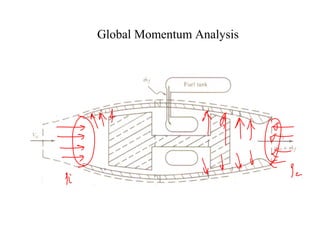
Global Momentum Analysis
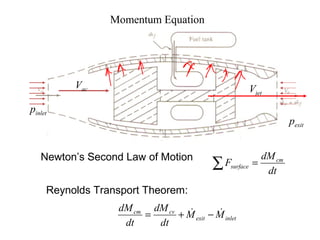
Momentum Equation
pinlet
pexit
Vac Vjet
∑ =
dt
dM
F cm
surface
Reynolds Transport Theorem:
inletexit
cvcm
MM
dt
dM
dt
dM  −+=
Newton’s Second Law of Motion
inletexit
cv
surface MM
dt
dM
F  −+=∑
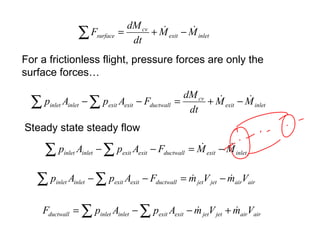
For a frictionless flight, pressure forces are only the
surface forces…
inletexit
cv
ductwallexitexitinletinlet MM
dt
dM
FApAp  −+=−− ∑∑
Steady state steady flow
inletexitductwallexitexitinletinlet MMFApAp  −=−− ∑∑
airairjetjetductwallexitexitinletinlet VmVmFApAp  −=−− ∑∑
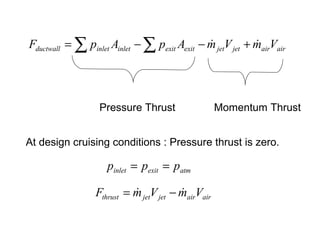
airairjetjetexitexitinletinletductwall VmVmApApF  +−−= ∑∑
Pressure Thrust Momentum Thrust
At design cruising conditions : Pressure thrust is zero.
airairjetjetthrust VmVmF  −=
atmexitinlet ppp ==
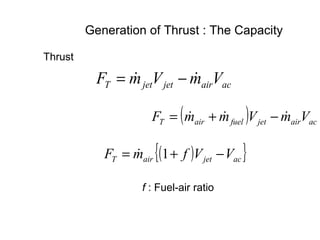
Generation of Thrust : The Capacity
( ) acairjetfuelairT VmVmmF  −+=
acairjetjetT VmVmF  −=
Thrust
( ){ }acjetairT VVfmF −+= 1
f : Fuel-air ratio
Dynamic Equilibrium : Cruising Vehicle
For a cruising vehicle:
( ){ } Vehicleon1 dragVVfmF acjetairT =−+= 
( ){ }
2
1
2
air
ac
acdragacjetair
V
ACVVfm ρ=−+
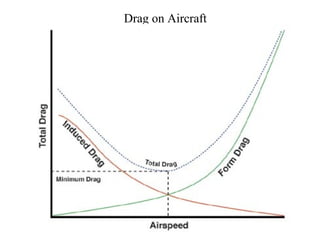
Drag on Aircraft
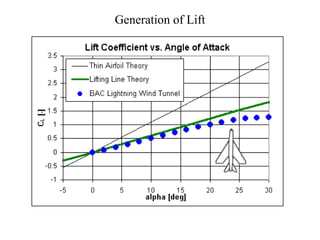
Generation of Lift
Drag Coefficient of an Air Craft
Generation of Lift
Drag Coefficient of an Air Craft
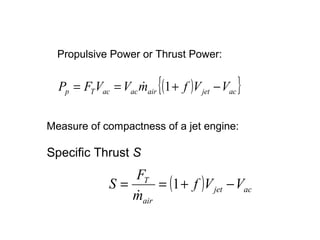
Propulsive Power or Thrust Power:
( ){ }acjetairacacTp VVfmVVFP −+== 1
Specific Thrust S
( ) acjet
air
T
VVf
m
F
S −+== 1

Measure of compactness of a jet engine:
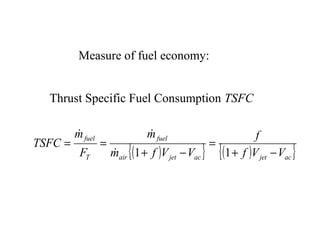
Thrust Specific Fuel Consumption TSFC
( ){ } ( ){ }acjetacjetair
fuel
T
fuel
VVf
f
VVfm
m
F
m
TSFC
−+
=
−+
==
11

Measure of fuel economy:
Aviation Appreciation
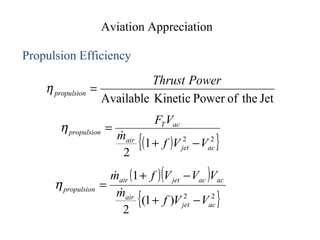
Propulsion Efficiency
JettheofPowerKineticAvailable
PowerThrust
propulsion =η
( ){ }22
1
2
acjet
air
acT
propulsion
VVf
m
VF
−+
=

η
( )( )
{ }22
)1(
2
1
acjet
air
acacjetair
propulsion
VVf
m
VVVfm
−+
−+
=


η
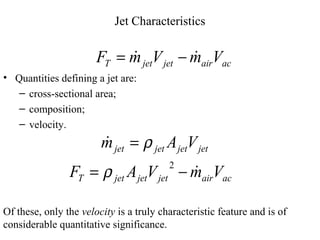
Jet Characteristics
• Quantities defining a jet are:
– cross-sectional area;
– composition;
– velocity.
jetjetjetjet VAm ρ=
acairjetjetjetT VmVAF −=
2
ρ
acairjetjetT VmVmF  −=
Of these, only the velocity is a truly characteristic feature and is of
considerable quantitative significance.
Jet Characteristics of Practical Propulsion Systems
System Jet Velocity (m/s)
Turbofan 200 - 600
Turbojet (sea-level, static) 350 - 600
Turbojet (Mach 2 at 36000 ft) 900 - 1200
Ramjet (Mach 2 at 36000 ft) 900 - 1200
Ramjet (Mach 4 at 36000 ft) 1800 - 2400
Solid Rocket 1500 – 2600
Liquid Rocket 2000 – 3500
Nozzle : Steady State Steady Flow
First Law :
No heat transfer and no work transfer & No Change in potential
energy.
in jet
cv
jetin
cv Wgz
V
hmgz
V
hmQ  +





++=





+++
22
22
jetin
V
h
V
h 





+=





+
22
22
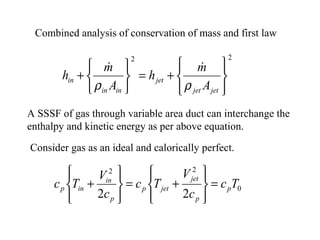
Combined analysis of conservation of mass and first law
22








+=






+
jetjet
jet
inin
in
A
m
h
A
m
h
ρρ

A SSSF of gas through variable area duct can interchange the
enthalpy and kinetic energy as per above equation.
Consider gas as an ideal and calorically perfect.
0
22
22
Tc
c
V
Tc
c
V
Tc p
p
jet
jetp
p
in
inp =








+=








+
γ
γ 1−








=
jet
in
jet
in
p
p
T
T
Isentropic expansion of an ideal and calorically perfect gas.
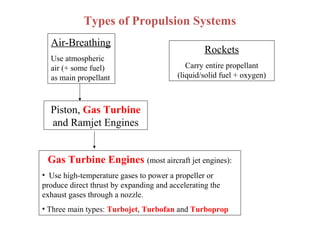
Types of Propulsion Systems
Air-Breathing
Use atmospheric
air (+ some fuel)
as main propellant
Rockets
Carry entire propellant
(liquid/solid fuel + oxygen)
Piston, Gas Turbine
and Ramjet Engines
Gas Turbine Engines (most aircraft jet engines):
• Use high-temperature gases to power a propeller or
produce direct thrust by expanding and accelerating the
exhaust gases through a nozzle.
• Three main types: Turbojet, Turbofan and Turboprop
Basic Operation of Jet Engines –
• Air enters the trough the intake duct (cowl).
• Air compressed by passage through the compressor.
• Mixed with fuel in the combustion chamber.
• Fuel is ignited, Pressure and Temperature
raised
• Some of the pressure used to turn a turbine;
• Turbine shaft drives the compressor.
• Hot, high pressure air forced through a nozzle.
• The reaction force is the engine thrust.
Classifications of Jet Engine
• Turbojets:
• Turbine used to drive the compressor.
• All intake air passes through the combustion chamber and exits through the nozzle.
• All thrust produced by hot, high-speed exhaust gases.
•Turbofans (Fan-Jet):
• A large propeller in the intake cowl, in front of compressor.
• Dramatically increases the amount of air pulled in the intake.
• Only a small percentage passed through the engine, the rest of cold air is Bypassed.
• Part of the thrust through the hot exhaust gases and part by the cold bypassed air.
Produces cooler exhausts and quieter engines.
• High by-pass ratio are most commonly used in larger commercial aircraft.
•Turboprops:
• Jet engine used to turn a large propeller, which produces most (90% or more) of
the thrust. Used in smaller aircraft.
Classifications of Jet Engine
Jet Engine Combuster
Film cooling via convection
FUEL IS MIXED WITH AIR BEFORE ENTERING THE CYLINDERS
THE FUEL/AIR MIXTURE IS THEN COMPRESSED
THEN IT IS IGNITED BY A SPARK
IN A PISTON ENGINE: -
ONCE FOR TWO REVS OF THE ENGINE (IN THE 4 STROKE CYCLE)
AIR IS COMPRESSED AND FORCED INTO THE COMBUSTOR FIRST
THEN THE FUEL IS SPRAYED IN UNDER PRESSURE
IT IS THEN IGNITED BY A SPARK (BUT ONLY ONCE FOR STARTING)
IN A JET ENGINE: -
COMBUSTION IS THEN CONTINUOUS WHILST THE ENGINE IS RUNNIN
THE COMBUSTION PROCESS
Jet engines are also called as gas turbines. The engine sucks
air in at the front with a fan.
A compressor raises the pressure of the air. The compressed
air is then sprayed with fuel and an electric spark lights the
mixture.
The burning gases expand and blast out through the nozzle, at
the back of the engine. As the jets of gas shoot backward, the
engine and the aircraft are thrust forward.
TURBO JET ENGINES
Major components
• Air intake
• Compressors
• Combustors
• Turbines
• Nozzles
• Fuel system
• Cooling system
Intermediate components
• Turbo pumps
• Afterburners( reheat)
• Thrust reversers
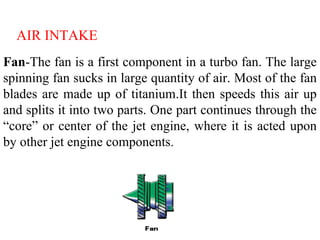
Fan-The fan is a first component in a turbo fan. The large
spinning fan sucks in large quantity of air. Most of the fan
blades are made up of titanium.It then speeds this air up
and splits it into two parts. One part continues through the
“core” or center of the jet engine, where it is acted upon
by other jet engine components.
AIR INTAKE
The second part “bypasses” the core of the
jet engine. It goes through a duct which
surrounds the core to the back of jet engine
where it produces much of force that propels
the airplane forward. This cooler air helps to
quiet the jet engine as well as adding thrust
to the jet engine.
Compressor - The compressor is the first component in the jet
engine core. The compressor is made up of fans with many
blades and attached to a shaft. The compressor squeezes the air
that enters it into progressively smaller areas, resulting in an
increase in the air pressure. This results in an increase in the
energy potential of the air. The squashed air is forced into the
combustion chamber.
Combustor - In the combustor the air is mixed with fuel and
then ignited. There are as many as 20 nozzles to spray fuel
into the air stream. The mixture of air and fuel catches fire.
This provides a high temperature, high-energy airflow. The
fuel burns with the oxygen in the compressed air, producing
hot expanding gases. The inside of the combustor is often
made of ceramic materials to provide a heat-resistant
chamber.The heat can reach 2700°.
Turbine - The high-energy airflow coming out of the
combustor goes into the turbine, causing the turbine blades to
rotate. The turbines are linked by a shaft to turn the blades in
the compressor and to spin the intake fan at the front. This
rotation takes some energy from the high-energy flow that is
used to drive the fan and the compressor. The gases produced
in the combustion chamber move through the turbine and spin
its blades.
The turbines of the jet spin around thousands of times. They
are fixed on shafts which have several sets of ball-bearing in
between them.
Nozzle - The nozzle is the exhaust duct of the jet engine.
This is the jet engine part which actually produces the thrust
for the plane. The energy depleted airflow that passed the
turbine, in addition to the colder air that bypassed the engine
core, produces a force when exiting the nozzle that acts to
propel the engine, and therefore the airplane, forward. The
combination of the hot air and cold air are expelled and
produce an exhaust, which causes a forward thrust.
The nozzle may be preceded by a mixer, which combines
the high temperature air coming from the jet engine core
with the lower temperature air that was bypassed in the
fan. The mixer helps to make the jet engine quieter.

UNIT - IV JET ENGINE PROPULSION

  • 1.
    ME 6604 –GAS DYNAMICS & JET PROPULSION UNIT – IV JET ENGINE PROPULSION Mrs.N.PREMALATHA ASSOCIATE PROFESSOR DEPARTMENT OF MECHANICAL ENGG
  • 2.
  • 3.
    Momentum Equation pinlet pexit Vac Vjet ∑= dt dM F cm surface Reynolds Transport Theorem: inletexit cvcm MM dt dM dt dM  −+= Newton’s Second Law of Motion
  • 4.
    inletexit cv surface MM dt dM F −+=∑ For a frictionless flight, pressure forces are only the surface forces… inletexit cv ductwallexitexitinletinlet MM dt dM FApAp  −+=−− ∑∑ Steady state steady flow inletexitductwallexitexitinletinlet MMFApAp  −=−− ∑∑ airairjetjetductwallexitexitinletinlet VmVmFApAp  −=−− ∑∑ airairjetjetexitexitinletinletductwall VmVmApApF  +−−= ∑∑
  • 5.
    airairjetjetexitexitinletinletductwall VmVmApApF +−−= ∑∑ Pressure Thrust Momentum Thrust At design cruising conditions : Pressure thrust is zero. airairjetjetthrust VmVmF  −= atmexitinlet ppp ==
  • 6.
    Generation of Thrust: The Capacity ( ) acairjetfuelairT VmVmmF  −+= acairjetjetT VmVmF  −= Thrust ( ){ }acjetairT VVfmF −+= 1 f : Fuel-air ratio
  • 7.
    Dynamic Equilibrium :Cruising Vehicle For a cruising vehicle: ( ){ } Vehicleon1 dragVVfmF acjetairT =−+=  ( ){ } 2 1 2 air ac acdragacjetair V ACVVfm ρ=−+
  • 8.
  • 9.
  • 10.
    Drag Coefficient ofan Air Craft
  • 11.
  • 12.
    Drag Coefficient ofan Air Craft
  • 13.
    Propulsive Power orThrust Power: ( ){ }acjetairacacTp VVfmVVFP −+== 1 Specific Thrust S ( ) acjet air T VVf m F S −+== 1  Measure of compactness of a jet engine:
  • 14.
    Thrust Specific FuelConsumption TSFC ( ){ } ( ){ }acjetacjetair fuel T fuel VVf f VVfm m F m TSFC −+ = −+ == 11  Measure of fuel economy:
  • 15.
    Aviation Appreciation Propulsion Efficiency JettheofPowerKineticAvailable PowerThrust propulsion=η ( ){ }22 1 2 acjet air acT propulsion VVf m VF −+ =  η ( )( ) { }22 )1( 2 1 acjet air acacjetair propulsion VVf m VVVfm −+ −+ =   η
  • 16.
    Jet Characteristics • Quantitiesdefining a jet are: – cross-sectional area; – composition; – velocity. jetjetjetjet VAm ρ= acairjetjetjetT VmVAF −= 2 ρ acairjetjetT VmVmF  −= Of these, only the velocity is a truly characteristic feature and is of considerable quantitative significance.
  • 17.
    Jet Characteristics ofPractical Propulsion Systems System Jet Velocity (m/s) Turbofan 200 - 600 Turbojet (sea-level, static) 350 - 600 Turbojet (Mach 2 at 36000 ft) 900 - 1200 Ramjet (Mach 2 at 36000 ft) 900 - 1200 Ramjet (Mach 4 at 36000 ft) 1800 - 2400 Solid Rocket 1500 – 2600 Liquid Rocket 2000 – 3500
  • 18.
    Nozzle : SteadyState Steady Flow First Law : No heat transfer and no work transfer & No Change in potential energy. in jet cv jetin cv Wgz V hmgz V hmQ  +      ++=      +++ 22 22 jetin V h V h       +=      + 22 22
  • 19.
    Combined analysis ofconservation of mass and first law 22         +=       + jetjet jet inin in A m h A m h ρρ  A SSSF of gas through variable area duct can interchange the enthalpy and kinetic energy as per above equation. Consider gas as an ideal and calorically perfect. 0 22 22 Tc c V Tc c V Tc p p jet jetp p in inp =         +=         +
  • 20.
  • 21.
    Types of PropulsionSystems Air-Breathing Use atmospheric air (+ some fuel) as main propellant Rockets Carry entire propellant (liquid/solid fuel + oxygen) Piston, Gas Turbine and Ramjet Engines Gas Turbine Engines (most aircraft jet engines): • Use high-temperature gases to power a propeller or produce direct thrust by expanding and accelerating the exhaust gases through a nozzle. • Three main types: Turbojet, Turbofan and Turboprop
  • 22.
    Basic Operation ofJet Engines – • Air enters the trough the intake duct (cowl). • Air compressed by passage through the compressor. • Mixed with fuel in the combustion chamber. • Fuel is ignited, Pressure and Temperature raised • Some of the pressure used to turn a turbine; • Turbine shaft drives the compressor. • Hot, high pressure air forced through a nozzle. • The reaction force is the engine thrust.
  • 23.
  • 24.
    • Turbojets: • Turbineused to drive the compressor. • All intake air passes through the combustion chamber and exits through the nozzle. • All thrust produced by hot, high-speed exhaust gases. •Turbofans (Fan-Jet): • A large propeller in the intake cowl, in front of compressor. • Dramatically increases the amount of air pulled in the intake. • Only a small percentage passed through the engine, the rest of cold air is Bypassed. • Part of the thrust through the hot exhaust gases and part by the cold bypassed air. Produces cooler exhausts and quieter engines. • High by-pass ratio are most commonly used in larger commercial aircraft. •Turboprops: • Jet engine used to turn a large propeller, which produces most (90% or more) of the thrust. Used in smaller aircraft. Classifications of Jet Engine
  • 25.
    Jet Engine Combuster Filmcooling via convection
  • 26.
    FUEL IS MIXEDWITH AIR BEFORE ENTERING THE CYLINDERS THE FUEL/AIR MIXTURE IS THEN COMPRESSED THEN IT IS IGNITED BY A SPARK IN A PISTON ENGINE: - ONCE FOR TWO REVS OF THE ENGINE (IN THE 4 STROKE CYCLE) AIR IS COMPRESSED AND FORCED INTO THE COMBUSTOR FIRST THEN THE FUEL IS SPRAYED IN UNDER PRESSURE IT IS THEN IGNITED BY A SPARK (BUT ONLY ONCE FOR STARTING) IN A JET ENGINE: - COMBUSTION IS THEN CONTINUOUS WHILST THE ENGINE IS RUNNIN THE COMBUSTION PROCESS
  • 27.
    Jet engines arealso called as gas turbines. The engine sucks air in at the front with a fan. A compressor raises the pressure of the air. The compressed air is then sprayed with fuel and an electric spark lights the mixture. The burning gases expand and blast out through the nozzle, at the back of the engine. As the jets of gas shoot backward, the engine and the aircraft are thrust forward. TURBO JET ENGINES
  • 28.
    Major components • Airintake • Compressors • Combustors • Turbines • Nozzles • Fuel system • Cooling system
  • 29.
    Intermediate components • Turbopumps • Afterburners( reheat) • Thrust reversers
  • 31.
    Fan-The fan isa first component in a turbo fan. The large spinning fan sucks in large quantity of air. Most of the fan blades are made up of titanium.It then speeds this air up and splits it into two parts. One part continues through the “core” or center of the jet engine, where it is acted upon by other jet engine components. AIR INTAKE
  • 32.
    The second part“bypasses” the core of the jet engine. It goes through a duct which surrounds the core to the back of jet engine where it produces much of force that propels the airplane forward. This cooler air helps to quiet the jet engine as well as adding thrust to the jet engine.
  • 34.
    Compressor - Thecompressor is the first component in the jet engine core. The compressor is made up of fans with many blades and attached to a shaft. The compressor squeezes the air that enters it into progressively smaller areas, resulting in an increase in the air pressure. This results in an increase in the energy potential of the air. The squashed air is forced into the combustion chamber.
  • 36.
    Combustor - Inthe combustor the air is mixed with fuel and then ignited. There are as many as 20 nozzles to spray fuel into the air stream. The mixture of air and fuel catches fire. This provides a high temperature, high-energy airflow. The fuel burns with the oxygen in the compressed air, producing hot expanding gases. The inside of the combustor is often made of ceramic materials to provide a heat-resistant chamber.The heat can reach 2700°.
  • 37.
    Turbine - Thehigh-energy airflow coming out of the combustor goes into the turbine, causing the turbine blades to rotate. The turbines are linked by a shaft to turn the blades in the compressor and to spin the intake fan at the front. This rotation takes some energy from the high-energy flow that is used to drive the fan and the compressor. The gases produced in the combustion chamber move through the turbine and spin its blades.
  • 38.
    The turbines ofthe jet spin around thousands of times. They are fixed on shafts which have several sets of ball-bearing in between them.
  • 39.
    Nozzle - Thenozzle is the exhaust duct of the jet engine. This is the jet engine part which actually produces the thrust for the plane. The energy depleted airflow that passed the turbine, in addition to the colder air that bypassed the engine core, produces a force when exiting the nozzle that acts to propel the engine, and therefore the airplane, forward. The combination of the hot air and cold air are expelled and produce an exhaust, which causes a forward thrust.
  • 40.
    The nozzle maybe preceded by a mixer, which combines the high temperature air coming from the jet engine core with the lower temperature air that was bypassed in the fan. The mixer helps to make the jet engine quieter.