Topic 1 – Physical Measurements 1.2b – Uncertainties and Errors
Measurement Errors Physics is fundamentally about  measuring  the physical universe.
Whenever you actually measure something then you are always comparing it against a standard and there is always a chance that you can make an error.
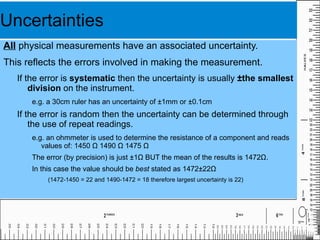
Errors can be of two general types: Random – these are unpredictable errors brought about by things usually out of your control e.g. electrical noise affecting an ammeter reading.
Systematic – these are errors usually brought about by the measuring equipment (or its operator) e.g. a calliper that does not actually read zero when it should.
Measurement Errors Random  errors can be reduced by repeating readings. As the error is random, some measurements will be high, others low but on average they should be more precise. Systematic  errors can be reduced by calibrating equipment. By checking zero readings and scale calibration, systematic errors can be calculated and compensated for.
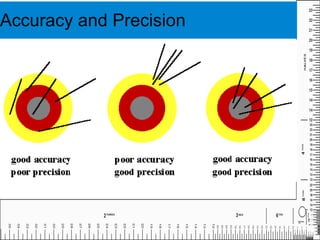
Accuracy and Precision An experimental result is described by its  accuracy  (how close it is to the true value) and its  precision  (how close repeat readings are together)
Accuracy is improved by reducing systematic errors
Precision is improved by reducing random errors.
Accuracy and Precision
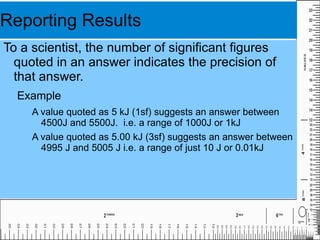
Reporting Results To a scientist, the number of significant figures quoted in an answer indicates the precision of that answer. Example A value quoted as 5 kJ (1sf) suggests an answer between 4500J and 5500J.  i.e. a range of 1000J or 1kJ
A value quoted as 5.00 kJ (3sf) suggests an answer between 4995 J and 5005 J i.e. a range of just 10 J or 0.01kJ
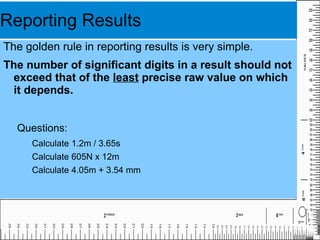
Reporting Results The golden rule in reporting results is very simple.
The number of significant digits in a result should not exceed that of the  least  precise raw value on which it depends. Questions: Calculate 1.2m / 3.65s
Calculate 605N x 12m
Calculate 4.05m + 3.54 mm

Physics 1.2b Errors and Uncertainties

  • 1.
    Topic 1 –Physical Measurements 1.2b – Uncertainties and Errors
  • 2.
    Measurement Errors Physicsis fundamentally about measuring the physical universe.
  • 3.
    Whenever you actuallymeasure something then you are always comparing it against a standard and there is always a chance that you can make an error.
  • 4.
    Errors can beof two general types: Random – these are unpredictable errors brought about by things usually out of your control e.g. electrical noise affecting an ammeter reading.
  • 5.
    Systematic – theseare errors usually brought about by the measuring equipment (or its operator) e.g. a calliper that does not actually read zero when it should.
  • 6.
    Measurement Errors Random errors can be reduced by repeating readings. As the error is random, some measurements will be high, others low but on average they should be more precise. Systematic errors can be reduced by calibrating equipment. By checking zero readings and scale calibration, systematic errors can be calculated and compensated for.
  • 7.
    Accuracy and PrecisionAn experimental result is described by its accuracy (how close it is to the true value) and its precision (how close repeat readings are together)
  • 8.
    Accuracy is improvedby reducing systematic errors
  • 9.
    Precision is improvedby reducing random errors.
  • 10.
  • 11.
    Reporting Results Toa scientist, the number of significant figures quoted in an answer indicates the precision of that answer. Example A value quoted as 5 kJ (1sf) suggests an answer between 4500J and 5500J. i.e. a range of 1000J or 1kJ
  • 12.
    A value quotedas 5.00 kJ (3sf) suggests an answer between 4995 J and 5005 J i.e. a range of just 10 J or 0.01kJ
  • 13.
    Reporting Results Thegolden rule in reporting results is very simple.
  • 14.
    The number ofsignificant digits in a result should not exceed that of the least precise raw value on which it depends. Questions: Calculate 1.2m / 3.65s
  • 15.
  • 16.