Copyright Sautter 2003
Centripetal Force
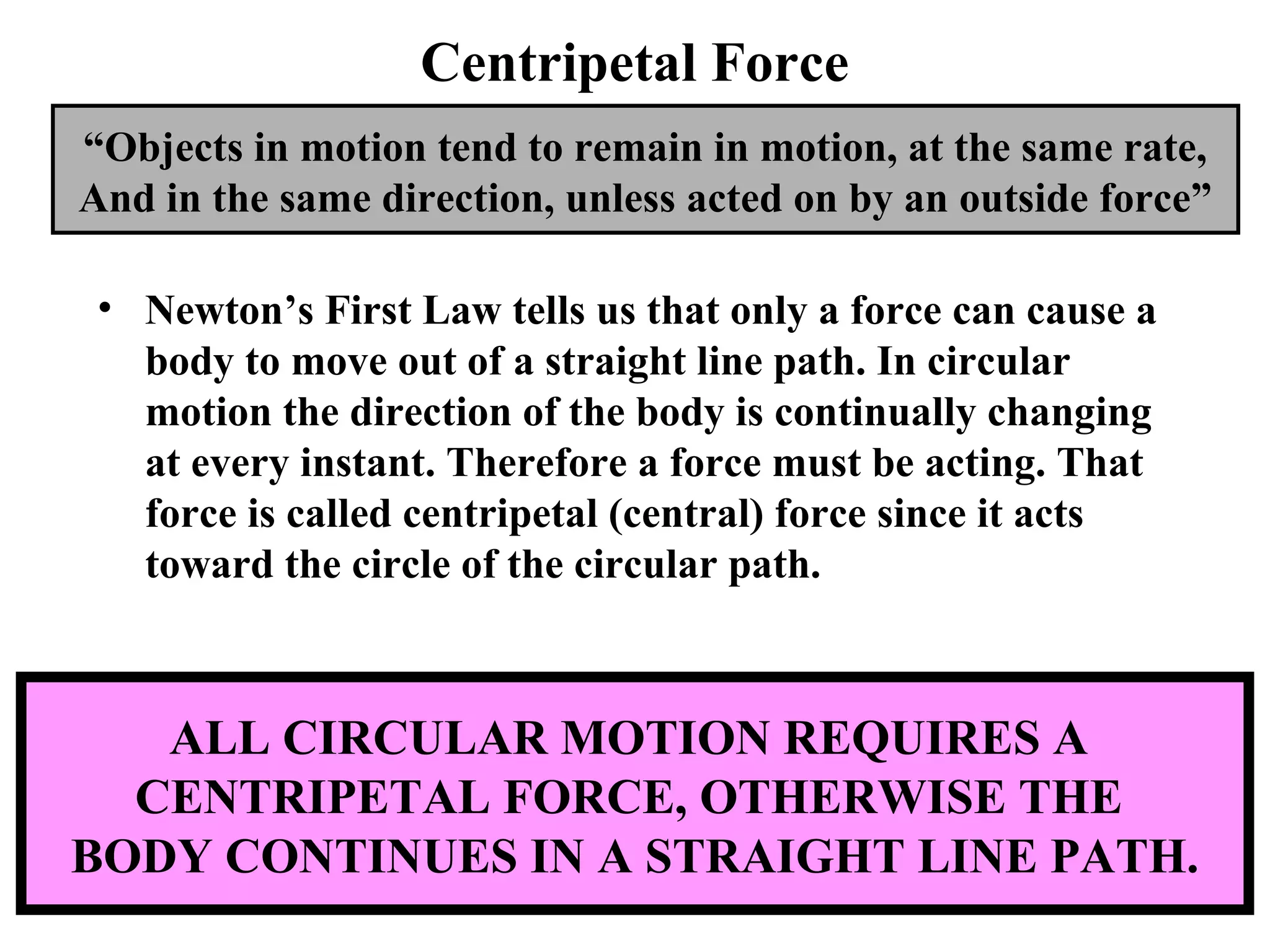
• Newton’s First Law tells us that only a force can cause a
body to move out of a straight line path. In circular
motion the direction of the body is continually changing
at every instant. Therefore a force must be acting. That
force is called centripetal (central) force since it acts
toward the circle of the circular path.
“Objects in motion tend to remain in motion, at the same rate,
And in the same direction, unless acted on by an outside force”
ALL CIRCULAR MOTION REQUIRES A
CENTRIPETAL FORCE, OTHERWISE THE
BODY CONTINUES IN A STRAIGHT LINE PATH.
Centripetal Force
• All circular motion requires a centripetal force.
Newton’s Second Law of Motion tells us that force
equal mass times acceleration. Therefore, centripetal
force must produce an acceleration (centripetal
acceleration). Since the force acts towards the center of
the circular path, the acceleration must also be
towards the center !
ALL CIRCULAR MOTION IS ACCELERATED
MOTION. THE ACCELERATION IS ALWAYS
TOWARDS THE CENTER OF THE CIRCULAR PATH.
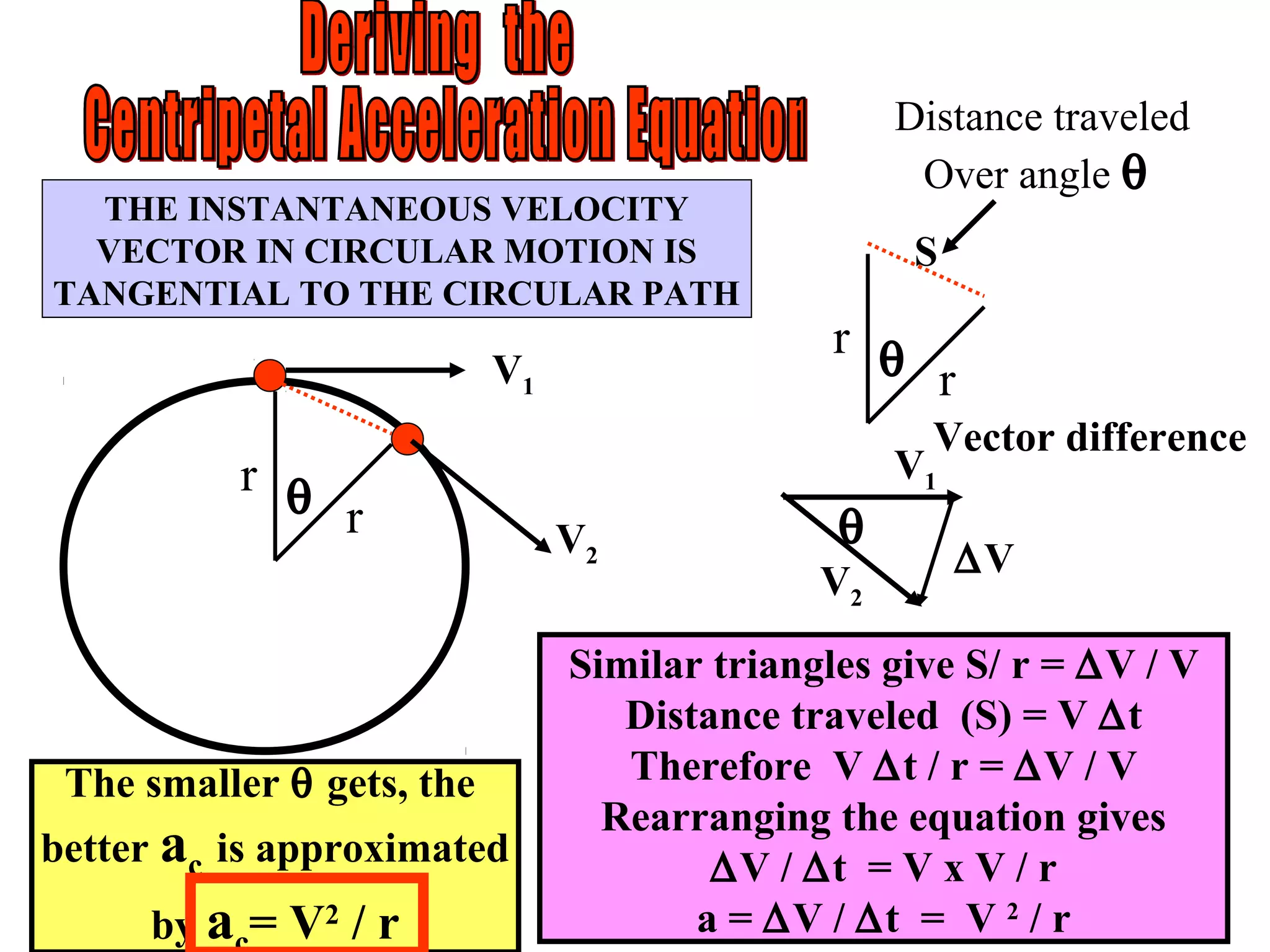
THE INSTANTANEOUS VELOCITY
VECTOR IN CIRCULAR MOTION IS
TANGENTIAL TO THE CIRCULAR PATH
V1
V2
r
rθ
r
rθ
Distance traveled
Over angle θ
S
Similar triangles give S/ r = ∆V / V
Distance traveled (S) = V ∆t
Therefore V ∆t / r = ∆V / V
Rearranging the equation gives
∆V / ∆t = V x V / r
a = ∆V / ∆t = V 2
/ r
V1
∆V
V2
θ
Vector difference
The smaller θ gets, the
better ac is approximated
by a = V2
/ r
Displacement Vector
(Radius)
Velocity Vector
(Tangent to the path)
Acceleration Vector
(Towards the center)
The velocity vector
is always
tangential to the
circular path
The acceleration
vector is always
towards the center
of the circular path
ωAVERAGE = ∆ω / ∆ t = (ω2 + ω1) / 2
θ = ωo t + ½ αt2
ωi = ωo + αt
θi = ½ (ωi
2
- ωo
2
) / α
s = θ R
Vlinear = ω R
alinear = α R
f = 1/ T, T = 1 / f
1 revolution = 360 degrees = 2 π radians
ω = 2 π f , ω = 2 π / T
acentripetal = V2
/ r
Fcentripetal = m V2
/ r
Centripetal Force & Acceleration Problems
A 1000 kg car rounds a turn of 30 meter radius at 9 m/s. (a)
What is its acceleration ? (b) What is the centripetal force ?
• (a) acentripetal = V2
/ r = 9 2
/ 30 = 2.7 m /s2
• (b) Fcentripetal = m V2
/ r = m x ac = 1000 x 2.7 = 2700 N
r = 30 mv = 9 m/s
Centripetal Force & Acceleration Problems
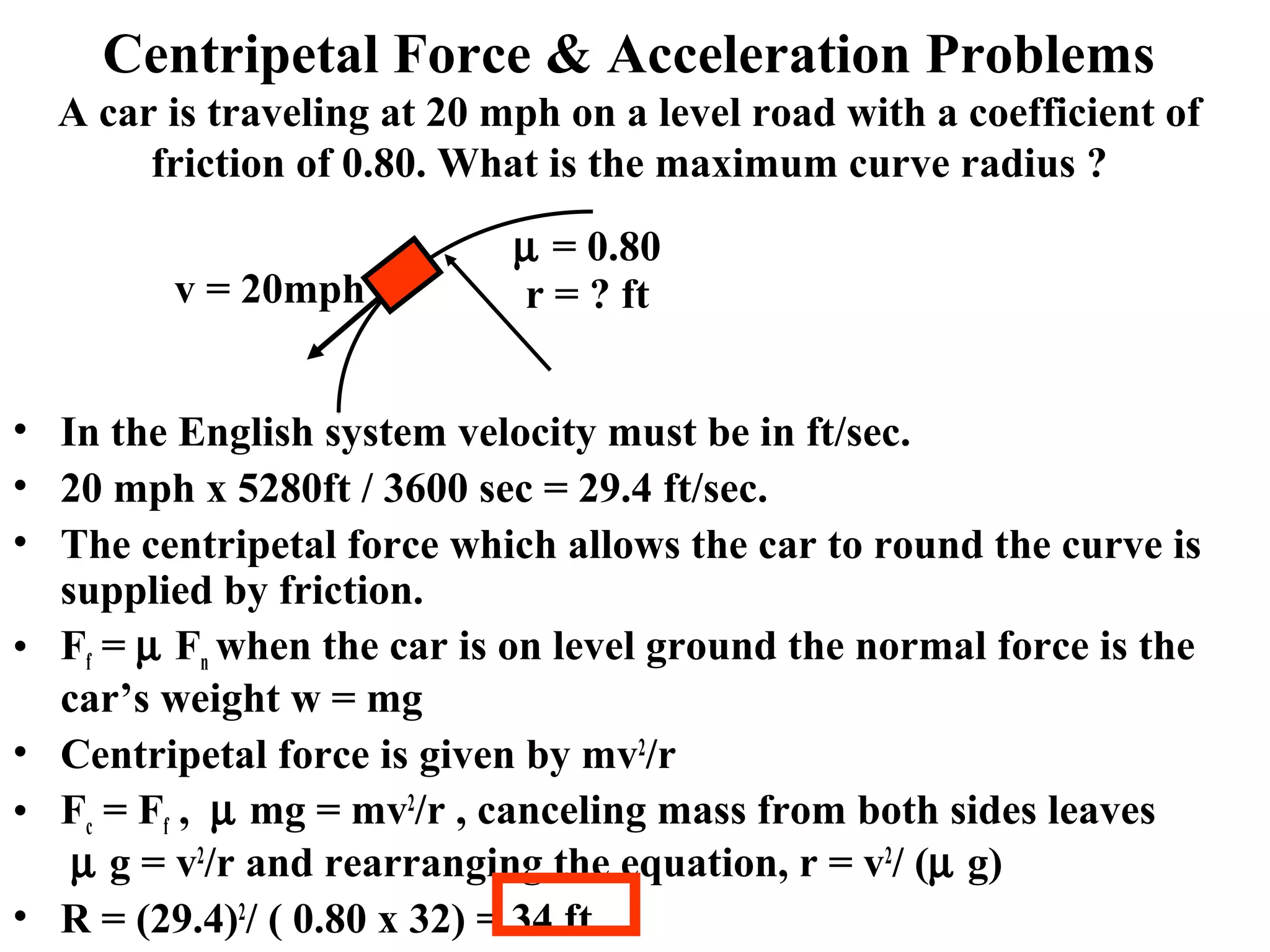
A car is traveling at 20 mph on a level road with a coefficient of
friction of 0.80. What is the maximum curve radius ?
• In the English system velocity must be in ft/sec.
• 20 mph x 5280ft / 3600 sec = 29.4 ft/sec.
• The centripetal force which allows the car to round the curve is
supplied by friction.
• Ff = µ Fn when the car is on level ground the normal force is the
car’s weight w = mg
• Centripetal force is given by mv2
/r
• Fc = Ff , µ mg = mv2
/r , canceling mass from both sides leaves
µ g = v2
/r and rearranging the equation, r = v2
/ (µ g)
• R = (29.4)2
/ ( 0.80 x 32) = 34 ft
r = ? ftv = 20mph
µ = 0.80
Centripetal Force & Acceleration
Problems
• Roadways are often banked to help supply
centripetal force thereby allowing cars to
execute curves more readily.
• Without banking, the friction between the tires
and the road, are the only source of centripetal
force.
• As the banking angle increases the amount of
centripetal force the roadway supplies
increases.
• The following slide analyzes the relationship
between the angle of banking and the
centripetal force.
θ
tan θ = Fc / W
Fcentripetal = W x tan θ
Fc
W
Fn
θ
Vector diagram
reaction
to normal
force
normal
force
weight
centripetal
force
Centripetal Force & Acceleration Problems
What is the angle of banking which would allow vehicles to
round a curve of 1000 foot radius at 50 mph without friction ?
• 50 mph x 5280 ft / 3600 sec = 73.5 ft/sec
• The centripetal force supplied by the banking.
• Fbanking = w x tan θ = mg tan θ, Fc = m v2
/r
• Fbanking= Fc , mg tan θ = m v2
/r , canceling mass gives
g tan θ = v2
/r and tan θ = v2
/ (g x r)
• tan θ = 73.5 2
/ (32 x 1000) = 0.169
• tan-1
(0.169) = 9.60
r = 1000 ft
v =50 mphθ
Centripetal Force & Acceleration
Problems
• Centripetal force problems often involve objects whirled in a
circle. An example is a rock tied to a string. The circular path
may be in the horizontal plane or the vertical plane.
• The rock moves in a circular path because of the pull of the
string to which it is tied. The string supplies the centripetal
force necessary for the rock to be moved from its inertial
straight line path into a circular path. The pull of the string
is referred to as tension in the string.
• When moving in a horizontal path the forces acting (the
tension, the weight and centripetal force) remain constant in
magnitude
• When moving in a vertical path the forces acting vary from
point to point during the travel.
Centripetal force (Fc)
weight
weight
Centripetal force (Fc)
Centripetal force (Fc)Centripetal force (Fc)
weight
weight
tension tension
tension
tension
At the top of the path
Weight & Fc are
Opposite in direction
At the bottom of the path
Weight & Fc are
in the same direction
Circular Motion in a Vertical Plane
A string 0.50 meters long is used to whirl a 1 kg rock in a vertical
circle at 5.0 m/s. (a) Find the tension at the top of the circle (b) Find
the tension at the bottom.
• (a) T + w = Fc , T + mg = mv2
/r, T + (1 x 9.8) = 1 (5.0)2
/ 0.50
• T + 9.8 = 25 / 0.50, T = 40.2 nt (downward) or – 40.2 nt
• (b) T = Fc + w , T = mv2
/r + mg = T = 1 (5.0)2
/ 0.50 + 1 (9.8)
• T = 59.8 nt (upward) or + 59.8 nt
weight
weight
tension
tension
Centripetal force (Fc)
At the top
T + w = Fc
At the bottom
T = Fc + w
Downward vectors are –
Upward vectors are +
Fc = m v2
/ r , w = mg
Circular Motion in a Vertical Plane
A 2 lb ball on the end of a string is spun in a vertical circle at 10
ft/s. The radius of the circle is 3.0 ft. What is the maximum tension
in the string ?
• T = Fc + w = mv2
/r + w, w = mg, m =w/g
• m = 2/32 slugs
• T = ((2/32) x 102
) / 3) + 2 = 4.08 lbs.
The maximum tension
Occurs at the bottom
Of the circle & equals
The weight + centripetal
force
weight = 2 lbs
tension
Centripetal force (Fc)
v = 10 ft/s
Circular Motion & Satellites
• Satellites orbiting the earth are held in their circular
path by the force of gravity. Gravity supplies the
centripetal force required for satellite motion.
• Gravity at the Earth’s surface is, on average, 9.8
meters per second2
or 32 feet per second2
. As we move
away from the Earth’s surface, the force of gravity
decreases.
• Since the force of gravity is the centripetal force
acting on a satellite, the velocity of the satellite
depends on the distance of the satellite from the
Earth.
Center
of Earth
Radius of Earth = 4000 miles
scale150 lbs
8000 miles
scale37.5 lbs
12000 miles
scale16.7 lbs
¼ g
1
/9 g
Normal
gravity
Circular Motion & Satellites
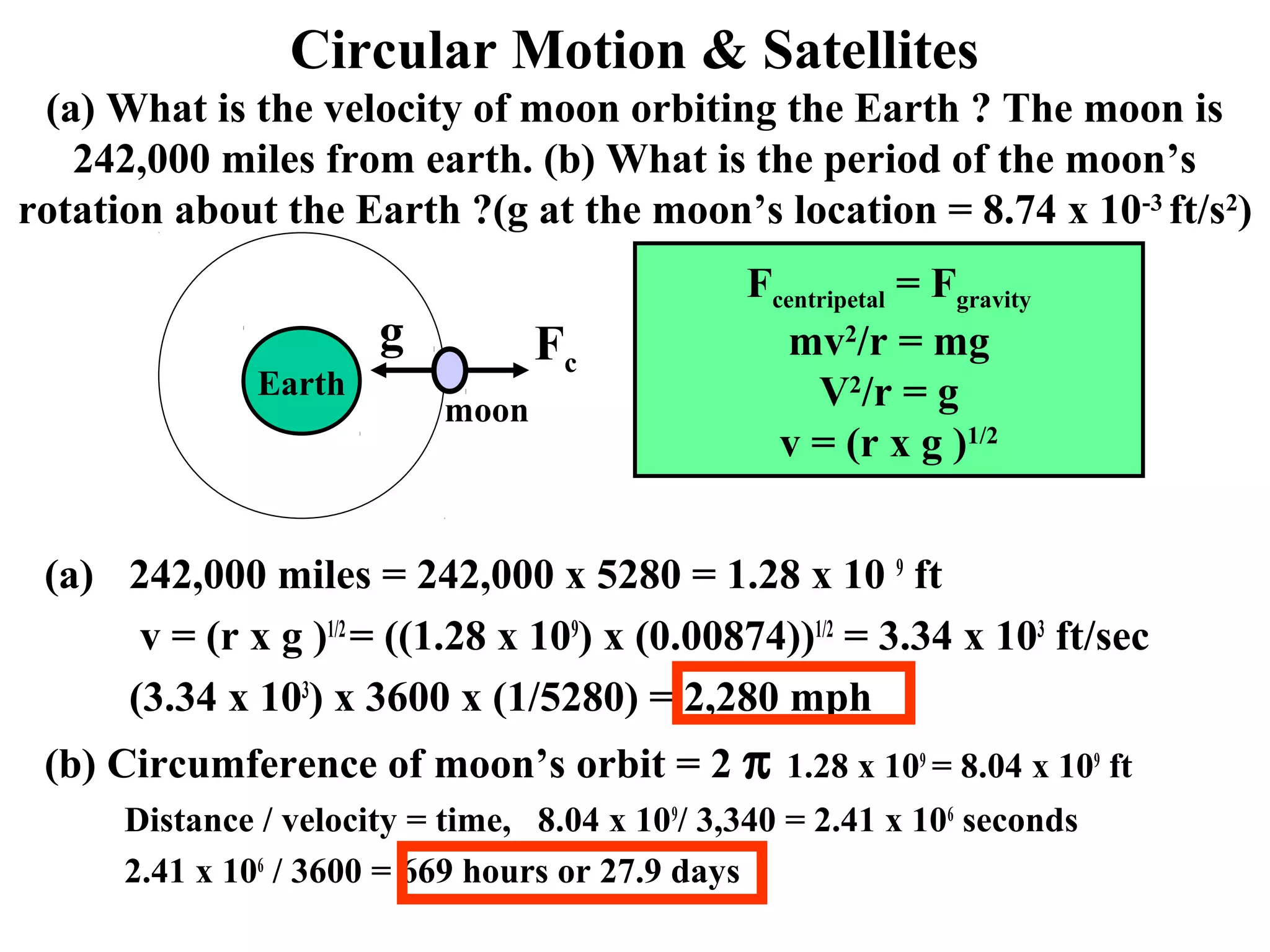
(a) What is the velocity of moon orbiting the Earth ? The moon is
242,000 miles from earth. (b) What is the period of the moon’s
rotation about the Earth ?(g at the moon’s location = 8.74 x 10⁻³
ft/s2
)
(a) 242,000 miles = 242,000 x 5280 = 1.28 x 10 9
ft
v = (r x g )1/2
= ((1.28 x 10⁹
) x (0.00874))1/2
= 3.34 x 10³
ft/sec
(3.34 x 10³
) x 3600 x (1/5280) = 2,280 mph
(b) Circumference of moon’s orbit = 2 π 1.28 x 109
= 8.04 x 10⁹
ft
Distance / velocity = time, 8.04 x 10⁹
/ 3,340 = 2.41 x 10⁶
seconds
2.41 x 10⁶
/ 3600 = 669 hours or 27.9 days
Earth
Fc
g
moon
Fcentripetal = Fgravity
mv2
/r = mg
V2
/r = g
v = (r x g )1/2
A 1200 kg car rounds a turn of 30 meter radius at 6.0 m/s
What is the centripetal acting on the car ?
(A) 48 nt (B) 147 nt (C) 240 nt (D) 1440 nt
A car just rounds a turn at 60 km/hr. The coefficient of friction between the
and the road is 0.65. What is the turning radius of the car ?
(A) 9.4 m (B) 22 m (C) 44 m (D) 565 m
A 0.500 kg rock is whirled in a vertical circle of radius 60 cm. The velocity
of the rock at the bottom of the swing is 4.0 m/s. What is the string tension ?
(A) 4.9 nt (B) 8.4 nt (C) 13.3 nt (D) 18.2 nt
A satellite orbits the Earth at 8000 km from the Earth’s center. Gravity
At this location is 6.2 m/s2
. What is the velocity of the satelliter ?
(A) 0.90 km /s (B) 7.0 km /s (C) 8.9 km /s (D) cannot be determined
A road is banked at 14 degrees and has a radius of 250 meters. What is
maximum speed of the cars rounding the turn without considering friction ?
(A) 2.47 m/s (B) 9.8 m /s (C) 32 m /s (D) 14 m/s
Click
here for
answers
Centripetalforce (1)

Centripetalforce (1)

  • 1.
  • 2.
    Centripetal Force • Newton’sFirst Law tells us that only a force can cause a body to move out of a straight line path. In circular motion the direction of the body is continually changing at every instant. Therefore a force must be acting. That force is called centripetal (central) force since it acts toward the circle of the circular path. “Objects in motion tend to remain in motion, at the same rate, And in the same direction, unless acted on by an outside force” ALL CIRCULAR MOTION REQUIRES A CENTRIPETAL FORCE, OTHERWISE THE BODY CONTINUES IN A STRAIGHT LINE PATH.
  • 3.
    Centripetal Force • Allcircular motion requires a centripetal force. Newton’s Second Law of Motion tells us that force equal mass times acceleration. Therefore, centripetal force must produce an acceleration (centripetal acceleration). Since the force acts towards the center of the circular path, the acceleration must also be towards the center ! ALL CIRCULAR MOTION IS ACCELERATED MOTION. THE ACCELERATION IS ALWAYS TOWARDS THE CENTER OF THE CIRCULAR PATH.
  • 4.
    THE INSTANTANEOUS VELOCITY VECTORIN CIRCULAR MOTION IS TANGENTIAL TO THE CIRCULAR PATH V1 V2 r rθ r rθ Distance traveled Over angle θ S Similar triangles give S/ r = ∆V / V Distance traveled (S) = V ∆t Therefore V ∆t / r = ∆V / V Rearranging the equation gives ∆V / ∆t = V x V / r a = ∆V / ∆t = V 2 / r V1 ∆V V2 θ Vector difference The smaller θ gets, the better ac is approximated by a = V2 / r
  • 5.
    Displacement Vector (Radius) Velocity Vector (Tangentto the path) Acceleration Vector (Towards the center)
  • 6.
    The velocity vector isalways tangential to the circular path
  • 7.
    The acceleration vector isalways towards the center of the circular path
  • 8.
    ωAVERAGE = ∆ω/ ∆ t = (ω2 + ω1) / 2 θ = ωo t + ½ αt2 ωi = ωo + αt θi = ½ (ωi 2 - ωo 2 ) / α s = θ R Vlinear = ω R alinear = α R f = 1/ T, T = 1 / f 1 revolution = 360 degrees = 2 π radians ω = 2 π f , ω = 2 π / T acentripetal = V2 / r Fcentripetal = m V2 / r
  • 9.
    Centripetal Force &Acceleration Problems A 1000 kg car rounds a turn of 30 meter radius at 9 m/s. (a) What is its acceleration ? (b) What is the centripetal force ? • (a) acentripetal = V2 / r = 9 2 / 30 = 2.7 m /s2 • (b) Fcentripetal = m V2 / r = m x ac = 1000 x 2.7 = 2700 N r = 30 mv = 9 m/s
  • 10.
    Centripetal Force &Acceleration Problems A car is traveling at 20 mph on a level road with a coefficient of friction of 0.80. What is the maximum curve radius ? • In the English system velocity must be in ft/sec. • 20 mph x 5280ft / 3600 sec = 29.4 ft/sec. • The centripetal force which allows the car to round the curve is supplied by friction. • Ff = µ Fn when the car is on level ground the normal force is the car’s weight w = mg • Centripetal force is given by mv2 /r • Fc = Ff , µ mg = mv2 /r , canceling mass from both sides leaves µ g = v2 /r and rearranging the equation, r = v2 / (µ g) • R = (29.4)2 / ( 0.80 x 32) = 34 ft r = ? ftv = 20mph µ = 0.80
  • 11.
    Centripetal Force &Acceleration Problems • Roadways are often banked to help supply centripetal force thereby allowing cars to execute curves more readily. • Without banking, the friction between the tires and the road, are the only source of centripetal force. • As the banking angle increases the amount of centripetal force the roadway supplies increases. • The following slide analyzes the relationship between the angle of banking and the centripetal force.
  • 12.
    θ tan θ =Fc / W Fcentripetal = W x tan θ Fc W Fn θ Vector diagram reaction to normal force normal force weight centripetal force
  • 13.
    Centripetal Force &Acceleration Problems What is the angle of banking which would allow vehicles to round a curve of 1000 foot radius at 50 mph without friction ? • 50 mph x 5280 ft / 3600 sec = 73.5 ft/sec • The centripetal force supplied by the banking. • Fbanking = w x tan θ = mg tan θ, Fc = m v2 /r • Fbanking= Fc , mg tan θ = m v2 /r , canceling mass gives g tan θ = v2 /r and tan θ = v2 / (g x r) • tan θ = 73.5 2 / (32 x 1000) = 0.169 • tan-1 (0.169) = 9.60 r = 1000 ft v =50 mphθ
  • 14.
    Centripetal Force &Acceleration Problems • Centripetal force problems often involve objects whirled in a circle. An example is a rock tied to a string. The circular path may be in the horizontal plane or the vertical plane. • The rock moves in a circular path because of the pull of the string to which it is tied. The string supplies the centripetal force necessary for the rock to be moved from its inertial straight line path into a circular path. The pull of the string is referred to as tension in the string. • When moving in a horizontal path the forces acting (the tension, the weight and centripetal force) remain constant in magnitude • When moving in a vertical path the forces acting vary from point to point during the travel.
  • 15.
    Centripetal force (Fc) weight weight Centripetalforce (Fc) Centripetal force (Fc)Centripetal force (Fc) weight weight tension tension tension tension At the top of the path Weight & Fc are Opposite in direction At the bottom of the path Weight & Fc are in the same direction
  • 16.
    Circular Motion ina Vertical Plane A string 0.50 meters long is used to whirl a 1 kg rock in a vertical circle at 5.0 m/s. (a) Find the tension at the top of the circle (b) Find the tension at the bottom. • (a) T + w = Fc , T + mg = mv2 /r, T + (1 x 9.8) = 1 (5.0)2 / 0.50 • T + 9.8 = 25 / 0.50, T = 40.2 nt (downward) or – 40.2 nt • (b) T = Fc + w , T = mv2 /r + mg = T = 1 (5.0)2 / 0.50 + 1 (9.8) • T = 59.8 nt (upward) or + 59.8 nt weight weight tension tension Centripetal force (Fc) Centripetal force (Fc) At the top T + w = Fc At the bottom T = Fc + w Downward vectors are – Upward vectors are + Fc = m v2 / r , w = mg
  • 17.
    Circular Motion ina Vertical Plane A 2 lb ball on the end of a string is spun in a vertical circle at 10 ft/s. The radius of the circle is 3.0 ft. What is the maximum tension in the string ? • T = Fc + w = mv2 /r + w, w = mg, m =w/g • m = 2/32 slugs • T = ((2/32) x 102 ) / 3) + 2 = 4.08 lbs. The maximum tension Occurs at the bottom Of the circle & equals The weight + centripetal force weight = 2 lbs tension Centripetal force (Fc) v = 10 ft/s
  • 18.
    Circular Motion &Satellites • Satellites orbiting the earth are held in their circular path by the force of gravity. Gravity supplies the centripetal force required for satellite motion. • Gravity at the Earth’s surface is, on average, 9.8 meters per second2 or 32 feet per second2 . As we move away from the Earth’s surface, the force of gravity decreases. • Since the force of gravity is the centripetal force acting on a satellite, the velocity of the satellite depends on the distance of the satellite from the Earth.
  • 19.
    Center of Earth Radius ofEarth = 4000 miles scale150 lbs 8000 miles scale37.5 lbs 12000 miles scale16.7 lbs ¼ g 1 /9 g Normal gravity
  • 20.
    Circular Motion &Satellites (a) What is the velocity of moon orbiting the Earth ? The moon is 242,000 miles from earth. (b) What is the period of the moon’s rotation about the Earth ?(g at the moon’s location = 8.74 x 10⁻³ ft/s2 ) (a) 242,000 miles = 242,000 x 5280 = 1.28 x 10 9 ft v = (r x g )1/2 = ((1.28 x 10⁹ ) x (0.00874))1/2 = 3.34 x 103 ft/sec (3.34 x 10³ ) x 3600 x (1/5280) = 2,280 mph (b) Circumference of moon’s orbit = 2 π 1.28 x 109 = 8.04 x 109 ft Distance / velocity = time, 8.04 x 10⁹ / 3,340 = 2.41 x 10⁶ seconds 2.41 x 10⁶ / 3600 = 669 hours or 27.9 days Earth Fc g moon Fcentripetal = Fgravity mv2 /r = mg V2 /r = g v = (r x g )1/2
  • 22.
    A 1200 kgcar rounds a turn of 30 meter radius at 6.0 m/s What is the centripetal acting on the car ? (A) 48 nt (B) 147 nt (C) 240 nt (D) 1440 nt A car just rounds a turn at 60 km/hr. The coefficient of friction between the and the road is 0.65. What is the turning radius of the car ? (A) 9.4 m (B) 22 m (C) 44 m (D) 565 m A 0.500 kg rock is whirled in a vertical circle of radius 60 cm. The velocity of the rock at the bottom of the swing is 4.0 m/s. What is the string tension ? (A) 4.9 nt (B) 8.4 nt (C) 13.3 nt (D) 18.2 nt A satellite orbits the Earth at 8000 km from the Earth’s center. Gravity At this location is 6.2 m/s2 . What is the velocity of the satelliter ? (A) 0.90 km /s (B) 7.0 km /s (C) 8.9 km /s (D) cannot be determined A road is banked at 14 degrees and has a radius of 250 meters. What is maximum speed of the cars rounding the turn without considering friction ? (A) 2.47 m/s (B) 9.8 m /s (C) 32 m /s (D) 14 m/s Click here for answers