Blood, Blood Composition, Blood Groups, Disorders of Blood.pptx
1.
PREPARED BY
Prof. ASHISHN. UMALE
M. PHARM IN PHARMACOLOGY
ASSISTANT PROFESSOR
SHRADDHA INSTITUTE OF PHARMACY, WASHIM-444505
HUMAN ANATOMY AND
PHYSIOLOGY - I
2.
Introduction to BodyFluids
Total Body Water: Approximately 60% of body weight.
Fluid Compartments:
Intracellular Fluid (ICF): Fluid inside cells (approx. 2/3).
Extracellular Fluid (ECF): Fluid outside cells (approx. 1/3).
Interstitial Fluid: Surrounds cells.
Plasma: Liquid portion of blood.
Transcellular Fluid: CSF, synovial fluid, etc.
Function: Maintenance of homeostasis, nutrient transport, and waste
removal.
Functions of Blood
Transportation:Oxygen (from lungs), nutrients (from GI
tract), hormones, and CO-2
Regulation: Body temperature, pH levels, and fluid volume.
Protection:
Hemostasis: Preventing blood loss via clotting.
Immunity: Phagocytosis by WBCs and antibody
production.
5.
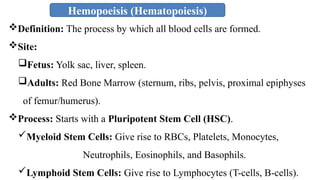
Hemopoeisis (Hematopoiesis)
Definition: Theprocess by which all blood cells are formed.
Site:
Fetus: Yolk sac, liver, spleen.
Adults: Red Bone Marrow (sternum, ribs, pelvis, proximal epiphyses
of femur/humerus).
Process: Starts with a Pluripotent Stem Cell (HSC).
Myeloid Stem Cells: Give rise to RBCs, Platelets, Monocytes,
Neutrophils, Eosinophils, and Basophils.
Lymphoid Stem Cells: Give rise to Lymphocytes (T-cells, B-cells).
6.
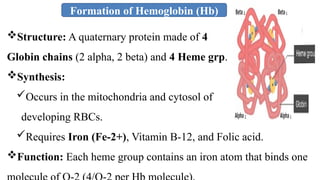
Formation of Hemoglobin(Hb)
Structure: A quaternary protein made of 4
Globin chains (2 alpha, 2 beta) and 4 Heme grp.
Synthesis:
Occurs in the mitochondria and cytosol of
developing RBCs.
Requires Iron (Fe-2+), Vitamin B-12, and Folic acid.
Function: Each heme group contains an iron atom that binds one
7.
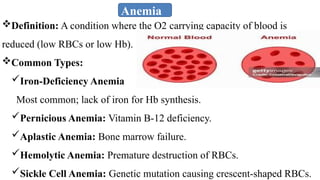
Anemia
Definition: A conditionwhere the O2carrying capacity of blood is
reduced (low RBCs or low Hb).
Common Types:
Iron-Deficiency Anemia
Most common; lack of iron for Hb synthesis.
Pernicious Anemia: Vitamin B-12 deficiency.
Aplastic Anemia: Bone marrow failure.
Hemolytic Anemia: Premature destruction of RBCs.
Sickle Cell Anemia: Genetic mutation causing crescent-shaped RBCs.
8.
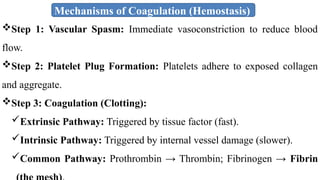
Mechanisms of Coagulation(Hemostasis)
Step 1: Vascular Spasm: Immediate vasoconstriction to reduce blood
flow.
Step 2: Platelet Plug Formation: Platelets adhere to exposed collagen
and aggregate.
Step 3: Coagulation (Clotting):
Extrinsic Pathway: Triggered by tissue factor (fast).
Intrinsic Pathway: Triggered by internal vessel damage (slower).
Common Pathway: Prothrombin → Thrombin; Fibrinogen → Fibrin
9.
Blood Grouping &Rh Factor
ABO System: Based on Antigens (A, B) on RBCs and Antibodies
(Anti-A, Anti-B) in plasma.
Type A: A antigens, Anti-B antibodies.
Type AB: Both antigens, no antibodies (Universal Recipient).
Type O: No antigens, both antibodies (Universal Donor).
Rh Factor: Presence (+) or absence (-) of the D-antigen.
Clinical Note: Rh incompatibility in pregnancy can lead to
Erythroblastosis Fetalis.
10.
Blood Transfusion &Significance
Purpose: To replace lost blood, treat severe anemia, or
provide clotting factors.
Significance of Cross-matching: Ensures recipient
antibodies won't attack donor RBCs.
Transfusion Reactions: Fever, chills, or life-threatening
Hemolysis if incompatible blood is given.
11.
Disorders of Blood
WBCDisorders:
Leukemia: Cancer of the bone marrow producing abnormal WBCs.
Leukopenia: Abnormally low WBC count.
Platelet Disorders:
Thrombocytopenia: Low platelet count leading to easy bruising/bleeding.
Clotting Disorders:
Hemophilia: Genetic lack of clotting factors (e.g., Factor VIII).
Polycythemia: Abnormal increase in RBC count, making blood too
viscous.