CIRCULAR
MOTION &
GRAVITATION
6.1 circular motion
Linear Motion
All objects considered previously have
been point objects. This makes it easy to
do calculations but inaccurate.
A point object has no dimensions,
therefore it can’t rotate. All objects
rotate to some extent.
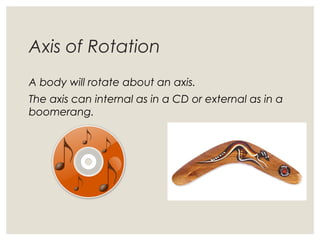
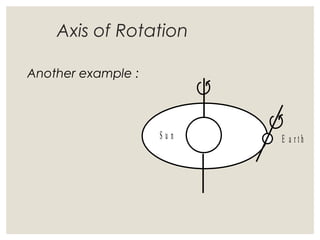
Axis of Rotation
A body will rotate about an axis.
The axis can internal as in a CD or external as in a
boomerang.
Axis of Rotation
Another example :
E a r t hS u n
Bodies
A body can be rigid or non-rigid, that is the body
may have moving parts.
Consider,
Paint being stirred.
A rubiks cube.
A diver.
Circular Motion
An object moving in a circular path will
have a constant speed.
It is continually changing direction,
therefore it’s velocity is continually
changing.
A relationship can be determined for the
speed of the object.
To do this some terms must be defined first.
Circular Motion Terms
Period
Is the time needed to complete one
cycle/rev (in secs). The symbol T is used.
Frequency
Number of cycles/revs completed per unit
time.
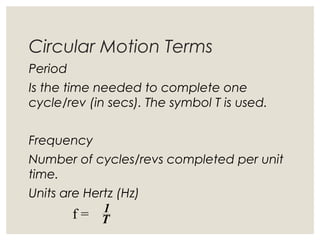
Units are Hertz (Hz)
T
1
f =
Circular Motion Terms
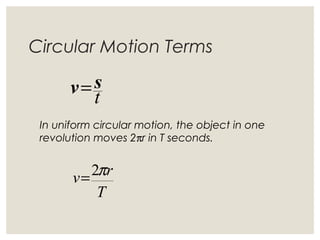
In uniform circular motion, the object in one
revolution moves 2πr in T seconds.
T
rv π2=
t
sv=
Try Example 1
The Earth has a diameter of 1.276 x 10⁷
m.
Find the average linear speed of a point
on the Earth’s equator.
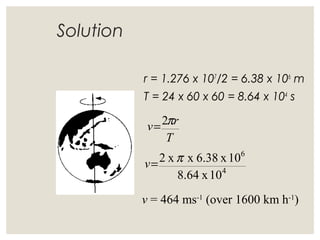
Solution
r = 1.276 x 10⁷
/2 = 6.38 x 10⁶
m
T = 24 x 60 x 60 = 8.64 x 10⁴
s
v = 464 ms-1
(over 1600 km h-1
)
T
rv π2=
4
6
10x8.64
10x6.38xx2 π=v
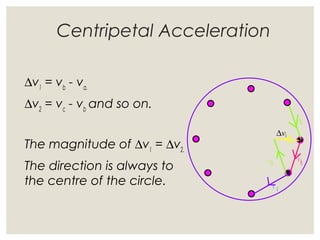
Centripetal Acceleration
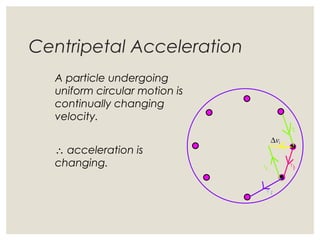
A particle undergoing
uniform circular motion is
continually changing
velocity.
∴ acceleration is
changing.
v
v
v
a
b
c
- va
∆v1
Centripetal Acceleration
∆v1
= vb
- va.
∆v2
= vc
- vb
and so on.
The magnitude of ∆v1
= ∆v2.
The direction is always to
the centre of the circle.
v
v
v
a
b
c
- va
∆v1
Centripetal Acceleration
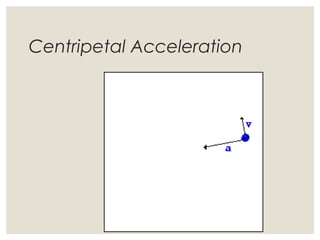
The acceleration which produces these
velocity changes in a direction…..
is called centripetal (centre seeking)
acceleration.
The direction is always towards the centre
of the circular motion.
Centripetal Acceleration
Average Acceleration
Defined as:
where ∆v = vf
- vi
.
  The instantaneous acceleration a at
any instant can be obtained by allowing
the time interval to become infinitesimal.
t∆
∆= va
_
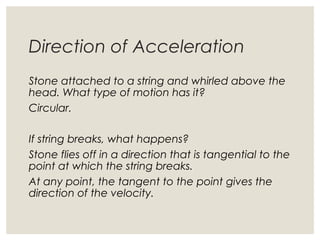
Direction of Acceleration
Stone attached to a string and whirled above the
head. What type of motion has it?
Circular.
If string breaks, what happens?
Stone flies off in a direction that is tangential to the
point at which the string breaks.
At any point, the tangent to the point gives the
direction of the velocity.
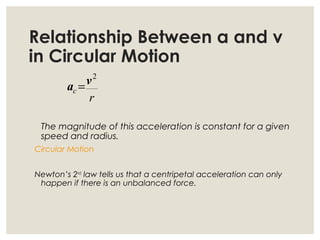
Relationship Between a and v
in Circular Motion
The magnitude of this acceleration is constant for a given
speed and radius.
Circular Motion
Newton’s 2nd
law tells us that a centripetal acceleration can only
happen if there is an unbalanced force.
r
c
2
va =
Force Causing the Centripetal
Acceleration
Any particle undergoing uniform circular motion is
acted upon by an unbalanced force which is….
Constant in magnitude.
Directed towards the centre of the circle.
Causes the Centripetal Acceleration.
Force Causing the Centripetal
Acceleration
When an object undergoes uniform circular
motion there is a net force which is directed
towards the centre of the circle,
The force has a physical origin
Gravity
Normal Force
Tension
Friction
Force Causing the Centripetal
Acceleration
Force Causing the Centripetal
Acceleration
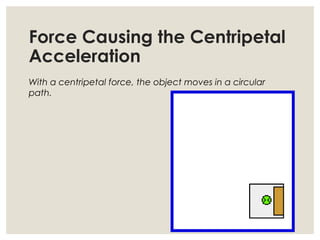
With a centripetal force, the object moves in a circular
path.
Force Causing the Centripetal
Acceleration
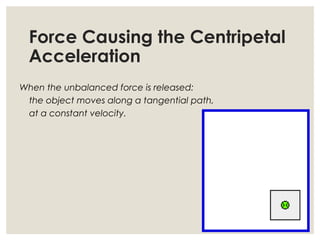
When the unbalanced force is released:
the object moves along a tangential path,
at a constant velocity.
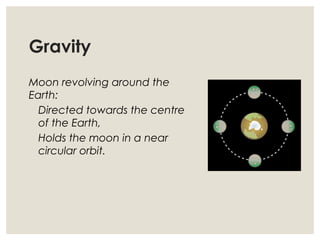
Gravity
Moon revolving around the
Earth:
Directed towards the centre
of the Earth,
Holds the moon in a near
circular orbit.
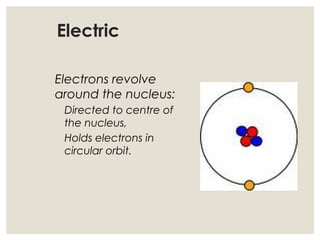
Electric
Electrons revolve
around the nucleus:
Directed to centre of
the nucleus,
Holds electrons in
circular orbit.
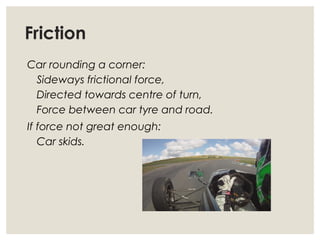
Friction
Car rounding a corner:
Sideways frictional force,
Directed towards centre of turn,
Force between car tyre and road.
If force not great enough:
Car skids.
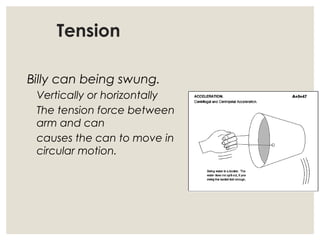
Tension
Billy can being swung.
Vertically or horizontally
The tension force between
arm and can
causes the can to move in
circular motion.
Force Causing the Centripetal
Acceleration
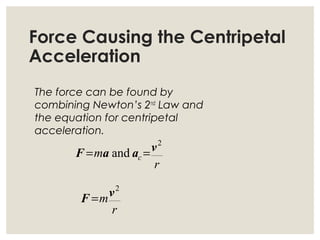
The force can be found by
combining Newton’s 2nd
Law and
the equation for centripetal
acceleration.
r
m c
2
and vaaF ==
r
m
2
vF =
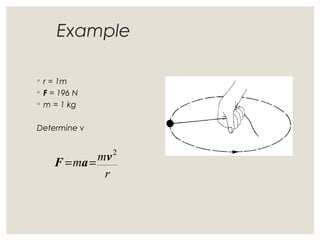
Example
◦ r = 1m
◦ F = 196 N
◦ m = 1 kg
Determine v
r
mm
2
vaF ==
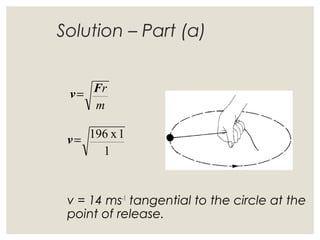
Solution – Part (a)
v = 14 ms-1
tangential to the circle at the
point of release.
1
1x196=v
m
rFv=
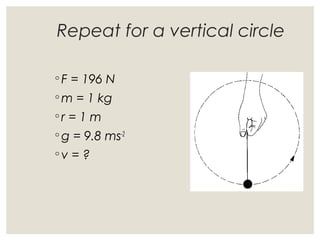
Repeat for a vertical circle
◦ F = 196 N
◦ m = 1 kg
◦ r = 1 m
◦ g = 9.8 ms-2
◦ v = ?
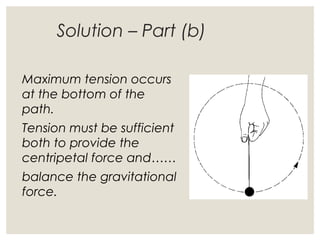
Solution – Part (b)
Maximum tension occurs
at the bottom of the
path.
Tension must be sufficient
both to provide the
centripetal force and……
balance the gravitational
force.
Solution – Part (b)
gvF m
r
m +=
2






















+= 9.8x1
1
x1196
2
v
v2
=196 - 9.8 = 186.2
v =13.6 ms-1
Angular displacement
Objects moving in circular motion go through angular
displacements (θ). A quarter circle has an angular
displacement of 90 degrees, a full circle has 360
degrees, from P to Q in the diagram it is 60 degrees.
The arc length is the distance traced
on the circle – this is a different displace-
ment to the straight line between P and Q.
True angular displacements are the angles measured
in radians (not degrees)
Radians
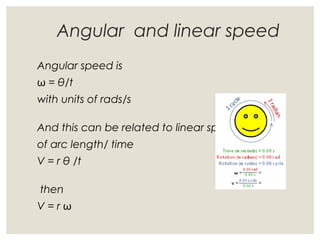
Angular and linear speed
Angular speed is
ω = θ/t
with units of rads/s
And this can be related to linear speed
of arc length/ time
V = r θ /t
then
V = r ω
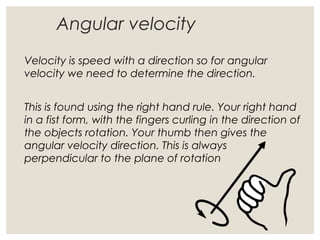
Angular velocity
Velocity is speed with a direction so for angular
velocity we need to determine the direction.
This is found using the right hand rule. Your right hand
in a fist form, with the fingers curling in the direction of
the objects rotation. Your thumb then gives the
angular velocity direction. This is always
perpendicular to the plane of rotation
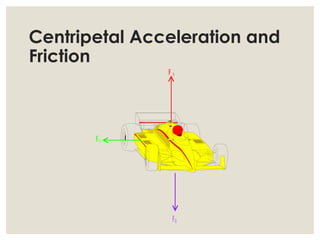
Centripetal Acceleration and
Friction
F N
F
FG
f r
Centripetal Acceleration and
Friction
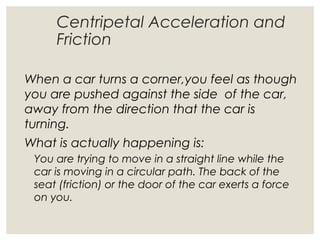
When a car turns a corner,you feel as though
you are pushed against the side of the car,
away from the direction that the car is
turning.
What is actually happening is:
You are trying to move in a straight line while the
car is moving in a circular path. The back of the
seat (friction) or the door of the car exerts a force
on you.
Centripetal Acceleration and
Friction
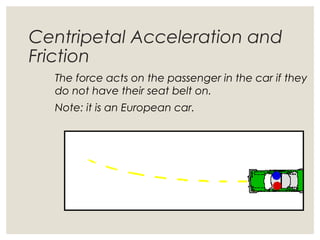
The force acts on the passenger in the car if they
do not have their seat belt on.
Note: it is an European car.
Centripetal Acceleration and
Friction
The car itself must also have a force acting on it to
turn around the bend.
If the road is flat, the force is the friction between
the tires and the road.
Centripetal Acceleration and
Friction
Under some conditions:
water or ice on the road
excessive speed
Frictional force is not enough.
Car will skid in a near straight line path.
Cars & Ice
Cars and Ice 2
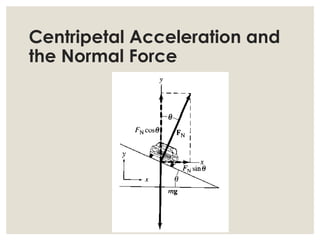
Centripetal Acceleration and the
Normal Force
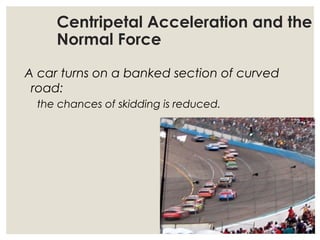
A car turns on a banked section of curved
road:
the chances of skidding is reduced.
Centripetal Acceleration and
the Normal Force
Centripetal Acceleration and
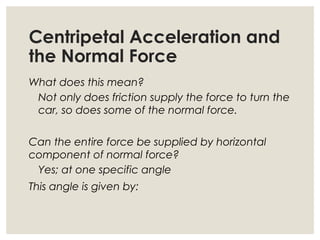
the Normal Force
What does this mean?
Not only does friction supply the force to turn the
car, so does some of the normal force.
Can the entire force be supplied by horizontal
component of normal force?
Yes; at one specific angle
This angle is given by:
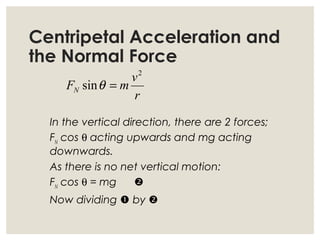
Centripetal Acceleration and
the Normal Force
In the vertical direction, there are 2 forces;
FN
cos θ acting upwards and mg acting
downwards.
As there is no net vertical motion:
FN
cos θ = mg 
Now dividing  by 
r
v
mFN
2
sin =θ
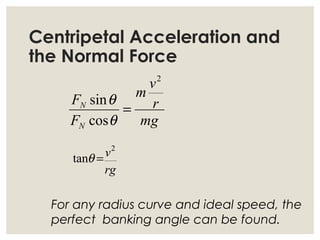
Centripetal Acceleration and
the Normal Force
For any radius curve and ideal speed, the
perfect banking angle can be found.
rg
v2
tan =θ
mg
r
v
m
F
F
N
N
2
cos
sin
=
θ
θ
Questions
Find the angular speed of the rotation of the
Earth?
Find the angular velocity of a vinyl record spinning
at 30 rpm?
Find the banking angle for a 35m radius turn at
60kph?

6.1 circular motion

  • 1.
  • 2.
    Linear Motion All objectsconsidered previously have been point objects. This makes it easy to do calculations but inaccurate. A point object has no dimensions, therefore it can’t rotate. All objects rotate to some extent.
  • 3.
    Axis of Rotation Abody will rotate about an axis. The axis can internal as in a CD or external as in a boomerang.
  • 4.
    Axis of Rotation Anotherexample : E a r t hS u n
  • 5.
    Bodies A body canbe rigid or non-rigid, that is the body may have moving parts. Consider, Paint being stirred. A rubiks cube. A diver.
  • 6.
    Circular Motion An objectmoving in a circular path will have a constant speed. It is continually changing direction, therefore it’s velocity is continually changing. A relationship can be determined for the speed of the object. To do this some terms must be defined first.
  • 7.
    Circular Motion Terms Period Isthe time needed to complete one cycle/rev (in secs). The symbol T is used. Frequency Number of cycles/revs completed per unit time. Units are Hertz (Hz) T 1 f =
  • 8.
    Circular Motion Terms Inuniform circular motion, the object in one revolution moves 2πr in T seconds. T rv π2= t sv=
  • 9.
    Try Example 1 TheEarth has a diameter of 1.276 x 10⁷ m. Find the average linear speed of a point on the Earth’s equator.
  • 10.
    Solution r = 1.276x 10⁷ /2 = 6.38 x 10⁶ m T = 24 x 60 x 60 = 8.64 x 10⁴ s v = 464 ms-1 (over 1600 km h-1 ) T rv π2= 4 6 10x8.64 10x6.38xx2 π=v
  • 11.
    Centripetal Acceleration A particleundergoing uniform circular motion is continually changing velocity. ∴ acceleration is changing. v v v a b c - va ∆v1
  • 12.
    Centripetal Acceleration ∆v1 = vb -va. ∆v2 = vc - vb and so on. The magnitude of ∆v1 = ∆v2. The direction is always to the centre of the circle. v v v a b c - va ∆v1
  • 13.
    Centripetal Acceleration The accelerationwhich produces these velocity changes in a direction….. is called centripetal (centre seeking) acceleration. The direction is always towards the centre of the circular motion.
  • 14.
  • 15.
    Average Acceleration Defined as: where∆v = vf - vi .   The instantaneous acceleration a at any instant can be obtained by allowing the time interval to become infinitesimal. t∆ ∆= va _
  • 16.
    Direction of Acceleration Stoneattached to a string and whirled above the head. What type of motion has it? Circular. If string breaks, what happens? Stone flies off in a direction that is tangential to the point at which the string breaks. At any point, the tangent to the point gives the direction of the velocity.
  • 17.
    Relationship Between aand v in Circular Motion The magnitude of this acceleration is constant for a given speed and radius. Circular Motion Newton’s 2nd law tells us that a centripetal acceleration can only happen if there is an unbalanced force. r c 2 va =
  • 18.
    Force Causing theCentripetal Acceleration Any particle undergoing uniform circular motion is acted upon by an unbalanced force which is…. Constant in magnitude. Directed towards the centre of the circle. Causes the Centripetal Acceleration.
  • 19.
    Force Causing theCentripetal Acceleration When an object undergoes uniform circular motion there is a net force which is directed towards the centre of the circle, The force has a physical origin Gravity Normal Force Tension Friction
  • 20.
    Force Causing theCentripetal Acceleration
  • 21.
    Force Causing theCentripetal Acceleration With a centripetal force, the object moves in a circular path.
  • 22.
    Force Causing theCentripetal Acceleration When the unbalanced force is released: the object moves along a tangential path, at a constant velocity.
  • 23.
    Gravity Moon revolving aroundthe Earth: Directed towards the centre of the Earth, Holds the moon in a near circular orbit.
  • 24.
    Electric Electrons revolve around thenucleus: Directed to centre of the nucleus, Holds electrons in circular orbit.
  • 25.
    Friction Car rounding acorner: Sideways frictional force, Directed towards centre of turn, Force between car tyre and road. If force not great enough: Car skids.
  • 26.
    Tension Billy can beingswung. Vertically or horizontally The tension force between arm and can causes the can to move in circular motion.
  • 27.
    Force Causing theCentripetal Acceleration The force can be found by combining Newton’s 2nd Law and the equation for centripetal acceleration. r m c 2 and vaaF == r m 2 vF =
  • 28.
    Example ◦ r =1m ◦ F = 196 N ◦ m = 1 kg Determine v r mm 2 vaF ==
  • 29.
    Solution – Part(a) v = 14 ms-1 tangential to the circle at the point of release. 1 1x196=v m rFv=
  • 30.
    Repeat for avertical circle ◦ F = 196 N ◦ m = 1 kg ◦ r = 1 m ◦ g = 9.8 ms-2 ◦ v = ?
  • 31.
    Solution – Part(b) Maximum tension occurs at the bottom of the path. Tension must be sufficient both to provide the centripetal force and…… balance the gravitational force.
  • 32.
    Solution – Part(b) gvF m r m += 2                       += 9.8x1 1 x1196 2 v v2 =196 - 9.8 = 186.2 v =13.6 ms-1
  • 33.
    Angular displacement Objects movingin circular motion go through angular displacements (θ). A quarter circle has an angular displacement of 90 degrees, a full circle has 360 degrees, from P to Q in the diagram it is 60 degrees. The arc length is the distance traced on the circle – this is a different displace- ment to the straight line between P and Q. True angular displacements are the angles measured in radians (not degrees)
  • 34.
  • 35.
    Angular and linearspeed Angular speed is ω = θ/t with units of rads/s And this can be related to linear speed of arc length/ time V = r θ /t then V = r ω
  • 36.
    Angular velocity Velocity isspeed with a direction so for angular velocity we need to determine the direction. This is found using the right hand rule. Your right hand in a fist form, with the fingers curling in the direction of the objects rotation. Your thumb then gives the angular velocity direction. This is always perpendicular to the plane of rotation
  • 37.
  • 38.
    Centripetal Acceleration and Friction Whena car turns a corner,you feel as though you are pushed against the side of the car, away from the direction that the car is turning. What is actually happening is: You are trying to move in a straight line while the car is moving in a circular path. The back of the seat (friction) or the door of the car exerts a force on you.
  • 39.
    Centripetal Acceleration and Friction Theforce acts on the passenger in the car if they do not have their seat belt on. Note: it is an European car.
  • 40.
    Centripetal Acceleration and Friction Thecar itself must also have a force acting on it to turn around the bend. If the road is flat, the force is the friction between the tires and the road.
  • 41.
    Centripetal Acceleration and Friction Undersome conditions: water or ice on the road excessive speed Frictional force is not enough. Car will skid in a near straight line path. Cars & Ice Cars and Ice 2
  • 42.
    Centripetal Acceleration andthe Normal Force A car turns on a banked section of curved road: the chances of skidding is reduced.
  • 43.
  • 44.
    Centripetal Acceleration and theNormal Force What does this mean? Not only does friction supply the force to turn the car, so does some of the normal force. Can the entire force be supplied by horizontal component of normal force? Yes; at one specific angle This angle is given by:
  • 45.
    Centripetal Acceleration and theNormal Force In the vertical direction, there are 2 forces; FN cos θ acting upwards and mg acting downwards. As there is no net vertical motion: FN cos θ = mg  Now dividing  by  r v mFN 2 sin =θ
  • 46.
    Centripetal Acceleration and theNormal Force For any radius curve and ideal speed, the perfect banking angle can be found. rg v2 tan =θ mg r v m F F N N 2 cos sin = θ θ
  • 47.
    Questions Find the angularspeed of the rotation of the Earth? Find the angular velocity of a vinyl record spinning at 30 rpm? Find the banking angle for a 35m radius turn at 60kph?